Learning From Conditionals
Benjamin Eva
∗Stephan Hartmann
†Soroush Rafiee Rad
‡March 20, 2019
Forthcoming in Mind Abstract
In this article, we address a major outstanding question of probabilistic Bayesian epistemology: ‘How should a rational Bayesian agent update their beliefs upon learning an indicative conditional?’. A number of authors have recently contended that this question is fundamentally underdetermined by Bayesian norms, and hence that there is no single update procedure that rational agents are obliged to follow upon learning an indicative conditional. Here, we resist this trend and argue that a core set of widely accepted Bayesian norms is sufficient to identify a normatively privileged updating procedure for this kind of learning. Along the way, we justify a privileged formalisation of the notion of ‘epistemic conservativity’, offer a new analysis of the Judy Benjamin problem and emphasise the distinction between interpreting the content of new evidence and updating one’s beliefs on the basis of that content.
1
Introduction
Indicative conditionals have been the source of much trouble for logicians, epistemologists, cognitive scientists and philosophers of language. Although they appear to play a central role in logical and uncertain reasoning, there is still no general consensus regarding their semantics or even whether they should be thought of as propositions with determinate semantics at all (see e.g. Adams (1975), Edgington (1995), Bennett (2003)). It is unsurprising then that the problem of assigning probabilities to indicative conditionals is equally controversial (see e.g. Lewis (1976), Hajek (2012), Skovgaard Olsenet al.(2016)), and thus that the relationship between indicative conditionals and the norms of Bayesian epistemology remains largely opaque (see e.g. Douven (2015)). In this paper, we aim to clarify this relationship by addressing a specific question: How should an agent change their beliefs when they learn an indicative conditional from a perfectly reliable information source? This question is already the focus of a large literature (see e.g. Nayaket al.(1996), Uffink (1995), Grove & Halpern (1997), van Fraassen (1981), van Fraassen et al. (1986)). However, in a recent survey, ∗Department of Philosophy, University of Konstanz, 78464 Konstanz (Germany) –
http://be0367.wixsite.com/benevaphilosophy – [email protected].
†Munich Center for Mathematical Philosophy, LMU Munich, 80539 Munich (Germany) – http://www.stephanhartmann.org
‡Department of Philosophy, University of Bayreuth, 95440 Bayreuth (Germany) – http://www.rafieerad.org –
Douven (2012) concludes that all extant accounts are problematic (for a much more detailed discussion, see Douven & Romeijn (2012)), and hence that a proper general account of updating probabilistic belief states by indicative conditionals is yet to be formulated.
The most important existing approach to modeling the learning of indicative conditionals utilises the formal machinery of probabilistic distance-minimisation. The idea is this: An agent has beliefs about a set of propositions. These beliefs are represented by a prior probability distribution P. She then learns new information which imposes a constraint on the posterior distribution Q. If the learned information is the conditional A→B, then (it is commonly assumed) the new distribution has to satisfy a conditional probability constraint of the form Q(B|A) =p0 ≤1. The posterior probability distribution is then found by minimising some distance measure between Q and P. Intuitively, the idea is that the agent should stay as close as possible to their prior belief state whilst ensuring that the constraint implied by the new information is satisfied. This can be made formally precise by utilising probabilistic distance measures such as the Kullback leibler divergence (see e.g. van Fraassen (1981); Diaconis & Zabell (1982)). It turns out that minimising the Kullback leibler divergence between the prior and posterior distributions is equivalent to conditionalising on the material conditional A⊃B when the learned conditional probability constraint is extreme (Q(B|A) = 1). Thus, the distance-minimisation approach reduces to simply conditionalising on the material conditional in the simplest case where the learned indicative conditional is interpreted as imposing an extreme conditional probability constraint.
However, this approach has been strongly criticised by Douven (2012), Douven & Romeijn (2012) and Douven & Dietz (2011), who forward a range of examples where conditionalising on the material conditional appears to yield strange and intuitively irrational updates. Furthermore, van Fraassen (1981) considers cases where the learned indicative conditional is naturally interpreted as imposing a non-extreme conditional prob-ability constraint of the form Q(B|A) = p0 ∈ (0,1). In these cases, minimising the distance between the prior and posterior distributions will generally diverge from simply Jeffrey conditionalizng on the material conditional, and it is unclear which probabilistic distance measure (if any) yields the intuitively rational up-date. Since these more general cases appear to involve learning experiences which are not easily describable in terms of conditionalisation or Jeffrey conditionalisation, they take us beyond the confines of standard Bayesian epistemology and seem to fall outside the purview of traditional Bayesian norms.
In this article, we defend (a particular variant of) the distance-minimisation approach against Douven
et al.’s purported counter examples and argue that conditionalising on the material conditional produces reasonable and well motivated results in cases where the learned conditional is assumed to impose an extreme conditional probability constraint (Section 2). We then move on to consider the more general situation where
the learned conditional is allowed to impose a non-extreme constraint. We argue that in this case agents should be guided by a norm of epistemic conservativity, and compare ways in which this norm can be made precise. Specifically, we contend that epistemically conservative agents should update on new evidence by minimising a particular kind of probabilistic distance measure (an ‘f-divergence’) between their prior and posterior credences (Section 3). In Section 4 we present an analysis of van Fraassen’s Judy Benjamin example in terms off-divergence minimisation and note that differentf-divergences give rise to different updates, none of which is obviously superior to its competitors. In order to resolve this impasse, we then appeal to resources from epistemic utility theory to identify a particularf-divergence (the Inverse Kullback leibler divergence) as normatively privileged, and argue that agents should utilise that divergence if they hope to achieve maximally accurate credences (Section 5). In Section 6 we utilise these considerations to develop a novel solution to the Judy Benjamin problem (and to learning conditionals in general), compare that solution to competing approaches from the recent literature, and draw an important and hitherto neglected distinction between the question of how rational agents should update their beliefs after learning indicative conditionals and the question of how rational agents shouldinterpret the content of newly learned conditionals. We conclude by describing how contemporary work in the psychology of reasoning can be usefully brought to bear on the latter question, and raise some outstanding issues to be addressed in future work (Section 7).
2
The Material Conditional: A Defence
We are interested here in the question of how an epistemic agent should update their degrees of belief after learning an indicative conditional of the form ‘If A, then B’. The existing literature on this question typically operates on the basis of a couple of idealizing assumptions. Firstly, it is standardly assumed that the informa-tion source from which the agent learns the condiinforma-tional is completely trustworthy and reliable, so the agent doesn’t have to worry about the possibility of being misled.1
Secondly, the agent has to translate the content of the learned conditional into a constraint on their posterior credences. In the kind of learning experience to which (Jeffrey) conditionalisation is standardly applied, the agent learns that a given truth-functional2 proposition H is either more or less likely than they had previously thought, and this effectively imposes a constraint on the posterior probability of H (e.g. P∗(H) = 1).3 In contrast, the dominant approach to modeling the learning of conditionals assumes that
1See Bovens & Hartmann (2003) for models of learning from partially reliable information sources. Note, however, that these
models only consider the learning of truth functional propositions and cannot be straightforwardly applied to the learning of conditionals.
2A terminological clarification: by ‘truth functional proposition’, we mean either an atomic proposition or a proposition that
can be generated from atomic propositions by the application of the standard truth-functional operations of classical logic (i.e. negation, disjunction and conjunction).
learning the conditional ‘If A, then B’ imposes a constraint, not on the probability of any single truth-functional proposition, but rather on the conditional probability of the consequent given the antecedent,P∗(B|A). This assumption is intuitively justified by the influential idea, commonly referred to as ‘Adams’ thesis’, that the probability of the indicative conditional ‘If A, then B’ is given by the corresponding conditional probability P(B|A). Although Lewis’ (1976) famous triviality results cast significant doubt on the general viability of this position, it still seems plausible to contend that learning the indicative conditional ‘If A, then B’ from a trustworthy source imposes a constraint on P∗(B|A). For the majority of the paper, we will accept this standard assumption as a given, and assume that epistemic agents can legitimately interpret the content of newly learned indicative conditionals as constraints on the posterior conditional probability of the consequent given the antecedent.4
Given these idealisations, the question of how one should update their credences after learning the con-ditional ‘If A, then B’ reduces to the problem of how one should update their credences upon learning a new value for the conditional probabilityP∗(B|A). For example, one might learn that the probability of it raining, given that there is a thunderstorm, is much lower than previously imagined, or that one’s chances of developing heart disease given that one eats a lot of red meat is higher than expected. In the simplest case, one would learn thatP∗(B|A) = 1, i.e. that A’s truth provides an absolute guarantee of B’s truth. But this is equivalent to the constraint thatP∗(A∧ ¬B) = 0, since both constraints simply state that there’s no possibility of A being true and B being false. And of course, this means that the agent has really just learned the truth functional proposition¬A∨B =df A⊃B and hence that Bayesian norms demand that she should
update her credences by conditionalising on A⊃B. So from a Bayesian perspective, there is no puzzle in the extreme case in which the learned conditional is interpreted as imposing the constraintP∗(B|A) = 1. The agent is duty bound to conditionalise on A⊃B, on pain of being susceptible to diachronic Dutch books (Lewis (1999)) and failing to minimise expected inaccuracy (Greaves & Wallace (2006)).
Although the situation looks clear cut from a Bayesian perspective, a number of authors have criticised the view that conditionalising on the material conditional provides a generally acceptable update procedure for agents who learn indicative conditionals. In the rest of this section, we provide a response to these criticisms and show that conditionalising on the material conditional performs remarkably well in a number of purportedly problematic cases.5
4As well as being standard in the philosophical literature (see e.g. van Fraassen (1981), van Fraassenet al.(1986), Douven &
Dietz (2011), Douven & Romeijn (2012)), this assumption is also widely (although not universally) accepted in the psychology of reasoning, where it has played an important role in the empirical study of dynamic conditional inferences (see e.g. Oaksford and Chater (2007), Fernbach and Erb (2013)). But we stress again that we are concerned here only with how learning indicative conditionals causes a rational agent to alter their credences over time, and take no definite position regarding the controversial issue of how agents should attach probabilities to indicative conditionals at a given moment in time. We remain completely agnostic about Adams’ thesis for the purposes of this paper.
2.1
The Case of Two Propositions
We begin with some formal preliminaries. An agent has beliefs about the propositions A and B. We introduce binary propositional variables A and B (in italic script) which have the values A and ¬A, and B and ¬B (in roman script), respectively. These beliefs are represented by a prior probability distributionP over the possible values ofA andB. In order to specifyP, it is sufficient to fix the prior probability
P(A) =a, (1)
and the conditional probabilities
P(B|A) =p , P(B|¬A) =q. (2)
With this, the prior probability distribution over the variablesAandB is given by
P(A,B) =a p , P(A,¬B) =a p
P(¬A,B) =a q , P(¬A,¬B) =a q , (3)
where we have used the shorthand notationsP(A,B) forP(A∧B) andxfor 1−x.
Next, the agent learns the natural language indicative conditional A→B. For now, we assume that the agent (legitimately) interprets the content of this conditional as imposing the extreme conditional probability constraintP∗(B|A) =p0= 1, which, as we noted above, is equivalent to learning
MC (Material Conditional): A⊃B, which is equivalent to¬A∨B.
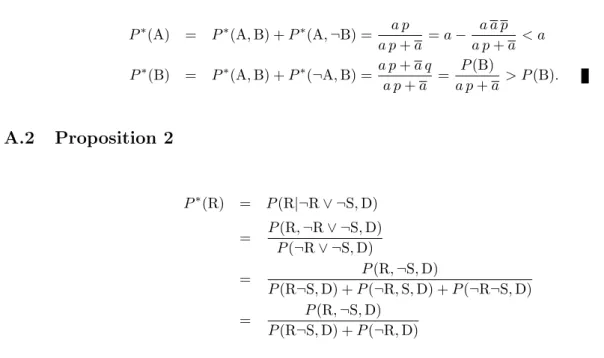
She then updates her probability distribution using Bayesian conditionalisation and arrives at the new prob-ability distributionP∗(·) =P(·|¬A∨B). This distribution is given by (all proofs are in Appendix A):
P∗(A,B) = a p a p+a , P ∗(A,¬B) = 0 P∗(¬A,B) = a q a p+a , P ∗(¬A,¬B) = a q a p+a (4)
From this, we can show that the following proposition holds.
Proposition 1 (Simple Conditional – MC) An agent considers the propositionsAandBand has a prior probability distributionP according to eqs. (3) (with 0< a, p, q <1) defined over the corresponding proposi-tional variables. LearningMCand updating by Bayesian conditionalisation then implies that the probability
ofA decreases and that the probability ofBincreases, i.e. P∗(A)< P(A)andP∗(B)> P(B).
Proposition 1 was first noticed by Popper & Miller (1983), and several authors have since cited the result as symptomatic of the representational deficiency of the material conditional. Specifically, it has been widely contended that it is implausible that the probability of the antecedent should decrease whenever we learn an indicative conditional, and hence that conditionalising on the material conditional cannot be the rational update procedure for this kind of learning. There are a couple of pertinent observations to be made here.
Recall that, following orthodoxy, we are working under the assumption that learning the indicative condi-tional ‘If A, then B’ imposes a constraint on the condicondi-tional probabilityP∗(B|A). We have noted that, in the special case where this constraint is extreme, i.e. of the formP∗(B|A) = 1, standard Bayesian epistemology requires us to conditionalise on the proposition A⊃B. Now, there are at least two lessons that one could plausibly draw from Proposition 1 (which have not yet been distinguished in the literature).
Firstly, one could draw the conclusion that conditionalising on A⊃B is not generally the rational response to learning the constraintP∗(B|A) = 1. Alternatively, one could draw the conclusion that it is not generally legitimate to interpret the content of the learned conditional as an extreme conditional probability constraint. The former conclusion concerns the norms of Bayesian epistemology, and the latter concerns the meaning of conditionals. In recent work, these two conclusions have been unduly conflated, which has unsurprisingly led to significant confusion.
We take the latter conclusion to be entirely uncontroversial and obvious from reflection on the actual use of conditionals in everyday discourse and reasoning. When somebody warns you that ‘if you smoke, you’ll get lung cancer’, you typically interpret the content of that statement not as ‘if you smoke, you will certainly get lung cancer’, but rather as ‘if you smoke, you will have a significantly increased risk of lung cancer’, i.e. you interpret the conditional as imposing a non-extreme conditional probability constraint. In light of this observation, it is clear that conditionalising on the material conditional is not, in full generality, the rational update procedure for agents who learn indicative conditionals (since it will not generally respect the learned constraint). But, to the best of our knowledge, nobody is actually defending the position that conditionalising on the material conditional is always the rational response to learning an indicative conditional. Clearly, this update procedure is meant only for the special case in which the learned conditionalcan be legitimately interpreted as imposing an extreme conditional probability constraint. So Proposition 1 is only problematic if, in those special cases, it is sometimes intuitively irrational to become less confident in A after learning ‘If A, then B’. If that were the case, then the import of Proposition 1 would be far greater than previously recognised, since it would seem to constitute an argument against Bayesian conditionalisation in general. Fortunately, it is, in full generality, intuitively rational to become less confident in A when we learn that A’s
truth counts as a guarantee of B’s truth.
To see this, consider the four maximal conjunctions or ‘possible worlds’ over which P is defined (A∧B, A∧ ¬B,¬A∧B and¬A∧ ¬B). When we learn the indicative conditional ‘If A, then B’, interpreted as the constraint P∗(B|A) = 1, what we learn is that the actual world is not a world at which A is true and B is false. Thus, we rule out half of the logically possible worlds at which the antecedent is true. Any probability mass that was stored in those worlds will then have to be transferred to other worlds, some of which will be worlds at which the antecedent is false. So it is unsurprising that the antecedent becomes less probable when we learn the indicative conditional. For, the learned conditional explicitly rules out some of the ways in which the antecedent can be true. This is just an instance of the general phenomenon that the more informative a proposition is, the less likely it is to be true. When we learn the indicative conditional, the antecedent becomes more informative (and hence more easily falsifiable) and less probable. This is an intuitive and unproblematic observation. More generally, it is clear that when the agent interprets the learned evidence as imposing the constraint thatP∗(B|A) = 1, they have really just learned the proposition A⊃B, and all the usual rationality arguments for conditionalisation apply. There is nothing special about this case that renders conditionalisation inapplicable.
However, Douven & Dietz (2011), Douven (2012) and Douven & Romeijn (2012) have presented a range of cases which purport to show that, even in the special case where the learned conditional can be legitimately interpreted by an extreme conditional probability constraint, conditionalising on the material conditional leads to problematic results. We turn now to providing a detailed analysis of these examples. In what follows, we call conditionals which can be interpreted as imposing extreme conditional probability constraints ‘strict conditionals’, and accept Douvenet al.’s presumption that the conditionals learned in the prospective counterexamples can reasonably be construed as strict (even if this might reasonably be deemed an unrealistic idealisation).
2.2
The Case of More than Two Propositions
Douven and collaborators have presented several examples that are meant to show that conditionalising on the material conditional leads to counter-intuitive consequences, even when the learned conditional is strict. Specifically, the following example is supposed to show that learning a strict conditional can sometimes cause the probability of the antecedent to increase, which, in light of Proposition 1, is incompatible with conditionalising on the material conditional.
The Ski Trip Example. Harry sees his friend Sue buying a ski outfit. This surprises him a bit, because he did not know that she had any plans to go on a ski trip. He knows that she recently had an important
exam and thinks it unlikely that she passed it. Then he meets Tom, his best friend and also a friend of Sue’s, who is just on his way to Sue to hear whether she passed the exam, and who tells him: “If Sue passed the exam, her father will take her on a ski vacation.” Recalling his earlier observation, Harry now comes to find it more likely that Sue passed the exam. So in this example upon learning the conditional information Harry should intuitively increase the probability of the antecedent of the conditional.6 (Douven & Dietz, 2011)
We begin by noting that in the ski trip example, the agent entertains three propositions, and not only two as in Proposition 1. What’s more, the agent does not only learn an indicative conditional, but also another proposition, i.e. that Sue bought a new ski outfit. Clearly, a Bayesian agent also has to conditionalise on this information (a fact that was not taken into account by Douven & Dietz (2011), Douven (2012) and Douven & Romeijn (2012)). If one does so, then (modulo one further plausible assumption about Harry’s prior beliefs) one obtains the intuitively correct result, as we will show now.
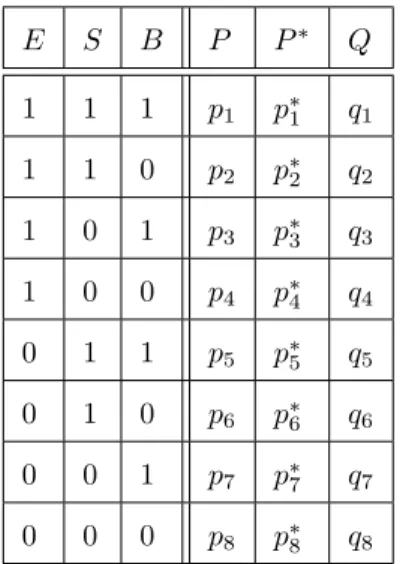
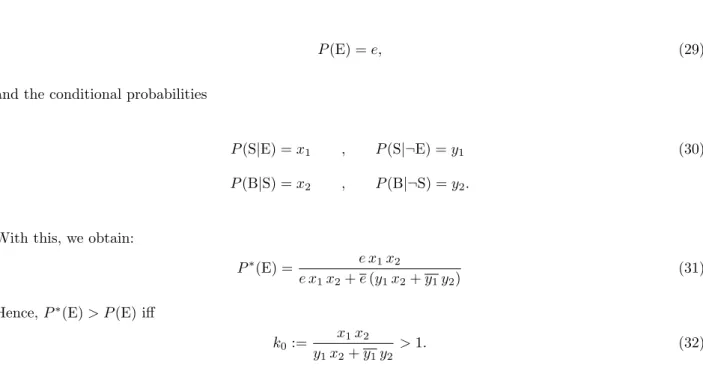
We introduce three binary propositional variables: The variable E has the values E: “Sue passed the exam”, and¬E: “Sue did not pass the exam”. The variable S has the values S: “Sue’s father invites her for a ski trip”, and¬S: “Sue’s father does not invite her for a ski trip”. The variableB has the values B: “Sue buys a new ski outfit”, and¬B: “Sue does not buy a new ski outfit”. We represent Harry’s prior and posterior credences by the probability distribution P and P∗, respectively. From the story, it is clear that Harry has low initial credence in B, E and S. Thus, we can safely assume that bothP(¬E,S,B) andP(¬E,¬S,B) are quite close to zero.7 During the course of the example, Harry learns two new pieces of evidence:
Ski1: B
Ski2: E⊃S.
Armed with the assumption that both P(¬E,S,B) and P(¬E,¬S,B) are small, it is possible to show (see Appendix B.1) that under a wide class of plausible formal reconstructions of the example, conditionalising on
Ski1andSki2will lead Harry to increase his credence in E, which is exactly the desired result. The probability of the antecedent will increase when we conditionalise on both the material conditional and the auxiliary proposition B. Thus, the ski trip example does not undermine the view that upon learning a (strict) indicative conditional, a Bayesian agent should simply conditionalise on the corresponding material conditional. Previous analyses of this example simply failed to take into account the fact that, in the example, the agent learns more than just the conditional.8 It is unsurprising that when this extra information is neglected, the resulting
6Note that the interpretation of the conditional as strict in this example can easily be made more plausible if we imagine that
the learned conditional is rather “If Sue passed the exam, her father willdefinitelytake her on a ski vacation.”
7Since it is specified thatP(S) andP(B) are both low and the variablesSandBare obviously (strongly) positively correlated. 8One might plausibly contend that B should be treated as part of Harry’s background knowledge, rather than something he
update seems irrational. More generally, the ski trip example does nothing to cast doubt on the view that upon learning a strict indicative conditional, the antecedent will never increase in probability. Certainly, the net effect of a compound update in which a strict conditional is learned together with some other propositions might be to increase the probability of the antecedent (as shown above), but that increase is not due to the learning of the conditional itself. Rather, it occurs in spite of the learning of the conditional, and is due entirely to the acquisition of additional evidence (in this case, the auxiliary proposition B).
Let us now turn to the second prospective counterexample:9
The Sundowners Example. Sarah and her sister Marian have arranged to go for sundowners at the West-cliff hotel tomorrow. Sarah feels that there is some chance that it will rain, but thinks they can always enjoy the view from inside. To make sure, Marian consults the staff at the Westcliff hotel and finds out that in the event of rain, the inside area will be occupied by a wedding party. So she tells Sarah: “If it rains tomorrow, then we cannot have sundowners at the Westcliff.” Upon learning this conditional, Sarah sets her probability for sundowners andrain to 0, but does not change her probability for rain. Thus, in this example, learning the conditional information has the effect of leaving the probability of the antecedent unchanged.10 (Douven & Romeijn, 2012)
To begin, we introduce two binary propositional variables. The variable R has values R: “It will rain tomorrow”, and¬R: “It will not rain tomorrow”. The variableS has the values S: “Sarah and Marian have sundowners”, and¬S: “Sarah and Marian do not have sundowners”. According to the story, Sarah learns
Sun1: R→ ¬S. We assume that Sarah represents this indicative conditional by the material conditional R⊃ ¬S, which is logically equivalent to¬R∨ ¬S.
Assuming that 0< P(R), P(S|R), P(S|¬R)<1, we can then use Proposition 1 and conclude thatP∗(R)< P(R), which conflicts with our intuitive judgment that the probability of rain should remain unchanged. At first glance, this example is more difficult to analyse than the ski trip example because it seems that Sarah only learns the conditional, and there is no additional evidence to explain why her update should conflict with Proposition 1.
explicitly updates on when he learns the conditional. But this poses no problems for our analysis. We can also assume that Harry starts with a credence functionP, which he later updates after learning B (which will then form part of his background knowledge), and only subsequently comes to learn the conditional. Because conditionalisation is a commutative operation (the order in which propositions are learned makes no difference to the posterior function we end up with), this is formally equivalent to treating B as part of the learning experience in the example. Our argument still works in exactly the same way.
9Note that Douven & Romeijn (2012) also consider a third salient example (the ‘driving test example’) that is structurally
analogous to the ski trip example, but in which it is intuitively rational for the agent todecreasetheir credence in the antecedent of the learned conditional. Since this does not yield any direct conflict with Proposition 1, we do not address it here.
10Again, we can make the analysis of the example in terms of strict conditionals more plausible by changing the learned
In order to see what’s gone wrong here, it is helpful to consider what motivates the intuition that Sarah’s credence in R should remain fixed across the learning experience. Importantly, we have stipulated that Sarah trusts Marian completely and so will assume that Marian has a good reason for asserting the conditional, for example that there is going to be a wedding party at the hotel. What’s more, Sarah will certainly consider this reason (whatever it may be) to be probabilistically independent of R. Clearly, whether or not the sisters can have sundowners inside in the event of rain has nothing to do with whether it will in fact rain, and this is why we think Sarah’s credence in R should remain unchanged. Whatever caused Marian to assert the conditional has nothing to do with the possibility of rain. But the example, as presented by Douven & Romeijn (2012) and formalised above, implicitly assumes this background structure in order to motivate the desired verdict (that Sarah’s credence in R shouldn’t change), whilst neglecting it entirely when it comes to formally modeling Sarah’s update in terms of conditionalising on the material conditional. When this background structure is properly taken into account, conditionalising on the material conditional will straightforwardly yield the intuitive verdict, as we will shortly show.
Another way to illustrate the reasoning above is to employ the distinction between the semantic and pragmatic content of an utterance (see e.g. Szabo (2005)). Roughly, the semantic content is the content that is explicitly conveyed by the speaker’s words whereas the pragmatic content encompasses all the extra content that would need to be conveyed in order for the utterance to be felicitous in the given context, or that would automatically be inferred by any competent listener upon hearing the utterance in that context. Thus, when Sarah says ‘If it rains tomorrow, then we cannot have sundowners at the westcliff’, the semantic content of her utterance can be interpreted by the material conditional R⊃ ¬S. However, it is clear that upon hearing this utterance any competent listener would automatically infer that in the event of rain, something will prevent them from having Sundowner’s, and this therefore forms part of the pragmatic content of the utterance. Alternatively, if we assume that what makes an utterance felicitous is its accordance with Grice’s maxims (1975), then we can invoke the maxim of quantity – ‘make your contribution as informative as is required’ – to make the same point. Part of what Marian needs to convey in order for the conversation to be successful is that in the event of rain, something will stop them from having sundowners inside. So in order for her utterance to be felicitous, this must be part of its content. Specifically, it must be part of the utterance’s pragmatic content. The plausibility of this contention is further reinforced when we notice that in ordinary discourse, it would seem strange to distinguish between the content of the utterances ‘If it rains tomorrow, we cannot have sundowners’ and ‘It it rains tomorrow, something will prevent us from having sundowners’.
In order to model all the relevant aspects of Sarah’s epistemic state, we introduce a third propositional variable D (for ‘disabler’) with the values D: “In the event of rain, something (e.g. a wedding party) will
prevent us from having sundowners inside”, and ¬D: “In the event of rain, nothing will prevent us from having sundowners inside”. Just like R, D is a disabler for S: R will prevent Sarah and Marian from having the sundowners outside, and D will prevent them having sundowners inside. If we make the simplifying assumption that Sarah is certain that the only thing that could prevent them from having sundowner inside is a wedding party, then D can be identified with the proposition ‘there will be a wedding party at the hotel’.11 It is part of Sarah’s background knowledge that there will be no sundowners if R and D are instantiated, i.e.
R∧D→ ¬S. (5)
In probabilistic terms, this means that the prior probability distribution satisfies the constraintP(¬S|R,D) = 1 and hence
P(R,S,D) = 0. (6)
Furthermore, it is clear (as we argued above) that Sarah regards R and D as being probabilistically indepen-dent. Whether or not it will be possible to have sundowners inside in the event of rain is entirely independent of the question whether or not it will rain in the first place. When Marian learns that a wedding party has reserved the inside area in the event of rain, she doesn’t take this information to render the prospect of rain any more or less likely then before. Indeed, this is exactly the intuition that motivates the claim that Sarah should not change her credence in R when she learns the conditional. We can also employ the causal structure of the example to make the same point. Intuitively, both R and D causally influence S, but they do not causally influence one another (and there is no obvious non-trivial common cause). Applying the causal Markov condition to this intuitive picture of the causal structure licenses the conclusion that R and D are probabilistically independent (see e.g. Spriteset al. (2000)).
Finally, the example assumes that Sarah considers Marian to be a perfectly reliable information source and interprets the conditional R→ ¬S as a strict conditional. Hence, she ensures that the posterior conditional probability of S given R is zero (which is ensured by conditionalising on R⊃ ¬S). But, as we noted above, if Sarah truly regards Marian as perfectly reliable, then of course she should additionally conditionalise on D, i.e she should conditionalise on there being some reason that they won’t be able to have sundowners inside in the event of rain. If she leaves the probability of D below 1, then in her posterior beliefs, she will simultaneously be certain that sundowners is impossible in the event of rain and be uncertain about whether there is any reason that they can’t have sundowners inside in the event of rain. Clearly, when Marian tells Sarah that they can’t have sundowners in the event of rain, part of the content of her assertion is that there is some
11Maybe Sarah does not think about a wedding party when she makes up her prior beliefs. But she will certainly take into
account that there issomedisabler that will have the result that they cannot have sundowners inside. Indeed, the story specifies that Sarah ‘thinks they can always enjoy the view from inside’, i.e. her prior for D is low.
reason that they can’t have sundowners inside (what else could have caused her to assert the conditional?), and Sarah needs to take this into account when she changes her beliefs. Specifically, as well as conditionalising onSun 1, Sarah should additionally conditionalise on
Sun2: D
Together, these observations are sufficient to obtain the following result.
Proposition 2 (Sundowners Example – MC) An agent considers the propositions R,S and D and has a prior probability distributionP defined over the corresponding propositional variables. R andD are proba-bilistically independent and P satisfies eq. (6). Learning Sun1 and Sun2 and updating by Bayesian condi-tionalisation then implies thatP∗(R) =P(R).
The crucial point here is that when Marian asserts the conditional ‘If R then not-S’, part of the conversa-tional implicature of her assertion is that there is some reason that they won’t be able to have sundowners in the event of rain, and it is part of the sisters’ epistemic common ground that any such reason will be entirely independent of whether it will in fact rain. This is what motivates the intuition that Sarah should not change her credence in rain after learning the conditional. It is not surprising that when we omit these important structural features from our probabilistic representation of Sarah’s epistemic state (and her subsequent up-date), we obtain peculiar results. Proposition 2 shows that when all of this extra structure is properly taken into account, Sarah’s learning experience can be adequately modeled in a Bayesian framework. Overall, we have reached the following conclusions:12
1. Updating by conditionalising on the material conditional leads to perfectly plausible results if there are only two propositions involved.
2. If more than two relevant propositions are involved, then these have to be accounted for and modeled in a proper way. More specifically, the ski trip example turns out to be unproblematic if one conditionalises not only on the material conditional but also on the relevant additional evidence. To properly account for our intuitions, it is also important to take account of the probabilistic independencies that are implied by the intuitive causal structure of the examples.
3. Conditionalising on the material conditional also produces the desired result in the sundowners example. In this case the extra proposition D is not explicitly stated, but its presence is implicitly assumed in
12We should stress here that these conclusions donot commit us to the view that natural language indicative conditionals
can in general be adequately modelled by the material conditional. Indeed, these conclusions are all perfectly compatible with Adams’ thesis (according to which the probability of an indicative conditional is given by the relevant conditional probability, andnot the probability of the material conditional), since conditionalising on the material conditional is equivalent to imposing an extreme conditional probability constraint on the posterior distribution. Furthermore, the next section makes clear that the material conditional is fundamentally incapable of adequately modeling the learning of non-strict conditionals.
motivating the ‘intuitively correct’ response to the learning experience.
3
Non-Strict Conditionals and Distance-Minimisation
In the previous section, we defended the position that conditionalising on the material conditional is generally the rational update procedure for learning strict indicative conditionals (although there may be situations in which the material conditional does not exhaust the conversational implicature of the strict conditional, in which case the implicit (pragmatic) content of the assertion should also be taken into account). For the remainder of the paper, we will focus on the more general case in which the learned conditional is non-strict, i.e. it cannot be legitimately interpreted by an extreme constraint of the form Q(B|A) = 1, but only by a non-extreme constraint of the form Q(B|A) = p0 ∈ (0,1). By way of illustration, consider van Fraassen’s famous Judy Benjamin example:
The Judy Benjamin Example. A soldier, Judy Benjamin, is dropped with her platoon in a territory that is divided in two halves, Red Territory and Blue Territory, respectively, with each territory in turn being divided in equal parts, Second Company area and Headquarters Company area, thus forming four quadrants of roughly equal size. Because the platoon was dropped more or less at the center of the whole territory, Judy Benjamin deems it equally likely that they are in one quadrant as that they are in any of the others. They then receive the following radio message: “I can’t be sure where you are. If you are in Red Territory, then the odds are 3 : 1 that you are in Second Company area.” After this, the radio contact breaks down. Supposing that Judy accepts this message, how should she adjust her degrees of belief? (van Fraassen, 1981)
Here, Judy learns a conditional that should be interpreted as telling her to increase her estimate of the conditional probability of being in the Second Company area given that she is in Red Territory, but not all the way to one. Clearly, it would be a mistake to conditionalise on the material conditional ‘Red Territory ⊃ Second Company area’, since that would result in mistakenly ruling out the possibility of being in Red Territory and the Headquarter area. So we need a more general approach to learning conditionals that is able to guide agents through this kind of learning experience. In particular, we need to identify the rational updating procedure for agents that learn a constraint of the formQ(B|A) =p0∈(0,1).13
The dominant approach to this problem in the literature is to argue that agents who learn non-extreme conditional probability constraints should be guided by a norm of conservativity. In particular, they should
13Huisman (2017) actually argues that the rational response to the Judy Benjamin example is to adopt indeterminate posterior
credences. Here, we aim to stay within the standard Bayesian paradigm and identify a rational update procedure that yields precise and probabilistic posterior credences.
update their credences in a way which ensures that their new credences (i) satisfy the learned constraint, and (ii) are as close as possible to their original credences, i.e. they should not change their beliefs in ways which are not necessitated by the new evidence. Of course, this is just an instance of the general normative principle that agents should change their beliefs conservatively in the face of new evidence. This principle has played a fundamental role in both Bayesian epistemology and the theory of qualitative belief revision (see e.g. G¨ardenfors & Rott (1995)). In what follows, we will take it for granted that rational agents should be guided by a norm of epistemic conservativity, and ignore recent controversies regarding whether that norm should ever be sacrificed in the interests of alternative epistemic goods (see e.g. Myrvold (2018)). Rather, we will focus on the question of how this norm should be made precise in a probabilistic setting and how it can be applied to guide Bayesian agents who learn non-strict conditionals, as in van Fraassen’s Judy Benjamin example.
More specifically, we are interested in the task of identifying exactly which notion of ‘closeness’ is appro-priate when we demand that epistemic agents should try to remain ‘as close as possible’ to their original credences when updating on new evidence. What’s the right way to measure the distance between two dif-ferent probabilistic belief states here? Without an answer to this question, the conservativity norm is not sufficiently precise to provide any concrete advice regarding how agents should update their beliefs in the face of new evidence.
3.1
Formalising Conservativity
It turns out that there are many ways to measure the distance between different probability distributions. For example, imagine that we want to measure the distance between the distributionsP andQ, defined over some common setW of possible worlds. One natural (and widely employed) option is to use the Euclidean squared distance between P and Q, D(P, Q) = P
w∈W
(P(w)−Q(w))2. The problem with this approach is that if we apply the conservativity norm with this notion of closeness, we will end up advocating update procedures that conflict with existing Bayesian update rules in strange and problematic ways. In particular, suppose that an agent learns the constraint that the posterior probability of some truth functional proposition A should increase to a particular valueQ(A) =a0 <1. Leitgeb & Pettigrew (2010) showed that minimising the Euclidean squared distance to this constraint yields a new update rule (now known as ‘Leitgeb-Pettigrew updating’ or ‘LP-updating’) according to which the agent should add some constant value to the probability of all possible worlds in which A is true. Levinstein (2012) showed that this update rule yields absurd and patently irrational updates in many cases. For example, if an agent initially believes two propositions A and B to be independent and then encounters some evidence that makes them far more confident in the truth of
A, LP-updating can lead them to radically revise their credence in B, even though they previously considered A and B to be independent and the learned evidence doesn’t appear to bear on that consideration in any way.14 The fundamental problem here is that LP-updating does not preserve the conditional probability ratios between the considered propositions, i.e. it is not a ‘rigid’ updating procedure.
It is well known that the only updating procedure that is guaranteed to preserve all relevant conditional probabilities in this kind of learning scenario is Jeffrey conditionalisation, which is widely accepted as the rational update procedure for Bayesian agents in cases of ‘ineffable learning’, i.e. cases where the agent gains evidence that makes them more confident of some proposition without becoming certain of any proposition. As well as having the important property of preserving conditional probabilities, Jeffrey conditionalisation has also been justified by diachronic dutch book arguments (Skyrms (1984)). In what follows, we take it for granted that Jeffrey conditionalisation is the rational update procedure for agents who undergo ineffable learning. Of course, we acknowledge that this might be a controversial step since some authors contend that Jeffrey conditionalisation is only a rational updating procedure in some circumstance (see e.g. Schwan & Stern (2017)), but given the widespread acceptance of Jeffrey conditionalisation in the Bayesian canon and the lack of any plausible alternative probabilistic updating rules, we take it that this assumption does not lessen the philosophical import of our conclusions.
Once we assume that rational agents should update by Jeffrey conditionalisation, we are able to rule out the Euclidean squared distance as a formalisation of epistemic conservativity. For, agents who try to be epistemically conservative in the sense captured by the Euclidean squared distance will employ LP-updating instead of Jeffrey conditionalisation in cases of ineffable learning, and will therefore end up committing the kinds of reasoning errors described by Levinstein (2012). The question now is whether there are alterna-tive ways of formalising epistemic conservativity that do not conflict with Jeffrey conditionalisation and are therefore compatible with existing Bayesian update rules. Happily, there exists a whole class of probabilistic distance measures that satisfy exactly this property.
Definition 1 (f-divergence) Let S1, . . . , Sn be the possible values of a random variableS over which
prob-ability distributions P (= the prior distribution) and Q (= the posterior distribution) are defined. The f -divergence betweenQand P is then given by
Df(Q||P) := n X i=1 P(Si)f Q(S i) P(Si) ,
14Specifically, Levinstein presents a case in which the agent has very high prior high credences in the propositions R: “The
colour of the car behind the door is red” and¬G : “Ghosts don’t exist”. Of course, she considers R and¬G to be probabilistically independent. She then catches a glimpse of the car and becomes confident that the car actually isn’t red. According to LP-updating, this should cause her to become agnostic about the existence of ghosts (her credence in G will go from being close to zero to being close to 1/2).
wheref is a convex function such that f(1) = 0.
f-divergences have a number of interesting properties (see Csisz´ar (1967, 1975, 1991, 2008) for a more detailed discussion): They are always non-negative and they vanish iff Q = P. However, unlike proper distance functions, they are not necessarily symmetric and they may violate the triangle inequality. Examples off-divergences are the Kullback leibler divergence (f(x) =xlogx), the inverse Kullback leibler divergence (f(x) =−logx), the Hellinger distance (f(x) = (1−√x)2), and theχ2-divergence (f(x) = (x−1)2). For us, the most important property off-divergencies is that they imply Jeffrey conditionalisation. (See also Diaconis & Zabell (1982).)
Proposition 3 (Jeffrey Conditionalisation) Let P be the prior probability distribution over the binary propositional variables H and E. The agent then learns that the probability of E shifts from P(E) to
Q(E). Minimising the f-divergence between Q and P, the posterior probability of H is then given by
Q(H) =P(H|E)Q(E) +P(H|¬E)Q(¬E).
Thus, in situations where the learned constraint on the posterior distribution is just the probability of a proposition (i.e. in the cases described by standard Bayesian updating), minimising thef-divergence between the prior and posterior distributions is equivalent to updating by (Jeffrey) conditionalisation. More pertinently, an epistemically conservative agent who formalises conservativity by means of an f-divergence will always reason in accordance with Jeffrey conditionalisation, andf-divergences can be seen as providing the formal resources needed to apply the norm of epistemic conservativity in a way that is continuous with the norms of standard Bayesian epistemology.
3.2
Learning Conditionals by Minimising
f
-Divergences
Returning to the central question of this paper, we now consider the implications of the preceding discussion for the problem of learning indicative conditionals. The first important observation is given by the following corollary of Proposition 3.
Corollary 1 (Simple Conditional –f-Divergence) An agent considers the propositionsAandBand has a prior probability distribution P according to eqs. (3) (with 0 < a, p, q <1) defined over the corresponding propositional variables. The agent then learnsA→Bwhich imposes the constraintQ(B|A) = 1on the poste-rior distributionQ. Minimising thef-divergence betweenQ andP then implies that the posterior probability distributionQis exactly the same as in eqs. (4).
(including the inverse KL divergence) with the relevant extreme conditional probability constraint. So the norm of epistemic conservativity (formalised in terms off-divergence minimisation) yields the standard update procedure for learning strict conditionals.15
For non-strict conditionals, the situation is of course significantly more complicated. To illustrate, we consider the simple situation where an agent entertains the propositions A and B. She then learns the indicative conditional A→B. This, however, does not prompt her to increase the conditional probability of B given A to 1 (since the conditional is non-strict), but only to some valuep0 > P(B|A). She increases the conditional probability, but not to its maximal value. We assume that her prior beliefsPare represented by the probability distribution given in eqs. (3) and that the posterior probability distributionQ can be parameterized in the same way, i.e.
Q(A,B) = a0p0 , Q(A,¬B) = a0p0
Q(¬A,B) = a0q0 , Q(¬A,¬B) = a0q0. (7)
The posterior probability distribution is then given by the following proposition:
Proposition 4 (Simple Conditional – Non-Extremef-Divergence) An agent considers the proposi-tionsA and Band has a prior probability distribution P according to eqs. (3) (with0 < a, p, q <1) defined over the corresponding propositional variables. The agent then learns A→B which imposes the constraint
Q(B|A) =p0<1on the posterior distributionQ(see eq. (7))). Minimising thef-divergence betweenQandP
then implies thatq0 =qanda0=a/(a+a·l)where the value of the likelihood ratiol depends on the particular
f-divergence. More specifically, we obtain
lIKL= 1 , lKL= p0 p p0 p0 p p0 lH = 1 √ p p0+pp p02 , lχ2 = p02 p + p02 p .
Furthermore,P0(B) =P(B) + [(p0−p)−a(l−1) (p−q)]·P0(A)can be smaller than, equal to, or larger than
P(B), depending on the prior distribution.
Proposition 4 gives a powerful general characterisation of the update obtained by minimising an f -divergence to a non-extreme conditional probability constraint. It also has important ramifications for the
15Note that this observation implies that in the sundowners and ski trip examples, minimising anf-divergence to the constraints
Ski1/Ski2andSun1/Sun2respectively will yield the same updates as those we obtained in the previous section using standard Bayesian conditionalisation. See also Appendix B.
analysis of van Fraassen’s Judy Benjamin example, as we will now show.
4
Judy Benjamin Reloaded
Recall the Judy Benjamin example from the beginning of the previous section. In the literature, three main criteria have been forwarded as general constraints on Judy’s response to the learned conditional. In order to state these criteria, we introduce two binary propositional variables. The variable R has the values R: “Judy lands in Red Territory”, and ¬R: “Judy lands in Blue Territory”. The variableS has the values S: “Judy lands in the Second Company Area”, and¬S: “Judy lands in Headquarters Area”. P andQrepresent Judy’s prior and posterior beliefs, respectively (where it is assumed thatP is a uniform distribution over the partition{R∧S,R∧ ¬S,¬R∧S,¬R∧ ¬S}).
JB1: Q(S|R) = 3/4 (and henceQ(¬S|R) = 1/4).
JB2: Q(A|X) =P(A|X) for any A and for any X∈ {R∧S,R∧ ¬S,¬R}. JB3: Q(R) =P(R) = 1/2.
JB1 simply requires that Judy updates her beliefs to take into account the content of the learned condi-tional. JB2 stipulates that Judy shouldn’t change any conditional degrees of belief other thanP(S|R) and P(¬S|R) (since the learned information doesn’t seem to tell her anything about the corresponding conditional probabilities). JB3 requires that Judy shouldn’t change her degree of belief in R, i.e. she shouldn’t become more or less confident that she is in Red Territory than she was before she learned the conditional (again, since the learned information doesn’t seem to tell her anything about whether or not she is in Red Territory).16
Now, van Fraassen (1981) initially presented the Judy Benjamin example as a test case for the proposal that rational agents should always update their credences by minimising the Kullback leibler (KL) divergence between their prior and posterior degrees of belief (this is sometimes referred to as the ‘infomin principle’). He noted that this proposal has two powerful motivations, namely:
(1) Minimising the KL divergence implies conditionalisation and Jeffrey conditionalisation when the learning experience concerns the probability of a truth-functional proposition.
(2) Minimising the KL divergence yields an intuitively conservative update.
16Note that the kind of learning described by the Judy Benjamin example clearly cannot be properly modeled by Jeffrey
conditionalising to set the probability of the material conditional R⊃S to a new value. To see why, imagine that Judy rather learns the conditional “If you are in Red Territory, then the odds that you are in the Second Company Area are 50 : 50.” Since her prior beliefs already satisfied the equalityP(S|R) = 1/2, it seems that she has not really learned anything new and so has no reason to change her beliefs. However, if she Jeffrey conditionalises to setQ(R⊃S) = 1/2, her degrees of belief will change significantly (sinceP(R⊃S)6= 1/2). This intuitively irrational response can be avoided if she rather minimises a distance measure to the learned conditional probability constraint.
However, he also noted that, despite these appealing properties, the proposal yields an unintuitive update in the Judy Benjamin case.17 Specifically, if Judy updates by minimising the KL divergence to the constraint Q(S|R) = 3/4, her posterior credences will violate the JB3 criterion, i.e. her confidence that she is in Red Territory will decrease across the update. And this seems problematic since the learned conditional didn’t seem to tell her anything about whether or not she was in Red Territory. Rather, the learned conditional only told her what she should expect under the supposition that she in Red Territory. Thus, it has been widely claimed that the Judy Benjamin example is a major problem for those that advocate minimising the KL divergence as a fully general updating procedure.
van Fraassen et al. (1986) provide an alternative analysis of the example. Specifically, they consider an amended version of the example in which Judy learns that the conditional probability of S given R is 1 (rather than 3/4), i.e. the learned conditional is strict.18 They note that in this extreme version of the example, it seems natural for Judy to reduce her belief in R. For, the learned information is equivalent to the proposition ¬(R∧ ¬S) = R⊃S, and conditionalising on that proposition will lead to a decrease in the probability of R (by Proposition 1). Now, there is nothing ostensibly ‘special’ about the learned odds in this case (1 : 0) as compared to those learned in the standard version of the example (3 : 1). So, the story goes, there is no reason to think that Judy can rationally decrease her belief in R in one case but not the other. Thus, we should drop the requirement that Judy’s confidence in R stays fixed across the update.
But even if this response is correct and JB3 is not a genuine rationality constraint (we discuss this response in more detail in Section 6), van Fraassenet al.(1986) note that there is another more fundamental problem for advocates of KL minimisation. In particular, they present two alternative probabilistic distance measures such that (i) updating by minimising those measures yields Jeffrey conditionalisation, (ii) all three measures look like equally good formalisations of epistemic conservativity, and (iii) all three measures yield different updates in the Judy Benjamin example. The problem is that there doesn’t seem to be any principled ground for choosing between the alternative distance measures, and hence that it’s unclear why Judy should minimise the KL divergence instead of some other probability distance measure. Again, the norm of epistemic conservativity is not sufficiently precise to provide concrete guidance to epistemic agents.
It is immediately clear that the analysis provided by van Fraassen (1981) and van Fraassenet al.(1986) can be greatly generalised and refined in light of the results described in the previous section. Firstly, we know that allf-divergences (of which there are infinitely many) yield update procedures which are equivalent to Jeffrey
17Vasudevan (2018) presents an alternative rationale for updating by the KL divergence in the Judy Benjamin example.
Specifically, he does not invoke any kind of conservativity norm, but rather argues that minimising the KL divergence is justified by the assumption that the informant’s report omits no relevant information. For the purposes of this paper, we intend to focus on clarifying the relationship between the Judy Benjamin problem and norms of epistemic conservativity, although we think that additional epistemic principles such as that invoked by Vasudevan (2018) may also have an important role to play.
18This extreme version of the example is also considered by Bovens (2013), who similarly reaches the conclusion that Judy’s
conditionalisation when the learned information concerns the probability of a truth functional proposition, and we also know from Proposition 4 that the the resultant updates will generally all be different. Thus, the degree to which the rational update in the Judy Benjamin example is underdetermined is far greater than has previously been acknowledged. There are infinitely many update procedures that are both compatible with Jeffrey conditionalisation and intuitively conservative, and there’s no obvious reason why Judy should prefer any one of them to any other. Or is there?
Recall Proposition 4, which shows that minimising thef-divergence to the constraint Q(S|R) = 3/4 will typically (excluding limit cases) lead to an update that violates JB3, with one prominent exception, namely the inverse KL divergence (IKL). Minimising the IKL divergence to a non-extreme conditional probability constraint will always leave the prior probability of the antecedent unchanged. This means that minimising the IKL divergence is the only way for Judy to satisfy all three criteria JB1–JB3 whilst being epistemically conservative and updating in a way that is consistent with Jeffrey conditionalisation. So if, contra van Fraassenet al.(1986), we accept the normative force of JB3, we are forced to conclude that minimising the IKL divergence is the rational solution to the Judy Benjamin problem. At first blush, this looks like an appealing solution to the problem. The IKL divergence appears to provide an update procedure that satisfies both of the main motivations that van Fraassen cites in favour of the KL divergence, and is also the only such update procedure that recommends what many consider to be the rational update in the Judy Benjamin example. The solution proposed by Douven & Romeijn (2012) is actually equivalent to minimising the IKL divergence (although they don’t identify the important fact that the IKL divergence is anf-divergence that produces an update that is continuous with Jeffrey conditionalisation). However, Douven and Romeijn stop short of endorsing the minimisation of the IKL divergence as a generally applicable update strategy.19 They eventually suggest that no single distance measure/update procedure is suitable for all learning scenarios, and tentatively advocate a kind of contextualism about update rules.
Here, we attempt to identify a single update procedure that provides a uniquely rational response to any given learning scenario. However, we think that the normative justification for such a procedure must be more general and philosophically principled than the simple observation that it yields what some take to be the rational update in the Judy Benjamin problem. The simple fact that the IKL divergence defines an update that satisfies JB3 does not constitute a serious argument in favour of using that distance measure in all cases of non-propositional learning.20 For, we have already seen that some authors (e.g. van Fraassenet al.(1986)) question whether JB3 should even be accepted as a rationality constraint in the first place. Furthermore, as
19This is already clear from the fact that they don’t think that rational agents should conditionalise on the material conditional
in the extreme version of the example where the learned constraint is strict, i.e.Q(S|R) = 1.
20By non-propositional learning, we mean learning experiences such as Judy Benjamin’s, in which the newly acquired evidence
we will see in the Section 6, it is possible to construct analogous examples in which it seems intuitive that the agent’s credence in the antecedent of the learned non-strict conditional should change, and in these cases the IKL divergence is guaranteed to give what looks like the wrong answer. We need a principled and context independent way of deciding between alternativef-divergences that can subsequently be used to cast light on problematic learning scenarios such as that described in the Judy Benjamin example.
We turn now to giving a general normative argument for a single, universally applicable update procedure based on the minimisation of anf-divergence. In Section 6, we consider the implications of this argument for the analysis of the Judy Benjamin example.
5
Accuracy and Conservativity
One natural approach to trying to decide between alternativef-divergences is to employ considerations from epistemic utility theory. In recent years, a number of authors have attempted to utilise the notion of ‘epistemic utility’ or ‘accuracy’ to provide purely epistemic justifications for the basic norms of Bayesian epistemology, including probabilism (Leitgeb & Pettigrew (2010)) and conditionalisation (Greaves & Wallace (2006)). One might hope that a similar justification can be given for a particularf-divergence, in which case we would be furnished with a unique rational update procedure in Judy Benjamin style cases.21
Recall that the central idea behind epistemic utility theory is that epistemic agents should aim to ap-proximate the truth with their degrees of belief or, in other words, that they should aim to minimise their inaccuracy. It is standardly assumed that the right way to quantify the inaccuracy of an agent’s partial beliefs is to employ a strictly proper scoring rule, i.e. a measure of inaccuracy which ensures that agents always expect their own partial beliefs to uniquely minimise inaccuracy. Two of the most important and widely defended proper scoring rules are the Brier and logarithmic scoring rules, defined below (whereW is the set of possible worlds).
• The logarithmic scoring rule is the rule which defines the inaccuracy of the credence function P at a worldw∈W byIL(P, w) =−ln(P(w)).
• The Brier score is the rule which defines the inaccuracy of the credence function P at a worldw∈W byIB(P, w) = (1−P(w))2+ P
w06=w
P(w0)2.
Now, it is well known that all strictly proper scoring rules, including IL and IB, can be used to define
a corresponding divergence measure, as we will soon show. Specifically, given a strictly proper scoring rule
21In what follows we assume a basic familiarity with epistemic utility theory. For a book-length introduction to the subject,
IS and any two credence functions P and Q, we can define expS(Q|P) := P
w∈WP(W)·IS(Q, w), which
encodes the extent to which an agent whose credences are given byP will expect the credences given byQ to be inaccurate. By strict propriety, expS(Q|P) is uniquely minimised whenQ=P. Leitgeb & Pettigrew
(2010) utilise the notion of ‘expected inaccuracy’ to articulate the following epistemic norm.
Diachronic Accuracy Norm: Suppose that at time t1 an agent’s prior credences are embodied by the probability distribution P, and that between times t1 and t2, she learns new information which imposes a constraint C on her posterior credences at time t2. Then at time t2 the agent should adopt credences encoded by a probability distribution Q such that (i) Q satisfies C, and (ii) for any Q0 that satisfies C, expS(Q|P) ≤ expS(Q0|P), where IS is one’s chosen proper scoring rule, i.e. Q should minimise expected
inaccuracy (from the perspective of the agent’s prior beliefs) amongst the class of possible probability functions that satisfy the learned constraintC.
The basic idea here is that when you update to take into account the new evidence, you should do so in the way that you expect to result in the most accurate posterior beliefs. In particular, the Diachronic Accuracy Norm requires agents to adopt the posterior probability distributionQthat minimises the quantity DS(P, Q) = expS(Q|P)−expS(P|P). When IS =IB, this quantity is just the square Euclidean distance
between P and Q, as discussed in Section 3. When IS = IL, expS(Q|P)−expS(P|P) is equal to the KL
divergence betweenP andQ, or the IKL divergence betweenQandP.22 Now, we already know that the IKL divergence is an example of an f-divergence, so by trying to minimise expected inaccuracy as measured by the logarithmic scoring rule, we will end up minimising anf-divergence (the IKL divergence) to the learned constraint, which is exactly the learning procedure advocated in this paper. And this is where things get interesting. For, the following two facts have been established in the statistics literature (assuming that the sample space is finite):
1. For any strictly proper scoring rule IS, the divergence measure defined by D(P, Q) := expS(Q|P)−
expS(P|P) is an example of a ‘Bregmann divergence’ (Gneiting & Raftery (2007)).
2. The KL divergence is the only element of the intersection of the set of Bregman divergences and the set off-divergences (Amari (2009)).
Thus, if we assume thatDS(P, Q) is equal to anf-divergence between P andQ, then thatf-divergence
must be the KL divergence. So the only way to minimise expected inaccuracy whilst minimising an f -divergence between P and Qis to minimise the KL divergence betweenP andQ, i.e. to minimise the IKL divergence betweenQandP. In contrast, it is easily seen that minimising the KL divergence betweenQand
22We are very grateful and indebted to Randall McCutcheon for correcting an error at this point in a previous version of this
P does not minimise expected inaccuracy forany strictly proper scoring rule. For, ifDS(P, Q) were equal to
KL(Q, P), that would imply thatDS(P, Q) was equal to IKL(P, Q), which can’t be the case since IKL is not a
Bregman divergence. So the IKL divergence has the very special property of being anf-divergence such that minimising the divergence fromQto P minimises expected inaccuracy according to a strictly proper scoring rule (the log rule). We’ve seen that assuming conservativity and Jeffrey conditionalisation as basic epistemic norms motivates adopting an update procedure defined by the minimisation of an f-divergence. However, there are many alternative f-divergences, all of which define different updating strategies. We need extra normative principles if we hope to overcome this underdetermination. We’ve now seen that the Diachronic Accuracy Norm is enough to break the deadlock and identify the minimisation of the IKL divergence between Qand P as a normatively privileged rational updating procedure, since unlike i.e. the KL divergence, it is an f-divergence that minimises expected inaccuracy according to a strictly proper scoring rule. For those readers that prefer to think in terms of the KL divergence, we stress that this update procedure is equivalent to minimising the KL divergence betweenP andQ.23
Before moving on, it is worth pausing briefly to note that the preceding argument might be considered problematic by those that advocate quantifying epistemic utility by means of a scoring rule other than the log rule. For, the IKL divergence only minimises expected inaccuracy when the agent in question identifies inaccuracy with epistemic disutility as measured by IL. And if one does not consider this conception of
epistemic disutility to be plausible, then perhaps the argument will be less than entirely convincing. We have a couple of responses to these concerns. Firstly, we reiterate that the following two norms are widely accepted in the literature: (i) agents should employ update rules that are compatible with Jeffrey conditionalisation, and (ii) agents should always aim to minimise their expected accuracy as measured by a strictly proper scoring rule. And it is a mathematical theorem that these two norms can be satisfied in full generality if one adopts the updating rule that says ‘minimise the Inverse Kullback Leibler divergence between your posterior and prior distributions (relative to the constraints given by the learning experience)’. The argument itself does not assert the superiority of the logarithmic scoring rule as a premise. Rather, it shows that if an agent wants to abide by two plausible norms relating to updating and epistemic utility, then they have good reason to conceive of epistemic utility in terms of the log rule. The argument does not rely on the admittedly controversial claim that the log rule encodes the most plausible conception of epistemic utility. Rather, it constitutes a new and compelling piece of evidence in support of that claim. Secondly, it should be noted that although the log score certainly has its critics, it is by no means universally rejected, and it is still very much a part of the very much open debate surrounding the proper formalisation of epistemic utility (see e.g. Fallis and Lewis (2016),
23Throughout the paper, we try to follow the common convention of minimising the divergence betweenQandP, rather than
betweenPandQ. For this reason, we talk in terms of minimising the IKL divergence betweenQandP, rather than minimising the KL divergence betweenP andQ.