SGX-Step: A Practical Attack Framework for Precise
Enclave Execution Control
Jo Van Bulck
imec-DistriNet, KU Leuven [email protected]Frank Piessens
imec-DistriNet, KU Leuven [email protected]Raoul Strackx
imec-DistriNet, KU Leuven [email protected]Abstract
Protected module architectures such as Intel SGX hold the promise of protecting sensitive computations from a poten-tially compromised operating system. Recent research con-vincingly demonstrated, however, that SGX’s strengthened adversary model also gives rise to to a new class of powerful, low-noise side-channel attacks leveraging first-rate control over hardware. These attacks commonly rely on frequent enclave preemptions to obtain fine-grained side-channel ob-servations. A maximal temporal resolution is achieved when the victim state is measured after every instruction. Current state-of-the-art enclave execution control schemes, however, do not generally achieve such instruction-level granularity. This paper presentsSGX-Step, an open-source Linux ker-nel framework that allows an untrusted host process to configure APIC timer interrupts and track page table en-tries directly from user space. We contribute and evaluate an improved approach to single-step enclaved execution at instruction-level granularity, and we show howSGX-Step en-ables several new or improved attacks. Finally, we discuss its implications for the design of effective defense mechanisms.
CCS Concepts •Security and privacy→Side-channel analysis and countermeasures;
Keywords Intel SGX, Controlled-Channel, Interrupt
1
Introduction
Today’s computing platforms rely on privileged system soft-ware to separate applications, and to govern the interac-tions between them. Commodity monolithic Operating Sys-tem (OS) kernels, however, consist of millions of lines of code written in unsafe languages, exposed to both logical bugs and low-level software vulnerabilities. In response to these
Permission to make digital or hard copies of all or part of this work for personal or classroom use is granted without fee provided that copies are not made or distributed for profit or commercial advantage and that copies bear this notice and the full citation on the first page. Copyrights for components of this work owned by others than the author(s) must be honored. Abstracting with credit is permitted. To copy otherwise, or republish, to post on servers or to redistribute to lists, requires prior specific permission and/or a fee. Request permissions from [email protected].
SysTEX’17, October 2017, Shanghai, China
© 2017 Copyright held by the owner/author(s). Publication rights licensed to Association for Computing Machinery.
ACM ISBN 978-1-4503-5097-6/17/10. . . $15.00
https://doi.org/10.1145/3152701.3152706
concerns, the past years have seen a significant research ef-fort [3, 6, 9] on Protected Module Architectures (PMAs) that support isolated execution of security-sensitive application components orenclaveswith a minimal Trusted Computing Base (TCB). These proposals have in common that they en-force security primitives directly in hardware, or in a small hypervisor, so as to prevent the untrusted OS from access-ing enclaved code or data directly, while still leavaccess-ing it in charge of shared platform resources such as system memory or CPU time. With the arrival of Intel’s Software Guard eX-tensions (SGX) [6, 7], such strong hardware-enforced trusted computing guarantees are now available on mainstream con-sumer devices.
Recent research demonstrated, however, that the increased capabilities of a privileged PMA attacker allow her to con-struct high-resolution, low-noise channels to spy on enclaved execution. Specifically, the past months have seen a steady stream of kernel-level SGX attacks exploiting information leakage from page tables [13, 15], CPU caches [4, 10], or branch prediction units [8]. These attacks commonly exploit the OS’s control over timer devices to gain fine-grained side-channel observations from frequent enclave preemptions. As such, the precision at which one can interrupt a victim enclave, determines the temporal resolution of the attack.
This paper shows that enclaved execution can be reliably monitored at amaximaltemporal resolution (i.e., instruction per instruction). Specifically, we present and evaluate SGX-Step, which is the first framework of its kind to achieve true single-stepping for arbitrary enclave programs. We further-more lower the bar for enclave preemption attacks consider-ably by exporting user space memory mappings for the local APIC timer device and enclave page tables. As part of our evaluation, we defeat a recently proposed branch prediction defense [8], demonstratingSGX-Step’s enhanced precision over previous proposals. Summarized, we make the follow-ing contributions:
• We show that enclaved execution can be precisely single-stepped using a novel APIC timer manipulation.
• We implementSGX-Stepas an open-source1 Linux
kernel driver and runtime library, and explain how it improves the temporal resolution of existing attacks.
• We evaluate our approach on two different SGX pro-cessors, and provide evidence thatSGX-Stepenables new attacks that were previously deemed infeasible.
2
Background and Related Work
2.1 Attacker Model and Intel SGX
Ongoing concerns on protecting sensitive data from soft-ware running at higher privilege levels have led to the Soft-ware Guard eXtensions (SGX) [6, 7] included in recent Intel x86 processors. SGX enables hardware-enforced isolation and attestation of security-critical code inenclaves, embed-ded in the virtual address space of a conventional OS pro-cess. Legacy page tables are left under explicit control of the untrusted OS, but the processor’s Memory Management Unit (MMU) enforces that enclave-private memory can never be directly accessed from outside. Hardware-level cryptog-raphy furthermore allows the untrusted OS to initialize en-claves, and swap in/out protected pages to untrusted storage. Enclave code is restricted to user mode, and has access to all its protected pages, as well as to the unprotected part of the application’s address space. Dedicated CPU instruc-tions switch the processor in or out ofenclave mode. eenter transfers control from the unprotected application context to a predetermined location inside the enclave, and the eexit instruction can be used to exit an enclave programmatically. Alternatively, in case of a fault or external interrupt, the processor executes an Asynchronous Enclave Exit (AEX) procedure that saves the execution context securely in a preallocated State Save Area (SSA) inside the enclave, and replaces the CPU registers with a synthetic state to avoid direct information leakage to the untrusted Interrupt Service Routine (ISR). The AEX procedure also takes care of pushing a predetermined Asynchronous Exit Pointer (AEP) on the unprotected call stack, so as to allow the OS interrupt han-dler to return transparently to unprotected trampoline code outside the enclave. From this point, an interrupted enclave can be continued by means of the eresume instruction.
To aid enclave development, SGX differentiates between
debugandproductionenclaves, where private memory of the former is accessible from outside via special ring-0 edb-grd/edbgwr instructions. Debug operations are ignored for production enclaves, however, such that they are provided with strong isolation of code and data memory. SGX further-more includes measures against obvious interference with production enclaves. Specifically, in enclave mode, the pro-cessor ignores performance counters, hardware breakpoints, and the single-step trap flag (rflags.tf).
2.2 Enclave Preemption Attacks
Given SGX’s strong adversary model, several recent studies have looked into its side-channel attack surface. Given the scope of this paper, we focus exclusively on attacks that preempt the enclaved execution, but it is worth noting that some recent L1 cache attacks [1, 11] can be mounted from a co-resident logical processor, without interrupting the victim enclave. Enclave preemption attacks on the other hand either leverage page faults or interrupts to inspect enclave behavior.
Fault-Driven Attacks. Seminal work by Xu et al. [15] first showed how carefully revoking access rights on enclave pages and observing the associated page faults, allows an adversarial OS to extract large amounts of sensitive data (full text, and images) from SGX enclaves. Subsequent work [14] has leveraged page faults as an enclave execution control technique to more easily exploit thread synchronization bugs in enclaves. Since page faults are triggered deterministically by the hardware, fault-driven attacks generally suffer from very little to no noise. A fundamental limitation of this chan-nel, however, concerns the relatively coarse-grained (4 KB) granularity at which page faults reveal memory accesses. Moreover, in order for the enclaved execution to continue, access rights on the faulting pages should be restored.
Interrupt-Driven Attacks.More recent SGX attacks im-prove over the spatial resolution of the page fault channel by exploiting information leakage at a cache line granularity. Not all, but a significant fraction of these attacks suspend the victim enclave to obtain precise side-channel observa-tions. Earlier proposals such as CacheZoom [10] rely on a rather coarse-grained kernel patch to interrupt the victim enclave more frequently. More recent work by Hähnel et al. [4] significantly improves the temporal resolution of en-clave cache attacks by directly configuring the local APIC timer in kernel space. While their approach approximately interrupts enclaved execution every three instructions, true single-stepping is not achieved, since(i)they focus on in-structions with memory operands only, and(ii)the approach was implemented and evaluated in a software simulator, leav-ing intricate microarchitectural interactions with real SGX hardware fundamentally unclear.
Recent research [8] onbranch shadowingattacks demon-strated that enclave-private control flow can be inferred by abusing cache collisions in the CPU-internal Branch Target Buffer (BTB). Such attacks critically rely on the periodic inter-leaved execution of the victim enclave with carefully aligned spy shadow code. Lee et al. [8] employ a kernel patch to achieve a relatively coarse-grained enclave interrupt granu-larity of about 50 instructions, which can be further improved to about 5 instructions by disabling the CPU cache hierarchy entirely (cr0.cd). Note however that disabling caching of course also invalidates aforementioned CPU cache attacks. Finally, our own previous work [13] on stealthy page table-based attacks relies on frequent enclave preemptions to mea-sure page table access patterns. This work also introduced a highly accurate PTE Flush+Flush technique, where a con-current spy thread running on another logical core contin-uously monitors a specific page table entry, and sends an inter-processor interrupt upon detecting an access. Note that this approach is distinct from single-stepping in that the enclaved execution is only preempted when a specific trigger page was accessed, whereasSGX-Stepinterruptseach
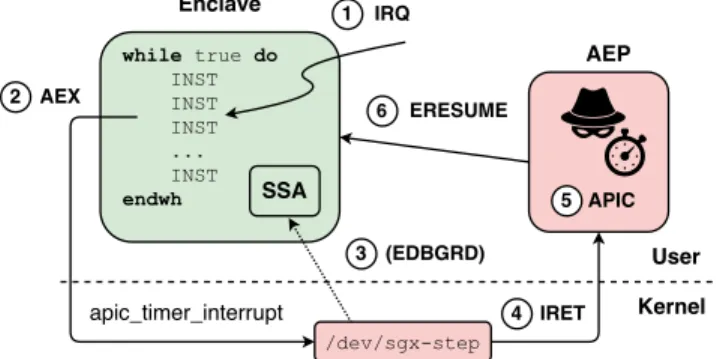
Figure 1.Framework for single-stepping SGX enclaves.
3
Design and Implementation
Our single-stepping objective is to execute an enclave one instruction at a time. Note that advanced x86 hardware debug assistance features such as the single-step trap flag (rflags.tf) or hardware breakpoints are explicitly suppressed in enclave mode [6]. Our implementation therefore leverages the OS’s control over hardware timer devices toemulatethis behavior with frequent enclave interrupts.
APIC Timer Configuration.Every Intel processor comes with a local Advanced Programmable Interrupt Controller (APIC) [6] to configure and deliver interrupts destined for that core. The APIC also contains a timer that can be oper-ated in one of three modes. In one-shot or periodic mode, the timer is configured through memory-mapped I/O registers. Specifically, by writing into an initial-count register, an inter-nal current-count register can be initialized. The local APIC decrements the current-count at the CPU’s bus frequency, divided by the value specified in the divide-configuration register, and generates an interrupt whenever the current-count reaches zero. In one-shot mode a single interrupt is generated, whereas in periodic mode the initial-count is automatically copied back into the current-count register. Alternatively, in TSC-deadline mode, an interrupt is gener-ated when the CPU’s internal timestamp counter reaches the absolute value specified in a dedicated model-specific register. This mode is substantially more precise, since the timestamp counter operates at the processor’s nominal fre-quency, instead of the much slower external bus frequency. The Skylake CPUs used in the evaluation for instance run at a base frequency of 2.5 GHz and 3.4 GHz, whereas the fixed external bus frequency is only 100 MHz (25/34 times slower). To facilitate APIC configuration,SGX-Stepcomes with a runtime library that creates user space virtual memory mappings for the physical APIC memory I/O configuration registers. By writing into the exported memory locations, the untrusted host process can easily configure the APIC timer one-shot/periodic interrupt source or trigger inter-processor interrupts directly from user space. Figure 1 summarizes
the sequence of hardware and software steps when inter-rupting and resuming an SGX enclave through our frame-work. 1 The local APIC timer interrupt arrives within an enclaved instruction. 2 The processor executes the AEX pro-cedure that securely stores execution context in the enclave’s SSA frame, initializes CPU registers, and vectors to the ker-nel-level interrupt handler. 3 Our/dev/sgx-steploadable kernel module registered itself in the APIC event call back list to make sure it is called on every timer interrupt. At this point, any attack-specific, kernel-level spy code can easily be plugged in. Furthermore, to enable precise evaluation of our approach on attacker-controlled debug enclaves,SGX-Step
canoptionallybe instrumented to retrieve the stored instruc-tion pointer from the interrupted enclave’s SSA frame using the edbgrd instruction. 4 The kernel returns to the user space AEP trampoline. We modified the untrusted runtime of the official SGX SDK to allow easy registration of a custom AEP stub. 5 At this point, any attack-specific user mode spy code can again easily be run, before the single-stepping adversary configures the APIC timer for the next interrupt, just before executing 6 eresume.
Timer Interval Prediction.With our framework in place, the only remaining challenge is to establish a suitable, plat-form specific timer interval so as to interrupt the first in-struction executed by the enclave after eresume. The timer interrupt should not systematically arrive too soon, within the monolithic eresume instruction, as then no progress would be made (i.e.,zero-step). Alternatively, should the in-terrupt arrive too late after completion of eresume, more than one instruction would be executed (i.e.,multi-step). The single-stepping adversary is therefore required to accurately predict the duration between the moment the timer is config-ured and completion of eresume. Naturally, due to modern processor optimizations, execution time prediction becomes increasingly difficult the more code is actually executed in the timer interval. In this respect, previous enclave preemp-tion attempts [4, 8, 10] all configure the APIC timer in kernel space, whereas enclaves have to be resumed in user mode. Consequently, these approaches suffer from significant timer jitter stemming from the considerable amount of code and a privilege level switch in the interrupt return path.
An important contribution of our framework therefore is that we drastically cut the amount of code in the timer interval path by directly configuring the APIC timer from user space. As a result,SGX-Stepreduces the timer config-uration challenge to prediction of eresume execution time, which we found to be relatively deterministic on our evalua-tion platforms. Our user-space APIC timer trick only works for the aforementioned single-shot or periodic timer modes, however, since TSC deadline configuration requires the priv-ileged wrmsr instruction. We thus improve timer interval predictability at the cost of a lower timer frequency. Note that this inconvenience can be overcome, however, for instance
by executing a deterministic amount of nop instructions between timer configuration and eresume.
In our experimental setup, we operate the APIC timer in one-shot mode with division 2. As explained above, timer configuration depends on CPU frequency, and hence remains inherently platform-specific. We established suitable timer intervals for both our evaluation platforms through an empir-ical approach that leveragesSGX-Stepto retrieve the inter-rupted instruction pointer from an attacker-controlled debug calibration enclave. We leave exploration of fully automated timer configuration approaches as future work.
Monitoring Page Table Entries.Single-stepping enclaved execution incurs a substantial slowdown, and is often only de-sired for some specific functions of interest.SGX-Step there-fore allows an adversary to initiate single-stepping mode after a specific code or data page has been accessed, using en-clave preemption from either page faults [15] or a dedicated spy thread [13]. Specifically, analogous to the APIC configu-ration trick above,SGX-Stepestablishes user space virtual memory mappings for theunprotectedphysical memory con-taining the victim enclave’s Page Table Entries (PTEs). By manipulating PTEs directly from user space, an adversary can provoke page faults (“present” bit), or gain insight in enclave memory usage (“accessed” and “dirty” attributes).
4
Evaluation
We evaluate the effectiveness ofSGX-Stepon both a mid-end laptop and a higher-end desktop CPU. We first provide mi-crobenchmarks, and afterwards demonstrate the enhanced attack potential ofSGX-Stepin two scenarios that are not exploitable with current, state-of-the-art techniques.
All experiments were conducted on real, off-the-shelf SGX hardware. Our first evaluation platform is a commodity Dell Inspiron 13 7359 laptop running a generic Linux 4.2.0 ker-nel on a Skylake dual-core Intel i7-6500U CPU with a base frequency of 2.5 GHz. Our Dell Optiplex 7040 desktop, on the other hand, features a generic Linux 4.4.0 kernel and a Skylake quad-core i7-6700 processor running at 3.4 GHz. Like previous SGX preemption attacks [4, 8, 10, 13] and con-formant to our attacker model, we disabled TurboBoost plus dynamic frequency scaling (C-States, SpeedStep), and affini-tized the victim enclave thread to a specific logical core to increase predictability on both machines.
4.1 Single-Stepping Microbenchmark
Our objective is to reliably single-steparbitraryenclave pro-grams, including inexpensive instructions without memory operands. To evaluate how accurately SGX-Steprealizes such true single-stepping, we constructed a challenging mi-crobenchmark experiment featuring a test enclave with a long slide of successive nop instructions. At the microar-chitectural level, a 1-byte nop is the lowest cost instruction,
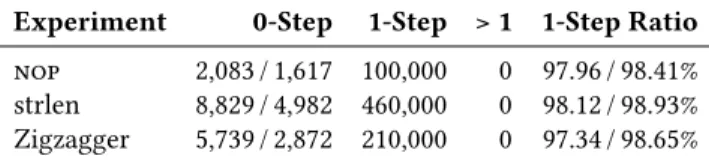
Table 1.Interrupts categorized according to the number of instructions executed in the victim enclave (i.e., zero-step, single-step, or multi-step). When laptop/desktop experimen-tal results differ, we present the laptop measurements first.
Experiment 0-Step 1-Step > 1 1-Step Ratio
nop 2,083 / 1,617 100,000 0 97.96 / 98.41%
strlen 8,829 / 4,982 460,000 0 98.12 / 98.93% Zigzagger 5,739 / 2,872 210,000 0 97.34 / 98.65%
consuming only a single micro-op without memory or regis-ter dependencies [5]. As such, many nops can be executed in a limited time window, and even a relatively small amount of jitter on timer interrupt arrivals can lead to the execution of multiple nops in the benchmark enclave. Hence, we argue that an approach that reliably single-steps a nop instruction slide, can easily single-step arbitrary instructions as well.
Our benchmark enclave executes a slide of 100,000 suc-cessive nop instructions. As part of the experiment, we instructed theSGX-Stepdriver to retrieve the instruction pointer from the state save area of the interrupted debug enclave using the edbgrd instruction, so as to infer the exact number of instructions executed in between two successive enclave interrupts.2In the evaluation on our laptop/desktop platforms, we measured a total of respectively 102,083 and 101,617 interrupts for the instruction slide. We confirmed that exactly 2,083/1,617 out of these did not change the enclave instruction pointer (i.e., zero-step), whereas the remaining 100,000 interrupts caused asingleincrement of the enclave instruction pointer. We thus conclude thatSGX-Stepwas able to reliably single-step all 100,000 nops, without ever executing more than one nop at a time. A small fraction of interrupts (2.04% on the laptop and 1.59% for the desktop) actually arrived too early, within the eresume instruction. These interrupts are superfluous, but rather harmless as they do not result in enclaved code being executed.
4.2 Precise Enclave Execution Control Attacks Determining String Length.Previous work [4] explored the temporal resolution limits of the page fault channel, dis-cussed in Section 2.2. That is, since an attacker needs to restore access rights on faulting pages in order to guarantee progress, fault-driven attacks cannot infer information from enclaved functions that access a single code and data page. As an example of such a function, consider the elementary
strlenimplementation in Fig. 2. Assuming the compiler
uses a CPU register for the loop counter, the entire loop eas-ily fits within a single code page, and every iteration accesses only one data page (containing the string). As such, progress
2Note that edbgrd only serves evaluation purposes, to establish the number
of instructions executed in the benchmark enclave, and would not be used in real attacks against production enclaves.
1 s i z e _ t s t r l e n (char * str ) 2 { 3 char * s ; 4 5 f o r ( s = str ; * s ; ++ s ) ; 6 r e t u r n ( s - str ) ; 7 }
1 mov % rdi ,% rax
2 1: cmpb $0x0 ,(% rax )
3 j e 2 f
4 i n c % rax
5 jmp 1 b
6 2: sub % rdi ,% rax
7 r e t q
Figure 2.Example of secret-dependent data accesses in a tight loop (source code and compiled assembly form).
can only be made if both thestrlencode page and secret string data page are accessible. That is, the length of the secret string cannot be inferred from page fault sequences. Previous research [13] has shown, however, that page ac-cesses can be observed without page faults, for instance by querying the PTE “accessed” bit after interrupting the en-clave. We thus leverageSGX-Stepto single-step the tight
strlenexecution loop, each time recording/clearing the
“ac-cessed” bit of the PTE referencing the string being processed. Note that accurate single-stepping results themselves also allow the string length to be inferred from the number of interrupts (i.e., instructions executed by the victim enclave). The right hand side of Fig. 2 provides the assembly version of thestrlenC source code on the left. We explicitly com-piled the code with optimizations set for size (-Os) to ensure a very compact loop with only 4 assembly instructions and a single memory operand. Note that precisely single-stepping this loop is considerably more challenging than the case without optimizations (totalling 5 instructions and 3 memory operands). In our experimental setup, we single-stepped a benchmark enclave that processed the string"SysTEX 2017"
(11 characters) 10,000 successive times. On every interrupt, just before resuming the enclave, we queried the PTE “ac-cessed” bit from the user space AEP trampoline handler. We correctly recognized the string length for all 10,000strlen
invocations. Additionally, we analyzed the full enclave in-struction pointer trace, retrieved with edbgrd, to categorize interrupts according to the amount of instructions executed in the victim enclave. The results are in Table 1. A first impor-tant finding, in line with our microbenchmark observations, is thatSGX-Stepreliably single-stepped all 460,000 instruc-tions on both the laptop and desktop processors, and without ever executing more than one instruction per interrupt. Only a relatively small fraction of the total number of interrupts (≤1.88%) arrived within eresume and did not result in an enclaved instruction being executed. These zero-step obser-vations can be easily filtered out, as we confirmed that they never falsely triggered the “accessed” bit of the string PTE.
Defeating Zigzagger.Section 2.2 introducedbranch shad-owing attacksthat rely on frequent enclave preemptions to execute shadow probing code for inferring enclave-private control flow via targeted BTB cache collisions. This recent
b0: lea b1, %r15 lea b2, %r14 cmp $0, a cmove %r14, %r15 b0.j: jmp zz1 b1: nop #<code1> lea b5, %r15 b1.j: jmp zz2 b2: lea b3, %r15 lea b4, %r14 cmp $0, b cmove %r14, %r15 b2.j: jmp zz3 b3: nop #<code2> lea b5, %r15 b3.j: jmp zz4 b4: nop #<code3> b5: nop #<code4> zz1: jmp b1.j zz2: jmp b2.j zz3: jmp b3.j zz4: jmpq *%r15 Zigzagger trampoline if (a!=0){ <code1> } else if (b!=0){ <code2> } else{ <code3> } <code4> Original code
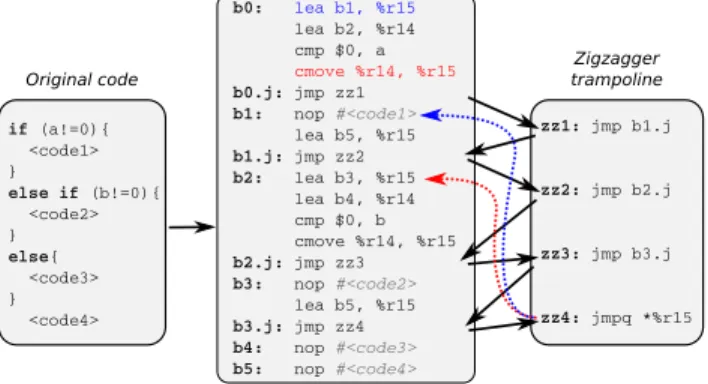
Figure 3.Example code snippet protected by Zigzagger. The final target address inr15is obfuscated with cmov and a tight trampoline sequence of jmp instructions (from [8]). work [8] also includes a compile-time defense scheme called Zigzagger. The key idea, illustrated in Fig. 3, is to obfus-cate the target address of a conditional jump via a cmov instruction, followed by a tight trampoline sequence of un-conditional jumps that ends with a single indirect branch instruction. By rapidly jumping back and forth between the instrumented code and the trampoline, Zigzagger makes rec-ognizing the current branch instruction considerably more challenging. Its security argument states that “since all of the unconditional branches are executed almost simultaneously in sequence, recognizing the current instruction pointer is difficult” [8]. Moreover, the branch shadowing attack in itself cannot directly infer the secret target address of the indi-rect branch atzz4. We show, however, that even Zigzagger-instrumented code can be reliably single-stepped. Specifi-cally, an attacker leveragingSGX-Stepcan reliably probe
eachintermediate unconditional trampoline jump (i.e.,zz1
tozz3). Observe that after branching to the secret target ad-dress, execution continues at one of only two possible target addresses, and eventually lands on the Zigzagger trampoline at eitherzz2orzz3. As such, a single-stepping adversary can infer the secret if condition, after detecting execution of the indirect branch atzz4, by probing the unconditional
zz2jump – which is only executed for the first code block. We evaluate a proof-of-concept Zigzagger attack by re-peatedly single-stepping the hardened assembly code3from Fig. 3. Specifically, we single-stepped a benchmark enclave that executes the 21-instruction code snippet 10,000 succes-sive times, and afterwards analyzed the edbgrd instruction pointer trace to establish the number of instructions executed on every interrupt. In line with our previous findings, Table 1 shows thatSGX-Stepneverexecutes more than one instruc-tion in the victim enclave per interrupt, allowing precise execution of the shadow code on both evaluation platforms.
3Since Zigzagger and the attack code from [8] were not made public, we
repeat the example assembly code snippet from that paper here. For the same reason, we could not launch the actual branch shadowing attack, only showing its feasibility with our single-stepping results.
Hence, these benchmarks can be considered clear evidence thatSGX-Stepenablesnewattacks, previously deemed infea-sible. The superfluous zero-step interrupt fractions (2.66% for the laptop and only 1.35% on the desktop) also keep on par with previous observations, and do not impede a real attack since the BTB cache remains unaffected by the victim.
5
Discussion
Attack Resolution and Implications.We showed that en-claves can be reliably interrupted one instruction at a time. In this,SGX-Stepimproves significantly over related state-of-the-art enclave preemption schemes that only approximate such instruction-level granularity after either disabling the CPU cache [8], or focussing exclusively on instructions with memory operands in a simulator [4]. From a practical per-spective,SGX-Stepfurthermore lowers the bar for precise enclave preemption attacks from user space.
These findings have profound consequences for the de-sign of effective defenses. Specifically, compiler-based tech-niques are fundamentally insufficient when they rely on (partial)atomic behaviorof the instruction stream, as effec-tively demonstrated for the Zigzagger [8] branch obfusca-tion technique above. Our precisestrlenattack furthermore highlights the inadequacy of defenses that focus on “aligning specific code and data blocks to exist entirely within a single page”, as still officially recommended by Intel [7].
Detecting Suspicious Interrupts.Heuristic compiler de-fenses, on the other hand, could focus on detecting high in-terrupt rates as an artefact of an ongoing attack. Importantly, in contrast to enhanced PMA designs such as Sanctum [3], SGX enclaves are explicitly leftinterrupt-unaware, since they ought to be resumed through a dedicated eresume instruc-tion. However, a contemporary line of research [2, 12] lever-ages x86 Transactional Synchronization eXtensions (TSX) to detect page faults or interrupts in enclave mode.
T-SGX [12] protects against page fault-based attacks by wrapping each basic block in a TSX transaction, and aborting the enclave after counting too many consecutive transaction aborts. Déjà Vu [2] instruments an enclave program to detect frequent preemptions through a reliable in-enclave reference clock thread that uses TSX to ensure it cannot be silently stopped by an untrusted OS. Both solutions would recognize the frequent interrupt rates generated bySGX-Step, but also suffer from several important limitations, however. First, an SGX-enabled processor (e.g., the laptop we used in our exper-iments) is not always shipped with TSX extensions, ruling out this defense for critical infrastructural software such as Intel’s Launch and Quoting Enclaves. Second, TSX defenses incur a significant run-time performance overhead [2, 12]. Third, these defenses cannot offer full protection as they rely on heuristics to recognize suspicious interrupt rates, which could also be caused by repeated cache conflicts or benign interrupts under heavy system load.
6
Conclusion
Our work shows that enclaved execution can be accurately single-stepped one instruction at a time. We demonstrated
SGX-Step’s improved temporal resolution over state-of-the-art preemption schemes in two challenging attack scenarios, highlighting the need for adequate defense mechanisms.
Acknowledgements.This work was partially supported by the Research Fund KU Leuven and the TearLess research project. Jo Van Bulck and Raoul Strackx are supported by a grant of the Research Foundation – Flanders (FWO).
References
[1] Ferdinand Brasser, Urs Müller, Alexandra Dmitrienko, Kari Kostiainen, Srdjan Capkun, and Ahmad-Reza Sadeghi. 2017. Software grand ex-posure: SGX cache attacks are practical. In11th USENIX Workshop on Offensive Technologies (WOOT ’17). USENIX Association.
[2] Sanchuan Chen, Xiaokuan Zhang, Michael K Reiter, and Yinqian Zhang. 2017. Detecting privileged side-channel attacks in shielded execution with Déjà Vu. InProceedings of the 2017 Asia Conference on Computer and Communications Security (Asia CCS ’17). ACM, 7–18. [3] Victor Costan, Ilia Lebedev, and Srinivas Devadas. 2016. Sanctum:
Min-imal hardware extensions for strong software isolation. InProceedings of the 25th USENIX Security Symposium. USENIX Association. [4] Marcus Hähnel, Weidong Cui, and Marcus Peinado. 2017.
High-resolution side channels for untrusted operating systems. In2017 USENIX Annual Technical Conference (ATC ’17). USENIX Association. [5] Intel Corporation. 2016.Intel 64 and IA-32 architectures optimization
reference manual. Reference no. 248966-033.
[6] Intel Corporation. 2017.Intel 64 and IA-32 architectures software devel-oper’s manual. Reference no. 325462-062US.
[7] Intel Corporation. 2017.Intel software guard extensions developer guide.
software.intel.com/en-us/documentation/sgx-developer-guide. [8] Sangho Lee, Ming-Wei Shih, Prasun Gera, Taesoo Kim, Hyesoon Kim,
and Marcus Peinado. 2017. Inferring fine-grained control flow in-side SGX enclaves with branch shadowing. InProceedings of the 26th USENIX Security Symposium. USENIX Association.
[9] P. Maene, J. Götzfried, R. de Clercq, T. Müller, F. Freiling, and I. Ver-bauwhede. 2017. Hardware-based trusted computing architectures for isolation and attestation.IEEE Trans. Comput.99 (2017).
[10] Ahmad Moghimi, Gorka Irazoqui, and Thomas Eisenbarth. 2017. CacheZoom: How SGX amplifies the power of cache attacks. In Con-ference on Cryptographic Hardware and Embedded Systems (CHES ’17). [11] Michael Schwarz, Samuel Weiser, Daniel Gruss, Clémentine Maurice,
and Stefan Mangard. 2017. Malware guard extension: Using SGX to conceal cache attacks. InDetection of Intrusions and Malware, and Vulnerability Assessment (DIMVA ’17).
[12] Ming-Wei Shih, Sangho Lee, Taesoo Kim, and Marcus Peinado. 2017. T-SGX: Eradicating controlled-channel attacks against enclave programs. InProceedings of the 2017 Annual Network and Distributed System Security Symposium (NDSS). San Diego, CA.
[13] Jo Van Bulck, Nico Weichbrodt, Rüdiger Kapitza, Frank Piessens, and Raoul Strackx. 2017. Telling your secrets without page faults: Stealthy page table-based attacks on enclaved execution. InProceedings of the 26th USENIX Security Symposium. USENIX Association.
[14] Nico Weichbrodt, Anil Kurmus, Peter Pietzuch, and Rüdiger Kapitza. 2016. AsyncShock: exploiting synchronisation bugs in Intel SGX enclaves. InEuropean Symposium on Research in Computer Security (ESORICS ’16). Springer.
[15] Yuanzhong Xu, Weidong Cui, and Marcus Peinado. 2015. Controlled-channel attacks: Deterministic side Controlled-channels for untrusted operating systems. InIEEE Symposium on Security and Privacy. IEEE, 640–656.