Staged Parser Combinators for Efficient Data Processing
Manohar Jonnalagedda
∗Thierry Coppey
‡Sandro Stucki
∗Tiark Rompf
†∗Martin Odersky
∗∗LAMP‡DATA, EPFL{first.last}@epfl.ch
†Oracle Labs:{first.last}@oracle.com
Abstract
Parsers are ubiquitous in computing, and many applications depend on their performance for decoding data efficiently. Parser combinators are an intuitive tool for writing parsers: tight integration with the host language enables grammar specifications to be interleaved with processing of parse re-sults. Unfortunately, parser combinators are typically slow due to the high overhead of the host language abstraction mechanisms that enable composition.
We present a technique for eliminating such overhead. We use staging, a form of runtime code generation, to dissoci-ate input parsing from parser composition, and elimindissoci-ate in-termediate data structures and computations associated with parser composition at staging time. A key challenge is to maintain support for input dependent grammars, which have no clear stage distinction.
Our approach applies to top-down recursive-descent parsers as well as bottom-up nondeterministic parsers with key applications in dynamic programming on sequences, where we auto-generate code for parallel hardware. We achieve performance comparable to specialized, hand-written parsers.
Categories and Subject Descriptors D.3.4 [Programming Languages]: Processors – Code generation, Optimization, Parsing
Keywords Parser combinators; multi-stage programming; algebraic dynamic programming
1.
Introduction
Parser combinators [18, 20, 36] are an intuitive tool for writ-ing parsers. Implemented as a library in a host language, they
Permission to make digital or hard copies of all or part of this work for personal or classroom use is granted without fee provided that copies are not made or distributed for profit or commercial advantage and that copies bear this notice and the full citation on the first page. Copyrights for components of this work owned by others than the author(s) must be honored. Abstracting with credit is permitted. To copy otherwise, or republish, to post on servers or to redistribute to lists, requires prior specific permission and/or a fee. Request permissions from [email protected].
OOPSLA ’14, October 20–24, 2014, Portland, OR, USA.
Copyright is held by the owner/author(s). Publication rights licensed to ACM. ACM 978-1-4503-2585-1/14/10. . . $15.00.
http://dx.doi.org/10.1145/2660193.2660241
use the language’s abstraction capabilities to enable compo-sition. As a result, a parser written with such a library can look like formal grammar descriptions, and is also readily executable: by construction, it is well-structured, and eas-ily maintainable. Moreover, since combinators are just func-tions in the host language, it is easy to combine them into larger, more powerful combinators.
However, parser combinators suffer from extremely poor performance (see Section 5) inherent to their implementa-tion. There is a heavy penalty to be paid for the expres-sivity that they allow. A grammar description is, despite its declarative appearance, operationally interleaved with input handling, such that parts of the grammar description are re-built over and over again while input is processed. Moreover, since parsing logic may depend on previous input, there is no clear phase distinction between language description and in-put processing that could be straightforwardly exploited for optimizations without giving up expressiveness and there-fore some of the appeal of parser combinators.
For this reason, parser combinators are rarely used in ap-plications demanding high throughput. This is unfortunate, because they are so useful and parsing is such an ubiquitous task in computing. Far from being used only as a phase of compiler construction, parsers are plentiful in the big data era: most of the data being processed is exchanged through structured data formats, which need to be manipulated effi-ciently. An example is to perform machine learning on mes-sages gathered from social networks. Most APIs return these messages in a structured JSON format transferred over the HTTP protocol. These messages need to be parsed and de-coded before performing learning on them.
The accepted standard for performance oriented data pro-cessing is to write protocol parsers by hand. Parser genera-tors, which are common for compilers, are not frequently used. One reason is that many protocols require a level of context-sensitivity (e.g. read a valuen, then readnbytes), which is not readily supported by common grammar for-malisms. Many open-source projects, such as Joyent/Nginx and Apache have hand-optimized HTTP parsers, which span over 2000 lines of low-level C code [1, 34]. From a soft-ware engineering standpoint, big chunks of low-level code
are never a desirable situation. First, there may be hidden and hard to detect security issues like buffer overflows. Sec-ond, the low-level optimization effort needs to be repeated for new protocol versions or if a variation of a protocol is desired: for example, a social network mining application may have different parsing requirements than an HTTP load balancer, even though both process the same protocol.
Parser combinators could be a very attractive implemen-tation alternative, if only they weren’t so slow. Their main benefit is that the full host language can be used to compose parsers, so context sensitivity and variations of protocols are easily supported. To give an example, we show the core of a combinator-based HTTP parser next.
Parsing Communication Protocols with Combinators The language of HTTP request and response messages is straight-forward to describe. Here is an example HTTP response:
HTTP/1.1 200 OK
Date: Mon, 23 May 2013 22:38:34 GMT
Server: Apache/1.3.3.7 (Unix) (Red-Hat/Linux) Last-Modified: Wed, 08 Jan 2012 23:11:55 GMT Etag: "3f80f-1b6-3e1cb03b"
Content-Type: text/html; charset=UTF-8 Content-Length: 129
Connection: close ... payload ...
In short, an HTTP response consists of a status message (with a status code), a sequence of headers separated by line breaks, a final line break, and the payload of the response. A header is a key-value pair. The length of the payload is specified by theContent-Length header. We can express this structure as follows using the parser combinator library that comes with the Scala distribution:
def status = (
("HTTP/" ~ decimalNumber) ~> wholeNumber <~ (text ~ crlf) ) map (_.toInt)
def headers = rep(header)
def header = (headerName <~ ":") flatMap { key => (valueParser(key) <~ crlf) map {
value => (key, value) }
}
def valueParser(key: String) =
if(key == "Content-Length") wholeNumber
elsetext
def body(i: Int) = repN(anyChar, i) <~ crlf
def response = (status ~ headers <~ crlf) map {
casest ~ hs => Response(st, hs) }
def respWithPayload = response flatMap { r => body(r.contentLength)
}
In the code above:
•thestatusparser looks for the code in a status message. It uses the sequential operators~, ~>and<~. The latter two
combinators ignore parse results on their left and right sides, respectively. Here, we are only interested in the status code (wholeNumber). Themapcombinator is then used to convert the code to an integer value.
•the headers parser uses the rep combinator to parse a
sequence of headers; header parses a key-value pair. It uses theflatMap combinator to bind the result of pars-ing a headerName to a key, which is then passed on to
valueParser. Note that this parser is context-dependent: it decides whether to parse the subsequent value based on the key. Themapcombinator is used to create the pair it-self.
•theresponseparser parses a status message followed by headers: here the map combinator is used to create a
Responsestructure (case class) from the results.
•Finally,respWithPayload parses and extracts the body of the message, based on the value of thecontentLengthfield of theResponsestructure.
It is easy to see the appeal of parser combinators from the above example. In less than30 lines of code we have de-fined a parser for HTTP responses, and it reads almost like an English description. Of course a bit more work is needed to support the full protocol; the complete parser we devel-oped contains around250 lines. Here, we have also omit-ted the definition of simple parsers such asdecimalNumberand
wholeNumber: the advantage being that these are implemented in a standard parser combinator library. Moreover, we can easily extend our implementation to handle key-value pairs more precisely by adding cases to thevalueParserfunction, for example. If these30lines of re-usable high-level code could be made to perform competitively with2000lines of low-level hand-written C, there would be much less incen-tive for the latter to exist.
Since parser combinators compose easily, a fast imple-mentation would even have the potential to surpass the per-formance of hand-written parsers in the case of protocol stacks: layering independent hand-optimized parsers may re-quire buffering which can be avoided if the parsers can be composed directly.
Nondeterministic Parsers and Dynamic Programming A key performance aspect of parser combinators is that the usual implementations perform top-down recursive descent with backtracking, which has exponential worst case per-formance. Communication protocols do not usually contain ambiguities, so backtracking will not frequently occur in this setting and recursive descent is a viable strategy. How-ever, protocol parsers are not the only use case for parsers in general and parser combinators in particular. Other im-portant data processing applications, for example in natural language processing and bioinformatics, require nondeter-ministic parsers and highly ambiguous grammars. These ap-plications involve computing a parse result over a sequence with respect to some cost function: we are not only looking for a parse result, we seek the best possible parse result. For
these use-cases, recursive descent with backtracking is in-efficient. An efficient implementation comes in the form of a memoization/dynamic programming algorithm. A general technique, Algebraic Dynamic Programming (ADP) [10], can be used to describe sequence structures as grammars in a parser combinator library. Contrary to recurrence relations, a grammar captures the structure of a sequence more intu-itively. ADP uses a grammar for the structure, and an al-gebra to compute over that structure. The added benefit of this separation is modularity: we can define multiple alge-bras (cost functions) for the same sequence structure. Pri-mary use cases for ADP-style parser combinators are dy-namic programming problems on sequences, found in the realm of bioinformatics, such as sequence folding. For very large sequences, it is beneficial to turn the evaluation strat-egy into a bottom-up algorithm: this exposes uniform layouts which are amenable to parallelization.
1.1 Contributions
We present a library of parser combinators that performs competitively to hand-optimized parsers. Lifting the perfor-mance level of parser combinators to that of hand-written parsers removes a key incentive to write parsers by hand, and enables more developers to reap the productivity bene-fits of high-level programming. In particular, we make the following contributions:
•We dissociate static from dynamic computations for
parser combinators using Lightweight Modular Staging (LMS) [25]. The key insight is to allow static (grammar level) computation to treat pieces of dynamic (input han-dling) computation as first class values, but not the other way around. We leverage the Scala type system to ensure that no parser combinators can appear in the generated code. As a result we create a program that, at the first stage, eliminates the combinator abstraction, and gener-ates an efficient parser. The first stage can still use the full host language for parser composition (Section 3).
•The stage distinction is non-obvious, due in particular to context-sensitive and recursive parsers. The key trade-off is between inlining code as much as possible vs. when and where to emit functions in the generated code. We use a mix of present-stage and future-stage functions at key junctions to generate efficient recursive descent patterns (Section 3.2). A similar technique also protects us from code blowup (Section 3.3).
•Staging alone is not sufficient to remove intermediate data structures that cross control flow joins in the gen-erated code. We perform additional rewrites at the inter-mediate representation (IR) level to remove these data structures as well. These rewrites involve splitting and merging data structures at conditional expressions so that their components can be mapped to local variables (Sec-tion 3.4).
•We generalize our technique to parsers for ambiguous grammars. As an extreme case, we consider general
dy-namic programming on sequences, which can be reduced to a parsing problem through the use of ADP (Section 4). From a grammar specification of a dynamic program and a cost function, we generate a CYK style parser. In con-trast to the recursive descent parsers generated for un-ambiguous grammars, we impose a bottom-up order for their ambiguous counterparts. At staging time, we com-poseiterations over lists (of results) instead of the lists themselves, and replace recursion by memoization (Sec-tions 4.1, 4.3, 4.2).
•Imposing a bottom-up order also opens up the possibil-ity to parallelize processing, as independent intermediate results can be computed independently [30, 32]. Our use of staging coupled with generative programming enables us to generate code that runs on the GPU for dynamic programs (Section 4.4). The GPU code computes an op-timal cost function efficiently. In Section 4.5, we discuss how to retrieve the trace of this optimal cost. This trace is independent of the cost function itself, and can be plied to other algebras later. Compared to previous ap-proaches, we trade extra memory usage in the forward computation for a better running time complexity for the backtrace computation.
•We evaluate the performance of our top-down parsers by comparing to hand-written HTTP and JSON parsers from the Nginx and JQ projects. Our generated Scala code, running on the JVM, achieves HTTP throughput of 75% of Nginx’s low-level C code, and 120% of JQ’s JSON parser. Other Scala based tools such as Spray are at least an order of magnitude slower. We evaluate our bottom-up parsers on two different bioinformatics algorithms. We compete with hand-written C code for the Nussinov algo-rithm, and show good scalability for both CPU and GPU code generated from parser combinators. (Section 5). Section 6 discussed related work and Section 7 con-cludes. Before going any further, we give some insight into the abstraction overhead related to parser combinators in Section 2.
2.
Parser Combinators
The introduction gave us a taste for implementing parsers with combinators. In this section we give insights on what causes them to be inefficient. For this, we show how they are commonly implemented.
Parser combinators are functions from an input to a parse result. For now we only consider deterministic parsers, in which case a parse result is either a success or a failure.
Figure 1 shows an implementation for parser combinators in Scala. The implementation is contained inside aParsers
module. The abstractParser[T]class is generic over the the type of results it can parse. It extends a function type: the notationT => Uis sugar for the classFunction1[T, U], which has an abstractapplymethod corresponding to function ap-plication. Creating a new parser is equivalent to creating a
traitParsers {
typeInput = Int
abstract classParseResult[T]
case classSuccess(res: T, next: Input)
extendsParseResult[T] {
defisEmpty = false }
case classFailure(next: Input)extendsParseResult[T] {
defisEmpty = true }
defsource: Array[Char] //abstract, defined later
abstract classParser[T]extends(Input => ParseResult[T]) {
def| (that: Parser[T]) = Parser[T] { pos =>
val tmp =this(pos)
if(tmp.isEmpty) that(pos)
elsetmp }
defflatMap[U](f: T => Parser[U]) = Parser[U] { pos =>
val tmp =this(pos)
if(tmp.isEmpty) Failure(pos)
else f(tmp.res)(tmp.next) }
defmap[U](f: T => U) = Parser[U] { pos =>
val tmp =this(pos)
if(tmp.isEmpty) tmp
elseSuccess(f(tmp.res), tmp.next) }
def~[U](that: Parser[U]): Parser[(T, U)] =
for( r1 <-this; r2 <- that )yield(r1,r2) }
defParser[T](f: Input => ParseResult[T]) = newParser[T] {
defapply(pos: Input) = f(pos) }
}
Figure 1. An implementation of parser combinators
new instance ofFunction1, and providing an implementation of theapplymethod. TheParserconvenience function simpli-fies the creation of a parser. We fix theInputtype member to beInt, because we study parsers over character arrays with integer indices. We create an algebraic data type (or acase
class in Scala terms) to represent a parse result. AParseResult
is either a success, in which case it contains the result, or a failure. TheflatMapcombinator, generic in a type parameter
U, allows to make decisions based on the result of a parser. Incidentally, this function corresponds to the monadic bind
for parser combinators. The alternation combinator | parses the right-hand side parser only if the left side parser fails. Themapcombinator transforms the value of a parse result. Finally, the~combinator does sequencing, where we are in-terested in the results of the left and the right hand side. Note that we useforcomprehensions, which are Scala’s
equiva-lent for thedonotation in Haskell.
In this paper we use the following combinators, in addi-tion to those present in Figure 1:
•lhs ~> rhssucceeds if bothlhsandrhssucceed, but we are only interested in the parse result ofrhs
•lhs <~ rhssucceeds if bothlhsandrhssucceed, but we are only interested in the parse result oflhs
•rep(p)repeatedly appliespto parse the input untilpfails. The result is a list of successive applications ofp.
•repN(n,p)appliespexactlyntimes to parse the input. The result is a list of thenconsecutive results ofp.
•repsep(p,q)repeatedly appliespinterleaved with the sep-aratorqto parse the input, untilpfails. The result is a list of the results ofp. For example,repsep(term, ",")parses a comma-separated list of terms, yielding a list of these terms.
We define two simple parsers which accept a character based on a predicate:
defacceptIf(p: Char => Boolean) = Parser[Char] { pos =>
if(pos < source.length && p(source(i))) Success(source(i), i + 1)
elseFailure(i) }
}
defaccept(c:Char) = acceptIf { (x: Char) => x == c }
We are interested in only one parse result here. In the more general case, we could also collect all possible parse results over an input, that is, a list of results rather than a single one. In the event of multiple parse results being present, we are often interested in an optimal parse result based on some cost function. We will see in section 4 how such problems relate to dynamic programming. For both use cases, we still want to preserve the expressiveness and intuition with which parser combinators can describe these problems. In particular, it is better to express a parse result and its cost function independently, even if we would like to compute them together.
2.1 The Overhead of Abstraction
The above, functional implementation leads to poor perfor-mance, because:
•The execution of a parser goes through many indirec-tions. First and foremost, every parser is a function. Func-tions being objects in Scala, function application amounts to method calls. A composite parser, composed of many smaller parsers, when applied to an input, not only con-structs a new parser at every application, but also chains
many method calls, which incurs a huge cost due to method dispatch. The use of higher-order functions in-curs this cost as well.
One would expect a virtual machine like the JVM to in-line most of these calls; the JVM’s heuristics are however geared to optimize hot code paths. We may only be able to inline a parser that is called very often. With a plug-gable VM, such as Truffle/Graal [39], we could hint the virtual machine to inline these code paths. The important insight here is that we want a more deterministic way of optimizing the method calls. This will also open up fur-ther optimization opportunities down the line.
•We construct many intermediate parse results during the execution of a parser: for every combinator, we box the parse, plus the position, into aParseResultobject, before manipulating its fields. Inlining by itself will not rid us of these intermediate data structures: for one, recursive parsers are very common, and the control flow of a parser has many split and join points in the form of conditionals. With ambiguous grammars and dynamic programming, the problems are exacerbated further. Because parse re-sults and cost functions are expressed independently, many large intermediate results may be created before the optimal result is eventually computed.
In summary, it is precisely the language abstraction mech-anisms that enable us tocomposecombinators that are hin-dering our performance. In the following sections, we show how to get rid of the penalty.
3.
Staging Parser Combinators
One way to remove composition abstraction in parser com-binators follows a well known technique, multi-stage pro-gramming, or staging [35]. The idea is to separate compu-tation into stages, where at each stage, parts of the program are partially evaluated, leaving behind a simpler, or faster, program. When a parser combinator is run on an input, its control structure is already fixed: it is statically known. The parsing itself depends on the input. We want to stage the static parts away, so that all that remains is the core logic of parsing itself. We perform the staging using the Lightweight Modular Staging (LMS) framework [25].
Lightweight Modular Staging LMS is a framework for developing embedded DSLs in Scala, that provides a library for domain-specific optimizations and code generation. A program written in LMS is compiled in two stages. During the first stage, the code is converted into an intermediate rep-resentation (IR), from which code is generated. We refer to this step as staging time. This generated code, representing an optimized version of the original DSL program is then run during the second stage. The IR is modular in the sense that it can be easily extended with domain-specific optimizations using classic programming features like pattern matching. Sitting atop the Scala Virtualized compiler [24] also enables
domain-specific overriding of basic language constructs like conditional expressions, loops and object creation.
LMS differentiates between staged and unstaged compu-tations using theReptype constructor. An expression of type
T will be executed at staging time, while an expression of typeRep[T]will be generated. As an example, consider the following functions:
defadd1(a: Int, b: Int) = a + b
defadd2(a: Rep[Int], b: Rep[Int]) = a + b
Theadd1function gets executed during code generation, pro-ducing a constant in the generated code, whileadd2 repre-sents a computation that will eventually yield a value of in-teger type, and is represented as an IR nodeAdd(a, b). The intermediate representation gives the DSL developer a prag-matic way to specify domain specific optimizations. For ex-ample, we can pattern match on the parameters of theAdd
node to detect when one of the operands is the constant0, and rewrite the expression to be the other operand. This way,
add2(a, 0)generates code foraonly.
The core LMS library provides interfaces, IR nodes and code generation for many common programming constructs, such as conditionals, Boolean expressions, arithmetic ex-pressions and array operations, among others. These can therefore be used out of the box.
3.1 Parser Combinators, Staged
Efficient staging of parser combinators is a question of cor-rectly identifying which computations to stage, and which computations to evaluate away. Let us look at the signature for parser combinators once again:
abstract classParser[T]extends(Input => ParseResult[T])
Clearly, neither the input position nor the contents of the parse result are known statically; they have to be staged. However, we know how the parsers will be composed. This means that we can evaluate function composition at staging
time. We represent a parser as an unstaged function on
stagedtypes:
abstract classParser[T]
extends(Rep[Input] => Rep[ParseResult[T]])
A functiondef f: Rep[T] => Rep[U], when applied to a param-eter of typeRep[T], is evaluated at staging time: at the call site, the body of the function is generated, instead of a call to the function. This amounts to inlining the function at the call site. On the other hand, functions of typeRep[T => U] repre-sent staged functions; the generated code will contain a func-tion declarafunc-tion, as well as a funcfunc-tion call, if the funcfunc-tion is applied. The difference between both is clearer by desug-aring the function type: unstaged functions are instances ofFunction1[Rep[T], Rep[U]], while staged functions are in-stances ofRep[Function1[T, U]].
We stage all composition functions in a similar way. Two rules drive our systematic staging of parsers:
•A primitive typeTis converted intoRep[T]. By primitive type, we mean a type that is input dependent: inputs and parse results.
•A function typeT => Uis converted intoRep[T] => Rep[U]
This way, higher-order functions also get inlined at call sites. The interface for staged parser combinators is given in figure 2. The implementations for the combinators follow those of unstaged parser combinators in section 2. We show the code for theflatMapcombinator as an example:
def flatMap[U](f: Rep[T] => Parser[U]) = Parser[U] { pos =>
valtmp =this(pos)
if(tmp.isEmpty) Failure[U](pos)
else{
valx = f(tmp.get)(tmp.next)
if(x.isEmpty) Failure[U](pos)elsex }
}
To get some insight as to how staging works for parser combinators, consider the following simple parser, which accepts the letter ’h’ followed by the letter ’i’:
val hi = (accept(’h’) ~ accept(’i’)) hi(0)
Applying the function to an input will inline the parser. The generated code we get looks like the following:
val idx = 0
val len = input.length
val p1: ParseResult[Char] =// parsing ’h’
if(idx < len) {
valres = input(idx)
if(res == ’h’) Success(res, idx + 1)
elseFailure(idx) } elseFailure(idx)
val p2: ParseResult[(Char, Char)] =// parsing ’i’
if(p1 == Success) {
validx1 = p1.next
if(idx1 < len) {
val res = input(idx1)
if(res == ’i’) Success((p1.res, res), idx1 + 1)
elseFailure(idx1) }elseFailure(idx1) } elsep1
p2
We notice that there are no Parser objects in the generated code. The body of theacceptfunction is inlined, and so is the body of the sequence function~.
3.2 Recursion
Even the most basic parsers have some form of recursion. Simply using unstaged functions will create infinite loops during code generation because recursive calls are unfolded and inlined during staging time. We are forced to stop the re-cursion by generating a staged function for recursive parsers. A recursive parser needs to be explicitly declared using the
abstract classParser[T]
extends(Rep[Input] => Rep[ParseResult[T]]){
defmap[U](f: Rep[T] => Rep[U]): Parser[U]
defflatMap[U](f: Rep[T] => Parser[U]): Parser[U]
deffilter(f: Rep[T] => Rep[Boolean]): Parser[T]
def~[U](that: Parser[U]): Parser[(T, U)]
def| (that: Parser[T]): Parser[T] }
Figure 2. Interface for staged parsers
reccombinator which performs this lifting. Therec combi-nator works using the classical memoization scheme. The first time it sees a parser, it stores, in a static map, a staged version of the parser function. The next time the same parser is seen, we replace it with a function application, using the staged function stored before. In the generated code, we have a function application. Thereccombinator is therefore simi-lar to a fixpoint combinator:
deflift[T, U]: (f: Rep[T] => Rep[U]): Rep[T => U] = ...
valstore =newMap[Parser, Sym]
defrec[T](p: Parser[T]): Parser[T] = { store.get(p)match{
caseSome(f) =>
Parser[T] { i => f(i) }
caseNone =>
valfunSym = fresh[Input => ParseResult[T]] store += (p -> funSym)
valf = (i: Rep[Input]) => p(i) createDefinition(funSym, lift(f)) store -= p
Parser[T] { i => funSym(i) } }
}
TheSymtype, and thefreshandcreateDefinitionfunctions are part of the LMS internals.Symrepresents a symbol in the IR of an LMS program. A new symbol for a specific type is created usingfresh, andcreateDefinitionlinks aReptype to a symbol in the IR tree. Finally, theliftfunction converts an unstaged function into a staged one.
3.3 Reducing Code Generation Blow-up
Consider the following parser:
defaParser = (a ~ b | c) ~ d
where none of the parsers are recursive. Following our op-timizations from above, there is a risk that code generation blows up: Thecparser is tried when eitheraorbfails: the code for parsercwill therefore be inlined in the fail branches for botha andb. The code for parserd is then further in-lined in each of the success branches; it is inin-lined 3 times. Aggressive and naive inlining results in an exponential code
blow-up due to many different branches being created. Once again, simply staging a parser implementation is insufficient. The explosion in branches happens because of combina-tors that offer multiple paths of computation. The alternation combinator | is the culprit here. We need to maintain a dia-mond control flow in the generated code in the presence of alternation. Once again, we use staged functions. We wrap the left alternative in a function. We also wrap the parser cre-ated by the alternation into a function. The implementation of | is a bit more complex this time:
abstract class Parser[T]
extends(Rep[Input] => Rep[ParseResult[T]]){ ...
def | (that: Parser[T]) = {
valp = Parser[T] { pos =>
val tmp = lift(this)
val x = tmp(pos)
if(x.isEmpty) that(pos)elsex }
lift(p) } }
3.4 Staged Records
So far, we have rid ourselves of the abstraction of combina-tors, and protected ourselves from recursion and code gener-ation blowup. The shape of the generated code still needs to be improved. We still create many intermediate data struc-tures. Recall thehiparser from above, and the code it gener-ates.
Each time we use an elementary parser, we create an in-stance of aParseResult. Further down, we use field lookups to inspect this object. There is some overhead due to box-ing/unboxing.
But we can use staging again! The idea is to represent parse results as staged record/struct implementation. The idea is reminiscent of what we did with functions. We staged function declaration and application away by using unstaged functions. Similarly, we represent parse results as records, or structs, but stage the record creation, and field lookups, away.
For this, we re-use the generic struct interface present in LMS [26] (Figure 3). The struct interface provides IR nodes for struct creation and field lookup. During code generation a record is produced. To optimize struct creation we operate on the IR level. In a first step, we override conditionals that produce structs to split the conditional expression among every field. In a second step, we re-merge the conditional expressions, with the fields remaining split at the root of the conditional expression.
As a result of the split and re-merge, thehiparser above now generates the following code:
val idx = 0
val len = input.length
defSuccess[T](res: Rep[T], next:Rep[Int]) = Struct( classTag[ParseResult[T]], "res" -> res, "empty" -> false, "next" -> next )
defFailure[T](next: Rep[Int]) = Struct( classTag[ParseResult[T]], "res" -> ZeroVal[T], "empty" -> true, "next" -> next )
override defifThenElse[T](cond: Rep[Boolean], left: Rep[T], right: Rep[T])
= (left, right)match{
case(Struct(tagA, elems), Struct(tagB, elemsB)) => assert(tagA == tagB)
valelemsNew = elems.zip(elemsB) map { (left, right) =>
if(cond) leftelseright }
Struct(tagA, newElems) }
Figure 3. Using structs for parse results, and splitting
varres: (Char, Char) =null varnext: Int = 0
varempty: Boolean = true
if(idx < len){ valr1 = input(idx) // parsing ’h’ if(r1 == ’h’) { validx2 = r1 + 1 val r2 = input(idx2) // parsing ’i’ if(r2 == ’i’) { res = (r1, r2) next = idx + 1 empty = true } } }
ParseResult(res, next, empty)
Note that we only create the parse result after having parsed fully, and have inlined the parsing of ’i’ into the success branch of ’h’.
Top-down, recursive-descent parsing works well for pro-tocols, because the grammars are deterministic, with limited backtracking. In general, however, the search for a parse can be exponentially expensive, and that will dominate the in-efficiencies due to boxing/unboxing and indirection. This problem occurs especially with ambiguous grammars. The
extreme case of ambiguity is when an input sequence has an exponential number of possible parses. In the next sec-tion, we see how to deal with non-deterministic, ambiguous grammars.
4.
Staged Parser Combinators for Dynamic
Programming on Sequences
We now consider parser combinators for ambiguous, non-deterministic grammars. These grammars can yield more than one parse result per input. Often, we are interested in one parse result, namely the optimal parse result with respect to some cost function. This is where techniques like memoization/dynamic programming come into play. In this section, we introduce the general method which is used to describe such grammars, using parser combinators. This method is known as Algebraic Dynamic Programming (ADP) [10, 14], and has practical applications in biology. We then focus on staging combinators for an optimal cost function. By processing the problem in a bottom-up fashion, we expose regular structure, which is good for parallelism. Staging permits, in addition to abstraction and intermediate data structure removal, to target GPUs as an additional code generation platform.
Matrix-chain Multiplication Let us start with a simple ap-plication problem: given a sequence of matricesmiof
appro-priate dimensions, we want to determine the order of mul-tiplication that minimizes the number of scalar multiplica-tions. This is a classic case of dynamic programming. The problem satisfies the Bellman property: optimal solutions are constructed from optimal sub-solutions. LetM[i, j]denote the optimal cost of multiplying matricesitoj, the solution is described by the following recurrence relation:
M[i, j] = 0 ifi=j, else
M[i, j] = min
i≤k<j
M[i, k] +M[k+ 1, j]
+rows(mi)·cols(mk)·cols(mj)
We can memoize intermediate results in a matrix, and look them up when we need them.
Parser combinators for dynamic programming The re-currence relations above do not capture thestructureof the problem in an intuitive manner. We can express the problem as a grammar instead:
val chain = tabulate(( singleMatrix map single | (chain ~ chain) map mult ) aggregate h)
A chain of matrices is made by either a single matrix, or two consecutive sub-chains. Themultandsinglefunctions act on a parse result, whiletabulatememoizes the computation. The
aggregatefunction, as its name indicates, combines results of a parse based on a given function.
To achieve this, we need a parser combinator implemen-tation that produces multiple results. Figure 5 shows this
im-plementation. Now, parsers are functions from a pair of in-tegers to a list of parse results. The pair of inin-tegers represent the subsequence that we wish to parse. The alternation com-binator is non-deterministic, so we concatenate results from the left parser and those from the right parser. The sequence combinator combines all results on the left side with those on the right (a cross-product). In essence, monadic opera-tions on parsers are mapped to monadic operaopera-tions on the underlying lists, as shown by Wadler [36].
Themult,singleandhfunctions are customizable: we may be interested in the optimal cost of multiplication, but we may also be interested in simply visualizing the result. More interestingly, we may want to visualize the optimal result. Algebraic dynamic programming is a formalism allowing us to specify these possibilities. Formally, ADP decomposes into four components:
•A signatureΣthat defines the input alphabet A, a sort symbolS and a family of operators◦ : s1, ..., sk → S
where eachsiis eitherSorA.
•A grammarG overΣoperating on a stringA∗that gen-erates sub-solutions candidates.
•An algebra, that instantiates a signature and attributes a score to extracted sub-solutions. The sort symbol and the signature functions have implementations.
•An aggregation function h : S∗ → S∗ retaining sub-solution with appropriate score (usually optimal ones). An implementation of a signature and two algebras for the matrix-chain multiplication problem are given in Figure 4.
TheMatMultSigtrait defines the signature for the problem. We define two operations,singlerepresenting a single ma-trix andmultrepresenting the multiplication of two matrices. Thehfunction is for aggregation. Note that the arguments tomultare of typeS. TheCostAlgebratrait provides concrete types forAandS, as Scala tuples. It also contains concrete implementations forsingle,multandh. These implementa-tions correspond to the recurrence relation seen above. As its name suggests, theCostAlgebralooks to minimize the op-timal cost.
ThePrettyPrintalgebra, on the other hand, defines a vi-sualization for the problem. The aggregation function is the identity function: we want to see all possible tree construc-tions for chaining matrices.
TheMatMultGrammartrait gives the structure for the prob-lem, as described above. Note that we mix in parser function-ality (theParserstrait) with theMatMultSigsignature. Finally,
MatMultties a grammar to a concretealgebra to a grammar
using mix-in composition.
Single sequences The parser combinator library presented above works on single sequences, just like recursive-descent combinators. Along with the matrix multiplication problem above, other dynamic programming problems that benefit from this approach can be found in the bioinformatics realm, mostly in sequence folding. From a parsing point of view,
traitMatMultSig {
typeA, S
defsingle(a: A): S
defmult(l: S, r: S): S
def h(xs: List[S]): List[S] }
traitCostAlgebraextendsMatMultSig {
typeA = (Int, Int) // input matrix (rows,columns)
typeS = (Int, Int, Int)// product (rows,cost,columns)
defsingle(a: A) = (a._1, 0, a._2)
defmult(l: S, r: S) = ( l._1,
l._2 + r._2 + l._1 * l._3 * r._3, r._3 )
def h(xs: List[S]) = List(xs.minBy(_._2)) }
traitPrettyPrintextendsMatMultSig {
typeA = (Int, Int);typeS = String
defsingle(a: A) = "[" + a._1 + "x" + a._2 + "]"
defmult(l: S, r: S) = "(" + l + "*" + r + ")" def h(xs: List[S]) = xs
}
traitMatMultGrammarextendsParserswithMatMultSig {
valchain = tabulate(( singleMatrix map single | (chain ~ chain) map mult ) aggregate h)
}
objectMatMultextendsMatMultGrammarwithCostAlgebra
Figure 4. The matrix chain multiplication problem in ADP
we are indeed trying to find thebest structure for a given sequence.
Another prominent class of dynamic programming prob-lems in bioinformatics is sequence alignment, with the most well-known algorithm being the Smith-Waterman algo-rithm: we want to find the best alignment oftwosequences. While ADP can support dynamic programs on multiple se-quences [30], state of the art implementations for sequence alignment face challenges that are orthogonal to its repre-sentation as a grammar. Not only do the size of the sequence require a stochastic approach, but there are also a number of hardware-specific optimizations that can be applied to accelerate Smith-Waterman even further [28, 29].
We therefore choose to focus on single sequence prob-lems in this paper; not only are sequence sizes typically smaller (fit on the GPU), but the expressivity and perfor-mance gains are also higher for these problems.
4.1 Top-down to Bottom-up Evaluation
Running thechainparser above on an input sequenceinwith the argument(0, in.length)will compute the best cost for the sequence. The parser runs in a top-down manner, calling rules recursively on smaller subsequences. The advantage of
abstract classParser[T]extends((Int, Int) => List[T]) {
def| (that: Parser[T]) = Parser[T] { (i, j) =>this(i, j) ++ that(i, j) }
def~[U](that: Parser[U]) = Parser[(T, U)] { (i,j) => if(i < j) { for(k <- i until j; x <-this(i, j); y <- that(k, j) )yield (x,y) } elseList() }
defmap[U](f: T => U) = Parser[U] { (i, j) =>this(i, j) map f }
defaggregate(h: List[T] => List[T]) = Parser[T] { (i, j) => h(this(i, j))
}
deffilter(p: (Int, Int) => Boolean) = Parser[T] { (i, j) =>if(p(i, j))this(i, j)elseList() }
}
defel(in: Input) = Parser[T] {
(i, j) =>if(i + 1 == j) List(in(i))elseList() }
deftabulate[T](p: Parser[T], mem: Array[Array[T]]) = Parser[T] { (i, j) =>if(mem(i)(j).isEmpty) { val tmp = p(i, j) mem(i)(j) = tmp tmp }elsemem(i)(j) }
Figure 5. An implementation of parser combinators for dy-namic programming
this strategy is that unreachable subsequences are not parsed in sparse problems. For our application cases, however, it is common that all subsolutions need to be computed. It is therefore useful to use a bottom-up strategy instead:
defbottomUp(p: Parser[T]) {
valn = in.length
(0 until n).foreach { d => (0 until n - d).foreach { i =>
valj = i + d
p(i, j) // call parser between i and j
} } }
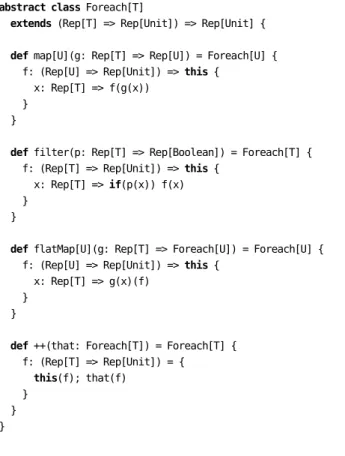
abstract class Foreach[T]
extends(Rep[T] => Rep[Unit]) => Rep[Unit] {
defmap[U](g: Rep[T] => Rep[U]) = Foreach[U] { f: (Rep[U] => Rep[Unit]) =>this {
x: Rep[T] => f(g(x)) }
}
deffilter(p: Rep[T] => Rep[Boolean]) = Foreach[T] { f: (Rep[T] => Rep[Unit]) =>this {
x: Rep[T] =>if(p(x)) f(x) }
}
defflatMap[U](g: Rep[T] => Foreach[U]) = Foreach[U] { f: (Rep[U] => Rep[Unit]) =>this {
x: Rep[T] => g(x)(f) }
}
def++(that: Foreach[T]) = Foreach[T] { f: (Rep[T] => Rep[Unit]) = {
this(f); that(f) }
} }
Figure 6. An implementation of Foreach
Here, we are taking advantage of the Bellman’s optimality principle to process all subproblems of a certain size (d) before moving to the next size. This evaluation strategy computes all the results on the same anti-diagonal (also known aswavefront) and progresses along the diagonal of the tabulation matrix. All recursive calls to a parser become simple table lookups.
4.2 Staging and Memoization
With recursive-descent parsers, we introduced therec combi-nator for handling recursion. Thetabulatecombinator plays an analogous role for memoization with dynamic program-ming. If a parser has already been seen, a table lookup is generated. Otherwise, the code for computing the current re-sult is generated. Once again, evaluation order ensures that code generation will not loop forever.
4.3 Staging and Lists
As with combinators for recursive-descent parsing, we first introduceReptypes to stage away composition. Naive staging will give us a result type ofRep[List[T]]. However, as men-tioned above, the goal is to return a single optimal solution, and we would like to avoid the additional boxing overhead of lists. The key to achieving this goal is to composeiterations over lists, represented by the typeForeach[T], rather than the
thread 1 thread 2 . . . first element last element cellM[i, j]contains solution for seq(i, .., j)
Figure 7. Threads progress jointly along matrix diagonal. Dependencies can be reduced to immediately preceding ma-trix cells.
lists themselves. The signature ofForeach(see Figure 6) mir-rors that of its namesake combinator: it takes a functionf, of typeT => Unit, and applies it to every element of the collec-tion.
In the implementation of parsers above, we replace
List[T]byForeach[T], and change the signature of theaggregate
function to return one optimal solution:
abstract classParser[T]
extendsRep[(Int, Int)] => Foreach[T] { ...
defaggregate(h: Foreach[T] => Rep[T]) = Parser[T] { (i, j) => h(this(i, j))
} }
The use ofReptypes will inline function calls, as previously. The end result of the staging step and the use of thebottomUp
function is a tight nested loop over the resulting matrix that proceeds along the diagonal.
With mutually recursive parsers, production rules need to be ordered to ensure that a parser is computed only when all its dependencies are valid (dependency analysis). In ad-dition, we can make the following observations:
•Referring to the intermediate solution matrix (Figure 7), all possible dependencies are contained in a sub-matrix. By induction, it suffices that the immediately preceding elements in the row and the column are valid for all other dependencies to be satisfied. Hence elements on a diagonal can be computed in parallel (wavefront).
•In the presence of multiple grammar rules, we evaluate all rules on a given subsequence at once; dependency anal-ysis provides us with a correct evaluation order, assum-ing that the grammar is correct (satisfies the Bellman’s property, and has no cyclic rules that would cause infinite loops in top-down evaluation).
4.4 GPU parallelization
Modern graphic cards1 are powered by massively parallel processors running hundreds of cores, each able to sched-ule multiple threads. The threads are grouped by warps (32 threads) and blocks, and scheduled synchronously: a diver-1We focus on Nvidia/CUDA features; other frameworks have similar con-cepts.
gence in execution path causes both alternatives to be sched-uled sequentially, thereby stalling some threads. Two levels of memory are exposed to the programmer: global memory accessible by any thread, and a faster local memory acces-sible by threads in the same block. In many applications, the computational power of GPUs outperforms the memory bandwidth such that (global) memory accesses is often the bottleneck.
The key insight is that GPU programs need to beregular, both in their computation logic (all threads should be kept busy) and memory accesses (contiguous, orcoalesced). In dynamic programming, the cost function is usually simple and regular with respect to the combination of sub-solutions. Since elements computed in parallel are along one diag-onal, the underlying matrix needs to be stored diagonal-by-diagonal. To respect the dependency order, threads progress along the rows of the matrix and synchronize with the neighboring thread (to validate column dependencies) be-fore moving to the next diagonal. This synchronization is done by active waiting on threads between computations of diagonals [40].
We use the heterogeneous code generation capacities of LMS to dissociate these hardware-specific decisions from the parser description. The progress on diagonals is given by thebottomUpfunction above. We generate GPU specific code for the body (p(i, j)) of these loops.
4.5 Computing the Backtrace
In addition to the optimal cost of a dynamic program, one is typically interested in the corresponding parse result. In our matrix multiplication example above, we could construct such results simply by mixing in thePrettyPrintalgebra and theCostAlgebra. This strategy does not extend easily to the GPU: the cost function is regular, but pretty printing involves string creation and storage, which adds unnecessary compu-tation overhead on the GPU. It is better to treatPrettyPrint
as a backtracing algebra, and reconstruct the best parse tree afterthe optimal cost has been found. In fact, it is possible to decouple the costing and backtracing algebras completely, by precomputingbacktraces. The remainder of this section describes this process.
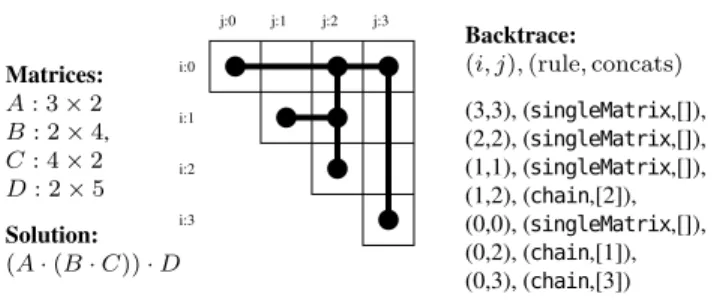
The cost function of a dynamic program computes its op-timal cost, which corresponds to one or more opop-timal parse trees. A backtrace is a linear representation of an optimal parse tree. Figure 8 depicts the backtrace for an example in-stance of the matrix multiplication problem. Given matrix dimensions in the left third of the figure, there is one op-timal multiplication order, given in pretty-print form. The optimal tree is overlaid on the cost matrix. The root of this tree naturally lies on cell[0,3], which contains the optimal cost for multiplying all four matrices. In the final third of the figure, we show the backtrace of the tree, that is, its in-order traversal.
The backtrace computation is done in two phases: during the forward cost computation phase, we store, along with
i:0 i:1 i:2 i:3 j:0 j:1 j:2 j:3 Backtrace: (i, j),(rule,concats) (3,3), (singleMatrix,[]), (2,2), (singleMatrix,[]), (1,1), (singleMatrix,[]), (1,2), (chain,[2]), (0,0), (singleMatrix,[]), (0,2), (chain,[1]), (0,3), (chain,[3]) Matrices: A: 3×2 B: 2×4, C: 4×2 D: 2×5 Solution: (A·(B·C))·D
Figure 8. A backtrace for an instance of the matrix multi-plication problem
the optimal cost, some backtrace-related information, which we call thepaper trail. This trail records what decisions we have made to reach a given cell. Once the forward phase is complete, we start from the root of the tree, and reconstruct the optimal backtrace as the in-order traversal of the tree. We can then reuse this backtrace and apply it to various algebras.
Computing the paper trail The paper trail is computed along with the cost function. We need to store, for each cell, how we got there. The only two combinators that contribute to this decision are sequencing (~) and alternation (|). Al-ternation tells us which production rule was chosen, while sequencing tells us where a subsequence was split. The num-ber of splits in a subsequence is determined by the numnum-ber of concatenation combinators in a given rule, and corresponds to the number of children of the relevant node in the parse tree. For the matrix multiplication problem (Figure 4), there can be at most one split, resulting in a binary parse tree with leaves and internal nodes corresponding to applications of thesingleMatrixandchainrules, respectively.
Therefore, at every cell, we store a pair(ruleId, concats), whereruleIdcorresponds to a chosen alternative, andconcats
is a list of splits due to concatenation. We attribute aruleId
for every alternative in atabulatecombinator in a prior gram-mar analysis phase.
Backtrace Construction After the forward phase, both the cost matrix and the backtrace matrix have been filled out. The actual backtrace corresponding to the optimal tree is reconstructed by running a simple recursive in-order tree traversal starting from the root cell[0, n]. This yields a list representation of the backtrace (List[(ruleId, concats)]). The final third of Figure 8 depicts this representation.
Reuse of the Backtrace Now that the backtrace is con-structed, it can be applied to any algebra. By following the list in order, we apply the score function of the given alge-bra to the rule specified by theruleIdparameter. Previous elements are guaranteed to be constructed beforehand.
A Note on Complexity Lettbe the number of tabulations,
cbe the maximum number of concatenations andr be the
number of rules in a grammar. Since these factors are con-stant for a given grammar, we will only take them into ac-count when they appear as exponents in the following com-plexity bounds.
The space complexity for the optimal cost matrixO(n2). Storing the paper trail takes an extraO(n2)of memory. The running time complexity of the forward computation phase is not affected by the paper trail, and remainsO(n2+c).
The backtrace reconstruction phase is a tree traversal, where the depth of the tree is n (as the cost matrix is of sizen2). The length of the backtrace is bounded by the size
of this tree, which is O(n). This is also the running time complexity of the backtrace phase.
Finally, if we want to apply the backtrace to another algebra, the running time is once again bounded by the length of the trace.
Previous approaches combining ADP and backtracing al-low to separate optimal cost computation and other alge-bras [14, 30]. The difference is that they do not explicitly compute a backtrace, but reuse the matrix computed in the forward phase. This saves on memory, but applying a new algebra has a higher complexity (O(n2)).
5.
Evaluation
5.1 Building Staged Libraries
We implemented parser combinator libraries for both recur-sive-descent parsers and dynamic programming parsers on top of the LMS framework. The core LMS library provides functionality that can be, and has been used for implement-ing many different DSLs [26]. Such functionality includes support for staged structs, arrays, lists, and strings, which are relevant to parser combinators. It also includes code gener-ation support for Scala, C, and CUDA, when relevant. As mentioned in Section 3, LMS gives us inlining, dead code elimination and common subexpression elimination for free. Given the above, we regard the development of LMS itself as an upfront cost, which has been amortized over the de-velopment of DSLs on top of it. Arguably, this is analogous to a general purpose language being an upfront cost to the development of a library in this language.
The implementation of staged DSLs took a bit more ef-fort than writing parser combinator libraries, however. This is expected: in DSL terminology, a library is ashallow em-bedding, while a staged DSL is adeep embedding. In partic-ular, the additional development cost with respect to a library was spent for:
•ensuring that we reuse existing functionality as much as possible. The danger with code generation frameworks is that it is easy to generate code for a specific use case; some optimization patterns risk being repeated for many cases, which leads not only to bad software practice, but also to optimization patterns being lost to other DSLs.
•extending the struct functionality with optimizations for conditional expressions.
•extending the framework with theForeachabstraction.
•adding CUDA code generation support for the parallel patterns exposed by dynamic programming problems.
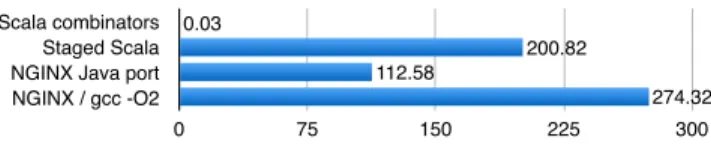
Scala combinators Staged Scala NGINX Java port NGINX / gcc -O2
0 75 150 225 300
274.32 112.58 200.82
0.03
Figure 9. HTTP parser throughput in MB/s
•manually inspecting generated code to ensure that inter-mediate data structures are indeed eliminated. In addi-tion to funcaddi-tionality and performance testing, we natu-rally had to make sure that the performance gains we ob-tain are due to abstraction overhead removal.
On the plus side, the effort spent on extensions to the LMS framework is well invested, as the extensions can be used by future projects as well.
5.2 Recursive-descent Parsers
We evaluated our staged recursive descent parsers, by imple-menting a HTTP parser and a JSON parser. The benchmark-ing environment for recursive descent parsers consisted of an Intel i7 3720-QM with 16GB of RAM, we use Scala 2.10 (-optimise) on Oracle JDK7 and GCC 4.8.2 with the most efficient optimization for given programs (-O2 or -O3). Our staged parser combinators generate Scala code for both the HTTP and JSON parser. We ran our Scala/Java benchmarks using Scalameter [23], a benchmarking and performance re-gression testing framework for the JVM. This framework handles JIT warm-ups as well as running a benchmark till performance stability.
HTTP Response Parser The first test is a comparison of the parsing throughput of different implementations of an HTTP response parser. To do that, we used a dataset of Twit-ter messages with 100 HTTP responses totaling 8.15 Mb of data that decompose in54.2 Kb of HTTP headers and
8.10Mb of JSON payload. The messages were obtained by querying the Twitter Search API. The HTTP parsing hap-pens only on headers.
We compare our staged combinators with both Scala’s standard parser combinators and the Nginx proxy client, a hand-optimized, fast, open-source implementation. We also ported this client to Java, for comparison. Figure 9 shows the results. As mentioned in the introduction, native Scala parser combinators are a non-option. The JIT engine of the JVM seems not able to optimize across functions. We per-form better than the Java port. We think that this difference may be due to the JVM performing better speculation for conditional expressions generated by our code, than on the state-machine like structure present in the hand-optimized code. Similarly, the C version is better than staged parser combinators. We presume that the O2 compiler optimizes switch/case statements efficiently.
Spray/parboiled Staged Scala JQ / gcc -O3 0 15 30 45 60 48.60 57.80 5.72
Figure 10. JSON parser throughput in MB/s
JSON Parser Our second evaluation (Figure 10) compares parsing of the JSON payload of the previous messages. The JSON grammar is given as:
val jsonParser = {
defvalue: Parser[Any] = obj | arr | stringLit | decimalNumber | "null" | "true" | "false"
defobj: Parser[Any] = "{" ~> repsep(member, ",") <~ "}"
defarr: Parser[Any] = "[" ~> repsep(value, ",") <~ "]"
defmember: Parser[Any] = stringLit ~ (":" ~> value) value
}
This parser looks very similar to a standard parser combi-nator implementation [21, Chapter 31]. A JSON object is either:
•a primitive value, such as a decimal, string literal, a Boolean or the null value.
•or an array of values (thearrfunction).
•or an associative table of key-value pairs (theobj func-tion).
We compare with Spray-json, a JSON parser for the pop-ular Spray web toolkit for Scala. Its JSON parser is written using a parser combinator library. We also compare with JQ, a popular, efficient, command line tool implemented in C to process queries on JSON. Once again, we see that a tra-ditional parser combinator implementation performs poorly. On the other hand, staged combinators compete very well with the C implementation, and even surpass them.
5.3 Dynamic Programming
Dynamic Programming on CPU and GPU Our bench-marking environment for dynamic programming (CPU and GPU) consisted of a dual Intel Xeon X5550 with 96GB of RAM with an Nvidia Tesla C2050 (3Gb RAM) graphic card. We measured the running time of two different bioinformat-ics algorithms for RNA sequence folding. RNA folding con-sists of identifying matching basepairs that produce 2D fea-tures such as hairpins, bugles and loops in the secondary structure of RNA molecules [13, 15]. For both algorithms, we generate C code from staged parser combinators. For par-allelization, we generate CUDA, additionally.
The Nussinov Algorithm The Nussinov algorithm maxi-mizes the number of matching basepairs. Its running time complexity isO(n3). Its grammar is given by:
val s = tabulate(
empty map nil
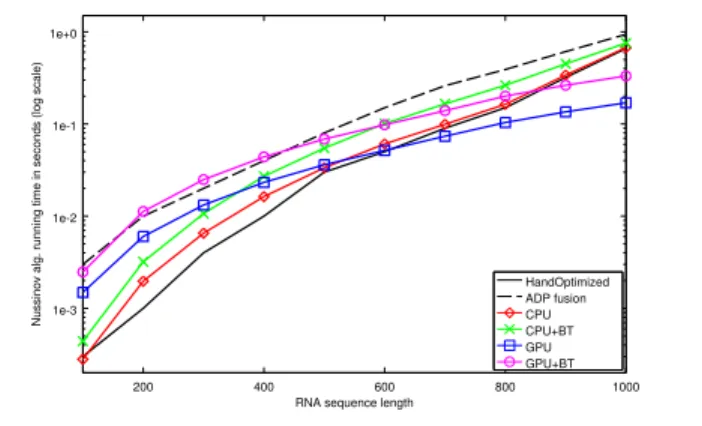
| el ~ s map left | s ~ el map right 200 400 600 800 1000 1e-3 1e-2 1e-1 1e+0
RNA sequence length
Nussinov alg. running time in seconds (log scale)
HandOptimized ADP fusion CPU CPU+BT GPU GPU+BT
Figure 11. Nussinov algorithm running time
| (el ~ s ~ el filter basePair) map pair
| s ~ s map split
) aggregate h
The Nussinov algorithm identifies4 possible folding alter-natives:
•an element on the left side is dropped.
•an element on the right side is dropped.
•two elements match according to thebasePairfilter.
•a fold is split into two smaller folds.
Our results are displayed in Figure 11. We show the running time for four variants of our generated code, along with a hand optimized C version, and an ADPfusion version:
•ADPfusion is an embedded Haskell DSL for ADP. It uses stream fusion [4] to eliminate intermediate list creation, and performs close to hand-optimized C on the CPU. We compare ADPfusion’s optimal cost calculation with ours, omitting the computation of the backtrace.
•The CPU versions of our implementations run on a single thread. The CPU+BT version fills the backtrace matrix and runs the procedure to construct the backtrace.
•Similarly, our CUDA implementation is presented both with and without the backtracing.
The CPU version without backtracing has similar perfor-mance to hand-optimized C code. Indeed, manual inspec-tion of the generated code reveals very close implementa-tions. The ADPfusion version is about 2× slower, which is in line with some remaining overhead that stream fusion is unable to completely eliminate [14, Section 7]. For se-quences larger than800elements, the CPU version takes a slight extra performance hit: this can be attributed to data overflowing caches. We notice that parallelizing on the GPU is worthwhile only for significant sequence sizes. Also since the costing algorithm is fairly simple, we notice a clear over-head when backtracing is enabled.
The Zuker Algorithm The Zuker algorithm also predicts the optimal secondary structure of an RNA sequence. In-stead of maximizing the number of basepairs, it minimizes free energy. Because the free energy is computed from
hun-200 400 600 800 1000 1e-3 1e-2 1e-1 1e+0 1e+1
RNA sequence length
Zuker alg. running time in seconds (log scale)
ViennaRNA ADP fusion CPU CPU+BT GPU GPU+BT
Figure 12. Zuker algorithm running time
dreds of coefficients based on physical measurements, a lot of memory traffic is generated for each computation. The grammar for Zuker’s algorithm consists of 4 tabulations with 15 productions and 13 scoring functions. The Zuker algo-rithm has a complexity of O(n4) but it is commonly ac-cepted to bound some productions of very rare large struc-tures to reduce its complexity toO(n3)with a large constant
factor.
In Figure 12, we present results obtained for the Zuker algorithm. Once again, we show results for both CPU and GPU generated code, with and without backtracing. We compare our implementation to ViennaRNA [13], a highly optimized Zuker algorithm implementation written in C for CPU. ViennaRNA fares better than our implementation be-cause it precomputes basepairs matching and stack-pairings for a sequence before launching the actual computation phase; our generated implementations do not benefit from such optimizations.
Compared to the simpler Nussinov algorithm, we can see that lookup tables introduce significant overhead to the com-putation. The overhead of computing the backtrace becomes negligible as a result. In Figure 12 the GPU is slower than CPU as the length of the sequences has not compensated for the transfer overhead yet.
Scalability To give an intuition of scalability for both the GPU and CPU versions, we benchmarked an extensive set of sequences ranging from500to5000elements in length (see Figure 13). The Nussinov algorithm scales better on GPU, offering speedups from4×to40×(respectively for
1000and5000elements sequences). The Zuker lookup ta-bles hamper GPU performance more significantly, as multi-ple random memory accesses are required for each scoring, thereby delivering at best3.3×speedup on the CPU for this algorithm.
6.
Related Work
Tools for Parsing Parser combinators and their implemen-tations are popular in functional programming. They were
0 1000 2000 3000 4000 5000 10−2 10−1 100 101 102 103
RNA sequence length
Nussinov alg. running time in seconds (log scale) CPUCPU+BT
GPU GPU+BT 0 1000 2000 3000 4000 5000 10−2 10−1 100 101 102 103
RNA sequence length
Zuker alg. running time in seconds (log scale) CPU CPU+BT GPU GPU+BT
Figure 13. Nussinov and Zuker algorithms scalability initially proposed by Wadler to illustrate monads, and are of the more general sort, as they produce a list of possi-ble parses [36]. They have since been incorporated into pro-gramming languages as libraries, like Parsec [18] in Haskell and the Scala parser combinator library [20]. These libraries focus on producing a single result. Koopman et al [17] use a continuation-based approach to eliminate intermediate list creation.
On the other hand are parser generators like Yacc [16], Antlr [22] and Happy [12]. While such tools are good in terms of performance, they do not easily support context-sensitivity, which is required in protocol parsing.
The staged parser combinator approach bridges the gap between both worlds in terms of features for a parser: ease of use, context-sensitivity, composability, specializability and performance.
Dynamic Programming/Memoization Parser combinators and memoization are common knowledge. Frost et al. intro-duce this technique [7, 8]. In libraries, techniques like pack-rat parsing [6] are supported. They are also known to support left recursion [37].
Our work on dynamic programming parsers is inspired by Algebraic Dynamic Programming [10]. The original imple-mentation was a Haskell library, and later a external DSL known as Bellman’s GAP was developed [30]. Bellman’s GAP also includes analysis techniques for verifying some soundness properties, and optimizing memory consumption and running time through yield-size analysis [11]. ADPfu-sion is a more recent Haskell DSL that uses compiler op-timizations to remove intermediate data structures (see be-low).
Bellman’s GAP and ADPfusion both have support for computing backtraces. Bellman’s GAP has an explicit prod-uct algebra constrprod-uct, which the compiler uses to gener-ate a backtrace for one of the algebras which is specified to be backtracing. ADPfusion supports a combine operator
<**which combines two algebras, and abacktraceoperator which can be used to apply an algebra on a matrix
result-ing from the optimal cost (forward) phase. Both these ap-proaches reuse the matrix computed in the forward phase, and may recompute some results during the backtrace. Our approach on the other first creates an algebra-agnostic back-trace. We trade memory consumption (the paper trail) for an improved running time complexity. The cost matrix can be ignored during the backtracing phase: if the matrix is com-puted on the GPU, we only need to transfer the backtrace back to the CPU, and not the full resulting matrix.
Other language approaches are StagedDP [33] (programs are expressed using classic recurrences) and Dyna [5] (a logic-programming style language prevalent in the field of NLP/stochastic grammar parsing).
Metaprogramming and Compiler Technology To match performance of lower-level implementations, high-level lan-guages require compiler technology. ADPfusion [14] uses Stream Fusion [4] to optimize away intermediate lists and generates tight efficient loops. Stream fusion depends on compiler optimizations performed further down for optimal performance. Our modular staging approach gives us more control on which optimizations we can activate.
Staged parser combinators are a specific instance of par-tial evaluation [9]. We make use of the well known tech-nique of multi-stage programming [35]. Sperber et al. also use partial evaluation for optimizing LR parsers which are implemented as a functional-style library [31].
Cartey et al[2] propose an intermediate DSL for recur-rence relations, which they analyze and generate GPU pro-grams from. Their approach is more general as they try to in-fer a parallel schedule from recurrence relations; we leverage our domain-specific knowledge to force diagonal progress.
Parallelization Bellman’s GAP supports a parallelization scheme for the GPU that is similar to ours, based on bottom-up evaluation and computation following the diagonal [32]. We additionally retrieve the backtrace on the GPU and trans-fer it to the CPU. The Nussinov and matrix multiplication problems have also been studied as pure GPU implementa-tions [3, 38].
Much work on parallelizing dynamic programming has focused on the Smith-Waterman sequence alignment prob-lem [19]. CudAlign [27, 28] matches sequences much larger than the GPU memory size, using a hybrid divide-and-conquer and dynamic programming approach. We have fo-cused in this paper on folding problems rather than align-ment problems.
7.
Conclusion and Future Work
In this paper, we have demonstrated an approach for improv-ing the performance of parser combinators, which removes the overhead of the composition. This is achieved by com-bining staging with abstractions that eliminate the creation of intermediate data structures. We not only retain user ben-efits (usability, modularity, composition), we also introduce
domain- and architecture-specific optimizations for further benefits. Our approach is applicable to different classes of parsers: top-down recursive descent and bottom-up dynamic programming.
An interesting avenue for future work is the optimization of more complex parsers that perform interleaving. For ex-ample, we can interleave the parsing of a chunked HTTP response with parsing of the underlying payload. The naive way of parsing the payload is to first buffer all of it, and then run an underlying parser. If the size of this payload is big, we will hit memory bottlenecks. Instead, it is possible to parse the payload upstream. The idea is to compose not only over parsers, but also overInput. The input, instead of just being a position in a sequence, will contain additional information about the sequence, such as the current character/token, and the rest of the input. The input becomes a representation of a stream reader over a sequence:typeInput = Reader[T].
Such a representation implies that we can compose and abstract over stream readers. For example, this allows to dif-ferentiate between lexers and token readers, where for the latter, the rest of the input is computed by first running a white space parser over the sequence. In a similar fashion, chunked parsing can be implemented by feeding a chunked sequence to a reader which understands how to parse chunk sizes. From the view point of a parser combinators user, he can still write the payload parser and the chunking parser in-dependently. In terms of optimizations, we can view stream readers as staged records: functions that compute the posi-tion, current character, and rest of the input can be staged away and inlined, using our approach.
In the big picture, we can see that parser combinators, be-yond helping with parsing, are also a nice way of expressing streaming problems. Our techniques for optimizing compo-sition can have interesting applications in other streaming-related applications as well.
Acknowledgments
We thank members of the LAMP team at EPFL for many fruitful discussions and insightful suggestions. Special thanks to Christian Höner zu Siederdissen for helping us under-standing and setting up ADPfusion. This research was spon-sored by ERC under the DOPPLER grant (587327). Part of this work was performed while the first author was an intern at Oracle Labs.
References
[1] The Apache HTTP server project. http://httpd.apache. org/.
[2] L. Cartey, R. Lyngsø, and O. de Moor. Synthesising graphics card programs from DSLs. InProceedings of the 33rd ACM SIGPLAN conference on Programming Language Design and Implementation, PLDI ’12, pages 121–132, New York, NY, USA, 2012. ACM.