K 066/921
Curriculum Guide for the Master's Program
C
OMPUTER
S
CIENCE
valid from winter semester 2013/14
1 Qualification profile ...2 2 Overview ...4 2.1 General structure ... 4 2.2 Admissions ... 4 2.3 Academic degree ... 5 2.4 Course types ... 5 2.5 ECTS points ... 5
2.6 Number of students per course ... 5
3 Major Subject ...5 4 Complementary Subject ...7 4.1 General Electives ... 7 4.2 Special Topics ... 8 4.3 Seminars ... 8 4.4 Gender Studies ... 8 5 Free Electives ...8
6 Master's thesis and Master's thesis seminars ...9
7 Examinations ...9
8 Recommended course of study ...9
1 Qualification profile
The Master's program in Computer Science at the Johannes Kepler University (JKU) Linz comes
with five areas of specialization:
Computational Engineering
,
Intelligent Information Systems
,
Networks and Security
,
Pervasive Computing
, and
Software Engineering
. Graduates have
ac-quired in-depth knowledge of the selected area of specialization in addition to a broad skill set
for problem solving.
General profile
Computer Science encompasses concepts, methods, and tools for systematic and automated
in-formation processing. Its roots lie in mathematics and electrical engineering. Today, computer
science is an established scientific discipline in its own right, and permeates numerous aspects of
business and technology as well as our daily life.
The Master's program in Computer Science aims at fostering problem solving skills. Based on
the foundations of computing, covered by the Bachelor's program in Computer Science at JKU,
the Master's program offers research-oriented education in contemporary areas of computer
sci-ence. Graduates are experts in their area of specialization. They are equipped with a solid
back-ground in information technology, and are capable of solving complex IT problems using
scien-tific methods.
Computer Science at JKU distinguishes itself as an application-oriented engineering discipline
with a balanced emphasis on theory and practice. Besides cultivating technical skills the
curricu-lum's educational mission accentuates proficiency in scientific methods, creativity,
multidiscipli-narity, team spirit, social skills as well as leadership skills, and prepares for life-long learning.
Computational Engineering
Computer Science continues to be a fast growing discipline. It is shaping our lives by enabling
new technologies well beyond the traditional engineering of technical and physical systems. At
JKU the specialization of Computational Engineering focuses on discrete methods of modeling
and computation in informatics and mathematics, and their applications to innovative
engineer-ing disciplines from computer systems and robotics to biological systems and fine arts. The
Mas-ter's program emphasizes the value of new computational methods as a driver for entirely new
areas of engineering, and prepares graduates with foundational knowledge to solve problems
within the broad arena of systems engineering.
Intelligent Information Systems
The large amounts of structured, unstructured, or multimedia data produced in various domains,
especially the World Wide Web, require intelligent strategies for analysis, semantic modeling,
processing, retrieval, extraction, and integration of information. Intelligent information systems
require engineering approaches, concepts, methods, and tools for information and services
pro-vided in a machine-interpretable way. This includes areas like relational databases, web
infor-mation systems, non-standard storage, (Web) search strategies, data and web mining,
so-cial/semantic web intelligence, pattern recognition, artificial intelligence, recommendation
sys-tems, personalized and context-aware syssys-tems, and cooperative situation awareness.
Additional-ly, eAccessibility and assistive technologies have become key aspects of intelligent information
systems. Comprehensive competences in these fields enable graduates to work in both research
and development, in industry as well as in high-profile research facilities around the world.
Networks and Security
The protection of IT systems against internal or external attacks is a strategically important task
for planning and operating such systems. Industry and economy require more security experts
with a profound knowledge in computer science and especially networks. Important aspects in
the application of security measures are the systematic configuration and monitoring of IT
infra-structures. Graduates of this specialization area have broad job opportunities ranging from the
design, implementation, and administration of security strategies, the administration of systems,
networks, and security policies, the application of cryptography as well as knowledge of the
le-gal environment in the security area. The profound technical education in this area allows a
ca-reer in research and development alike.
Pervasive Computing
The design of miniaturized systems, which are invisibly integrated in their environment and are
connected in a spontaneous and wireless way require special computer science methods. The
specialization in Pervasive Computing therefore deals with a combination of technologies (e.g.,
sensors, actuators, wireless communication, miniaturized memories and processors), paradigms
(e.g., context-aware and adaptive systems, autonomous and self-organizing systems, organic and
bio-inspired systems) and methods (e.g., for interaction, coordination, computational perception,
reasoning and learning, artificial intelligence, virtual reality, semantic interoperability, system
reliability, security, and user friendliness). The educational goals are decision and evaluation
skills as well as skills for designing and developing pervasive computing systems such as
"in-formation appliances", "wearable systems", or "ambient intelligence systems".
Software Engineering
Business and industry have a considerable demand for well-trained software engineers who are able to manage large software projects, to apply cutting-edge software development techniques as well as to un-derstand and to direct all phases of the software development process. The specialization in Software Engineering aims at educating such experts. It covers formal foundations as well as methods and tools for all project phases, such as requirements engineering, system modelling, architectural design, implementa-tion, testing, deployment, and maintenance of software systems. The focus is on scientific methods and their application in building high-quality software in an economic way. Since most Computer Science graduates work in software development, a specialization in Software Engineering is an excellent prepa-ration for their professional career.
Further Information
• Home page of CS @ JKU http://cs.jku.at
• Infos of the curriculum committee http://cs.jku.at/teaching/stuko/news/ • Study handbook with course descriptions http://www.jku.at/studienhandbuch • Official curriculum http://cs.jku.at/teaching/
This study guide serves as the major source of information for students. The full legal provisions for this Master's program can be found in the official curriculum.
2 Overview
2.1 General structure
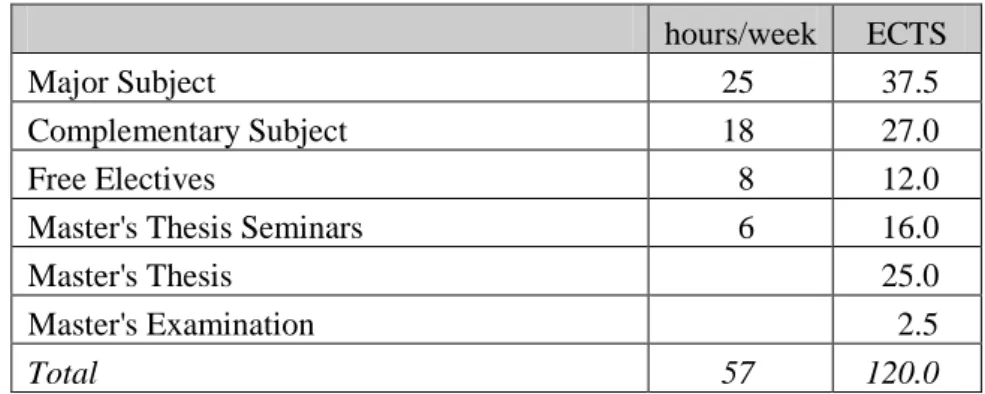
The Master's program in Computer Science is a two years full-time program comprising 120 ECTS points. It is delivered in English. Table 1 shows its overall structure.
Table 1: Master's program in Computer Science
hours/week ECTS
Major Subject 25 37.5
Complementary Subject 18 27.0
Free Electives 8 12.0
Master's Thesis Seminars 6 16.0
Master's Thesis 25.0
Master's Examination 2.5
Total 57 120.0
The Major Subject is the core of the curriculum. It can be selected from five areas of specialization: • Computational Engineering
• Intelligent Information Systems • Networks and Security
• Pervasive Computing • Software Engineering
All courses of the selected area have to be passed.
The Complementary Subject allows students to extend their Computer Science skills beyond the Major Subject. Students can freely select courses from other areas of specialization or from a catalogue of elec-tive courses.
The Free Electives are courses that can be chosen from all degree programs at any university. They give students the opportunity to educate their personality and to acquire skills beyond Computer Science. The Master's Thesis is the final project in this program. It is a scientific thesis, in which the knowledge and skills obtained during the study should be demonstrated. The Master's Thesis Seminars serve to pre-pare and guide the composition of the Master's Thesis. These seminars are compulsory courses.
2.2 Admissions
Graduates of the JKU Bachelor's programs Informatik, Wirtschaftsinformatik, and Informationselektronik are admitted without restrictions. For bachelors of Wirtschaftsinformatik and Informationselektronik there is a list of recommended courses from the Bachelor's program in Informatik that can be attended as part of the Complementary Subject (see the web).
Graduates of Computer Science or related programs at other universities, universities of applied sciences, and other post-secondary educational institutions can be admitted if their degree programs are equivalent to the Bachelor's program in Informatik at JKU. Differences between programs can be compensated by replacing one or more courses from the Complementary Subject with courses specified in the notification of admission. If equivalence cannot be fully established the notification of admission can require addi-tional courses with up to 20 ECTS points.
Candidates have to apply at the JKU Admissions Office. Further information can be obtained from http://www.jku.at/study/admission/.
2.3 Academic degree
Graduates are awarded the academic degree "Diplom-Ingenieurin" or "Diplom-Ingenieur", abbreviated "Dipl.-Ing.", "Dipl.-Ing. (JKU)", "DI", or "DI (JKU)". This corresponds to the international degree "Mas-ter of Science" (MSc), although the MSc degree is not conferred.
2.4 Course types
Lectures ("Vorlesungen", VO) are courses that introduce students to certain areas and methods of their study.
Labs ("Übungen", UE) are courses which reinforce topics from the corresponding lecture by carrying out practical and concrete exercises. Marking is based on continuous assessment of the students' work.
Combined courses ("Kombinierte Veranstaltungen", KV) are courses consisting of lectures and labs, which are intertwined according to didactic aspects.
Practicals (PR) have similar goals as labs and are continuously assessed. In contrast to labs they can be independent from lectures and usually promote project-oriented work in a team.
Seminars (SE) are courses involving collaboration between students. Marking of seminars is based on continuous assessment of the students' work, on their preparation of talks (including seminar papers) and on their participation in discussions.
2.5 ECTS points
In line with the European Credit Transfer System (ECTS) 1 ECTS point corresponds to 25 full hours of work. This includes the attendance of courses as well as the time for preparation, exercises, and practical work at home. The total effort of this Master's program is 120 ECTS points, or 30 ECTS points per se-mester. With a few exceptions, 1 weekly hour of teaching is worth 1.5 ECTS points.
Lecturers have to adjust the effort of every course such that it matches the ECTS points of the course, where corresponding lectures and labs are considered as a unit.
2.6 Number of students per course
In courses of the Major Subject 35 students are admitted to labs, 15 students are admitted to practicals, and 20 students are admitted to seminars. Combined courses as well as electives do not have parallel groups.
3 Major Subject
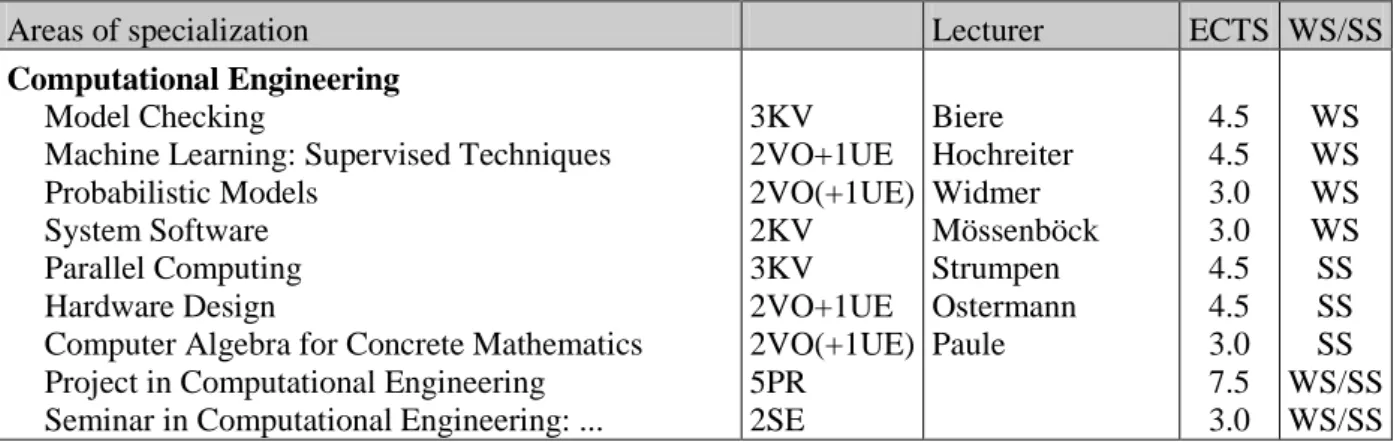
For the Major Subject students have to select one of five areas of specialization listed in Table 2 and have to take all courses listed in the selected area.
Table 2: Mandatory courses and areas of specialization (WS = winter semester, SS = summer semester)
Areas of specialization Lecturer ECTS WS/SS
Computational Engineering
Model Checking
Machine Learning: Supervised Techniques Probabilistic Models
System Software Parallel Computing Hardware Design
Computer Algebra for Concrete Mathematics Project in Computational Engineering Seminar in Computational Engineering: ...
3KV 2VO+1UE 2VO(+1UE) 2KV 3KV 2VO+1UE 2VO(+1UE) 5PR 2SE Biere Hochreiter Widmer Mössenböck Strumpen Ostermann Paule 4.5 4.5 3.0 3.0 4.5 4.5 3.0 7.5 3.0 WS WS WS WS SS SS SS WS/SS WS/SS
Intelligent Information Systems
Knowledge Based Systems
Information Retrieval and Extraction Basic Methods of Data Analysis Multimedia Search and Retrieval Integrated Information Systems Learning from User-generated Data Web Information Systems
Accessible Software and Web Design Project in Intelligent Information Systems Seminar in Intelligent Information Systems: ...
2KV 2KV 2KV 3KV 2KV 3KV 3KV 1KV 5PR 2SE Küng Pröll Hochreiter Schedl, Knees Wöß Knees, Schedl Retschitz., Kaps. Miesenberger 3.0 3.0 3.0 4.5 3.0 4.5 4.5 1.5 7.5 3.0 WS WS WS WS SS SS SS SS WS/SS WS/SS
Networks and Security
Introduction to IT Security
Information Security Management Computer Forensics and IT Law System Administration Systems Security Secure Code Network Management Network Security Cryptography
Security Models in Information Systems Project in Networks and Security Seminar in Networks and Security: ...
2VO 2VO 2VO 2KV 2KV 1KV 2KV 1KV 2KV 2KV 5PR 2SE NN+Eschelbeck Schaumüller-B. Sonntag Hörmanseder Eschelbeck Sonntag Hörmanseder Hörmanseder Scharinger Küng 3.0 3.0 3.0 3.0 3.0 1.5 3.0 1.5 3.0 3.0 7.5 3.0 WS WS WS WS SS SS SS SS SS SS WS/SS WS/SS Pervasive Computing
Pervasive Comp.: Systems and Environments Pervasive Comp.: Design and Development Computer Vision
Principles of Interaction Principles of Cooperation
Machine Learning and Pattern Classification Project in Pervasive Computing
Seminar in Pervasive Computing: ...
2VO+1UE 2VO+1UE 3KV 2VO+1UE 2VO+1UE 3KV 5PR 2SE Ferscha Ferscha Bimber External Kotsis Widmer 4.5 4.5 4.5 4.5 4.5 4.5 7.5 3.0 WS WS WS SS SS SS WS/SS WS/SS Software Engineering
Formal Methods in Software Development Requirements Engineering
Principles of Programming Languages System Software
Software Architectures Model-driven Engineering Software Testing
Software Processes and Tools Project in Software Engineering Seminar in Software Engineering: ...
3KV 2KV 2KV 2KV 3KV 2KV 2KV 2KV 5PR 2SE Schreiner Grünb., Pomberg. Blaschek, Präh. Mössenböck Blaschek, Weinr. Egyed, Grünb. Plösch, Samet. Grünb., Egyed 4.5 3.0 3.0 3.0 4.5 3.0 3.0 3.0 7.5 3.0 WS WS WS WS SS SS SS SS WS/SS WS/SS
Practical and Seminar
Each area of specialization has a practical (5 hours) and a seminar (2 hours). The practical serves as a consolidation and an application of the skills acquired in the respective area. It is usually organised as a team work. The seminar should rehearse scientific working principles. Its name is "Seminar in A" (where A is the name of the area of specialization) with an appropriate subtitle denoting the topic of the seminar. The seminar is also part of the seminar catalogue in Table 4.
4 Complementary Subject
The Complementary Subject allows students to deepen and/or broaden their computing skills according to their special interests. Students have to select courses with a total of 18 hours (27 ECTS) from the follow-ing categories (they are strongly expected to select 3 ECTS points from Gender Studies):
• Areas of specialization that were not selected as the Major Subject (see Section 3) • General Electives as described in Section 4.1
• Special Topics as described in Section 4.2 • Seminars as described in Section 4.3 • Gender Studies as described in Section 4.4
4.1 General Electives
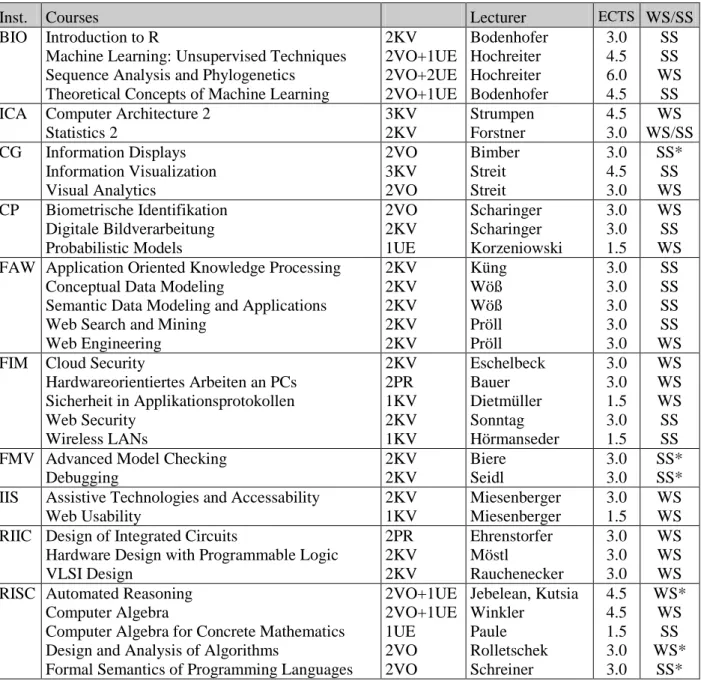
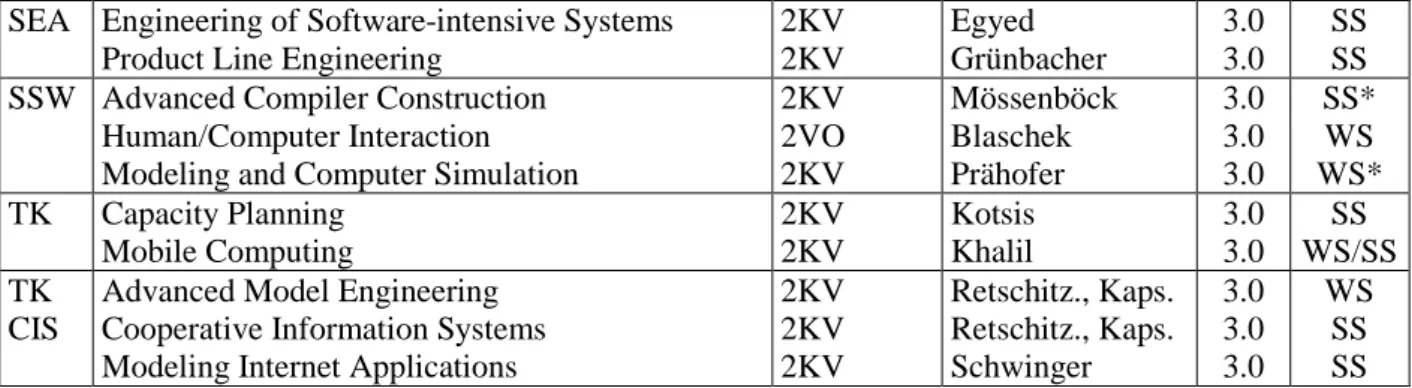
The General Electives comprise the courses listed in Table 3. Courses that have already been taken in the Bachelor's program cannot be selected in the Master's program. The General Electives are regularly of-fered at least every two years.
Table 3: General Electives (* = offered every second year)
Inst. Courses Lecturer ECTS WS/SS
BIO Introduction to R
Machine Learning: Unsupervised Techniques Sequence Analysis and Phylogenetics
Theoretical Concepts of Machine Learning
2KV 2VO+1UE 2VO+2UE 2VO+1UE Bodenhofer Hochreiter Hochreiter Bodenhofer 3.0 4.5 6.0 4.5 SS SS WS SS ICA Computer Architecture 2
Statistics 2 3KV 2KV Strumpen Forstner 4.5 3.0 WS WS/SS CG Information Displays Information Visualization Visual Analytics 2VO 3KV 2VO Bimber Streit Streit 3.0 4.5 3.0 SS* SS WS CP Biometrische Identifikation Digitale Bildverarbeitung Probabilistic Models 2VO 2KV 1UE Scharinger Scharinger Korzeniowski 3.0 3.0 1.5 WS SS WS FAW Application Oriented Knowledge Processing
Conceptual Data Modeling
Semantic Data Modeling and Applications Web Search and Mining
Web Engineering 2KV 2KV 2KV 2KV 2KV Küng Wöß Wöß Pröll Pröll 3.0 3.0 3.0 3.0 3.0 SS SS SS SS WS FIM Cloud Security
Hardwareorientiertes Arbeiten an PCs Sicherheit in Applikationsprotokollen Web Security Wireless LANs 2KV 2PR 1KV 2KV 1KV Eschelbeck Bauer Dietmüller Sonntag Hörmanseder 3.0 3.0 1.5 3.0 1.5 WS WS WS SS SS FMV Advanced Model Checking
Debugging 2KV 2KV Biere Seidl 3.0 3.0 SS* SS* IIS Assistive Technologies and Accessability
Web Usability 2KV 1KV Miesenberger Miesenberger 3.0 1.5 WS WS RIIC Design of Integrated Circuits
Hardware Design with Programmable Logic VLSI Design 2PR 2KV 2KV Ehrenstorfer Möstl Rauchenecker 3.0 3.0 3.0 WS WS WS RISC Automated Reasoning
Computer Algebra
Computer Algebra for Concrete Mathematics Design and Analysis of Algorithms
Formal Semantics of Programming Languages
2VO+1UE 2VO+1UE 1UE 2VO 2VO Jebelean, Kutsia Winkler Paule Rolletschek Schreiner 4.5 4.5 1.5 3.0 3.0 WS* WS SS WS* SS*
SEA Engineering of Software-intensive Systems Product Line Engineering
2KV 2KV Egyed Grünbacher 3.0 3.0 SS SS SSW Advanced Compiler Construction
Human/Computer Interaction Modeling and Computer Simulation
2KV 2VO 2KV Mössenböck Blaschek Prähofer 3.0 3.0 3.0 SS* WS WS* TK Capacity Planning Mobile Computing 2KV 2KV Kotsis Khalil 3.0 3.0 SS WS/SS TK CIS
Advanced Model Engineering Cooperative Information Systems Modeling Internet Applications
2KV 2KV 2KV Retschitz., Kaps. Retschitz., Kaps. Schwinger 3.0 3.0 3.0 WS SS SS
4.2 Special Topics
Special Topics allow institutes to take up current trends in their fields and to use the teaching offer of guest lecturers. Courses from this category can be announced without being listed in the curriculum, and there is no obligation to hold them regularly.
The name of special topics courses consists of a main title ("Special Topics:") and a subtitle denoting the actual contents of the course. The type of such courses (VO, UE, KV, PR, SE) as well as their length in hours can be freely chosen by the lecturers. The ECTS points are calculated as hours × 1.5.
4.3 Seminars
Seminars are courses in which scientific methods are taught and practiced. Students have to write a semi-nar thesis about a research-related topic and present it in a semisemi-nar talk. The name of a semisemi-nar consists of a main title as shown in Table 4 and a subtitle denoting the topic of the seminar.
Table 4: Seminars
Seminars ECTS WS/SS
Seminar in Computational Engineering: ... Seminar in Intelligent Information Systems: ... Seminar in Networks and Security: ...
Seminar in Pervasive Computing: ... Seminar in Software Engineering: ...
2SE 2SE 2SE 2SE 2SE 3.0 3.0 3.0 3.0 3.0 WS/SS WS/SS WS/SS WS/SS WS/SS
4.4 Gender Studies
Courses from Gender Studies help students to understand gender-specific aspects of computing and tech-nology. Students are strongly expected to select 3 ECTS points from Table 5.
Table 5: Gender Studies
Courses ECTS WS/SS
Ethics and Gender Studies
Gender Studies Managing Equality TN
Soziale und geschlechterspezifische Aspekte der IT
2VO 2KV 2KS 3.0 3.0 3.0 WS/SS WS/SS SS
5 Free Electives
Students have to take free elective courses with a total of 8 hours (12 ECTS). These courses can be se-lected from any degree program at any university and can be taken throughout the whole Master's pro-gram. Their goal is to provide students with additional skills beyond the area of Computer Science. Courses in social skills, foreign languages, and gender studies are particularly recommended, but it is also possible to select more Computer Science courses here.
6 Master's thesis and Master's thesis seminars
As a final project students have to write a Master's thesis. The Master's thesis can be written at any Com-puter Science institute, but its topic should be chosen from the selected Major Subject. The goal of the Master's thesis is to demonstrate that students are able to solve a non-trivial problem in their area of spe-cialization using scientific methods and latest technology.
As a preparation and a guidance for the Master's thesis students have to take the two master seminars from Table 6.
Table 6: Master's thesis seminars
Courses ECTS WS/SS
Master's Thesis Seminar WS Master's Thesis Seminar SS
3SE 3SE 8.0 8.0 WS SS
7 Examinations
The degree program is completed if all examinations for the courses described in Sections 3 to 6, as well as the Master's examination have been passed and the Master's thesis has been accepted.
Course examinations. The examination mode (written or oral) for lectures (VO) and for combined courses (KV) can be defined by the lecturer. Labs (UE) and practicals (PR) are assessed by continuous and final evaluations. Seminars (SE) are assessed on the basis of the seminar paper, the seminar presenta-tion and the cooperapresenta-tion of the student in the seminar.
Master's examination. The Master's examination is the final examination of the degree program. It is assessed by a committee of three professors and consists of the following three parts:
• Master's thesis defence (20 minutes), assessed by the head of the examination committee.
• Examination about the Major Subject (20 minutes), assessed by an examiner representing the Major Subject.
• Examination about one or several courses of the Complementary Subject (20 minutes), assessed by an examiner representing these courses.
The effort of the Master's examination is calculated with 2.5 ECTS points.