R E S E A R C H A R T I C L E
Open Access
A comparison of sequencing platforms and
bioinformatics pipelines for compositional
analysis of the gut microbiome
Imane Allali
1,4, Jason W. Arnold
1, Jeffrey Roach
2, Maria Belen Cadenas
1, Natasha Butz
1, Hosni M. Hassan
3,
Matthew Koci
3, Anne Ballou
3, Mary Mendoza
3, Rizwana Ali
3and M. Andrea Azcarate-Peril
1*Abstract
Background: Advancements in Next Generation Sequencing (NGS) technologies regarding throughput, read length and accuracy had a major impact on microbiome research by significantly improving 16S rRNA amplicon sequencing. As rapid improvements in sequencing platforms and new data analysis pipelines are introduced, it is essential to evaluate their capabilities in specific applications. The aim of this study was to assess whether the same project-specific biological conclusions regarding microbiome composition could be reached using different sequencing platforms and bioinformatics pipelines.
Results: Chicken cecum microbiome was analyzed by 16S rRNA amplicon sequencing using Illumina MiSeq, Ion Torrent PGM, and Roche 454 GS FLX Titanium platforms, with standard and modified protocols for library preparation. We labeled the bioinformatics pipelines included in our analysis QIIME1 and QIIME2 (de novo OTU picking [not to be confused with QIIME version 2 commonly referred to as QIIME2]), QIIME3 and QIIME4 (open reference OTU picking), UPARSE1 and UPARSE2 (each pair differs only in the use of chimera depletion methods), and DADA2 (for Illumina data only). GS FLX+ yielded the longest reads and highest quality scores, while MiSeq generated the largest number of reads after quality filtering. Declines in quality scores were observed starting at bases 150–199 for GS FLX+ and bases 90–99 for MiSeq. Scores were stable for PGM-generated data. Overall microbiome compositional profiles were comparable between platforms; however, average relative abundance of specific taxa varied depending on sequencing platform, library preparation method, and bioinformatics analysis. Specifically, QIIME with de novo OTU picking yielded the highest number of unique species and alpha diversity was reduced with UPARSE and DADA2 compared to QIIME.
Conclusions: The three platforms compared in this study were capable of discriminating samples by treatment, despite differences in diversity and abundance, leading to similar biological conclusions. Our results demonstrate that while there were differences in depth of coverage and phylogenetic diversity, all workflows revealed comparable treatment effects on microbial diversity. To increase reproducibility and reliability and to retain consistency between similar studies, it is important to consider the impact on data quality and relative abundance of taxa when selecting NGS platforms and analysis tools for microbiome studies.
Keywords: 16S rRNA amplicon sequencing - microbiome analysis - microbiome - microbiome composition - next generation sequencing platforms, Bioinformatics pipeline, NGS bias
* Correspondence:[email protected] 1
Department of Medicine, Division of Gastroenterology and Hepatology, and Microbiome Core Facility, Center for Gastrointestinal Biology and Disease, School of Medicine, University of North Carolina, Campus Box 7555, 332 Isaac Taylor Hall, Chapel Hill, NC 27599-7545, USA
Full list of author information is available at the end of the article
© The Author(s). 2017 Open Access This article is distributed under the terms of the Creative Commons Attribution 4.0 International License (http://creativecommons.org/licenses/by/4.0/), which permits unrestricted use, distribution, and reproduction in any medium, provided you give appropriate credit to the original author(s) and the source, provide a link to the Creative Commons license, and indicate if changes were made. The Creative Commons Public Domain Dedication waiver (http://creativecommons.org/publicdomain/zero/1.0/) applies to the data made available in this article, unless otherwise stated.
Background
Sequencing of 16S rRNA amplicons is now a well-established and robust method used in compositional studies of the gut microbiome of humans, animals, and insects. These studies have generated a wealth of infor-mation regarding the impact of diet [1–4], disease [5–7], antibiotics [8], probiotics [9–11], prebiotics [12, 13] and environmental exposures [14] on the microbiota, while simultaneously permitting the identification of new bac-teria [15]. However, the excitement of applying these emerging technologies to new and important research questions has relegated important technical consider-ations affecting comparisons between research done by different laboratories following different protocols. Given the importance of NGS technologies on microbiome research, comparative studies focusing on different plat-forms are essential to confirm or refute published data. Early microbiome studies focused on quality control, aimed to reduce sequencing error by bioinformatically re-moving chimeras and other sequencing artifacts from 16S rRNA amplicon sequences generated by pyrosequencing [16]. Later, studies have compared data output from differ-ent sequencing platforms applied to genome [17–19] and 16S rRNA amplicon sequencing [20, 21]. While bioinfor-matics tools like removal of chimeric sequences can re-duce some of the intrinsic errors of sequencing data, it is challenging to eliminate the bias introduced by primer design [22], library preparation [23], DNA isolation methods [24], and PCR amplification artifacts, each of which introduce unique biases that can result in over or underrepresentation of individual microbes within com-plex communities [25]. These biases are unavoidable and rarely impact the overall merit of a study.
Collective concerns regarding methodological biases and the ability to compare studies from different re-search groups originated a collaborative effort designed to comprehensively evaluate methods employed in the study of the human microbiome, the Microbiome Qual-ity Control project (MBQC). Inspired by earlier projects like the Microarray Quality Control project (MAQC), the MBQC focused on the analyses of the impacts of sample collection, DNA extraction, sequencing protocol, and bioinformatics data analysis pipelines on amplicon profiling of the human fecal microbiome. Although the coalition is still in early stages, the MBQC has identified the DNA isolation method (and the lab performing the DNA isolation), as well as 16S rRNA amplification primers used, as major sources of variation, while se-quencing depth and sample storage had small but de-tectable effects on the generated data [26].
A number of recent studies have attempted to identify errors or bias generated by the intrinsic characteristics of sequencing platforms [18, 27, 28]. Performance compari-sons between sequencing platforms and bioinformatics
pipelines indicate that Roche GS FLX+, Illumina MiSeq, and Ion Torrent PGM are capable of generating high quality, comparable data [22, 29–31]. In one study, the performance of Ion Torrent PGM, Pacific Biosciences RS and Illumina MiSeq platforms was compared on genome sequencing of 4 bacterial strains with different GC con-tents [17]. Although all three platforms provided sufficient depth and resolution, there were biases present in each platform. PGM yielded deep coverage for GC-rich se-quences but was biased for AT-rich sese-quences coverage. PacBio and MiSeq demonstrated equivalent coverage of GC- and AT-rich sequences [17], but had varying error rates prior to assembly [32]. A different study compared the performances of Illumina GA II and Roche GS FLX+ using the same DNA samples obtained from a complex freshwater planktonic community. The platforms showed comparable total diversity; however, more homopolymer errors were identified with the Roche GS FLX+ platform compared to GA II which generated longer and more ac-curate contigs [18]. Finally, a comparison of the healthy skin microbiome using the Illumina MiSeq and Roche GS FLX+ platforms showed that sequencing data from the V3-V4 16S rRNA hypervariable region were concordant between replicates, and between platforms indicating that the method and platforms were comparable for determin-ing skin microbiota [33].
Further comparative studies between Ion Torrent PGM, Illumina MiSeq, Illumina HiSeq, and Roche GS FLX+ confirmed that the later generated the longest reads among these platforms (up to 600 bp) but had a relatively high error rate with poly-bases of more than 6 base pairs [27]. Additionally, sequencing runs on Roche GS FLX+ had a higher cost and lower throughput than the Illumina platform. Conversely, the Illumina platform had the fastest run time and highest throughput, up to 13.5 Gb on the MiSeq PE300, but relatively high frequency of substitution errors and shorter reads compared to GS FLX+ [34]. Run time and homopolymer error rates for the Ion Torrent PGM platform was substantially lower compared to the Roche GS FLX+ platform but yielded a lower throughput, shorter reads and lower quality scores [35].
Together, the previously discussed data indicate that technical protocols and sequencing platforms have a variable impact on output. In this study, we report a comparison of the three most widely utilized sequencing platforms: Illumina MiSeq, Ion Torrent PGM, and Roche 454 GS FLX+, using the most current library preparation protocols and sequencing kits available for 16S rRNA amplicon sequencing. Although Roche dis-continued support for the 454 GS FLX+ sequencing platform in 2016, the platform still has relevance to studies that have used this technology in the past or any ongoing studies that may utilize a sequencing provider whom is still running the 454 GS FLX+ sequencer. More
importantly, this study couples the platform comparison with a systematic assessment of bioinformatics pipelines commonly used for amplicon data analysis: Quantitative Insights Into Microbial Ecology (QIIME) [36] and UPARSE [37] with or without chimera detection methods, based either on de novo OTU picking or open reference OTU picking. Although a relatively recently developed tool that has not been extensively tested for accuracy and efficacy, we have also included DADA2 [38] and a comparator method in our analysis in order to assess the effectiveness of bioinformatic analysis at a finer level than the traditional 97% similarity threshold.
Fourteen cecum samples randomly selected from an ongoing study aiming to investigate the impact of vac-cination against Salmonella and prebiotic supplementa-tion on the chicken gut microbiome and immune responses were used in this study. We have previously shown that prebiotics have a modulatory effect on the gut microbiome [13, 39], not by dramatically altering its composition but by impacting very specific bacterial groups. Hence, we chose to include in our comparison of bioinformatics pipelines methods without chimera re-moval in order to determine if specific groups known to be altered by the prebiotic (Bifidobacterium, Lactobacil-lus) were impacted by this additional step. Clearly, the utility of chimera removal has been widely demonstrated in the analysis of 16S rRNA amplicon sequencing data [40, 41].
The aim of the present study was to explore influences of sequencing platforms and bioinformatics pipelines on diversity and relative abundance of bacterial taxa in 16S rRNA amplicon data. Additionally, each platform and analysis pipeline was compared for their abilities to dis-criminate between samples from various treatment groups in order to validate their functionality in micro-biome studies.
Methods
Samples and DNA isolation
The same physical samples were used for all sequencing experiments across platforms and bioinformatics pipe-lines. Total genomic DNA was extracted using E.Z.N.A. Stool DNA Kit (Omega Bio-Tek, Norcross, GA) according to manufacturer’s instructions with minor modifications. Briefly, 200 mg of intestinal content were added to a tube containing 540μl of SLB buffer and 200 mg of glass beads. Samples were homogenized using a TissueLyser (Qiagen, Germantown, MD) for 5 min at 30 Hz in 1 min intervals between bead beating and ice incubation cycles. DS buffer and proteinase K were added according to the manufac-turer’s instruction. The mix was incubated at 70 °C for 10 min, followed by another incubation at 95 °C for 5 min. Quality of the isolated DNA was assessed by agar-ose gel electrophoresis and purity verified using 260/280
and 260/230 ratios measured by NanoDrop 1000 instru-ment (Thermo Fisher Scientific, Waltham, MA). DNA concentration was quantified using Quant-iT™ PicoGreen dsDNA Reagent (Molecular Probes, Thermo Fisher Scien-tific division, Eugene, OR).
454 Genome sequencer FLX+ 16S rRNA amplicon sequencing
Protocols for preparation of libraries for sequencing are represented in Fig. 1. Initial amplification of the hypervari-able V1-V2 region of the bacterial 16S rRNA was per-formed on total DNA from collected samples as previously described [1, 13, 42]. Reaction master mixes contained the Qiagen Hotstar Hi-Fidelity Polymerase kit reagents (Qiagen, Valencia CA) with a forward primer composed of the Roche Titanium Fusion Primer A (se-quencing primers used in this study are listed in Table 1) a 10 bp Multiplex Identifier (MID) sequence (Roche, In-dianapolis, IN), unique to each of the samples, and the universal bacterial primer 8F [43]. The reverse primer was composed of the Roche Titanium Primer B, the identical 10 bp MID sequence, as the forward primer, and the re-verse bacterial primer 338R [44]. Negative controls, not containing template, were amplified for all barcode-primer sets. Each sample was gel purified individually using the E-Gel Electrophoresis System (Life Technolo-gies, Thermo Fisher Scientific division, Grand Island, NY) and standardized prior to pooling. The 16S rRNA ampli-cons were sequenced on a 454 Genome Sequencer FLX+ system instrument (Roche, Indianapolis, IN) at the Micro-biome Core Facility, (University of North Carolina, Chapel Hill, NC) using the GS FLX Titanium XLR70 sequencing reagents and corresponding protocol. Initial data analysis, base pair calling and trimming of each sequence to yield high quality reads, were performed by Research Comput-ing at the University of North Carolina at Chapel Hill. Illumina MiSeq 16S rRNA amplicon sequencing
DNA was amplified using primers targeting the V1-V2 region of the bacterial 16S rRNA gene [15, 43] and over-hang adapter sequences appended to the primer pair for compatibility with Illumina index and sequencing adapters. The complete sequences of the primers are listed in Table 1. Master mixes contained 12.5 ng of total DNA and 2× KAPA HiFi HotStart ReadyMix (KAPA Biosystems, Wilmington, MA). Negative controls, not containing template, were amplified for all barcode-primer sets. Each 16S amplicon was purified using AMPure XP reagent (Beckman Coulter, Brea, CA). In the next step each sample was amplified using a limited
cycle PCR program, adding Illumina sequencing
adapters and dual- index barcodes (index 1(i7) and index 2(i5)) (Illumina, San Diego, CA) to the amplicon target. The final libraries were again purified using AMPure XP
reagent (Beckman Coulter), quantified and normalized prior to pooling. The DNA library pool was then dena-tured with NaOH, diluted with hybridization buffer and heat denatured before loading on the MiSeq reagent cartridge (Illumina) and on the MiSeq instrument (Illu-mina). Automated cluster generation and paired-end
sequencing with dual reads were performed according to the manufacturer’s instructions.
Ion torrent PGM 16S rRNA amplicon sequencing
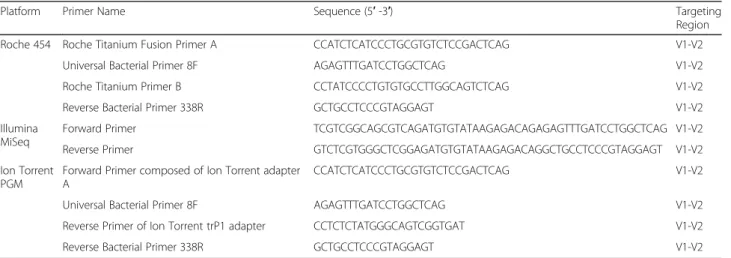
For amplicon library preparation the V1-V2 hypervari-able region of the 16S rRNA gene was amplified from Table 1 Primer sequence information for all platforms
Platform Primer Name Sequence (5′ -3′) Targeting
Region
Roche 454 Roche Titanium Fusion Primer A CCATCTCATCCCTGCGTGTCTCCGACTCAG V1-V2
Universal Bacterial Primer 8F AGAGTTTGATCCTGGCTCAG V1-V2
Roche Titanium Primer B CCTATCCCCTGTGTGCCTTGGCAGTCTCAG V1-V2
Reverse Bacterial Primer 338R GCTGCCTCCCGTAGGAGT V1-V2
Illumina MiSeq
Forward Primer TCGTCGGCAGCGTCAGATGTGTATAAGAGACAGAGAGTTTGATCCTGGCTCAG V1-V2
Reverse Primer GTCTCGTGGGCTCGGAGATGTGTATAAGAGACAGGCTGCCTCCCGTAGGAGT V1-V2
Ion Torrent PGM
Forward Primer composed of Ion Torrent adapter A
CCATCTCATCCCTGCGTGTCTCCGACTCAG V1-V2
Universal Bacterial Primer 8F AGAGTTTGATCCTGGCTCAG V1-V2
Reverse Primer of Ion Torrent trP1 adapter CCTCTCTATGGGCAGTCGGTGAT V1-V2
Reverse Bacterial Primer 338R GCTGCCTCCCGTAGGAGT V1-V2
Fig. 1 Schematic of the experimental design of this study to test impact of library preparation methods and protocols on diversity and relative abundance of bacteria. Protocol steps are indicated on the left. Standard methods are in black boxes while non-standard methods with modified conditions are shown in grey boxes
total bacterial DNA using the forward primer composed of Ion Torrent adapter A, a 10 bp IonXpress ™ barcode (Life Technologies, Thermo Fisher Scientific division, Grand Island, NY), unique to each sample and the uni-versal bacterial primer 8F. The reverse primer consisted of Ion Torrent trP1 adapter followed by reverse bacterial primer 338R. PCR reactions contained 50 ng of DNA template, 2.5 units of HotStar Hi-fidelity DNA polymer-ase (Qiagen, Valencia, CA), 1× HotStar Hi-Fidelity PCR
buffer containing dNTPs, and 0.6 μM of each primer.
Negative controls, not containing template, were ampli-fied for all barcode-primer sets. The PCR products were gel purified individually using the E-Gel Electrophoresis System. DNA concentrations were quantified using Quant-iT™ PicoGreen® dsDNA Reagent (Molecular Probes, Thermo Fisher Scientific division, Eugene, OR) and mixed at equimolar concentrations. Template-Positive Ion OneTouch™ 200 Ion Sphere™ Particles were prepared from library pool using the Ion OneTouch™ 2 system (Life Technologies, Thermo Fisher Scientific div-ision, Grand Island, NY). The prepared templates were sequenced on the Ion Torrent PGM instrument (Life Technologies) in the Microbiome Core Facility using the Ion PGM 400 sequencing reagents. All kits were used according to the manufacturer’s instructions. Initial data analysis, base pair calling and trimming of each se-quence was performed on Ion Torrent browser to yield high quality reads.
Modifications to the library preparation methodologies The library preparation protocol for the three evaluated sequencing platforms is depicted in Fig. 1. The Illumina amplification protocol for 16S rRNA amplicon gener-ation has 25 cycles at 55 °C annealing temperature, while the protocol used in this study for barcoding and library preparation for 454 and Ion Torrent has 10 more cycles and 5 degrees less in the annealing temperature step of the PCR reaction. Therefore, we decided to evaluate modifications of the PGM library preparation protocol to determine if these differences had an impact on diver-sity and taxa composition of samples. Consequently, for the second PGM run (PGM2) we maintained the same annealing temperature (50 °C) but reduced the number of cycles to 25 and for the third PGM run (PGM3) we maintained the number of cycles (35 cycles) but in-creased the annealing temperature to 55 °C.
Bioinformatics analysis
Roche 454 sequencing results were initially processed using GS Data Analysis Software package [45]. The three Ion Torrent sequencing runs (PGM1, PGM2 and PGM3) were initially processed using the onboard data analysis software of the Ion PGM [46]. The two Illumina sequencing runs (MiSeq1 and MiSeq2) were converted
to multiplexed fastq format using CASAVA 1.8.2 [47]. Paired-end reads from the Illumina platform were joined using the QIIME 1.8.0 [36] invocation of fastq-join [48]. Bioinformatic analysis of bacterial 16S rRNA amplicon data was conducted using the QIIME software pipeline [36] and as described [42]. The combined six raw se-quencing data plus metadata describing the samples were de-multiplexed and filtered for quality control. Se-quences were aligned and clustered into operational taxonomic units (OTU) based on the de novo OTU picking algorithm using the QIIME implementation of UCLUST [49]. After OTU picking step [49], chimeras and singletons were removed using ChimeraSlayer [40, 50]. After taxonomic assignation of OTUs, sequences were aligned and phylogenetic trees were built with Fas-tTree 2.1.3 [51]. OTUs with 97% similarity level were se-lected for taxonomical assignment and employed for diversity (Shannon index) and richness analysis. Beta di-versity estimates were calculated within QIIME using weighted and unweighted Unifrac distances [52] between samples at a sub-sampling depth of 1000 sequences per sample. From these estimates, jackknifed principal coor-dinates were computed to compress dimensionality into two- and three-dimensional principal coordinate analysis plots. QIIME was also used to calculate alpha diversity with a sub-sampling depth of 1000 using observed species, Shannon and phylogenetic diversity (PD) met-rics. To evaluate the similarities between bacterial communities a principal coordinate analysis (PCoA) using Unweighted and Weighted Fast Unifrac [52, 53] was performed to compare samples based on their treatment.
In addition to the primary bioinformatics pipeline, additional pipelines were applied. The first pipeline was based on the de novo OTU picking algorithm as imple-mented in QIIME 1.8.0 [49] as the primary bioinformat-ics pipeline however in this pipeline chimeras were not removed. The second and third pipelines were based on open reference OTU picking as implemented in QIIME 1.8.0 [49] and differ only in the use of ChimeraSlayer [40, 50]. The fourth and fifth pipeline was based on UPARSE [37] and differ only in the use of chimera de-tection. The different bioinformatics pipelines were named as follows; QIIME1 refers to the pipeline based on the de novo OTU picking without chimera checking, QIIME2 (not to be confused with QIIME version 2 com-monly referred to as QIIME2), the de novo OTU picking pipeline with chimera detection, QIIME3 refers to the open reference OTU picking pipeline without chimera checking, and QIIME4 the open reference OTU picking pipeline with chimera detection. In addition, two pipe-lines based on UPARSE were used: UPARSE1 with chimera detection and UPARSE2 without chimera checking (Fig. 2).
Restricting consideration to the two Illumina MiSeq platform results, two pipelines intended to assess micro-bial communities at a finer resolution than the trad-itional 97% similarity threshold were considered. The software package DADA2 [38] was used to produce a se-quence table to be compared to an OTU table produced from QIIME de novo OTU picking with a similarity threshold of 99% from which chimeric sequences and singleton OTUs were filtered. Assignment of taxonomy was performed on each table using both the DADA2 taxonomy classification method and the QIIME tax-onomy classification method. Beta diversity and procrus-tes analysis were applied to the results of both approaches for comparison. The non-phylogenetic Bray-Curtis metric was used for calculation of beta diversity.
PhyloToAST [54] analysis was performed on data and visualized using the Interactive Tree of Life (iTol) v3 [55].
Statistical analyses
Analysis of variance (ANOVA) was used to identify sig-nificant differences in phylogenetic diversity (PD) and species richness (S) indexes. Analysis of Similarities (ANOSIM) and Permutational Multivariate Analysis of Variance (PERMANOVA) analyses were applied to Un-weighted Unifrac similarity matrices to compute similar-ities between groups. The Kruskal Wallis test for multiple pairwise comparisons was performed to evalu-ate significant differences in relative abundances of bac-terial taxa using JMP genomics (SAS, JMP Genomics 10.0). In all analyses alpha was set at 0.05.
Results
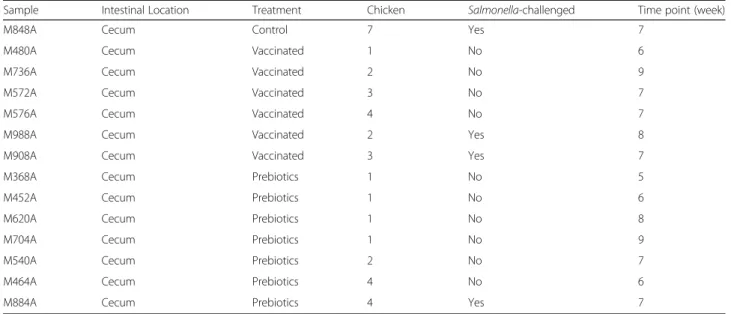
Samples from this study are from a Salmonella challenge study conducted in poultry. The parent study aimed to evaluate the impact of an attenuated Salmonella strain on the gut microbiota of poultry, and to determine its effect on the gut microbiome and efficacy on Salmonella infection clearance after challenge. A secondary object-ive was to determine how prebiotics modify the struc-ture of the gut microbiome, and the impact of this modification on Salmonella infection clearance (Azca-rate-Peril et al., in preparation). In the current study, analysis of microbiome composition was conducted on 14 chicken cecum samples randomly selected from 3 dif-ferent groups: 1) control group, 2) Salmonella-vacci-nated group, and 3) prebiotics-fed group. Each of the groups was assigned also to two subgroups according to a Salmonella challenge. Table 2 lists the characteristics of each sample. In order to compare platforms perform-ance and bioinformatics analysis pipelines, total DNA from samples was amplified with primers targeting the V1-V2 hypervariable region of the 16S rRNA gene and sequenced using the GS FLX+ (Roche), Ion Torrent PGM or Illumina MiSeq platforms according to the scheme shown in Fig. 1. A summary of expected sequen-cing output, reads length, and quality scores from the three platforms is presented in Table 3. The GS FLX+ run produced the lowest number of raw reads (1/8 of a plate) compared to PGM (314X chip) and MiSeq (one lane); however, quality scores were higher in comparison to both PGM and MiSeq platforms (Table 4). Quality scores were more stable over the read length for the
Fig. 2 Evaluated bioinformatics pipelines using QIIME [36] and UPARSE [37] using two different OTU picking methods (QIIME only) either with or without chimera removal steps
PGM instrument while we observed a decline starting at bases 150–199 for the GS FLX+ run and at bases 90–99 for the MiSeq run. After filtering (length > 200 bp, qual-ity scores >25), 96% of the GS FLX+ reads, 91.8% of the MiSeq, but only 14.9% of the PGM platform reads were suitable for further analysis. However, the filtered num-ber of reads for this platform and sequencing chip was within the manufacturer’s indicated output (≈ 80,000– 100,000 reads/314X chip).
UPARSE reported a lower phylogenetic diversity than both de novo QIIME and open reference QIIME pipelines regardless of the sequencing platform
The bioinformatics analysis pipelines used in our study to determine the taxonomic composition and bacterial diversity of 14 chicken cecum samples using three differ-ent platforms are depicted in Fig. 2. Rarefaction analyses at an even sampling depth of 1000 reads/sample were conducted to determine Phylogenetic Diversity (PD) and Table 2 Characteristics of samples used in this study
Sample Intestinal Location Treatment Chicken Salmonella-challenged Time point (week)
M848A Cecum Control 7 Yes 7
M480A Cecum Vaccinated 1 No 6
M736A Cecum Vaccinated 2 No 9
M572A Cecum Vaccinated 3 No 7
M576A Cecum Vaccinated 4 No 7
M988A Cecum Vaccinated 2 Yes 8
M908A Cecum Vaccinated 3 Yes 7
M368A Cecum Prebiotics 1 No 5
M452A Cecum Prebiotics 1 No 6
M620A Cecum Prebiotics 1 No 8
M704A Cecum Prebiotics 1 No 9
M540A Cecum Prebiotics 2 No 7
M464A Cecum Prebiotics 4 No 6
M884A Cecum Prebiotics 4 Yes 7
Table 3 GS FLX (Roche), PGM (Ion Torrent, Life Technologies) and MiSeq (Illumina) platform comparison. Data was obtained from the corresponding platform’s website
Roche 454 Ion Torrent Illumina MiSeq
Sequencing Kit GS FLX Titanium XLR70 PGM 400 Sequencing MiSeq Reagent Kits v2
Expected Read Length
Up to 600 bp Up to 400 bp MiSeq Reagent Kit v2: Up to 2 × 250 bp
Typical Throughput 450 Mb Ion 314™ Chip v2: Up to 100 Mb Ion 316™ Chip v2: Up to 1 Gb Ion 318™ Chip v2: Up to 2 Gb Up to 8.5 Gb
Reads per Run ~1000,000 shotgun, ~700,000 amplicon
Ion 314™ Chip v2: 400–550 thousand Ion 316™ Chip v2: 2–3 millions Ion 318™ Chip v2: 4–5.5 millions
~15 million reads
Consensus Accuracy
99.995% 99% 99%
Run Time 10 h Ion 314™ Chip v2: 2.3
to 3.7 h Ion 316™ Chip v2: 3.0 to 4.9 h Ion 318™ Chip v2: 4.4 to 7.3 h 4 h and approximately 39 h depending on the number of cycles
Sample Input gDNA, cDNA, or amplicons
(PCR products)
gDNA, cDNA, or amplicons (PCR products)
gDNA, cDNA, or amplicons (PCR products)
Small genome, amplicon, and targeted gene panel sequencing
Weight 532 lbs. (242 kg) 65 lbs. (30 kg) 120 lbs. (54.5 kg)
Species Richness (S) of samples (Fig. 3a and b, Add-itional file 1: Table S1). PD values were lower for all plat-forms when UPARSE pipelines were applied to data compared to both de novo QIIME pipelines and open reference QIIME pipelines (Fig. 3a). A similar observa-tion in the case of de novo OTU picking was previously reported by Pylro et al. [56]. In contrast, S values were comparable between all bioinformatics pipelines (Fig. 3b).
Statistically significant differences in pairwise compari-sons between platforms and all bioinformatics pipelines are summarized in Fig. 3, right panels. In general terms, diversity values for GS FLX+ compared to the MiSeq runs were significantly different, while diversity values for the PGM1 platform (the PGM standard method) were not significantly different to data generated using the MiSeq platform. The non-standard PGM2 and Table 4 Comparative summary of sequencing depth, reads length, and quality between GS FLEX, PGM, and MiSeq platforms
Platform Raw
reads
Filtered
readsa Mean Length afterfiltering (bp) Percentage of reads keptafter filtering Mean quality score beforequality filtering Number ofidentified OTUs
Roche 454 118,018 113,306 377 96% 37.7 1028 Ion Torrent PGM 481,593 71,652 297 14.9% 23.4 2747 Illumina Miseq 4,149,441 3,811,042 334 91.8% 37.5 3731 a
Number of reads after filtering, reads of less than 200 nucleotides and with quality scores below 25 were removed
Significantly different (p<0.05) Not significantly different (p>0.05) GSFLEX MiSeq1 0.015 0.06 0.18 0.015 0.015 0.015 GSFLEX MiSeq2 0.03 0.075 0.075 0.03 0.015 0.03 MiSeq1 MiSeq2 1 1 1 1 1 1 PGM1 MiSeq2 0.135 0.06 0.69 1 0.555 1 PGM1 MiSeq1 0.06 0.12 1 0.645 0.045 0.105 PGM1 GSFLEX 0.015 0.015 1 0.225 0.195 0.015 PGM2 PGM3 0.015 0.03 0.015 0.015 0.015 PGM2 MiSeq2 1 1 1 1 1 1 PGM2 MiSeq1 1 1 1 1 1 0.15 PGM2 GSFLEX 0.015 0.015 0.33 0.03 0.015 0.015 PGM2 PGM1 0.36 0.435 1 1 1 1 PGM3 PGM1 0.015 0.015 0.075 0.015 0.105 0.015 PGM3 GSFLEX 1 1 1 1 1 1 PGM3 MiSeq1 0.015 0.015 0.015 0.015 0.015 0.015 PGM3 MiSeq2 0.045 0.03 0.015 0.015 0.015 0.015 PLATFOR M GSFLEX MiSeq1 0.075 0.195 0.09 0.105 0.03 0.03 GSFLEX MiSeq2 1 1 1 1 0.36 0.93 MiSeq1 MiSeq2 0.015 0.015 0.105 0.225 0.075 0.015 PGM1 MiSeq2 1 1 1 1 1 1 PGM1 MiSeq1 0.015 0.015 1 1 0.705 0.195 PGM1 GSFLEX 1 1 1 1 1 1 PGM2 PGM3 0.18 0.165 0.03 0.03 0.105 0.06 PGM2 MiSeq2 1 1 1 1 1 1 PGM2 MiSeq1 0.255 0.255 0.015 0.015 0.015 0.015 PGM2 GSFLEX 1 1 0.09 0.285 1 1 PGM2 PGM1 0.015 0.03 1 1 1 1 PGM3 PGM1 0.015 0.03 1 1 1 1 PGM3 GSFLEX 0.3 0.225 0.015 0.015 0.015 0.015 PGM3 MiSeq1 1 1 0.06 0.03 0.075 0.09 PGM3 MiSeq2 0.015 0.015 0.015 0.03 0.015 0.015
(A)
(B)
ANALYSIS PIPELINE PLATFOR M Phylogenetic Diversity Species RichnessFig. 3 A comparison of phylogenetic diversity (PD) and species richness (S) between the 6 runs (GS FLX, MiSeq1, MiSeq2, PGM1, PGM 2 and PGM3) and in each pipeline a Phylogenetic diversity b Species Richness. Panels on the right show a matrix comparison between pipelines. Numbers within cells indicateP-values >0.05 < 0.1. *P < 0.01,**P < 0.001
PGM3 generated diversity values were significantly dif-ferent to the Illumina, GS FLX+ and standard PGM runs. Interestingly, significant differences were observed in the number of species detected between the Miseq1 and Miseq2 runs, which were intended to test reproduci-bility, when data was applied through QIIME1, QIIME2, and UPARSE2 pipelines. We did not observe overall statistical significant differences in phylogenetic diversity or number of species due to treatment, time, or chicken within any of the platforms.
Overall microbiome composition of samples
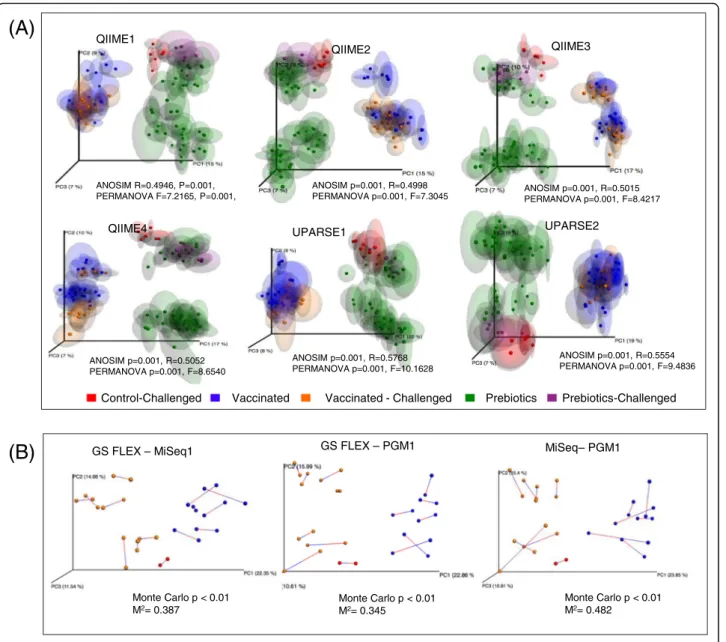
Analysis of Similarities (ANOSIM) and Permutational Multivariate Analysis of Variance (PERMANOVA) ana-lyses were performed on Unweighted Unifrac data to evaluate differences between the 6 runs and bioinformat-ics pipelines. We did not observe clustering by sequen-cing platform (Additional file 2: Figure S1) but instead samples grouped according to their corresponding ex-perimental treatment group regardless of the sequencing platform and bioinformatics pipelines (Fig. 4a). Principal Coordinates Analysis (PCoA) of samples also showed two sub clusters in the prebiotics group, which are most probably associated with different time points in the course of this experiment. Similar results were observed in the Principal Coordinates Analysis (PCoA) based on Weighted Unifrac matrices (not shown).
Procrustes analysis allowed us to determine whether the same conclusions could be made from different β-diversity analyses regardless of which platform was used to compare the samples. Although Procrustes analysis of data generated in the three platforms (GS FLX+, MiSeq1 and PGM1) analyzed using the QIIME2 pipeline (de novo OTU picking plus chimera depletion) showed sub-stantial differences (Monte Carlo p < 0.01 and high M2 values) (Fig. 4b), these differences were not as large as the differences observed between treatments groups. This analysis suggests that in spite of differences in the β-diversity, all platforms were capable of discriminating between treatments.
Microbiome composition was impacted by platform and bioinformatics pipeline
Operational Taxonomic Units (OTUs) were identified at a 97% similarity cut-off in the QIIME and UPARSE pipe-lines. The number of sequences assigned to OTUs for GS FLX+ was similar in all bioinformatics pipelines (99%). De novo (QIIME1 and QIIME2) versus open-reference OTU picking impacted the number of assigned sequences for Illumina MiSeq runs but not for GS FLX+ runs. QIIME1 and QIIME2, both using UCLUST for de novo OTU picking, and UPARSE1 and UPARSE2, both using USEARCH for open reference OTU picking, re-sulted in a higher number of unassigned reads from the
Illumina MiSeq generated data (ranging from 3.6 to 4.1%). Marginal differences were observed in the OTU assignment between the three PGM runs in all bioinfor-matics pipelines. PGM3 (same annealing temperature, 50 °C, and a reduced number of cycles from 35 to 25) showed a Firmicutes abundance of almost 99%, while PGM1 and PGM2 ranged from 96.8% to 98.7%. How-ever, this difference was exaggerated when comparing Vaccinated and Vaccinated-Challenged samples, with Firmicutes dropping as low as 72.8% for PGM3 vs 90.3% for PGM2. (Additional file 1: Table S2).
Firmicutes and Bacteroidetes were the most repre-sented phyla in QIIME and UPARSE pipelines. GS FLX+ generated data showed the highest abundance of Firmi-cutes with an average of 96.2% followed by the MiSeq platform with an average of 93.2%, and PGM with 91.8%. Bacteroidetes were detected at 3% by GS FLX+, 2.3% by the MiSeq platform, and 6.4% by PGM. Proteo-bacteria and Tenericutes were represented in low abun-dance in all platforms and pipelines; however, they were significantly (Kruskal-Wallis P ≤ 0.01) over represented in the MiSeq generated data compared to PGM and GS FLX+.
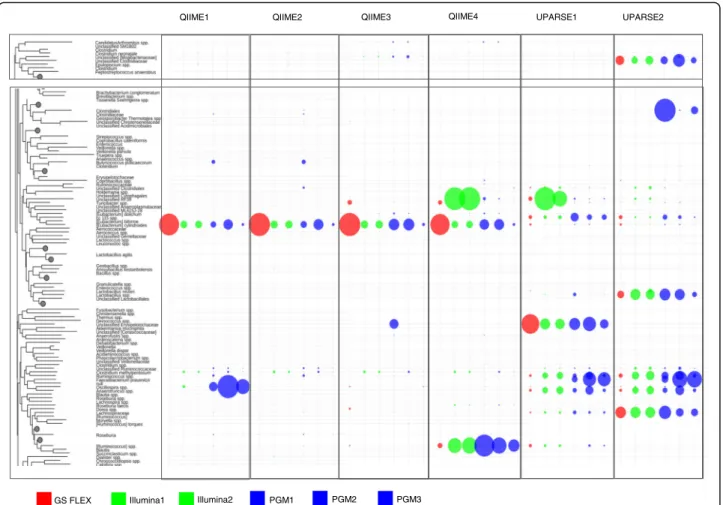
Distinct differences were observed between platforms and pipelines in the relative abundance of specific genera (Fig. 5). Overall, the QIIME pipelines generated a different bacterial profile compared to the UPARSE pipeline with a clear im-pact of the chimera depletion on relative abundance of bac-terial taxa. GS FLX+ resulted in an over representation of Eubacterium cylindroidescompared to the other platforms and protocols. Modification of PCR protocols in the PGM runs also had an impact on this taxa as well as on detection of Butyricicoccus pullicaecorum, a butyrate producer thought to exert anti-inflammatory effects [57] and Oscillos-pira, a genus highly represented in the data generated by the PGM platform and analyzed by the QIIME pipeline with no chimera depletion (QIIME1). The open reference OTU picking pipelines (QIIME3 and QIIME4) generated a differential representation of unclassified Erysipelotricha-ceae (specifically over represented in PGM1), Turicibacter (highly prevalent in the Illumina runs), and potential Rumi-nococcusspecies. Taxa differentially represented by platform in the UPARSE pipelines included Turicibacter, unclassified Clostridiaceae, Clostridiales (highly prevalent in the PGM pipelines), Eubacterium biforme, Lactobacillus spp., unclas-sified Erysipelotrichaceae, Ruminococcus, Anaerotruncus, and Lachnospiraceae.
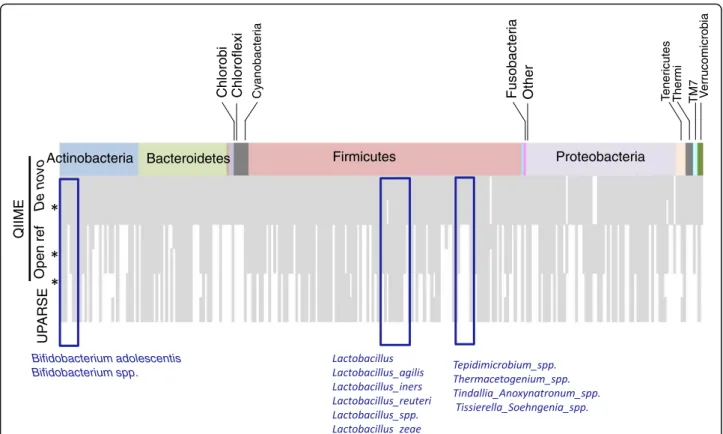
Further analysis using PhyloToAST [54] (Fig. 6) showed that the de novo OTU picking approach in the QIIME pipeline identified the highest number of unique species (over 250) followed by the open reference OTU picking approach (approximately 180) and UPARSE (ap-proximately 140). Relevant groups under detected by the open reference and UPARSE OTU picking approaches
included Bifidobacterium spp. (absent in the open refer-ence and UPARSE OTU picking approaches) and
Bifido-bacterium adolescentis (not identified by UPARSE).
Differences in the detection profiles were also observed for lactobacilli. Bifidobacteria and lactobacilli are of sig-nificance for the samples analyzed in this study since these populations are expected to be impacted by pre-biotic feeding, one of the conditions analyzed. Other taxa differentially identified by the different pipelines in-cluded species of Tepidimicrobium, Thermacetogenium, Tindallia_Anoxynatronum, and Tissierella_Soehngenia. These groups correspond to poorly characterized soil bacteria.
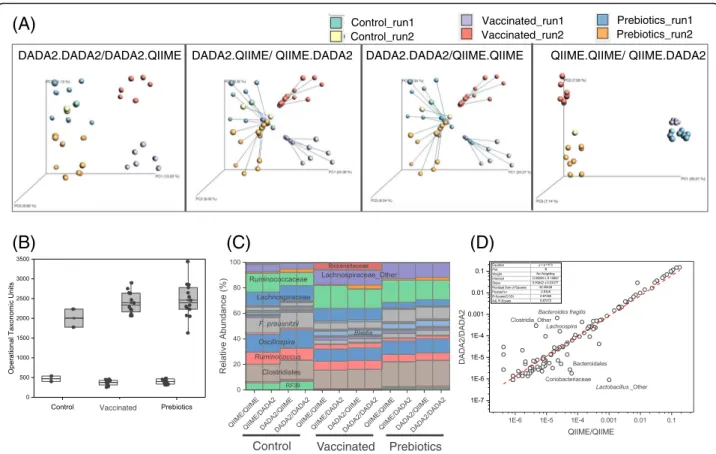
Finally, comparing the results of the pipelines intended to assess finer resolution features of the microbial com-munities, we found that the conclusions obtained in the previous analyses largely hold. For both pipelines, sam-ples clustered in beta diversity PCoA plots according to treatment and sequencing run. Procrustes analysis showed that the primary difference in taxa assessments occurred due to the OTU/variant selection rather than the mechanism of assigning taxa to individual sequence representatives (Fig. 7a). The number of OTUs or se-quence representatives produced by DADA2 was smaller than the number of OTUs obtained from de novo OTU picking with at 99% similarity threshold (Fig. 7b). At the QIIME1 ANOSIM R=0.4946, P=0.001, PERMANOVA F=7.2165, P=0.001, QIIME2 ANOSIM p=0.001, R=0.4998 PERMANOVA p=0.001, F=7.3045 QIIME3 ANOSIM p=0.001, R=0.5015 PERMANOVA p=0.001, F=8.4217 QIIME4 ANOSIM p=0.001, R=0.5052 PERMANOVA p=0.001, F=8.6540 UPARSE1 ANOSIM p=0.001, R=0.5768 PERMANOVA p=0.001, F=10.1628 UPARSE2 ANOSIM p=0.001, R=0.5554 PERMANOVA p=0.001, F=9.4836
Control-Challenged Vaccinated Vaccinated - Challenged Prebiotics Prebiotics-Challenged
Monte Carlo p < 0.01 M2= 0.387 Monte Carlo p < 0.01 M2= 0.482 Monte Carlo p < 0.01 M2= 0.345
GS FLEX – MiSeq1 GS FLEX – PGM1 MiSeq– PGM1
(A)
(B)
Fig. 4 a Principal Coordinates Analysis PCoA (Unweighted UniFrac) plots of data generated by the three different platforms, analyzed by different bioinformatics pipelines and colored according to treatment group (Prebiotics, control andSalmonella-vaccinated). PERMANOVA F and P values and ANOSIM R andP values are indicated. b Procrustes analysis of sequencing data from the different platforms analyzed with the QIIME2 (de novo OTU picking plus chimera depletion). M andP values are indicated in the figure
genus level or lower, the pipeline using QIIME for both OTU picking and taxonomic assignment identified a total of 166 different taxa, while the pipeline using DADA2 for sequencing error suppression and taxonomic assignment detected 138 (Additional file 3: Table S3), with 65 groups identified at the species level. However, we observed that the taxonomy profiles determined by two different se-quence representative selecting algorithms were similar and impacted mainly by the treatment. For the sequencing results produced by the Illumina MiSeq platform, both bioinformatic approaches support essentially the same biological conclusions.
Discussion
Next Generation Sequencing (NGS) has revolutionized the field of microbiome research [58–63]. Over the course of the last decade, NGS has become a faster, more accurate, and cost effective tool for the study of complex microbial communities [64]. In this study, with the objective of determining project-specific impacts of sequencing platforms and bioinformatics pipelines, we
compared 16S rRNA amplicon sequencing data
generated using three different platforms and 7 bioinfor-matics pipelines. GS FLX+, the traditional “gold stand-ard” in terms of sequence length and quality prior to the development of Illumina and Life Sciences technologies, still generated the longest reads with the highest mean quality score per read after filtering, but this platform was not cost effective compared to newer platforms. Illu-mina MiSeq generated the highest number of reads per run but exhibited a lower mean quality score when com-pared to Roche GS FLX+. The Ion Torrent PGM plat-form yielded lower quality reads than MiSeq, and therefore fewer usable reads after quality filtering;
how-ever, performance was within the manufacturer’s
parameters.
PCR-based high throughput amplicon sequencing in-troduces biases to the results obtained, regardless of the sequencing platform [16, 50]. In this study, Ion Torrent PGM sequencing was performed on amplicon libraries generated from three different PCR conditions (Fig. 1). Modification of the PCR protocols for generation of se-quencing libraries on the PGM platform directly im-pacted the number of identified species and sample
QIIME1 QIIME2 QIIME3 QIIME4 UPARSE1 UPARSE2
GS FLEX Illumina1 Illumina2 PGM1 PGM2 PGM3
Fig. 5 Selected differences in relative abundances of the most impacted taxa according to data generated by different platforms (indicated by different colors) and bioniformatic analysis pipelines (indicated across the top). The full figure can be seen in Additional file 2: Figure S2
diversity. Our results clearly indicate that modifications to the PCR conditions result in a differential representa-tion of specific taxa. An increased number of PCR cycles probably increased amplification of background DNA and decreased specificity, as a lower annealing temperature. This is an important issue when analyzing low biomass samples, especially considering that DNA contamination of reagents and laboratory-grade water has been clearly demonstrated [65]. Other parameters that can impact taxa identification and relative quantification are DNA input and chosen amplification primers. The DNA input for the GS FLX+ and PGM standard protocols is 4 times greater than the input for amplicon generation for sequencing on the MiSeq instrument following the standard protocol. This could account for differences observed in the relative abundance of bacterial taxa since the less abundant bac-terial DNA will have greater chances to be amplified when the amount of DNA is higher. No previous studies have compared DNA input on 16S rRNA sequencing data gen-eration, although the DNA isolation procedure has been shown to have a significant impact on sequencing results [66]. Previous studies have shown an impact of the primer sets on 16S rRNA amplicon sequencing [26, 67]. In this study we evaluated the same set of primers for all amplifi-cations (8F and 338R); however, a potential impact of adapters and barcodes specific to each platform added to
the sequencing primers cannot be discarded. Moreover, primers targeting the V4 region of the 16S rRNA gene are currently the most widely used; however, our project ini-tially used the 454 platform for amplicon sequencing ana-lysis. Since the region V1-V2 was the most traditionally used across decades of research, and was reported optimal specifically for 16S rRNA amplicon pyrosequencing across a range of taxonomic classifications from phylum to fam-ily [68], we chose to target such region. We are aware, however, that recent studies provide support to targeting the V3-V4 regions of the 16S rRNA gene for studies of bacterial diversity and this is currently standard in our la-boratory. We targeted the same region across platforms for the sake of comparison. Finally, standard library prep-aration protocols (GS-FLX+, PGM1, and MiSeq1/MiSeq2) coupled with the most widely used bioinformatics analysis procedure (QIIME2 = de novo OTU picking with removal of chimeras) showed a significant difference in PD be-tween GS-FLX+ and PGM1, and in the number of identi-fied species between the two MiSeq runs between PGM1 and MiSeq1.
Different sequencing platforms/pipelines generate re-sults with differing phylogenetic distributions (Fig. 5). As the sequencing chemistry differs between platforms, introducing internal biases, this finding is not without
precedent [23–25, 69–71]. Furthermore, microbial
Actinobacteria Bacteroidetes Firmicutes
Fusobacter ia Other Cy anobacte ri a Chlorobi Chloroflex i Proteobacteria V e rr ucomicro b ia T eneri c u tes T hermi TM 7 o v o n e D f er n e p O E S R A P U E MII Q Bifidobacterium adolescentis Bifidobacterium spp.
Fig. 6 Unique species identified by the different bioinformatic analysis schemes. Boxes indicate taxa not detected by open reference OTU picking (QIIME) and UPARSE methods, which may be of significance for the study
genera often vary drastically in genome composition. For example, Lactobacillus reuteri has a GC content of 35.9%–38.9% [72] while Bifidobacterium longum has GC content of 60% [73]. This difference in genomic GC con-tent impacts the ability of different platforms to accur-ately identify presence or absence, and to determine microbial abundance. As such, biases introduced as a re-sult of the sequencing chemistry, and limitations of indi-vidual platforms to discriminate between microbes with varying genomic GC content makes it important to con-sider the technology used in relation to the scope of the project. Our study showed that UPARSE analysis yields fewer microbial genera and lower phylogenetic diversity than QIIME analysis (Fig. 3a, Fig. 6). Both UPARSE and QIIME pipelines start by quality-filtering reads, trim-ming them to a fixed length, optionally discarding singleton reads, and clustering the remaining reads. The differences between the two pipelines rely on the cluster-ing algorithm. UPARSE uses a ‘greedy’ algorithm that
performs chimera filtering and OTU clustering
simultaneously, while QIIME performs chimera filtering as a separate step. In this study we evaluated both the de novo and open reference OTU picking in QIIME. The main advantage of the first method is that it does not re-quire a collection of reference sequences before working with a new marker gene. The open-reference OTU pick-ing combines closed-reference OTU pickpick-ing, in which input sequences are aligned to pre-defined cluster cen-troids in a reference database, and if the input sequence does not match any reference sequence at a defined per-cent identity threshold, the sequence is excluded, and de novo OTU picking is applied to the remaining se-quences. The OTU picking algorithm used by UPARSE does not require technology- or gene-specific parameters (such as an OTU size cutoff ), algorithms (such as flow-gram denoising) or data (such as a curated multiple alignment) [37]. The impact of different bioinformatics pipelines on the diversity captured from specific micro-bial ecosystems was investigated in Pylro et al. [56]. The study concluded that UniFrac distances between samples
DADA2.DADA2/DADA2.QIIME DADA2.QIIME/ QIIME.DADA2 DADA2.DADA2/QIIME.QIIME QIIME.QIIME/ QIIME.DADA2
(A)
(B)
(D)
Control Vaccinated Prebiotics
(C)
Control_run1 Control_run2 Vaccinated_run1 Vaccinated_run2 Prebiotics_run1 Prebiotics_run2 VaccinatedFig. 7 Comparisons made between the two different OTU/variant calling (either DADA2 or QIIME de novo OTU picking at 99% similarity) and the two different taxa assigment algorithms (DADA2 or QIIME using the Greengenes database). Labels are: QIIME.QIIME indicating QIIME was used for OTU picking and taxonomic assigment, QIIME.DADA2 indicating QIIME was used for OTU picking and DADA2 was used for taxonomic assignment, DADA2.QIIME indicating the DADA2 was used for sequencing error supression and QIIME was used for taxonomic assignment, and DADA2.DADA2 indicating that used for both sequencing error suppresion and taxonomic assignment. a Procrustes analysis. b A comparison of the number of OTUs identified by DADA2 (clear boxes) and QIIME de novo OTU picking at 99% similarity (shaded boxes).c Taxonomic profiles of samples grouped by treatment and bioinformatics pipeline. Only major taxa are indicated in the Figure. d Correlation analysis of relative abundances of bacterial taxa at species level. For a complete list see Additional file 3: Table S3
sequenced on both Illumina MiSeq and PGM were sig-nificantly correlated.
Procrustes analysis of data showed clear differences be-tween data generated from each platform (Fig. 4b and 7a). Nevertheless, despite differences in platform sequencing performance and data output, all three platforms were capable of discriminating samples by treatment and led us to similarly valid biological conclusions (Fig. 4a). Our re-sults are in agreement with a previous study that showed that soil samples analyzed by 16S rRNA sequencing using either the Illumina MiSeq or PGM platforms clustered by site rather than by sequencing platform [56].
Determining the most accurate and appropriate ap-proaches to generate and analyze sequencing data from complex microbial communities remains an important goal of researchers focused on microbiota studies. Un-fortunately without a standardized set of protocols from sample preparation and handling to final data analysis (and every step in between), it is impossible to eliminate biases from these studies entirely. However, making an effort to choose the correct sequencing platform for a given study as well as the most appropriate data analysis tools will drastically reduce errors in data acquisition and processing between studies. In this context, emer-ging analysis methods (methods that attempt to differen-tiate between sequences with similarity greater than the 97% convention) such as DADA2 [38] and Oligotyping [74] are an innovative and interesting new development in the processing of sequencing of microbial communi-ties. These methods differ from conventional methods in substantial ways, for example, the suppression of se-quencing errors and estimation of their probability dis-tribution. These matters are of fundamental importance to methods that attempt to differentiate biologically meaningful single nucleotide variation from sequencing data and warrant ongoing comparisons of relevant pro-tocols and analysis methods for the study of complex microbial communities.
In our study, we compared DADA2 [38] and QIIME de novo OTU picking with a similarity threshold of 99% for OTU or variant calling, and then assignment of tax-onomy was performed on each table using either the DADA2 taxonomy classification method and the QIIME taxonomy classification method. As with UPARSE, ap-plying the DADA2 variant calling pipeline resulted in lower numbers of identified OTUs, resulting in signifi-cant differences between pipelines demonstrated by the Procrustes analysis. However, both pipelines resulted in clustering of samples by treatment and Illumina run. Moreover, a linear correlation analysis comparing rela-tive abundances determined by the pipeline using QIIME for both OTU picking and taxonomic assign-ment and the pipeline using DADA2 for both sequen-cing error suppression and taxonomic assignment
showed a Person’s r value of 0.93 indicating a strong correlation between values (Fig. 7d). Although applica-tion of the DADA2 algorithm for taxonomy assignment resulted in a higher number of species identified, reli-ability on the assignment at sub genus level is largely unknown since this software has not been extensively tested and was developed with a mock community of known bacterial strains as opposed to be done on native communities. As such, use of this software for analysis of gut microbial communities should be done with cau-tion. Traditional microbiology methods and whole gen-ome shotgun sequencing data will confirm or deny whether single nucleotide polymorphisms of a single bacterial gene are sufficient to obtain reliable species level information within complex communities.
Conclusion
Our study confirmed differences between sequencing plat-forms and library preparation protocols in the
determin-ation of microbial diversity and species richness.
Moreover, we showed that bioinformatics pipelines used to analyze sequence data yielded results that differ de-pending on specific parameters. However, we concluded that, specifically for our chicken-Salmonella infection study, despite these differences, samples from variable treatment groups were differentiated from one another re-gardless of the sequencing platform and/or bioinformatics pipeline used allowing us to draw similar conclusions. This suggested that the same biological conclusions could be drawn from data, as long as the data is collected and analyzed consistently throughout the course of the experi-ment. It is critical for researchers to take into consider-ation the limitconsider-ations of each sequencing platform, and choose a system appropriate for their experimental design.
Additional files
Additional file 1: Table S1. Phylogenetic diversity (PD) and species richness (S) values by platform, experimental group, and bioinformatics pipeline. Table S2. Most abundant phyla identified by platform, experimental group, and bioinformatics pipeline. (DOCX 159 kb) Additional file 2: Figure S1. Principal Coordinates Analysis PCoA (Unweighted UniFrac) plots of data generated by the three different platforms, analyzed by different bioinformatics pipelines and colored according to sequencing platform. PERMANOVA F andP values and ANOSIM R andP values are indicated. Figure S2. Differences in relative abundances of the most impacted taxa according to data generated by different platforms (indicated by different colors) and bioniformatic analysis pipelines (indicated across the top). (PPTX 4115 kb)
Additional file 3: Table S3. Relative abundance of taxonomic groups by treatment and bioinformatics pipeline. (XLSX 74 kb)
Abbreviations
ANOSIM:Analysis of Similarities; ANOVA: Analysis of variance; DADA2: Divisive Amplicon Denoising Algorithm2; MAQC: Microarray Quality Control project; MBQC: Microbiome Quality Control project; NGS: Next Generation Sequencing; PCoA: Principal Coordinate Analysis; PD: Phylogenetic Diversity;
PERMANOVA: Permutational Multivariate Analysis of Variance; QIIME: Quantitative Insights Into Microbial Ecology Acknowledgements
We are grateful to Dr. J. Bruno-Barcena and Mr. Hunter Whittington for their input on data analysis using Phylotoast and iTOL tools.
Funding
The Microbiome Core Facility is supported in part by the NIH/National Institute of Diabetes and Digestive and Kidney Diseases grant P30 DK34987. This research was also supported by the USDA-NIFA Award# 2012 –68,003-19,621 and NCTraCs. I. A. is a Fulbright Scholar.
Availability of data and materials
This project is available at NCBI under BioProject ID PRJNA40025. Authors’ contributions
IA Performed bioinformatics and statistical analyses of data and wrote the manuscript. JWA Contributed to manuscript writing and editing. MBC and NB performed DNA isolation, barcoding, library preparation and sequencing of samples. JR Performed bioinformatics analysis of data and contributed to manuscript writing and editing. HH, MK Performed animal experiments and contributed to manuscript writing and editing. AB, MM, and RA performed animal experiments. MAAP Designed the experiments, advised IA, contributed to bioinformatics and statistical analyses of data and wrote the manuscript. All authors read and approved the final manuscript.
Ethics approval
Animals were euthanized according to protocol #15–065-A, approved by the North Carolina State University Institutional Animal Care and Use Committee (OLAW# D16–00214) and sampled for gut microbiome analysis.
Consent for publication Not applicable. Competing interests
The authors declare that they have no competing interests.
Publisher’s Note
Springer Nature remains neutral with regard to jurisdictional claims in published maps and institutional affiliations.
Author details 1
Department of Medicine, Division of Gastroenterology and Hepatology, and Microbiome Core Facility, Center for Gastrointestinal Biology and Disease, School of Medicine, University of North Carolina, Campus Box 7555, 332 Isaac Taylor Hall, Chapel Hill, NC 27599-7545, USA.2Research Computing, University of North Carolina, Chapel Hill, NC, USA.3Department of Poultry Science, North Carolina State University, Raleigh, NC, USA.4Laboratory of Biochemistry & Immunology, Faculty of Sciences, Mohammed V University, Rabat, Morocco.
Received: 6 November 2016 Accepted: 29 August 2017
References
1. Thompson AL, Monteagudo-Mera A, Cadenas MB, Lampl ML, Azcarate-Peril MA. Milk- and solid-feeding practices and daycare attendance are associated with differences in bacterial diversity, predominant communities, and metabolic and immune function of the infant gut microbiome. Front Cell Infect Microbiol. 2015;5:3.
2. Turnbaugh PJ, Ridaura VK, Faith JJ, Rey FE, Knight R, Gordon JI. The effect of diet on the human gut microbiome: a metagenomic analysis in humanized gnotobiotic mice. Sci Transl Med. 2009;1(o):6ra14.
3. Hildebrandt MA, Hoffmann C, Sherrill-Mix SA, Keilbaugh SA, Hamady M, Chen YY, Knight R, Ahima RS, Bushman F, Wu GD. High-fat diet determines the composition of the murine gut microbiome independently of obesity. Gastroenterology. 2009;137(5):1716–24. e1711-1712
4. Bonder MJ, Tigchelaar EF, Cai X, Trynka G, Cenit MC, Hrdlickova B, Zhong H, Vatanen T, Gevers D, Wijmenga C, et al. The influence of a short-term gluten-free diet on the human gut microbiome. Genome Med. 2016;8(1):45.
5. Sommer F, Nookaew I, Sommer N, Fogelstrand P, Bäckhed F. Site-specific programming of the host epithelial transcriptome by the gut microbiota. Genome Biol. 2015;16(1):62.
6. Drumo R, Pesciaroli M, Ruggeri J, Tarantino M, Chirullo B, Pistoia C, Petrucci P, Martinelli N, Moscati L, Manuali E, et al. Salmonella enterica Serovar Typhimurium Exploits Inflammation to Modify Swine Intestinal Microbiota. Front Cell Infect Microbiol. 2015;5:106.
7. Kim HJ, Li H, Collins JJ, Ingber DE. Contributions of microbiome and mechanical deformation to intestinal bacterial overgrowth and inflammation in a human gut-on-a-chip. Proc Natl Acad Sci U S A. 2016; 113(1):E7–e15.
8. Candon S, Perez-Arroyo A, Marquet C, Valette F, Foray AP, Pelletier B, Milani C, Ventura M, Bach JF, Chatenoud L. Antibiotics in Early Life Alter the Gut Microbiome and Increase Disease Incidence in a Spontaneous Mouse Model of Autoimmune Insulin-Dependent Diabetes. PLoS One. 2015;10(5): e0125448.
9. Vandenplas Y, Huys G, Daube G. Probiotics: an update. J Pediatr. 2015;91(1): 6–21.
10. Gao Z, Guo B, Gao R, Zhu Q, Wu W, Qin H. Probiotics modify human intestinal mucosa-associated microbiota in patients with colorectal cancer. Mol Med Rep. 2015;12(4):6119.
11. Nami Y, Haghshenas B, Abdullah N, Barzegari A, Radiah D, Rosli R, Khosroushahi AY. Probiotics or antibiotics: future challenges in medicine. J Med Microbiol. 2015;64(Pt 2):137–46.
12. Vandenplas Y, Zakharova I, Dmitrieva Y. Oligosaccharides in infant formula: more evidence to validate the role of prebiotics. Br J Nutr. 2015;113(9):1339–44. 13. Monteagudo-Mera A, Arthur JC, Jobin C, Keku T, Bruno-Barcena JM,
Azcarate-Peril MA. High purity galacto-oligosaccharides enhance specific Bifidobacterium species and their metabolic activity in the mouse gut microbiome. Benef Microbes. 2016;7(2):247.
14. Maurice CF, Haiser HJ, Turnbaugh PJ. Xenobiotics shape the physiology and gene expression of the active human gut microbiome. Cell. 2013;152(1–2):39–50. 15. Woo PC, Lau SK, Teng JL, Tse H, Yuen KY. Then and now: use of 16S rDNA gene sequencing for bacterial identification and discovery of novel bacteria in clinical microbiology laboratories. Clin Microbiol Infect. 2008;14(10):908–34.
16. Schloss PD, Gevers D, Westcott SL. Reducing the effects of PCR amplification and sequencing artifacts on 16S rRNA-based studies. PLoS One. 2011;6(12):e27310.
17. Quail MA, Smith M, Coupland P, Otto TD, Harris SR, Connor TR, Bertoni A, Swerdlow HP, Gu Y. A tale of three next generation sequencing platforms: comparison of ion torrent, Pacific biosciences and Illumina MiSeq sequencers. BMC Genomics. 2012;13:341.
18. Luo C, Tsementzi D, Kyrpides N, Read T, Konstantinidis KT. Direct comparisons of Illumina vs. Roche 454 sequencing technologies on the same microbial community DNA sample. PLoS One. 2012;7(2):e30087. 19. Li X, Buckton AJ, Wilkinson SL, John S, Walsh R, Novotny T, Valaskova I,
Gupta M, Game L, Barton PJ, et al. Towards clinical molecular diagnosis of inherited cardiac conditions: a comparison of bench-top genome DNA sequencers. PLoS One. 2013;8(7):e67744.
20. Claesson MJ, Wang Q, O'Sullivan O, Greene-Diniz R, Cole JR, Ross RP, O'Toole PW. Comparison of two next-generation sequencing technologies for resolving highly complex microbiota composition using tandem variable 16S rRNA gene regions. Nucleic Acids Res. 2010;38(22):e200.
21. Salipante SJ, Kawashima T, Rosenthal C, Hoogestraat DR, Cummings LA, Sengupta DJ, Harkins TT, Cookson BT, Hoffman NG. Performance comparison of Illumina and ion torrent next-generation sequencing platforms for 16S rRNA-based bacterial community profiling. Appl Environ Microbiol. 2014;80(24):7583–91.
22. Tremblay J, Singh K, Fern A, Kirton ES, He S, Woyke T, Lee J, Chen F, Dangl JL, Tringe SG. Primer and platform effects on 16S rRNA tag sequencing. Front Microbiol. 2015;6:771.
23. Jones MB, Highlander SK, Anderson EL, Li W, Dayrit M, Klitgord N, Fabani MM, Seguritan V, Green J, Pride DT, et al. Library preparation methodology can influence genomic and functional predictions in human microbiome research. Proc Natl Acad Sci U S A. 2015;112(45):14024–9.
24. Yu G, Fadrosh D, Goedert JJ, Ravel J, Goldstein AM. Nested PCR biases in interpreting microbial community structure in 16S rRNA gene sequence datasets. PLoS One. 2015;10(7):e0132253.
25. Dechesne A, Musovic S, Palomo A, Diwan V, Smets BF. Underestimation of ammonia-oxidizing bacteria abundance by amplification bias in amoA-targeted qPCR. Microb Biotechnol. 2016;9(4):519.
26. Sinha R, Abnet CC, White O, Knight R, Huttenhower C. The microbiome quality control project: baseline study design and future directions. Genome Biol. 2015;16:276.
27. Liu L, Li Y, Li S, Hu N, He Y, Pong R, Lin D, Lu L, Law M. Comparison of next-generation sequencing systems. J Biomed Biotechnol. 2012;2012:251364. 28. Shokralla S, Spall JL, Gibson JF, Hajibabaei M. Next-generation sequencing
technologies for environmental DNA research. Mol Ecol. 2012;21(8):1794–805. 29. Whiteley AS, Jenkins S, Waite I, Kresoje N, Payne H, Mullan B, Allcock R,
O'Donnell A. Microbial 16S rRNA ion tag and community metagenome sequencing using the ion torrent (PGM) platform. J Microbiol Methods. 2012;91(1):80–8.
30. Indugu N, Bittinger K, Kumar S, Vecchiarelli B, Pitta D. A comparison of rumen microbial profiles in dairy cows as retrieved by 454 Roche and ion torrent (PGM) sequencing platforms. PeerJ. 2016;4:e1599.
31. Sinclair L, Osman OA, Bertilsson S, Eiler A. Microbial community composition and diversity via 16S rRNA gene amplicons: evaluating the illumina platform. PLoS One. 2015;10(2):e0116955.
32. Ferrarini M, Moretto M, Ward JA, Surbanovski N, Stevanovic V, Giongo L, Viola R, Cavalieri D, Velasco R, Cestaro A, et al. An evaluation of the PacBio RS platform for sequencing and de novo assembly of a chloroplast genome. BMC Genomics. 2013;14:670.
33. Castelino M, Eyre S, Moat J, Fox G, Martin P, Ijaz U, Quince C, Ho P, Upton M, Barton A. The skin microbiome in psoriatic arthritis: methodology development and pilot data. Lancet. 2015;385(Suppl 1):S27.
34. Shendure J, Ji H. Next-generation DNA sequencing. Nat Biotechnol. 2008; 26(10):1135–45.
35. Loman NJ, Misra RV, Dallman TJ, Constantinidou C, Gharbia SE, Wain J, Pallen MJ. Performance comparison of benchtop high-throughput sequencing platforms. Nat Biotechnol. 2012;30(5):434–9.
36. Caporaso JG, Kuczynski J, Stombaugh J, Bittinger K, Bushman FD, Costello EK, Fierer N, Pena AG, Goodrich JK, Gordon JI, et al. QIIME allows analysis of high-throughput community sequencing data. Nat Methods. 2010;7(5):335–6.
37. Edgar RC. UPARSE: highly accurate OTU sequences from microbial amplicon reads. Nat Methods. 2013;10(10):996–8.
38. Callahan BJ, McMurdie PJ, Rosen MJ, Han AW, Johnson AJ, Holmes SP. DADA2: High-resolution sample inference from Illumina amplicon data. Nat Methods. 2016;13(7):581–3.
39. Azcarate-Peril MA, Ritter AJ, Savaiano D, Monteagudo-Mera A, Anderson C, Magness ST, Klaenhammer TR. Impact of short-chain
galactooligosaccharides on the gut microbiome of lactose-intolerant individuals. Proc Natl Acad Sci U S A. 2017;114(3):E367–75.
40. Edgar RC, Haas BJ, Clemente JC, Quince C, Knight R. UCHIME improves sensitivity and speed of chimera detection. Bioinformatics. 2011;27(16): 2194–200.
41. Langille MG, Zaneveld J, Caporaso JG, McDonald D, Knights D, Reyes JA, Clemente JC, Burkepile DE, Vega Thurber RL, Knight R, et al. Predictive functional profiling of microbial communities using 16S rRNA marker gene sequences. Nat Biotechnol. 2013;31(9):814–21.
42. Devine AA, Gonzalez A, Speck KE, Knight R, Helmrath M, Lund PK, Azcarate-Peril MA. Impact of ileocecal resection and concomitant antibiotics on the microbiome of the murine jejunum and colon. PLoS One. 2013;8(8):e73140. 43. Edwards U, Rogall T, Blocker H, Emde M, Bottger EC. Isolation and direct
complete nucleotide determination of entire genes. Characterization of a gene coding for 16S ribosomal RNA. Nucleic Acids Res. 1989;17(19):7843–53. 44. Fierer N, Hamady M, Lauber CL, Knight R. The influence of sex, handedness,
and washing on the diversity of hand surface bacteria. Proc Natl Acad Sci U S A. 2008;105(46):17994–9.
45. GS Data Analysis Software. Roche Applied Science. Indianapolis; 2013. 46. Ion Personal Genome Machine. Life Technologies. Grand Island; 2011. 47. CASAVA 1.8.2. San Diego: Illumina, Inc.; 2011.
48. Aronesty E. Comparison of sequencing utility programs. Open Bioinform J. 2013;7:1–8.
49. Edgar RC. Search and clustering orders of magnitude faster than BLAST. Bioinformatics. 2010;26(19):2460–1.
50. Haas BJ, Gevers D, Earl AM, Feldgarden M, Ward DV, Giannoukos G, Ciulla D, Tabbaa D, Highlander SK, Sodergren E, et al. Chimeric 16S rRNA sequence formation and detection in Sanger and 454-pyrosequenced PCR amplicons. Genome Res. 2011;21(3):494–504.
51. Price MN, Dehal PS, Arkin AP. FastTree 2–approximately maximum-likelihood trees for large alignments. PLoS One. 2010;5(3):e9490.
52. Lozupone C, Hamady M, Knight R. UniFrac–an online tool for comparing microbial community diversity in a phylogenetic context. BMC Bioinform. 2006;7:371.
53. Lozupone C, Knight R. UniFrac: a new phylogenetic method for comparing microbial communities. Appl Environ Microbiol. 2005;71(12):8228–35. 54. Dabdoub SM, Fellows ML, Paropkari AD, Mason MR, Huja SS, Tsigarida AA,
Kumar PS. PhyloToAST: bioinformatics tools for species-level analysis and visualization of complex microbial datasets. Sci Rep. 2016;6:29123. 55. Letunic I, Bork P. Interactive tree of life (iTOL) v3: an online tool for the
display and annotation of phylogenetic and other trees. Nucleic Acids Res. 2016;44(W1):W242–5.
56. Pylro VS, Roesch LF, Morais DK, Clark IM, Hirsch PR, Totola MR. Data analysis for 16S microbial profiling from different benchtop sequencing platforms. J Microbiol Methods. 2014;107:30–7.
57. Eeckhaut V, Machiels K, Perrier C, Romero C, Maes S, Flahou B, Steppe M, Haesebrouck F, Sas B, Ducatelle R, et al. Butyricicoccus pullicaecorum in inflammatory bowel disease. Gut. 2013;62(12):1745–52.
58. Nekrutenko A, Taylor J. Next-generation sequencing data interpretation: enhancing reproducibility and accessibility. Nat Rev Genet. 2012;13(9):667–72. 59. Metzker ML. Emerging technologies in DNA sequencing. Genome Res. 2005;
15(12):1767–76.
60. Metzker ML. Sequencing technologies - the next generation. Nat Rev Genet. 2010;11(1):31–46.
61. Zhang J, Chiodini R, Badr A, Zhang G. The impact of next-generation sequencing on genomics. J Genet Genomics Yi chuan xue bao. 2011;38(3): 95–109.
62. Meldrum C, Doyle MA, Tothill RW. Next-generation sequencing for cancer diagnostics: a practical perspective. Clin Biochem Rev Aust Assoc Clin Biochem. 2011;32(4):177–95.
63. Wu K, Huang RS, House L, Cho WC. Next-generation sequencing for lung cancer. Future Oncol. 2013;9(9):1323–36.
64. Venter JC, Levy S, Stockwell T, Remington K, Halpern A. Massive parallelism, randomness and genomic advances. Nat Genet. 2003;33(Suppl):219–27. 65. Salter SJ, Cox MJ, Turek EM, Calus ST, Cookson WO, Moffatt MF, Turner P,
Parkhill J, Loman NJ, Walker AW. Reagent and laboratory contamination can critically impact sequence-based microbiome analyses. BMC Biol. 2014;12:87. 66. Kennedy NA, Walker AW, Berry SH, Duncan SH, Farquarson FM, Louis P,
Thomson JM, Consortium UIG, Satsangi J, Flint HJ, et al. The impact of different DNA extraction kits and laboratories upon the assessment of human gut microbiota composition by 16S rRNA gene sequencing. PLoS One. 2014;9(2):e88982.
67. Fouhy F, Clooney AG, Stanton C, Claesson MJ, Cotter PD. 16S rRNA gene sequencing of mock microbial populations- impact of DNA extraction method, primer choice and sequencing platform. BMC Microbiol. 2016;16(1):123. 68. Hamp TJ, Jones WJ, Fodor AA. Effects of experimental choices and analysis
noise on surveys of the“rare biosphere”. Appl Environ Microbiol. 2009; 75(10):3263–70.
69. Ibarbalz FM, Perez MV, Figuerola EL, Erijman L. The bias associated with amplicon sequencing does not affect the quantitative assessment of bacterial community dynamics. PLoS One. 2014;9(6):e99722. 70. Kennedy K, Hall MW, Lynch MD, Moreno-Hagelsieb G, Neufeld JD.
Evaluating bias of illumina-based bacterial 16S rRNA gene profiles. Appl Environ Microbiol. 2014;80(18):5717–22.
71. Schirmer M, Ijaz UZ, D'Amore R, Hall N, Sloan WT, Quince C. Insight into biases and sequencing errors for amplicon sequencing with the Illumina MiSeq platform. Nucleic Acids Res. 2015;43(6):e37.
72. Mendes-Soares H, Suzuki H, Hickey RJ, Forney LJ. Comparative functional genomics of lactobacillus spp. reveals possible mechanisms for specialization of vaginal lactobacilli to their environment. J Bacteriol. 2014; 196(7):1458–70.
73. Schell MA, Karmirantzou M, Snel B, Vilanova D, Berger B, Pessi G, Zwahlen MC, Desiere F, Bork P, Delley M, et al. The genome sequence of Bifidobacterium longum reflects its adaptation to the human gastrointestinal tract. Proc Natl Acad Sci U S A. 2002;99(22):14422–7. 74. Eren AM, Maignien L, Sul WJ, Murphy LG, Grim SL, Morrison HG, Sogin ML.
Oligotyping: Differentiating between closely related microbial taxa using 16S rRNA gene data. Methods Ecol Evol. 2013;4(12):1111.
![Fig. 2 Evaluated bioinformatics pipelines using QIIME [36] and UPARSE [37] using two different OTU picking methods (QIIME only) either with or without chimera removal steps](https://thumb-us.123doks.com/thumbv2/123dok_us/8345493.2217818/6.892.86.808.711.1053/evaluated-bioinformatics-pipelines-uparse-different-picking-methods-chimera.webp)