Available online at www.jlls.org
JOURNAL OF LANGUAGE
AND LINGUISTIC STUDIES
ISSN: 1305-578XJournal of Language and Linguistic Studies, 16(1), 59-72; 2020
Identifying learning styles of language learners:
A useful step in moving towards the learner-centred approach
Sudarat Payaprom a1 , Yupares Payaprom b
a Chiang Rai Rajabhat University, Faculty of Humanities, Chiang Rai, 57100, Thailand
b Boromarajonani College of Nursing, Department of Community Health Nursing, Chiang Mai, 50180, Thailand
APA Citation:
Payaprom, S., & Payaprom, P. (2020). Identifying learning styles of language learners: A useful step in moving towards the learner-centered approach. Journal of Language and Linguistic Studies, 16(1), 59-72. Doi:10.17263/jlls.712646
Submission Date:14/09/2019 Acceptance Date:10/01/2020
Abstract
Knowing students’ learning styles provides a good start for the design of effective instruction. The purpose of this research is to determine the preferred learning styles of undergraduate students and to determine the relationship between learning style preferences, gender, and educational majors. A cross-sectional descriptive study was conducted among the first-year undergraduate students enrolling in the Languages Program at Chiang Rai Rajabhat University, Thailand. The VARK questionnaire in a printed form was distributed to 472 first-year undergraduate students in Languages Program at Chiang Rai Rajabhat University. The frequency of students’ learning styles was identified using descriptive statistics, and chi- square analyses were carried out to examine the relationship between students’ preferred learning styles, gender and academic majors. A total of 372 completed questionnaires received from the students, giving a response rate of 78.8%. The findings revealed that most language learners (64.0%) had multimodal learning style preferences. Only 36.0% of the students preferred a uni-modal learning style, and kinesthetic was the most preferred learning style. A statistically significant correlation between educational majors and learning styles was observed (p = 0.02). However, no association was found between gender and student’s learning style preferences (p=0.45). The findings of this study suggest that various teaching strategies need to be used in the classroom to accommodate learners with diverse learning styles, making learning more engaging and meaningful to students.
© 2020 JLLS and the Authors - Published by JLLS.
Keywords: undergraduate student; learning styles; VARK
1. Introduction
Student-centered approach is certainly not a new idea, but the progress in adopting such an approach to teaching in higher education has been slow. Universities are calling for more learner-centered approaches to teaching and learning (Altena, 2017; Kumar, 2016; Schweisfurth, 2011). With the increasing demands of the knowledge-based economy, information and communication technology,
1
Corresponding author. Tel.: +66-053-776-013
student-centered learning is now more important than ever. It is hoped that this approach will better equip students with necessary skills for success in life, such as critical thinking and problem-solving skills. In the face of global challenges, several countries have launched an ambitious attempt to reform their higher education systems, including Thailand. The education system in Thailand has been undergoing continuous reforms, and the application of the student-centered approach to teaching is considered to be the heart of the educational reform (Office of the National Education Commission [ONEC], 2000). According to the Amended National Education Act 2002, it clearly specified in section 22 that “education shall be based on the principle that all learners are capable of learning and self-development, and the learners are regarded as the most important. The teaching-learning approach should aim at enabling learners to develop themselves at their own pace and to achieve their full potential” (ONEC, 2003, p.62). Moreover, it should also enable teachers to create a positive learning environment, instructional media, and facilities to support and promote student learning. However, the application of this new teaching approach in Thailand has not been as successful as expected. There are many factors affecting the implementation of this new approach in the classroom, including the conceptions of student-centered learning and some misconceptions about learner-centeredness (Thamraksa, 2004; Tongpoon-Patanasorn, 2011). As the students were placed at the core of learning process in learner-centered classroom, understanding of how students learn and which learning styles they prefer is perhaps a useful step in moving towards a student-centered classroom.
Learning styles is a person’s preferred method of learning new information (Felder & Brent, 2005; Fleming, 2001). There is now evidence that different individuals learn differently (e.g. Alqunayeer & Zamir, 2015; Marcy, 2001; Peyman et al., 2014). For university learners in particular, they are very diverse in terms of their age, gender, social, culture and educational backgrounds as well as psychological conditions. These factors contribute to the differences in learning styles of students. For instance, in language learning, some students learn better through listening, reading and working on vocabulary while others like to learn by doing role plays with a friend, and using English out of class. A number of learning style models have been widely used to explain individual differences in learning. The VARK model provides one such self-explanatory model. This model differentiates learners into four types of learning styles: Visual (V), Auditory (A), Read/write (R), and Kinesthetic (K).
By considering the student learning styles, instructors can design effective learning activities and create a positive learning environment that increases student engagement. When students engage in the lessons or classroom activities, it is likely that they can process and retain information better. Furthermore, engagement in the classroom has been shown to be associated with desired outcomes such as greater student satisfaction, better attendance, higher grade point averages and test scores, and perseverance (Burris et al., 2008; Sims and Sims, 2006). Fazarro et al. (2009)’s study has demonstrated the effectiveness of teaching methods based on the students’ learning styles. The study results revealed that students who received a teaching approach addressing different learning styles had significantly higher course grade average (M=3.17, SD =.54) than the control group taught with traditional teaching which focused on course objectives and learning outcomes (M=2.67, SD=.64), p<.005. Therefore, the present study was carried out to accomplish the two objectives: 1) to investigate the preferred learning styles of the first-year undergraduate students enrolling in Languages Program at Chiang Rai Rajabhat University, Thailand and 2) to examine the correlation between students’ learning style preferences, gender, and educational majors. The findings will be used to guide for designing of teaching methods to suit students’ preferred learning styles in order to maximize learning outcomes.
1.1
Learning style models
grouped into four broad categories: personality models, social-interaction models, information-processing models, and instructional preferences models (Claxton & Murrell, 1987). The personality models examine an individual’s personality characteristics such as extroversion and introversion. These personality traits of the students inevitably affect learning behaviour. The social-interaction models focus on students’ relationships with teachers and classmates. These models allow students to work together in groups. In this strategy, students act both as a learner and a peer facilitator (Bhavin, 2013). The information-processing models attempt to understand how students think and learn. The models emphasize the students’ abilities to take in information, process, store, retrieve, and use information they receive. When teachers fully understand these models, they can select effective strategies and create learning environment that are most likely to improve students’ memory and retain more information (Huitt, 2003). Finally, the instructional preferences models differentiate learners based on how they prefer to receive information. The VARK model has been one of the most popular instructional preference models, developed by Fleming and Mills (1992). VARK is the abbreviation referring to the four learning styles: Visual, Auditory, Read/write, and Kinesthetic. The VARK model identifies four types of learners based on the way how they best acquire and process new information. The visual learners rely primarily on pictorial and diagrammatic information; they learn best by seeing and visualizing. The auditory learners like to acquire information through listening, hearing, and speaking. For read-write learners, they prefer information that is presented in text, and the kinesthetic learners typically learn best through hands-on activities or interactive experiences. A learner may prefer more than one learning modality for one task. Many previous studies (e.g. Al-Saud, 2013; Kharb et al., 2013; Peyman et al., 2014; Wen, 2011) have highlighted the importance of identifying students’ learning styles. Awareness of the students’ preferred learning styles can help teachers implement effective teaching strategies that promote student engagement and learning.
1.2
Research questions
The research questions for the present study were:
1) What are the preferred learning styles of the first-year undergraduate students enrolling in the Languages Program at Chiang Rai Rajabhat University?
2) Is there a correlation between gender and preferred learning styles?
3) Is there a relationship between learning style preferences and educational majors?
2. Method
2.1 Sample / Participants
A cross-sectional descriptive study was conducted among undergraduate students enrolling in the Languages Program at Chiang Rai Rajabhat University, Thailand. A total of 472 students (academic year 2017-2018) from five different major tracks, including English, English studies, Thai, Japanese and Chinese were recruited to complete the VARK questionnaire (version 7.0) (Fleming and Mills, 1992),
and 372 were completed and returned, yielding a response rate of 78.8%. In accordance with the ethical practices, all participants were fully informed about the research purposes. Participation in
answer sheets. The completed questionnaires were kept confidential. All computerized data were stored in password-protected computer.
2.2
Instrument
The questionnaire contains 16 multiple choice questions, which is used to classify learning styles into four learning modalities, namely, visual, aural (which one aural or auditory), read-write, and kinesthetic modes. The VARK questionnaire in a printed form was provided to students. Before answering the question, students were informed that the questions did not have a “right” or “wrong” answer and that the aim was to find out what they would really do in the context of each question. The students were instructed to select one response from among the four responses (a, b, c, or d) that best explains their preference for each question. However, students were able to select more than one response for each question. The Thai version of VARK questionnaire translated by Sureeporn Pawuttipattarapong (Pawuttipattarapong, 2014) was adopted in this study. The questionnaire was tried out by 10 students before starting the study. The correlation coefficient was 0.81.
2.3
Data collection and analysis
Researchers met with participants in their classes, and the objectives of the study were explained to
participants. After giving written informed consent, all students were required to complete a VARK questionnaire. Following this, the completed questionnaires were manually checked for completeness of data before submission for data entry and analysis. The frequencies and percentages of students’ preferred learning styles were calculated by using the VARK questionnaire scoring chart. A chi-square test was carried out to examine the association between gender, educational major, and students’ learning style preferences. If the reported p-value falls below 0.05, the study results are considered statistically significant.
3. Results
Chart 1. Learning style preference distribution of students
Chart 1 shows the overall distribution of learning styles. Almost two-thirds of students (64.0%) were multi-modal learners (a mixture of two or more preferences) whereas 134 students (36.0 %) were uni-modal learners.
Chart 2. Distribution of uni-modal learning styles
Chart 3. Distribution of multi-modal learning styles
Chart 3 shows the percentage of students with multi-modal learning styles. Students were sub-classified as bi-, tri-, and quad modal learners, who prefer to use two, three, or four learning modalities. One hundred and twenty-three students (33.0%) preferred quad-modal learning styles (VARK), 69 students (18.6%) preferred bi-modal styles, and 46 students (12.4%) preferred tri-modal learning styles.
Chart 4. Percentage of each gender that prefers uni-modal and multimodal learning styles, n= 372:
female=287 and male=85 respondents.
In order to determine if there were differences in learning styles according to gender and educational majors, chi-square analyses were performed.
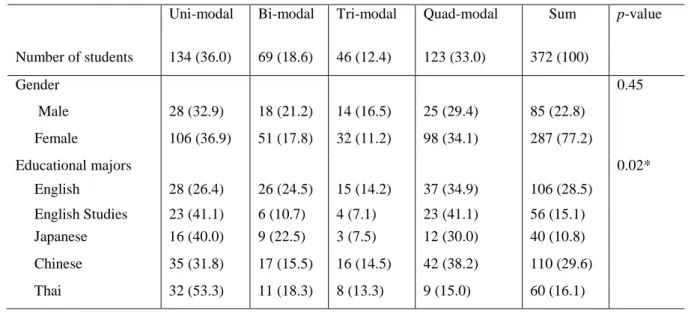
Table 1. Learning style preferences among first-year undergraduate students by gender and educational majors a
Note: a Data presented as No. (%); * p< 0.05
As shown in Table 1, significant differences were observed between preferred learning styles and educational majors (2= 24.4, p=0.02). By contrast, no significant differences were found between learning style preferences and gender (2= 2.65, p=0.45). Of the 106 students majoring in English, 28 students (26.4%) had single-modal style preferences and the remaining (73.6%) had multi-modal learning style preferences (26 students (24.5%) preferred bi-modal, 15 (14.2%) preferred tri-modal and 37 (34.9%) preferred quad-modal learning styles). Of the 56 the English Studies majors, 41.1% of the students were uni-modal while 58.9% were multimodal in their learning preferences (6 students [10.7%], 4 [7.1%], and 23 [41.1%] tended to use bi-modal, tri-modal, and quad-modal learning styles respectively). Among 40 Japanese major students, 16 students (40%) had uni-modal learning style preferences, and the remaining (60%) had multi-modal learning style preferences (9 students [22.5%], 3 [7.5%], and 12 [30.0%] preferred bi-modal, tri-modal and quad-modal learning styles respectively). For the Chinese majors, 35 students (31.8%) preferred only one mode of learning, and most students (62.2%) were multimodal learners (17 students [15.5%] preferred bi-modal, 16 [14.5%] and 42 [38.2%] preferred tri-modal and quad-modal learning styles respectively. Conversely, more than half of Thai major students (53.3%) preferred one single modal and 28 students (46.7%) preferred multimodal learning styles (11students [18.3%] preferred bi-modal, 8 [13.3%] and 9 [15.0%] preferred tri-modal and quad-modal learning styles respectively).
Uni-modal Bi-modal Tri-modal Quad-modal Sum p-value
Number of students 134 (36.0) 69 (18.6) 46 (12.4) 123 (33.0) 372 (100)
Gender 0.45
Male 28 (32.9) 18 (21.2) 14 (16.5) 25 (29.4) 85 (22.8)
Female 106 (36.9) 51 (17.8) 32 (11.2) 98 (34.1) 287 (77.2)
Educational majors 0.02*
English 28 (26.4) 26 (24.5) 15 (14.2) 37 (34.9) 106 (28.5)
English Studies 23 (41.1) 6 (10.7) 4 (7.1) 23 (41.1) 56 (15.1) Japanese 16 (40.0) 9 (22.5) 3 (7.5) 12 (30.0) 40 (10.8)
Chinese 35 (31.8) 17 (15.5) 16 (14.5) 42 (38.2) 110 (29.6)
Table 2. Percentage distribution of single-modal learning styles according to educational majors
Table 2 shows the frequency distribution (%) of single-modal learning styles with respect to educational majors. While Kinesthetic learning style was the highest prevalent for all educational majors, except for Chinese major, the percentage of students who preferred the kinesthetic one varied significantly among different majors. It was preferred by 17.0 percent of English major students, 18.3 percent of students majoring in Thai, 21.4 percent of students majoring in English studies, and 27.5 percent of students majoring in Japanese. For Chinese majored students, auditory mode (11.8%) was the most prevalent unimodal learning preference, followed by read-write (9.1%) and visual (7.3%) modes. The kinesthetic learning style was preferred by only 3.6 percent of students of Chinese major.
Thus, the findings of this study clearly show that the distribution of learning style preferences between students of different majors was not the same. Consequently, they cannot be taught with the same instructional strategies and styles.
4. Discussion
In this study, most students (64.0 %) preferred multi-modal learning styles. The findings of this research are similar to those of previous studies (e.g. Baykan and Nacar, 2007; Kharb et al., 2013; Moayyeri, 2015), showing that most of the first-year undergraduate students majoring in languages preferred to use a combination of learning styles in order to receive and learn new information. This implies that the students learn better when they are taught by multiple modes of information presentation than when a single- mode learning is being used. According to Hyland (1993), students with multimodal learning styles have ability to process information in very different ways, and this helps to increase their chance for success in language learning compared to uni-modal learners. By using variety learning modes, this will help to enhance the students’ abilities to memorize, retain, and recall information (Fleming, 2001). Furthermore, this study, in line with previous research (e.g. Kharb et al., 2013; Nagesh, Manjunath, Dharmaraj, & Shrish, 2016; Trinidad, 2008), found that kinesthetic was the most prominent single mode of learning among first-year students. This result clearly demonstrates that students prefer active participation in the knowledge acquisition process. Therefore, active learning strategies that accommodate multiple learning styles, such as role-playing, debates, games, and discussions in class need to be promoted in the classroom. In particular, teachers can use these active learning activities even in large classrooms (Cortright et al., 2005; Lujan & DiCarlo, 2006).
Interestingly, a significant difference of learning style preferences and educational majors was found in this study. The findings suggest that students of different majors require different learning strategies to facilitate their success in learning. As found in the present study, students majored in English, and
Educational majors Uni-modal learning style preferences Multi-modal modes
V A R K total
English - 4.7 4.7 17.0 26.4 73.6
English Studies 7.1 10.7 1.8 21.4 41.1 58.9
Japanese 2.5 10.0 - 27.5 40.0 60.0
Chinese 7.3 11.8 9.1 3.6 31.8 68.2
Chinese had a broader range of learning preferences than those majored in English Studies and Japanese. Students majored in Chinese tended to be more auditory learners compared to students majored in English. For students majoring in Thai, read-write (20.0%) and kinesthetic learning styles (18.3%) have been found more dominant than other learning styles. Although it appears that most students from different language majors preferred multimodal with a dominance of kinesthetic learning, each major still contains students with different types of learning styles (Table 1-2). A recent study of 205 business students from different majors, including accounting, marketing, management, finance, economics, and general business have also found that students from different majors use different styles of learning. The findings showed that management majors were more kinesthetic learners, whereas marketing majors were more visual learners (Nikki, Stephen, & Marie, 2015). In addition, the results of other studies (e.g. Hativa, N., Birenbaum, M., 2000; Jones, Reichard, & Mokhtari, 2003; Moayyeri, 2015; Ultanir, Ultanir, & Orekeci Temel, 2012) revealed significant differences in learning style preferences among the students of different fields of study. The significant differences in students’ learning style preferences across language majors found in the present study indicated that teaching strategies and styles that are best suited for students in one academic major may not work best for others. Consequently, the same teaching methods may not be used for all students and subject areas, highlighting the importance of adjustment in teaching methods for each academic major.
Additionally, the findings of this study revealed that no significant association was observed between learning style preferences and gender among students majoring in languages. These findings are consistent with previous studies in this area (Al-Saud, 2013; Slater et al., 2007; Zeraati et al., 2008). However, it should be noted that there were more females than males in the study population of the present study (female = 287; male = 85). Multimodal learning styles were preferred by majority of students, and kinesthetic was the most preferred learning style for both sexes.
Of the unimodal learners, male students preferred visual presentation more than females, while female preferred auditory and reading-writing modes more than males. Although these differences fail to reach statistical significance, the diversity of learning styles among students needs to be addressed when designing the learning activities and materials. Crucially, evidence suggests that teaching based on students’ styles enhance students’ academic achievement (e.g. Burke and Dunn, 2003; Flemimg, 2001; Rochford, 2004). In other words, the learning styles approach to teaching improves academic performance and educational attainment of students. As such, it is essential that the instructors are aware of the learning styles of their students. Students’ learning styles are not static, but they can change and develop considerably over time depending on learning task, experience and context (Felder, 1995; Srijongjai, 2011). Furthermore, the learning style information will also help students be able to adapt their preferred learning modality to choose appropriate learning strategies for enhancing their learning (Kharb et al., 2013; Wen, 2011).
strategies and materials are adapted according to the students’ learning styles, an increase in student
engagement and academic achievement was observed (Peacock, 2001; Lovelace, 2005). The present study has some limitations that need to be addressed. One of the limitations is that the
use of VARK self-report questionnaire. Additionally, there may be also other factors affecting the learning styles of students, such as cultural background, socioeconomic status, and prior academic experiences (Caldwell & Ginther, 1996; Joy & Kolb, 2009). Therefore, future research should take such factors into account, and both quantitative and qualitative data collection methods, including questionnaires and interviews should be used to more fully explore the student’s preferred learning style. Despite the limitation of the study, the VARK learning styles inventory offers instructors with insight into their students’ learning styles, which can aid in improving both teaching and student learning that lead to higher academic achievement.
5. Conclusions
The findings reported in this study underscore the difference in the way students learn. Most language learners had multiple learning style preferences. Kinesthetic and auditory were the predominant unimodal learning stylesamong the first-year undergraduate students majoring in languages. In addition, a significant difference was observed between learning style preferences and educational majors. Therefore, instructors should address the students’ diverse learning styles in order to motivate them to engage in the learning process. This will not only create a better learning environment in the classroom but will also motivate students to pursue and achieve academic goals.
6. Ethics Committee Approval
The authors confirm that ethical approval was obtained from Chiang Rai Rajabhat University, Institutional Review Board (IRB) (Approval Date and Number: 30 January 2018 / ETH.CRRU 001/61).
References
Alqunayeer, H.S. & Zamir, S. (2015). Identifying learning styles in EFL classroom. International Journal of Learning and Teaching, 1(2), 82–87. DOI: 10.18178/ijlt.1.2.82-87
Al-Saud, L. & M., S. (2013). Learning style preferences of first-year dental students at King Saud University in Riyadh, Saudi Arabia: Influence of gender and GPA. Journal of Dental Education, 77(10), 1371–1378.
Altena, S. (2017). Over 100 years old-Barriers to implementing student-centred learning. Retrieved on October 18, 2018 from:https://www.hes.edu.au/sites/default/files/uploaded-content/field_f_content_file/teqsa_2017_conference_proceedings.pdf
Arthurs, J.B. (2007). A juggling act in the classroom: Managing different learning styles. Teaching and Learning in Nursing, 2(1), 2–7. DOI: 10.1016/j.teln.2006.10.002
Bhavin, H. P. (2013). Social Interaction Model. International Journal for Research in Education, 2(5), 30-32.
Burke, K. & Dunn, R. (2003). Learning style-based teaching to raise minority student test scores: There’s no debate. Social Studies, 94 (4), 167–170.
Burris, S., Kitchel, B., Molina, Q., Vincent, S., & Warner, W. (2008). The language of learning Styles. Techniques, 82 (2), 44-48.
Claxton, C.S. & Murrell, P.H. (1987). Learning styles: Implications for improving educational practices. Washington, DC: Association for the Study of Higher Education.
Caldwell, G. P. & Ginther, D. W. (1996). Differences in learning styles of low socioeconomic status for low and high achievers. Education, 117(1), 141-146.
Cortright, R.N., Collins, H.L. & DiCarlo, S.E. (2005). Peer instruction enhanced meaningful learning: ability to solve novel problems. Advances in Physiology Education, 29 (2), 107–111. Fayombo, G.A. (2013). Active learning strategies and academic achievement among some psychology
undergraduates in Barbados. International Journal of Educational and Pedagogical Sciences, 7(7), 2034–2038.
Fazarro, D.E., Pannkuk, T., Pavelock, D. & Hubbard, D. (2009). The Effectiveness of Instructional Methods based on Learning Style Preferences of Agricultural Students: A Research Tool for Continuous Improvement for Faculty in Career and Technical Education (CTE) Programs. Journal of Industrial Teacher Education, 45(3), 84-104.
Felder, R.M. (1995). Learning and teaching styles in foreign and second language education. Foreign Language Annals, 28(1), 21–31.
Felder, R.M. & Brent, R. (2005). Understanding student differences. Journal of English Education, 94(1), 57–72.
Fleming, N.D. & Mills, C. (1992). Not another inventory, rather a catalyst for the reflection. To Improve the Academy, 11, 137.
Fleming, N.D. (2001). Teaching and learning styles: VARK strategies. Christchurch. New Zealand. Gill, D. (2005). Meeting differing learning styles of non-traditional students in the second language
classroom. Journal of College Teaching & Learning, 2(8), 1-7.
Hativa, N., & Birenbaum, M. (2000). Who prefers what? disciplinary differences in students’ preferred approaches to teaching and learning styles. Retrieved on December 15, 2017 from: http://link.springer.com/article/10.1023/A%3A1007095205308.
Huitt, W. (2003). The information processing approach to cognition. Education Psychology Interactive. Valdosta, GA: Valdosta State University. Retrieved on March 12, 2018 from:https://pdfs.semanticscholar.org/f6d5/f813ca0ba9fbf871067babdf8689302daa7b.pdf
Hyland, K. (1993). Culture and learning: a study of the learning style preferences of Japanese Students. RELC Journal, 24(2), 69–91.
Jones, C., Reichard, C., & Mokhtari, K. (2003). Are students’ learning styles discipline specific? Community College Journal of Research and Practice, 27(5), 363-375.
Joy, S. & Kolb, D. (2009). Are there cultural differences in learning style?. International Journal of Intercultural Relations, 33, 69-85.
Kumar, M. K. (2016). Challenges of implementing student-centered strategies in classrooms. International Research Journal of Engineering and Technology, 3 (2), 1224-1227.
Lovelace, M. K. (2005). Mata-analysis of experimental research based on the Dunn and Dunn model. The Journal of Educational Research, 98(3), 176-183.
Lujan, H. L. & DiCarlo, S.E. (2006). First-year medical students prefer multiple learning styles. Advances in Physiology Education, 30(1), 13–16.
McCarthy, B. (1980). The 4MAT system: Teaching to learning styles with right left mode Techniques. Burlington, IL: Excel.
Marcy, V. (2001). Adult learning Styles: How the VARK© learning style inventory can be used to improve student learning. Perspective on Physician Assistant education. Journal of the Association of Physician Assistant Programs, 12 (2), 1–5.
Moayyeri, H. (2015). The impact of undergraduate students’ learning preferences (VARK Model) on their language achievement. Journal of Language Teaching and Research,6(1), 132–139.
Mondal, N. (2011). Evaluation of English language teaching methods used in higher secondary education in Bangladesh. Language in India, 11(12), 181–197.
Nagesh, R. G., Manjunath, S. M., Dharmaraj, B., & Shrish, P. (2016). A comparative study of the learning styles among 1st, 2nd, and final year MBBS students. International Journal of Basic & Clinical Pharmacology, 5(6), 2341-2344.
Nikki, S., Stephen, F. & Marie, K. (2015). How college Business students learn with emphasis on differences between majors. Journal of College Teaching & Learning, 12(4), 223-230.
Office of the National Education Commission (ONEC). (2000). Learning reform: A Learner-Centered Approach. Bangkok, Thailand: Wattana Panit Printing & Publishing Company Limited.
Office of the National Education Commission (ONEC). (2003). Education in Thailand 2002/2003. Bangkok: Amarin Printing and Publishing.
Oxford, R. (2001). Language learning styles and strategies. In. M. Celce-Murcia, Ed. Teaching English as a second or foreign language (3rd ed.). USA: Heinle & Heinle.
Peacock, M. (2001). Match or mismatch? Learning styles and teaching styles in EFL. International Journal of Applied Linguistics, 11(1), 1-20.
Peyman, H., Sadeghifar, J., Khajavikhan, J., Yasemi, M., Rasool, M., Yaghoubi, Y.M...& Karim,H. (2014). Using VARK approach for assessing preferred learning styles of first year medical sciences students: A survey from Iran. Journal of Clinical and Diagnostic Research, 8(8), GC01-GC04. Pawuttipatthrapong, S. (2014). VARK (Thai version), Chonburi (Thailand), Burapa University.
Retrieved on February 5, 2017 from: https://doi.org/10.3352/jeehp.2016.13.38.
Rochford, R. (2004). Improving academic performance and retention among remedial students. Community College Enterprise, 10, 23–36.
Schweisfurth, M. (2011). Learner-centered education in developing country contexts: From solution to problem?. International Journal of Educational Development, 31, 425-432.
Sims, R.R. & Sims, S.J. (2006). Learning styles and learning: A key to meeting the accountability demands in education. New York: Nova Science Publishers.
Srijongjai, A. (2011). Learning styles of language learners in an EFL writing class. Procedia- Social and Behavioral Sciences, 29, 1555–1560.
Thamraksa. (2004). Student-Centered Learning: Demystifying the Myth. Retrieved on November 8, 2018 from: http://www.bu.ac.th/knowledgecenter/epaper/jan_june2004/chutima.pdf.
Trinidad, O.C. (2008). Demographics and learning styles of Automotive Technology students. Thesis Master, South Illinois University.
Tongpoon-Patanasorn. (2011). Impact of learner-centeredness on primary school teachers: A Case Study in Northeast Thailand. The Journal of ASIA TEFL, 8(3),1–28.
Ultanir, E., Ultanir, Y. G., & Orekeci Temel G. (2012). The examination of university students’ learning styles by Means of Felder-Silverman Index. Education and Science, 37(163), 29-42.
Wen, Xu. (2011). Learning styles and their implications in learning and teaching. Theory and Practice in Language Studies, 1(4), 413–416.
Zeraati, A., Hajian, H. & Shojaian, R. (2008). Learning styles of medical and midwifery Students in Mashhad University of Medical Sciences. Journal of Medical Education, 12(1-2), 17–22.
Dil öğrenenlerinin öğrenme stillerini belirleme: Öğrenci merkezli yaklaşıma
doğru ilerlemede yararlı bir adım
Öz
Öğrencilerin öğrenme stillerini bilmek, etkili öğretim tasarımı için iyi bir başlangıç sağlar. Bu araştırmanın amacı lisans öğrencilerinin tercih ettiği öğrenme stillerini ve öğrenme stili tercihleri, cinsiyet ve eğitim branşları arasındaki ilişkiyi belirlemektir. Tayland, Chiang Rai Rajabhat Üniversitesi Dil Programına kayıt yapan ilk yıl lisans öğrencileri arasında kesitsel tanımlayıcı bir çalışma yapılmıştır. Basılı formdaki VARK anketi, 472 birinci sınıf lisans öğrencisine Chiang Rai Rajabhat Üniversitesi Dil Programında dağıtılmıştır. Öğrencilerin öğrenme stilleri tanımlayıcı istatistikler kullanılarak belirlenmiş ve öğrencilerin tercih ettiği öğrenme stili, cinsiyet ve akademik branşlar arasındaki ilişkiyi incelemek için ki-kare analizleri yapılmıştır. Öğrencilerden alınan toplam 372 anket% 78.81 yanıtlama oranı vermiştir. Bulgular çoğu dil öğrencisinin (% 64) multimodal öğrenme stili tercihlerine sahip olduğunu ortaya koymuştur. Öğrencilerin sadece% 36'sı tek modlu bir öğrenme stilini tercih etmiş ve kinestetik en çok tercih edilen öğrenme stilini oluşturmuştur. Eğitim dalları ile öğrenme stilleri arasında istatistiksel olarak anlamlı bir ilişki gözlenmiştir (p = 0.02). Bununla birlikte, cinsiyet ve öğrencinin öğrenme stili tercihleri arasında bir ilişki bulunmamıştır (p = 0.45). Bu çalışmanın bulguları, öğrenmeyi öğrenciler için daha ilgi çekici ve anlamlı kılan, farklı öğrenme stillerine sahip öğrencileri barındırmak için sınıfta çeşitli öğretim stratejilerinin kullanılması gerektiğini göstermektedir.
AUTHOR BIODATA
Dr. Sudarat Payaprom currently works as an English lecturer at the Faculty of Humanities, Chiang Rai Rajabhat University. She received a doctorate degree in TESOL from University of Wollongong, Australia. Her research interests include learning strategies, learning styles, the genre-based approach to language learning, and systematic functional linguistics.