Received 24 May 2020; received in revised form 12 August 2020; accepted 2 September 2020.
To cite this article: Vilas and Shirsat (2020). Influence of compressing pressure and sintering temperature on
Influence of compressing pressure and sintering temperature on
microstructure and mechanical properties of Ni-Cr based
composites
Vilas K. Patil 1,2*, Shirsat U.M. 1
1 Department of Mechanical Engineering, Amrutvahini College of Engineering, Sangamner, 422
608 Maharashtra, INDIA.
2 Faculty of Mechanical Engineering Department, K.K. Wagh Institute of Engineering Education
and Research, Nashik, 422003Maharashtra, INDIA.
*Corresponding author: [email protected]
KEYWORDS ABSTRACT
Composite powder Sintering temperature Mechanical properties Compacting pressure
1.0 INTRODUCTION
Ni-Cr based self-lubricating is used in various applications due to its combination with other elements Santos et al. (2020), Fattahi et al. (2020), Huang et al. (2017), Mohamad et al. (2017). With the addition of other elements in Ni-Cr composite, its physical and mechanical properties will improve for elevated temperature. Sliney (1982) and Ouyang et al. (2009) studied the Tribological properties of self-lubricant for high-temperature applications and still are one of the challenging problems in the manufacturing of self-lubricant for such application. Wu et al. (1997) developed Ni/MoS2 self-lubricating composites material for high-temperature applications with
the addition of MoS2. The properties of material improve up to a specific limit with the addition
of MoS2, but it is not used for higher temperature applications. Xiong (2001) investigated the
Ni-Cr-Mo-Al-Ti-B with the MoS2. The result says that the mechanical and Tribological properties of
the material are increased with the addition of MoS2 up to 10wt%. Hodgson et al. (2004), Vidal et
al. (2009) Zhang and Liu (2016) developed a Co-Cr-Mo base composite and studied in biomedical application due to its better corrosion resistance properties. Jia et al. (2013) investigate Ni-Cr self-lubricating composites with the addition of BaCr2O4 by hot pressing method for elevated
temperature up to 800oC. Wan et al. (2017) studied the physical and mechanical properties of
Ni-Cr based composite with two different sintering temperatures and reported the maximum porosity percentages for given applied load. Sabahi et al. (2019) studied the influence of sintering temperature 1150°C, 1300°C and 1450°C on Ti–Mo–B4C Composites and concluded that higher
temperature increases the characteristics of composite. Halpin-Tsai calculated the practical young’s modulus of composite and observed that, the practical value should be present between the theoretical values of young’s modulus. Various Researchers Mohamad et al. (2017) Sabahi et al. (2019) manufacture Ni-Cr base composite by using powder metallurgy process with different applied pressure, sintering temperature and studied the mechanical and Tribological properties for various applications, but still some development is required in such composition.
This work is to enhance the mechanical properties of Ni-Cr based self-lubricating material by compressing under 220 MPa, 275 MPa and 330 MPa pressure and different sintering temperature 900°C and 1000°C. Also, study its influence on mechanical characteristics.
2.0 EXPERIMENTAL PROCEDURE
Composition of Ni, Cr, Co, Si, Mo, Cu and W are selected as per the graph theory of Chen W K (1997) and multi-criterion Decision Making (MCDM) of Darji and Rao (2014). This Ni-Cr (12-15
μm average size, 99.9 wt.% purity) base composition is developed for high-speed engineering applications. Composite wt.% shown in Table 1 is uniformly mixed with binding agent by using a ball mill process having case-hardened stainless-steel ball (24 mm in diameter). The ratio of ball to powder is taken as 10:1 in weight. Here the milling process is done under Argon gas, with 08 hours having a rotational speed 400 rpm. The mixed composite powder is used for the preparation of respective specimens. The cylindrical-shaped green pallets with a diameter of 12mm × 30mm were pressed in ambient temperature (28°C) with uniaxial pressure 220 MPa,
275 MPa and 330 MPa. Computerized Universal testing machines having 150 T Capacity is used as a Mechanical press. To avoid the friction between the pressed powders during cold pressing,
the surface of the die is highly finished with Ra value 0.052 μm. Green pallets were kept in the
the furnace is noted 40°C per minute. To avoid the chemical reaction or oxidation, a closed system used an Ar gas flow as an inert blanket.
WF Mohamad et al. (2017) developed Ni-Cr based composites with and without the addition of solid lubricants (MoS2, silver and CaF2) prepared by the powder metallurgy method. The
Samples were sintered at two different temperatures, 1000°C and 1200°C. In this work, furnace temperature is maintained below the lowest melting point of given elements. Cu particles having a low melting point; hence sintering temperature used 9000C and 10000C for sintering different
batches manufactured green pallets were kept in the furnace at room temperature and time noted for such condition. Then after every 5 to 10 minutes, the temperature of the furnace was noted. After reaching the peak value of temperature, it kept constant for 2 hours. Then it is cool till the temperature of the furnace down up to 800C. Manufacturing green pallets and sintering process
duration for specimen I, II and III-IV, are 43, 24 and 18 hours respectively for (1000°C) sintering
Table 1: Typical Formulation of the pallets specimens fabricate.
Ni % Cr% Co% Si% Mo% Cu% W% PVA%
Specimen-I 27.21 49.19 12 2.75 4.6 2 2 0.25 Specimen-II 27.21 47.54 12.25 2.75 4 3 3 0.25 Specimen-III 51.75 24 12.25 1.75 5 3 2 0.25 Specimen-IV 48.21 25 14.08 2.75 4.6 2.8 2.31 0.25
Figure 1 shows the detailed temperature profile for sintering, from room temperature to 1000°C temperature and it takes 90 minutes for reaching this temperature. After reaching 1000°C temperature, it is stable for 2 hours. Then it cools down up to 80°C, such as sintering time present 16 Hours. All specimens were removed from the furnace under 80°C temperature and then kept in a tray for cooling till room temperature was noted.
Figure 1: Temperature Profile used in sintering for 10000°C condition.
Figure 2 shows the detailed temperature profile for sintering, from room temperature to 900°C furnace takes 60 minutes. After reaching this temperature, it is stable for 2 hours, and then again, it takes some time to cool down. The total time for such a process was 20 hours. After 20 hours, the temperature of the furnace was noted 86°C. All specimens were removed from the furnace under 86oC temperature and then kept in a tray for cooling till room temperature noted.
Figure 2: Temperature profile used in sintering for 900°C condition.
2.1 Mechanical Characteristics
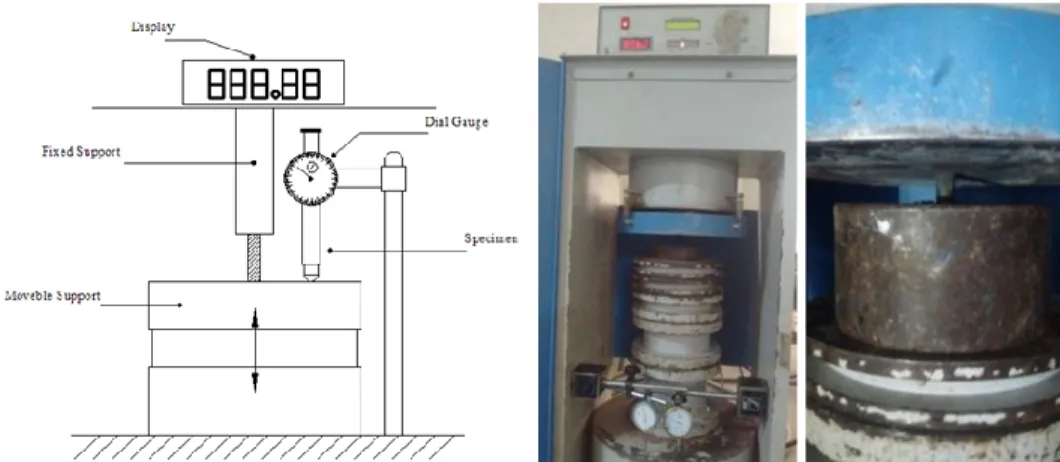
The modulus of elasticity and compression stress of the composite specimens calculated at room (29°C) temperature using an experimental setup, as shown Figure 3. The specimen is kept between two jaws and applies the pressure and notes the corresponding reading. Modulus of elasticity calculated based on volume changed. Crushing or compressive stress value calculated based on applied load till crack developed in specimen or break specimen.
Figure 3: Schematic/ Experiment setup for finding Young’s Modulus and crushing stress of
specimen.
3.0 RESULTS AND DISCUSSION
Table 2: Porosity percentages for different specimens. Specimen
Number Sintering Temp. (0C)
Porosity (%) Batch-I
(220MPa) Batch-II (275MPa) Batch-III (330MPa) 1 900 1000 4.082 3.830 3.769 2.938 2.446 1.909
2 900 4.304 3.475 2.755
1000 3.643 2.455 2.179
3 900 3.962 2.562 2.155
1000 3.330 2.324 1.865
4 900 3.495 2.856 2.501
1000 2.959 2.677 1.894
Figure 4: Porosity percentage under 900°C sintering Temperature for 220 MPa,275 MPa and 330 MPa pressure condition.
Figure 4 shows the porosity of Ni-Cr composite decreases for 330 MPa applied pressure on green pallets than the 220 MPa and 275 MPa. The porosity of Ni-Cr composite varies for the other elements wt.% and applied load. Such a trend is also the same for different load conditions under 900oC sintering temperature. Minimum porosity 2.15% is present for specimen 03 under 330MPa
Figure 5: Porosity percentage under 1000°C sintering Temperature for 220 MPa,275 MPa and 330 MPa pressure condition.
Figure 5 also shows the porosity of Ni-Cr composite decreases for higher side applied pressure on green pallets than lower pressure. The porosity of Ni-Cr composite varies for the other elements wt.% and applied load. Such a trend is also the same for different load conditions under 1000°C sintering temperature. Minimum porosity 1.865% is present for specimen 03 under 330MPa load condition and higher porosity 3.830% is present for specimen 01 under 220 MPa load condition under the 1000°C sintering temperature. As per the Sabahi (2019) it is proved that the porosities of composite specimens decrease with increased compressing pressure and sintering temperature, which has also been observed in Tosun et al. (2019) research.
3.1 Microstructure Analysis
Surface preparation of the final specimen done by using Silicon carbide paper grade 600, 800, 1000 and 1200, Alumina polishing powder (0.017-micron size, Rotary cotton surface having 800 rpm. For better results of microstructure, Acetone (CH3)2CO was used as an etchant. The final
surface was deep in acetone and used a hot dryer to remove the wet particles. In the final step, the specimen surface kept on an optical microstructure and observed its microstructure under 10
μm and 20 μm.
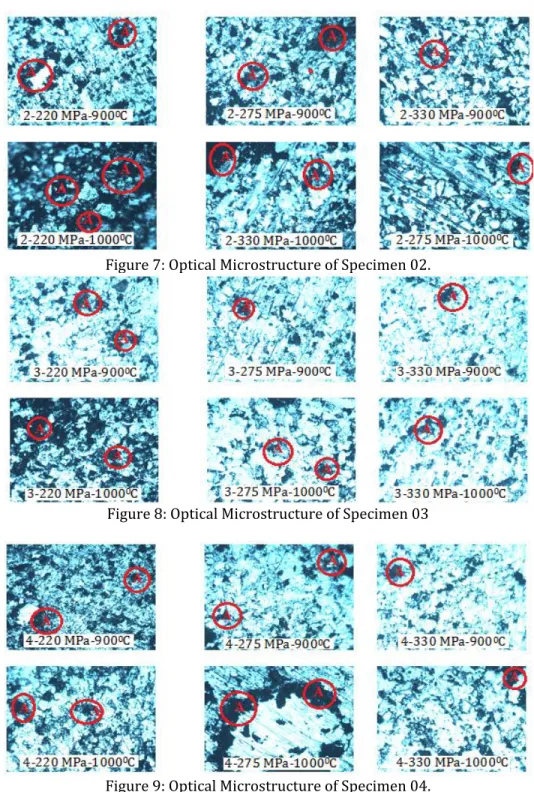
Figure 6 to 9 shows the detailed microstructure of Ni-Cr based composite for different sintering temperature and load.
Figure 7: Optical Microstructure of Specimen 02.
Figure 8: Optical Microstructure of Specimen 03
Figure 9: Optical Microstructure of Specimen 04.
sintering temperature and throughout the structure of specimens is the same. Specimens sintering under 900°C temperature covered the maximum black zone area than 1000°C sintering temperature. Also, the compressing pressure plays a vital role in porosity. If compressing pressure increases for manufactured specimens, then the porosity percentage decreases. In porosity contents, it observed that the porosity of specimens decreases with higher compressing pressure and sintering temperature. Han et al. (2017) studied particle scale on compaction composite powders. The result shows that higher compaction pressure and same compactness pressure change the microstructure and mechanical characteristics of a composite, including porosity and stresses. Through the above whole macrostructure, the percentages of porosity were decreased with increasing compactness pressure and sintering temperature, which has also been observed in Tosun et al. (2019).
Modulus of elasticity of composite calculated as per the experimental setup, as shown in Figure 3 and Equation 1 by applying forces on specimens, as shown in Table 3.
𝜕𝑙 = 𝑃𝐿
𝐴𝐸 (1)
Where,
𝜕𝑙= deformed length/ change in length (mm) 𝑃 = Applied force on Specimen (N)
𝐴 = Cross section area of specimen (mm2) 𝐿 = Length of Specimen (mm)
𝐸 = Modulus of Elasticity (GPa)
Table 3: The modulus of elasticity of Ni-Cr base composite specimen number 01 to 04. Specimen
Number
Sintering Temp. (0C)
Modulus of Elasticity (GPa) Batch-I
(220MPa)
Batch-II (275MPa)
Batch-III (330MPa) 1 900 1000 153.24 155.45 185.64 163.25 207.45 203.56
2 900 1000 171.23 173.64 135.26 184.25 205.63 173.56
3 900 1000 148.75 142.23 156.43 208.15 201.56 210.55
Figure 10: Modulus of Elasticity of specimen (900oC sintering Temperature and 220MPa,275MPa
and 330MPa compressing pressure condition).
Figure 10 shows the modulus of elasticity of Ni-Cr based composite notes with Co, Si, Mo, Cu and W with different wt%. Specimen 01 having maximum modulus elasticity 207.45 GPa than other specimens for 900°C sintering temperature for 330 MPa applied load. For 220 MPa and 275 MPa condition modulus of elasticity is less than 330 MPa condition under 900°C sintering temperature.
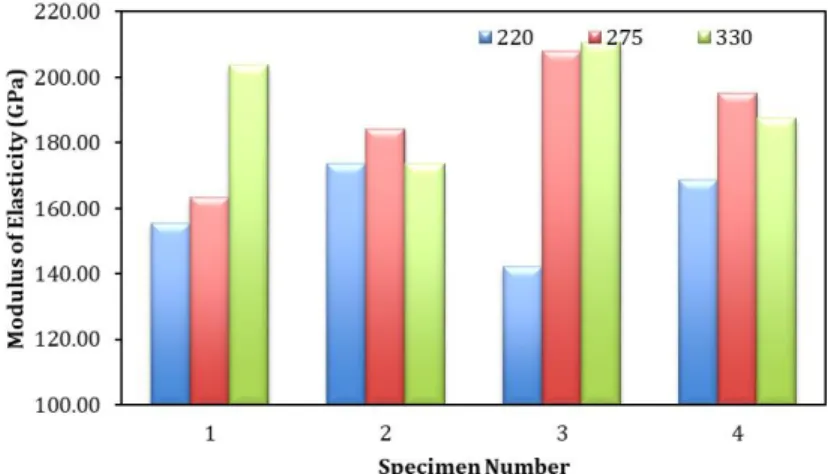
Figure 11: Modulus of Elasticity of specimen (1000°C sintering Temperature and 220 MPa, 275 MPa and 330 MPa compressing pressure condition).
Figure 11 shows the modulus of elasticity of Ni-Cr based composite notes with Co, Si, Mo, Cu and W with different wt.% under 10000C sintering temperature. Specimen 03 having maximum
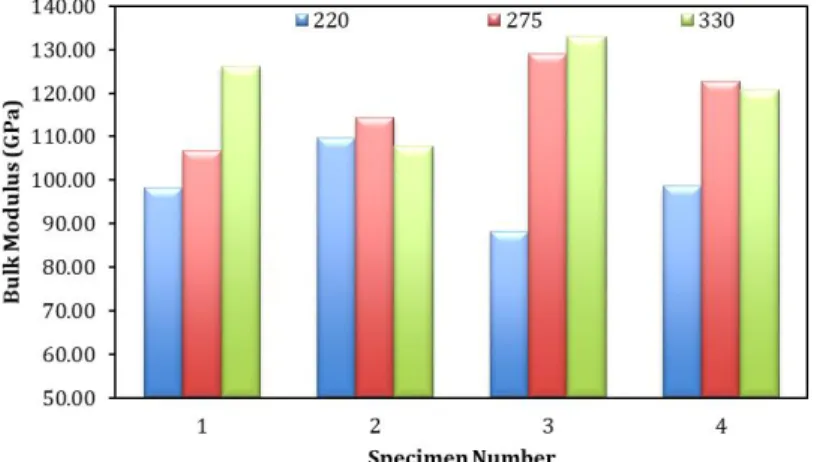
Bulk Modulus is calculated based on the relation between young’s modulus and Poisson’s ratio as per Equation 2 and using experimental setup Figure 3. Here the trend of the result is the same as the modulus of elasticity. Table 4 shows the bulk modulus of specimens with a range of 85.17 GPa to 132.98 GPa.
𝐾 = 𝐸
3(1 − 2𝜇) (2)
𝐾= bulk Modulus (GPa)
𝐸 = Modulus of Elasticity (GPa)
𝜇 = Poisson’s ratio
Table 4 Bulk modulus (K). Specimen
Number Sintering Temp. (0C)
Bulk Modulus (GPa) Batch-I
(220MPa)
Batch-II (275MPa)
Batch-III (330MPa)
1 900 94.593 116.31 130.47
1000 98.141 106.70 126.21
2 900 109.76 85.07 129.52
1000 109.66 114.33 107.73
3 900 93.24 98.05 127.30
1000 88.12 128.96 132.98
4 900 1000 108.13 98.70 126.27 122.77 127.44 120.77
Figure 13: Bulk Modulus of the specimen (1000°C sintering Temperature and 220 MPa,275 MPa and 330 MPa compressing pressure condition).
3.1 Hardness
A computerized micro hardness tester is used for measuring hardness value. 1 kgf load applied on a sample for 10 seconds along the diameter (core) of the specimen, and at least three indentations for hardness measured. Then the average of these readings is reported as the hardness value of that specimen, as shown in Table 5.
Table 5: Hardness range of specimen.
Specimen No. Sintering under 900°C Hardness Value(Hv) in range Sintering under 1000°C
1 185-199 192-210
2 198-212 196-214
3 212-236 208-245
4 209-242 202-238
Variation is present in hardens of Ni-Cr composite under the different sintering temperature conditions. Highest hardness value obtained at the 1000oC sintering temperature. The porosity of
the specimen and the particle present on the surface of the specimen decided the hardness value of the composite, which has also been observed in Tosun and Mehmet (2019) research work.
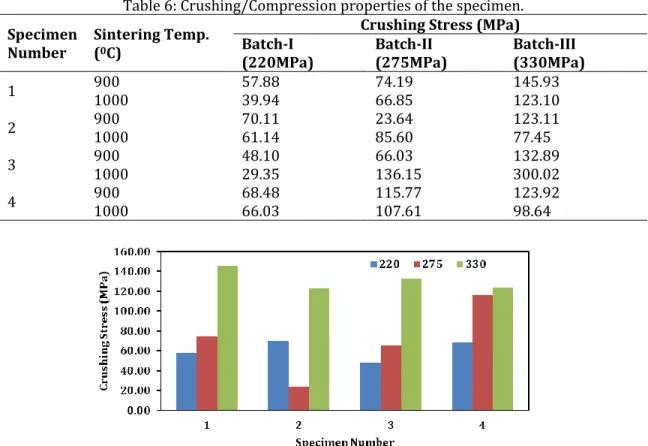
Table 6 shows the detailed values of crushing stress (MPa) for all specimens. For specimen 2 minimum stress values present 23.64 MPa for compacting pressure and sintering temperature 275MPa, 900oC, respectively. The maximum crushing stress values present for specimen 03 is
Table 6: Crushing/Compression properties of the specimen. Specimen
Number Sintering Temp. (0C)
Crushing Stress (MPa) Batch-I
(220MPa) Batch-II (275MPa) Batch-III (330MPa) 1 900 1000 57.88 39.94 74.19 66.85 145.93 123.10
2 900 70.11 23.64 123.11
1000 61.14 85.60 77.45
3 900 48.10 66.03 132.89
1000 29.35 136.15 300.02
4 900 68.48 115.77 123.92
1000 66.03 107.61 98.64
Figure 14: Crushing stress of specimen (900°C sintering Temperature and 220 MPa, 275 MPa and 330 MPa compressing pressure condition).
Figure 15: Crushing stress of specimen (1000°C sintering Temperature and 220 MPa,275 MPa and 330 MPa compressing pressure condition).
4.0 CONCLUSIONS
The dynamic process of Ni-Cr based composite powder compactness and sintering under different temperatures has been studied. The compression pressure effect on the compact composite and sintering temperature of the composite are discussed, and the mechanical characteristics of the composite are observed.
(a) With increased compression/compact pressure and sintering temperature on Ni-Cr composite, the porosity of composite decreases. Higher side compression 330MPa pressure plays a vital role in the proper bonding of particles in composition, and it avoids the maximum gap between them. This study is useful for deciding the initial load for pressed composite powder and selecting the sintering temperature for composite material.
(b) For maximum porosity percentage, a low load is sufficient for converting powder into a green pallet. Hence porosity is based on the selected load and sintering temperature. The results confirmed that the coaxial different compressing pressure plays an essential role in the mechanical characteristics of Ni-Cr based composition.
(c) Porosity % of Ni-Cr based composite decreases with 330MPa compacting pressure and 1000oC sintering temperature. The influence of Low Porosity % increases the
mechanical properties of Ni-Cr composite for different wt.% in the composition.
ACKNOWLEDGEMENT
REFERENCES
Altenbach, Holm, Johannes Wolfgang Kissing (2013). Mechanics of composite structural elements, Springer Science & Business Media.
Chen W K (1997) Graph Theory and its engineering application Advanced series in Electric and computer engineering, University of Illinois, Chicago.
Darji, V. P., & Rao, R. V. (2014). Intelligent multi criteria decision making methods for material selection in sugar industry. Procedia Materials Science, 5, 2585-2594.
Fattahi, Z., Sajjadi, S. A., Babakhani, A., & Saba, F. (2020). Ni–Cr matrix composites reinforced with nano-and micron-sized surface-modified zirconia: Synthesis, microstructure and mechanical properties. Journal of Alloys and Compounds, 817, 152755.
Han, P., An, X., Zhang, Y., Huang, F., Yang, T., Fu, H., & Zou, Z. (2017). Particulate scale MPFEM modeling on compaction of Fe and Al composite powders. Powder Technology, 314, 69-77. Hodgson, A. W. E., Kurz, S., Virtanen, S., Fervel, V., Olsson, C. O., & Mischler, S. (2004). Passive and
transpassive behaviour of CoCrMo in simulated biological solutions. Electrochimica Acta, 49(13), 2167-2178.
Huang, X. Y., Wang, J. H., Zhang, H. Q., Ren, J., Zan, Q. F., Gong, Q. M., & Wu, B. (2017). WC-Ni-Cr-based self-lubricating composites fabricated by pulsed electric current sintering with addition of WS2 solid lubricant. International Journal of Refractory Metals and Hard Materials, 66, 158-162.
Jia-Hu Ouyang , Xue-Song Liang, Zhan-GuoLiu, Zhen-Lin Yang, Yu-JinWang (2013). Friction and wear properties of hot-pressed NiCr–BaCr2O4 high temperature self-lubricating composites
Wear 301, 820–827
Lu, Yan, and Zuomin Liu (2013). A calculated model for the porosity effect of a self-lubricating composite on its lubrication property. Tribology International 60, 169-175.
Mechnik, V. A., Bondarenko, N. A., Kolodnitskyi, V. M., Zakiev, V. I., Zakiev, I. M., Storchak, M. & Kuzin, N. O. (2019). Physico-mechanical and Tribological Properties of Ni-Sn and Fe-Cu-Ni-Sn-VN Nanocomposites Obtained by Powder Metallurgy Methods. Tribology in Industry, 41(2).
Mohamad, W. F., Khan, A. A., Ahmad, F., & Yassin, A. (2017). Physical and Mechanical Properties of Ni-Cr based composites with addition of solid lubricants produced through powder metallurgy process. In MATEC Web of Conferences (Vol. 87, p. 02011). EDP Sciences.
Ouyang, J. H., Li, Y. F., Wang, Y. M., Zhou, Y., Murakami, T., & Sasaki, S. (2009). Microstructure and tribological properties of ZrO2 (Y2O3) matrix composites doped with different solid lubricants
from room temperature to 800° C. Wear, 267(9-10), 1353-1360.
Sabahi Namini, A., Shahedi Asl, M. & Delbari, S.A. Influence of Sintering Temperature on Microstructure and Mechanical Properties of Ti–Mo–B4C Composites. Met. Mater. Int. (2019). Santos, R. F., Rocha, A. F., Bastos, A. C., Cardoso, J. P., Rodrigues, F., Fernandes, C. M. & Vieira, M. F. (2020). Microstructural characterization and corrosion resistance of WC-Ni-Cr-Mo composite–The effect of Mo. International Journal of Refractory Metals and Hard Materials, 86, 105090.
Sliney, H. E. (1982). Solid lubricant materials for high temperatures—a review. Tribology International, 15(5), 303-315.
Tosun Gul and Mehmet Kurt (2019). The porosity, microstructure, and hardness of Al-Mg composites reinforced with micro particle SiC/Al2O3 produced using powder metallurgy.
Vidal, C. V., & Muñoz, A. I. (2009). Effect of thermal treatment and applied potential on the electrochemical behaviour of CoCrMo biomedical alloy. Electrochimica Acta, 54(6), 1798-1809. Wan Amir Faiz and Abdullah (2017). Physical and Mechanical Properties of Ni-Cr based composites with addition of solid lubricants produced through powder metallurgy process, MATEC Web of Conferences 87, 02011.
Wu, Y., Wang, F., Cheng, Y., & Chen, N. (1997). A study of the optimization mechanism of solid lubricant concentration in NiMoS2 self-lubricating composite. Wear, 205(1-2), 64-70.
Xiong, D. S. (2001). Lubrication behavior of Ni-Cr-based alloys containing MoS2 at high
temperature. Wear, 251(1), 1094–1099.