Sensitivity of PBL schemes of the WRF-ARW model in simulating the
dispersion modeling over a tropical station
RAHUL BOADH and A. N. V. SATYANARAYANA
Centre for Oceans, Rivers, Atmosphere and Land Sciences, Indian Institute of Technology Kharagpur, Kharagpur – 721302, India
Corresponding author: A. N. V. Satyanarayana: email: [email protected]
T. V. B. P. S. RAMA KRISHNA
Hyderabad – 500007, India SRIKANTH MADALA
Centre for Oceans, Rivers, Atmosphere and Land Sciences, Indian Institute of Technology Kharagpur, Kharagpur – 721302, India
Received: March 12, 2015; accepted: November 11, 2015
RESUMEN
Las circulaciones atmosféricas de mesoescala desempeñan un papel importante en el transporte de la contaminación del aire y en cuestiones relacionadas con la calidad del aire a nivel local. La estructura
desempeñan un papel importante en la dispersión de contaminantes en la atmósfera. Por lo tanto, se simu-laron los parámetros de la PBL sobre Naigpur, India, utilizando el modelo de mesoescala ARW v. 3.6.1. Las simulaciones de alta resolución se llevaron a cabo por medio de dominios anidados con resolución horizontal de 27, 9 y 3 km, y 27 niveles verticales obtenidos mediante la utilización de los campos
meteo-la evolución de los parámetros de meteo-la PBL y meteo-la estructura termodinámica durante el periodo de estudio, se eligieron ocho días de invierno y verano (enero y abril) con buen tiempo y ausencia de actividad sinóptica
la difusión turbulenta del cierre de energía cinética (TKE, por sus siglas en inglés) no locales (Yonsei University [YSU] y el Modelo Convectivo Asimétrico v. 2 [ACM2, por sus siglas en inglés]) y tres locales (Mellor-Yamada-Nakanishi and Niino Level 2.5 PBL [MYNN2], Mellor-Yamada-Janjic [MYJ] y elimina-ción de escala casi normal [QNSE, por sus siglas en inglés]). La validaelimina-ción de los parámetros simulados mediante el modelo con los datos in situ disponibles reveló que el esquema PBL no local YSU seguido
termodinámica de la atmósfera. Los resultados del estudio sugieren que los esquemas PBL, en especial YSU y MYNN2, tuvieron un mejor desempeño para representar los parámetros de la capa limítrofe y son útiles en estudios de dispersión de contaminantes atmosféricos.
ABSTRACT
Mesoscale atmospheric circulations play an important role in the transport of air pollution and local air quality -portant role in air pollution dispersion. Hence, the PBL parameters over Nagpur, India are simulated using the
© 2016 Universidad Nacional Autónoma de México, Centro de Ciencias de la Atmósfera.
ARW v. 3.6.1 mesoscale model. High-resolution simulations are conducted with triple nested domains having
a horizontal resolution of 27, 9 and 3 km, as well as 27 vertical levels by using the 1 × 1º NCEP Final Analysis
meteorological fields for initial and boundary conditions. Eight fair-weather days in winter and summer (Janu
-ary and April 2009) with no significant synoptic activity were chosen for the study. Sensitivity experiments of the ARW model were conducted with two non-local (Yonsei University [YSU], and Asymmetric Convective
Model v. 2 [ACM2]) and three local turbulence kinetic energy (TKE) closure (Mellor-Yamada Nakanishi and
Niino Level 2.5 PBL [MYNN2], Mellor-Yamada-Janjic [MYJ], and quasi-normal scale elimination [QNSE])
turbulence diffusion parameterizations, to study the evolution of PBL parameters and the thermodynamical
structure during the study period. After validation of the simulated parameters with the available in situ data, it was revealed that the non-local PBL scheme YSU, followed by local scheme MYNN2, could be able to
capture the characteristic variations of surface meteorological variables and the thermodynamical structure of the atmosphere. The present results suggest that PBL schemes, namely YSU and MYNN2, performed better in representing the boundary-layer parameters and are useful for air pollution dispersion studies.
Keywords: Planetary boundary layer, WRF, mesoscale, thermodynamical structure.
1. Introduction
The planetary boundary layer (PBL) is the lowest 1-3 km region of the atmosphere within the troposphere, characterized by friction and turbulent mixing (Stull,
1988; Garratt, 1994). The boundary-layer processes
are especially influential in the evolution of the lower atmospheric flow field and other state parameters.
The PBL plays an important role in the transportation of energy (including momentum, heat and moisture) into the upper layers of the atmosphere and acts as a
feedback mechanism in wind circulation. The depth
and structure of the atmospheric boundary layer are determined by the physical and thermal properties
of the underlying surface along with the dynamics and thermodynamics of the lower atmosphere. The thermodynamical state of the PBL plays a significant role in mixing and dispersion of air pollutants.
In particular, the PBL turbulence diffusion plays
an important role in the evolution of lower atmo
-spheric phenomena, which in turn determines air
pollution dispersion and its transport. PBL parame-terization schemes are essential for better simulations
of air quality, wind components and turbulence in the lower part of the atmosphere (e.g., Steeneveld et al., 2008; Storm et al., 2009; Hu et al., 2012; García-Diez
et al., 2013). The literature indicates that initial as
well as boundary conditions, resolution, and physical
process parameterizations play an important role in better simulations of atmospheric dynamics (Mc-Queen et al., 1995; Pielke and Uliasz, 1998; Warner
et al., 2002; Jiménez et al., 2006).
Though numerical models incorporate well-de -veloped physics such as surface heat, moisture bud-gets, canopy effects, and boundary-layer turbulent
diffusion to resolve the flow, representation of these processes at the model grid resolution is subject to
several input data. The thermo-dynamical state of the
PBL plays important role in mixing and dispersion
of air pollutants.
Mesoscale models include complete physics for convection, boundary-layer turbulence, radiation and
land-surface processes which play an important role in simulations of various extreme events in general and especially in weather forecasting. The PBL turbulence
diffusion in particular plays an important role in the
evolution of lower atmospheric phenomena such as
convective thunderstorm development, pollution diffu-sion and transport. PBL parameterization schemes are
important for accurate simulations of turbulence, wind and air quality in the lower atmosphere. Some studies were reported in literature regarding the sensitivity of
the PBL schemes of mesoscale models (e.g., Srinivas et al., 2007; Li and Pu, 2008; Storm et al., 2009; Miao et al., 2009; Hu et al., 2010, 2012, 2013; López-Espinoza and Zavala-Hidalgo, 2012; García-Diez et al., 2013; Srikanth et al., 2014).
Several recent studies emphasized the role of PBL parameterization in atmospheric simulations
with mesoscale models (e.g., Hu et al., 2010; Gil-liam and Pleim, 2010; Shin and Hong, 2011; Floors
et al., 2013; Yang et al., 2013). Papanatasiou et al. (2010) have used the Weather Research and Forecasting (WRF) modeling system to study the
wind field over the east coast of central Greece
under summer conditions. Over tropical Indian
regions, relatively few studies are available on the
performance of PBL schemes in mesoscale models
In a sensitivity experiment of the WRF model for
thunderstorm predictions, Srikanth et al. (2014)
noticed that the Mellor-Yamada-Janjic (MYJ) local
diffusion PBL scheme produced better results over the tropical hilly station Gadanki. Air quality assess-ment requires accurate predictions of boundary-layer
temperature, humidity, winds and mixed-layer depth.
The YSU, a non-local diffusion scheme and the
MYNN2, a local diffusion scheme captured well
the PBL structures over the tropical coastal station
Kalpakkam during fair weather conditions (Harip -rasad et al., 2014). Srikanth et al. (2015) studied the sensitivity of different PBL schemes available in the Advanced Research WRF (ARW) mesoscale model
in simulating the PBL flow-field and other param -eters over Ranchi during different seasons. After
validating with available in situ measurements, their study reported that the ACM2 followed by MYNN2
and YSU PBL turbulent diffusion parameterizations
has shown better performance in simulating surface
meteorological variables. Boadh et al. (2015) have
explored the sensitivity of the ARW model over Visakhapatnam and concluded that the non-local
schemes YSU followed by ACM2 better simulate surface meteorological variables as well as the ther -modynamical structure of the atmosphere.
In this study the flow-field and atmospheric pa -rameters over the Nagpur region are simulated using ARW v3.6.1 mesoscale model to evaluate its
perfor-mance for lower atmospheric meteorological fields by conducting sensitivity experiments with various
conceptually different PBL schemes.
2. Study region
Nagpur (21.15º N, 79.09º E) is the largest city in central India and the second capital of the state of
Ma-harashtra. It is a fast growing metropolis, is the third
most populous city in Maharashtra after Mumbai and Pune, and the center for urbanization, development,
industrialization and commercial activity. However,
the efforts to enhance the green cover of the city,
which has a scrubbing effect on air pollutants are scarce. Nagpur has a tropical wet and dry climate (according to the Koppen climate classification) with dry conditions prevailing for most of the year. It is situated 312.42 masl. Summers are extremely hot, lasting from March to June, with May being the hottest month. During the winter period (November to January), temperatures can drop below 10 ºC over
the region. The highest recorded temperature in the
city was 47.9 ºC on May 22, 2013, while the lowest was 3.9 ºC.
3. Data and methodology 3.1 Data and study period
We have used the 1 × 1º final analysis (FNL) data
from the National Centre for Environmental Predic-tion (NCEP) in the present study. For validating the ARW model simulations, available meteorological
observations such as wind speed and wind direction
at 10 m height, temperature and relative humidity at 2 m height, obtained from the India Meteorological Department (IMD) for Nagpur airport are used. Avail-able upper air radiosonde observations consisting of
zonal wind (ms–1), meridional wind (ms–1), relative
humidity (%) and equivalent potential temperature (K), obtained from the Department of Atmospheric
Science, University of Wyoming (http://weather. uywo.edu/upperair/sounding.html), are used for
validation of the vertical structure of the atmosphere over Nagpur. Quality control of these data has been conducted as part of the Severe Thunderstorm Obser-vations and Regional Modeling (STORM) program,
and quality checks were conducted with DigiCORA
radiosondes and found reasonably good (Tyagi et al., 2013). Additionally, it is noticed from literature (Boadh et al., 2015; Srikanth et al., 2015) and many researchers have used these radiosonde data sets,
which ensures the good quality of data and allows us
to use it for validation in the present study. Atrri and
Tyagi (2010) suggest, according to the IMD, classifi
-cation of the different seasons as winter (December,
January and February), summer or pre-monsoon (March, April and May), monsoon (June, July, August and September) and post-monsoon (October, Novem-ber). In the present study, to test the model sensitivity
of five PBL parameterization schemes, two contrast
-ing months (January, represent-ing the winter season,
and April, representing the summer season) are con-sidered. For each month, simulations are conducted for eight fair weather days during which no signif
-icant synoptic activities occurred. These days were
chosen in order to conduct the performance of the
PBL parameterizations without any influence of ex
-ternal weather event influences. Accordingly, in the
present study the selected dates for simulations of
for winter, and 00:00 UTC on April 08-15, 2009 for
the summer month, as initial conditions.
3.2 Model description – mesoscale model
To simulate the local scale flow and PBL character -istics over the Nagpur region, the ARW v. 3.6.1, 3-D non-hydrostatic atmospheric mesoscale model is used in the present study. The model consists of an Eulerian
mass solver with fully compressible non-hydrostatic equations, terrain following vertical coordinate, and staggered horizontal grid with complete Coriolis and
curvature terms. The prognostic variables include
three-dimensional wind, perturbation quantities of
pressure, geopotential, turbulent kinetic energy surface
pressure, potential temperature and scalars (water vapor mixing ratio, cloud water, etc.). A detailed de -scription of the model physics, equations and dynamics is available in Skamarock et al. (2008).
3.3 Model configuration and initialization
Horizontal and vertical resolution are factors im-plied in modeling small-scale atmospheric phe-nomena. Though high resolution results in more precise, better-resolved, small-scale processes, it increases the numerical costs of the model (Mass
et al., 2002; Gego et al., 2005; Chou, 2011). For
this purpose the WRF model is designed with
three nested grids (27, 9 and 3 km) (Fig. 1) and 27 unequally spaced vertical sigma. The outer
domain (d01) covers a larger region with a 27 km
resolution and 60 × 60 grids. The second inner
domain (d02) has a 9 km resolution with 91 × 91
grids, and the innermost domain (d03) has a 3 km
resolution with 112 × 112 grids. The second and third nests are two-way interactive domains. The model is run using 1 × 1º six-hourly data from the
NCEP FNL for the initial and boundary conditions. The model physics options used are the Kain-Fritsch scheme (Kain, 2004) for convective
parameteriza-Table I. Overview of the WRF model
Dynamics Non-hydrostatic
Data NCEP FNL
Interval 6 h
Grid size Domain 1: (60 × 60) × 27, domain 2: (91 × 91) × 27, domain 3: (112 × 112) × 27 Resolution Domain 1: 27 × 27 km, domain 2: 9 × 9 km, domain 3: 3 × 3 km
Covered area 13.8-27.4º N, 71.9-86.2º E
Map projection Mercator
Horizontal grid system Arakawa-C grid
Integration time step 90 s
Vertical coordinates Terrain-following hydrostatic pressure vertical coordinate with 27 vertical levels
Time integration scheme 3rd order Runga-Kutta scheme Spatial differencing scheme 6th order center differencing
PBL scheme 1) YSU, 2) MYNN2, 3) MYJ, 4) QNSE, 5) ACM2 Surface layer parameterization Noah land surface scheme
Microphysics Eta microphysics
Short wave radiation Dudhia scheme
Long wave radiation RRTM scheme
Cumulus parameterization Kain-Fritsch scheme
Nagpur d02
26
24
22
20
18
16
14
72 74 76
Longitude E (º)78 80 82 84 86
Latitude N (º
) d03
tion, WRF single moment class 6 (WSM6) (Hong
et al., 2006) for cloud microphysics, the NOAH land surface model (Chen and Dudhia, 2001) for surface physics, the Rapid Radiative Transfer Model
(Mlawer et al., 1997) for long-wave radiation process
-es, and the Dudhia scheme for short wave radiation
(Dudhia, 1989). The modeling domains and config -uration are presented in Table I.
3.4 PBL sensitivity experiments
The PBL parameterizations and land surface influ
-ence the simulation of turbul-ence, winds, and other state variables in the lower atmosphere. In the present study, to test the model sensitivity five PBL parame
-terizations schemes, namely two non-local schemes
(Yonsei University [YSU] [Hong et al., 2006], and Asymmetric Convective Model v. 2 [ACM2] [Pleim, 2007]), and three local turbulence kinetic energy
(TKE) closure (Mellor-Yamada Nakanishi and Nii-no Level 2.5 PBL [MYNN2] [Nakanishi and NiiNii-no, 2004], Mellor-Yamada-Janjic [MYJ] [Janjic, 2002],
and quasi-normal scale elimination [QNSE] [Suko-riansky et al., 2005]) are selected. Several recent studies emphasize the role of PBL parameterization in
atmospheric flow-field simulations (e.g., Skamarock
et al., 2008; Shin and Hong, 2011; Xie et al., 2012; Floors et al., 2013; Srikanth et al., 2014; Hariprasad
et al., 2014; Kleczek et al., 2014, Boadh et al., 2015; Srikanth et al., 2015).
3.5 Model validation and statistical evaluation
The model-generated surface meteorological vari-ables such as air temperature (AT), relative humidity (RH) at 2 m, wind speed (WS), wind direction (WD)
10 m above the ground level, and vertical profiles of zonal wind, meridional wind, relative humidity and
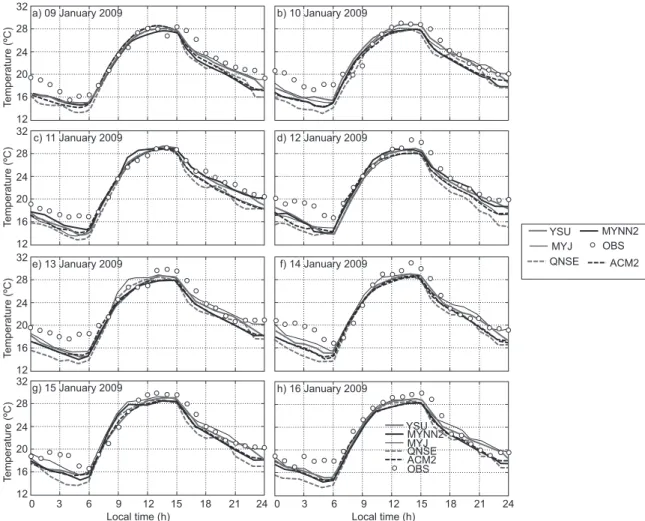
Fig. 2. Validation of model simulation of air temperature (AT) (°C) with observations during the study period
(January 2009) over Nagpur.
32 a) 09 January 2009 b) 10 January 2009 28
24 20
Te
mperature (ºC) 16
12
32 c) 11 January 2009 28
24 20
Te
mperature (ºC)
16 12
d) 12 January 2009
32 e) 13 January 2009 28
24 20
Te
mperature (ºC) 16
12
f) 14 January 2009
32 g) 15 January 2009 28
24 20
Te
mperature (ºC) 16
12
0 3 6 9 12
Local time (h)15 18 21 24 0 3 6 Local time (h)9 12 15 YSU MYNN2 MYJ QNSE ACM2 OBS
18 21 24 h) 16 January 2009
YSU MYNN2 MYJ
equivalent potential temperature during the study
period (representative days of the summer and win
-ter seasons) are validated with the available surface meteorological observations as well as radiosonde
observations. Results are compared qualitatively and quantitatively for both surface meteorological
variables as well as the thermodynamical structure of
the atmosphere. Quantitative comparisons are based on error statistics mean bias (MB), mean absolute error (MAE), root mean square error (RMSE) and
correlation coefficient (CC) (Wilks, 2011).
4. Results and discussion
4.1 Surface meteorological parameters
In this section an intercomparison of performance of various PBL parameterization schemes in simulating the diurnal variation of surface meteorological vari-ables such as AT (ºC), RH (%), WS (ms–1) and WD (º),
along with in situ observations at hourly intervals at
the Nagpur station, is presented.
4.1.1 Air temperature
The diurnal variation of air temperature (AT) in
Jan-uary 2009 is shown in Fig. 2. The model was able to
capture a similar trend of evolution for the diurnal variation as seen in the observations. During night-time, a slight cold mean bias (i.e., observation-model < 0) is noted in January 2009. The MYJ, MYNN2 and
YSU are closer to the observations in comparison with
the rest of the schemes. Based on the analysis, more
cold bias has been noticed with the simulations using the QNSE scheme than with the other schemes during
nighttime. During daytime, all PBL schemes are
in good agreement with the observation. The diurnal
variation of AT in April 2009 has been depicted in Fig. 3, and it can be noticed that all PBL schemes Fig. 3. Validation of model simulation for air temperature (AT) (°C) with observations during the study period
(April 2009) over Nagpur. 45 a) 09 April 2009
35
25
Te
mperature (ºC)
15
0 3 6 9 12
Local time (h)15 18 21 24 0 3 6 Local time (h)9 12 15 18 21 24
YSU MYNN2 MYJ
QNSE ACM2 OBS 45 c) 11 April 2009
35
25
Te
mperature (ºC)
15
b) 10 April 2009
d) 12 April 2009
45 e) 13 April 2009
35
25
Te
mperature (ºC)
15
f) 14 April 2009
45 g) 15 April 2009
35
25
Te
mperature (ºC)
15
exhibits cold mean bias. In general comparison, one
can see that, YSU, MYJ and MYNN2 schemes are in
good agreement with the observations in comparison with the other scheme. Overall, QNSE simulations of AT have shown more cold bias during nighttime both during January and April, whereas all the PBL schemes are in agreement with the observations. Sim -ilar results are reported by García-Diez et al. (2013) over Europe and Srikanth et al. (2015) over Ranchi.
On close examination, it is noticed that non-local
scheme YSU and local schemes MYNN2 and MYJ
simulate AT reasonably well.
4.1.2 Relative humidity (RH)
The diurnal variation of relative humidity (RH)
du-ring January and April 2009 is shown in Figs. 4 and 5,
respectively, over Nagpur. RH is overestimated by
most of the schemes, but they were able to capture
the similar trend of diurnal variation, as shown in the
observations during both months. It is clearly seen
in Fig. 5 that RH is lower in April because Nagpur
is hot and dry during summer.
In general, YSU, ACM2 and MYJ schemes better simulated the RH and captured the diurnal variation
reasonably well as compared to other schemes.
In January and April, the local scheme QNSE sim-ulated a higher magnitude of RH compared to other schemes. The overestimation of RH by QNSE may be attributed to cold bias. Similar type of the varia-tions has been reported by Srikanth et al. (2015) over Ranchi and Hariprasad et al. (2014) over Kalpakkam.
4.1.3 Wind speed and direction
Comparisons of wind speed (WS) and direction (WD) are made through joint frequency distribution plots and henceforth referred to as wind roses. The wind roses
Fig. 4. Validation of model simulations for relative humidity (%) with observations during the study period
(January 2009) over Nagpur. 100 a) 09 January 2009
80
60 40
Relative humidity (%
)
20 0
0 3 6 9 12
Local time (h)15 18 21 24 0 3 6 Local time (h)9 12 15 18 21 24
YSU MYNN2 MYJ
QNSE OBSACM2 b) 10 January 2009
d) 12 January 2009 100 c) 11 January 2009
80
60 40
Relative humidity (%
)
20 0
f) 14 January 2009 100 e) 13 January 2009
80
60 40
Relative humidity (%
)
20 00
100 g) 15 January 2009 80
60 40
Relative humidity (%
)
20 0
of model-generated WS and WD are compared with
observations for all study days during both January and April 2009. In the present study, wind roses are
prepared together for the eight chosen days during
Jan-uary and April; they are compared with observations
in Figs. 6 and 7, respectively.
Observed wind roses during January 2009 (Fig. 6f)
reveal that winds blow mostly from the east, northeast
and southeast. MYNN2 (Fig. 6b) and YSU (Fig. 6a)
show similar patterns but with smaller magnitudes. Regarding wind direction, MYNN2, YSU, and ACM2 (Fig. 6e) produced smaller magnitudes but were able to capture the easterly and northeasterly winds.
In January, MYJ and QNSE produced high
wind speeds (4-6 ms–1) compared to other PBL
schemes (YSU, MYNN2 and ACM2) in the east
and east-southeast directions. The wind roses for
April (Fig. 7) show strong wind speeds (6-8 ms–1)
from north and north-northeast winds and moderate north-northwest winds simulated by the ACM2,
QNSE and MYJ schemes (Fig. 7e, d, c). Winds from
north and north-northwest directions simulated by the
YSU and MYNN2 schemes (Fig. 7a, b,
respective-ly) with moderate wind speeds (4-6 ms–1) followed
slightly similar patterns of observation, but with
different magnitude.
Overestimation of winds seems to be a common experience with the WRF model, which was also reported by earlier works (e.g., Srikanthet al., 2013; Zhang et al., 2013; Hariprasad et al., 2014; Srikanth
et al., 2015). In general, during both January and
April, model simulated winds by the non-local YSU
and ACM2 schemes, and the local MYNN2 scheme
were better able to capture low wind conditions as
compared to MYJ and QNSE, as can be seen in the
observations. The overestimation of winds by the Fig. 5. Validation of model simulations for relative humidity (%) with observations during the study period
(April 2009) over Nagpur. a) 09 April 2009 80
60
40
Relative humidity (%
)
20
0
0 3 6 9 12
Local time (h)15 18 21 24 0 3 6 Local time (h)9 12 15 18 21 24
YSU MYNN2 MYJ
QNSE ACM2 OBS c) 11 April 2009
80
60
40
Relative humidity (%
)
20
0
b) 10 April 2009
d) 12 April 2009
e) 13 April 2009 80
60
40
Relative humidity (%
)
20
0
f) 14 April 2009
h) 16 April 2009 g) 15 April 2009
80
60
40
Relative humidity (%
)
20
WRF may be attributed to the non-accurate prescrip-tion of surface roughness and induced turbulence intensity in the atmospheric surface layer.
Hariprasad et al. (2014) have shown that YSU
and MYNN2 produce better PBL structures over the tropical coastal station Kalpakkam during fair
weather conditions. Srikanthet al. (2015) have also
shown that YSU, MYNN2 and ACM2 produce better
PBL structures over Ranchi. In general, our results
support and confirm that the YSU, MYNN2 and
MYJ schemes produce better PBL structures over the
Nagpur region. Based on qualitative comparisons, we noticed that YSU followed by MYNN2 simulated
most surface meteorological parameters reasonably
well in both January and April as compared to the
other tested PBL schemes. East
West
South North
a) YSU
10% 15%
20% 25%
5%
West
South North
c) MYJ
16% 20%
West
South North
b) MYNN2
East
10% 15%
20% 25%
5%
East
8% 12%
4%
West
South North
e) ACM2
20% 25%
>= 8.0 Wind speed
Calms: 0.0% (m/s)
7.0 - 8.0 6.0 - 7.0 5.0 - 6.0 4.0 - 5.0 3.0 - 4.0 2.0 - 3.0 1.0 - 2.0 0.0 - 1.0
East
West
South North
d) QNSE
12% 15%
East
6% 9%
3%
10% 15%
5%
West
South North
f) OBS
28% 35%
East
14% 21%
7%
4.2 Thermodynamical structure of the atmosphere
In this section we discuss the vertical profiles of zonal winds (ms–1), meridional wind (ms–1), relative
humidity (%) and equivalent potential temperature (K) derived from simulations using different PBL
schemes along with available radiosonde observa -tions. In Figure 8, the purpose of using θe instead
of potential temperature (θ) is that the former is a
conserved variable and better represents convective instability (Tyagi et al., 2013). Radiosonde
obser-vations data were obtained from the Department of
Atmospheric Science, University of Wyoming. Since these radiosonde observations are only available at 00:00 UTC (05:30 LT), model simulations are only validated during this time. This is one of the limita-tions of the present study.
East West
South
a) YSU
12% 16%
20%
c) MYJ
b) MYNN2
e) ACM2
>= 8.0 Wind speed
Calms: 0.0% (m/s)
7.0 - 8.0 6.0 - 7.0 5.0 - 6.0 4.0 - 5.0 3.0 - 4.0 2.0 - 3.0 1.0 - 2.0 0.0 - 1.0
d) QNSE
f) OBS
North
8% 4%
East West
South
15% 20%
25%
North
East West
South
18% 24%
30%
North
12% 6%
East West
South
15% 20%
25%
North
10% 5%
East West
South
20%
10% 5%
East West
South North North
12% 16%
8% 4%
9% 12%
15%
6% 3%
For the sake of continuity, we show the results for two days (January 10 and 13, 2009) for the winter month (Fig. 8) and two days (April 11 and 13, 2009)
for the summer month (Fig. 9). Model simulated
profiles for zonal wind (ms–1) (a, e), meridional
wind (ms–1) (b, f), relative humidity (%) (c, g),
and equivalent potential temperature θe (K) (d, h),
as well as parameters derived from radiosonde obser -vations over Nagpur at 05:30 LT on January 10 and 13, 2009, and April 11 and 13, 2009, are shown in
Figures 8 and 9, respectively. In general, and mostly
for the winter month, winds in the lower atmosphere up to 200 m (which can be seen in the observed pro
-files of zonal and meridional winds in Fig. 8a, b, e, f), blow in the northeast direction. The change of wind
direction to the southeast in the 200-1500 m layer, and
subsequently to the southwest in the 1500-2200 m layer and to the northwest above this height, can be
noticed in the radiosonde observations.
For summer, winds in the lower atmosphere
are mostly northerly, and up to 600 m they are
northeasterly; above that, most winds are found to be westerly and northwesterly, which can be noticed
in the radiosonde observations (Fig. 9a, b, e, f). All the PBL schemes reasonably simulated vertical
vari-ations of wind speed and direction for both seasons. For winter, RH in the lower atmosphere up to 3000 m was around 50-80% (Fig. 8c, g), and for summer a smaller magnitude of RH around 15-30% was noticed
in observations (Fig. 9c, g). RH variation for January
and April was well simulated in all the PBL schemes. Equivalent potential temperature in morning profiles
Fig. 8. Validation of model simulated vertical thermal structure profiles of (a, e) zonal wind (ms–1); (b, f) meridional
wind (ms–1); (c, g) relative humidity (%); and (d, h) equivalent potential temperature (θ
e) (K) with radiosonde obser
-vations at 05:30 LT over Nagpur on January10 and 13, 2009 (winter), respectively. (Obser-vations are given in circles.)
a) b)
3000
2500
2000
Height (m)
1500
1000
500
0
e)
3000
2500
2000
Height (m)
1500
1000
500
0 –15 –10
Zonal wind (ms–5 0 5 10–1)
c) d)
f)
Meridional wind (ms–1) Relative humidity (ms–1) θ
e (K)
–5 0 5 10 25 50 75 100 310 315 320 325
g) h)
OBS YSU
MYNN2 MYJ
generally shows stable conditions with stable layers ~500 m during the winter month and ~300 m over
the summer month. The observed vertical
varia-tion of equivalent potential temperature was well captured by all PBL schemes except for a smaller magnitude (around 2-3 K) for the lower atmosphere up to 500 m over the winter month (Fig. 8d, h) and a
higher magnitude around 2 K for the summer month (Fig. 9d, 9h).
The analysis of vertical profiles of the above pa -rameters reveals a clear-cut variation both in January
and April. These characteristics are well simulated by all PBL schemes, though with few differences.
Based on the results it can be observed that
qualita-tively the YSU followed by the MYNN2 scheme has
reasonably simulated the PBL vertical
thermodynam-ical structure of the atmosphere as compared to other PBL schemes over the Nagpur region.
4.3 Statistical analysis of surface meteorological variables and the thermodynamical structure of the atmosphere
A statistical analysis based on MB, MAE, RMSE and
CC between simulated and observed surface meteo
-rological variables such as AT, RH, WS and WD with five PBL schemes for the simulation period (eight days
in January 2009 and 8 days in April 2009) are given in Table II. Since the direct comparison of simulated
and observed wind directions can lead to large errors whenever wind fluctuations occur around 0º/360º, wind direction errors are assessed by comparing the vector winds (u, v) (Srikanth et al., 2015). It has been
Fig. 9. Validation of model simulated vertical thermal structure profiles of (a, e) zonal wind (ms–1); (b, f) meridional
wind (ms–1); (c, g) relative humidity (%); and (d, h) equivalent potential temperature (θ
e) (K) with radiosonde obser
-vations at 05:30 LT over Nagpur on April 11 and 13, 2009 (summer), respectively. (Obser-vations are given in circles.)
a)
e)
3000
2500
2000
Height (m)
1500
1000
500
0 3000
2500
2000
1500
1000
500
0 –8 –4
Zonal wind (ms–1)
0 4 8
Height (m)
Meridional wind (ms–1) Relative humidity (ms–1) θ
e (K)
–12 –8 –4 0 4 0 15 30 45 305310 315 320 325
OBS YSU
MYNN2 MYJ QNSE
ACM2
f) g) h)
found that all the PBL schemes simulated a cold bias
in temperature with YSU and MYJ, giving lesser
errors and higher correlations compared to other PBL schemes. For RH, all PBL schemes produced a humid bias. The relatively lesser errors and good correlations
obtained with YSU and ACM2 indicate these schemes
simulate the RH better than other PBL schemes. The
error statistics for winds show that a slight overestima -tion of their strength is noticed in the MYJ, QNSE, and
YSU schemes. However, the smaller RMSE and higher
correlations obtained from YSU, ACM2 and MYNN2
indicate these schemes have simulated wind speed reasonably well. Although most schemes adequately simulated wind direction, the higher correlations and lesser errors obtained with YSU, MYNN2 and ACM2 confirm that these schemes simulated better the wind direction than the other two schemes.
Overall, for various surface meteorological vari-ables, the YSU and MYNN2 schemes produced lesser
errors and were in better agreement with observations within the study region. A statistical analysis of MB, MAE, RMSE and CC between simulated and observed vertical profiles of zonal and meridional
wind components, relative humidity and equivalent potential temperature using five PBL schemes along with available observations, are given in Table III. Mean statistics show that all PBL schemes produce a
cold bias in RH and a cold mean bias (i.e., model-ob-servation < 0) in equivalent potential temperature.
Overall, regarding surface meteorological
vari-ables as well as the thermodynamical structure of
the atmosphere, the YSU and MYNN2 schemes
produced lesser errors and were in better agreement with observations within the study region compared
to other PBL schemes.
4.4 Sensible heat flux, latent heat flux and momen
-tum flux
Surface fluxes such as sensible heat (QH), latent heat
(QE) and momentum flux (MF) transported from the atmospheric surface layer to the atmosphere above
play a vital role in defining the vertical profiles of temperature, humidity and wind components in the
atmospheric boundary layer. In the present study,
the diurnal variation of these fluxes simulated with different PBL schemes of the WRF model are
Table II. Statistical analysis of air temperature (ºC), surface relative humidity (%), surface wind
speed (ms–1), zonal wind (ms–1) and meridional wind (ms–1) with different PBL schemes over Nagpur.
Parameter Errors YSU MYNN2 MYJ QNSE ACM2
Air temperature (ºC) MB MAE RMSE CC –1.04 1.56 1.93 0.97 –1.68 2.05 2.40 0.97 –1.03 1.70 2.13 0.97 –2.23 2.52 3.05 0.96 –1.60 2.03 2.41 0.97 Relative humidity (%) MB
MAE RMSE CC 4.66 9.72 12.41 0.88 5.13 10.19 13.00 0.87 5.75 10.14 12.95 0.88 9.25 12.26 15.61 0.88 5.43 9.79 12.54 0.89 Wind speed (ms–1) MB
MAE RMSE CC 0.33 0.78 1.04 0.53 –0.06 0.90 1.18 0.50 0.48 0.99 1.27 0.44 0.39 0.98 1.27 0.33 –0.09 0.84 1.09 0.50
Zonal wind (ms–1) MB
MAE RMSE CC –0.02 0.84 1.15 0.71 0.23 0.95 1.23 0.64 0.17 1.11 1.43 0.63 0.42 1.29 1.63 0.56 0.32 1.03 1.30 0.63
Meridional wind (ms–1) MB
presented in Figures 10 and 11, for January 10 and 13, 2009, and April 11 and 13, 2009, respectively.
Though all the PBL schemes simulated nearly similar values of nighttime QH, significant differences are found in daytime fluxes, especially in afternoon
hours (Fig. 10a, b and Fig. 11a, b) during both January
and April. The daily cycle shows in general higher fluxes in model simulated QH with QNSE and MYJ, compared to other schemes. Higher heat flux would lead to a strongly convective atmosphere and growth
of deep daytime PBLs (Srikanth et al., 2015). It is also noticed that QH magnitudes are higher during
April than in January.
The diurnal variation of latent heat flux (QE) is
shown in Figure 10c, d, and Figure 11c, d) during
January and April. As seen in the QH diurnal variation,
a similar trend is noticed in QE. In general, QNSE, MYJ simulated higher magnitudes of QE compared to the other schemes.
A higher momentum flux (MF) was noticed during April compared to that of January as shown in
Fig. 10e, f, and Fig. 11e, f). As with QH and QE, the WRF model with QNSE and MYJ simulated a higher
MF during April. From the analysis, it is noticed that
PBL schemes differ in the simulation of these flux -es during both January and April. From th-ese case
studies, it was observed that YSU and MYNN2 sim
-ulated smaller magnitudes of these fluxes compared
to QNSE, MYJ and ACM2.
4.5 PBL height, convective velocity scale and
venti-lation coefficient
Here we discuss the PBL height (PBLH) (also called mixed layer height), which attains significance in
air quality dispersion assessment, the convective velocity scale (W*), also called mixing scaling pa
-rameter, and the ventilation coefficient (VC). The VC is the product of the average wind speed and mixing layer height, which means that VC shows the
capacity of the atmosphere to disperse and reduce the pollutants over a region. VC is used as a direct measure to differentiate the degree of transport/ Table III. Statistical analysis of zonal wind (ms–1), meridional wind (ms–1), relative humidity (%),
and equivalent potential temperature (K) with different PBL schemes over Nagpur.
Parameter Errors YSU QNSE MYNN2 MYJ ACM2
Zonal wind (ms–1) MB –0.59 –0.65 –0.13 –0.34 –0.38
MAE 2.65 2.78 2.52 2.77 2.71
RMSE 3.28 3.44 3.18 3.36 3.37
CC 0.54 0.51 0.55 0.52 0.52
Meridional wind (ms–1) MB 0.18 0.63 0.47 0.57 0.63
MAE 2.79 2.97 2.65 2.69 2.70
RMSE 3.68 3.89 3.54 3.57 3.60
CC 0.55 0.55 0.56 0.55 0.59
Relative humidity (%) MB –9.17 –7.74 –9.11 –8.40 –8.85
MAE 11.17 10.20 11.13 10.67 11.15
RMSE 14.63 13.38 14.65 13.95 14.55
CC 0.87 0.88 0.87 0.88 0.87
Equivalent potential
temperature (K) MBMAE –2.234.46 –2.574.80 –2.644.64 –2.374.60 –2.394.60
RMSE 5.75 6.34 6.01 5.93 5.99
Fig. 10. (a, b) Model simulated sensible heat flux (Wm–2); (c, d) Latent heat flux (Wm–2); and (e, f) Momentum
flux (Nm–2), on January 10 and 13, 2009, respectively, over Nagpur.
300 a) 10 January 2009 250
200
100 150
50
–50 0
Sensible heat flux (W
m
–2)
0 3 6 9 12
Local time (h)15 18 21 24 0 3 6 Local time (h)9 12 15 18 21 24
YSU MYNN2 MYJ QNSE
ACM2 140 c) 10 January 2009
120 100
60 80
40
0 0.16 0.14 0.12 0.1 0.08 0.06 0.04 0.02 0 20
Sensible heat flux (W
m
–2)
Momentum flux (N
m
–2)
b) 13 January 2009
d) 13 January 2009
f) 13 January 2009 f) 10 January 2009
Fig. 11. (a, b) Model simulated sensible heat flux (Wm–2); (c, d) Latent heat flux (Wm–2); and (e, f) Momentum
flux (Nm–2), on April 11 and 13, 2009, respectively, over Nagpur.
450 a) 11 April 2009 400
300 350
150 200 250
100
–500 50
225 200 175 150 125 100 75 50 25 0 0.2
0.15
0.1
0.05
0
Sensible heat flux (W
m
–2)
Latent heat flux (W
m
–2)
Momentum flux (N
m
–2)
0 3 6 9 12
Local time (h)15 18 21 24 0 3 6 Local time (h)9 12 15 18 21 24
YSU MYNN2 MYJ QNSE ACM2 b) 13 April 2009
d) 13 April 2009 c) 11 April 2009
dispersion of pollutants taking place within the con
-vective boundary layer. It reflects the transport rate of populations in the mixing layer. Higher values
of VC indicate effective dispersion. The calculation of VC is given by
V = Xi Yi
where Xi is the atmospheric mixing layer height
above the ground (m), and Yi is the wind speed
near the ground (ms–1). Viswanahdam et al. (1993,
1995, 1997) reported the climatological atmospheric dilution indices, the dispersive capacity of the at-mosphere, and the utility of surface meteorological variables in atmospheric dispersion studies over Indian cities.
PBLH predictions are important for the
estima-tion of mean quantities (temperature, wind, etc.) in
meteorological models, and are also important for air pollutant dispersion modeling (Carruthers et al., 1994; Cimorelli et al., 2005; Steeneveld et al., 2008; García Diez et al., 2013; Boadh et al., 2015). It
rep-resents the effective region of turbulent mixing for
heat, moisture and pollutants. Errors in simulating
the mixed-layer depth would affect the mixing of pollutants. Deep mixed layers enhance the dispersion while shallow layers restrict the vertical diffusion of
pollutants. The employed PBL schemes in the present study estimate the PBLH differently. Hence, in our
study we used the model derived vertical profiles of wind components and temperature, and we estimated
the PBLH based on the approach suggested by Voge-lezang and Holtslag (1996). We computed the PBLH
with all five schemes for stable, unstable and neutral conditions. Simulations were made for PBLH, W*
and VC for all eight days both in January and April.
For the sake of continuity we show the analysis for
January 10 and 13, 2009, and April 11 and 13, 2009 in Figures 12 and 13, respectively.
The diurnal variation of PBLH obtained using various PBL schemes over Nagpur on January 10
and 13, 2009 is shown in Fig. 12a, b respectively,
and during summer on April 11 and 13, 2009 in Fig. 13a, b. We could not make direct comparisons of the simulated PBLH against observations, since observed PBLH measurements are not available.
However, an intercomparison of values from dif
-ferent numerical experiments provides the relative
performance of different PBL schemes.
The PBL schemes YSU and MYNN2 produce
shallow boundary layers in January and April, while
ACM2 and MYJ produce moderate deep boundary layers in both months. In general, it is noticed that
YSU and MYNN2 simulated relatively shallow
boundary layers (PBLH ~1600 ± 300 m); ACM2 and MYJ produced moderate boundary layers (PBLH ~2300 ± 300 m), and QNSE produced deeper layers (PBLH ~2900 ± 200 m) during January. For April,
YSU and MYNN2 also simulated relatively shallow
boundary layers (PBLH ~2300 ± 200 m), ACM2 and MYJ moderate boundary layers (PBLH ~2700 ± 400 m) and QNSE deeper layers (PBLH ~4500 ± 250 m). The diurnal cycle of simulated PBL heights indicates the QNSE produces relatively deep bound-ary layers in both Janubound-ary and April. QNSE yielded
deep boundary layers because it produced signifi
-cantly high sensible heat flux compared to other PBL
schemes. Kompalli et. al. (2014) found the deeper
mixing height during summer (~3014 ± 1187 m) and the shallower mixing height during winter (~1488 ± 706 m) over Nagpur. Deep boundary layers with QNSE, ACM2 were also reported by Hariprasasd
et al. (2014) at a tropical coastal site (Kalpakkam); Shin and Hong (2011) at mid-latitudes, and Srikanth
et al. (2015) over Ranchi. The mixing extremes with
the QNSE and ACM2 schemes found in our study support the results of earlier simulation studies.
The convective velocity scale is also called mixing
scaling parameter. Venkatram (1978) compared his theory to estimate different W* values at different
PBLHs with boundary layer data obtained during the
1973 Minnesota experiment (Kaimalet al., 1976). The diurnal variation of W* during daytime convection (W* > 0) obtained using various PBL schemes on January 10 and 13, 2009 is shown in Fig. 12c, d, re
-spectively, while for April 11 and 13, 2009 it is shown in Fig. 13c, d. In January, all PBL schemes except
QNSE simulated smaller magnitudes of W*, as seen in Fig. 12c, d. It can be noticed that QNSE simulated higher values (~2.5 ms–1), whereas values simulated by
MYNN2 were smaller (~1.7 ms–1), and simulations by
other schemes were within this range of magnitude. W*
is higher in April, as shown in Fig. 13c, 3d as compared
to January. Among the PBL schemes, QNSE simulated higher values (~3.9 ms–1), and MYNN2 smaller values
(~2.7 ms–1). The higher W* during April is attributed
to a more convective uplift due to sensible heat flux
Fig. 12. (a, b) Model simulated PBLH (m); (c, d) W* (ms–1); (e, f) VC (m2 s–1) for January 10 and 13, 2009,
respectively, over Nagpur. 3500 a) 10 January 2009 3000
2500 2000
1000 1500
500 0
PBLH (m)
VC (m
2S –1)
0 3 6 9 12
Local time (h)15 18 21 24 0 3 6 Local time (h)9 12 15 18 21 24
YSU MYNN2 MYJ QNSE ACM2 b) 13 January 2009
c) 10 January 2009 3
2
1
10
W.
(ms
–1)
d) 13 January 2009
e) 10 January 2009 12000
8000
4000
0
f) 13 January 2009
Fig. 13. (a, b) Model simulated PBLH (m); (c, d) W* (ms–1), and (e, f) VC (m2 s–1), on April 11 and 13, 2009,
respectively, over Nagpur. 5000
4500 4000 3500 3000 2500 2000 1500 1000 500 0 4
3
2
1
0
a) 11 April 2009
PBLH (m)
VC(m
2S –1)
W*
(ms
–1)
0 3 6 9 12
Local time (h)15 18 21 24 0 3 6 Local time (h)9 12 15 18 21 24
YSU MYNN2 MYJ QNSE
ACM2 b) 13 April 2009
24000 20000 16000 12000 8000 4000 0
e) 11 April 2009
c) 11 April 2009 d) 13 April 2009
The variation in VC during daytime and nighttime on January 10 and 13, and April 11 and 13, 2009 is
shown in Figures 12e, f, and 13e, f, respectively. The VC tended to be higher and significantly varied during daytime, while it was relatively lower and constant during nighttime in both months. Similar results were reported by Goyal and Chalapati (2007) for Kochi, who stated that VC was higher during the afternoon while it was lower during the evening and morning in all
seasons. QNSE produces a higher VC (~8 × 10³ m2 s–1
during winter and ~195 × 103 m2 s–1 in the summer),
while MYNN2 and MYJ produce a lower VC (~2 ×
103 m2 s–1 in January and ~8.5 × 10³ m2 s–1 in April,
respectively) compared to other schemes.
Kompalli et. al. (2014) estimated the VC and found its minimum mean value (~5.7 × 10³ ± 0.4 ×
103 m2 s–1) in January and its maximum (~15.160 ×
103 m2 s–1) in April 2012. We found results within the
range for VC in January 2009 on different days: ~5 × 10³ ± 0.5 × 10³ m2 s–1; however, in April it was under
-estimated: ~8 × 10³ ± 0.4 × 10³ m2 s–1. It was found that
VC was extensively variable and high during daytime, while it was quite invariable and low during night
-time, showing a higher dispersion capacity of the PBL during daytime and lower during nighttime.
5. Summary and conclusions
The main aim of the present study is to evaluate the performance of various PBL schemes of the WRF-ARW model in simulating the characteristics of me-soscale meteorological parameters over Nagpur for the application of air pollution dispersion studies.
The model is integrated with high resolution (3 km) to capture the boundary layer flow parameters over different topographical fluctuations over the study region. Simulations were performed for winter and
summer in order to study the application of simulat-ed meteorology in air quality assessment. Sensitivity
experiments were conducted using two non-local
(YSU, ACM2) and three local (MYNN2, MYJ, QNSE) turbulence kinetic energy (TKE) closure PBL turbulent diffusion parameterization schemes. The simulated thermodynamical structure of the atmosphere and surface meteorological variables
were validated with available observations over the
study region. Results indicate that the model could
capture the local scale flow field and site-specific
meteorological variables at Nagpur. Simulations
show widely varying flows, mixed layer height,
and air temperature both in January and April that
would impact the plume trajectory from pollutant
sources around the Nagpur region. The analysis of
different meteorological variables shows that these
are sensitive to the PBL parameterization employed in the model. In general, it has been found that for most variables, non-local scheme YSU and
the level 2.5 TKE scheme MYNN2 were in better agreement with observations, both qualitatively and
quantitatively. The model simulated deep to very
deep boundary layers during summer and shallow layers during winter. Among the different PBL pa
-rameterization schemes, QNSE followed by ACM2
and MYJ simulated relatively deep boundary layers,
and MYNN2 and YSU simulated relatively shallow
layers in both months (January and April). The VC simulated by QNSE compared to other schemes in both months (January and April). In January, VC
values simulated by all PBL schemes were much lower than observations, which means pollution
values may be very high in Nagpur during January.
A lower VC was simulated with YSU followed by
MYNN2 during the study periods. A statistical analysis based on MB, MAE, RMSE and CC re-vealed that YSU and MYNN2 scheme produced
smaller errors and were in better agreement with
observations regarding surface meteorological variables and the thermodynamical structure of the atmosphere over the study region, compared to other PBL schemes. Within its limitations, the study
advocates that non-local scheme YSU followed
by local TKE scheme MYNN2 are suitable for air pollution dispersion modeling studies over Nagpur.
Acknowledgments
Rahul Boadh would like thank the Indian Institute
of Technology Kharagpur for providing research
fellowship and necessary facilities to conduct his Ph.D. work. The first author gratefully acknowl -edges Dr. S. R. Wate, Director of NEERI, Nagpur for giving the necessary permissions and providing facilities to carry out part of the research in NEERI
Nagpur. Authors are grateful with two anonymous reviewers for their suggestions and comments for
improving the quality of the manuscript.
References
Environment Monitoring and Research Centre, India
Meteorological Department, New Delhi, 122 pp.
Boadh R., A. N. V. Satyanarayana, T. V. B. P. S. Rama Krishna and S. Madala, 2015. Sensitivity of PBL
parameterization schemes of weather research fore
-casting model and integration with AERMOD in the
dispersion of NOX over a coastal region of southern
Visakhapatnam (India). Asia-Pac. J. Chem. Eng. 10, 356-368.
Carruthers D. J., R. J. Holroyd, R. J. Hunt and J. C. R. Weng, 1994. UKADMS: A new approach to modelling
dispersion in the Earth’s atmospheric boundary-layer.
J. Wind Eng. Ind. Aerodyn.52, 139-153.
Chen F. and J. Dudhia, 2001. Coupling an advanced
land-surface/ hydrology model with the Penn State/
NCAR MM5 modeling system. Part I: Model de-scription and implementation. Mon. Weather Rev.
129, 569-585.
Chou S. H., 2011. An example of vertical resolution impact
on WRF-Var analysis. Electron. J. Oper. Meteorol.
12, 1-20.
Cimorelli A. J., S. G. Perry, A. Venkatram, J. C. Weill, R. J. Paine, R. B. Wilson, R. F. Lee, W. D. Peters and R. W. Brode, 2005. AERMOD: A dispersion model for industrial source applications. Part I: General model formulation and boundary-layer characterization. J. Appl. Meteorol.44, 682-693.
Dudhia J., 1989. Numerical study of convection observed
during the winter monsoon experiment using a me
-soscale two-dimensional model. J. Atmos. Sci. 46,
3077-3107.
Floors R., C. L. Vincent, S. E. Gryning, A. Peña and E. Batchvarova, 2013. The wind profile in the coast -al boundary layer: Wind lidar measurements and numerical modelling. Bound.-Lay. Meteorol. 147, 469-491.
García Diez M., J. Fernández, L. Fitaand C. Yague, 2013. Seasonal dependence of WRF model biases and sensi-tivity to PBL schemes over Europe. Q. J. R. Meteorol. Soc.139, 501-514.
Garratt J. R., 1994. The atmospheric boundary layer. Cambridge University Press, 316 pp (Cambridge At-mospheric and Space Science Series).
Gego E., C. Hogrefe, G. Kallos, A. Voudouri, J. Irwin
and S. Rao, 2005. Examination of model predictions
at different horizontal grid resolutions. Environ. Fluid
Mech.5, 63-85.
Gilliam R. C. and J. E. Pleim, 2010. Performance
assess-ment of new land surface and planetary boundary layer
physics in the WRF-ARW. J. Appl. Meteorol. Climatol.
49, 760-774.
Goyal S. K. and R. C. V. Chalapati, 2009. Assessment of atmospheric assimilation potential for industrial development in an urban environment: Kochi (India).
Sci. Total Environ.376, 27-39.
Hariprasad K. B. R. R., C. V. Srinivas, A. Bagavath Singh,
S. Vijaya Bhaskara Rao, R. Baskaran and B. Venkatra
-man, 2014. Numerical simulation and intercomparison
of boundary layer structure with different PBL schemes in WRF using experimental observations at a tropical
site. Atmos. Res.145, 27-44.
Hong S. Y. and J. J. O. Lim, 2006. The WRF single-mo-ment microphysics scheme (WSM6). J. Korean Me-teor. Soc.42, 129-151.
Hu X.-M., J. W. Nielsen-Gammon and F. Zhang, 2010. Evaluation of three planetary boundary layer schemes in the WRF model. J. Appl. Meteorol. Climatol.49, 1831-1844.
Hu X.-M., D. C. Doughty, K. J. Sanchez, E. Joseph and J. D. Fuentes, 2012. Ozone variability in the atmo-spheric boundary layer in Maryland and its implica-tions for vertical transport model. Atmos. Environ.
46, 354-364.
Hu X.-M., P. M. Klein and M. Xue, 2013. Evaluation of the
updated YSU planetary boundary layer scheme with in
WRF for wind resource and air quality assessments. J.
Geophys. Res. Atmos. 118, 10490-10505.
Janjic Z. I., 2002. Nonsingular implementation of the
Mellor-Yamada level 2. 5 scheme in the NCEP meso
model. NCEP Office Note. No. 437. National Centers
for Environmental Prediction, 61 pp.
Jiménez P., O. Jorba, R. Parra and J. M. Baldasano, 2006. Evaluation of MM5-EMICAT2000-CMAQ
perfor-mance and sensitivity in complex terrain: High-resolu
-tion applica-tion to the north-eastern Iberian Peninsula.
Atmos. Environ.40, 5056-5072.
Kaimal J. C., J. C. Wyngaard, D. A., Haugen, O. R. Cote, Y. Izumi, S. J. Caughey and C. J. Readings, 1976. Turbulence stucture in convective boundry layer. J. Atmos. Sci. 22, 2152-2169.
Kain J. S., 2004. The Kain-Fritsch convective parame-terization: An update. J. Appl. Meteorol. 43, 170-181. Kleczek M. A., G. J. Steeneveld and A. A. M. Holtslag,
2014. Evaluation of the weather research and fore
Kompalli S. K., S. S. Babu, K. K. Moorthy, M. R. Manoj,
N. V. P. Kiran Kumar, K. H. F. B. Shaeb and A.. K. Joshi, 2014. Aerosol black carbon characteristics over Central India: Temporal variation and its dependence
on mixed layer height. Atmos. Res.147-148, 27-37.
Li X. and Z. Pu, 2008. Sensitivity of numerical
sim-ulation of early rapid intensification of Hurricane
Emily (2005) to cloud microphysical and planetary boundary layer parameterizations. Mon. Weather Rev.
136, 4819-4838.
López-Espinoza E. D. and J. Zavala-Hidalgo, 2012. Weath-er forecast sensitivity to changes in urban land covWeath-ers
using the WRF model for central México. Atmósfera
25, 127-154.
Mass C. F., D. Ovens, K. Westrick and B. A. Colle, 2002. Does increasing horizontal resolution produce more skillful forecasts. Bull. Am. Meteorol. Soc.83, 407-430.
McQueen J. T., R. R. Draxler and G. D. Rolph, 1995. Influence of grid size and terrain resolution on wind field predictions from an operational mesoscale model.
J. Appl. Meteorol. 34, 2166-2181.
Miao J. F., K. Wyser, D. Chen and H. Ritchie, 2009. Im-pacts of boundary layer turbulence and land surface process parameterizations on simulated sea breeze characteristics. Ann. Geophys. 27, 2303-2320.
Mlawer E. J., S. J. Taubman, P. D., Brown, M. J. Iacono
and S. A. Clough, 1997. Radiative transfer for inho-mogeneous atmosphere: RRTM, a validated
correlat-ed-k model for the longwave. J. Geophys. Res. 102,
16663-16682.
Nakanishi M. and H.Niino, 2004. An improved
Mellor-Ya-mada level-3 model with condensation physics: Its de
-sign and verification. Bound-Lay. Meteorol. 112, 1-31.
Pielke R. A. and M. Uliasz, 1998. Use of meteorological models as input to regional and mesoscale air quality models limitations and strengths. Atmos. Environ.32, 1455-1466.
Pleim J. E., 2007. A combined local and nonlocal closure model for the atmospheric boundary layer, Part I model description and testing. J. Appl. Meteorol. Climatol.
46, 1383-1395.
Sanjay J., 2008. Assessment of atmospheric boundary-lay
-er processes represented in the num-erical model MM5 for a clear sky day using LASPEX observations. Bound-Lay. Meteorol.129, 159-177.
Shin H. H. and S. Y. Hong, 2011. Intercomparison of plan-etary boundary-layer parameterizations in the WRF model for a single day from CASES-99. Bound.-Lay. Meteorol.139, 261-281.
Skamarock W. C., J. B. Klemp, J. Dudhia, D. O. Gill, D. M. Barker, M. G. Dudha, X. Huang, W. Wang and Y.
Powers, 2008. A description of the advanced research
WRF Ver.30. NCAR Technical Note. NCAR/TN-475+STR. National Centre for Atmospheric Research, Boulder, CO, 113 pp.
Srikanth M., A. N. V. Satyanarayana and B. Tyagi, 2013. Performance evaluation of convective parameterization schemes of WRF-ARW model in the simulation of pre-monsoon thunderstorm events over Kharagpur us-ing STORM data sets. Int. J. Comput. Appl.71, 43-50. Srikanth M., A. N. V. Satyanarayana and T. N. Rao, 2014.
Performance evaluation of PBL and cumulus parame-terization schemes of WRF ARW model in simulating severe thunderstorm events over Gadanki MST radar facility - Case study. Atmos. Res.139, 1-17.
Srikanth M., A. N. V. Satyanarayana, C. V. Srinivas and
M. Kumar, 2015. Mesoscale atmospheric flow-field simulations for air quality modelling over complex
terrain region of Ranchi in eastern India using WRF.
Atmos. Environ.107, 315-328.
Srinivas C. V., R. Venkatesan and A. Bagavath Singh, 2007. Sensitivity of mesoscale simulations of land-sea breeze to boundary layer turbulence parameterization.
Atmos. Environ. 41, 2534-2548.
Srinivas C. V., P. T. Rakesh, K. B. R. R. Hariprasad, R. Venkatesan, R. Baskaran and B. Venkatraman, 2014. Assessment of atmospheric dispersion and radiological impact from the Fukushima accident in a 40-km range using a simulation approach. Air Quality, Atmosphere & Health7, 209-227.
Srinivas C. V., K. B. R. R. Hariprasad, C. V. Naidu, R. Baskaran and B. Venkatraman, 2015. Sensitivity analysis of atmospheric dispersion simulations by FLEXPART to the WRF simulated meteorological predictions in a coastal environment. Pure Appl. Geo-phys., doi:10.1007/s00024-015-1104-z.
Steeneveld G. J., T. Mauritsen, E. I. F. DeBruijn, J. V.
G. De Arellano, G. Svensson and A. A. M. Holtslag, 2008. Evaluation of limited-area models for the repre-sentation of the diurnal cycle and contrasting nights in CASES-99. J. Appl. Meteorol. Climatol.47, 869-887.
Storm B., J. Dudhia, S. Basu, A. Swift and I. Giammanco,
2009. Evaluation of the Weather Research and
Fore-casting model on foreFore-casting low-level jets: Implica
-tions for wind energy. Wind Energy12, 81-90.
Sukoriansky S., B. Galperin and V. Perov, 2005.
Appli-cation of a new spectral theory of stably stratified
turbulence to the atmospheric boundary layer over sea ice. Bound.-Lay. Meteorol.117, 231-257.
Tyagi B., A. N. V. Satyanarayana and N.K. Vissa, 2013. Thermodynamical structure of atmosphere during pre-monsoon thunderstorm season over Kharagpur as revealed by STORM data. Pure Appl. Geophys.170, 675-687.
Venkatram A., 1978. Estimating the convective velocity scale for diffusion applications. Bound.-Lay. Meteorol.
15, 447-452.
Viswanadham D. V., A.N.V. Satyanarayana and L. Prasad,
1993. Some aspects of surface layer for direct use in air pollution. Indian Journal of Environmental Protection
13, 179-184.
Viswanadham D.V., A.N.V. Satyanarayana and Stuti
Mishra, 1995. Climatological atmospheric dilution indices over India. Indian Journal of Environmental
Protection15, 734-738.
Viswanadham D.V., Stuti Mishra and A.N.V. Satyanaraya
-na, 1997. Concept and assessment of dilution hours over India. Indian Journal of Environmental Protec -tion, 296-299.
Vogelezang D. H. P. and A. A. M. Holtslag, 1996. Evaluation and model impacts of alternative boundary-layer height formulations. Bound.-Lay. Meteorol. 81, 245-269.
Warner, T. R., R. S. Sheu, J. F. Bowers, R. I. Sykes, G.C.
Dodd and D. S. Henn, 2002. Ensemble simulations
with coupled atmospheric dynamic and dispersion
models: Illustrating uncertainties in dosage simula-tions. J. Appl. Meteorol.41, 488-504.
Wilks, D. S., 2011. Statistical methods in the atmospheric science, 3rd ed. Elsevier Academic Press, 704 pp. Xie B., J. C. H. Fung, A. Chan and A. Lau, 2012.
Evalu-ation of nonlocal and local planetary boundary layer schemes in the WRF model. J. Geophys. Res. 117, D12103.
Yang Q., L. K. Berg, M. Pekour, J. D. Fast, R. K. New
-som, M. Stoelinga and C. Finley, 2013. Evaluation
of WRF-predicted near-hub-height winds and ramp events over a Pacific Northwest site with complex
terrain. J. Appl. Meteorol. Climatol. 52, 1753-1763. Zhang H., Z. Pu and X. Zhang, 2013. Examination of er