An Energy-Conserving Predictive Preemptive
Multipath Routing Protocol for Adhoc Networks: A
Lifetime Improvement
Moussa Ali cherif
1and Sofiane Boukli Hacene
11
Computer Science Department, Sidi Bel Abbes University, Algeria [email protected], [email protected]
Abstract: Mobile device are widely used today in MANETs, due to their rich functionality. However, route failure may occur due to less received power, mobility, congestion and device failures. Also, the battery life of these devices is very limited and deploying resource hungry applications such as streaming on these mobile devices, is a challenging task. It is extremely important to maximize the efficient use of the contained resources on these devices especially when they participate in a mobile ad hoc network. In this paper, we propose a cross-layer networking mechanism for the optimization. Our work focuses on Mac and routing layers of the OSI stack. We propose a cooperation of the routing layer with the MAC layer power-control technique to see how they can cooperate to decrease the energy consumption of adhoc networks. We propose an energy-conserving multipath routing protocol for adhoc networks lifetime improvement protocol called E-PPAOMDV (Energy aware Predictive Preemptive AOMDV). This protocol is based on new metric to preserves the residual energy of nodes and balances the consumed energy to increase the network lifetime. Also, we propose a mechanism based on Newton interpolation, to distinguish between both situations, failures due to congestion or mobility, and consequently avoiding unnecessary route repair process. The E-PPAOMDV was implemented using NS-2. The simulation results demonstrate the merits of our proposed E-PPAOMDV. Our proposal improves the performance of mobile ad hoc networks by extending the lifetime of the network and decreasing the average consumed energy with approximately 1 to 3%, while the average end-to-end delay is reduced by 33%, normalized routing load by 20 to 27%; also, increasing the packet delivery ratio with approximately 2-10% and the throughput with 5% when compared with AOMR-LM.
Keywords: Ad-Hoc networks, Multipath Routing, energy, PPAOMDV, MAC, Cross layer.
1.
Introduction
MANETs are an autonomous collection of mobile nodes that dynamically create a wireless network among themselves. Each node within a MANET is free to move in any arbitrary direction with any arbitrary speed. These nodes may be present in vehicles or may be carried in hand by an individual. Either ways, these nodes are capable of discovering other nodes in their vicinity and forming arbitrary topologies by connecting with these nodes. The versatility of MANETs makes them best suited for certain scenarios such as battlefields or disaster hit areas. MANETs are highly dynamic and spontaneous networks. One of the major drawbacks of nodes within in a MANET is their constrained battery life. Hence the protocols designed for use in MANETs must consider energy efficiency as one of its primary design criteria.
Several routing protocols have been designed [9],[16],[21],[23],[27] specially for MANETs. Extensive
research work is carried out to study some of the most commonly used protocols such as Ad hoc On-demand Distance Vector (AODV)[1][2], Dynamic Source Routing (DSR)[5] and Adhoc On demand Multipath Distance Vector (AOMDV)[7]. The energy optimization of routing protocols designed for MANETs can be performed at any layer of the OSI stack. However, recent research works have focused on cross-layer designs. Using this approach, information can be shared between the various protocol layers in order to achieve higher power conservation. Also, on-demand routing protocols discover routes only when the source needs to send packets. Therefore, there is almost no route maintenance overhead, whereas the route discovery before data transmission increases the delay. However, if the link failure happened, nodes should inform the sources to change the existing route and retransmit the packets that were lost due to link failure. Therefore, on-demand routing protocols increase delay and decrease the successful packet arrival ratio. This causes the reduction of the packet delivery ratio.
Several approaches have been proposed [3],[4],[8],[11],[26] to flexibly anticipate link failure by adding a function that predicts the link failure in one of the popular on-demand routing protocols which is Ad hoc On-demand Distance Vector (AODV) [1][2]. Previous approaches encounter some difficulties, especially in scenario without mobility. The problem is that these approaches predict link failures based of the Received Signal Strength (RSS) information and interpret that it happened due to node mobility, where actually it was due to congestion. Therefore, the process of route repair should not be performed since it increases even more the congestion, decreasing the overall performance of the network.
Transmitting information to a neighboring node in MAC layer is preceded by the exchange of Request To Send (RTS)/Clear To Send (CTS) frames. If this communication fails, the MAC layer waits (back off time) and retries later. After several failed attempts, the MAC layer informs the routing layer using a cross layer interaction. In our approach, the cause of that unsuccessful communication is sent to the routing layer. If the last received power of the destination node indicates that it is reachable, the routing layer is informed, using the variable xmit_reason with the value XMIT_REASON_HIGH_RSS. Depending on this information a node will decide whether it performs a route repair or not.
(E-PPAOMDV). It is an on-demand routing protocol based on new metric, were we propose an energy-aware mechanism, which exploits the residual energy of nodes to select the paths according to the energy level of their nodes, and that aims to create congestion-free routes by making use of information gathered from the MAC layer. Also we propose a cross-layer networking mechanism to distinguish between both situations, failures due to congestion or mobility, and consequently avoiding unnecessary route repair process, where we use a “Route Failure Prediction Technique” based on the Newton interpolation for estimating whether an active link is about to fail or will fail. The rest of the paper is organized as follows. Section 2 describes related works; the proposed protocol is presented in section 3 and its performance is evaluated and compared with that of AOMR-LM [9] and AOMDV[7] in section 4. Some conclusions and future works are given in section 5.
2.
Related Works
2.1 Energy-aware routing protocols
In ad hoc networks, energy efficiency is very important. Energy-aware routing optimization has been treated in recent years. Indeed, numerous routing algorithms have been published to solve this problem.
In [9], a new multipath routing protocol, AOMR-LM, has been proposed , it is an extension of the existing multipath routing protocol AOMDV, performing energy-aware routing in mobile adhoc networks. The authors have shown that AOMR-LM conserves the residual energy of nodes and balances the consumed energy over multiple paths. Comparing the performance of AOMR-LM with those of the AOMDV[7] and ZD-AOMDV[21] protocols, AOMR-LM is able to balance the energy consumed. It increases the lifetime, consumes less energy, and has a lower average end-to-end delay than the other simulated protocols because paths are computed depending on the energy level of their nodes, and the one of the best paths is selected.
In [12], authors analyze the best modulation scheme, and transmission approach to minimize the total energy consumption required to send a given number of bits. The modulation schemes are compared based on their energy consumptions at their transmitting node. They consider hop distance estimation for latency analysis. The hop distance estimation used to find the minimum number of hops required to relay a packet from one node to another node in a random network by statistical method. From the minimum number of hops, the authors have calculated the energy consumption and latency. The statistical model is compared with two other linear models. The result obtained shows that, the statistical method yields a better result for all the performance parameters.
The authors of [13] propose a new metric, the drain rate, to forecast the lifetime of nodes according to current traffic conditions. This metric is combined with the value of the remaining battery capacity to determine which nodes can be part of an active route. they describe new route selection mechanisms for MANET routing protocols, which they call the Minimum Drain Rate (MDR) and the Conditional Minimum Drain Rate (CMDR). Using the ns-2 simulator and the dynamic source routing (DSR) protocol, authors compare MDR and CMDR against prior proposals for power-aware
routing and show that using the drain rate for power-aware route selection offers superior performance results.
The author of Stability-energy consumption tradeoff among mobile ad hoc network routing protocols [14], present an ns-2 simulation based analysis on the energy consumption of the stability-oriented on-demand mobile ad hoc network (MANET) routing protocols. The stability-oriented routing protocols studied include Associativity Based Routing (ABR), Flow-oriented Routing Protocol (FORP) and Route-lifetime Assessment Based Routing (RABR) protocol. their simulation results show that FORP routes are more stable than RABR routes, which are more stable than ABR routes. On the other hand, based on the energy consumed per packet and the average energy used per node, ABR is better than RABR, which is better than FORP.
In [15], authors propose an energy efficient multipath routing protocol for choosing energy efficient path. This system also considers transmission power of nodes and residual energy as energy metrics in order to maximize the network lifetime and to reduce energy consumption of mobile nodes. The objective of this system is to find an optimal route based on two energy metrics while choosing a route to transfer data packets. Simulation results show that the proposed routing protocol with transmission power and residual energy control mode can extend the life-span of network and can achieve higher performance when compared to traditional ad-hoc on-demand multipath distance vector (AOMDV) routing protocol.
In [16] the authors proposed a Multipath Routing protocol for Network Lifetime Maximization (MRNLM), a protocol that defines a threshold to optimize the forwarding mechanism. It proposes an energy-cost function and uses the function as the criterion for multiple path selection. During the transmission phase, they use a method called “data transmission in multiple paths one by one” to balance the energy consumption on the multiple paths.
Multimedia Dynamic Source Routing (MMDSR) [17] is a multipath routing protocol that is able to self-configure dynamically according to network states. The authors used the cross-layer techniques to improve the end-to-end performance of video-streaming services over networks using the IEEE 802.11e. MMDSR uses an analytical model to estimate the path error probability. This model is used by the routing scheme to estimate the lifetime of paths. In this way, they hope that proper proactive decisions can be taken before the paths are broken.
In [18], a distributed power control has been designed as a way to improve the energy efficiency of routing algorithms in ad hoc networks. Each node in the network estimates the necessary power to reach its own neighbors, and this estimated power is used for tuning the transmission power (thereby reducing interference and energy consumption). In [23] authors present an extension of the routing protocol AODVM[22]. They propose to improve the multipath routing strategy with a path classification to allow the paths with the best energy level to be chosen. They have evaluated and studied by computer simulation, the performances of their routing protocol AODVME+ and compared it with the AODVM[22] and MMRE[19] protocols.
evaluation of the routing protocols. Authors adopt a numerical approach based on Finite State Markov Chain channel model to study the performance of an ad-hoc routing protocol under various radio propagation models. they presents a new cross-layer algorithm for joint physical and routing layers in wireless ad hoc networks, applying this to the OLSR protocol to demonstrate the effectiveness of the use of Link Lifetime (LLT) and the channel quality measured by Signal to Interference and Noise Ratio (SINR) as metric in the selection of routes.
In [27], H. Touil and Y. Fakhri propose a Three-in-One solution MAC protocol called QoS Maximization of EDCA (QM-EDCA), which is an enhanced version of EDCA. Based on the fuzzy logic mathematic theory, QM-EDCA incorporates a dynamic MAC parameters fuzzy logic system, in order to adapt dynamically the Arbitration inter frame Spaces according to the network state and remaining energy. Their Simulation results show that QM-EDCA outperforms EDCA by reducing significantly the collision rate, and maximizing traffic performance and energy-efficiency. In [28], the authors propose an efficient power aware routing scheme for Wireless Heterogeneous Sensor Networks (WHSNs), which can provide loop-free, stateless, source-to-sink routing scheme without using prior information about neighbor.
In [29], I. Aloui, O. Kazar, L. Kahloul, and S. Servigne provide a new Multiple agents Itinerary Planing (MIP) which is based not only on geographic information but also on the amount of data provided by each node to reduce the energy consumption of the network. Their simulation results show that their approach is more efficient than other approaches in terms of task duration and the amount of energy consumption.
Finally, the majority of these protocols have been compared only with the original protocols, which do not explicitly consider energy consumption.
2.2 AOMDV Overview
AOMDV [7] is an extension of AODV[2][3] protocol where it computes multiple disjoint loop-free paths in a route discovery [7]. Authors assume that every node AOMDV shares several characteristics with AODV. It is based upon the distance vector concept and uses hop-by-hop routing approach. Moreover, AOMDV also finds routes on demand using a route discovery procedure. The main difference is in the number of routes found in each route discovery. In AOMDV, RREQ propagation from the source to the destination establishes multiple reverse paths both at intermediate nodes as well as the destination. Multiple RREPs traverse these reverse paths back to form multiple forward paths to the destination into the source and intermediate nodes routing tables. This discovery process can be exploited to collect fresh node information, such as residual energy.
3.
The Proposed E-PPAOMDV
3.1 Protocol Overview
In this section, an improved routing protocol, named Energy aware Predictive Preemptive AOMDV (E-PPAOMDV), is presented. E-PPAOMDV is a multipath routing protocol based on AOMDV protocol, with a new energy-aware
mechanism, which exploits the residual energy of nodes to select the paths according to the energy level of their nodes.
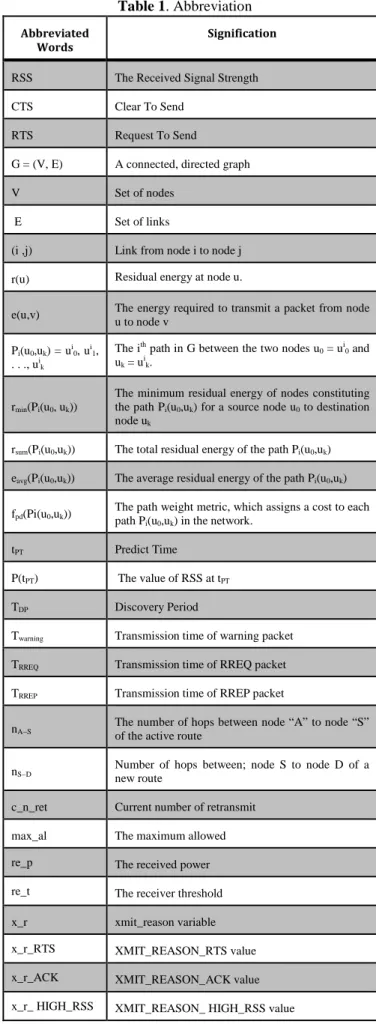
Table 1. Abbreviation
Abbreviated Words
Signification
RSS The Received Signal Strength
CTS Clear To Send
RTS Request To Send
G = (V, E) A connected, directed graph
V Set of nodes
E Set of links
(i ,j) Link from node i to node j
r(u) Residual energy at node u.
e(u,v) The energy required to transmit a packet from node u to node v
Pi(u0,uk) = ui0, ui1,
. . ., ui k
The ith path in G between the two nodes u
0 = ui0 and
uk = uik.
rmin(Pi(u0, uk))
The minimum residual energy of nodes constituting the path Pi(u0,uk) for a source node u0 to destination
node uk
rsum(Pi(u0,uk)) The total residual energy of the path Pi(u0,uk)
eavg(Pi(u0,uk)) The average residual energy of the path Pi(u0,uk)
fpd(Pi(u0,uk)) The path weight metric, which assigns a cost to each
path Pi(u0,uk) in the network.
tPT Predict Time
P(tPT) The value of RSS at tPT
TDP Discovery Period
Twarning Transmission time of warning packet
TRREQ Transmission time of RREQ packet
TRREP Transmission time of RREP packet
nA−S The number of hops between node “A” to node “S”
of the active route
nS−D Number of hops between; node S to node D of a new route
c_n_ret Current number of retransmit
max_al The maximum allowed
re_p The received power
re_t The receiver threshold
x_r xmit_reason variable
x_r_RTS XMIT_REASON_RTS value
x_r_ACK XMIT_REASON_ACK value
3.1.1 Problem definition
Our network is represented by a connected, directed graph G = (V, E) with |V| = n nodes and |E| = l links, where V is a set of nodes and E is a set of links, respectively. The nodes in V include a source node s, a destination node d which receive data from the source; the intermediate nodes are Relay nodes, excluding the source and destination nodes, along the paths from the source to destination. The following notations are used:
• (i ,j)∈E: Link from node i to node j, where i ∈V and j∈V.
• r(u)∈ℜ+: residual energy at node u.
• e(u,v),∈ℜ+, (u,v)∈E : be the energy required to transmit a packet from node u to node v. We assume that e(u,v)=e(v,u) for all (u,v) ∈E.
• Let Pi(u0, uk) = ui0, ui1, . . ., uik be the ith path in G between the two nodes u0 = ui0 and uk = uik.
• Let rmin(Pi(u0, uk)), the minimum residual energy of nodes constituting the path Pi(u0,uk) for a source node u0 to destination node uk, be expressed as :
(
)
(
P
u
u
)
{
r
( )
u
with
k
j
}
r
min i 0,
k=
min
ij,
0
≤
≤
(1)
• The total residual energy of the path Pi(u0,uk), denotedrsum(Pi(u0,uk)), is given by:
(
)
(
)
∑
( )
=
=
kj i j k
i
sum
P
u
u
r
u
r
0
0
,
(2) • Let eavg(Pi(u0,uk)), the average residual energy of a path,be given by:
(
)
(
)
(
(
)
)
1
,
,
00
=
+
k
u
u
P
r
u
u
P
e
sum i kk i
avg
(3)
3.1.2 Multipath discovery
E-PPAOMDV employs a weight metric in its cost function; the path weight metric fpd(Pi(u0,uk)) which assigns a cost to each path Pi(u0,uk) in the network. The weight function fpd combines the minimum residual energy rmin(Pi(u0,uk)), and the average residual energy of a path eavg(Pi(u0,uk)), to select optimal paths.
The fpd of the path Pi(u0,uk) from node u0 to node uk is calculated as:
(
)
(
i k)
(
i(
k)
)
pd
P
u
u
r
P
u
u
f
0,
=
α
×
min 0,
(
1
−
)
×
(
e
avg(
P
i(
u
0,
u
k)
)
)
+
α
(4)For the simulation of our protocol E-PPAOMDV, we chose
α = 0.42, the same value in AOMR-LM [9].
E-PPAOMDV is a reactive routing protocol; no permanent routes are stored in nodes. The source node initiates route discovery procedure by broadcasting the RREQ message similar to the route discovery of AOMDV protocol [7]. We modify the format of the RREQ message and the RREP message of the AOMDV protocol by adding two new fields: the min_re_en field and the sum_re_en field.
When the intermediate node receives an RREQ, it compares its residual energy with the value of the min_re_en message field; if it is lower, the node replaces the value min_re_en with its own value and increases the field sum_re_ene by the value of its residual energy. The same process is repeated
until the RREQ message reaches its final destination. Multiple disjoint reverse paths are computed during the route discovery like AOMDV protocol [7].
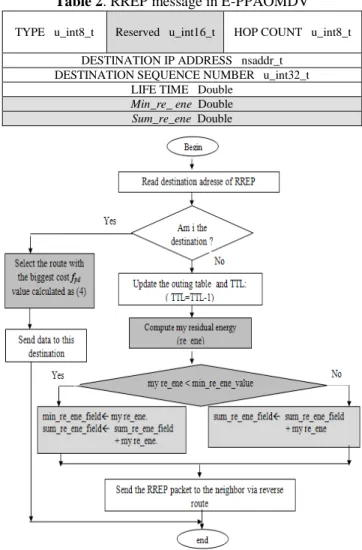
When the destination node receives the RREQ packet, first it set RREP’s min_re_ene_field = initial_energy, and it set RREP’s sum_re_ene_field = 0, and it sends the route reply packet RREP organized as detailed in Table 2.
When the intermediate node receives the RREP packet, it first compares its residual energy with the value of the min_re_ene message field; if it is lower, the node replaces the value min_re_ene with its own value and increases the field sum_re_ene by the value of its residual energy. see (Figure 1). The same process is repeated until the RREP message reaches the node source.
Table 2. RREP message in E-PPAOMDV
TYPE u_int8_t Reserved u_int16_t HOP COUNT u_int8_t
DESTINATION IP ADDRESS nsaddr_t DESTINATION SEQUENCE NUMBER u_int32_t
LIFE TIME Double
Min_re_ ene Double Sum_re_ene Double
Figure 1. Flow char for RREP in E-PPAOMDV
3.1.3 Route maintenance
Route error detection in E-PPAOMDV is similar to route error detection in AOMDV [7]. Upon receiving the RREP, an intermediate node records the previous hop and relays the packet to the next hop. If a node detects a link break during route maintenance phase, it erases the path from its table and looks for an alternate path toward the destination node, if one is available; otherwise, it sends a Route Error (RERR) packet to the source node. Upon receiving the RERR, the source node selects an alternative path as described in Section 3.1.2, otherwise, it initiates a new round of route discovery.
3.2 The Proposed Mechanism for Congestion Control
that tracks the RSS of received data packet from each neighboring node in order to know when an adjacent node is near enough for a successful transmission.
We use a “Route Failure Prediction Technique” based on the Newton interpolation (5) for estimating whether an active link is about to fail or will fail, and it can distinguish between both situations; link error at MAC layer was due to congestion and due to mobility of nodes to avoid the unnecessary route repair process. The Predict Time (tPT) is calculated as (7) and the Discovery Period TDP can be calculated as (8). The general form of the Newton interpolation is:
( )
∑
[
]
∏
−(
)
= =−
=
1 1 1 0...
k i i n k kn
x
f
x
x
x
x
P
(5)( )
t
f
[ ] [ ]
t
1f
t
1,
t
2(
t
t
1)
P
PT=
+
PT−
[
t
1,
t
2,
t
3]
(
t
t
1)(
t
t
2)
f
PT−
PT−
+
(6)Where:
[
] [ ] [ ]
1 3 2 1 3 2 3 2 1,
,
,
,
t
t
t
t
f
t
t
f
t
t
t
f
−
−
=
,[ ] [ ] [ ]
1 2 1 2 2 1,
t
t
t
f
t
f
t
t
f
−
−
=
,f
[ ]
t
1=
P
1,f
[ ]
t
2=
P
2 ,f
[ ]
t
3=
P
3.P(tPT) is the value of RSS at tPT, P1,P2,P3 and t1,t2,t3 are 1st,
2nd and 3rd RSS and their received time respectively.
By using Discovery Period TDP , Predict Time (tPT ) is shown as:
DP PT
t
T
t
=
3+
(7)D S RREP D S RREQ S A warning
DP
T
n
T
n
T
n
T
=
×
−+
×
−+
×
− (8)Where, Twarning, TRREQ and TRREP represent the transmission
time of warning packet, RREQ packet and RREP packet, respectively. Also nA−S and nS−D represent the number of
hops between node “A” to node “S” of the active route and number of hops between; node S to node D of a new route, respectively.
Figure 2. Node A predicts link failure
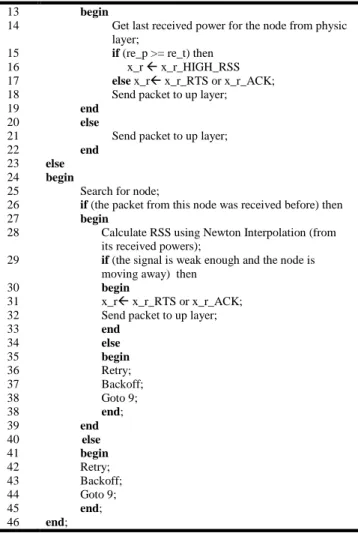
Algorithm 1 : Retransmit RTS/DATA
1 2 3 4 5 6 7 8 9 10 11 12
c_n_ret current number of retransmit max_al the maximum allowed re_p the received power re_t the receiver threshold x_r xmit_reason
x_r_RTS XMIT_REASON_RTS x_r_ACK XMIT_REASON_ACK
x_r_ HIGH_RSS XMIT_REASON_ HIGH_RSS Retransmit RTS or DATA;
if (c_n_ret ≥ max_al) then
begin
if (xmit_failure) then
13 14 15 16 17 18 19 20 21 22 23 24 25 26 27 28 29 30 31 32 33 34 35 36 37 38 38 39 40 41 42 43 44 45 46 begin
Get last received power for the node from physic layer;
if (re_p >= re_t) then
x_r x_r_HIGH_RSS
else x_r x_r_RTS or x_r_ACK;
Send packet to up layer; end
else
Send packet to up layer;
end else begin
Search for node;
if (the packet from this node was received before) then begin
Calculate RSS using Newton Interpolation (from its received powers);
if (the signal is weak enough and the node is
moving away) then
begin
x_r x_r_RTS or x_r_ACK; Send packet to up layer;
end else begin Retry; Backoff; Goto 9; end; end else begin Retry; Backoff; Goto 9; end; end;
The proposed approach that uses the Newton interpolation is shown here, the algorithm1 shows also how MAC layer informs to the routing layer, when several attempts to communicate to the receiver node failed. The normal behaviour of MAC layer in order to transmit information to a neighbouring node is to send a Request To Send (RTS). If this communication fails, the MAC layer waits (back off time) and tries it again later. After several and unsuccessful attempts, the MAC layer informs to the routing layer that communication was unsuccessful.
- In our approach, the reason for that unsuccessful communication is sent to the routing layer.
- If the last received power of the destination node indicates that it is reachable, the routing layer is informed, using the variable xmit_reason with the value XMIT_REASON_HIGH_RSS (see Algorithm1). In this case, the routing layer should interpret that communication to destination was not possible, not because of a broken link but rather congestion, therefore route maintenance is not needed. If that is not the reason delivered to the routing layer, a route maintenance process is required. The implementation is divided into two parts:
The first part, keeps the last three received signals from a node in an array, and computes RSS using Newton Interpolation (from the received data packets) as (6).
- If the signal is weak enough and the node moving away, the MAC layer sends a Request To Send (RTS). The second part decides the kind of message (link failure, either due to errors or due to congestion using signal strength of neighboring nodes) to be sent to the upper layer.
(RTS)/Clear To Send (CTS) frames.
- If this communication fails, the MAC layer waits (back off time) and retransmits later.
- After several unsuccessful attempts, the MAC layer informs to the routing layer that communication failed, using the variable xmit_reason with the value XMIT_REASON_RTS or XMIT_REASON_ACK (see Algorithm1).
3.2.1 Extension of MAC Layer
AOMDV [7] interprets a link failure (in MAC layer) as a broken link, even when it was caused by congestion at the receiver. The sender node should know why communication was impossible. We implemented an approach that tracks the RSS of received data packet from each neighboring node in order to know when an adjacent node is near enough for a successful transmission. If lost packets were due to congestion and high traffic, AOMDV triggers route repair, and this can affect the network performance. If lost packets is due to low signal quality or misrouted packets, then route repair is needed because the receiver is not reachable. Afterward, the signal strength of neighboring nodes can be used to detect the reason for lost packets, distinguishing between congestion and broken links due to mobility, because in the last case, the receiver is unreachable and its signal strength is now available. The implementation is divided into two parts; the first part, keeps the last three received signals from a node in an array, and computes RSS using Newton Interpolation (from the received data packets) as (6); if the signal is weak enough and the node moving away, the MAC layer sends a Request To Send (RTS). The second part decides the kind of message (link failure, either due to errors or due to congestion using signal strength of neighboring nodes) to be sent to the upper layer, whenever the communication is impossible but the destination node is in the transmission range of the sender.
Transmitting information to a neighboring node in MAC layer is preceded by the exchange of Request To Send (RTS)/Clear To Send (CTS) frames. If this communication fails, the MAC layer waits (back off time) and retransmits later. After several unsuccessful attempts, the MAC layer informs to the routing layer that communication failed. In our approach, the reason for that unsuccessful communication is sent to the routing layer. If the last received power (the result of Newton interpolation) of the destination node indicates that it is reachable, the routing layer is informed, using the variable xmit_reason with the value XMIT_REASON_HIGH_RSS (see Algorithm1). In this case, the routing layer should interpret that communication to destination was impossible, not because of a broken link but rather congestion, therefore, route maintenance is not needed. If that is not the reason delivered to the routing layer, a route maintenance process is required.
3.2.2 Extension of AOMDV
When a node tries to communicate with a neighboring node and this communication failed (after several attempts, MAC layer sends an error to the routing layer). AOMDV interprets that the neighboring node is not present anymore and communication failure was due to mobility.
In a scenario without mobility communication failures may
arise, but AOMDV will interpret that it was due to mobility, where actually, it was due to congestion. Therefore, the process of route repair should not be performed since it increases even more the congestion, decreasing the overall performance of the network. The proposed amelioration will make AOMDV capable to distinguish between both situations, avoiding the route repair process when the link error at MAC layer was due to congestion and not due to mobility of nodes. In our approach, when a node is not able to communicate with a neighboring node, MAC layer informs to the upper layer that there was a problem including whether the neighboring node is still reachable or not (see Algorithm1). Therefore, the sender node does not perform route maintenance if it was informed that the neighboring node is still reachable.
4.
Simulation and Performance Results
We have used the implementation of AOMDV [7] in the NS simulator version 3.35 [10]. Our results are based on the simulation of 50 wireless nodes forming an ad hoc network moving about in an area of 1500 meters by 300 meters for 200 seconds of simulated time. Two Ray Ground reflection model was adopted. Nodes positions were generated randomly.
The movement scenario files used for each simulation are characterized by a pause time. Each node begins the simulation by selecting a random destination in the simulation area and moving to that destination at a speed distributed uniformly between 0 and 10 meters per second. It then remains stationary for pause time seconds. This scenario is repeated for the duration of the simulation. We carry out simulations with movement patterns generated for 6 different pause times: 0, 20, 40, 80,160 and 200 seconds. A pause time of 0 seconds corresponds to continuous motion, and a pause time of 200 (the length of the simulation) corresponds to limited motion. Constant bit rate (CBR) sources are used in the simulations. The packet rate is 4 packets /sec when 30 sources are assumed. The performance metrics used to evaluate performance are:
• Average Energy Consumption: It is the average energy
consumed by all nodes in the network. This should be minimized.
• Average end-to-end delay of data packets: This includes
all possible delays caused by buffering during route discovery, queuing at the interface queue, retransmission delays at the MAC layer, and propagation and transfer times. This should be minimized.
• Packet delivery ratio: The ratio of the data packets
delivered to the destination to those generated by the CBR sources. This should be maximized.
• Throughput: the overall rate of transfer (received bytes/
Time of simulation) which should be maximized.
• Normalized routing load: The number of routing packets
transmitted per data packet delivered to the destination. This should be minimized.
the energy between paths. Thus, energy is balanced out across the network, reducing uneven energy consumption.
Figure 3. Average consumed energy
Secondly, E-PPAOMDV is able to avoid nodes with low energy in the construction of the multipath. Thirdly, E-PPAOMDV reduces collisions by reducing the number of retransmissions; these have a positive impact on the energy consumption of nodes. In fact, the nodes use less energy for transmitting a packet correctly. It can be seen that significant performance gains between 1-3% in the average energy consumed by all nodes, were obtained from E-PPAOMDV over AOMR-LM.
Figure 4. Average End to end delay
In Figure 4 the results obtained for the end-to-end delay metric are presented. We observe that the end-to-end delay is affected by the route repair procedure because data packets are buffered until an alternative route is found. The results show that the end-to-end delay of E-PPAOMDV is lower than those of AOMR-LM and AOMDV. The two reasons are that our E-PPAOMDV protocol favors nodes having a high energy level and prevents the critical nodes from participating in the data packet transmission. This produces fewer broken links and greatly reduces the end-to-end delay. On the other hand our proposed mechanism; distinguish between both situations, failures due to congestion or mobility, and consequently avoiding unnecessary route repair process. Figure 4 shows a gain of about 33 % less of E-PPAOMDV over AOMR-LM, in the pause time 200s.
Figure 5. Packet delivery fraction
Figure 5 represents the simulation results for the delivery ratio metric. The results indicate that the packet delivery ratio increases with the increase of the pause time (low mobility). For example, when the pause time increases from 80s to 200s, the packet delivery ratio increases approximately 22%. Also, it can be seen that significant performance gains between 2-10% in the delivery ratio were obtained from E-PPAOMDV over AOMR-LM.
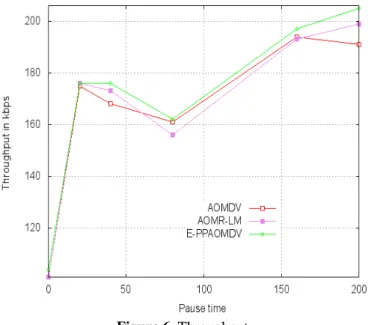
Figure 6. Throughput
reached, the MAC layer notifies the routing layer that it was unable to deliver the traffic to the next hop and the routing scheme generates a RERR packet to notify the source of the connection that the path is broken.
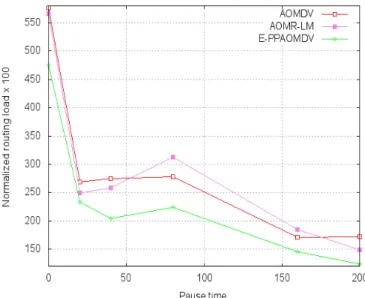
Figure 7. Normalized Routing Load
As a result, the source node searches the cache for alternative paths to route its traffic and, if none is found, a new route discovery process is instigated. AOMR-LM and AOMDV have alternative routing paths cached but they will interpret communication failures that it was due to mobility, where actually, it was due to congestion. Therefore, the process of route repair should not be performed since it increases even more the congestion, and triggers new route discoveries, which increase the normalized routing load. On the other hand, E-PPAOMDV has alternative QoS-aware routing paths cached, and the affected traffic is switched to one of the alternative paths with highest capacity (the biggest fpd) and E-PPAOMDV does not perform route maintenance if it was informed that the neighboring node is still reachable. E-PPAOMDV triggers new route discoveries only when no routing path is available in the cache of the source node or the neighboring node is not reachable resulting in lower routing overhead and, consequently, the normalized routing load. It can be observed from Figure 7 that the biggest gains of E-PPAOMDV over AOMR-LM is of 27,5% and happen with 80s of pause time. This has a good impact on energy because the number of control packets generated is low.
5.
Conclusion and Future Works
Mobile ad hoc networks are characterized by their lack of infrastructure and their dynamicity: link failures and route breaks occur frequently. Moreover, the frequent changes of topology exhaust the batteries of the nodes, which decreases the network performance.
In this paper, we have proposed an Energy aware Predictive Preemptive Multipath Ad hoc On-Demand Distance Vector (E-PPAOMDV). There are two main contributions in this work. The first, is our protocol is based on an energy-aware mechanism, (the residual energy of nodes). The second, is the proposition of a cross-layer networking mechanism to distinguish between both situations, failures due to congestion or mobility; by the usage of the “Route Failure Prediction Technique” based on the Newton interpolation for estimating whether an active link is about to fail or will fail.
We have shown that E-PPAOMDV conserves the residual energy of nodes and balances the consumed energy over multiple paths.
This concept extends the network lifetime and improves energy consumption when compared with AOMR-LM protocol. Comparing the performance of E-PPAOMDV with
those of the AOMR-LM and AOMDV protocols, E-PPAOMDV is able to balance the energy consumed; it
increases the lifetime, consumes less energy, has a lower average end-to-end delay; has a higher throughput, has a higher packet delivery ratio and has a lower normalized routing load than the other simulated protocols. Because: 1- paths are computed depending on the energy level of their nodes; and the best path is selected. 2- Our routing protocol reduces collisions by reducing the number of retransmissions; these have a positive impact on the energy consumption of nodes. In fact, the nodes use less energy for transmitting a packet correctly.
Since less MAC errors, less route errors, and less route changes provokes lower routing overhead in the network. As the routing overhead is decreasing, the nodes are able to transmit more data packets; therefore, a higher throughput is obtained (up to 5% ); also, a gain of about 33% in average end to end delay, while the packet delivery ratio is increased with approximately 2-10%. As a result, a significant performance gains between 1-3% in the average energy consumed by all nodes, were obtained from E-PPAOMDV over AOMR-LM.
In the future, we plan to study the QoS multilayer management; (MAC, network) can be enhanced to include the application layer. In this case, the application layer can adjust the flow rate according to the information provided by the lower layers.
Our approach proposed, is developed with the objective of avoiding disconnections and maximize lifetime of MANETs. The main idea makes sense in streaming over MANETs, for example: one of the important applications of streaming over a MANET is in a disaster recovery operation. In a disaster hit area, the communication infrastructure may be damaged or absent and it may be vital to establish a temporary network that assists the rescue workers during their rescue operation. Such a network would help in facilitating communication and cooperation between the various emergency teams involved in the rescue operation. Mobile devices that are carried by the rescue personnel may be used to stream live video captured through a cam, to a central server. This live stream can be used to timely dispatch medical assistance and supplies to the right areas and people who need them the most. The application of streaming over a MANET is not confined to a rescue operation and may span many other application areas such as battlefields.
References
[1] E. Belding-Royer, C. Perkins, “Evolution and future directions of the ad hoc on-demand distance-vector routing protocol,” Ad Hoc Networks Journal, Vol. 1, No.1, pp. 125–150, 2003.
[3] S.H. Boukli, A. Lehireche, and A. Meddahi, “Predictive Preemptive Ad Hoc On-Demand Distance Vector Routing,” Malaysian Journal of Computer Science, Vol. 19, No 2, pp.189-195, 2006.
[4] K. Hayato, M. Naoki, H.S. Bouk, and I. Sasase, “High Precision-Predictive Preemptive Ad hoc On-demand Distance Vector Routing in Ad hoc Networks,” in The 11th International Symposium on Wireless Personal Multimedia Communications (WPMC’08), 2008. [5] D. B. Johnson, Y. Hu, and D. A. Maltz, “The dynamic
source routing protocol (DSR) for mobile ad hoc networks for ipv,” IETF Request for Comments: 4728, February 2007.
[6] B. Tuch, “Development of WaveLAN, an ISM Band Wireless LAN,” AT&T Technical Journal, Vol. 4 No.72, pp. 27–33, July/August 1993.
[7] K. Marina, and R. Samir, “Ad hoc on-demand multipath distance vector routing,” Wireless Communications and Mobile Computing, Vol. 6, pp. 969–988, 2006.
[8] S. Mallapur, “Predictive Preemptive Ad Hoc on-Demand Multipath Distance Vector Routing Protocol,” Int. Journal of Computer Science & Emerging Technologies (IJCSET), Vol. 1, No 2, pp.155-160, August 2010.
[9] O. Smail, B. Cousin, R. Mekki and Z. Mekkakia, “A multipath energy-conserving routing protocol for wireless ad hoc networks lifetime improvement,” EURASIP Journal on Wireless Communications and Networking,http://jwcn.eurasipjournals.com/content/20 14/1/139, pp.1-12, 2014.
[10] NS-2 Network Simulator, available at http://www.isi.edu/nsnam/ns/, November 2011.
[11] M. Ali cherif , M. K. Faraoun and S. B. Hacene, “Link Quality and MAC-Overhead aware Predictive Preemptive Multipath Routing Protocol for Mobile Ad hoc Networks,” International Journal of Communication Networks and Information Security (IJCNIS), Vol. 5, No. 3, pp. 210-218, December 2013. [12] M.Chitra and Padmavathy , “Performance Evaluation of
Energy Efficient Modulation Scheme and Hop Distance Estimation for WSN,” International Journal of Communication Networks and Information Security (IJCNIS), Vol. 2, No. 1, pp. 44-49, April 2010.
[13] K. Dongkyun, J. J. Garcia-Luna-Aceves, K. Obraczka, J.-C. Cano, and P. Manzoni, “Routing mechanisms for mobile ad Hoc networks based on the energy drain rate,” IEEE Trans. Mobile Computing, Vol. 2, No. 2, pp. 161-173, 2003.
[14] N. Meghanathan, “Stability-energy consumption tradeoff among mobile ad hoc network routing protocols,” Proc. Third Int. Conf. Wireless and Mobile Comm. (ICWMC ’07), Mar. 2007.
[15] M. C. Aye and A. M. Aung, “energy efficient multipath routing for mobile ad hoc networks,” International Journal of Information Technology, Modeling and Computing (IJITMC), Vol. 2, No.3, pp. 11-18, August 2014.
[16] J. Liu, J. Chen, and Y. Kuo, “Multipath routing protocol for networks lifetime maximization in ad-hoc networks,” Proceedings of the 5th International Conference on Wireless Communications, Networking and Mobile Computing (WiCom '09), pp. 1-4, 2009.
[17] M. Aguilar Igartua, and V. Carrascal Frías, “Self-configured multipath routing using path lifetime for video-streaming services over Ad Hoc,” Computer Communications, Vol 33, pp. 1879–1891, 2010. [18] P. Bergamo, D. Maniezzo, A. Travasoni, A. Giovanardi,
G. Mazzini, and M. Zorzi, “Distributed power control for energy efficient routing in ad hoc networks,” Wireless Networks J., Vol. 10, No. 1, pp. 29-42, 2004. [19] Y. Liu, L. Guo, H. Ma, and T. Jiang, “Energy efficient
on demand multipath routing protocol for multihop ad hoc networks,” Proceedings IEEE 10th International Symposium on Spread Spectrum and Applications, pp. 592-597, 2008.
[20] S. Lee, and M. Gerla, “Split multipath routing with maximally disjoint paths in ad hoc networks,” In Proceedings of IEEE International Conference on Communications (ICC '01), Helsinki, Finland, pp. 3201–3205, 2001.
[21] H Nasehi, NT Javan, AB Aghababa, YG Birgani, “Improving energy efficiency in manets by multi-path routing,” Int. J. Wirel. Mobile Netw. (IJWMN) Vol. 5, No. 1, pp. 163-176, 2013 .
[22] Z. Ye, S. V. Krishnamurthy, and S. K. Tripathi, “A framework for reliable routing in mobile ad hoc networks,” IEEE Conf. Computer Communications (INFOCOM 2003), Vol. 1, pp. 270-280, 2003.
[23] S. Omar, Z. Mekkakia, B. Messabih, R. Mekki and B. Cousin, “Energy Conservation for Ad Hoc On-Demand Distance Vector Multipath Routing Protocol ,” I.J. Computer Network and Information Security (IJCNIS), Vol. 6, pp. 1-8 , 2014.
[24] M. Drini and T. Saadawi, “Link Lifetime Based Route Selection in Mobile Ad-Hoc Networks,” International Journal of Communication Networks and Information Security (IJCNIS), Vol. 1, No. 3, pp. 31-39, December 2009.
[25] M. Ali-cherif, M.K. Faraoun, N. Doumi, and M. Kather, “Integration of dynamic current bandwidth capacity calculation for existing AODV,” in Proceding of IEEE ICITeS 2012 Int. Conf. on Information Technology and e-Services, pp. 669-675, March 2012.
[26] M. Ali-cherif, M.K. Faraoun, and S.H. Boukli, “Enhanced Predictive Preemptive Multipath Routing Protocol for Mobile Ad hoc Network,” IEEE CommSoft E-Letters, Vol. 2, No. 1, pp. 9-12, May 2013.
[27] H. Touil and Y. Fakhri, “A Fuzzy-based QoS Maximization Protocol for WiFi Multimedia (IEEE 802.11e) Ad hoc Networks,” International Journal of Communication Networks and Information Security (IJCNIS) , Vol. 6, No. 3, pp. 217-225, December 2014. [28] M. Viju and B. Paramasivan, “An Individual Node
Delay Base Efficient Power Aware Routing Protocol for Wireless Heterogeneous sensor Networks,” International Journal of Communication Networks and Information Security (IJCNIS) , Vol. 7, No. 1, pp. 50-59, April 2015.