Mobility Adaptive Density Connected Clustering
Approach in Vehicular Ad Hoc Networks
Anant Ram, Manas Kumar Mishra
Department of Computer Engineering and Applications, GLA University Mathura, India
Abstract: Clustering is one of the popular topology management approaches that can positively influence the performance of networks. It plays significant role in VANETs. However, VANETs having highly mobile nodes lead to dynamic topology and hence, it is very difficult to construct stable clusters. More homogeneous environment produces more stable clusters. Homogeneous neighborhood for a vehicle is strongly driven by density and standard deviation of average relative velocity of vehicles in its communication range. So, we propose Mobility Adaptive Density Connected Clustering Algorithm (MADCCA), a density based clustering algorithm. The Cluster Heads (CHs) are selected based on the standard deviation of average relative velocity and density matrices in their neighborhood. Vehicle, which is having more homogeneous environments, will become the cluster heads and rest of the vehicles in their communication range will be the Cluster Members (CMs). The simulation results demonstrate the better performance of MADCCA over other clustering algorithms new ALM and MOBICA.
Keywords: Clustering, VANETs, Cluster Head, Cluster Member, Relative velocity.
1.
Introduction
VANETs play a key role in realizing the dream of smarter planet by supporting variety of the applications like, intelligent transportation systems, roadside advertisement and online entertainment. The growth of traffic on roads can be the potential carrier for data packets. This also indicates the availability of suitable or even free of charge network between the vehicles [1-2]. VANETs have two kinds of nodes which participate in communication, one is static road side units and other is mobile vehicle as a node well equipped with all kind of necessary equipment required for navigation and communication. The communication over any VANETs can be classified into different categories like vehicle to vehicle communication (V2V), vehicle to infrastructure (V2I). V2V communication transfers the information without the help of road side unit. Vehicles use the IEEE802.11p to communicate with other vehicles and have a broadcast range of 1000 meters [3]. In case of V2V communication every vehicle is considered to have been installed with onboard sensing units, which allow large scale sensing, decision making and controlling actions to perform a number of tasks that arises in wireless communication system. In V2I Communication, vehicle uses both infrastructure as well as vehicles as packet forwarder towards to the destination.
In any network majority of decisions are based on topology information of the network. However, due to high mobility of the vehicles, the topology information is one of the challenging tasks of the networks. Clustering is one of the strategies which make global topology updates more adaptive and less complex. The clustering process brings similar kinds of objects within the same cluster. Moreover, in
case of networks the clusters are generally identified based on the unique member termed as Cluster Head (CH), which facilitates and coordinates the Cluster members (CMs). Most of the clustering algorithms in VANETs are derived from those proposed for MANET. Vehicle clustering has the potential to improve the scalability of networking protocols such as for routing and medium access control protocols, the CHs can act as central coordinators that manages the access of its CMs to the wireless channel(s) [4]. However, for vehicles cluster forming and maintaining the clusters require explicit exchange of control messages. In VANETs, vehicles moving with high and variable speeds cause frequent changes in the network topology, which can significantly increase the cluster maintenance cost. Therefore, forming stable clusters that last for a long time is a major issue in clustering of VANETs. Frequent changes in the internal cluster structure consume the networks radio resources and causes service disruption for the cluster-based routing protocols. On the other hand, an external change in the cluster structure is concerned with cluster’s relationship with the other clusters in the network. One metric that evaluates the external relationship of a cluster with other clusters, is the overlapping among clusters. The time variations of the distance between neighboring CHs, due to vehicle mobility, can cause the coverage ranges of the clusters to overlap. However, as the overlapping range between the two clusters increases, it may cause the merging of the two clusters into a single cluster [5,6,7]. The non-overlapped clustered structure produces the less number of clusters and reduces the design complexity, On the other hand, a highly overlapping clustered structure may, cause complexity in the channel assignment, lead to broadcast storm. Additional channel resources ought to be used to prevent inter-cluster interference due to overlapping. Many research works focused the attention on non-overlapped clustering, due to the fact that real networks are better characterized by well-defined statistics of disjoint partitions.
In this work, we propose a new clustering approach which works in non-overlapped manner, i.e. successive CHs are not under communication range of each other. This approach takes the standard deviation of average relative velocity and average of absolute density difference with respect to its neighboring, in addition to the location and direction of movement into consideration in the clustering process. The way which we are adopting, will help us to generate much more stable clusters. The grouping of the vehicles will take place based on density, and least standard deviation in average relative velocity with neighbor vehicles.
relative velocity of a vehicle with its surrounding will be very high if average relative velocity difference of a vehicle is high with each of its neighborhood. This indicates that either this vehicle is moving very slow or very fast with respect to its neighbor vehicles. While the standard deviation of average relative velocity parameter improves intra-cluster homogeneity, the density variation parameter is targeted to enhance inter-cluster homogeneity. The vehicle which has the best bet based on these two parameters, among the cluster members, is chosen as the CH of that cluster.
This paper mainly focuses about density based clustering in vehicular ad hoc network. This results in more stable clusters that evolve a reliable route delivery of the information for commercial and safety applications using V2V communication. The rest of the paper is organized as follows: section 2 presents literature on clustering algorithms in Vehicular ad hoc networks. Section 3 presents the proposed system model for density based clustering in VANETs. Section 4 describes the proposed clustering algorithms. Section 5 presents the result obtained through simulation and evaluates the performance with respect to the related works proposed in literature. Finally Section 6 concludes the paper.
2.
Related Work
Some clustering algorithms which have been proposed for MANETs are only considering the location information and direction information but none of them took the speed difference into consideration for cluster formation in VANETs. In case of VANETs high speed causes the effect in cluster stability. There are certain clustering algorithms which generate clusters without considering the mobility matrix and few others consider the mobility metric. The lowest ID clustering Algorithm [8] is one of the easiest clustering algorithms to cluster the mobile nodes in wireless ad hoc network which only considers the lowest ID to cluster the nodes. Initially the nodes broadcast the message to its neighborhood, which contain the unique ID of the node. The node which is having lowest ID in its neighborhood is considered as CH, rest of the mobile nodes under the communication range of elected CH are considered as the CMs. Moreover, majority of approaches depend on the property based metrics of the mobile nodes. In case of mobile ad hoc network or the vehicular ad hoc networks the mobility is one of the main issues. The Lowest ID clustering Algorithm does not consider the mobility metric information for clustering.One of the mobility based clustering algorithms MOBIC [9] clusters the mobile nodes in MANETs. In this approach the relative mobility between two mobile nodes is calculated using the received signal strength of two successive beacon messages received by the mobile node from another mobile node. The node calculates the relative velocity of its neighbor node is modeled as the ratio of current received signal strength and previous received signal strength from the same mobile node. After that mobile node calculate the aggregate mobility metric based on the relative mobility. The mobile nodes with least aggregate mobility are selected as CH. Since calculation of relative mobility metric based on received signal strength is highly unreliable, may mislead to cluster stability.In [10], author presented affinity propagation based clustering scheme for VANETs. Affinity propagation based clustering can generate much more stable clustering. In this approach the vehicles
exchange messages with their neighbor vehicles to transmit availability and responsibility. The simulation results demonstrate that the performance of the clustering scheme using affinity propagation is better than MOBIC in terms of stability. In [11], the authors proposed a new clustering technique for VANETs applications. In this paper authors assume that nodes know their geographical locations from GPS. They introduced a new aggregate local mobility (ALM), based on relative mobility metric. The ratio between two successive takes of the distance between a node and its neighbor is used to define the relative mobility between two. The head selection is based on lower ALM of a node. In Density Based Clustering (DBC) [12], authors consider connectivity level, link quality and traffic conditions into account to cluster vehicles. Based on density notion, the vehicular network is divided into dense region and sparse region. A vehicle which has links more than a predefined value is considered as in the dense region otherwise, it is considered to be in sparse region. During the clustering process, link quality is estimated to make re-clustering decision. Based on the experimental evaluation, the CH change ratio is reported to be less than the lowest ID algorithm [8]. A vehicular clustering based on the weighted clustering algorithm (VWCA) is presented in [13]. VWCA is a scheme using multiple metric derived from distrust value, number of neighbors based on dynamic transmission range and vehicle movement direction, to increase cluster stability and connectivity. A new speed difference based clustering technique was presented in [14]. It enhances the stability of the network topology by defining stable and unstable clustering neighbors depending on their speed and relative movement direction.The Neighbor Mobility-based Clustering Scheme (NMCS) algorithm is introduced in [15]. NMCS models mobility using a mobility-oriented variant of the node degree metric. Instead of simply counting the number of neighbors of a given node, the node degree is defined as the sum of the number of neighbors that have left a node’s range and the number of new neighbors acquired since the last processing round. The sum is then divided by the total number of neighbors to normalize the degree of mobility in the vicinity of the node: therefore, nodes with lower values for this metric are located in a relatively stable environment, indicating that such nodes are good candidates for the cluster head role. DMCNF [16] employs a novel affiliation scheme in which a node “follows” a one-hop neighbor. If the neighbor is a CH, this behavior is considered to be a normal direct affiliation; if it is a cluster member, the node is said to have affiliated indirectly with the CH. This method can then be used for dynamically reconfiguring the clustering structure, since a normal cluster member may potentially assume the CH role if it has accrued more “followers” than its current CH and it has a lower average relative velocity with respect to those followers. Vehicular Multi-hop algorithm for Stable Clustering (VMaSC), first proposed in [17], extends prior work in [18] to integrate the cluster structure with a network of LTE base stations for data dissemination purposes.
approach to achieve much more stable clustering in VANETs. Our proposed algorithm generates homogeneous clusters by considering two hop neighbors characteristic, in terms of standard deviation of average relative velocity and the average absolute density difference metrics along with the direction. The proposed algorithm outperforms new ALM and MOBIC clustering algorithms.
3.
Proposed System Model for Density Based
Clustering in VANETs
Due to high mobility of the vehicles, there may be frequent restructuring of the clusters, which may generate tremendous communication overhead. Thus, it can reduce the available bandwidth for message dissemination, significantly. Therefore, the main objective of clustering in VANETs is to provide a relatively stable topology in their highly dynamic and mobile environment. In addition, for resource constrained wireless communication, the cluster should not be formed to be very large or very small. Very large clusters increase the traffic of transmitted messages from members to their CH and it introduces delay in message delivery. However, small clusters may decrease the stability of the network as the re-affiliation of the network increases. Since majority of the clustering algorithms for VANETs are based on mobility metric but do not focused much more about the density of the vehicles. We proposed the concept of density based clustering in vehicular ad hoc networks with traffic on highways being considered as the scenario. However, it only considers vehicles moving in the same direction for its estimations of the desired metrics. It considers that the communication is only occurring between the vehicles without the support of road side units. We assume that every of the vehicle is equipped with GPS and on board units (OBU).
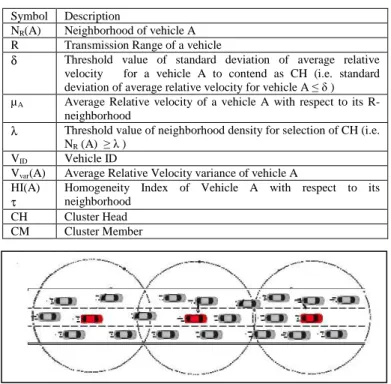
Table 1. Presents the symbols used to represent various
system parameters
Symbol Description
NR(A) Neighborhood of vehicle A
R Transmission Range of a vehicle
δ Threshold value of standard deviation of average relative
velocity for a vehicle A to contend as CH (i.e. standard deviation of average relative velocity for vehicle A ≤δ ) µA Average Relative velocity of a vehicle A with respect to its
R-neighborhood
λ Threshold value of neighborhood density for selection of CH (i.e. NR (A) ≥λ )
VID Vehicle ID
Vvar(A) Average Relative Velocity variance of vehicle A
HI(A)
τ Homogeneity Index of Vehicle A with respect to its neighborhood
CH Cluster Head
CM Cluster Member
Figure 1. Clustering of vehicle in highways as a scenarios
In Figure 1 it can be seen that, each red color vehicle represents the CH and rest of the vehicles are their CMs. The
CH is responsible to aggregate the information and also to pass on information to its CMs, which is received from its neighbor CHs. The CHs may be in direct communication range of each other or may receive the information through gateway vehicles in a multi hop manner. Gateway vehicles are those vehicles which exist in the communication range of at least two CHs. Further, when a vehicle moves relatively away from its CH and the distance between the vehicle and CH is greater than the cluster radius, it will join the next approachable CH, otherwise it will generate its own new cluster. When two CHs come relatively closer to each other, then CH of the smaller cluster size will discharge its responsibility and will merge up with the bigger size cluster as its member.
Lemma 1: Adaptive Neighbourhood Density
The density of all the density connected vehicles can be considered as a random variable and its expected value can be determined. Let us assume that, each vehicle has sufficient density in its neighbourhood and hence, the density can be considered as contiguous event. Thus, the expected density in the neighbourhood of any vehicle can be modeled as follows: Suppose, a vehicle A has n neighbours in the direction of destination vehicle and let λ1 , λ2 , . . . , λn be the neighbourhood density of all its n neighbor vehicles, respectively. Because all n neighbours’ vehicles are under communication range of vehicle A, So vehicle A receives the density information in HELLO beacon message periodically. Based on the above received information by every vehicle calculate the expected value of λ with respect to its neighbours in the direction of destination as follows: λmax = Max (λ1, λ2,…………,λn) (1)
λmin = Min (λ1,λ2,…………,λn) (2)
Let F(λ) and f(λ) be the Cumulative Distribution Function(CDF) and Probability Density Function(PDF) of λ
, respectively. Then the Cumulative Distribution Function F(λ) = P{{λ1≥λ, λ2≥λ3,…………, λn≥λ }
=∏ λ ≥λ = ( λ
λ ) (3)
And the probability density function
f(λ) =
λF(λ) =λ (
λ
λ ) (4)
Then the expected value of λ is will be as follows:
(λ) = λ λ f(λ) dλ
λ
(λ) = λ
λ (
λ
λ ) dλ
λ
λ
(λ) =
λ (
λ ! λ " !
# ) (5)
Thus the value of λ for the vehicle A will be equal to the value of E(λ).This way every vehicle calculate the neighborhood density threshold value λ for the selection of cluster head.
Lemma 2: R-neighbors NR(A): Two vehicles A and B are said to be R- neighbors if the distance between them is less than the transmission range R. The neighborhood of vehicle A is defined as follows:
NR(A) = { B| ∀ B Euclidian distance(A, B) ≤ R } (6)
Lemma 3: Average Relative Velocity of Vehicle A: if $%
be velocity of vehicle A and $& be the velocity of every
vehicle B ∈ NR(A) then the average relative velocity of vehicle A with respect to the neighborhood will be as follows
µ%=∑∀&∈*+(%)|$% $&|
.Lemma 4: Average Relative Velocity Variance: - Average relative velocity variance of a vehicle Awith its surrounding vehicles is defined as follows:
,$-.(%) =
∑ (µ% µ&)/ ∀&∈*+(%)
|*+(%)| (8)
Lemma5: Average Absolute Density Difference
(Homogeneity Index): The average absolute density
difference for a vehicle A with respect to its R- neighbors is defined as follows:
12(3) =∑∀&∈*+(%)|*+(%) *+(&)|
|*+(%)| (9)
4.
Proposed Clustering Algorithm
The stability of any cluster depends on the similarity among its cluster head and members. Cluster stability can be defined through different mechanisms with the most frequently used parameters being CH duration, CM duration, CH change frequency, and cluster size. The proposed approach targets to model similarity considering the above characteristic to generate stable clusters. Every vehicle collects the position and velocity by sending periodic beacon messages. Initially every vehicle sends the velocity and position information in HELLO message. After receiving these HELLO beacon messages, each vehicle estimates the average of the relative velocities of itself with respect to that of its neighbors and the neighborhood density. After that every vehicle broadcast the estimated average relative velocity and density information in MMVD message to its neighborhood. As the MMVD get broadcast by vehicles, every other receiver vehicle will indirectly get the relative velocity characteristics of two hop neighbors rather than one hop neighbors. The average relative velocity metrics is used to calculate the standard deviation of average relative velocity. Further, every vehicle calculates the average of the absolute density difference. Subsequently, every vehicle broadcast the MVVD message which carries standard deviation of average relative velocity and absolute density difference to its neighbors. Based on above received information every vehicle can announce itself as a CH or cluster member by following the conditions specified in the cluster head selection algorithm 2.
4.1 Cluster Formation
This section discusses the detailed process of forming and maintaining the cluster structure in VANETs based on neighborhood density and standard deviation of average relative velocity with respect to neighborhood. When a vehicle A enters into a road segment, it broadcast the cluster join request (CJR) message to search for the existing cluster in its neighborhood. If the vehicle receives a reply (CRJ) against this join request message from any neighboring CH within specified waiting time duration (Tw), then it simply joins the cluster as member and set the CH id as the CHID. The value of Tw, we set in the simulation 1seond. Further, it sends MACK to declare the joining of the cluster as member. If not, then it simply initiates the cluster formation process and broadcast the cluster formation message (MCF) to its neighborhood. Now every vehicle verifies that if it satisfies the following conditions.
1) Standard deviation of average relative velocity should be less or equal to δ.
2) The neighborhood density should be greater or equal toλ.
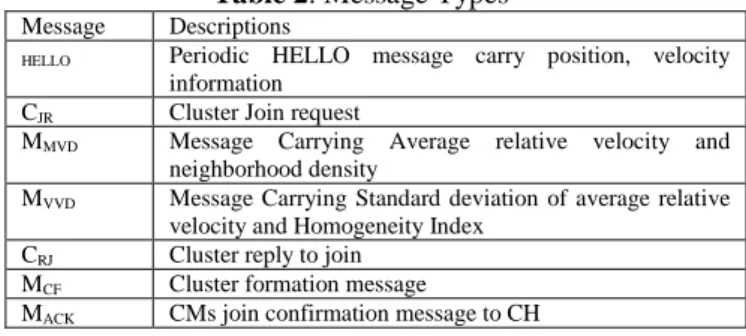
3) Homogeneity index should be less than equal to τ. Whereδ and τ are the user specified parameters. If a vehicle satisfies the above three conditions, then it announces itself as a CH. Then it broadcast the CRJ message in neighborhood. After receiving the CRJ message, rest of the vehicles can become CMs and need to send the MACK to the CH. A CM will choose the CH with the least relative velocity when it receives messages from more than one cluster heads. However, this requires each CM to be familiar with the relative velocity among all possible CHs. This information is estimated using the beacon messages received from the cluster heads. Algorithm 1 presents the proposed approach for the Cluster formation. Table 2 presents the various types of messages to be used for Cluster formation and maintenance.
Table 2. Message Types
Message Descriptions
HELLO Periodic HELLO message carry position, velocity
information
CJR Cluster Join request
MMVD Message Carrying Average relative velocity and
neighborhood density
MVVD Message Carrying Standard deviation of average relative
velocity and Homogeneity Index
CRJ Cluster reply to join
MCF Cluster formation message
MACK CMs join confirmation message to CH
4.2 Cluster Head Selection
Based on above mobility and density metrics, we model the CH selection algorithm that selects the optimal CH. Algorithm 2 presents the Cluster Head Selection algorithm followed in the proposed approach.
Most Suitable CH (MSCH)
Any vehicle that satisfies the following conditions is capable of becoming the most suitable CH.
1.Standard deviation of average relative velocity(A) ≤ δ
2.NR(A) ≥ λ 3.HI(A) ≤ τ
Where δ and τ are the user defined parameters. While every vehicle calculates the density threshold value λ adaptively. Every parameter stated above captures the properties of 2R- neighborhood. However, if more than one vehicle satisfies the above conditions then the vehicle which is having higher neighborhood density will become the CH.
Algorithm 1. Algorithm for Cluster Formation
Require: A set of vehicles either networked in a clustered
form or to be networked in a cluster form
Ensure: Formation of number of clusters each having
vehicles with highly similar characteristics
Cluster Initialization:
for each vehicle A which wants to be a part of the network
do Broadcast the Cluster Join Request CJR
if time taken to receive Cluster Reply to Join CRJ < Tw To check if there is any CH in the vicinity of A then
Set CH id received in CRJ as CHID Broadcast MACK to declare the joining of the Cluster as Member
else
Set the current state of A to Ainit
Ainit will broadcast MCF to initialize cluster formation `
Cluster Formation:
if NR(A) receives a MCF from Ainit then NR(A) broadcast the HELLO message
end if
After receiving the HELLO message
for each vehicle in NR(A) including vehicle A do
Calculate the average relative velocity and neighborhood density using neighborhood information and then each vehicle broadcast the MMVD message in its neighborhood, which carries average relative velocity and neighborhood density information.
end for
After receiving the MMVD
for each vehicle in NR(A) including vehicle A do
Calculate the standard deviation of average relative velocity and homogeneity index and then each vehicle broadcast the MVVD message in its neighborhood.
end for
for each vehicle in NR(A) including vehicle A do
if it satisfies the conditions of MSCH then
It declares itself as CH and broadcast the CRJ message. Every vehicle which receives this CRJ will set the id available in CRJ message as the CHID and send the message MACK to the corresponding CH.
else
if None of the vehicle satisfy the MSCH then
Discard the cluster formation process and wait for Tw time.
end if end if
end for end
Cluster Stability Factor (CSF)
Cluster stability factor is defined to maximize the stability of cluster structure. The selected CH is expected to facilitate the CMs for a longer period of time. Therefore, the vehicle A having the higher CSFA with respect to its surrounding is more eligible to be elected as CH. The CSFA can be defined as follows:
CSFA = NR(A)/Sqrt(Vvar(A))× HI(A) (10)
Where NR(A) is the density of the vehicles in the communication range of that vehicle, Vvar(A) is the average relative velocity variance of the vehicle with respect to its neighborhood and HI(A) is the Homogeneity index of the vehicle in its neighborhood.
Algorithm 2. Algorithm for Cluster Head Selection
Require: A set of vehicles either networked in a clustered
form or to be networked in a cluster form
Ensure: Formation of number of clusters each having vehicles with highly similar characteristics
Cluster Initialization: for each vehicle in NR(A) do
Each vehicle evaluates itself for the conditions of MSCH
if more than one vehicle satisfies the condition of MSCH then Put them into the queue
end if end for
Analyze the queue if queue is not empty then
Extract the vehicle from the queue with maximum neighborhood density as declare it as MSCH
MSCH broadcast the MCF in its neighborhood
end if
After receiving the MCF
for each vehicle Ai in the neighborhood of MSCH do set IDCH(Ai) = IDMSCH
send MACK to MSCH
end for
MSCH maintains the CM list after receiving all the MACK
end
4.3 Cluster Maintenance
Since we know that VANET is associated with high mobility factor, due to this CMs frequently leave the current cluster and enters in the vicinity of another cluster. Hence, cluster maintenance becomes a big challenge. Therefore, we propose to follow the following approaches to handle different aspects of cluster maintenance, which are required, often.
Cluster Joining
When a non-clustered vehicle broadcast a Join Request CJR message, then the nearby CH checks that its velocity doesn't have much difference with the average velocity of the CH and the neighborhood density of that vehicle should be greater or equal to λ. If the vehicle is found to satisfy both the conditions, then the CH responds with a Join Reply CRJ message containing its id as the CH, along with other details. Otherwise the non-clustered vehicle initiate cluster formation process.
Cluster Leaving
When a CM moves out of the CH communication range, which is inferred by the non-reception of periodic beacons from the CM by the CH? The CH removes that vehicle from its CM list. Further, when the CM which has left the cluster doesn't receive HELLO message from the CH, it assumes that it had left its designated cluster. Hence, it initiates cluster joining process.
Cluster Merging
When two CH come under communication range of each other, then one should discharge its responsibility. This will help in reducing the overall network overhead and also to reduce the redundancy in the overlapped part of their respective clusters. The CH with higher average relative velocity variance will discharge its responsibility because its stability is lesser with respect to its neighborhood, and will become a CM of the other CH. The re-clustering will only be triggered when two CHs are comes under contact of each other.
5.
Results and Analysis
The comparative simulation was conducted using NS2.34. Vehicle mobility was simulated with SUMO [19]. SUMO considers many parameters like vehicle acceleration, deceleration, size and maximum speed. In our simulation we used the vehicle average length of 5m, the acceleration rate of 0.7m/s2, deceleration rate of 4m/s2 and the maximum speed of 35m/s. We considered highway traffic scenario with road segment length of 2km. The number of lane is two in both the directions. The realistic scenario was generated for VANET using MOVE [20], i.e. built on top of the open source micro traffic simulator, SUMO [19].
vehicle moving in the opposite direction. The purpose of clustering algorithms in case of VANETs is to reduce the impact of speed on the structure of cluster. The proposed approach considers the standard deviation of average relative velocity, the neighborhood density, and homogeneity index to achieve the stable cluster and to initiate the re-clustering. To calculate the standard deviation of average relative velocity, density and homogeneity index threshold, in the proposed approach every vehicle sends periodically (5s) the MMVD and MVVD messages to the neighbors, which carry the above mentioned information. The threshold values for δ and τ is decided based on the average characteristic of the scenarios. We evaluated the cluster stability and rest of the performances for MADCCA, new ALM and MOBIC. The various metrics we used for performance evaluation are as follows.
Average Cluster Duration: It is the time duration between a
vehicle becoming a CH and the moment it discharges the responsibility of CH.
Average CM Duration: It is the time duration for which a
vehicle remains the CM of a particular CH.
Average Number of Clusters: The average number of
clusters which are present in the network since inception to any instance of time.
Average Rate of CH Change: The total number of CH
changes per second.
Performance of the clustering method: We performed the
simulation evaluation based on the following parameters.
Table 3. Simulation Parameters
Simulation Parameters Value
Simulator Ns-2 (v2.34)
Simulation Time 400 s
Area range Road Segment length (2000 m)
Maximum Velocity 10 - 35m/s
Transmission Range 250
0 m
Number Of Vehicles 50-250
Number of lane 4
Bandwidth 2Mbps
Interface Queue Length 50
Traffic Type CBR
Packet Size 512 Bytes
Beacon Interval 200ms
δ 1 m/s
τ 0.1-0.3
We present the comparison among the proposed clustering algorithm MADCCA, new ALM, and MOBIC. The proposed clustering algorithm which selects the cluster based on the mobility matrices and density matrices and the simulation result outperform in comparison to the approaches ALM and MOBIC. Above mentioned parameters are used to evaluate the cluster stability measures like average cluster head duration, average rate of cluster head change per second, average number of cluster heads and average communication overhead.
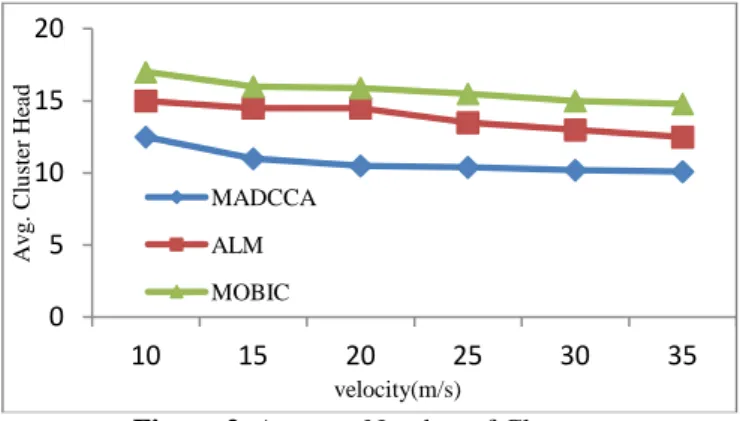
1. Average Number of Clusters: The average number of
clusters which are present in the network since inception to any instance of time. Figure 2 presents the results obtained through simulation. The results obtained are for a network size with 50-250 vehicles. Less number of clusters in proposed approach means that more vehicles are part of any cluster in comparison to other approaches. The reduced number of clusters in the proposed approach indicates that based on the homogeneity index, It cluster the vehicle into more dense as well as in sparse region. Since the calculation of the density threshold (λ) is adaptive in nature. Therefore the value of λ for every vehicle to announce as cluster head
will be different, that automatically creates the dense and sparse clusters in the network. Another reason for reduced number of cluster head is average relative velocity characteristic with respect to its neighbors. However other two approaches MOBIC and new ALM are not considering the density of the vehicles for clustering therefore, these approaches generates the number of increased clusters.
Figure 2. Average Number of Clusters
2. Average Cluster Size: It is the average of the number of
CMs belonging to a cluster. Figure 3 presents the results obtained through simulation. The results obtained are for a network size with 50-250 vehicles and with average velocity of 12 m/s. More vehicles are part of the clusters in proposed clustering approach shows that the clustering mechanism is able to capture large number of similar vehicles. Based on the homogeneity index, It cluster the vehicle into more dense as well as in sparse region, therefore the number of cluster members associated with dense cluster are higher than the sparse cluster. We can observe in the simulation result, as the vehicle density is increasing the number of dense clusters are increasing and sparse clusters are going to reduce. Due to this the average cluster size is going to increase. While other two approaches MOBIC and new ALM give the moderate performance in terms of average number of clusters members.
Figure 3. Average Number of Cluster Members
3. Average Rate of CH Change: The Average Number of
CH changes per second. Figure 4 presents the results obtained through simulation. The rate of change of CH represents the CH stability. Slower the rate of change of CH, more stable is the clusters and more robust is the clustering algorithm. The proposed approach has the least rate as obtained by the simulation results. The proposed approach achieves the more stable clusters due to cluster head selection conditions which basically consider the average relative velocity characteristics in terms of the standard deviation and homogeneity index. The head selection procedure clusters the vehicles based on more homogeneous
0 5 10 15 20
10 15 20 25 30 35
A
v
g
.
C
lu
st
er
H
ea
d
velocity(m/s) MADCCA
ALM
MOBIC
0 2 4 6 8
50 100 150 200 250
A
v
g
.
C
lu
st
er
S
iz
e
Number of vehicle with Avg velocity 12(m/s) MADCCA
ALM
environments in term of density as well as the speed. On the other side the MOBIC and New ALM gives the moderate performance.
Figure 4. Average Rate of CH Change per Second
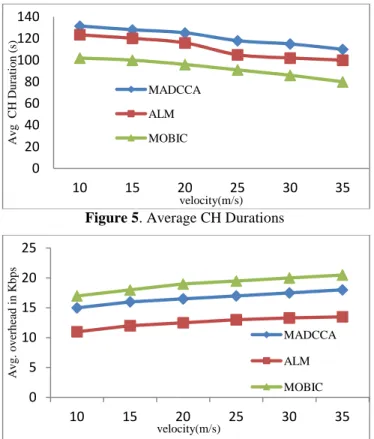
4. Average Cluster Duration: It is the time duration
between a vehicle becoming a CH and the moment it discharges the responsibility of CH. Figure 5 presents the results obtained through simulation. The rate of change of CH represents the CH stability. Further, higher CH duration as shown in the results means that the clustering approach is able to select a more stable CH. This represents the accuracy and validity of the CH selection mechanism. Since cluster head selection in the proposed approach considers the similar characteristics based on the average relative velocity metric and density metric. Which in result, generates more stable clusters, while other two approaches MOBIC and new ALM gives the moderate performances.
Figure 5. Average CH Durations
Figure 6. Average Communication Overhead in Kbps
5. Average Communication Overhead: It is the average
amount of bits in terms of control messages needed for cluster formation and maintenance since initialization of the network. Figure 6 presents the results obtained through simulation. The results show that the clustering approach is
able to perform at par with other approaches. This represents the proposed approach is more robust and accurate without compromising much on the communication overhead.
6.
Conclusion
In this work, we proposed Mobility Adaptive Density Connected Clustering Algorithm (MADCCA), a density based clustering algorithm. The Cluster Heads (CHs) are selected based on the observation that vehicles, which are having more homogeneous environments, will become the cluster heads and rest of the vehicles in their communication range will be the Cluster Members (CMs). We used standard deviation of relative velocity, density of the neighborhood and Homogeneity index for selecting the cluster head for a cluster. These selection parameters resulted in a more stable clustering among the vehicles of VANETs. We simulated and compared the performance of the proposed approach with that of the methods proposed in new ALM [11] and MOBIC [9]. The results indicate significant improvement in establishing stable clusters among the nodes by the proposed approach. Using this cluster algorithm as the base for cluster based routing protocol for VANETs can be a direction for future work. Further, it will be of interest to investigate the impact of the stable clusters formed by the approach in the performance of routing protocol.
References
[1] T. Sukuvaara, C. Pomalaza-raez, “Vehicular Networking Pilot System for Vehicle- to- Infrastructure and Vehicle-to-Vehicle Communication”, International Journal of Communication Networks and Information Security (IJCNIS), Vol. 1, No. 3, pp. 1-11, 2009.
[2] T. Sukuvaara, K. Mäenpää, R. Ylitalo, H. Konttaniemi, J. Petäjäjärvi, J. Veskoniemi, M. Autioniemi, “ Vehicular Networking Road Weather Information System Tailored for Arctic Winter Conditions”, International Journal of Communication Networks and Information Security (IJCNIS), Vol. 7, No. 1, April 2015.
[3] J. B. Kenney, “Dedicated Short-Range Communications (DSRC) Standards in the United States,” Proceedings of the IEEE, Vol. 99, No. 7, pp. 1162-1182, 2011.
[4] H. Su, X. Zhang, “Clustering-based multichannel mac protocols for QoS provisionings over vehicular ad hoc networks,” IEEE Transaction on Vehicular Technology, Vol. 56, No. 6, pp. 3309–3323, 2007.
[5] Y. Gunter, B. Wiegel, H. P. Grosmann, “Cluster-based medium access scheme for VANETs,” IEEE Intelligent Transportation Systems Conference, New York, pp. 343–348, 2007.
[6] Z. Wang, L. Liu, M. Zhou, N. Ansari, “A position-based clustering technique for ad hoc inter vehicle communication,” IEEE Transaction on Systems, Man, and Cybernetics, Part C: Applications and Reviews, Vol. 38, No. 2, pp. 201–208, 2008. [7] K. Abboud, W. Zhuang, “Impact of node mobility on single-hop cluster overlap in vehicular ad hoc networks,” 17th ACM International Conference on Modeling Analysis and Simulation of Wireless and Mobile Systems, New York, pp. 65-72, 2014.
[8] M, Garela, J. Tzu-Chieh Tsai, “Multicluster mobile multimedia radio network,” Wireless Networks, Vol. 1, No. 3, pp. 255-265, 1995.
[9] P. Basu, N. Khan, T.D.C. Little, “A mobility based metric for clustering in mobile ad hoc networks,” International Conference on Distributed Computing Systems Workshop, pp. 413-418, 2001.
[10]C. Shea, B. Hassanabadi, S. Valaee, “Mobility-based clustering in VANETs using affinity propagation”, In Global
0 0.2 0.4 0.6 0.8 1
10 15 20 25 30 35
A
v
g
.
R
at
e
o
f
C
H
C
h
an
g
e
/s
ec
.
velocity(m/s)
MADCCA
ALM
MOBIC
0 20 40 60 80 100 120 140
10 15 20 25 30 35
A
v
g
C
H
D
u
ra
ti
o
n
(
s)
velocity(m/s) MADCCA
ALM
MOBIC
0 5 10 15 20 25
10 15 20 25 30 35
A
v
g
.
o
v
er
h
ea
d
i
n
K
b
p
s
velocity(m/s)
MADCCA
ALM
Telecommunications Conference GLOBECOM IEEE, pp. 1–6, 2009.
[11]E. Souza, I. Nikolaidis, P. Gburzynski, “A new aggregate local mobility (ALM) clustering algorithm for VANETs,” IEEE International Conference on Communications, Cape Town- South Africa, pp. 1–5, 2010.
[12]S. Kuklinski, G. Wolny, “Density based clustering algorithm for vanets,” In Testbeds and Research Infrastructures for the Development of Networks Communities and Workshops TridentCom, pp. 1–6, 2009.
[13]A. Daeinabi, A.G.P. Rahbar, A. Khademzadeh, “VWCA: An efficient clustering algorithm in vehicular ad-hoc networks,” Journal of Network and Computer Applications, Vol. 34, No. 1, pp. 207-222, 2011.
[14]Z.Y. Rawashdeh, S.M. Mahmud, “A novel algorithm to form stable clusters in vehicular ad hoc networks on highways,” EURASIP Journal on Wireless Communications and Networking, Vol. 2012, No. 1, pp. 1-13, 2012.
[15]J. H. Kwon, C. Kwon, E. J. Kim, “Neighbor mobility-based clustering scheme for vehicular ad hoc networks,” in Proc. Int. Conf. Platform Technol. Service (PlatCon), pp. 31–32, Jan. 2015.
[16]Y. Chen, M. Fang, S. Shi, W. Guo, X. Zheng, “Distributed multihop clustering algorithm for VANETs based on neighborhood follow,” EURASIP J. Wireless Commun. Netw., Vol. 1, pp. 1–12, Apr. 2015.
[17]S. Ucar, S. C. Ergen, O. Ozkasap, “VMaSC: Vehicular multihop algorithm for stable clustering in vehicular ad hoc networks,” in Proc. IEEE Wireless Commun. Netw. Conf. (WCNC), Shanghai, China, pp. 2381–2386, Apr. 2013. [18]S. Ucar, S. C. Ergen, and O. Ozkasap, “Multihop-cluster-based
IEEE 802.11p and LTE hybrid architecture for VANET safety message dissemination,” IEEE Trans. Veh. Technol., Vol. 65, No. 4, pp. 2621–2636, 2016.
[19]M. Behrisch, L. Bieker, J. Erdmann, D. Krajzewicz, “Sumo- simulation of urban mobility: an overview,” The Third International Conference on Advances in System Simulation, pp. 63-68, 2011.