Open Access
Research
Attachment as an organizer of behavior: implications for substance
abuse problems and willingness to seek treatment
Kristin M Caspers*, Rebecca Yucuis, Beth Troutman and Ruth Spinks
Address: Roy J and Lucille Carver College of Medicine, Department of Psychiatry, University of Iowa, Iowa City, IA, 52242, USA Email: Kristin M Caspers* - [email protected]; Rebecca Yucuis - [email protected]; Beth Troutman - [email protected]; Ruth Spinks - [email protected]
* Corresponding author
Abstract
Background: Attachment theory allows specific predictions about the role of attachment representations in organizing behavior. Insecure attachment is hypothesized to predict maladaptive emotional regulation whereas secure attachment is hypothesized to predict adaptive emotional regulation. In this paper, we test specific hypotheses about the role of attachment representations in substance abuse/ dependence and treatment participation. Based on theory, we expect divergence between levels of maladaptive functioning and adaptive methods of regulating negative emotions.
Methods: Participants for this study consist of a sample of adoptees participating in an ongoing longitudinal adoption study (n = 208). The Semi-Structured Assessment of the Genetics of Alcohol-II [41] was used to determine lifetime substance abuse/dependence and treatment participation. Attachment representations were derived by the Adult Attachment Interview [AAI; [16]]. We constructed a prior contrasts reflecting theoretical predictions for the association between attachment representations, substance abuse/dependence and treatment participation.
Results: Logistic regression was used to test our hypotheses. As predicted, individuals classified as dismissing, preoccupied or earned-secure reported the highest rates of substance abuse/dependence. Individuals classified as dismissing reported significantly lower rates of treatment participation despite their high rates of substance abuse/dependence. As expected, the continuous-secure group reported lowest rates of both substance abuse/dependence and treatment participation.
Conclusion: The findings from this study identify attachment representations as an influential factor in understanding the divergence between problematic substance use and treatment utilization. The findings further imply that treatment may need to take attachment representations into account to promote successful recovery.
Background
Attachment theory provides clinicians and researchers alike a method of examining the impact of early experi-ences on later adjustment [1-6]. According to attachment theory, early experiences with caregivers are transformed
into internal mental representations of attachment during childhood and adolescence [3,7-10]. Internal models of attachment are theorized to consist of beliefs about the self and others from which rules are derived and used to guide behavior [4-7,10,11]. Attachment representations
Published: 02 November 2006
Substance Abuse Treatment, Prevention, and Policy 2006, 1:32 doi:10.1186/1747-597X-1-32
Received: 30 June 2006 Accepted: 02 November 2006
This article is available from: http://www.substanceabusepolicy.com/content/1/1/32 © 2006 Caspers et al; licensee BioMed Central Ltd.
are further believed to affect behavior by influencing the intensity of emotional experience and subsequent attempts at emotional regulation [3,8]. In this paper, we utilize the concept of attachment as an organizational construct from which predictions about substance use problems and willingness to seek treatment can be derived [12].
Attachment theory allows for specific predictions about quality of early experiences with caretakers and the effect of these experiences on future behavior and relationships [3,13]. Internal working models of attachment are con-structed from repeated interactions with caretakers and are derived from the responsiveness of caretakers during episodes of distress [4,5,7,14,15]. These internal represen-tations are hypothesized to act as filters for future relation-ships and experiences [1,7,9,13,16]. For example, responsive and supportive behaviors from caretakers are thought to produce secure attachment representations, which are hypothesized to result in openness to emo-tional experiences and a willingness to engage in creative and productive emotional regulation. In contrast, unsup-portive caretaking (e.g., rejection, neglect) during child-hood is thought to be characteristic of dismissing attachment. As a result, individuals classified as dismiss-ing are most commonly characterized as engagdismiss-ing in emo-tional distancing and greater reliance on the self rather than others. Finally, inconsistent support from caretakers during childhood is most often associated with preoccu-pied attachment which is thought to produce persistent anxiety towards interpersonal relationships and exagger-ated levels of negative affect.
Attachment representations show predictive associations with a wide-range of pathological behavior including per-sonality disorder(s), mood disturbance and psychopathy [3,8,13,17-24]. Empirical support of the association between attachment and problematic substance use is less explored and most studies assess self-reported attachment styles [25-30] rather than internal mental representations of attachment as derived from instruments such as the Adult Attachment Interview [16]. Studies in which attach-ment representations (e.g., internal working models of attachment) are assessed typically rely on clinical samples, suffer from limited sample sizes, or provide inconsistent results [21,24,3,32]. For example, Riggs and Jacobvitz [32] failed to demonstrate a significant association between substance abuse problems and organized attachment, whereas unresolved attachment surrounding abuse was predictive. In contrast, Rosenstein and Horowitz [21] found a trend toward higher rates of substance abuse among adolescents classified as dismissing when com-pared to adolescents classified as preoccupied. Consistent with Rosenstein and Horowitz [21], Allen, Hauser, and Borman-Spurrell [31] found a significant positive
associa-tion between problematic substance use and scales most often attributed to a dismissing state of mind (e.g., dero-gation of caretakers) and a negative association with scales most often associated with preoccupied attachment (e.g., involving anger). However, Allen et al. [31] failed to find a significant overall effect of attachment category on sub-stance abuse.
Preliminary analyses of data presented in this paper show significant associations between attachment representa-tions and reports of illicit substance use within a non-clin-ical sample [33]. We found significantly higher rates of illicit substance use among individuals classified as dis-missing or preoccupied when compared to individuals classified as secure. Although our preliminary analyses provide support for a potential role of attachment in sub-stance use, there were several limitations to our study. First, analyses were limited to the prediction of ever using a substance which combines experimental and problem-atic users into a single indistinguishable group (i.e., users). Second, variation in inferred childhood experi-ences within the secure group was ignored (i.e., earned-versus continuous-secure). Although the validity of such a distinction has been questioned, we believe separation of the secure group into continuous versus earned-security is warranted due to differences in rates of psychopathology between the two groups. Earned-security is associated with higher rates of mood disturbance which might increase risk for problematic substance use [34-37]. Finally, the illicit substance use group combined mari-juana and non-marimari-juana substances while alcohol was excluded from the analyses. Therefore, one primary goal of this paper is to examine the association between attach-ment representations and problematic substance use within a large, non-clinical sample.
parenting, which is characteristic of preoccupied attach-ment representations, is thought to produce a hypervigi-lance towards others' coupled with a continued dissatisfaction with support received. Therefore, individu-als classified as preoccupied are expected to report higher rates of seeking professional support due to the unsuccess-ful impact of intervention.
Although researchers have studied the interplay between attachment representations and therapeutic quality, very little research has been conducted on the impact of attach-ment on the willingness to seek treatattach-ment [38-40]. We are aware of only a single study that examined attachment representations and likelihood to seek treatment. Riggs, Jacobvitz, and Hazen [11] report significant associations between lifetime history of psychotherapy and attach-ment representations. Individuals classified as dismissing reported the lowest rates of psychotherapy whereas indi-viduals classified as secure reported the highest. Riggs et al. did not distinguish between earned- and continuous-secure which may contribute to high rates of therapy within the secure group [11]. Concurrent examination of the association between attachment representations, sub-stance use problems, and willingness to seek treatment will further advance substance abuse interventions.
In summary, attachment theory allows for specific predic-tions about adaptive and maladaptive behavior in adult-hood. We test two primary hypotheses in this paper. Our first hypothesis predicts that individuals classified as dis-missing, preoccupied or earned-secure will report higher rates of problematic substance use than individuals classi-fied as continuous-secure. This proposition arises from the role of both inferred childhood experiences and attachment representations in maladaptive emotional regulation [3,13]. We predict high rates of lifetime sub-stance abuse/dependence among individuals classified as earned-secure, despite their secure state of mind, due to the influence of inferred negative childhood experiences on substance use. Although ratings on childhood experi-ences derived from the Adult Attachment Interview [16] are not veridical with actual experience, we hypothesize that the negative mood proposed to account for the view on childhood experiences will increase the likelihood of problematic substance use [34,36]. Problematic substance use among individuals classified as dismissing or preoccu-pied, on the other hand, is hypothesized to result from an insecure working model of attachment which is thought to promote maladaptive approaches to emotional regula-tion (e.g., substance abuse). Our second hypothesis pre-dicts different rates of treatment participation as a function of attachment representations. We anticipate low rates of treatment participation by individuals classified as dismissing, despite predicted high rates of substance use problems, due to persistent devaluing of relationships
common among this group. We predict high rates of treat-ment participation among individuals classified as preoc-cupied, due to hypervigilance towards distress, and earned-security, due to strong valuing of relationships [1,32].
Method
Participants
Participants for this study were recruited as part of an ongoing longitudinal adoption study. Roughly half the adoptees were originally selected due to the presence of psychopathology (e.g., alcohol problems and/or antiso-cial behaviors) in a birth parent. During the most recent re-interview, participant psychiatric histories were updated and the Adult Attachment Interview [AAI; [16]] was administered (n = 208). Approximately 53% of the sample was female and ranged between 24 and 66 years of age (M = 39, S.D. = 7.95). Average household income was $40,000 to $49,999 per year. The sample was pre-dominantly Caucasian (92%), with the remaining sample comprised of 4% Hispanic, 2% African American, and 1% "Other". Adoptees were adopted by non-relatives within 2 months of age (SD = 5.44) with 67.8% adopted prior to one month and 94.2% adopted prior to 6 months of age.
Measures
Adult attachment classification
The AAI [16] is a semi-structured interview that assesses an individual's attachment representations. Individuals are asked to provide five adjectives describing their childhood relationship with their adoptive mother and father, sepa-rately. Participants are also asked to provide experiential support for the chosen descriptors. Questions about parental responses during episodes of emotional upset, illness, and injury are also probed, as are experiences with death and trauma. Finally, the individual is asked to describe changes in and current feelings about their rela-tionship with their parents. Interviews were transcribed verbatim and coded by coders deemed reliable by the lab of Mary Main and Eric Hesse (Rebecca Yucuis and Kristin Caspers, Trained by Deborah Jacobvitz, Austin TX, 2001; Beth Troutman and Jeanne Frederickson, Trained by June Sroufe, Minneapolis, MN, 2002 and 1999, respectively). Approximately half of the AAIs were double-coded. Disa-greements were resolved through conference. Overall inter-rater agreement was 94% for the secure versus inse-cure distinction (κ = .86, p < .001), 91% percent agree-ment for the organized classifications (κ = .84, p < .001), and 93% agreement for the unresolved/not unresolved classifications (κ = .71, p < .001). Cronbach alphas were equally high for the individual scales ranging from .84 to .93.
par-ents. Five parental behaviors are rated on a 9-point scale: loving, rejection, pressure-to-achieve, involving-reversing, and neglect. Loving behavior reflects emotional support and availability. Rejection reflects active rejection or an avoidance of a child's attachment behaviors. Involving-reversing represents role-reversal between parent and child. Pressure-to-achieve reflects parental emphasis on achievement as a key component to the parent-child rela-tionship. Finally, neglect represents parental unrespon-siveness to attachment-related behaviors. The method by which ratings for childhood experiences are derived results in estimates of probable experiences with caretak-ers during childhood and adolescence. The presence of behaviors may be determined by either direct evidence (e.g., provision of comfort during episodes of distress) or the absence of evidence (e.g., no mention of comfort dur-ing episodes of distress). Therefore, ratdur-ings of childhood experiences are considered inferred rather than reflective of actual behaviors.
The next step in coding is determining attachment repre-sentations [16]. The transcript is evaluated for coherency and key indicators for each classification are rated. Three primary organized states of mind are derived from the transcripts: dismissing (Ds), secure (F), and preoccupied (E). Dismissing attachment is characterized by an inabil-ity to recall specific memories for positive adjectives used to describe either the mother and/or father. Individuals classified as dismissing often show a high degree of self-reliance, place minimal value on attachment relation-ships, and portray their childhoods as positive but are unable to provide experiential support. Inferred parental behaviors of rejection and/or neglect are most often asso-ciated with dismissing representations. Individuals classi-fied as preoccupied are unable to focus on questions at hand and respond in either a vague or actively angry man-ner when discussing past or current interactions with their caretakers. These individuals appear as if they are unable to move beyond their childhood experiences, remaining entangled with their parents. Inferred childhood experi-ences associated with preoccupied attachment most often involve inconsistent behavior and/or involving-reversing. Finally, individuals classified as secure are able to provide experiential support for adjectives provided, whether pos-itive or negative. They are consistent in their portrayal of early experiences, are willing to evaluate past and current relationships, and show valuing of attachment and for-giveness for negative experiences. The secure classification can be further divided into two sub-classifications based on ratings for inferred parental behavior: earned-secure and continuous-secure [32-37]. The earned-secure group is comprised of individuals with low ratings on positive indicators of inferred childhood experiences but demon-strate a secure state of mind. The continuous-secure group is comprised of individuals who experienced a supportive
relationship with at least one parent and expectedly devel-oped a secure state of mind.
Finally, a category of unresolved/disoriented (U) is assigned when significant lapses in discourse are present during discussions of loss or trauma. A few examples of speech patterns indicative of the unresolved category are confusions of the dead person as living, excessive detail surrounding the event of death or trauma, identifying the self as causal in the death of a loved one or deserving of abuse, or extreme reactions to experiences of loss or trauma. Given a classification of unresolved, subjects are also assigned a corresponding organized classification (e.g., U/Ds).
Substance use problems
The Semi-Structured Assessment for the Genetics of Alco-holism – II [SSAGA-II; [41]] was used to collect detailed information about lifetime substance use including alco-hol, tobacco, marijuana, and all non-marijuana sub-stances (e.g., cocaine, stimulants, hallucinogens, etc). Lifetime diagnoses of abuse or dependence of alcohol, marijuana, and any illicit drugs were derived from DSM-IV criteria. Overall prevalence rates for each diagnosis were as follows: alcohol dependence (18/208, 9%), alco-hol abuse (90/208, 43%), marijuana abuse or depend-ence (42/208, 20%), and any illicit drug abuse or dependence (35/208, 17%). Fifty-six percent (115/208) reported one or more substance-related diagnosis. Sub-stance abuse or dependence of alcohol, marijuana, or non-marijuana drugs served as independent outcome var-iables.
Mental health treatment
Solicitation of mental health care was determined from the SSAGA-II [41]. Two questions were used, each based on a yes/no response: 1) Have you ever spoken to a pro-fessional (e.g., psychiatrist, psychologist, medical doctor, nurse) about any emotional problems and 2) Have you ever received outpatient treatment which includes speak-ing to a psychiatrist, psychologist, or therapist. Fifty per-cent (104/208) reported seeing a mental health professional and 38% (79/208) reported receiving outpa-tient treatment. The majority of individuals sought treat-ment for emotional problems not related to substance abuse/dependence. Sixty-six percent of those who spoke to a professional about an emotional problem also reported receiving outpatient treatment.
Analyses
con-trasts. For the prediction of substance abuse/dependence, we predicted higher rates of problematic use among indi-viduals classified as dismissing, preoccupied, or earned-secure when compared to individuals classified as contin-uous-secure. We also predicted non-significant differences among the former three groups (i.e., dismissing, preoccu-pied, and earned-secure). Thus, three contrasts were con-structed reflecting the following comparisons (assigned values indicated in parentheses): 1) continuous-secure (-1) versus all other classifications (+.333), 2) preoccupied or earned-secure (-.50) versus dismissing (+1) and 3) earned-secure (-1) versus preoccupied (+1). The three contrasts were entered simultaneously into logistic regres-sions predicting alcohol, marijuana, or non-marijuana substance abuse/dependence.
For the prediction of treatment participation, we hypoth-esized higher rates of treatment among individuals classi-fied as preoccupied or earned-secure when compared to individuals classified as dismissing or continuous-secure. We also predicted no differences between the former groups (e.g., dismissing and continuous-secure) as well as no differences between the latter groups (e.g., preoccupied and earned-secure). Three contrasts tested our hypotheses in the prediction of treatment participation (assigned val-ues indicated in parentheses): 1) dismissing or continu-ous-secure (-.50) versus preoccupied or earned secure (+.50), 2) dismissing (-1) versus continuous-secure (+1), and 3) earned-secure (-1) versus preoccupied (+1). The three contrasts were simultaneously entered into a logistic regression predicting lifetime history of treatment partici-pation.
We also tested for the effect of gender, current age, current mood (e.g., depression/anxiety symptoms) and personal-ity disorder on the association between attachment repre-sentations, substance use problems, and treatment participation. The parameter estimates for attachment representations were not substantially reduced and remained significant. Therefore, the unadjusted findings are presented.
Results
Preliminary analyses
The distribution of the AAI organized classifications dif-fered significantly from expected, χ2 (2) = 31.965, p < .001, with a larger proportion of individuals in the dis-missing category (Observed = 39% versus Expected = 24%) and a smaller proportion of individuals in the pre-occupied classification (Observed = 8% versus Expected = 18%) [42]. The distribution of the unresolved classifica-tion (20%; 39/194), however, was consistent with expec-tations, χ2 (1) = .558, p = .455.
We examined the validity of our definition of earned-secure by comparing inferred childhood experiences (see Table 1). Individuals classified as continuous-secure showed significantly higher means on all positive inferred parental behaviors and lowest ratings on all inferred neg-ative indices. Few differences on inferred childhood expe-riences were found between the dismissing, preoccupied, and earned-secure classifications.
The observed differences in inferred childhood experi-ences emphasize the distinction between earned- and continuous-security. Inferred negative childhood experi-ences with caretakers may increase the likelihood of prob-lematic substance use despite coherent attachment representations. Given the similarities between individu-als classified as dismissing, preoccupied, and earned-secure on the inferred parenting scales, we hypothesized similar rates of problematic substance use across these groups. Based on attachment theory, however, we expected higher rates of treatment participation among those individuals classified as preoccupied or earned-secure and lower rates of participation among individuals classified as dismissing. Individuals classified as continu-ous-secure were hypothesized to have relatively low rates of substance use problems. We also predicted high rates of treatment participation among individuals classified as continuous-secure due to their hypothesized openness towards emotions and interpersonal relationships [11]. The analyses presented below explicitly tested these assumptions.
Organized states of mind and substance use problems
Organized states of mind and participation in treatment
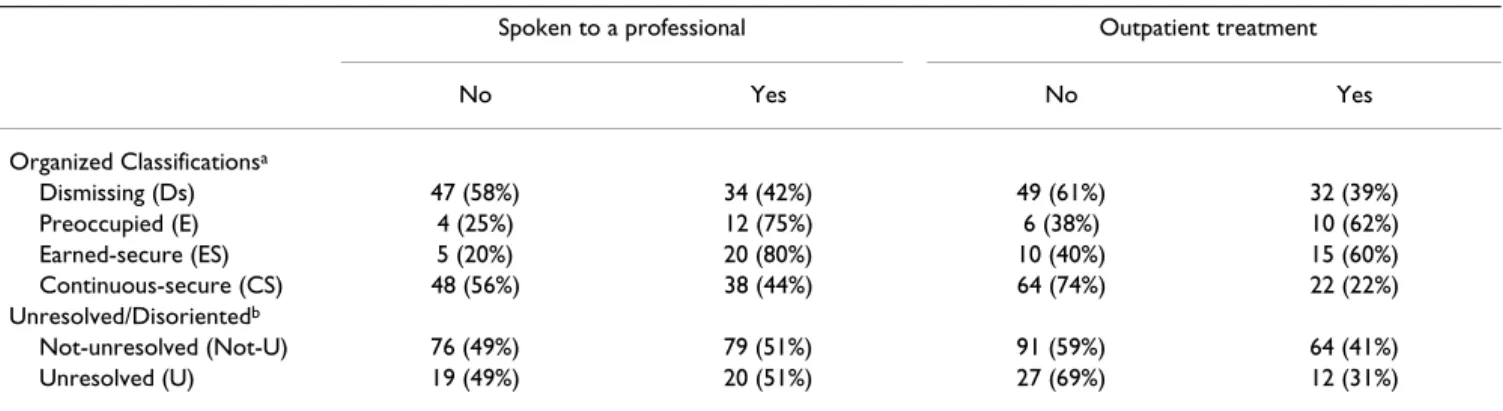
The cross-classification table between organized attach-ment representations and treatattach-ment participation are pre-sented in Table 4. Results from the logistic regression models are presented in Table 5. The overall models were significant for both speaking to a professional and outpa-tient treatment. The attachment contrast comparing indi-viduals classified as dismissing or continuous-secure versus individuals classified as preoccupied or earned secure was significant in both models (see Table 5). The odds of speaking to a professional about mental health problems was 4.5 times more likely if classified as preoc-cupied or earned-secure. Similarly, participation in an outpatient treatment program increased three-fold when classified as preoccupied or earned-secure. The contrast
comparing individuals classified as continuous-secure versus dismissing approached significant for outpatient treatment which was less likely among those classified as continuous-secure (see Table 5). None of the other con-trasts were significant.
Divergence between need for treatment and participation in treatment
Finally, we examined whether organized attachment rep-resentations accounted for lower rates of participation in treatment among individuals having a lifetime substance abuse/dependence diagnosis [43-45]. In the analyses above, we demonstrated that individuals classified as dis-missing reported lower rates of treatment participation than individuals classified as preoccupied or earned
Table 2: AAI Attachment Representations and Substance Abuse/Dependence.
Alcohol Diagnosisa
(n = 193)
Marijuana Diagnosis (n = 194)
Non-Marijuana Drug Diagnosis (n = 194)
No Yes No Yes No Yes
Organized Attachment
Dismissing (Ds) 35 (44%) 44 (56%) 63 (78%) 18 (22%) 66 (82%) 15 (18%)
Preoccupied (E) 7 (44%) 9 (56%) 11 (69%) 5 (31%) 9 (56%) 7 (44%)
Earned-secure (ES) 9 (36%) 16 (64%) 15 (60%) 10 (40%) 20 (80%) 5 (20%)
Continuous-secure (CS) 48 (56%) 38 (44%) 77 (90%) 9 (10%) 78 (91%) 8 (9%)
Unresolved/Disoriented
Not-unresolved (Not-U) 73 (47%) 81 (53%) 123 (79%) 32 (21%) 130 (84%) 25 (16%)
Unresolved (U) 18 (46%) 21 (54%) 32 (82%) 7 (18%) 31 (80%) 8 (20%)
Note. Ds = dismissing. E = preoccupied. ES = earned-secure. CS = continuous-secure Sample size of 194 for analyses including unresolved/ disoriented attachment classification. Percentages are within substance and rows.
a Diagnoses were missing for two subjects due to incomplete data.
Table 1: Distribution of Inferred Childhood Experiences across Attachment Groups.
Dismissing (n = 81)
Preoccupied (n = 16)
Earned-secure (n = 25)
Continuous-secure (n = 86)
M SD M SD M SD M SD
Mother
Loving 3.004 .18 2.584 .36 2.594 .29 5.801,2,3 .15
Rejection 4.564 .23 5.214 .45 5.294 .37 1.801,2,3 .19
Involving-Reversing 1.412 .20 2.851 .39 2.07 .32 1.81 .16
Pressure-to-Achieve 1.79 .20 2.45 .39 1.2 .32 1.38 .16
Neglecting 1.782 .18 3.541,3,4 .35 2.162,4 .29 1.262,3 .14
Father
Loving 2.814 .18 2.994 .18 2.044 .29 5.511,2,3 .15
Rejection 4.623,4 .23 3.753,4 .46 5.861,2,4 .38 2.091,2,3 .19
Involving-Reversing 1.252 .12 2.281,4 .23 1.62 .19 1.132 .09
Pressure-to-Achieve 1.57 .16 1.87 .31 2.204 .26 1.293 .13
Neglecting 3.454 .28 3.674 .56 3.694 .46 2.061,2,3 .23
secure despite equal rates of substance abuse/dependence problems among these three groups. We were interested in examining if this divergence between the presence of substance abuse problems and treatment was statistically significant. Therefore, we identified a sub-sample of indi-viduals having a lifetime diagnosis of alcohol, marijuana, and/or non-marijuana substances (n = 75). We compared treatment participation among individuals classified as dismissing (-1) versus individuals classified as preoccu-pied or earned-secure (+1). Individuals classified as dis-missing were significantly less likely to speak to a professional than individuals classified as preoccupied or earned-secure (see Table 6). The model predicting partici-pation in outpatient treatment showed a marginal effect in the same direction. Therefore, despite the presence of substance abuse/dependence problems, individuals clas-sified as dismissing were less likely to engage in treatment than individuals classified as preoccupied or earned-secure.
Discussion
Attachment theory provides a useful framework from which appropriate interventions into substance use prob-lems can be developed [1]. Our research questions focused on the association between attachment represen-tations, lifetime prevalence of substance
abuse/depend-ence, and likelihood of participating in treatment. We hypothesized that attachment representations would show predictable associations with problematic substance use and participation in treatment. We further predicted that individuals with certain attachment states of mind would be less likely to seek treatment despite significant problems with substance use.
Our predictions were derived from hypothesized influ-ences of attachment representations on emotional regula-tion and percepregula-tions about interpersonal relaregula-tionships [1,3,8,11]. Specifically, individuals with a dismissing state of mind are believed to view relationships as unimportant and minimize distress. Thus, we predicted that dismissing attachment would be associated with a lower likelihood of seeking treatment despite the presence of substance abuse/dependence [39,44,45]. We hypothesized that pre-occupied attachment, on the other hand, would be associ-ated with hypervigilance towards interpersonal relationships and distress. Therefore, higher rates of involvement in treatment and substance abuse/depend-ence were predicted among individuals classified as preoc-cupied. Finally, we predicted that secure attachment, regardless of inferred early experiences, would be associ-ated with greater openness towards both emotions and interpersonal relationships resulting in a greater
likeli-Table 4: AAI Attachment Representations and Participation in Treatment.
Spoken to a professional Outpatient treatment
No Yes No Yes
Organized Classificationsa
Dismissing (Ds) 47 (58%) 34 (42%) 49 (61%) 32 (39%)
Preoccupied (E) 4 (25%) 12 (75%) 6 (38%) 10 (62%)
Earned-secure (ES) 5 (20%) 20 (80%) 10 (40%) 15 (60%)
Continuous-secure (CS) 48 (56%) 38 (44%) 64 (74%) 22 (22%)
Unresolved/Disorientedb
Not-unresolved (Not-U) 76 (49%) 79 (51%) 91 (59%) 64 (41%)
Unresolved (U) 19 (49%) 20 (51%) 27 (69%) 12 (31%)
Note. Ds = dismissing, E = preoccupied, ES = earned-secure, CS = continuous-secure. Not-U = not unresolved. U = unresolved.
a n = 208. b n = 194.
Table 3: Logistic Regression Predicting Substance Abuse/Dependence from Organized Attachment Contrasts.
Alcohol Abuse/Dependencea Marijuana
Abuse/Dependenceb
Non-Marijuana Substance Abuse/Dependencec
Attachment Contrasts OR p 95% CI OR p 95% CI OR p 95% CI
Ds or E or ES versus CS 1.575 .058 0.984, 2.519 2.89 .001 1.504, 5.587 2.532 .006 1.304, 4.926
E or ES versus Ds 0.930 .787 0.549, 1.576 0.673 .176 0.379, 1.194 0.629 .133 0.344, 1.152
ES versus E 0.878 .693 0.461, 1.672 0.870 .685 0.445, 1.702 1.719 .128 0.856, 3.453
Note. Ds = dismissing, E = preoccupied, ES = earned-secure, CS = continuous-secure.
hood of seeking treatment. We predicted different rates of substance abuse/dependence between the earned- versus continuous-secure classifications [34-37]. Specifically, we anticipated that individuals classified as earned-secure would report higher rates of substance abuse/dependence than those classified as continuous-secure due to greater negative affect associated with the former group.
The findings were consistent with our predictions. Indi-viduals classified as dismissing reported low rates of par-ticipation in treatment despite substantial problems with substance abuse/dependence. Individuals classified as preoccupied or earned-secure reported both high rates of substance abuse/dependence and a greater likelihood of seeking treatment. Finally, individuals classified as con-tinuous-secure reported both low levels of treatment par-ticipation and substance use problems.
The pattern of findings for dismissing and earned-secure representations identifies attachment representations as an influential factor in the divergence between the pres-ence of problems and likelihood of receiving treatment [39,44,45]. Both groups had similar inferred negative experiences with caretakers during childhood and similar rates of substance use problems; however, individuals classified as earned-secure were more likely to report seek-ing treatment. One interpretation from our findseek-ings is that attachment representations influence an individual's willingness to seek treatment. Individuals classified as earned-secure, despite their negative inferred experiences with caretakers, continue to value interpersonal relation-ships. Thus, they are more likely to report seeking
treat-ment. An alternative interpretation, although unsubstantiated with these data, is the potential mallea-bility of attachment representations with appropriate treatment [21]. Individuals designated as earned-secure in our sample may have been classified as dismissing or pre-occupied prior to entering treatment. The earned-secure classification could thus be a consequence of treatment and not a motivating factor in seeking treatment. Finally, the validity of the earned-secure classification continues to be questioned. It is possible that the actual quality of childhood experiences was not accurately reflected by our inferred experience scales due a negative bias accounting for the low ratings [34-37]. This explanation of earned-security would slightly alter the interpretation of our find-ings attributing substance use problems to the presence of a negative bias and associated mood disturbance rather than to negative childhood experiences per se. Regardless, our findings add further to the apparent qualitative differ-ence with regard to psychopathology between individuals classified as earned- versus continuous secure.
Implications for treatment providers
The findings presented in this paper represent merely a snapshot into the complex role of attachment in the ther-apeutic process [1]. At this point, we are only able to spec-ulate about the nuances introduced by attachment representations and the implication of these nuances for the successful treatment of addiction. For example, our findings suggest that a seemingly uniform outcome (e.g., addiction) may result from qualitatively different external and internal experiences thereby requiring modification of interventions to fit "the developing person" [38]. A
Table 6: Logistic Regression Predicting Treatment Participation Among Individuals with Substance Abuse/Dependence (n = 75) from Organized Attachment Contrasts.
Spoken to a professional a Outpatient Treatment b
Attachment Contrast OR p 95% CI OR p 95% CI
Ds versus E or ES 2.538 .015 1.200, 5.376 1.779 .090 0.913, 3.472
Note. Ds = dismissing, E = preoccupied, ES = earned-secure.
a Wald χ2 (1) = 6.772, p < .009. b Wald χ2 (1) = 2.995, p = .084.
Table 5: Logistic Regression Predicting Treatment Participation from Organized Attachment Contrasts.
Spoken to a professionala Outpatient Treatmentb
Attachment Contrasts OR p 95% CI OR p 95% CI
CS or Ds versus E or ES 4.578 .001 2.039, 10.278 3.337 .001 1.618, 6.885
CS versus Ds 1.046 .773 0.770, 1.420 0.726 .056 0.522, 1.740
E versus ES 0.866 .706 0.410, 1.831 1.054 .873 0.553, 2.009
Note. Ds = dismissing, E = preoccupied, ES = earned-secure, CS = continuous-secure.
continued balance between theory, research, and practice will further advance the development of successful inter-ventions into addiction [1,2,38]. An example of such bal-ance is Flores' [46] incorporation of attachment theory into a model for the treatment of addiction. He conceptu-alizes addiction treatment as a "time dependent process" [p. 69, [46]] in which attachment-related issues alter the focus and nature of intervention across the different stages of recovery. His depiction of addiction as an "attachment disorder" emphasizes the intricate balance that must be achieved when attempting to shift individuals from sub-stance use towards more adaptive methods of emotional regulation. Although it is not always clinically feasible to fully assess attachment related cognitions, intervention-ists can be trained to watch for hallmark indicators of behaviors associated specific attachment orientations [1,2]. Such insight by interventionists will increase the likelihood that addicts will be successful in reducing the rewards of substance use (e.g., negative affect reduction) and promote the development of mentalizing abilities (e.g., reflective functioning) that allow greater insight into the motivations behind use [46,47].
Limitations
This study represents a preliminary examination of the association between attachment and treatment. We used a sample of adoptees which limits generalization of the findings. Although the sample was not selected on psy-chopathology of the adoptee, the sample was balanced on birth parent antisocial and substance use behaviors which increases risk of these disorders in the adoptees. This bio-logical risk increases the odds of psychopathology among the adoptees limiting generalization to a truly random non-clinical sample.
A second limitation involves incomplete information on the purpose and type of treatment, including referral or self-guided solicitation. The questions used to indicate treatment participation were rudimentary at best. Future studies should delineate what type of professional was seen for treatment (e.g., psychiatrist, psychologist, social worker, counselor), the type of treatment implemented (e.g., pharmacological, cognitive behavioral, group), and duration of treatment. Researchers could then explore if certain treatment programs are better matched to certain attachment representations [1,46].
A third limitation is the inability to pinpoint timing of treatment which is especially relevant when evaluating earned-security. We utilized lifetime estimates for both substance abuse/dependence and treatment. With ade-quate data, future studies could examine treatment suc-cess in terms of recovery from substance abuse/ dependence. Exacerbation of substance misuse could also be observed throughout the therapeutic process. It may be
possible that use, or desire to use, may increase as working models of attachment are challenged. This would be espe-cially informative in further understanding the complex interplay between attachment representations and sub-stance use problems.
The final limitation pertains to the omission of the unre-solved state of mind surrounding abuse or trauma. Unre-solved attachment represents a breakdown of the organized attachment system. Although we could predict elevated substance use problems within this group, we could not make specific hypotheses about help-seeking behavior without taking into account secondary organ-ized classifications (e.g., dismissing, preoccupied, earned-or continuous-secure). Unfearned-ortunately, the number of individuals classified as unresolved (n = 39) precluded such analyses.
Conclusion
Our findings demonstrate a potential explanation for dis-crepancies between substance use problems and treat-ment of such problems. Referrals for treattreat-ment and continued follow-up may become increasingly important depending on one's attachment representations. The process of promoting recovery may also rely heavily on attachment. Assessment of both substance use problems and attachment may improve likelihood of successful recovery from substance use problems.
Competing interests
The author(s) declare that they have no competing inter-ests.
Acknowledgements
I wish to thank the adoptees for participating in this study. I would also like to thank Beth Troutman and Jeanne Frederickson for their assistance in coding the Adult Attachment Interviews. Funding for this project was pro-vided by the National Institute on Drug Abuse (RO1 DA05821).
References
1. Slade A: Attachment theory and research: Implications for the theory and practice of individual psychotherapy with adults. In Handbook of attachment: Theory, research, and clinical appli-cations Edited by: Cassidy J, Shaver PR. New York The Guilford Press; 1999:575-594.
2. Slade A: The move from categories to process: Attachment phenomena and clinical evaluation. Infant Mental Health Journal
2004, 25(4):269-283.
3. Sroufe A: Emotional Development New York: Cambridge University Press; 1996.
4. Bowlby J: A Secure Base New York Basic Books; 1988.
5. Bowlby J: Attachment and loss, Vol. 1: Attachment. London Hogarth Press and the Institute of Psycho-Analysis; 1969.
6. Bowlby J: Attachment and loss, Vol. 2: Separation, anxiety and anger. London Hogarth Press and Institute of Psycho-Analysis; 1973.
8. Kobak RR, Sceery A: Attachment in late adolescence: Working models, affect regulation, and representations of self and others. Child Development 1988, 59:135-146.
9. Main M: Metacognitive knowledge, metacognitive monitor-ing, and singular (coherent) vs. multiple (incoherent) models of attachment: Findings and directions for future research.
In Attachment across the lifecycle Edited by: Harris P, Stevenson-Hinde J, Parkes C. New York: Routledge-Kegan Paul; 1991:127-159. 10. Carlson EA, Sroufe LA, Egeland B: The construction of
experi-ence: A longitudinal study of representation and behavior.
Child Development 2004, 75(1):66-83.
11. Riggs SA, Jacobvitz D, Hazen N: Adult attachment and history of psychotherapy in a normative sample. Psychotherapy: Theory/ Research/Practice/Training 2002, 39(4):344-353.
12. Sroufe A, Waters E: Attachment as an organizational con-struct. Child Development 1977, 48:1184-1199.
13. Sroufe LA, Carlson EA, Levy AK, Egeland B: Implications of attach-ment theory for developattach-mental psychopathology. Develop-ment & Psychopathology 1999, 11:1-13.
14. Bretherton I: Attachment theory: Retrospect and prospect.
Growing points in attachment theory and research. Monographs of the Soci-ety for Research in Child Development 1985, 50:3-35.
15. Thompson RA, Raikes HA: Toward the next quarter-century: Conceptual and methodlogical challenges for attachment theory. Development and Psychopathology 2003, 15:691-718. 16. Main M, Goldwyn R: Adult classification system (version 6.3).
University of California, Berkeley; 1998. Unpublished manuscript 17. Allen JP, Moore C, Kuperminc G, Bell K: Attachment and
adoles-cent psychosocial functioning. Child Development 1988,
69(5):1406-1419.
18. Dozier M: Attachment organization and treatment use for adults with serious psychopathological disorders. Development and Psychopathology 1990, 2:47-60.
19. Dozier M, Stovall KC, Albus KE: Attachment and psychopathol-ogy in adulthood. In Handbook of attachment Edited by: Cassidy J, Shaver PR. Hove: Brunner-Routledge; 1999:63-86.
20. Fonagy P, Target M, Gergely G: Attachment and borderline per-sonality disorder: A theory and some evidence. Psychiatric Clin-ics of North America23(1):103-122.
21. Fonagy P, Leigh T, Steele M, Steele H, Kennedy R, Mattoon G, Target M, Gerber A: The relation of attachment status, psychiatric classification, and response to psychotherapy. Journal of Con-sulting and Clinical Psychology 1996, 64:22-31.
22. Hesse : The adult attachment interview : Historical and cur-rent perspectives. In Handbook of attachment: Theory, research, and clinical applications Edited by: Cassidy J, Shaver PR. New York The Guilford Press; 1999:575-594.
23. Patrick M, Hobson RP, Castle D, et al.: Personality disorder and the mental representation of early social experience. Devel-opment & Psychopathology 1994, 6:375-388.
24. Rosenstein DS, Horowitz HA: Adolescent attachment and psy-chopathology. Journal of Consulting and Clinical Psychology 1996,
64(2):244-253.
25. Brennan KA, Shaver PR: Dimensions of adult attachment, affect regulation, and romantic relationship functioning. Personality and Social Psychology Bulletin 1995, 21(3):267-283.
26. Cooper ML, Shaver PR, Collins NL: Attachment styles, emotion regulation, and adjustment in adolescence. Journal of Personality and Social Psychology 1998, 74(5):1380-1397.
27. McNally AM, Palfai TP, Levine RV, Moore BM: Attachment dimen-sions and drinking-related problems among young adults the mediational role of coping motives. Addictive Behaviors 2003,
28(6):1115-1127.
28. Mickelson KD, Kessler RC, Shaver PR: Adult attachment in a nationally representative sample. Journal of Personality and Social Psychology 1997, 73(5):1092-1106.
29. Schindler A, Thomasius R, Sack P-M, Gemeinhardt B, Kustner U, Eck-ert J: Attachment and substance use disorders: A review of the literature and a study in drug dependent adolescents.
Attachment & Human Development 2005, 7(3):207-228.
30. Finzi-Dottan R, Cohen O, Iwaniec D, Sapir Y, Weizman A: The drug-user husband and his wife: Attachment styles, family cohe-sion, and adaptability. Substance Use & Misuse 2003,
38(2):271-292.
31. Allen JP, Hauser ST, Borman-Spurell E: Attachment theory as a framework for understanding sequelae of sever adolescent
psychopathology: An 11-year follow-up study. Journal of Con-sulting and Clinical Psychology 1996, 64(2):254-263.
32. Riggs SA, Jacobvitz D: Expectant parents' representations of early attachment relationships: Associations with mental health and family history. Journal of Consulting and Clinical Psychol-ogy 2002, 70(1):195-204.
33. Caspers KM, Cadoret RJ, Langbehn D, Yucuis R, Troutman B: Con-tributions of attachment style and perceived social support to lifetime use of illicit substances. Addictive Behaviors 2005,
30:1007-1011.
34. Roisman GI, Padrün E, Sroufe LA, Egeland B: Earned-secure attachment status in retrospect and prospect. Child Develop-ment 2002, 73(4):1204-1219.
35. Paley B, Cox MJ, Burchinal MR, Payne CC: Attachment and mari-tal functioning: Comparison of spouses with continuous-secure, earned-continuous-secure, dismissing, and preoccupied attach-ment stances. Journal of Family Psycholology 1999, 13:580-597. 36. Pearson JL, Cohn DA, Cowan PA, Cowan CP: Earned- and
contin-uous-security in adult attachment: Relation to depressive symptomatology and parenting style. Development & Psychopa-thology 1994, 6:359-373.
37. Phelps JL, Belsky J, Crnic K: Earned security, daily stress, and parenting: A comparison of five alternative models. Develop-ment & Psychopathology 1997, 10:21-38.
38. Suess GJ, Sroufe J: Clinical implications of The development of the person. Attachment & Human Development 2005, 7(4):381-392. 39. Tyrrell CL, Dozier M, Teague GB, Fallot RD: Effective treatment
relationships for persons with serious psychiatric disorders: The importance of attachment states of mind. Journal of Con-sulting and Clinical Psychology 1999, 67(5):725-733.
40. Dozier M, Cue KL, Barnett L: Clinicians as caregivers: Role of attachment organization in treatment. Journal of Consulting and Clinical Psychology 1994, 62:793-800.
41. Bucholz KK, Cadoret R, Cloninger CR, Dinwiddie SH, et al.: A new, semi-structured psychiatric interview for use in genetic link-age studies: A report on the reliability of the SSAGA. Journal of Studies on Alcohol 1994, 55(2):149-158.
42. van IJzendoorn MH, Bakermans-Kranenberg MJ: Attachment rep-resentations in mothers, fathers, adolescents, and clinical groups: A meta-analytic search for normative data. Journal of Consulting and Clinical Psychology 1996, 64(1):8-21.
43. Lopez FG, Melendez MC, Sauer EM, Berger E, Wyssmann J: Internal working models, self-reported problems, and help-seeking attitudes among college students. Journal of Counseling Psychology
1998, 1:79-83.
44. Dozier M, Lomax L, Tyrrell CL, Lee SW: The challenge of treat-ment for clients with dismissing states of mind. Attachment & Human Development 2001, 3(1):62-76.
45. Dozier M, Lee SW: Discrepancies between self- and other-report of psychiatric symptomatology: Effects of dismissing attachment strategies. Development & Psychopathology 1995,
7:217-226.
46. Flores PJ: Addiction as an attachment disorder: Implications for group therapy. International Journal of Group Psychotherapy 2001,
51(1):63-81.