SOCIOECONOMIC STATUS, PARENTING, AND EXTERNALIZING PROBLEMS IN AFRICAN AMERICAN SINGLE MOTHER HOMES: A PERSON-ORIENTED APPROACH
Margaret T. Anton
A thesis submitted to the faculty of the University of North Carolina at Chapel Hill in partial fulfillment of the requirements for the degree of Master of Arts in The Department of
Psychology (Clinical Psychology).
Chapel Hill 2014
Approved by: Deborah J. Jones Dianne S. Ward
ABSTRACT
Margaret T. Anton: Socioeconomic Status, Parenting, and Externalizing Problems in African American Single Mother Homes: A Person-Oriented Approach
(Under the direction of Deborah J. Jones)
African American youth, particularly those from single mother homes, are
ACKNOWLEDGMENTS
The Ethnicity, Culture and Health Outcomes Program, a Junior Faculty Development Grant, a University Research Council Grant, provided funding for this project. Support for this project was also provided by NIMH 1R34MH082956 (ClinicalTrials.gov Identifier:
NCT01367847). I would also like to thank the families of the African American Families and Children Together (AAFACT) study for their contributions.
TABLE OF CONTENTS
LIST OF TABLES……….vii
LIST OF FIGURES………..viii
LIST OF ABBREVIATIONS……….ix
INTRODUCTION………...1
METHOD………7
Overview………...7
Participants………...8
Procedure……….8
Measures………..9
PLAN OF ANALYSES……….12
Preliminary Analyses……….12
Primary Analyses………...12
RESULTS………..14
Expert Ratings………14
Cluster Analyses………15
Multinomial Regression……….16
Multiple Regression Model………17
DISCUSSION………19
APPENDIX A: DEMOGRAPHICS (MOTHER-REPORT)………...36
APPENDIX B: MATERNAL WARMTH/SUPPORT (MOTHER-REPORT)……….39
APPENDIX C: MATERNAL MONITORING (MOTHER-REPORT)………40
APPENDIX D: MATERNAL KNOWLEDGE (MOTHER-REPORT)………41
APPENDIX E: CHILD BEHAVIOR CHECKLIST (MOTHER-REPORT)………42
APPENDIX F: EXPERT RATER SCALE………...45
LIST OF TABLES
Table 1 - Demographics (n =194) for the overall sample………..29 Table 2 - Descriptive statistics and correlations among main study variables………..30 Table 3 - Means on cluster variables (i.e., maternal warmth and control)
by parenting style cluster………...31 Table 4 - Modeled probability (%) of being assigned to a cluster based on
LIST OF FIGURES
Figure 1 - Three clusters of parenting styles in the full sample (N = 194)………34 Figure 2 - The interrelationship of parenting style, maternal income, and
INTRODUCTION
Despite the recognition that parenting is associated with the development of youth externalizing problems, relatively little empirical research has been dedicated to understanding the antecedents and predictors of parenting, especially within the most at-risk and underserved groups (e.g., Kotchick & Forehand, 2002; Le et al., 2008; McLoyd, 1990). Although studies suggest that race and ethnicity may be predictors of parenting style (e.g., Baumrind, 1972; Hashima & Amato, 1994; Rafferty & Griffin, 2010), others highlight that more attention in the parenting literature needs to be given to the variability of other contextual variables within minority families, particularly those most vulnerable to negative youth outcomes, including single mother families (see Garcia-Coll et al., 1996; Hill, 2006; McLoyd, 1990; & Pinderhughes & Le, 2008 for reviews). Of note, the majority (67%) of African American youth will reside in a single parent, primarily mother-headed, household at some point during childhood and/or
adolescence (Barrett & Turner, 2005; Mather, 2010; The Annie E. Casey Foundation, 2012). Likely due to a variety of legal, policy, and societal factors, African American youth, especially those from single mother households, are dramatically overrepresented in statistics on
variability in maternal parenting behavior and socio-economic status (Barrett & Turner, 2005; also see Jones, Zalot, Chester, Foster, & Sterrett, 2007; Murry, Bynum, Brody, Willert, & Stephens, 2001 for reviews).
To some extent, this gap in the literature may be due to historical trends in the study of parenting and the measurement of parenting constructs. Early, seminal parenting research was conducted using a person-oriented approach in which parents were aggregated into parenting classes that included parents presenting similar patterns of behavior across multiple dimensions (see McGroder, 2000 for a review). Most notably, Baumrind’s (1971) work placed parents into three parenting styles based on their patterns of responses on two constructs: demandingness and responsiveness: (1). Authoritarian or parents who scored high on demandingness and low on responsiveness; (2). Authoritative or parents who scored high on both demandingness and responsiveness; and (3). Permissive or parents who scored low on demandingness and high on responsiveness (also see McKee, Jones, Forehand, & Cuellar, 2013, for a review). In turn, findings by Baumrind and many others since that time highlight that Authoritative parenting style is the most optimal for child socio-emotional functioning (e.g., Deater-Deckard, Dodge, Bates, & Pettit, 1996; Dodge, Pettit, & Bates, 1994; McGroder, 2000).
Despite the early person-oriented foundation of the parenting literature, researchers have increasingly relied on a variable-oriented approach, in which parents are categorized primarily in Baumrind’s pre-established parenting styles and/or along one or more of her parenting
African American families. This practice continues despite lingering questions regarding the generalizability and validity of these parenting typologies for diverse families (e.g., Kilgore, Snyder, & Lentz, 2000; McLoyd, 1990; McWayne, Owsianik, Green, & Fantuzzo, 2008).
More specifically, three hypotheses and trends emerged from initial research on diverse families, which primarily included a comparison of low income, African American parenting practices to middle or high income, European American parenting practices (Hill, 2006). One hypothesis posits that African American parents are more likely to fall into harsh or unsupportive parenting styles (i.e., Authoritarian parenting) than European American parents (Baumrind, 1972; Baumrind, 1997; Hashima & Amato, 1994). This work suggests that African American parents may be less likely to engage in, or at least report, supportive behaviors as measured on traditional parenting scales, such as hugging and praising their children, and may be more likely to engage in or report punitive behaviors, such as yelling at or spanking their children than
European American parents (e.g., Baumrind, 1972; Hashima & Amato, 1994; McGroder, 2000). When researchers, however, began to probe this pattern and its effect on child outcomes, a second hypothesis emerged. Although harsh and unsupportive parenting is associated with child psychopathology, especially externalizing behaviors, in all children, the deleterious effects of these parenting styles may not be as robust for African American children (e.g., Baumrind, 1997; Brody & Flor, 1998; Costello, Keeler, & Angold, 2001; Deater-Deckard et al., 1996). That is, although African American parenting styles may be more authoritarian than European
independence and assertiveness (Baumrind, 1972), as well as increased cognitive and social competence (Brody & Flor, 1998), in low-income African American youth. In addition,
environmental stressors, such as dangerous neighborhoods in which African American families are more likely to live than their European American counterparts (Le et al., 2008), may make parenting practices, such as parental control, more advantageous within the African American community (Brody & Flor, 1998; Garcia-Coll, Meyer, & Brillon, 1995). Despite these findings and hypotheses, however, some research still posits that higher levels of harsh and inconsistent parenting leads to externalizing problems in African American children as it does in European American families (Dodge et al., 1994; Kilgore et al., 2000).
The inconsistent findings on African American parenting and its influence on child outcomes then led to a third idea that called into question the validity and generalizability of intact, middle income, European American normed parenting styles for African American families, particularly given the rise of single mother families within the African American community (e.g., Garcia-Coll et al., 1996; Kilgore et al., 2000; Le et al., 2008; McWayne et al., 2008). Therefore, leaders in the field, including Garcia-Coll and colleagues (1996), cautioned that additional research needs to examine African American maternal parenting in a within group model, in order to help disentangle the sociocultural context of parenting and its impact on child outcomes.
approach to establish maternal parenting style clusters within a sample of African American single mother families. Building upon prior research on parenting in general and African American parenting in particular, it was predicted that mothers would fall into one of three maternal parenting clusters: positive or Authoritative parenting (high warmth and high control); No Nonsense parenting (moderate warmth and high control); and Harsh parenting (low warmth and high control).
In addition, it was expected that parenting styles within African American single mother families might vary as a function of a different sociocultural variables, primarily socioeconomic status (SES). Separate from race and single parent status, SES, or family income and maternal level of education, has been associated with maternal parenting practices in the literature more broadly. Research indicates that lower family income and less maternal education are often associated with aspects of parenting typically considered adverse, including high levels of control, lower levels of affection, and more inconsistent parenting practices overall (e.g., Hill, 2006; Hoff, Laursen, & Tardif, 2002; McLoyd, 1990; Rafferty & Griffin, 2010).
Importantly, African Americans and single mother headed families are disproportionately represented in poverty rates in the United States (e.g., Costello et al., 2001; McLoyd, 1990; Rafferty & Griffin, 2010). Yet, the bulk of the work on SES and parenting has compared
as discrimination and lower rates of employment opportunities than European American parents and two parent headed homes (McLoyd, 1990; Rafferty & Griffin, 2010). To this point, some research on racial minority parenting practices indicates that the differences between European American and African American parenting practices disappear when income and education are controlled for (Hashima & Amato, 1994) or only low-income families are examined (Cook, Roggman, &D’zatko, 2012). Such work, however, does not thoughtfully capture the added sociocultural context of single motherhood (Barrett & Turner, 2005; Burchinal, Follmer, & Bryant, 1996). Accordingly, the second aim of the current study was to begin to elucidate the influence of socioeconomic status on maternal parenting within African American single mother families in particular. Specifically, given research suggesting that families with higher SES are less susceptible to stressors that compromise parenting practices (Conger & Donnellan, 2007), it was hypothesized that families with higher levels of maternal education and income (i.e., two variables often used to characterize SES) would engage in more positive parenting practices than mothers with lower levels of education and income. In addition, building upon research that suggests that family stress and contextual factors, such as dangerous neighborhoods, associated with poverty may lead to deficits in parenting (Dodge et al., 1994; Hoff et al., 2002), it was expected that lower SES families would be more likely to fall into the harsh parenting or no nonsense parenting clusters and less likely to fall into the positive parenting cluster.
research suggests that parenting deficits, such as harsh discipline and lack of warmth, associated with the development of child externalizing behaviors, result from family economic hardship (e.g., Bates, Pettit, Dodge, & Ridge, 1998; Dodge et al., 1994; Hoff et al., 2002). Yet,
investigating the separate and joint influence of SES and parenting on children has been challenging, because other variables, such as race and single parent status, influence both parenting and SES (Hoff et al., 2002). In addition, previous research suggests that SES and parenting may interact differently for African Americans than European Americans (Hill, 2006).
Accordingly, the third aim of the current study was to investigate the moderating effect of family SES on the relationship between maternal parenting style, specifically no nonsense
parenting, and youth externalizing problems within an African American single mother sample. It was predicted that when family SES is lower, the relationship between no nonsense parenting and youth externalizing behavior would not be as strong as when family SES is higher. Previous research suggests that no nonsense parenting serves a protective role for children living in more impoverished circumstances, because higher levels of control may be necessary to protect children (Brody & Flor, 1998). This type of parenting style, however, may be detrimental for higher income children, because increased maternal control in the absence of high maternal warmth is not necessary for these children.
METHOD Overview
recruited from counties across central North Carolina. Recruitment was conducted through community agencies (e.g., health departments, YMCAs, churches), public events (e.g., health fairs), local advertisements (e.g., university-wide informational emails, bus displays, brochures), and word-of-mouth (e.g., participants telling other families about the project). Two hundred and forty-one African American single mother families met eligibility criteria. Of these 241 families, approximately 80 percent (n = 194) completed all study procedures.
Participants
Participants for the current analyses were 194 African American single mother-child dyads (see Table 1). On average the adolescents were 13 years old (SD=1.59, range=11-16 years), and gender was about evenly spilt (54.6% boys). Mothers were on average 38 years old (SD= 6.67, Range= 26-64 years). Consistent with national trends for African American single mother families, half the mothers reported that they were “never married” (51%) (The Annie E. Casey Foundation, 2012). Half of the mothers completed some college or vocational school (51%), and the majority (82%) were employed. The average household income was $29,734 (SD = $17,456). Of note, in contrast to many African American samples, this sample is relatively diverse in terms of education and income of mothers.
Procedure
recorded their answers via the computer mouse and keyboard. Interviews assessed a variety of psychosocial variables and took approximately 60 to 90 minutes to complete. Families were compensated $25 for their participation.
In addition to the standard AAFACT protocol, data were collected specifically for the current analyses in order to identify items from three measures to use in the cluster analyses of parenting behavior (see Plan of Analyses for more detail). A panel of five experts in child clinical psychology who study parenting and/or African American families were asked to complete blind ratings of items from measures of maternal warmth (IBQ; Prinz, Foster, Kent, & O'Leary, 1979), maternal monitoring (Stattin & Kerr, 2000), and maternal knowledge (PKS; Stattin & Kerr, 2000) (Jensen et al., 2007; Lengua, Sadowski, Friedrich, & Fisher, 2001). First, experts were provided with a brief overview of the parenting literature, including definitions of Baumrind’s (1971) constructs (i.e., responsiveness and demandingness) and maternal warmth and control. Experts were then asked to decide how well items from these three measures of parenting behavior assessed two constructs: maternal warmth/responsiveness and maternal control/demandingness. Experts were provided with the following answer options modeled after the methods in Jensen et al. (2007): 0- Definitely not; 1-Probably not; 2- Kind of; more than not; and 3- Excellent match (see Appendix F). Consistent with Jensen et al. (2007) who used a similar methodology, these answer options were selected to intentionally exclude a middle category to make items easier to rate and improve rater agreement.
Measures
Demographics. Mothers completed a demographics measure, which included
SES. Maternal education and household income were reported by mothers and were used
to form a measure of socioeconomic status for each parent-youth dyad by entering both income and education level into a multinomial regression model (see Plan of Analyses).
Parenting Style. Parenting style clusters were empirically derived using cluster analysis
(see Plan of Analyses for more detail). Accordingly, coefficient alphas are reported for the relevant scales, however, analyses were conducted using an item-level approach:
Maternal Warmth. Mothers completed the short form of the Interaction Behavior Questionnaire (IBQ; Prinz et al., 1979). This measure assessed warmth and support in the mother-child relationship. The short form contains 20 items with the highest phi coefficients and the highest item-to-total correlations with the 75 items in the long form IBQ. The short form correlates .96 with the longer version. Sample items, which may be endorsed as True or False, include, “For the most part, he or she likes to talk to you,” and “This child usually listens to what you have to tell him or her.” Scores ranged from 0 to 20, with higher scores indicating greater warmth and support in the mother-child relationship. In addition to being discussed as a measure of warmth in the child-parent relationship or of relationship quality, the IBQ has also been discussed in previous research as measuring parent-child interaction and communication-conflict behavior/ positive communication (Wade, Wolfe, Brown, & Pestian, 2005; Steele, Nesbitt-Daly, Daniel, & Forehand, 2005; Klein & Forehand, 1997). Prinz et al. (1979) and Robin and Weiss (1980) have reported adequate internal consistency and discriminant validity. The alpha coefficient for the current sample was .87.
5-point scale: 0 (Not at All), 1 (Rarely), 2 (Some of the time), 3 (Most of the time), and 4 (Always). Sample items ask mothers how much they know about “What this child does during his or her free time” and “When this child has an exam or assignment due at school.” Higher scores indicated more maternal monitoring. For the current sample, the coefficient alpha was .79.
Maternal Knowledge. The Parental Knowledge Scale (PKS; Stattin & Kerr, 2000) assessed mothers’ knowledge about adolescents’ daily activities. Fifteen items are rated on a 5-point scale: 0 (Not at All), 1 (Rarely), 2 (Some of the time), 3 (Most of the time), and 4
(Always). Five items make up three subscales: child disclosure; parental solicitation; and parental control; however, items were only used from the parental solicitation and parental control subscales of the measure. Sample items measuring parental solicitation include, “Do you talk with this child’s friends when they come to your home?” and “In the last month, how often have you started a conversation with this child about his or her free time?” Parental control is measured with items such as, “Does this child need to ask you before he or she can decide with friends what to do on a Saturday night?” and “Do you require that this child tell you where he or she is at night, whom he or she is with, and what they do together?” For the current study, the coefficient alpha was .74.
Youth Externalizing. The Aggression and Conduct Problems subscales of the Child
Behavior Checklist (CBCL; Achenbach, 1991) were used to assess the adolescent’s externalizing behaviors in the past 6 months. Mothers answered 32 items, and the two subscales were
(Achenbach, 1991). The Externalizing Score is the sum of the items on the Aggression and Conduct Problems subscales. The coefficient alpha for the Externalizing Score was .86.
PLAN OF ANALYSES Preliminary analyses
During preliminary data analysis, descriptive statistics, including means and standard deviations for continuous variables, as well as percentages for count variables, were conducted on sociodemographic and major study variables. The association between sociodemographic and outcome variables was also examined (See Table 1 and Table 2).
Ninety-two percent of the cases had complete data (i.e., 178 out of 194 cases) on the primary constructs of interest for these analyses. Because there was only a relatively small proportion of missing data (range from .01 percent to 4 percent), due to caregivers skipping items or because some items were not applicable to all respondents, single imputation was used for implementing the expectation-maximization (EM) algorithm to estimate missing values. Primary Analyses
Given the study’s focus on understanding variability in parenting styles within African American single mother families, a person-oriented approach was employed. In order to identify the cluster variates (i.e., parenting behaviors, including maternal warmth and control) for the cluster analyses, latent class analysis (LCA) implemented by the Latent Gold Program (Vermunt & Magidson, 2005) was used to determine maternal warmth and a maternal control clusters from the expert data. LCA is a model-based cluster analysis that provides statistical criteria for
the goal of maximizing distance between subgroups and minimizing the variance within subgroups (Hair & Black, 2008; von Eye & Bogat, 2006).
In order to complete the cluster analyses, Hair and Black’s (2008) 6-stage process was used. After examining the data, the cluster variates were standardized and a distance matrix was created using Gower’s distance (Everrit, 1993; Hair & Black, 2008). In order to empirically derive the clusters, a combination of hierarchical analyses (i.e., Ward’s method) and non-hierarchical analyses (i.e., k-means) were used. Ward’s Method attempts to maximize the differences between clusters by treating each individual case as a separate cluster and then combining the most similar clusters systematically until there is one all-inclusive cluster (Ward, 1963). The centroids derived in the agglomerative analysis were used as seed points in the second (non-hierarchical) cluster analysis, as well as the number of clusters derived by investigating cluster trees and pseudo-T-squared coefficients. The final cluster solution was accepted by examining the correspondence of the solutions between the hierarchical and non-hierarchical procedures and the matching of clusters with theory. Cluster means of the two constructs (warmth and control) were investigated to label the final clusters.
Given the multi-category nominal outcome (parenting style clusters generated in Aim 1), a multinomial regression model was used test the hypothesized link between family SES
(maternal income and education) and parenting style in Aim 2.
and youth externalizing behavior, and to examine the moderating role of SES on the relationship between parenting style and African American youth externalizing behavior. The overall
average association of parenting style and income on youth externalizing behavior will be investigated separately, as well as the relationship parenting style and youth externalizing behavior, holding income constant at the mean. Any significant interactions were explicated.
Power analyses were conducted to ensure that all study aims, including the model with the interaction term, were sufficiently powered (i.e., β = .80 or greater) to test the proposed hypotheses with the available sample size (i.e., 194 participants).
RESULTS Expert Ratings
Latent class analysis (LCA) was used to derive cluster variates from the expert ratings of three parenting behavior measures. For the current analyses, a two-cluster solution LCA was tested first for maternal warmth and then for maternal control. Results from these analyses indicated that items from the Interaction Behavior Questionnaire (IBQ; Prinz et al., 1979), a measure of maternal warmth, and on the Parenting Knowledge Scale (PKS; Stattin & Kerr, 2000), a measure of maternal knowledge, were identified as part of the maternal warmth construct. In addition, these analyses suggested that items from both the Parenting Knowledge Scale (PKS; Stattin & Kerr, 2000), as well as a measure of maternal monitoring (Stattin & Kerr, 2000) represent maternal control. Analyses indicated that a maternal warmth and control factor with good internal consistencies (alpha = 0.61; 12 items for warmth; alpha = 0.96; 16 items for control) could be derived from three measures of parenting behavior.
13 items were classified as measuring maternal warmth. The probabilities of being assigned to the maternal warmth cluster ranged from 77 percent to 100 percent. One item, “In the last month, how often have you started a conversation with this child about his or her free time?,” was classified in both the maternal warmth and control clusters. This item was removed in order to increase the differentiation between the two constructs. Therefore, 12 maternal warmth variables and 16 maternal control variables were retained for the cluster analyses.
Cluster Analyses
The cluster analyses began by addressing missing data with single imputation. Single imputation provides consistent estimates of parameter values, but standard errors may be affected because of overestimation of sample sizes (Schafer & Graham, 2002). Because cluster analyses do not rely on or use precision estimates, the potential standard error biases should not influence the results. Some of the imputed values were outside the range of the data due to the means of items being near the boundaries of the range of the data. These values were rounded down to be within the range of the data (e.g., 4.01 was rounded to 4). No notable differences in the variable distributions were observed after the missing data were imputed.
Next, Ward’s method of agglomeration was used with Gower’s distance to determine the number of clusters and cluster seeds for the k-means cluster analysis. This procedure was
three and five clusters of African American single mother parenting styles. When examining the pseudo-T-squared coefficients, it is suggested that the number of clusters is determined based on the relative stability in change in the coefficient from one stage to the next (Hair & Black, 2008). Based on this criterion, the 3-cluster solution, including the cluster seeds was carried forward into the non-hierarchical or k-means analysis.
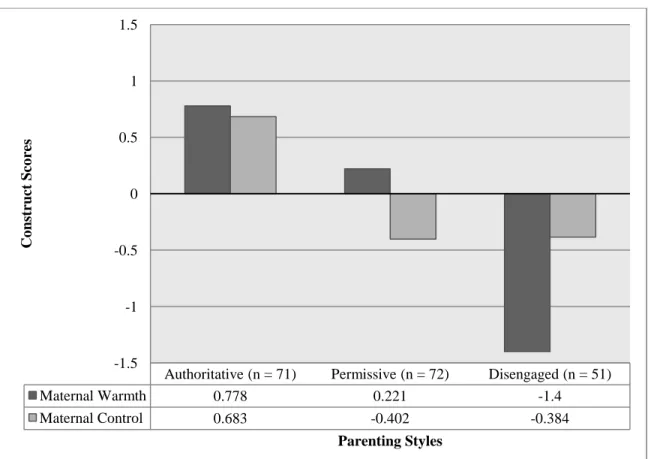
A k-means cluster analysis with an a priori three clusters solution was conducted using the cluster centroids from the Ward’s Method analysis as the cluster seeds. In order to profile the clusters, the average of each construct, maternal warmth and control, was found. The three clusters that emerged are: 1) Cluster 1, labeled Authoritative (n = 71), and was characterized by the highest scores on the maternal warmth and maternal control constructs; 2) Cluster 2, labeled Permissive (n = 72), was characterized by moderately above average levels of maternal warmth and moderately low levels of maternal control; 3) Cluster 3, labeled Disengaged, was the least prevalent cluster (n = 51), and was characterized by relatively low scores on maternal warmth and moderately low scores on maternal control. Cluster means on each construct (warmth and control) for these final clusters are presented in Table 3, and cluster profiles are depicted in Figure 1.
Multinomial Regression
style cluster. The overall model and the association between education and parenting style, however, approached statistical significance (i.e., p < .10).
In order to better understand the patterns associated with the marginal significance of this overall model, nine subpopulations were defined to represent the sample. Values of relatively low, medium, and high income ($10,000, $30,000, and $50,000, respectively) and education (high school/GED, college degree, and more than college degree, respectively) were selected to best capture the majority of the sample and variation within the sample. Results from these analyses suggested that, although the model and parameter estimates are not statistically significant, there is a substantial model effect in the data (see Table 4). That is, at the highest income ($50,000) and education level (graduate, law, or medical school degree) the likelihood of falling in the Authoritative parenting cluster was more than 93%, while at the lowest income ($10,000) and education level (high school diploma/GED) the likelihood of falling in either of the non-optimal parenting clusters (i.e., Permissive or Disengaged parenting) was more than 61%. Multiple Regression Model
similar results to more complex models, with family income a potentially more powerful indicator of overall SES than education (Cirino et al., 2002; Duncan, Daly, McDonough, & Williams, 2002). As such, in order to maximize independent variance and enhance
interpretability, only maternal income was included at this stage of analysis.
Overall, parenting style, maternal income, and the interaction between parenting style and income accounted for approximately 32% of the variance in youth externalizing behavior, F (5, 188) = 17.67, p < .0001. Both parenting style and income were statistically significantly associated with youth externalizing behavior, however, the interaction was not a statistically significant predictor. Given this pattern of findings, main effects will be examined in more detail and the pattern of the interaction, although not significant, will be explored.
Holding income constant at its mean ($29,734), parenting style was statistically
significantly associated youth externalizing problems, F (2, 188) = 37.26, p < .0001. As such, the parameter estimates indicate that for cluster 1, Authoritative Parenting, the modeled average youth externalizing score is 3.35, for cluster 2, Permissive Parenting, the modeled average youth externalizing score is 5.69, and for cluster 3, Disengaged Parenting, the modeled average youth externalizing score is 12.04. The combined effect of parenting style accounted for
Permissive and Disengaged parenting with externalizing problems across income was
significantly different than zero. Specifically, the interaction between Permissive parenting and income indicates that for every $10,000 increase in maternal income externalizing behaviors decrease .92 units, while the interaction between Disengaged parenting and income indicates that for every $10,000 increase in maternal income externalizing behaviors decrease .94 units (see Figure 2). The slope associated with the interaction between Authoritative parenting and Income, however, was not statistically significantly different than zero.
DISCUSSION
This study examined variability in parenting styles within an African American single mother sample, as well as sociocultural predictors (i.e., SES) and child outcomes (i.e.,
externalizing problems) associated with the derived parenting styles. Results from the study confirmed variability in parenting styles within African American single mother families; however, the empirically derived parenting styles differed to some extent from what was
predicted based on prior theory and research. Although not statistically significant, the pattern of results also suggested a trend consistent with study hypotheses regarding SES and parenting. Finally, although the original hypothesis pertained to a parenting style that was not observed in this study (i.e., No Nonsense parenting), results indicate that the derived parenting styles and maternal income predicted youth externalizing behaviors, and for certain parenting styles youth externalizing behavior varied by maternal income. Each of these findings will be discussed in more detail in the subsequent sections.
consistent with previous work with both African American and single mothers (e.g., Baumrind, 1997; Brody & Flor, 1998; McLoyd, 1990). Yet, the finding that mothers in our sample reported relatively high levels of warmth is inconsistent with previous literature suggesting that African American and single mothers are less likely to engage in behaviors conveying warmth, such as hugging or praising their children, than European Americans (e.g., Baumrind, 1972; Baumrind, 1997; Hashima & Amato, 1994). Maternal warmth is associated with a myriad of positive youth outcomes, such as academic achievement, decreased aggression, and social competence (e.g., Deater-Deckard et al., 1996; Dodge et al., 1994; McHale et al., 2006). Better understanding which mothers engage in behaviors demonstrating warmth may help us identify factors
associated with this positive parenting dimension, and, in turn, design interventions to promote positive parenting practices. Accordingly, the within group approach used in this investigation, rather than the comparative approach more typically used in the literature, may help to better clarify relative variability within African American single mother families (Hill, 2006).
Despite the overall high levels of warmth and control reported by mothers in the sample, cluster analyses highlight variability in levels of these two parenting behaviors across the sample. Cluster analyses generated three distinct subgroups of mothers within the sample, which were labeled Authoritative, Permissive, and Disengaged based on the average level of each parenting behavior within the clusters. Contrary to the existing literature, cluster analyses not only
indicated that there is variability in parenting style within African American single mothers, but also the parenting style considered to be the most prevalent among African Americans,
of the sample engaged in the parenting style long considered optimal for child outcomes, regardless of sociocontextual variables (i.e., Authoritative) (e.g., Deater-Deckard et al., 1996; Dodge et al., 1994; McGroder, 2000).
Moving beyond the parenting clusters, existing literature tends to focus on marital status and race as predictors of parenting (Baumrind, 1972; Baumrind, 1997; Hashima & Amato, 1994); yet, this study suggests that other important contextual variables, primarily SES, may predict parenting within African American single mother families. While not statistically
significant, a substantial model effect within the data and the trends towards significance for the overall model (p < .10), are worthy of consideration. In line with previous research (Hill, 2006; Hoff et al., 2002), the trends towards significance suggest that family SES (maternal income and education) is associated with parenting style.
The modeled probabilities within this sample further explicate this relationship. The modeled probabilities suggest that, as maternal income decreases the probability of engaging in Authoritative parenting decreases, while the probability of engaging in both Permissive and Disengaged parenting styles increases. This finding is consistent with the literature suggesting that families with lower SES are more susceptible to stressors that compromise parenting practices (e.g., Conger & Donnellan, 2007; Hill, 2006; McLoyd, 1990). It is possible that lower income African American single mother families have more demands, such as more hours at work relative to higher income families, which prevent mothers from engaging in parental control, such as monitoring their children afterschool.
not decrease. Although levels of maternal control are about equivalent between the Permissive and Disengaged parenting clusters, the level of warmth substantially differs between these two parenting styles (i.e., moderately high warmth for Permissive parenting and low warmth for Disengaged families). Although these findings need to be interpreted cautiously given non-significance, previous research suggests that maternal education level in particular may be a better predictor of warmth than income (Davis- Kean, 2005; Klebanov, Brooks-Gunn & Duncan, 1997). Research suggesting a positive association between maternal education level and maternal
coping skills may provide one explanation for this finding (Judge, 1998; Klebanov et al., 1994;
Lee, 2003). It is possible that increased education and, in turn, increased coping strategies that
may evolve with higher levels of education may help mothers exhibit warmth even in the face of
life stressors, such as financial strain and child behavior problems.
In addition to beginning to elucidate specific socioeconomic factors associated with variability within African American single mother parenting styles, results also begin to reveal socioeconomic and parenting contexts associated with African American youth externalizing behaviors. As predicted, the results from the multiple regression indicate that adolescents with mothers who engage in Authoritative parenting are more likely to have below average
parenting may engage in behaviors that convey warmth, which, in turn, may be slightly more protective than Disengaged parenting resulting in relatively lower levels of externalizing behaviors. Alternatively, Disengaged parents may lack the supervision or behavioral control necessary to ameliorate or end youth problem behaviors (Baumrind, 1991; Kawabata, Alink, Tseng, van IJzendoorn, & Crick, 2011).
Less maternal income was also associated with increases in youth externalizing behavior. Poverty may be associated with environments, such as homes that are less cognitively
stimulating and dangerous neighborhoods, which may be detrimental for youth psychological well being, including increased externalizing behavior (Davis-Kean, 2005; Dearing, McCartney, & Taylor, 2006). Another possibility supported by the literature (e.g., Conger & Donnellan, 2007; Cook et al., 2012, Hoff et al., 2002; McLoyd, 1990) is that the relationship between
income and youth externalizing behavior operates through compromised parenting. Although the categorical parenting predictor prevented the examination of mediators, future research should examine parenting and other potential mechanism.
Finally, in order to preliminarily examine the effect of income on the association between parenting style and externalizing behavior, the moderating role of maternal income was
parenting is the most optimal for youth externalizing behavior, while Permissive parenting leads to externalizing behavior that is average for the sample, and Disengaged parenting is the most deleterious for youth externalizing behavior. Consistent with the cumulative risk model, (Appleyard, Egeland, Dulmen, & Sroufe, 2005; Burchinal et al., 1996), these results highlight that Authoritative parenting is not only optimal for youth externalizing behavior, but that it protects youth with multiple risk factors (i.e., low-income, single mother household, racial minority).
middle-income, intact, European American families. While cluster analyses are a first step toward a more culturally-sensitive understanding of parenting practices within African American single mother families, an important direction for future works is to investigate the construct validity of these measures for African American and single mother families. Fifth, given several non-significant, but marginal, findings and the empirically driven nature of some of the analyses, research should replicate these analyses to increase the confidence of some of the observed patterns in this sample. Finally, this study focused on African American single mother families, so findings may not generalize to other racial or ethnic groups or two parent African American families. Yet, we believe that the focus on African American single mother families in particular is a strength of the study, which we turn to next.
This study also has strengths. First, this study focuses on African American youth from single-mother households between the age of 11 and 16 years. This age range, which is relatively ignored in the parenting literature, is critical given the importance of parenting in promoting a safe adolescent transition and the prevention of risky behavior and outcomes (Tragesser, Beauvais, Swaim, Edwards, & Oetting, 2007). In addition, 67 percent of African American youth live in single-mother households at some point during their childhood or
adolescence (Barrett & Turner, 2005; Mather, 2010; The Annie E. Casey Foundation, 2012). As such, findings are informative for meeting the needs of a growing, yet underrepresented, segment of the United States population. Third, much of the research on African American single
Accordingly, the current study examined parenting, SES, and youth externalizing problems within a sample that more closely approximates national statistics on African American single-mother families in the Untied States (Shattuck & Kreider, 2013). This more representative sample, as well as the within group analyses of African American parenting yielded more variability in parenting style and youth outcomes than is traditionally discussed or recognized within African American single-mother families, work that has traditionally relied on
comparative designs (Hill, 2006; Hoff et al., 2002). Fourth, the broader literature on race has emphasized the need to disentangle the contextual roles of race and SES (e.g., Hoff et al, 2002; McLoyd, 1990; Pinderhughes & Le, 2008). As such, these within group analyses and a
relatively economically diverse sample allowed for the examination of SES within African American single mother families. Finally, and perhaps most importantly, this study reverted back to the person-oriented approach used at the advent of the parenting literature (McGroder, 2000). This approach helped elucidate variability in parenting styles within African American single-mother families, which, in turn, may better inform family-focused interventions targeting this relatively underserved group.
parenting. Findings suggest promise for this approach to further elucidate the contexts in which African American single mothers engage in optimal parenting practices, as well as subgroups of African American youth from single mother homes that may be at increased risk for the
development of externalizing problems. In the future, combining the person-oriented approach with a variable oriented or dimensional approach may provide additional information about the influence of parenting style on youth problem behaviors (McNamara, Selig, & Hawley, 2010). For example, future research should examine parenting styles with both person-oriented and variable oriented approaches to determine which method accounts for more of the variability in externalizing problems, and should extend this approach to determine how parenting patterns may be associated with other youth outcomes, such as internalizing problems. In addition, given the importance and integral involvement of extended family support and non-marital coparents in African American single-mother childrearing, future research should include fathers and non-marital coparents (e.g., grandparents and other extended family) in analyses of parenting style and investigate the joint effects of parenting style on youth outcomes (Hoeve, Dubas, Gerris, van der Laan, & Smeenk, 2011; Hoff et al., 2002; Martin, Ryan, & Brooks-Gunn, 2007). It is the combination of this work that will yield a more culturally relevant understanding of the parenting practices within African American single mother families that has the potential to inform more targeted and tailored preventative interventions and policies for this relatively underserved and at-risk population (e.g., Kotchick & Forehand, 2002; Le et al., 2008; McLoyd, 1990). Findings suggest that youth externalizing problems may be malleable in response to family environment change, including parenting and sociocultural factors. Preventive interventions targeting
Kotchick, & Long, 2004).Interventions designed to increase African American single mother’s coping skills in particular may increase the capacity for maternal warmth in the face of economic hardship and youth problem behaviors (Judge, 1998; Klebanov et al., 1994; Lee, 2003). Then, interventions that target the quality of home and neighborhood environments for disadvantaged families in particular may further or maximally promote youth well being and decrease youth externalizing behavior (Davis-Kean, 2005; Dearing et al., 2006). Although sociocultural factors, such as maternal income and education may be less amenable to intervention, long-term public policies can be implemented to provide resources and incentives to support at-risk and
underserved populations. For example, findings suggest that increasing maternal education may lead to increased maternal warmth and, in turn, optimal parenting practices and enhanced youth outcomes. Yet, current welfare policy often provides financial support, while few incentives are provided for continuing education. This remains the case in spite of research that suggests small increases in maternal education can have substantial impacts on family environment and
Table 1
Demographics (n =194) for the overall sample
Mothers Youth
Variable M SD % M SD %
Age (years) 38.05 6.67 -- 13.00 1.59 --
Gender
Female % -- -- 100.00 -- -- 45.40
Male % -- -- 0.00 -- -- 54.60
Education
Less than high school -- -- 0.50 -- -- --
Some high school -- -- 5.20 -- -- --
High school or GED -- -- 8.80 -- -- --
Some college -- -- 51.00 -- -- --
College degree -- -- 20.10 -- -- --
Some graduate school -- -- 6.20 -- -- --
Graduate school -- -- 8.20
Employment Status* -- -- 82.00 -- -- --
Annual Income $29,734 $17,456 -- -- -- --
Table 2
Descriptive Statistics and Correlations Among Main Study Variables
Variables M (SD) Range 1 2 3 4 5
1 Maternal Warmth 14.34 (2.94) 4-18 -- 0.51** 0.21** 0.14 -0.56**
2 Maternal Control 57.64 (5.63) 23-60 -- 0.19* 0.24** -0.41**
3 Maternal Income $29,734 ($17,456) $0-$120,000 -- 0.41** -0.21**
4 Maternal Education -- -- -- -0.25**
5 Youth Externalizing 6.49 (6.60) 0-35 --
Notes. *p < .05; **p < .01
3
Table 3
Means on Cluster Variables (i.e., Maternal Warmth and Control) by Parenting Style Cluster
Maternal Warmth Maternal Control
Table 4
Modeled Probability (%) of Being Assigned to a Cluster Based on Maternal Education and Income
Predictors Parenting Style Clusters
Education Income
Authoritative (n = 71) %
Permissive (n = 72) %
Disengaged (n = 52) %
HS/GED 10 38.32 22.68 39.00
College 10 53.87 21.36 24.78
More than College 10 67.87 18.02 14.11
HS/GED 30 61.03 3.37 35.60
College 30 76.89 2.84 20.27
More than College 30 87.42 2.16 10.42
HS/GED 50 74.66 0.38 24.96
College 50 86.61 0.30 13.09
More than College 50 93.41 0.22 6.38
Table 5
Multiple Regression Analyses Predicting Youth Externalizing Behaviors
∆R2 Total R2 β t
Parenting Style 0.28*** 0.28 -- --
Authoritative -- -- 3.35 --
Permissive -- -- 5.69 --
Disengaged -- -- 12.04 --
Average Maternal Income 0.03** 0.31 -0.74 3.21**
Parenting Style X Maternal Income 0.01 0.32 -- --
Authoritative X Maternal Income -- -- -0.36 -0.97
Permissive X Maternal Income -- -- -0.92 -1.94*
Disengaged x Maternal Income -- -- -0.94 -2.47**
Figure 1. Three clusters of parenting styles in the full sample (N = 194).
Authoritative (n = 71) Permissive (n = 72) Disengaged (n = 51)
Maternal Warmth 0.778 0.221 -1.4
Maternal Control 0.683 -0.402 -0.384
-1.5 -1 -0.5 0 0.5 1 1.5
C
o
n
st
ru
ct
S
co
re
s
Figure 2. The interrelationship of parenting style, maternal income, and youth externalizing
APPENDIX A: DEMOGRAPHICS (MOTHER-REPORT)
Interviewers identified each family with a participation identification number and the location of data collection (home, agency, etc); interviewers also listed their own names. Mothers were asked to report on various demographic questions about their level of education, employment, income, etc.
Q4. Mother age
__ __ years 98 Refuse to Answer
Q5. How much schooling did you finish? (Choose one)
1 Less than HS
2 Some HS
3 HS diploma or GED
4 Some college or vocational school
5 College degree
6 Some graduate, law, or medical school 7 Graduate, law, or medical school degree
8 Refuse to Answer
Q6. Are you currently a student? 1 Yes
0 No Skip to Q8
8 Refuse to Answer Skip to Q8
Q7. Are you a full- or part-time student? (Choose one) 1 Part-time student
2 Full-time student
8 Refuse to Answer
Q8. Are you currently employed?
1 Yes Skip to Q11
0 No
8 Refuse to Answer Skip to Q11
Q9. Which best describes your unemployment status? (Choose one)
1 Unemployed not due to a disability
2 Unemployed due to a disability
3 Retired
8 Refuse to Answer
Q10. Are you currently looking for work?
1 Yes Skip to Q13
0 No Skip to Q13
7 Don't Know Skip to Q13
8 Refuse to Answer Skip to Q13
Q11. Are you employed full- or part-time? (Choose one) 1 Part-time employee
2 Full-time employee
8 Refuse to Answer
Q12. What is it you do for a living?
___ __ _ __ __ __ __ __ __ __ __ __ __ __ __ __ __ __ __ __ __ __ __ __ __ __ __ __ __ __ __ __ _ Q13. What was your household income last year, before taxes?
$__ __ __ __ __ __ $
999997 Don't Know
999998 Refuse to Answer
Q14. What is your zip code? __ __ __ __ __ __
999997 Don't Know
999998 Refuse to Answer
Q15. How long have you lived in this zip code? __ __ YEARS
__ __ MONTHS
__ __ WEEKS
97 Don't Know (Years)
98 Refuse to Answer (Years)
Q16. Does your neighborhood have a name?
1 Yes
0 No Skip to Q18
7 Don't Know Skip to Q18
8 Refuse to Answer Skip to Q18
Q17. What is your neighborhood's name?
__ __ __ __ __ __ __ __ __ __ __ __ __ __ __ __ __ __ __ __ __
Q18. Are you the biological mother of the child participating in this study? (Choose one)
1 Biological mother
2 Adoptive mother
3 Other
If Q18 is equal to 3, then skip to Q19.
If Q18 is less than 3, then skip to Q20.
Q19. Describe relation to child
__ __ __ __ __ __ __ __ __ __ __ __ __ __ __ __ __ __ __ __ __ __ __ __ __ __ __ __ __ __ __ __ __ __ _ Q20. Have you ever been married? (Choose one)
0 Never married
1 Legally married, but separated
2 Divorced
3 Widowed
8 Refuse to Answer
Q21. How many children do you have, including the one in this study? __ __children
98 Refuse to Answer
Q22. How many adults live in your home, including yourself? __ __ people
98 Refuse to Answer
Q23. How many children live in your home, including your own children? __ __ people
APPENDIX B: MATERNAL WARMTH/SUPPORT (MOTHER-REPORT)
Think back over the last several weeks at home. Please tell us if you believe that the statement is mostly true or mostly false about you and the child participating in this study. Your answers will not be shown to your child, coparent, or anyone else in your family.
Choose: 0 = True 1 = False
1. The child is easy to get along with
2. The child is well behaved in your discussions with him or her
3. The child is receptive to criticism or listens when you correct him or her 4. For the most part he or she likes to talk to you
5. You and he or she never seem to agree
6. This child usually listens to what you tell him or her
7. At least three times a week, you and he or she get angry with each other 8. He or she says that you have no consideration or respect for his or her feelings 9. You and this child compromise or reach an agreement during arguments 10.This child often doesn’t do what you ask
11.The talks that you and he or she have are frustrating 12.This child often seems angry with you
13.He or she acts impatient with you
14.In general, you don’t think that you and he or she get along very well 15.This child almost never understands your side of an argument
16.This child and you have big arguments over little things 17.He or she is defensive and often doesn’t listen to what you say 18.He or she thinks your opinions or ideas don’t count
19.You and he or she argue a lot about rules
APPENDIX C: MATERNAL MONITORING (MOTHER-REPORT) The next several items will ask you how much you know about the activities of the child participating in this study.
Choose: 0 = Not at All 1 = Rarely 2 = Some of the time 3 = Most of the time 4 = Always
How often do you know:
1. What your child does during his or her free time?
2. Who this child has as friends during his or her free time? 3. What type of homework this child has?
4. What this child spends his or her money on?
5. When this child has an exam or assignment due at school? 6. How this child does on different subjects in school? 7. Where this child goes when out at night with friends? 8. What this child does and where he or she go after school?
APPENDIX D: MATERNAL KNOWLEDGE (MOTHER-REPORT)
The following items will ask you how often you know about the daily activities of the child participating in this study.
Choose: 0= Not at all 1= Rarely 2= Some of the time 3 = Most of the time 4 = Always
How often:
1. Does this child talk at home about how he or she is doing in different subjects in school? 2. Does this child usually tell you how school was when he or she gets home? For example, how
he or she did on exams, relationships with teachers, etc.?
3. Does this child keep a lot of secrets from you about what he or she does with his or her free time?
4. Does this child hide a lot from you about what he or she does during nights and weekends 5. If this child goes out at night, does he or she tell you what he or she has been doing? 6. In the last month, have you talked with the parents of this child's friends?
7. Do you talk to this child's friends when they come to your home? For example, ask what they do or think or feel about things?
8. In the last month, have you started a conversation with this child about his or her free time? 9. Do you initiate a conversation about things that happened during this child's school day? 10. Do you usually ask this child to talk about things that happened during his or her free time?
For example, whom he or she met, activities, etc.?
11. Does this child need to have your permission to stay out late on a weekday evening? 12. Does this child need to ask you before he or she can decide with friends what to do on a
Saturday night?
13. If this child has been out very late one night, do you require that he or she explain what he or she did and whom he or she was with?
14. Do you require that this child tell you where he or she is at night, whom he or she is with, and what they do together?
APPENDIX E: CHILD BEHAVIOR CHECKLIST (MOTHER-REPORT) The following is a list of items that describe children and adolescents. For each item that
describes your child now or within the past 6 months, please tell us whether the item is very true, somewhat true, or not true of your child. Please answer all items as well as you can, even if some do not seem to apply to your child.
Choose: 0= Not true 1= Somewhat true 2= Very true 8= Refuse to Answer
How true is this of your child:
1. Drinks alcohol without parents' approval 2. Argues a lot
3. There is very little he or she enjoys 4. Cries a lot
5. Cruelty, bullying, or meanness to others 6. Demands a lot of attention
7. Destroys his or her own things
8. Destroys things belonging to his or her family or others 9. Disobedient at home
10. Disobedient at school
11. Doesn't seem to feel guilty about misbehaving 12. Breaks rules at home, school, or elsewhere
13. Fears certain animals, situations, or places, other than school 14. Fears going to school
15. Fears he or she might think or do something bad 16. Feels he or she has to be perfect
17. Feels or complains that no one loves him or her 18. Feels worthless or inferior
19. Gets in many fights
20. Hangs around with others who get in trouble 21. Would rather be alone than with others 22. Lying or cheating
23. Nervous, high strung, or tense 24. Nightmares
26. Too fearful or anxious 27. Feels dizzy
28. Feels too guilty 29. Overtired
30. Aches or pains, (not stomach or headaches), without a known medical cause 31. Headaches, without a known medical cause
32. Nausea, feel sick, without a known medical
33. Problems with eyes, (not if corrected by glasses), without a known medical cause 34. Rashes or other skin problems, without a known medical cause
35. Stomachaches or cramps, without a known medical cause 36. Vomiting, throwing up, without a known medical cause 37. Physically attacks others
38. Prefers being with older kids 39. Refuses to talk
40. Runs away from home 41. Screams a lot
42. Secretive, keeps things to self
43. Self-conscious or easily embarrassed 44. Sets fires
45. Sexual problems 46. Shy or timid 47. Steals at home
48. Steals outside the home 49. Stubborn, sullen, or irritable
50. Sudden changes in mood or feelings 51. Sulks a lot
52. Suspicious
53. Swearing or obscene language 54. Talks about killing self
55. Teases a lot
59. Smokes, chews, or sniffs tobacco 60. Truancy, skips school
61. Underactive, slow moving, or lacks energy 62. Unhappy, sad or depressed
63. Unusually loud
64. Uses drugs for nonmedical purposes, (don't include alcohol or tobacco) 65. Vandalism
APPENDIX F: EXPERT RATER SCALE
Overview: For over 20 years, two universal parenting dimensions have helped define patterns of
parenting. Baumrind (1967) originally referred to these two dimensions as demandingness and responsiveness. Baumrind characterized parental demandingness as involving the use of direct confrontation and monitoring, patterns of firm and consistent discipline, and high maturity demands, while she characterized parental responsiveness as affective warmth, cognitive responsiveness,
attachment and bonding, unconditional acceptance, sensitive attunement, involvement, and reciprocity. Over time, the name of these constructs shifted, and the two terms are now referred to as parental control and parental warmth. Parental control is often defined as the amount of supervision, the decisions parents make about their children’s activities and friends, and the rules parents hold for their children. In addition, parental warmth has been defined as a parents’ expression of interest in children’s activities and friends, involvement in children’s activities, expression of enthusiasm and praise for children’s accomplishments, and demonstration of affection and love.
Instructions: Below is a list of items commonly used to assess maternal parenting behaviors, specifically maternal warmth and control. For each item, first decide if the item is measuring maternal
warmth. Then, decide if the item is measuring maternal control. Answers range from 0: Definitely not to 3: Excellent match. This scale was modeled after similar methods used in Jensen et al. (2007).
Do the following items measure maternal warmth/responsiveness?
1. The child is easy to get along with 0- Definitely not
1- Probably not
2- Kind of; more than not 3- Excellent match
2. How often do you know whom this child has as friends during his or her free time? 0- Definitely not
1- Probably not
2- Kind of; more than not 3- Excellent match
3. How often do you know what type of homework this child has? 0- Definitely not
1- Probably not
2- Kind of; more than not 3- Excellent match
4. The child is well behaved in your discussions with him or her 0- Definitely not
1- Probably not
5. How often do you initiate a conversation about things that happened during this child's school day? 0- Definitely not
1- Probably not
2- Kind of; more than not 3- Excellent match
6. At least three times a week, you and he or she get angry with each other 0- Definitely not
1- Probably not
2- Kind of; more than not 3- Excellent match
7. Before this child goes out on a Saturday night, how often do you require him or her to tell you where he or she is going?
0- Definitely not 1- Probably not
2- Kind of; more than not 3- Excellent match
8. He or she says that you have no consideration or respect for his or her feelings 0- Definitely not
1- Probably not
2- Kind of; more than not 3- Excellent match
9. How often do you know when this child has an exam or assignment due at school? 0- Definitely not
1- Probably not
2- Kind of; more than not 3- Excellent match
10. How often do you require that this child tell you where he or she is at night, whom he or she is with, and what they do together?
0- Definitely not 1- Probably not
2- Kind of; more than not 3- Excellent match
11. You and this compromise or reach an agreement during arguments 0- Definitely not
1- Probably not
2- Kind of; more than not 3- Excellent match
12. How often do you know how this child does on different subjects in school? 0- Definitely not
3- Excellent match
13. This child often doesn’t do what you ask 0- Definitely not
1- Probably not
2- Kind of; more than not 3- Excellent match
14. How often in the last month, have you talked with the parents of this child's friends? 0- Definitely not
1- Probably not
2- Kind of; more than not 3- Excellent match
15. The talks that you and he or she have are frustrating 0- Definitely not
1- Probably not
2- Kind of; more than not 3- Excellent match
16. In the last month, how often have you started a conversation with this child about his or her free time? 0- Definitely not
1- Probably not
2- Kind of; more than not 3- Excellent match
17. In general, you don’t think that you and he or she get along very well 0- Definitely not
1- Probably not
2- Kind of; more than not 3- Excellent match
18. How often do you usually ask this child to talk about things that happened during his or her free time? For example, whom he or she met, activities, etc.?
0- Definitely not 1- Probably not
2- Kind of; more than not 3- Excellent match
19. How often does this child need to have your permission to stay out late on a weekday evening? 0- Definitely not
1- Probably not
2- Kind of; more than not 3- Excellent match
20. This child and you have big arguments over little things 0- Definitely not
3- Excellent match
21. He or she thinks your opinions or ideas don’t count 0- Definitely not
1- Probably not
2- Kind of; more than not 3- Excellent match
22. How often does this child need to ask you before he or she can decide with friends what to do on a Saturday night?
0- Definitely not 1- Probably not
2- Kind of; more than not 3- Excellent match
23. For the most part he or she likes to talk to you 0- Definitely not
1- Probably not
2- Kind of; more than not 3- Excellent match
24. You and he or she argue a lot about rules 0- Definitely not
1- Probably not
2- Kind of; more than not 3- Excellent match
25. How often do you know what your child does during his or her free time? 0- Definitely not
1- Probably not
2- Kind of; more than not 3- Excellent match
26. You and he or she never seem to agree 0- Definitely not
1- Probably not
2- Kind of; more than not 3- Excellent match
27. This child usually listens to what you tell him or her 1. Definitely not
2. Probably not
3. Kind of; more than not 4. Excellent match
28. How often do you know where this child goes when out at night with friends? 0- Definitely not
3- Excellent match
29. The child is receptive to criticism or listens when you correct him or her 0- Definitely not
1- Probably not
2- Kind of; more than not 3- Excellent match
30. How often do you know what this child does and where he or she goes after school? 0- Definitely not
1- Probably not
2- Kind of; more than not 3- Excellent match
31. He or she acts impatient with you 0- Definitely not
1- Probably not
2- Kind of; more than not 3- Excellent match
32. How often do you know in the past month, how often have you had no idea where this child was at night?
0- Definitely not 1- Probably not
2- Kind of; more than not 3- Excellent match
33. This child tells you he or she thinks you are unfair 0- Definitely not
1- Probably not
2- Kind of; more than not 3- Excellent match
34. How often do you talk to this child's friends when they come to your home? For example, ask what they do or think or feel about things?
0- Definitely not 1- Probably not
2- Kind of; more than not 3- Excellent match
35. This child often seems angry with you 0- Definitely not
1- Probably not
or she did and whom he or she was with? 0- Definitely not
1- Probably not
2- Kind of; more than not 3- Excellent match
37. He or she is defensive and often doesn’t listen to what you say 0- Definitely not
1- Probably not
2- Kind of; more than not 3- Excellent match
38. How often do you know what this child spends his or her money on? 0- Definitely not
1- Probably not
2- Kind of; more than not 3- Excellent match
39. This child almost never understands your side of an argument 0- Definitely not
1- Probably not
2- Kind of; more than not 3- Excellent match
Now, do these items measure maternal control/ demandingness?
1. The child is easy to get along with 0- Definitely not
1- Probably not
2- Kind of; more than not 3- Excellent match
2. How often do you know whom this child has as friends during his or her free time? 0- Definitely not
1- Probably not
2- Kind of; more than not 3- Excellent match
3. How often do you know what type of homework this child has? 0- Definitely not
1- Probably not
2- Kind of; more than not 3- Excellent match
4. The child is well behaved in your discussions with him or her 0- Definitely not
3- Excellent match
5. How often do you initiate a conversation about things that happened during this child's school day? 0- Definitely not
1- Probably not
2- Kind of; more than not 3- Excellent match
6. At least three times a week, you and he or she get angry with each other 0- Definitely not
1- Probably not
2- Kind of; more than not 3- Excellent match
7. Before this child goes out on a Saturday night, how often do you require him or her to tell you where he or she is going?
0- Definitely not 1- Probably not
2- Kind of; more than not 3- Excellent match
8. He or she says that you have no consideration or respect for his or her feelings 0- Definitely not
1- Probably not
2- Kind of; more than not 3- Excellent match
9. How often do you know when this child has an exam or assignment due at school? 0- Definitely not
1- Probably not
2- Kind of; more than not 3- Excellent match
10. How often do you require that this child tell you where he or she is at night, whom he or she is with, and what they do together?
0- Definitely not 1- Probably not
2- Kind of; more than not 3- Excellent match
11. You and this compromise or reach an agreement during arguments 0- Definitely not
1- Probably not
2- Kind of; more than not 3- Excellent match
12. How often do you know how this child does on different subjects in school? 0- Definitely not