W h o ’s afraid of volatility?
Not anyone who wants a
true edge in his or her tra d i n g ,
t h a t ’s for sure.
Get a handle on the essential
concepts and learn how to
improve your trading with
p ractical volatility analysis
and trading techniques.
V
olatility is both the boon and bane of all traders — you can’t live with it and you can’t really trade without it.Most of us have an idea of what volatility is. We usually think of “choppy” markets and wide price swings when the topic of volatility arises. These basic concepts are accurate, but they also lack nuance.
Volatility is simply a measure of the degree of price move-ment in a stock, futures contract or any other market. What’s necessary for traders is to be able to bridge the gap between the simple concepts mentioned above and the sometimes confus-ing mathematics often used to define and describe volatility.
But by understanding certain volatility measures, any trad-er — options or othtrad-erwise — can learn to make practical use of volatility analysis and volatility-based strategies. We’ll explore these volatility calculations and discuss how to use them.
There are two main measures of volatility: historical volatility and implied volatility.
Historical volatility is the measure of a stock’s price move-ment based on historical prices. It measures how active a stock price typically is over a certain period of time. Usually, histor-ical volatility is measured by taking the daily (close-to-close) percentage price changes in a stock and calculating the average over a given time period. This average is then expressed as an annualized percentage. Historical volatility is often referred to as actual volatility or realized volatility.
Short-term or more active traders tend to use shorter time periods for measuring historical volatility, the most common being five-day, 10-day, 20-day and 30-day. Intermediate-term and long-term investors tend to use longer time periods, most commonly 60-day, 180-day and 360-day.
There’s some unavoidable math involved here, but under-standing the concepts is the important thing, since you’ll never have to calculate historical volatility by hand — any piece of analytical software will do it for you.
To calculate historical volatility:
1 . M e a s u re the day-to-day price changes in a market.
Calculate the natural log of the ratio (Rt) of a stock’s price (S) from the current day (t) to the previous day (t-1):
The result corresponds closely to the percentage price change of the stock.
2. Calculate the average day-to-day changes over a certain
period. Add together all the changes for a given period (n) and calculate an average for them (Rm):
3. Find out how far prices vary from the average calculated
in Step 2. The historical volatility (HV) is the “average vari-ance” from the mean (the “standard deviation”), and is esti-mated as:
4. Express volatility as an annual percentage. To annualize
the historical volatility, the above result is multiplied by the square root of 252 (the average number of trading days in a year). For example, if you calculated the 10-day historical volatility using Steps 1-4 and the result was 20 percent, this would mean that if the volatility present in the market over that 10-day period holds constant for the next year, the market could be expected to vary 20 percent from it current price.
Sometimes historical volatility is estimated by “ditching the mean” and using the following formula:
The latter formula for historical volatility is statistically called a n o n - c e n t e re d a p p roach. Traders commonly use it because it is closer to what would actually affect their profits and losses. It also performs better when n is small or when there is a strong trend in the stock in question.
In other words, historical volatility measures how far price swings over a given period tend to stray from a mean or aver-age value. Table 1 (p. xx) illustrates how the 10-day historical volatility is calculated (using both methods above) for America Online (AOL) prices from Dec. 9 to Dec. 23, 1999. The resulting historical volatilities of approximately 52 and 54 percent
sug-continued on p. x
TRADING Strategies
R
t= LN
( )
St - 1
St
Rt
n
n
Rm
=
Rt
2
n
HV=
Rt
-
Rm
2
n - 1
HV=
gest the stock will likely fluctuate this far from its current price if this level of volatility remains constant.
TABLE 1: HISTORICAL VOLATILITY
Date Price Rt = Ln(St / St-1) (Rt)2 (Rt – Rm)2
12/9/99 86.25
12/10/99 91.5 .059088916 .0034915 .004193031 12/13/99 94 .02695581 .00072662 .001064098 12/14/99 88.8125 -.056767376 .00322254 .002611483 12/15/99 89.625 .009106893 .000082936 .0002182 12/16/99 86.125 -.03983457 .00158679 .00116758 12/17/99 85 -.013148473 .00017288 .0000560068 12/20/99 86.25 .014598799 .00021312 .00041061 12/21/99 85 -.014598799 .00021312 .0000798181 12/22/99 82.75 -.026827242 .0007197 .000447853 12/23/99 81.5 -.015220994 .00023168 .0000913227
Rm= -.005664704
Sum = .01066089 .010340002
10-day HV = 51.83% 53.81%
Implied volatility is the current volatility of a stock, as estimat-ed by its option price. An option’s value consists of several components — the strike price, expiration date, the current stock price, dividends paid by the stock (if any), the implied volatility of the stock and interest rates. If you know the price of an option and all the above inputs, except volatility, then you can modify the option-pricing model to calculate the implied volatility. (For more basic information on options, see “Getting started in options,” p. xx.)
Because there are many options on a stock, with different strike prices and expiration dates, each option can, and typi-cally will, have a different implied volatility. Even within the same expiration, options with different strike prices will have different implied volatilities.
Generally, the implied volatilities of calls and puts show a distinct pattern, called the skew of implied volatility. Implied volatility tends to be higher for out-of-the-money (OTM) options compared to at-the-money (ATM) options. This is because OTM options present more risk on very large moves; to compensate for this risk, they tend to be priced higher. But equally OTM calls and puts do not necessarily have the same implied volatility, and this difference represents the bias or
skew of the market. The skew can be caused by a strong direc-tional bias in the stock or the market, or by very large demand for either calls or puts, which pushes implied volatility higher. To use implied volatility in volatility analysis, it is necessary to calculate a representative implied volatility for a stock. This is merely an average of the implied volatilities of the different options on that stock. However, there is no accepted standard for which representative implied volatility to use. Many people simply use the average implied volatility of the at-the-money options for the next few expirations, while some take a more sophisticated approach by factoring in several at-the-money and out-of-the-money options. Figure 1 (opposite page) shows the relationship between 30-day historical volatility and implied volatility in IBM.
Implied volatility acts as a proxy for option value. It is the only parameter in option pricing that is not directly observable from the market, and cannot be “hedged” or offset with some other trading instrument. Because all other factors can be “locked in,” the price of the option becomes entirely depend-ent on the implied volatility. This is an important fact to con-sider when looking for relative value in options; to compare the relative value of two options you need only look at their implied volatilities.
Implied volatility represents the market’s expectation of a stock’s future price moves. High implied volatility means the market expects the stock to continue to be volatile — i.e., make large moves, either in the same direction or up and down. Conversely, low implied volatility means the market believes the stock’s price moves will be rather conservative. However, studying implied volatility reveals much more information.
Because implied volatility is a surrogate for option value, a change in implied volatility means there is a change in the option value. Many times, there will be significant changes in the implied volatility of the calls vs. the puts in a stock. This signals there may be a shift in the bias of the market, or that “something’s going on.”
For example, in late 1999, when Republic National Bank of New York (RNB) was acquired by HSBC USA, the implied volatility of RNB collapsed, pending closing of the deal. This was natural, as the price of the acquisition was fixed, so RNB’s stock price was expected to be very stable.
However, one day after the deal was announced, implied volatility on out-of-the-money RNB puts jumped up signifi-cantly, accompanied by a rise in put volume. This suggested the market, or some large player, was getting nervous about something, or that there was a large rumor afloat. Two days later, news about a possible scandal that could have put the acquisition in jeopardy emerged and the stock dropped nearly 20 percent.
Besides the skew phenomenon, implied volatility pro v i d e s
The best candidates for covered call writing are stocks
significant insight on the market’s curre n t thinking. In early 2000, the implied volatility of the financial sector dro p p e d quite rapidly — and in some cases signif-icantly below historical volatility, even though stock prices for the sector had d ropped quite a bit. This suggested the market was not worried and expected the sector to be stable in the future .
Usually, however, when a stock’s price is dropping, it is typical to see implied volatility rise rapidly — signaling nerv-ousness about the stock. Many times, breakouts from technical levels, accom-panied by large implied volatility moves, signal the market thinks the breakout is significant and will lead to large moves in the stock. A breakout with little to no change in implied volatility may not be a convincing development. Thus, studying implied volatility patterns on a stock reveals much information regarding how the market views the stock.
Because the implied volatility is the mar-ket’s guess of future price volatility, it is interesting to see how accurate the mar-ket’s predictive capabilities are.
We studied several stocks and ran regression analysis between their 30-day implied volatility and their historical volatility 30 days later. In other words, the implied volatility from Dec. 1 was c o m p a red with the actual historical volatility on Jan. 1, and so on. We also tested 30-day historical volatility against historical volatility 30 days later. The results are presented in Table 2.
continued on p. x
The 30-day historical volatility and implied volatility are juxtaposed on this daily chart of IBM
FIGURE 1 IMPLIED VOLATILITY VS. HISTORICAL VOLATILITY
Feb. Mar. Apr. May June July Aug. Sept. Oct. Nov. Dec. Jan.
2000 2001
30-day HV IV Index mean
140 130 120 110 100 90 80 80%
70%
60%
50%
40%
30%
20%
IBM (IBM), daily
Source: iVolatility.com
TABLE 2
:PREDICTIVE ABILITY OF VOLATILITY
The correlation between historical volatility (HV) and implied volatility (IV) in select stocks over roughly a 10-year period. The higher the number, the greater the correlation.
Stock symbol HV vs. lagged IV HV vs. lagged HV
AMGN 0.31 0.14 AOL 0.19 0.23
C 0.06 -0.03
CSCO 0.45 0.36 ERICY 0.15 -0.10
GE 0.27 0.21
IBM -0.15 -0.01 INTC 0.33 0.08 JDSU 0.17 0.11
Stock symbol HV vs. lagged IV HV vs. lagged HV
JNPR 0.33 0.20
LU 0.11 0.16
MSFT 0.38 0.12 NDX 0.46 0.41 ORCL 0.27 0.24 SPX 0.08 0.20 SUNW 0.45 0.28 WMT 0.22 0.29
The higher the correlation (with 1.00 being an exact correla-tion), the closer the prediction. As you can see, in most cases the implied volatility did not provide a very accurate predic-tion of the actual future historical volatility. The historical volatility itself also proved to be an unreliable predictor, sug-gesting that in the stock volatility business, history does not necessarily repeat itself.
Does this mean that the market is always wrong? No. It sim-ply means it is very difficult to predict the future price volatil-ity of a stock. However, it also means this difficulty leads to more trading opportunities and more market inefficiencies to trade against.
Trading the difference in historical and implied volatility. Professional option traders, market makers and institutions trade volatility by running “delta-hedged” positions.
This means they buy or sell options and maintain a hedge against the option position in the underlying stock. This removes any net exposure to a small move in the stock. They continuously adjust this hedge as the market moves. Because the hedge is in the underlying stock, these traders effectively capture historical volatility on the hedges while capturing implied volatility on the option price. That is, if they sell options at a higher implied volatility than the historical volatil-ity of their hedges, they make money. Similarly, if they buy options at a lower implied volatility than the historical volatil-ity of the hedges, they make money.
Figure 2 (above) shows that delta-hedged volatility traders would have benefited from being long Coke (KO) in most of 2000 because the historical volatility stayed consistently higher than the implied volatility.
This strategy has a relatively low risk p rofile, but it involves a significant num-ber of transactions. It also re q u i res pro p e r portfolio risk management systems. While this type of delta-hedging volatility trading is difficult to implement and not very appropriate for the individual investor or non-institutional trader, it illustrates how volatility analysis can be translated into a practical trading strategy. This is not to say that volatility analy-sis is not an important part of the indi-vidual trader’s arsenal. There are several strategies that can be greatly fine-tuned with proper volatility analysis.
C o v e red call writing. C o v e red call writing (i.e., taking a long stock position with a short out-of-the-money call) is a popular strategy. There are several serv-ices that provide covered call analysis, but none use any kind of volatility analy-sis. Covered call selection can be greatly improved with proper volatility analysis.
Covered calls give the best return if the stock ends up just higher than the strike price of the call. The first criteria for cov-ered call selection should be choosing a stock you are mildly bullish on. If you are very bullish on a stock, and your view is correct, you will kick yourself for writ-ing covered calls.
Next, you should look at the implied and historical volatili-ty of the stock. It might seem that the higher the implied volatility, the better candidate the stock is for writing calls, but this is not always the case. If the historical volatility is very high, it implies the stock moves around a lot, and thus has a high probability of moving below the strike price. The best can-didates for covered call writing are stocks with the biggest dif-ference between implied and historical volatility.
Another thing to look at is the current implied volatility compared to the historical range of implied volatility. When implied volatilities are close to their historical highs, it may be a better time for writing covered calls.
If you are planning to exit such trades before expiration, you may want to look for stocks whose implied volatility tends to fall as the stock appreciates. In other words, as the call option you wrote becomes closer to being at-the-money, the volatility drops, giving you the chance to reverse the entire trade at a bet-ter profit. On the other hand, if you were long a stock whose implied volatility has risen, your profits will be negated by the higher premium you will have to pay for the option because of the volatility increase.
Referring again to Figure 1, notice that whenever IBM’s stock price dropped, there was a spike in implied volatility. If, after a move down, you believed IBM would recover or stabi-lize, it would have been an ideal time to write covered calls.
Writing puts. Writing puts (“naked” puts) is another com-mon strategy for those who are willing to be long the stock if it ends up below the put strike price. Many traders will sell puts
continued on p. x
During this period, historical volatility remained (for the most part) higher than implied volatility, suggesting relatively low option volatility and proportionally lower option premiums
FIGURE 2 VOLATILITY SPREAD
Feb. Mar. Apr. May June July Aug. Sept. Oct. Nov. Dec. Jan.
200030-day HV IV Index mean 2001
70%
60%
50%
40%
30%
20%
Coke (KO), daily
in lieu of buying the stock at a certain level.
Volatility analysis can help the decision-making process for this strategy. Stocks whose implied volatility tends to spike when the stock falls may not be good candidates for writing puts, because if you change your mind and want to exit the position, it could be very expensive. On the other hand, if a stock is dropping but implied volatility is not changing much, it may be a good candidate to write puts on, as the market is not suggesting nervousness about the stock.
Choosing call and put spreads. Call spreads (bull spreads) and put spreads (bear spreads) — simultaneously going long and short a put or call — are popular options strategies, as they offer a cheap way to take advantage of an anticipated price move in the stock. The problem many traders have found is that the returns are sometimes not so attractive when exiting the spread. This is typically because of the volatility effect.
For example, say you bought a 100/110 call spread (long the
100 call, short the 110) on a stock trading at 100. If the stock rises to 110 or above, you may wish to take profits on the spread. But at 110, your short option with the 110 strike price is at the money and, thus, has the maximum exposure to change in volatility. If the implied volatility for this stock has risen with the market move, then you will be buying back the 110 call at a higher volatility than when you put the spread on. This will eat into your profits on the spread. However, if the implied volatility has fallen, it will be in your favor.
When executing a call or put spread, you want to look for stocks whose implied volatility tends to fall as the stock moves up (for a call spread) or down (for a put spread). Looking again at Figure 1, it is clear that buying put spreads would not have been advisable, but buying call spreads would have been, as the implied volatility always seems to come off a bit when the stock rises.
One trap traders using volatility analysis tend to fall into is interpreting volatility itself as a directional indicator. High or low volatility by itself does not imply a certain direction or expected direction of the stock.
However, careful analysis of volatility patterns, combined with other indicators and stock movements, can lead to some i n t e resting direction-based trading strategies. Different stocks behave differ-ently, but in many cases, implied volatil-ity tends to be a leading indicator of stock direction.
When a stock is falling, every trader is looking for an indi-cation of whether the stock will continue in that direction or whether it will stabilize and present a possible buying oppor-tunity. When a stock is declining and the implied volatility does not change (or falls), it suggests the market is not too nervous about the stock. On the other hand, if the implied volatility rises, it means the market continues to be nervous about the stock’s downside potential.
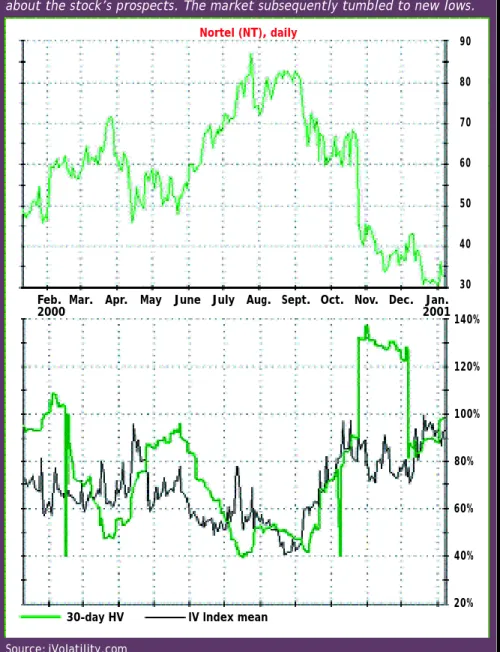
This is shown in Figure 3 (above). In July 2000, although Nortel (NT) shot to new highs and broke technical levels, the implied volatility did not jump much, signaling lukewarm confidence in the move. But when the stock dropped off sharply in September, implied volatility made new highs, showing nervousness by the market. In October, even though the stock seemed to be trying to consolidate, the implied
continued on p. x
Although the market consolidated in October 2000 after falling from its highs, implied volatility made new highs that month, suggesting nervousness about the stock’s prospects. The market subsequently tumbled to new lows.
FIGURE 3 COMBINING TECHNICAL SIGNALS AND VOLATILITY
Feb. Mar. Apr. May June July Aug. Sept. Oct. Nov. Dec. Jan.
2000 2001
30-day HV IV Index mean
90 80 70 60 50 40 30 140%
120%
100%
80%
60%
40%
20%
Nortel (NT), daily
volatility made new highs, suggesting a nervous market. Sure enough, the stock tanked in late October.
Option volume and volatility changes also can be important indica-tors. Sudden jumps in call or put vol-ume, combined with jumps in implied volatility, signal extreme market activity and possible market bias — and possi-bly a directional indicator.
Combining implied volatility changes with technical analysis can be a powerful tool as well. It is not uncom-mon to see a rise in put volume and implied volatility as a stock is hitting technical levels on a rally. This can sig-nal the market is worried about a down-side correction and traders are buying puts as protection.
Volatility is an important tool for traders trying to calculate the expected daily trading range of a stock. Because the volatility of a stock is its standard devi-ation, a trader can statistically establish “confidence intervals” of the price moves. In statistics, a one standard deviation range means that there is a 67-percent likelihood the stock price will stay within the range (a 67-percent con-fidence interval). Similarly a 1.65 stan-dard deviation range represents a 90-percent confidence interval.
The formula is:
S * M * V * (n/252)
where
S = stock price
M = number of standard deviations V = volatility
N= number of days
For example, if a stock is trading at $75 with a volatility of 50 percent, then for one day and one standard deviation, the expected range of the stock will be: FIGURE 4 INTRADAY CONFIDENCE LEVELS
General Electric (GE), intraday
Microsoft Corporation (MSFT), intraday
4 8 . 6 4 8 . 3 4 8 . 0 4 7 . 7 4 7 . 4 4 7 . 1 4 6 . 8 4 6 . 5 4 6 . 2 4 5 . 9 4 5 . 6 4 5 . 3 4 5 . 0 4 4 . 7 4 4 . 4 4 4 . 1 4 3 . 8
5 2 . 0 5 1 . 5 5 1 . 0 5 0 . 5 5 0 . 0 4 9 . 5 4 9 . 0 4 8 . 5 4 8 . 0 4 7 . 5 4 7 . 0 4 6 . 5 4 6 . 0 4 5 . 5 4 5 . 0 4 4 . 5 4 4 . 0 4 3 . 5 4 3 . 0 Wednesday Thursday Friday Monday Tuesday
Wednesday Thursday Friday Monday Tuesday Source: PCQuote.com
Option volume and volatility changes also can be important
indicators. Sudden jumps in call or put volume, combined with
jumps in implied volatility, signal extreme market activity and
possible market bias.
Because volatility is a measure of how much price is likely to vary from an average value (its standard deviation), it can be used to determine likely trading ranges, or “confidence levels,” such as the intraday levels shown here.
75*50 percent* (1/252) = 2.40 Accordingly, it’s possible to build the following ranges:
Days 67-percent 90-percent
confidence confidence
One $ 7 2 . 60-$77.40 $ 7 1 . 04- $ 7 8 . 9 6 Two $ 7 1 . 60-$78.40 $ 6 9 .40- $ 8 0 . 6 0
Once the range is established, day traders can use them to pick daily entry and exit points, as well as stop-loss lev-els.
The volatility to use is an individual’s choice. Some prefer to use short-term historical volatility while some use implied volatility. The stock price is usu-ally the previous close, but it is not
uncommon to use the open price to cal-culate the daily range, especially when, as has been the case lately, many stocks open at a gap from the previous close.
The actual trading strategy is entirely up to the trader. But an example of one could be to enter a trade when the stock has moved beyond the 67-percent confi-dence range and take profit when it comes back in the range. Use the 90-per-cent range as stop-loss levels.
F i g u re 4 are intraday charts of General Electric (GE) and Micro s o f t (MSFT) showing the one-day expected trading band for the 67-percent confi-dence interval (the red lines are the upper and lower levels of the band). The charts are from Jan. 3 - Jan. 8, and were established using implied volatility and the open price.
Volatility plays a crucial role in every option, stock, futures and currency trad-er’s life, whether they are aware of it or not. Understanding how volatility behaves and its relation to the market will give you an advantage you cannot get from simply analyzing price.
For additional volatility research, see www.ivolatility.com.