Proceedings of the
12th International Workshop on Graph Transformation
and Visual Modeling Techniques
(GTVMT 2013)
Well-formed Model Co-evolution with Customizable Model Migration
Florian Mantz, Gabriele Taentzer, Yngve Lamo
13 pages
Guest Editors: Matthias Tichy, Leila Ribeiro
Managing Editors: Tiziana Margaria, Julia Padberg, Gabriele Taentzer
Well-formed Model Co-evolution with Customizable Model
Migration
∗Florian Mantz1, Gabriele Taentzer21, Yngve Lamo1
1[email protected],[email protected]
Institutt for data og realfag Høgskolen i Bergen, Norway
Fachbereich Mathematik und Informatik Philipps-Universit¨at Marburg, Germany
Abstract: Model-driven engineering (MDE) is a software engineering discipline which focuses on models as the primary artifact of the software development pro-cess while programs are mainly generated by means of model-to-code transforma-tions. In particular, modeling languages tailored to specific domains promise to increase the productivity and quality of software. Nevertheless due to e.g. evolving requirements, modeling languages evolve and existing models have to be migrated. Corresponding manual model migration is tedious and error-prone, therefore tools have been developed to (partly) automate this process. We follow the idea of con-sidering such modeling language and model co-evolutions as related graph transfor-mations ensuring a correct and unique typing of migrated models. In this paper, we present a general and formal construction of well-formed model migration schemes that are able to co-adapt any model of a given modeling language to a performed meta-model change. We show how appropriate model migration schemes can be constructed and discuss how they may be customized.
Keywords:meta-model evolution, model migration, graph transformation
1
Introduction
Model-driven engineering [Fow10] (MDE) is a software engineering discipline which raises the abstraction level in software development by using models as primary artifacts. In particular, domain-specific modeling languages (DSMLs) are means to increase productivity and quality of software. Developers can focus on their essential tasks while repetitive and technology-dependent artifacts are automatically generated by transformations specified by experts in these areas. To keep this high level of abstraction, a modeling language has to evolve simultaneously to the evolving understanding of its target domain. However, this often causes trouble since ex-isting models need to co-evolve with their languages (see. Figure 1). This evolution-migration problem has been tackled in practice with the result that tools have been developed that (par-tially) automate this tedious and error-prone process (see e.g. [HBJ09, RKPP10]). In current approaches however, parts of model migrations still have to be specified manually. In our work,
we support this step by generating default migration rule schemes for arbitrary meta-model evo-lution steps. These rule schemes may be customized by the user as long as the given correctness criteria are satisfied.
Modeling Language evolution //
Modeling Language0
Model
conforms to
O
O
migration +3
Model0
conforms to
O
O
Figure 1: Model co-evolution: Modeling language evolution and model migration
Modeling languages in MDE are usually defined by meta-models. Hence, the challenge of modeling language evolution in MDE is often referred to as the problem of meta-model evolution with corresponding model migration. We tackle this model co-evolution challenge by using al-gebraic graph-transformations [EEPT06]. More specifically, we employ a variant of the classical double-pushout (DPO) approach using co-span rules [EHP09] offering a better synchronization of deletion and creation actions than the usual DPO approach [TML12]. For example, moving an element can be easier represented by first adding a new copy of the element before deleting its old version. In the co-span approach, the intermediate graph contains the whole context while in the span approach, it contains the preserved part only. This context can be advantageously used to formulate adequate model migrations. Our earlier work in [TML12,MTL12] presents a general framework of co-transformations by graph transformations where meta-model evolu-tions and model migraevolu-tions are defined as inter-related graph transformaevolu-tions. This framework allows for migration variants. It also shows how model migrations can be derived automatically from meta-model evolutions resulting in model-specific migration rules.
In this paper, we go a step further and present model-independent migration schemes. Given an evolution rule, a default migration scheme is automatically deduced and may be customized to special needs. While the default migration scheme replays changes in the evolution rule as far as possible, potential customizations may follow special strategies to insert new model elements or to glue existing ones. Evolutions that need custom migration schemes are e.g. the insertion of a new objects of singleton classes such as registries, the insertion of new containers, new acyclic connections between model elements, new connections to existing model elements, etc. Roughly spoken, customization of migration schemes is needed whenever the insertion of new elements and gluing of existing ones need to fulfill special requirements. After the customization phase, the adapted migration scheme is applied to a specific meta-model evolution and a specific instance model. We show how a well-formed, model-specific migration rule can be deduced automatically and then applied.
2
Evolution Scenario
tokens. The meta-model and the example Petri net are presented in abstract and concrete syntax. While we are working with the abstract syntax (on the right) in our theory, meta-models and models are also shown in concrete syntax (on the left) to give the reader an intuition how they are usually presented to a modeler.
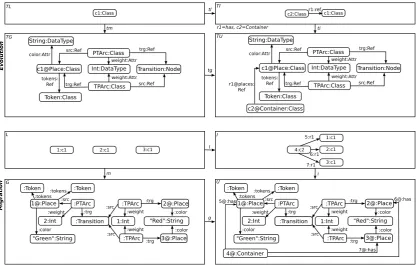
To illustrate our approach, the small evolution scenario covers several steps: Petri nets shall be equipped with containers for places and transitions. The container insertion is done in two steps: First, a model container is inserted for all places and second, transitions are also put into those containers.
Third, the attribute “color” is moved from “Place” to
“To-ken”. Meta-model evolutions
and model migrations are for-mulated by rule-based transfor-mations, i.e. evolution and mi-gration rules specify
correspond-ing changes. Figure 3 shows
the insertion of a new con-tainer for places as example co-transformation depicting models in abstract syntax.
Figure 2: Petri net meta-model with an instance model
c1@Place:Class Transition:Node PTArc:Class TPArc:Class Int:DataType weight:Attr Token:Class String:DataType weight:Attr src:Ref src:Ref trg:Ref trg:Ref tokens: Ref color:Attr c2@Container:Class r1@places: Ref
1@:Place :PTArc :TPArc 2@:Place
:Transition :src :trg :weight 2:Int :Token :tokens
"Green":String :TPArc 3@:Place 1:Int :color :src :src :trg :trg :Token :tokens "Red":String :color 4@:Container 7@:has 6@:has 5@:has
c2:Classr1:refc1:Class
7:r1 3:c1 6:r1 2:c1 4:c2 5:r1 1:c1 TI TU I U c1@Place:Class Transition:Node PTArc:Class TPArc:Class Int:DataType weight:Attr Token:Class String:DataType weight:Attr src:Ref src:Ref trg:Ref trg:Ref tokens: Ref color:Attr c1:Class TL TG tm tl ti tg
1@:Place :PTArc :TPArc 2@:Place
:Transition :src :trg :weight 2:Int :Token :tokens
"Green":String :TPArc 3@:Place 1:Int :color :src :src :trg :trg :Token :tokens "Red":String :color
1:c1 2:c1 3:c1
L G m l i g Ev ol u ti on M ig ra ti o n r1=has, c2=Container
Figure 3: Co-transformation example: Insertion of a container for places
The lower layer shows the migration of a specific Petri net model (introduced inFigure 2) where one container is inserted for all its places. Note that graph mappings are encoded in graph element names: Strings before “@” indicate graph mappings within one layer while strings after “@” and before ’‘:” of meta-model elements as well as strings after “:” of instance model elements are used to indicate the typing of instance model elements (i.e. graph mappings between layers).
Evolution - Rule (given)
Migration - Multi-Rule Migration - Multi-Rule (generated)
Model-Independent Migration Scheme
Kernel-Rule (user defined)
Model-Independent Migration Scheme (customized)
Migration - Multi-Rules
Model-Specific Migration Scheme for Example Petri-Net
Customization (manual) Application
tl TI
c2:Class r1:ref c1:Class
TL
c1:Class
Prio 1
l I
2:c2 :r1 1:c1
L
1:c1
1
l I 5:r1 1:c1 4:c2
L
1:c1 1
Kernel-Rule I
4:c2
L l1'
l I
2:c2
L 1'
l I 6:r1 2:c1 4:c2
L
2:c1 2
l I 7:r1 3:c1 4:c2
L
3:c1 3
Prio 1
l I
:c2 :r1 1:c1
L
1:c1
1
1 1 1 1
1' 1' 1' 1'
1 1
2 2
3 3
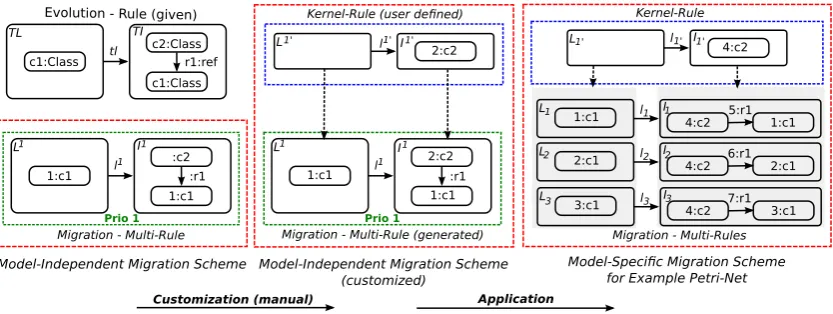
Figure 4: Migration schemes for adding a new model element
Since migration rules have to specify all model changes, they are model-specific and typically grow with increasing model sizes. Therefore, we are looking for a model-independent solution to specify model migrations. This leads us to migration schemes. An example migration scheme for the insertion of a new class is shown inFigure 4in the lower left corner. It just consists of one basic migration rule to be applied multiple times , hence it is called a multi-rule. Migration rules are typed by evolution rules. In this example, the migration rule is isomorphic to its evolution rule. The rule specifies the basic action during migration: insertion of a new element connected to the old one. Applying this multi-rule as often as possible to all places in a Petri net would give us a new container for each match of the rule. This is not exactly what we want to have. Actually, the new element should be the same for all matches. Therefore, we customize the migration scheme to this special need and add a so-called kernel rule specifying that all new elements shall be glued to one. (See the migration scheme in the middle ofFigure 4.) This customization suits well to the first evolution step where a new container (and only one) is inserted for all places. On the right, we see a migration scheme being specific for model G inFigure 3where three places occur. Therefore, three copies of the multi-rule are in that scheme and each one is applied exactly once. Gluing all these rules at the kernel rule yields the migration rule inFigure 3.
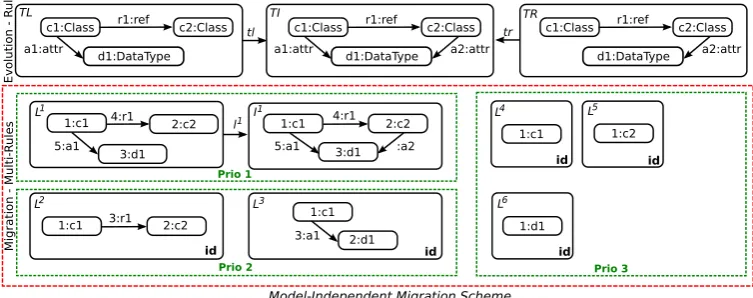
pri-oritize the rules based on their inclusions. The one with the highest priority is an exact copy of the evolution rule. All others are identity rules and have lower priorities. Their purpose is to complete the scheme such that also parts ofT Lcan be identified for migration and potentially deleted. For example, ruler3being the identity onL3, is needed to identify all old attributes to be removed (although not moved to another class but deleted by default). Rules with higher priority are matched first. All rules in one priority class can be matched in parallel. And furthermore, a rule is matched only if its match is not already completely covered by a previous match. Apply-ing this scheme to Petri nets, the color attribute may be moved from “Place” to “Token” and is removed from places even without connected “Token”-element to remain well-typed.
Evolution -
R
ule
Migration
Multi-R
ules
tl tr
Prio 1
id l I 1:c1 4:r1
5:a1 3:d1
2:c2
:a2
L
1:c1 4:r1
5:a1 3:d1
2:c2 1
1 1
Prio 3
L6 TI
c1:Class r1:ref
a2:attr d1:DataType
c2:Class a1:attr
TL
c1:Class r1:ref
a2:attr d1:DataType
c2:Class
TR
r1:ref c1:Class
d1:DataType c2:Class a1:attr
3:a1 2:d1
1:c1 1:c1
id
Prio 2
L
L2 3
3:r1 2:c2
id L4
1:c1
1:d1
1:c2
id L5
id
Model-Independent Migration Scheme
Figure 5: Migration Rule Derivation
3 Meta-model Evolution with Model Migration by Co-transformation
First, we recall the basic definitions of co-span transformations and co-transformations as defined in [EHP09,TML12,MTL12]. Co-span transformations are analog to usual DPO transformations with the exception that they use co-spans instead of spans, i.e. additions are performed before deletions. Co-transformations are the formal framework we use to formulate model co-evolution. We choose the usual category of graphs and graph morphisms as the underlying category (for details see [EEPT06]).
Definition 1(Graph) A graphG= (GV,GE,srcG,trgG)consists of a setGV of vertices (or nodes), a setGEof edges (or arrows), and two mapssrcG,trgG:GE→GV assigning the source and target
to each edge, respectively.e:x→ydenotes an edgeewithsrcG(e) =xandtrgG(e) =y.
Definition 2(Graph morphism) A graph morphismg:G→Hconsists of a pair of mapsgV : GV →HV,gE :GE →HE preserving the graph structure, i.e., for each edgee:x→yinGwe have an edgegE(e):gV(x)→gV(y)inHwithgV◦srcG=srcH◦gE andgV◦trgG=trgH◦gE.
Definition 3(Connected component) Given a graph H, we define an equivalence relation on vertices≡ ⊆HV×HV where≡is the transitive closure of∼withv1∼v2 ⇐⇒ ∃e:v1→v2∈
HE or∃e:v2→v1∈HE. Let[v]≡⊆HV denote an equivalence class of≡. A complete subgraph
GvHover[v]≡is called aconnected component.
Note that each vertex (and edge) belongs to exactly one connected component. Note further that injective morphisms are denoted by “”, surjective morphisms by “”, bijective mor-phisms by their combination, and inclusions by “,→”.
Definition 4 (Co-span transformation rule) A co-span transformation rule p=L→l Ir R
consists of graphsL(left-hand-side),I (interface), andR(right-hand-side) and two jointly sur-jective morphismslandrwhereris injective. Ifris bijective a rulepis called non-deleting and can be written asl=L→I. In the case of non-deleting rules we also callIright-hand-side.
Definition 5(Co-span transformation) Given a co-span transformation rulep=L→l Ir R
together with an injective morphism m:LG, called match, rule p
can be applied toGif a co-span double-pushout exists as shown in the diagram on the right.t:G=p,m⇒His called aco-span transformation.
L
m
l //
(PO1)
I
i
(PO2)
R
m0
oo
r
oo
G g //U oo H
h
oo
The co-span double pushout exists if the co-span gluing condition holds (see [EHP09,MTL12] for more details). Note that morphismlis allowed to be non-injective which means that graph elements may also be glued during evolutions. Co-span transformations are used to define co-transformations formalizing meta-model evolutions and their corresponding model migrations in a rule-based manner.
Definition 6(Co-transformation rule) A co-span rulet p=T L→tl T Itr T Rtogether with a
co-span rule p=L→l Ir R form a co-transformation rule (t p,p), if there are graph morphismstL:L→T L,tI:I→T IandtR:R→T Rsuch
that both squares in the diagram on the right commute. In such a
co-T L tl //
=
T I
=
T R
oo
tr
oo
L
l // tL
OO
I
tI
OO
R
oo
r
oo
tR
OO
transformation rule(t p,p), rulet pis called anevolution rulewhile rule pis called amigration rulewrt.t p. We also say that migration rulepis well-typed wrt.t p.
Definition 7(Match of co-transformation rule) A match(tm,m)of a co-transformation rule
(t p,p)is given by two corresponding matchestm:T LT Gof the evolution rule
t pandm:LGof the migration rule p so that the matches together with the typing morphismstL: L→T L andtG:G→T Gconstruct a commuting square: tm◦tL=tG◦m. IfGm L→tL T Lis a pullback then the match is called complete.
T L //tm //T G
=
L // m //
tL
OO
G
tG
OO
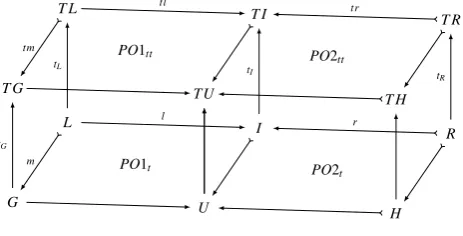
Definition 8(Co-transformation) A co-transformation(tt,t)is defined by two graph transfor-mationstt:T Gt p,tm=⇒T H andt:G=p,m⇒H that apply a co-transformation rule(t p,p) via match
(tm,m)simultaneously to type graphT Gand its instance graphG, so that there are graph mor-phisms tU:U →TU andtH: H →T H such that all faces of Figure 6 commute. In such a
while the instance graph transforma-tiont:G=p,m⇒H is called amigration
wrt.tt.
T G T L
TU T I
T H T R
PO1tt PO2
tt tm
tl tr
G L
U I
H R
PO1t PO2t
m
l r
tG
tL t
I t
R
Figure 6: Co-transformation
An example of a co-transformation is given in Section 2illustrated by Figure 3. Since the example co-evolution step does not delete anything, the right cube is the identity. Therefore, the left cube is shown only.
4
Migration Schemes and Automatic Model Migration
In the following, we present a model-independent solution to specify model migrations by so-called migration schemes. The concept of migration scheme builds up on interaction schemes used to specify amalgamated graph transformation as presented in e.g. [Tae96]. For a better understanding, we recall basic definitions of kernel and multi-rules and interaction schemes, here for non-deleting rules. Thereafter, model-independent and later model-specific migration schemes are defined as special interaction schemes. Migration schemes cover the insertion and gluing of graph elements only, while their deletion is done by a pullback construction. The reason for this design decision is the observation that deletions in meta-model evolutions have to be completely reflected by their model migration while this is not true for insertions and gluings. New meta-model elements, for example, need not cause any changes in models but they may. Hence, we define a default migration scheme for a given evolution rule and allow that it may be customized under certain conditions (seeSection 5for allowed customizations).
In the following, we distinguish multi-rules to be applied as often as possible from kernel rules that are needed to glue newly inserted elements such that they are only inserted once for several multi-rules matches overlapping in the left-hand-side of the kernel rule.
Definition 9(Kernel morphism for non-deleting rules) Given non-deleting rulesl1: L1→I1
(called kernel rule) and l2: L2 → I2 (called multi-rule), a kernel morphism
k:l1→l2is a pair(a,b)of morphismsa:L1→L2andb:I1→I2such that (1) is
commuting.
L1 l1 //
(1) a
I1
b
L2 l 2
/
/I2
Definition 10(Interaction scheme of non-deleting rules) Given a setKof non-deleting kernel-rules, a setMof non-deleting multi-rules and a setKM of kernel morphismsk: lk→lmfromK
toMwithlk∈Kandlm∈M. An interaction scheme of non-deleting rules is a triple(K,M,KM).
the model-independent migration schemes on the left and in the middle of the figure as well as the model-specific one on the right.
In the following, we construct special interaction schemes for model migrations, so-called migration schemes. Given an evolution ruleT L→T I, a default migration scheme is constructed by defining multi-rules for all connected subgraphs of T L and their extensions by connected parts inT I. We consider connected graphs due to the assumption that they define model parts that belong together. Including multi-rules over all subgraphs of connected components ensures that also partial patterns are recognized and adequately migrated in model-specific migration rules. In addition, loop edges in meta-models may have instances not being loops. Those cases also have to be covered by migration rules. Kernel rules are considered to be all empty by default.
Definition 11 (Default migration scheme) Given a non-deleting evolution rule
t p: T L→T I, the default migration scheme(K,M,KM)t p for rulet pis constructed by the
fol-lowing steps:
1. Construct a setMLof multi-rule left-hand sides by creating all possible connected subgraphs ofT L. For each loop inT L, a left-hand-side is added containing a graph that has only one unfolded edge:
ML:={LvT L| L is connected} ∪ MLloop
MLloop:={LE ={e:v1→v2},LV ={v1,v2} ∀e∈T LwithsrcT L(e) =trgT L(e)}
In addition, prio:ML→Ndefines the priority function withprio(Li)>prio(Lj)ifLiALj. 2. Construct a set of non-deleting multi-rules:
First construct∀L∈(ML\MLloop)a graphILwith:
IVL=T IV\tl(T LV\tL(LV))
IEL={e∈T IE\tl(T LE\tL(LE))|srcT I(e)∈IVL∧trg
T I
(e)∈IVL}
ILcompletestl(L)by the new elements ofT I.
T L tl //T I
L? l //
tL
OO
=
I?L tI
OO
M:={lL:L→π(tl(L),IL)|L∈(ML\MLloop)andlL=tl|Li} ∪ Mloop
Mloop:={idL:L→L|L∈MLloop}
whereπ(U,H)denotes the connected component ofHthat containsUV ifUvH.
3. ∀l:L→I∈M:∃inL:L,→T LandinI:I,→T Ibeing the typing morphisms.
4. SetK={/0 : /0→ /0}contains the empty kernel rule /0 as default. 5. KM={/0l: /0→l| ∀l∈M}is the default set of kernel morphisms.
suitable kernel rule is selected from the given migration scheme. Otherwise, it is constructed by epi-mono-factorization. This means that the intersection graph is taken as left-hand side and its potential gluing in its multi-rules is reflected in the right-hand side of its kernel rule. The result of this construction is a model-specific migration scheme containing multi-rules as often as they can be matched. For an example, consider the scheme on the right ofFigure 4.
Definition 12(Model-specific migration scheme for graphs) Let(K,M,KM)t pbe a default
mi-gration scheme over evolution rulet p= (T L→tl T Itr T R)and lettt:T Gt p,tm=⇒Hbe an evolution step. Furthermore, letGbe a graph typed byT G, i.e.tG:G→T G:
1. Match all multi-ruleslu:Lu→Iu∈MtoGand construct match setMM=:{mi:LiG|1≤i≤n}such that:
∀Li with 1≤i≤n =⇒ ∃lu:Lu→Iu∈M,Li=Lu
and@mj∈MMwithmi(Li)vmj(Lj)
T Goo tmoo T L
G OO = Li oo mi oo OO tLi OO Lj oo
@mj
^^
``
``
PP
tL j
bb
2. Let Li
ai j
Li j
aji
Lj be the pullback of Li
mi
G
mj
Lj,
∀1≤i< j≤n.∀Li j with 1≤i< j≤n:
(a) If∃ls:Ls→Is∈KwithLi j=Lsand
∃(a:Ls→Lu,b:Is→Iu)∈KMandai j =a,Li=Lu.
=⇒ ki j= (ai j,bi j) ∈ KMwithbi j =bandli j:Li j→Ii j
withIi j=Isbe inK.(Analogously forkji).(ki j,kji)∈KM
Ls ls //
= auv Is buv
Li j li j //
=ai j
=
Ii j
bi j=
Li li //
Ii
Lu lu //
OO OO OO = Iu OO OO OO
(b) Otherwise generate a kernel rule:
Construct (Ii j, li j: Li j → Ii j, bi j: Ii j → Ii) by
epi-mono-factorization of li◦ai j. In this case, li j: Li j → Ii j ∈ K and
ki j = (ai j,bi j). (Analogously forkji∈KM). Then,(ki j,kji)∈KM
Li j li j //
ai j
li◦ai j
Ii j
bi j
Li li //
Ii
This yields the model-specific migration scheme(K,M,KM)tt,G.
Remark1 Note that the epi-mono-factorization ofli◦ai j yields the sameli j:Li j →Ii j as that
oflj◦ajidoes.
Remark2 It is obvious that both kinds of migration schemes are interaction schemes of
non-deleting rules.
Definition 13(Star gluing)
1. Given a set of graph morphism spansS= (Gi←gi jGi j→g jiGj)1≤i<j≤n, a gluing relationISis the
equivalence relation generated by the relationIS={(gi j(x),gji(x))|x∈Gi j,1≤i<j≤n}.
2. Given a set of graph morphism spansS= (Gi gi j
←Gi j g ji
→Gj)1≤i<j≤n with its
gluing relationIS, the star gluing graph G is defined byG= (]1≤i≤nGi)/IMS, the quotient set of the disjoint union of all Gi. The maps gi: Gi →Gfor all 1≤i≤nsend each element ofGi to its equivalence class in G. The pair (G,{gi|1≤i≤n})is called thestar gluing of S.
Gi j
~
~
Gi
gi !!
= Gj
gj
}
}
G
Definition 14 (Model-specific migration rule) Given a model-specific migration scheme
(K,M,KM)tt,Gwith match set MM=:{mi:LiG|1≤i≤n}over evolutiontt:T G t p,tm
=⇒T H
as defined in Definition12. LetGbe a graph typed byT G, i.etG:G→T G:
1. Take allai j andaji as well asbi j andbji for 1≤i< j≤n and construct the star gluings
(L,{ai|1≤i≤n})and(I,{bi|1≤i≤n})of morphism stars SL= (Li
ai j
Li j
aji
Lj)1≤i<j≤n
andSI= (Ii
bi j
Ii j
bji
Ij)1≤i<j≤nwith induced morphisml:L→I. Matchmof model-specific
migration rulelis the induced morphismm:LGoverMM=:{mi:LiG|1≤i≤n}.
2. Finally, construct the right-hand side R of the model-specific migration rule as pullback
Ir R→tR T R of I→tI T Itr T R (see Figure 6). r is the induced morphism of pullback
Ir R→tR T R.
The figure on the right shows the dou-ble cube ofFigure 6using a migration scheme to construct the non-deleting part of model-specific migration rules.
Morphism r:I R of the migration
rule is constructed by a pullback delet-ing all instances that cannot be typed overT R. This new construction of mi-gration rules fits to our earlier work in [TML12,MTL12] as shown in the next propositions. Hence, a model mi-gration constructed in such a way, is applicable and migrates a model “cor-rectly” (i.e. in a well-typed manner) and in a unique way.
T L
T I
T R
T G
Li
Lj
TU
Ii
Ij
T H
Li j
Ii j
G
U
H L
I
R
tl
tr
li j
l
r li
lj
tG
tL
tI
tR
tm
m
Proposition 1 A model-specific migration rule is typed over its evolution rule.
Proof sketch: Since all multi-rules of migration schemes are well-typed (seeDefinition 11) and
L and I are star gluing graphs, their typing morphisms tL and tI are induced morphisms. In addition, we havetI◦l=tl◦tL, due to uniqueness of induced morphisms. The existence oftR
Proposition 2 The construction of model-specific migration rules results in complete matches
only, i.e. T L←tL Lm G is the pullback of T Ltm T G←tG G (seeFigure 6).
Proof sketch: All multi-rule matches inMM induce a unique morphismm:LG. Since the
default migration scheme contains a multi-rule for each connected subgraph ofT L, all elements ofT Lthat have occurrences inGare matched by multi-rules. Hence, the star gluing graph of the left-hand sides of a model-specific migration scheme covers at least the pullback graph. Since the overlapping of each two multi-rule matches has to be a pullback, the star gluing graph cannot be larger than the pullback graph.
5
Migration Scheme Customizations
Although constructed along reasonable design decisions, default migration schemes do not al-ways define desired model migrations. As mentioned in Section 2, the insertion of new con-nected elements have to be limited in some cases, e.g. in case that a singelton class are specified. Sometimes they should be glued as in this example, sometimes they should be inserted in certain contexts only. Similarly, the gluing of meta-model elements can lead to retyping or gluing of model elements during migration but do not have to. Hence variations in migration strategies are possible and it is essential that migration schemes are customizable. However, we want to make sure that such customized migration schemes still satisfiesProposition 1andProposition 2. This means that the set of multi-rules is complete so that it can amalgamate every possibleLand that the resulting migration rules are always well-typed over their evolution rules. Given a default migration scheme, the following customizations are possible:
1. A multi-rule may be deleted if its LHS can be amalgamated by LHSs of other multi-rules. 2. A non-deleting multi-rule may be added if itsLand itsI are typed overT LandT I,
respec-tively as long as the multi-rule is not conflicting with any other rule. A conflict between two rules occurs if two elements ofLare preserved by one rule and merged by the other.
3. GraphI of a multi-rule may be extended if its extension is still typed overT I.
4. A kernel rulek:Lk→Ik with kernel morphism to at least one multi-rule may be added. This means thatIkvImifLkvLmwithm:Lm→Imbeing the corresponding multi-rule.
An example for a customized migration scheme is given in the middle of Figure 4. Here, a new kernel rule with kernel morphism to the existing multi-rule are added.
6
Related Work
models. Inspired by the achievements for databases, current approaches for meta-model evo-lution use libraries and catalogs for co-evoevo-lution operations. However, meta-model evoevo-lution researchers have realized that a fixed set of co-evolution operators is not sufficient and allow therefore to extend or adapt the default migration transformations.
There are several tools around that consider the co-evolution of Eclipse Modeling Framework (EMF) models. COPE (now:Edapt) [HBJ09] provides a rich set of co-evolution operators that implement evolution and migration definitions. If the required migration is not available, a mod-eling language designer has to add the migration strategy as a Groovy/Java program. Epsilon Flock [RKPP10] is another tool that is able to migrate EMF models. In contrast to COPE, Flock does not provide migration operations. Instead, it uses a “conservative copy” strategy that au-tomatically copies as much as possible to a migrated version of the model. However, migration scripts have to be written if model elements shall be moved and not forgotten, while pull up and push down attribute are correctly migrated by the conservative copy strategy. EMF Mi-grate [EMF] is another migration tool for EMF. It supports not only on model migration but also the migration of other meta-model-dependent artifacts such as ATL transformations. For model migration, EMF Migrate provides migration libraries that can be customized and extended. Our work differs from this related work in the sense that we consider correctness criteria on a formal level to be applied to show correctness of co-transformations in general as well as for user adap-tations. Furthermore, we develop a strategy for deriving model migration schemes that are not only working for pre-defined migration operations but allow user-defined meta-model evolution rules with deduced migration schemes.
The closest work to ours is the one by K¨onig et al. [KLS11]. They also consider correctness criteria for model co-evolution based on a categorical framework. However, they do not work with algebraic graph transformation and do not provide customizable rule schemes for model migration.
7
Conclusion and Future Work
Bibliography
[EEPT06] H. Ehrig, K. Ehrig, U. Prange, G. Taentzer.Fundamentals of Algebraic Graph
Trans-formation. Springer, March 2006.
[EHP09] H. Ehrig, F. Hermann, U. Prange. Cospan DPO Approach: An Alternative for DPO
Graph Transformation.EATCS Bulletin98:139–149, 2009.
[EMF] EMF Migrate. Project Web Site.http://www.emfmigrate.org.
[Fow10] M. Fowler.Domain-Specific Languages. Addison-Wesley Professional, 2010.
[HBJ09] M. Herrmannsdoerfer, S. Benz, E. J¨urgens. COPE - Automating Coupled
Evolu-tion of Metamodels and Models. In Drossopoulou (ed.),ECOOP 2009. LNCS 5653, pp. 52–76. Springer, 2009.
[HVW10] M. Herrmannsdoerfer, S. Vermolen, G. Wachsmuth. An Extensive Catalog of Oper-ators for the Coupled Evolution of Metamodels and Models. In Malloy et al. (eds.),
SLE 2010. LNCS 6563, pp. 163–182. Springer, 2010.
[Jen03] K. Jensen.Coloured Petri Nets. Springer, 2003.
[KLS11] H. K¨onig, M. L¨owe, C. Schulz. Model Transformation and Induced Instance
Mi-gration: A Universal Framework. In Silva Sim˜ao and Morgan (eds.), SBMF 2011. LNCS 7021, pp. 1–15. Springer, 2011.
[L¨am01] R. L¨ammel. Grammar Adaptation. In Oliveira and Zave (eds.), FME 2001.
LNCS 2021, pp. 550–570. Springer, 2001.
[Li99] X. Li. A Survey of Schema Evolution in Object-Oriented Databases. InTOOLS 1999. Pp. 362–371. IEEE Computer Society, 1999.
[MTL12] F. Mantz, G. Taentzer, Y. Lamo. Co-Transformation of Type and Instance Graphs Supporting Merging of Types with Retyping: Long Version. Technical report, De-partment of Mathematics and Computer Science, University of Marburg, Germany, September 2012.www.uni-marburg.de/fb12/forschung/berichte/berichteinformtk.
[RKPP10] L. Rose, D. Kolovos, R. F. Paige, F. A. C. Polack. Model Migration with Epsilon Flock. In Tratt and Gogolla (eds.),ICMT 2010. LNCS 6142, pp. 184–198. Springer, 2010.
[SK04] J. Sprinkle, G. Karsai. A Domain-Specific Visual Language for Domain Model
Evo-lution.Journal of Visual Languages and Computing15(3–4):291–307, 2004.
[Tae96] G. Taentzer. Parallel and Distributed Graph Transformation: Formal Description
and Application to Communication-Based Systems. PhD thesis, Technical University
of Berlin, 1996.