ARTIGO ORIGINAL
RESUMO
Introdução: O uso da terapêutica com perfusão subcutânea contínua de insulina na diabetes mellitus tipo 1 é cada vez mais frequente devido aos seus efeitos benéficos no controlo glicémico e na flexibilidade do estilo de vida. Constituiu objetivo deste estudo avaliar o impacto da terapêutica com perfusão subcutânea contínua de insulina no controlo glicémico, índice de massa corporal, dose diária total de insulina e complicações desta modalidade terapêutica durante vinte anos de experiência no Centro Hospitalar e Universitário de Coimbra.
Material e Métodos: Estudo retrospetivo que inclui doentes com diabetes mellitus tipo 1 seguidos no Centro Hospitalar e Universitário de Coimbra, que iniciaram terapêutica com perfusão subcutânea contínua de insulina até 2005 e com pelo menos 10 anos de tratamento com terapêutica com perfusão subcutânea contínua de insulina. Avaliou-se a hemoglobina glicada A1c, o índice de massa corporal e a dose diária total de insulina imediatamente antes e seis meses, um ano, cinco, 10, 15 e 20 anos após terapêutica com perfusão subcutânea contínua de insulina a partir dos registos médicos. Avaliou-se ainda a frequência de complicações agudas associadas a este tipo de terapêutica.
Resultados: Obtiveram-se dados de 20 doentes (sete homens; 13 mulheres) com duração média de doença até início da terapêutica com perfusão subcutânea contínua de insulina de 16,1 ± 7,9 anos, idade média de início de terapêutica com perfusão subcutânea contínua de insulina de 31,1 ± 8,4 anos e seguimento durante 13,2 ± 2,3 anos. As indicações para colocação de bomba foram: inadequado controlo metabólico em 15 doentes, história de hipoglicemias assintomáticas ou severas em quatro doentes, e gravidez/ planeamento de gravidez em um doente. A mediana de hemoglobina glicada A1c prévia foi 9,3% (6,5 - 16,0) tendo diminuído aos seis meses para o valor mínimo de 7,2% (5,3 - 9,8); p < 0,0125. A redução da hemoglobina glicada A1c manteve-se estatisticamente significativa nos primeiros 10 anos de seguimento. Verificou-se uma diferença estatisticamente significativa na variação do índice de
The Impact of Prolonged Use of Continuous Subcutaneous
Insulin Infusion in the Control of Type-1 Diabetes
Impacto do Uso Prolongado da Terapêutica Subcutânea
Contínua com Insulina no Controlo da Diabetes
Mellitus
Tipo 1
1. Faculdade de Medicina. Universidade de Coimbra. Coimbra. Portugal.
2. Serviço de Endocrinologia, Diabetes e Metabolismo. Centro Hospitalar e Universitário de Coimbra. Coimbra. Portugal. 3. Laboratório de Bioestatística e Informática Médica. Instituto Biomédico de Investigação da Luz e da Imagem. Coimbra. Portugal. Autor correspondente: Sérgio Azevedo. [email protected]
Recebido: 11 de maio de 2018 - Aceite: 31 de outubro de 2018 | Copyright © Ordem dos Médicos 2019
Sérgio AZEVEDO1, Joana SARAIVA1,2, Francisco CARAMELO1,3, Lúcia FADIGA2, Luísa BARROS2, Carla BAPTISTA2,
Miguel MELO1,2, Leonor GOMES1,2, Francisco CARRILHO2
Acta Med Port 2019 Jan;32(1):17-24 ▪ https://doi.org/10.20344/amp.10778 ABSTRACT
Introduction: The use of continuous subcutaneous insulin infusion therapy in type 1 diabetes mellitus has increased due to its benefits on glycemic control and on the lifestyle flexibility. The aim of this study was to assess the impact of continuous subcutaneous insulin infusion therapy on glycemic control, body mass index, total daily dose of insulin and complications associated with this therapy, during 20 years of experience in Centro Hospitalar e Universitário de Coimbra.
Material and Methods: This retrospective study included patients with type 1 diabetes mellitus who started continuous subcutaneous insulin infusion therapy up until 2005, followed at Centro Hospitalar e Universitário de Coimbra. Glycated hemoglobin A1c, body mass index, total daily dose of insulin and acute complications associated with continuous subcutaneous insulin infusion therapy were evaluated immediately prior to initiation of continuous subcutaneous insulin infusion therapy with follow-up at six months, one year, five, 10, 15 and 20 years. The frequency of acute complications associated with this type of therapy was also evaluated.
Results: This study included 20 patients (seven males, 13 females) with mean disease duration up to the start of continuous subcutaneous insulin infusion therapy of 16.1 ± 7.9 years, mean age of onset of continuous subcutaneous insulin infusion therapy of 31.1 ± 8.4 years and follow-up during 13.2 ± 2.3 years. The reasons for initiating pump therapy were: inadequate metabolic control in 15 patients, history of asymptomatic or severe hypoglycemia in four patients, and pregnancy/pregnancy planning in one patient. The previous median of glycated hemoglobin A1c was 9.3% (6.5 – 16.0) and, at six months, decreased to the minimum value of 7.2% (5.3 – 9.8); p < 0.0125. The reduction of glycated hemoglobin A1c remained statistically significant in the first 10 years of follow-up. There was a statistically significant difference in the body mass index variation at 10 years with continuous subcutaneous insulin infusion therapy compared to previous body mass index; 24.7 kg/m2 (18.9 – 31.8) vs 25,5 kg/m2 (18.9 – 38.9), p < 0.0125. Daily insulin requirements were reduced from 56.5 U (32.0 – 94.0) to 43.8 U (33.0 – 64.0) (p < 0.0125) at six months and no statistical differences were found in the remaining follow-up. There were two severe episodes of hypoglycemia (incidence 0.0095/patient/year), five episodes of diabetic ketoacidosis (0.0238/patient/year) and no infections at the site of catheter insertion.
Discussion: This study shows that continuous subcutaneous insulin infusion therapy improved glycemic control, especially during the first 10 years of follow-up and allowed a significant decrease in total daily dose of insulin in the first six months. The rate of acute complications was low.
Conclusion: Treatment with continuous subcutaneous insulin infusion therapy seems effective in achieving metabolic control in selected patients with type 1 diabetes mellitus.
ARTIGO ORIGINAL
INTRODUCTION
Diabetes mellitus (DM) refers to a group of metabolic disorders leading to hyperglycaemia resulting from defects in insulin secretion, insulin action (insulin resistance) or
both.1
Different microvascular and macrovascular complica-tions may arise from chronic hyperglycaemia. Different studies on type 1 diabetes mellitus (DM1) have shown that an intensive treatment with the goal of maintaining blood glucose levels close to the normal range could decrease
the frequency and severity of long-term complications.2,3
The use of insulin replacement therapy that seek to mimic the insulin production profile of a healthy person with no diabetes is required in order to achieve optimal glycaemic control. Insulin therapy with multiple daily injections (MDI) or continuous subcutaneous insulin infusion (CSII) pump therapy have been considered as efficient therapeutic
ap-proaches.4
CSII therapy, also known as insulin pump therapy, was introduced almost half a century ago and has always evolved ever since. At first, insulin pumps were bulky machines only used for research. Their technological capabilities have dramatically progressed and current insulin pumps do not
exceed the size of a mobile phone.5 The infusion system
consists of a portable electromechanical pump connected to a reservoir with a rapid-acting insulin analogue. Insulin is administered into a fine bore cannula placed subcutane-ously, allowing for insulin subcutaneous perfusion with a pre-defined 24-hour continuous basal flow and boluses are
activated by patients at meals or whenever appropriate.6
According to the definition of the Portuguese General
Directorate of Health (DGS - Direção Geral de Saúde),7
patient motivation and competency in blood glucose self-monitoring, in addition to the appropriate skill for its use and specific requirements are crucial for a patient to be con-sidered as eligible for insulin pump treatment, as shown in Table 1.
Most studies have been based on direct comparisons between MDI and CSII therapy. Superiority of CSII in re-ducing glycated haemoglobin (HbA1c) both in adult (0.29% reduction) and in children with DM1 (0.22% reduction has
been shown in a review by Pozzilli et al.8 combining different
meta-analyses and systematic reviews). Apart from an im-proved glycaemic control following the introduction of CSII therapy, which is higher in patients with worse glycaemic control, lower daily insulin requirements have been found when compared to MDI. The use of CSII therapy in selected
patients with DM1 is currently widely recommended.8
The efficacy of CSII therapy in long-term glycaemic con-trol has been poorly assessed. Some studies have shown a significant HbA1c reduction up to 10 years of CSII
ther-apy.9-12 Portuguese studies, with maximum five-year
dura-tion, have shown an improved glycaemic control, mostly during the initial six months of therapy. A variable behaviour of HbA1c level has been found, with significant reduction
throughout the whole follow-up4,13,14 while such long-term
significant reduction has not been found.15,16
An increasing risk of hypoglycaemia has been found
by the DCCT study with intensive insulin therapy,2 while a
lower frequency of severe hypoglycaemia has been found in some more recent studies, in patients having changed
from MDI to CSII therapy.13,17,18 An increasing rate of
ke-toacidosis with the use of CSII therapy has been found by
the first studies,5 which was due to an erratic functioning of
Table 1 – Indication for CSII therapy
At least one of the following:
1. Suboptimal metabolic control with intensive insulin therapy (multiple daily injections - at least 4 injections a day) including insulin glargine or other insulin with similar pharmacokinetic profile, defined as:
a. HbA1c > 7%;
b. Dawn phenomenon, with blood glucose levels > 140 - 160 mg/dL; c. High day-to-day variation in blood glucose levels.
2. History of hypoglycaemia with no prodromal symptoms or frequent severe hypoglycaemia 3. Need for flexibility in lifestyle
4. Pregnancy (or pregnancy planning)
5. Need for precise insulin delivery in small doses Adapted from: Direção Geral de Saúde. Norm no.17/DSCS/DGDID. 2008
massa corporal após 10 anos de seguimento comparativamente com o valor prévio à terapêutica com perfusão subcutânea contínua de insulina; 24,7kg/m2 (18,9 - 31,8) vs 25,5 kg/m2 (18,9 - 38,9), p < 0,0125. As necessidades diárias de insulina foram reduzidas de 56,5 U (32,0 - 94,0) para 43,8 U (33,0 - 64,0) (p < 0,0125) nos primeiros seis meses e não se encontraram diferenças estatísticas no restante seguimento relativamente às necessidades prévias à terapêutica com perfusão subcutânea contínua de insulina. Verificaram-se duas hipoglicemias Verificaram-severas (incidência 0,0095/doente/ano), cinco cetoacidoVerificaram-ses diabéticas (0,0238/doente/ano) e nenhuma infeção no local de inserção do cateter.
Discussão: Este estudo demonstrou a eficácia da terapêutica com perfusão subcutânea contínua de insulina, que está associada a uma diminuição significativa da hemoglobina glicada A1c sustentada durante 10 anos e a uma redução da dose diária total de insulina, significativa nos primeiros seis meses. A taxa de complicações agudas foi baixa.
Conclusão: A evidência sugere que a terapêutica com perfusão subcutânea contínua de insulina é efetivamente vantajosa no controlo metabólico em doentes com diabetes mellitus tipo 1 selecionados.
ARTIGO ORIGINAL
the insulin pump and suboptimal education both of patients
and healthcare professionals.5 More recent studies of MDI
vs. CSII have shown a similar or even lower rate of
hypogly-caemia with CSII when compared to MDI.6
This study was aimed at assessing the impact of long-term use of CSII on glycaemic control, body mass index (BMI), daily insulin dose (DID) and treatment-related com-plication rate, namely severe hypoglycaemia, diabetic ke-toacidosis and recurrent catheter-associated infections.
MATERIAL AND METHODS
This is a retrospective observational study aimed at the assessment of glycaemic control, BMI and DID following the implementation of CSII therapy.
Patients with DM1 having been started on CSII therapy
up to Dec 2005 at the Centro Hospitalar e Universitário de
Coimbra (CHUC) and having previously been on MDI were
included in the study. Patients who did not comply with at least 10 years of follow-up at the outpatient clinic of the De-partment of Endocrinology, Diabetes & Metabolism of the CHUC were excluded from the study, in addition to those having been started on CSII therapy under the age of 18. Data regarding HbA1c level, BMI and DID immediate-ly following the implementation of CSII therapy and at six months, one year, 5, 10, 15 and 20 years were collected from the medical records of CHUC outpatient clinic. The presence of diabetic ketoacidosis, severe hypogly-caemia and catheter-associated infection was assessed and the presence of an episode of diabetic ketoacidosis was considered in any patient presenting with blood glu-cose >250 mg/dL associated with serum bicarbonate < 15 mEq/L or pH >7.3 and ketonaemia or ketonuria requiring emergency management. The presence of severe hypo-glycaemia was considered when a patient presented with characteristic symptoms of hypoglycaemia requiring the as-sistance of another person to treat, mainly when associated with a confirmed blood glucose < 50 mg/dL.
The statistical analysis was carried out by use of the
Statistical Package for the Social Sciences(SPSS) version
22 software and consisted of a comparison of HbA1c levels,
BMI and DID at six months, one year, 5 and 10 years vs.
pre-treatment (0). The period corresponding to a 15-year follow-up was excluded from inferential data analysis due to the small size of this group of patients (n = 4). Paired
data were compared with the use of non-parametric Wil-coxon test and Bonferroni correction was applied in order to reduce the error associated with multiple comparisons. A level of significance to be considered in each comparison according to the total number of comparisons is defined by this correction method. A 95% confidence interval and Bon-ferroni’s correction were considered, in addition to a total of four comparisons for each variable; a statistically significant
test was considered when p < 0.0125. Results are shown
as median (range) for continuous variables and as absolute frequency (relative, %) for categorical variables.
RESULTS
A group of 20 patients aged between 31 and 61 (65% female) was included in the study and their clinical charac-teristics are shown in Table 2.
Unacceptable metabolic control was the major indication for the implementation of CSII therapy in 15 patients (75%) [the reason underlying the choice for CSII therapy was the presence of hypoglycaemia with no prodromal symptoms or frequent severe hypoglycaemia in four patients and preg-nancy (or pregpreg-nancy planning) in one patient].
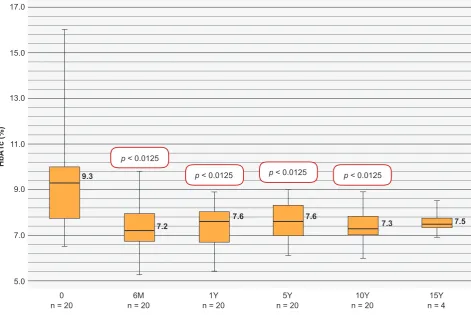
The course of HbA1c in our group of patients is shown in Fig.1. A 9.3% pre-CSII HbA1c level was found (6.5 – 16.0), which has been reduced to 7.2% (5.3 – 9.8) six months later
(p < 0.0125), to 7.6% at one year (5.4-8.9) (p < 0.0125) and
to 7.6% at five years (6.1 – 9.0) (p < 0.0125). A statistically
significant reduction remained at 10 years [7.3% (6.0 – 8.9),
p < 0.0125], while our group of patients was reduced at 15
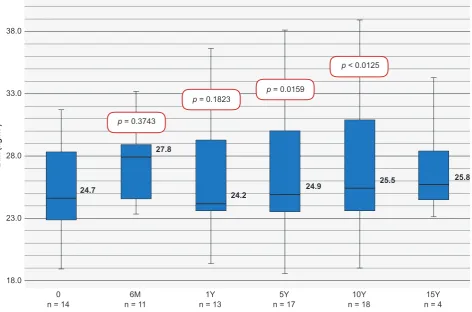
years (n = 4), with a 7.5% level of HbA1c (6.9 – 8.5). An insulin pump therapy was initially used in our institu-tion more than 20 years ago in one patient with a 16.0% baseline HbA1c level which has been significantly reduced following the implementation of CSII therapy to 8.9% at six months and 8.0% at one year, with a small variation over the next few years, reaching 9.0% at 20 years (Fig. 2). The BMI variation throughout patient follow-up is shown
in Fig. 3. Pre-treatment BMI was 24.7 kg/m2 (18.9 – 31.8),
increasing to 27.8 kg/m2 [(23.3 – 33.3); p = 0.3743] at six
months, to 24.2 kg/m2 [(19.4 – 36.7); p = 0.1823] at one year
and still showing a statistically non-significant increase at 5
years, to 24.9 kg/m2 [(18.6 – 38.1), p = 0.0159]. A significant
difference from pre-treatment BMI has only been found at
10 years [25.5 kg/m2 (18.9 – 38.9), p < 0.0125]. Our group
Table 2 – Characteristics of our group of patients
M ± SD Min. Max.
Age (years) 44.3 ± 8.7 31.0 61.0
Age at diagnosis (years) 15.0 ± 9.9 1.0 37.0
Diabetes duration up to CSII implementation (years) 16.1 ± 7.9 4.0 32.0
Age at CSII therapy implementation (years) 31.1 ± 8.4 18.0 48.0
Duration of CSII therapy (years) 13.2 ± 2.3 12.0 21.0
ARTIGO ORIGINAL
of patients was significantly reduced at 15 years (n = 4),
with BMI 25.8 kg/m2 (23.1 – 34.2); BMI of the single patient
followed for 20 years changed from 24.7 kg/m2
(pre-treat-ment) to a maximum value of 28.4 kg/m2 at six months and
a minimum of 24.2 kg/m2 at 20 years.
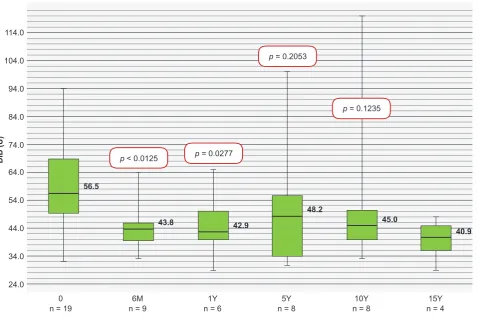
The course of DID is shown in Fig. 4 and has been sig-nificantly reduced over the first six months of therapy when
compared to pre-treatment; 56.5U (32.0 – 94.0) vs. 43.8U
(33.0 – 64.0), p < 0.0125. Even though lower doses have
been found when compared to pre-treatment daily insulin doses, no significant differences were found throughout the remaining follow-up period.
Two episodes of severe hypoglycaemia have occurred throughout a 20-year follow-up in our group of patients (0.0095 episodes/patient/year) and five of diabetic ke-toacidosis (0.0238 episodes/patient/year). No recurrent catheter-associated infection requiring the use of antibiotic therapy has been found.
DISCUSSION
A significant reduction in HbA1c level has been found in this study over the first 10 years of CSII therapy, which was
more significant over the first six months of therapy (2.1%; p
< 0.0125) and greater than what has been described in
oth-er similar studies (approximately 1.35%).4,13 A total of 15 out
of the 20 patients in our study (75%) were started on CSII therapy due to suboptimal metabolic control. It has been shown that patients previously with poorer metabolic con-trol would benefit from higher reduction in HbA1c level
fol-lowing the introduction of CSII therapy.18-20 A mild increase
in HbA1c level has been found at six months, reaching a maximum level of 7.6% at one and five years of follow-up. A trend towards an increasing HbA1c level at six months has
been described in other studies.4,13,15,16 The loss of
commit-ment and motivation as the ‘novelty’ of the therapy faded away can explain for a long-term poorer glycaemic control. Disease progression and the follow-up of these patients, at-tending a lower number of consultations per year, can also have affected blood glucose control leading to poorer meta-bolic control.
A significant reduction in our group of patients after 10 years of follow-up (n = 4 at 15 years and n = 1 at 20) has been found, preventing from any consistent statistical anal-ysis of this period. A reduction in HbA1c level from 16% to 9% at 20 years has been found in the patient with the long-est follow-up at our institution (Fig. 2). Any HbA1c reduc-tion in these patients is crucial as even a small reducreduc-tion is associated with a reduction in the risk of diabetes-related Figure 1 – Boxplots – Course of HbA1c level. Statistically significant with p < 0.0125.
HbA1c: glycated haemoglobin; M: months; Y: years
HbA1c (%)
5.0 7.0
0
n = 20 n = 206M
p < 0.0125
p < 0.0125 p < 0.0125 p < 0.0125
1Y
n = 20 n = 205Y n = 2010Y n = 415Y
9.0
9.3
7.2 7.6 7.6 7.3 7.5
ARTIGO ORIGINAL
Figure 2 – Course of HbA1c level found in patient using CSII therapy with a 20-year follow-up (n = 1) CSII: continuous subcutaneous insulin infusion; M: months; Y: years
HbA1c (%)
6.0 8.0
0 6M 1Y 5Y 10Y 15Y 20Y
10.0
16.0
8.9
8.0
8.3 8.7
8.5
9.0
12.0 14.0 16.0 18.0
Figure 3 – Boxplots – Course of BMI. Statistically significant with p < 0.0125. BMI: body mass index; M: months; Y: years
BMI (kg/m
2)
18.0
0
n = 14 n = 116M
p = 0.3743
p = 0.1823 p = 0.0159
p < 0.0125
1Y
n = 13 n = 175Y n = 1810Y n = 415Y
23.0
24.7
27.8
24.2 24.9
25.5 25.8
ARTIGO ORIGINAL
microvascular complications.2,3
Weight gain is one of the major concerns with intensive
insulin therapy.21 BMI variation directly related to weight
var-iation was assessed in the present study and an increasing BMI has been found, particularly over the first six months of CSII therapy, even though a statistical significance was only
obtained at 10 years of therapy: 24.7 kg/m2 (18.9 – 31.8) vs.
25.5 kg/m2 (18.9 – 38.9), p < 0.0125. These results were
different from those described by other studies, showing a mild weight reduction, even though no statistically
signifi-cant differences were obtained.4,13 A BMI varying curve has
been found throughout the remaining periods, with no sig-nificant variation. The increasing BMI throughout the follow-up that was found in our study could have been related to patient’s pre-treatment suboptimal glycaemic control. As fifteen (75%) of our patients were started on CSII due to persistent hyperglycaemia, an improved glycaemic control could have been associated with greater weight gain than what was found in other series, in which mean baseline HbA1c was closer to the expected outcome, corresponding
to an increasing BMI.4,14,16
A significant DID reduction was found over the first six
months of follow-up [56.5U (32.0 – 94.0) vs. 43.8U (33.0 –
64.0), p < 0.0125], which was not found over the remaining
follow-up periods; it is worth mentioning that pre-treatment
DID level was never exceeded. These data are in line with
other studies.4,8,13 The reduction in daily insulin
require-ments with CSII therapy could be explained by the insulin absorption profile due to a more physiological absorption and more accurate adjustment of baseline 24-hour baseline
flow of insulin.4,13
A reduction in the incidence of ketoacidosis and severe hypoglycaemia has been found with CSII therapy, in line
with other studies.13,17 CSII with rapid-acting insulin
ana-logues allows for greater flexibility with lower glycaemic
variability, according to Karges et al.,22 leading to lower
rates of acute and long-term complications, including hy-poglycaemia. A reduction in the risk of diabetic ketoacidosis with CSII therapy was associated with more frequent blood
glucose self-monitoring.22 A similar rate of ketoacidosis has
been found by most studies with the use of CSII therapy vs.
MDI, with an adequate patient education and practice with
the use of the perfusion system.13 It is worth mentioning that
the rate of complications found in the present study, namely the rate of severe hypoglycaemia, could have been under-estimated due to the possible absence of records regarding this information.
Major limitations of the study are related to the fact that this was a retrospective study, with a limited data col-lection regarding BMI and DID, reducing the capability of Figure 4 – Boxplots – Course of DID. Statistically significant with p < 0.0125.
DID: daily insulin dose; M: months; Y: years
DID (U)
24.0 34.0 44.0 54.0 64.0 74.0 84.0 94.0 104.0 114.0
0
n = 19 n = 96M
p < 0.0125 p = 0.0277
p = 0.2053
p = 0.1235
1Y
n = 6 n = 85Y n = 810Y n = 415Y
56.5
43.8 42.9
48.2
45.0
ARTIGO ORIGINAL
statistical inference on these variables. Due to the fact that this is a relatively recent technology, few patients with DM1 are currently on CSII therapy for over 10 years and this is a limitation regarding the statistical analysis, even though not preventing from obtaining a descriptive analysis of the behaviour of patients in real-life settings using this therapy in the long run.
Despite these limitations, the study has shown daily clinical practice with a heterogeneous group of patients with DM1 using CSII therapy.
CONCLUSION
All the evidence suggests that CSII therapy is really use-ful in reaching metabolic control in selected patients with DM1. According to our study, the beneficial effect of CSII therapy can be maintained for long periods of time, with a low risk of acute complications and could be considered as first-line treatment in patients with DM1.
HUMAN AND ANIMAL PROTECTION
The authors declare that the followed procedures were according to regulations established by the Ethics and Clini-cal Research Committee and according to the Helsinki Dec-laration of the World Medical Association.
DATA CONFIDENTIALITY
The authors declare that they have followed the
proto-cols of their work centre on the publication of patient data.
CONFLICTS OF INTEREST
The authors declare that there were no conflicts of inter-est in writing this manuscript.
FINANCIAL SUPPORT
The authors declare that there was no financial support in writing this manuscript.
REFERENCES
1. Expert Committee on the Diagnosis and Classification of Diabetes Mellitus. Report of the expert committee on the diagnosis and classification of diabetes mellitus. Diabetes Care. 2003;26:S5-20. 2. The Diabetes Control and Complications Trial Research Group. The
effect of intensive treatment of diabetes on the development and progression of long-term complications in insulin-dependent diabetes mellitus. N Engl J Med. 1993;329:977-86.
3. Epidemiology of Diabetes Interventions and Complications (EDIC). Design, implementation, and preliminary results of a long-term follow-up of the Diabetes Control and Complications Trial cohort. Diabetes Care. 1999;22:99-111.
4. Balsa AM, Neves C, Alves M, Pereira M, Carvalho D, Medina JL. Terapêutica de infusão subcutânea contínua de insulina. Acta Med Port. 2011;24:147-56.
5. Didangelos T, Iliadis F. Insulin pump therapy in adults. Diab Res Clin Practice. 2011;93:S109-13.
6. Pickup J, Keen H. Continuous subcutaneous insulin infusion at 25 years: evidence base for the expanding use of insulin pump therapy in type 1 diabetes. Diabetes Care. 2002;25:593-8.
7. Direção Geral de Saúde. Circular normativa nº17/DSCS/DGID. Gestão integrada de diabetes - elegibilidade dos doentes para tratamento através de perfusão subcutânea contínua de insulina. Lisboa: DGS; 2008.
8. Pozzilli P, Battelino T, Danne T, Hovorka R, Jarosz-Chobot P, Renard E. Continuous subcutaneous insulin infusion in diabetes: patient populations, safety, efficacy, and pharmacoeconomics. Diabetes Metab Res Rev. 2016;32:21-39.
9. Carlsson BM, Attvall S, Clements M, Gumpeny SR, Pivodic A, Sternemalm L, et al. Insulin pump-long-term effects on glycemic control: an observational study at 10 diabetes clinics in Sweden. Diabetes Technol Ther. 2013;15:302-7.
10. Orr CJ, Hopman W, Yen JL, Houlden RL. Long-term efficacy of insulin pump therapy on glycemic control in adults with type 1 diabetes mellitus. Diabetes Technol Ther. 2015;17:49-54.
11. Marchand L, Kawasaki-Ogita Y, Place J, Fayolle C, Lauton D, Boulet F,
et al. Long-term effects of continuous subcutaneous insulin infusion on glucose control and microvascular complications in patients with type 1 diabetes. J Diabetes Sci Technol. 2017;11:924-9.
12. Nixon R, Folwell R, Pickup JC. Variations in the quality and sustainability of long-term glycaemic control with continuous subcutaneous insulin infusion. Diabet Med. 2014;21:1174-7.
13. Saraiva J, Carrilho F, Barros L, Baptista C, Melo M, Gomes L, et al. Long term follow-up in type 1 diabetes patients using continuous subcutaneous insulin infusion systems. Infusystems International. 2013;12:6-8.
14. Esteves C, Belo S, Neves MC, Arteiro C, Carvalho D. Glycemic control and weight outcomes after initiation of continuous subcutaneous insulin infusion therapy. Rev Port Endocrinol Diabetes Metabol. 2015;10:128-32.
15. Santos MJ. Avaliação da qualidade de vida e do controlo glicémico em diabéticos tipo 1 com bomba infusora de insulina. Tese de Mestrado em Medicina. Porto: Instituto de Ciências Biomédicas Abel Salazar, Universidade do Porto; 2009.
16. Monteiro AM, Alves M, Pereira ML, Marques O. Experiência do serviço de endocrinologia do hospital de Braga no tratamento de diabéticos tipo 1 com bombas infusoras de insulina. In: Hospital de Braga-endocrinologia, diabetes e metabolismo - comunicações e conferências. Braga: Hospital de Braga; 2015.
17. Joubert M, Morera J, Vicente A, Rod A, Parienti JJ, Reznik Y. Cross-sectional survey and retrospective analysis of a large cohort of adults with type 1 diabetes with long-term continuous subcutaneous insulin infusion treatment. J Diabetes Sci Technol. 2014;8:1005-10.
18. Pickup JC, Sutton AJ. Severe hypoglycaemia and glycaemic control in Type 1 diabetes: meta-analysis of multiple daily insulin injections compared with continuous subcutaneous insulin infusion. Diabet Med. 2008;25:765-74.
ARTIGO ORIGINAL
importance of blood glucose variability. Diabetes Metab Res Rev. 2006;22:232-7.
20. Retnakaran R, Hochman J, DeVries JH, Hanaire-Broutin H, Heine RJ, Melki V, et al. Continuous subcutaneous insulin infusion versus multiple daily injections: the impact of baseline A1c. Diabetes Care. 2004;27:2590-6.
21. Weight gain associated with intensive therapy in the diabetes control
and complications trial. Diabetes Care. 1988;11:567-73.