©Science and Education Publishing DOI:10.12691/ces-5-1-1
Aliphatic Hydrocarbon Fingerprints of Some Crude Oil
Polluted Soils from Niger Delta, Nigeria
Udeh Ogochukwu Vivian, Osuji Leo C., Achugasim Ozioma*
Department of Pure and Industrial Chemistry, University of Port Harcourt, Port Harcourt, Nigeria *Corresponding author: [email protected]
Abstract
Crude oil-polluted soil samples were collected from five different oil polluted sites at Etche, Ahoada, Bodo, Ebocha and Bille in Niger Delta. The samples were analyzed using Gas chromatography with Flame ionization detector (GC-FID) for the Total Petroleum Hydrocarbon (TPH) to determine the different oil fractions and thus provide evidence of hydrocarbon contamination at the affected sites. The Pristane/Phytane ratios of the samples indicated that the released oil had both oxidizing and reducing source input. Similarly, the n-alkane distribution gave carbon preference index (CPI) values that pointed to both marine and terrestrial source input. The similarities in pattern from the star diagram also points to the marine and terrestrial source inputs to the oils. Depletions of nC21-nC23 hydrocarbon fractions and disappearance of nC8-nC21 fractions from gas chromatogram showed serious
degradation on the sites.
Keywords
: gas chromatography, fingerprinting, total petroleum hydrocarbon, carbon preference index, pristane,phytane
Cite This Article:
Udeh Ogochukwu Vivian, Osuji Leo C., and Achugasim Ozioma, “Aliphatic Hydrocarbon Fingerprints of Some Crude Oil Polluted Soils from Niger Delta, Nigeria.” Chemical Engineering and Science, vol. 5, no. 1 (2018): 1-5. doi: 10.12691/ces-5-1-1.1. Introduction
Petroleum is a mixture of gaseous, liquid and solid hydrocarbons that occurs naturally beneath the earth’s surface and exists as crude oil, natural gas or condensates
[1]. Crude oil consists of hydrocarbons and non-hydrocarbons; the hydrocarbons consist of alkanes (paraffins), alkenes (olefins) and the aromatics [1]. With the increased rate of crude oil spillage into the environment through various oil exploration activities, soil pollution in the Niger Delta region has greatly increased. These oil releases can be as a result of equipment failures, improper system of operations or can even be caused by saboteurs damaging the oil facilities [4]. These activities can lead to pollution of aquatic environments when through the action of wind and wave, oil spreads across the water leading to soil pollution, thus agricultural activities are affected adversely
[5]. The hydrocarbons in these spillages can be analyzed through a number of instrumental techniques. These techniques include but not limited to; Gas Chromatography, Gas Chromatography-Mass Spectroscopy, High Pressure Liquid Chromatography. These techniques determine the source of oil, chemical composition and degree of weathering of crude oil. GC technique is used extensively to determine hydrocarbons and other organic compounds by determining their composition, molecular specie and their concentrations in the sample [2].
Total petroleum hydrocarbons (TPH) refers to the measurable amount of petroleum-based hydrocarbons in an environmental matrix [8]. TPH is generally used to
describe a large family of several hundred of chemical compounds that originally come from crude oil as each chemical in any environmental matrix (soil or water) is measured [9]. Fingerprinting of petroleum hydrocarbons from C8 to C40 is used to analyze the characteristics
of oil in order to evaluate among others the hydrocarbon range in the crude. Fingerprinting evaluation using gas chromatography helps to determine the maturity, source and biodegradation of the entire crude oil by determining the hydrocarbon range in a gas chromatograph and certain hydrocarbon ratios are employed [2]. Biomarker diagnostic ratios are parameters used for oil correlation, determination of organic input and precursors, depositional environment, assessment of maturity and evaluation of in-reservoir oil degradation [10]. Frequently used biomarkers for diagnostic ratios are pristine/phytane, pristine/n-C17, phytane /n-C18, C21/C23 tricyclicterpanes etc.
[6].
2. Materials and Methods
3. Results and Discussions
The chemical fingerprints of oils from the five polluted sites at Etche, Ahoada, Bodo, Ebocha and Bille were assessed using GC-FID analysis of the different oil fractions. Five parameters used for this purpose include: Pristane/phytane, pristane/n-C17, CPI, Pr + nC17/ph +
n-C18 and degree of waxiness (∑C21-C32/∑ C15-C20) as
shown in Table 1 below.
Table 1. Some diagnostic ratios for the five soil samples
TPH
RATIOS Pr/ph
Pr/n-C17 CPI
∑C21-C32/∑
C15-C20
Pr+n-C17/ph+n-C18
ETCHE 0.97 3.13 1.41 0.06 1.16
AHOADA 0.69 0.3 0.96 0.58 1.32
BODO 0 0 6.97 0 0
EBOCHA 4.69 0.33 3.39 0.23 7.12
BILLE 0.48 0.46 2.28 0.66 0.68
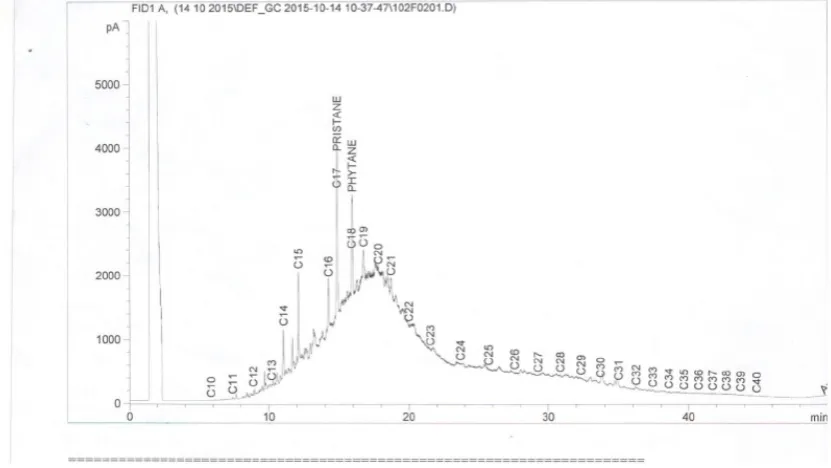
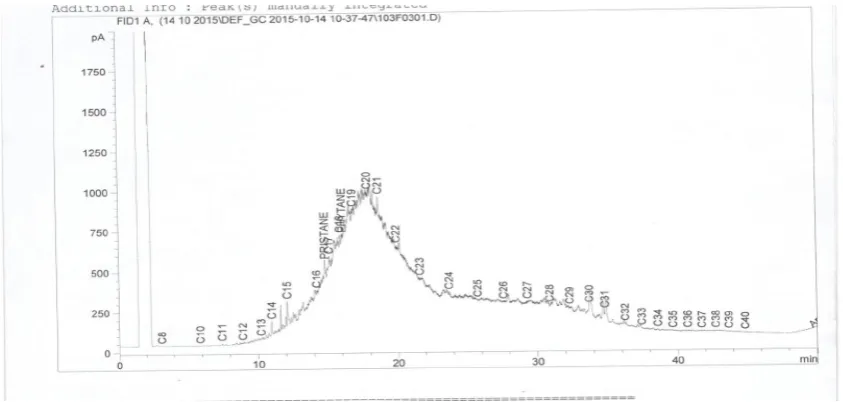
The mode of distribution of n-paraffins in the crude oil extract of Etche, Ahoada, Ebocha and Bille showed a hydrocarbon predominance of n-C15 to n-C20 reflecting
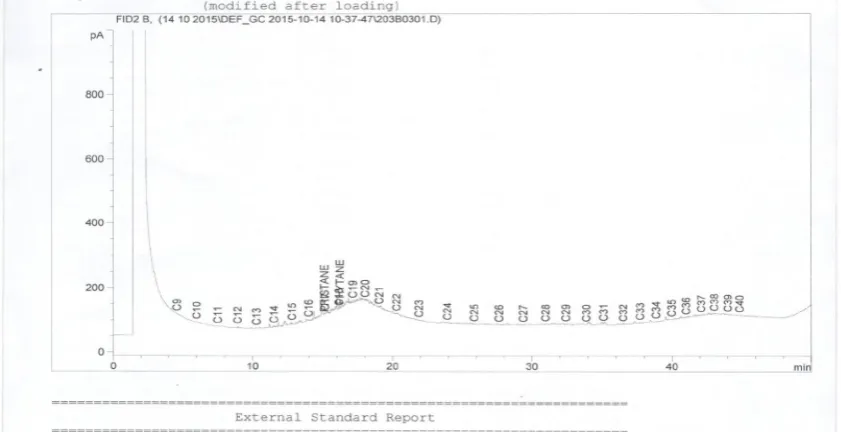
marine origin [3]. Also, there was a total disappearance of n-C18 to n-C21 in the crude oil extracts from Bodo and
n-C32 to n-C30 in all the five sites especially Etche
suggesting serious biodegradation on these sites. The ratios of pristane to pyhtane (pr/ph) can be used as a
source index of the spilled oils depositional environment. Since pristane represent a product of decarboxylation, the ratio of the Pr/Ph tends to be high in more oxidizing environment and low in reducing environment [2]. The crude oil samples of Ebocha oilfields had high Pr/Ph ratio of 4.69 suggesting terrestrial input while those from Etche, Ahoada and Bille had low Pr/Ph ratios of 0.97, 0.69 and 0.48 respectively. These ratios below unity could be an indication of petroleum origin and/or highly reducing depositional environment [2]. The Pr/n-C17 ratios of the
oil extracts were 0.30, 0.33 and 0.46 in samples from Ahoada, Ebocha and Bille respectively indicating these ratios below unity could be an indication that serious weathering activities has taken place while Pr/n-C17 ratio
for Etche was 3.13 indicating less weathering activities on Etche oilfield, as the pristine to its neighboring n-alkane C17 decreases as weathering proceeded [6]. The degree
of waxiness in spilled oil samples from Ahoada, Etche, Ebocha and Bille was less than 1 revealing low waxy nature suggesting marine organic source input under reducing conditions [3].
Carbon preference index (CPI) can be used for evaluating both the source and maturity of crude oils [7] [1]. The pattern of distribution of n-alkanes in samples from Etche, Ebocha and Bille showed that the odd carbon-numbered alkanes were more abundant than the even numbered alkanes in the lower range of n-C13 to n-C22
resulting in high CPI of approximately 1.41, 3.39 and 2.28 respectively for the n-C13 to n-C22 at Etche, Ebocha and
Bille respectively suggesting that the lower n-alkanes of the spilled oil, might have been derived from plants/terrestrial sources. On the other hand, n-C13 to n-C22
in oil spilled samples from Ahoada has a CPI of 0.96 close to unity indicating mature samples and marine input from nC13 to nC22. The CPI values for the ranges indicated that
oils may have been sourced from both marine and terrestrial environments.
Figure 2. TPH (n-alkanes) chromatogram of oil from Ahoada soil sample
Figure 3. TPH (n-alkanes) chromatogram of oil from Bodo soil sample
Figure 5. TPH (n-alkanes) chromatogram of oil from Bille soil sample
Figure 6. Star Plot depicting TPH ratios for the five sample locations
A star plot consisting of a series of ratios from the five parameters was used to make correlation of the different oilfield extracts.
4. Conclusion
Analysis of crude oil polluted soils from Ahoada, Ebocha, Bodo, Bille and Etche oil spillage sites shows that the soils were highly polluted. The CPI values reveal mature oil from marine and terrestrial source input. The star diagram shows that oils from Ahoada, Bille and Etche were closely matched suggesting a close grouping among the oils and is reflective of oil generation from a common source (marine source). Oils from Ebocha show fairly close pattern with Bille and Etche suggesting common source (terrestrial source). These similarities in pattern of oil are in line with the marine and terrestrial source rocks of the oils. However, Bodo was observed in the star plot to
follow pattern different from the other oils. This difference in path followed by the oil is in line with different source rock between the oils.
References
[1] Osuji, L.C. Petroleum Chemistry and Toxicology in Theory and Practice. JESO International Owerri, Nigeria(2011). Pp 72-372.
[2] Hunt, J. M. Petroleum Geochemistry and Geology, W. H. Freeman and company New York, U. S. A.: (1996). Pp 231-617.
[3] Peters, K. E., Walters, C.C. and Moldowan , J.M., The Biomarker Guide: Interpretation Molecular Fossils in petroleum and Ancient Sediments. Cambridge University Press. 1999.
[4] Osuji, L.C., Ebitimi, J. E. and Ojinnaka, C. M. Chemical reclamation of crude –oil-inundated soils from Niger Delta, Nigeria. (2005). Pp. 1-10.
[5] Achugasim, O. Analysis of soils from Ukpeliede-1 oil spillage site Rivers State. A MSc. Thesis submitted to the Department of Pure and Industrial Chemistry, University of Port Harcourt, Nigeria. (2005).
0 2 4 6
8pr/ph
pr/n-C17
CPI
ΣC21-C31/ΣC15-C20 pr+n-C17/ph+n-C18
[6] Yasser, M. M. and Rania, E. M. Biomarkers, Chromatography and its Applications, Dr Sasikumar Dhanaras (2012).
[7] Tissot, P. and Welte, D. Petroleum formation and occurrence, 2nd ed., Springer Verlag, Berlin, (1984). 669.
[8] Ross, S. and Connell, D. Analytical Methods for the
Determination of Total Petroleum Hydrocarbons in soil. National Environmental Protection Council Services Cooperation (NEPC).
Proceedings of the fifth National Workshop on the assessment of site contamination. (2003). pp. 134.
[9] John, W. and Wigger, P. Petroleum hydrocarbon fingerprinting-Numerical interpretation development in environmental liability management. Oklahoma Pergamom press (1997). pp. 23-57.