Available online throug
ISSN 2229 – 5046
THE INFLUENCE OF THERMAL RADIATION ON MHD FLOW
OF A MICROPOLAR FLUID OVER A STRETCHABLE DISK WITH VISCOUS DISSIPATION
K. KALYANI*
2,
NAIKOTI KISHAN
1AND M. CHENNA KRISHNA REDDY
11
Department of Mathematics,
Osmania University, Hyderabad, Telangana, India.
2
Department of Mathematics,
R.B.V.R.R Womens College, Narayanguda, Hyderabad, Telangana, India.
(Received On: 09-08-17; Revised & Accepted On: 20-09-17)
ABSTRACT
T
he flow induced in a micropolar fluid by stretchable disk is investigated assuming that the fluid is a micropolar overa stretchable disk and the disk is subjected to an external transversse magnetic fluid under the influence of thermal radiation and viscous dissipation. A suitable similar transformation is used to transform the governing boundary layer partial differential equation into ordinary differential equations. The implicit finite difference scheme is used to solve the reduced non-linear ordinary differential equations along with the associated boundary conditions. Effects of the flow parameters such as micropolar parameter, magnetic field parameter, Prandtl number, thermal radiation, viscous dissipation on the axial, radial velocities, microrotation and temperature distribution are shown graphically and analyzed. Also a quantitative discussions are presented for shear and couple stresses and heat transfer rate over the disk.
Keywords: micropolar fluids, stretchable disk, MHD, thermal radiation, viscous dissipation.
1. INTRODUCTION
The investigation of boundary layer flow over a stretching surface has attracted by the research community, due to its significant applications in many technological and engineering processes. The problem of fluid flow between two parallel disks is also important due to its significant applications in industries such as magnetic storage devices, crystal growth processes, rotating machinery, gas turbine engines, hydrodynamical machines and apparatus, geothermal, geophysical, heat and mass exchanges, computer storage devices, semiconductor manufacturing and processes with rotating waters. Fang et al. [1] determined exact solution of Navier Stokes equation analytically to study the MHD viscous flow under slip conditions over a permeable stretching surface. Robert et al. [2] used analytical solution of axis-symmetric flow between two stretchable disk. Fang and Zhang [3] presented an exact solution for the steady state Navier Stokes equations in cylindrical polar coordinates by a similarity transformation. The transition effect of the boundary layer flow due to a suddenly imposed magnetic field over a viscous flowpast a stretching sheet and due to sudden withdrawal of the magnetic field over a viscous flow past a stretching sheet under a magnetic field was analyzed by Kumaran et al., [4]. Ezzat et al., [5] considered perfectly electrically conducting fluid past a non isothermal stretching sheet in the presence of a transverse magnetic field acting perpendicularly to the direction of motion of the fluid. The theoretical analysis of the laminar boundary layer flow and heat transfer of power law non-Newtonian fluids over a stretching sheet was considered by Xu and Liao [6]. Kishan and kavitha [7] analyzed the MHD Non-Newtonian flow and heat transfer past a Non-linear stretching surface with thermal radiation and viscous dissipation.
Corresponding Author: K. Kalyani*
1,
© 2017, IJMA. All Rights Reserved 85 Micropolar fluids are fluids with microstructure. Physically, micropolar fluids may represent fluids consisting of rigid, randomly oriented (or spherical) particles suspended in a viscous medium, where the deformation of fluid particles is ignored. The fluid motion of the micropolar fluid is characterised by the concentration laws of mass, momentum and constitutive relationships describing the effect of couple stress, spin-inertia and micromotion. Hence the flow equation of micropolar fluid involves a micro-rotation vector in addition to classical velocity vector. In micropolar fluids, rigid particles in a small volume element can rotate about the centroid of the volume element. The micropolar fluids in fact can predict behavior at microscale and rotation is independently explained by a microrotation vector. The theory of micropolar fluids, introduced by Eringen [8, 9] in order to deal with the characteristics of fluids with suspended particles, has received a considerable interest in recent years. Also, as demonstrated by Papautsky et al. [10], Eringen’s model successfully predicts the characteristics of flow in microchannels. The study of heat and mass transfer for an electrically conducting micropolar fluid past a porous plate under a influence of a magnetic field in a rotating frame of reference has attracted the interest of many investigators in view of its applications in many industrial (in the design of termites and thermo mechanics) astrophysical (dealing with the sun spot development, the solar cycle and a structure of a rotating magnetic stars), geophysical (hydrologist study the migration of underground water, petroleum engineers to observe the movement of oil and gas through the reservoir) and many other practical applications, i.e. in biomechanical problems (ex: blood flow in the pulmonary alveolar sheet). It is well known that rotating heat exchangers or extensively used by the chemical and automobile industries. The dynamics of micropolar fluids has attracted considerable attention during the last few decades because traditional newtonian fluids cannot precisely describe the characteristics of fluid flow with suspended particles. Similarly, magnetohydrodynamics (MHD) has attracted the research community due to its novel industrial applications. Excellent literature survey on the subject may be found in Rashidi et.al [11], Rashidi and Erfani [12], Balasiddulu et al. [13]. Ali. et al., [14] studied the Numerical simulation of MHD micropolar fluid with shrinking walls. An excellent review of the various applications of micropolar fluid mechanics was presented by Ariman et al. [15]. The mathematical theory of equations of micropolar fluids and the applications of these fluids in the theory of lubrication and porous media are presented by Lukaszewicz [16]. More interesting aspects of the theory and application of micropolar fluids can be found in the books of Eringen [17]. Goverdhan and Kishan [18] studied the unsteady magnetohydrodynamic boundary layer flow of an incompressible micropolar fluid over a stretching sheet. M.Ashraf et al. [19] studied the MHD flow and heat transfer of a micropolar fluid over a stretchable disk.
Many industrial technological systems are subjected to heating and cooling such as cooling from the intake air and periods of thermal contact with vale seat, during the combustion cycle, heat conduction is sliding solids, regenerating heat exchangers, solar heating systems. Most of such applications involved condition of high temperature phenomenon or high power radiations sources. A distinguishing feature of radiative heat transfer is that it is associated with the radiation heat flux, which is proportional to the differences of individual absolute temperatures of the bodies each raised to the fourth power. This is a primary difficulty in modelling radiation heat transfer problems in that the radiation heat
flux involves an integro-differential equation in the governing energy equation. Bhatta charya et al., [20] studied the effects of thermal radiation on micropolar fluid over a porous shrinking sheet. In all previous investigations, the effect of thermal radiation on the flow and heat transfer has not been provided. The effect of radiation on MHD flow and heat transfer problem has become more important industrially. Abo-eldohad and Ghoniam [21] analyzed the radiation effects on heat transfer of a micropolar fluid past a vertical porous flat plate in the presence of radiation with variable heat flux in porous medium. Rahman and Sultan [22] has studied the steady convective flow of a micropolar fluid past a vertical porous flat plate in the presence of radiation with variable heat fluxes in porous medium. The effects of
thermal radiation were also by researches by Mahmoud Maa[23], Chamkha AJ et al.,[24].
The aim of present paper is to study the effects of thermal radiation and viscous dissipation on MHD boundary layer flow of an incompressible electrically conductor of a micro polar fluid over a stretchable disk. A numerical solution is obtained for axial, radial velocities, micro rotation and temperature distribution are presented graphically and analyzed.
2. MATHEMATICAL ANALYSIS
Consider an axisymmetric laminar incompressible flow of an electrically conducting micropolar fluid over a stretchable disk. A uniform transverse magnetic field B0 is applied at the disk. The governing equations of motion for the MHD laminar viscous flow of a micropolar fluid is
𝑢 𝑟 +
𝜕𝑢 𝜕𝑟 + �
𝜔 𝜈
𝜕𝜔 𝜕𝜂 = 0,
𝜌 �𝑢 𝜕𝑢𝜕𝑟+𝑤�𝜔𝜈 𝜕𝜂𝜕𝑢� = −𝜕𝑝
𝜕𝑟− 𝒌�
𝜔 𝜈
𝜕𝑣2
𝜕𝜂 −𝜎𝑒𝐵02𝑢 + (𝜇+κ)� 𝝏𝟐𝒖
𝜕𝒓𝟐 + 𝟏 𝒓
𝜕𝑢 𝜕𝑟 +
𝜔 𝜈
𝝏𝟐𝒖 𝝏𝟐𝜂𝟐 −
𝑢 𝑟2�,
ρj�𝑢 𝜕𝑣2
𝜕𝑟 +𝑤�
𝜔 𝜈
𝜕𝑣2
𝜕𝜂�= 𝜅 �� 𝜔
𝜈 𝜕𝑢
𝜕𝜂−
∂w
∂r�−2𝜿𝑣2 +𝛾 � 𝜕2𝜐2
𝝏𝒓𝟐 + 𝟏𝒓𝜕𝑣2𝜕𝑟 + 𝜔𝜈𝝏
𝟐𝑣2
𝜕𝜂𝟐 − 𝑣2𝑟2�, (1)
And the equation for temperature field with viscous dissipation,
𝜌𝑐𝑝�𝑢 𝜕𝑇𝜕𝜈+𝑤�𝜔𝜂 𝜕𝑇𝜕𝜂� + 𝜌𝑐1 𝑝
𝜕𝑞𝑟 𝜕𝑦 - 𝜅0�
𝝏𝟐𝑻
𝝏𝒓𝟐 + 𝟏𝒓𝜕𝑇𝜕𝑟 + 𝜔𝜈𝝏
𝟐𝑻
𝜕𝜂𝟐�– μ �∂u∂y� 2
Where T is the temperature field, 𝑐𝑝 the specific heat at a constant pressure, 0 is the thermal conductivity of the fluid,
and 𝜂=𝑧�𝜔
𝜈 is the similar variable.
Using Rosseland approximation for radiation 𝑞𝑟= −4𝜎3𝑘𝜕𝑇
4
𝜕𝑦,
Where k is the mean absorption coefficient and 𝜎 is the Stefan Boltzmann constant. 𝑇4 is expressed as a linear function
of temperature by using Taylor series expansion about 𝑇∞ is 𝑇4= 4𝑇∞3T - 3𝑇∞4 , we have
𝜕𝑞𝑟
𝜕𝑦 =−
16 3
σ𝑇∞3 k
𝜕2𝑇 𝜕𝑦2,
Here, the quantity 𝜔 is a pseudoangular velocity corresponding to the disk stretching and its unitis 1/s. The boundary conditions over the stretching disk for the velocity field for the present problem are
u(r,0) = r 𝜔 w(r,0) =0 u(r,∞)=0 (3)
The no-spin boundary conditions at the boundaries for microrotation are given by
(𝑣1,𝑣2,𝑣3) = (0,0,0) at 𝜂= 0 and 𝜂= ∞ (4)
The boundary conditions for the temperature field can written as
T = � 𝑇0 𝑎𝑡 𝜂= 0
𝑇∞ 𝑎𝑡 𝜂=∞ � (5) Where 𝑇0 is the constant temperature at the disk and 𝑇∞ is the constant temperature at infinity (with 𝑇0>𝑇∞)
In order to obtain the velocity, microrotation and temperature fields for the present problem. we have to solve equations (1) and (2) subject to the boundary conditions given in equations (3) and (4). For this purpose, we use the following similarity transformation
u = −𝑟𝜔𝑓′(𝜂)
2 𝑤= √𝜔𝜈𝑓 (𝜂) p = 𝜈𝜔𝑃(𝜂), (6)
𝑣2= �𝜔𝜈 r 𝜔𝑔 (𝜂) 𝜃 (𝜂) = 𝑇𝑇−0−𝑇𝑇∞∞,
Using equations (6) we see that continuity equation (1) is identically satisfied, and hence velocity components represent a possible fluid motion.
Now by using equations (6) in momentum equation (1) we get
�𝑓 ′�2
2 −𝑓𝑓 " + 2 𝑐1𝑔′ + (1 + 𝑐1) 𝑓 ‘’’−𝑀2𝑓′ = 0, (7)
Where 𝑐1= κ
𝜇 𝑀2= 𝜎𝐵02
𝜌𝜔
are the vortex viscosity parameter and the magnetic parameter, respectively. M is also known as Hartmann number.
Using equations (6) in the angular momentum equation (1) we get
c2𝑔′′− 𝑐1�𝑓′′
2 + 2𝑔� − 𝑐3�𝑓𝑔′−
𝑓′
2𝑔�= 0 , (8)
c2 = 𝛾𝜔𝜇𝜈 c3 = 𝜌𝜔𝑗𝜇
are the spin gradient viscosity parameter and the microinnertia density parameter, respectively. Energy equation (2) in view of equations (6), takes form
(1 +43𝑅)𝜃′′− 𝑃𝑟𝑓𝜃′+𝐸𝑐𝑓′′2 = 0, (9)
Where Pr = 𝜇𝑐𝑝/𝑘0 is the Prandtl number.
Boundary conditions (3) to (5) in view of above transformations equations (6) in the dimensionless the form can be written as 𝑓 (0) = 0 𝑓′(0) = −2 𝑓′(∞) = 0
𝑔(0) = 0 𝑔′(∞) = 0 𝜃(0) = 1 𝜃(∞) = 0 (10)
The quantities of physical interest, the shear and couple stresses on the disk are defined respectively as
𝜏𝜔 = −(𝜇+𝜅)𝜕𝑢𝜕𝑧⎮z=0 = 𝜇(1 +𝑐1)𝑟𝜔�𝜔𝜐 �𝑓2′′� ⎮𝜂=0 (11)
© 2017, IJMA. All Rights Reserved 87 We have to solve the system of equations (7) (8) and (9) subject to the boundary conditions given in equation (10).
3. RESULTS AND DISCUSSION
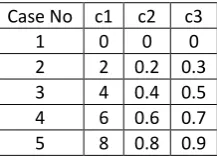
The present investigation is to study the effects of MHD and viscous dissipation on the flow and heat transfer characteristic associated with the study laminar incompressible viscous fluid flow of an electrically conducting micropolar fluid over the stretchable disk. The equations 3.2 along with the boundary condition 3.3 are solved by using implicit finite difference scheme known as Kellar Box method. The numerical results for axial, radial velocities, microrotation and temperature effects have been completed for different flow parameter namely magnetic parameter M, Eckert number Ec, Prandtl number P for different sets of material constants c1, c2, c3. The arbitrary choosen values of c1, c2, c3 are given in Table 1. A comprehensive numerical study findings in the present paper is given in tabular and graphical form together and analyzed and their interpretation is presented. The accuracy of numerical digits of present study is verified by comparing the results of 𝑓 ‘’ (0), −𝑔’(0) with Asraf et al., [19] and observed that there is a good agreement between both the results. The different cases of material constants has given in Table 1. It is observed that the micropolarity of the fluids becomes more prominent for larger values of these constants than the smaller values. Also the numerical results have been completed separately for three different cases of these constants to make a better understanding of the behaviour of the micro polar fluids. For better understanding of the influences of micropolar structure of electrically conducting fluids presented shear and couple stresses at the disk and velocity, microrotation and temperature fields over the disk. The graphical interpretation of the results are present through the figures (1) to (4).
Figure 1(a)-(d) illustrates the influence of micropolar parameters c1, c2 and c3 on axial velocity, radial velocity, microrotation and temperature profiles respectively. It may be conclude that fig 1(a) and (b) the axial and radial velocities decreases with the increase of microrotation parameter. It is also clear that the microrotation distribution increases near the disk and reverse steps is observed away from the boundary layer. The temperature profiles decreases for four cases of micropolar parameter decreases by increasing the values of c1, c2 and c3.The thermal boundary layer decreases as the values of micropolar parameter c1,c2,c3 increases. It is due to reason that the micropolar structure of the fluid causing the microrotation in the fluid which is responsible for the increase in the couple stress co-efficient at the disk. Fig 2(a)-(d) predict the influence of magnetic field on axial, radial velocity, microrotation and temperature respectively. From fig2 (a) – (d) it can been seen that axial as well as radial velocities increases with the increase of magnetic field parameter M. It is clear from the figure that the velocity boundary layer becomes thinner by increasing the values of M. The effect of magnetic field on microrotation for fixed values of micro polar parameters as shown in figure 2(c). It is noticed that the microrotation profiles decreases near the disk and a reverse trend is observed far away from the boundary. This is due to damping effect of the magnetic field which shows that intensity of the applied magnetic field can be used to decrease the angular rotaton especially suspension close, arising in lubrication problems. From figure 2(d) it can be seen that the effect of the magnetic field on the temperature distribution is to increases the temperature profiles. The thermal boundary layer thickness with the influence of magnetic field. Figure (4) depicts the effect viscous dissipation on temperature profiles it can be seen that the temperature profiles increases with the increase the value of Eckert number. The figure (5) present graphical representation of thermal radiation effects on temperature profiles. The effect of thermal radiation is to increases the temperature field away from the boundary and reverse effect is observed near the boundary.
Table-1: Five Cases of micropolar parameters c1, c2, c3, c4 and c5
Case No c1 c2 c3
1 0 0 0
2 2 0.2 0.3 3 4 0.4 0.5 4 6 0.6 0.7 5 8 0.8 0.9
Table-2: Shear and couple stresses, and values of heat transfer rate over the disk for M =2, Pr =0.7 and various values of c1, c2, c3
Table-3: Shear and couple stresses over the disk for c1=3, c2=0.1, c3=0.7 Pr =0.7 and for various of M.
M
M.Ashrafa, K. Batool Present study
𝑓’’(0) −𝑔’(0) 𝑓’’(0) −𝑔’(0) 0 0.98820 2.19514 0.9859 2.2088 1 1.29915 2.77224 1.2964 2.7909 2 1.98111 3.93447 1.97711 3.9631 3 2.79668 5.16728 2.7915 5.2082 4 3.67174 6.33861 3.6659 6.3931 5 4.58056 7.42231 4.5747 7.4916
Table-4: Shear and couple stresses and values of heat transfer rate over the disk for various values of four of micro polar parameter c1,c2,c3, M, Pr and Ec. Whereas case 6: c1=0.3,c2=0.1,c3=0.2.
Case M Pr Ec R 𝑓′′(0) −𝑔′(0) −𝜃′(0)
1 2 0.7 0.1 1 4.6234 0 0.1741
2 2.4166 2.339 0.4506
3 1.7990 1.9143 0.5548
4 1.4858 1.6695 0.6143
5 1.2899 1.5031 0.6539
6 0 0.9859 2.2088 0.7069
6 1 1.2964 2.7909 0.6384
6 2 1.9771 3.9631 0.4934
6 3 2.7915 5.2082 0.3351
6 0.71 1.9771 3.9631 0.4971
6 1 1.9771 3.9631 0.6185
2 1.9771 3.9631 0.9168 7 1.9771 3.9631 1.6337 0.1 1.9771 3.9361 0.4924 0.2 1.9771 3.9631 0.3315 0.5 1.9771 3.9631 0.1511 1 1.9771 3.9631 -0.7158 2 1.9771 3.9631 -0.4412 3 1.9771 3.9631 -0.3059 4 1.9771 3.9631 -0.2249
© 2017, IJMA. All Rights Reserved 89 (b )
(c )
(d)
(a)
(b)
© 2017, IJMA. All Rights Reserved 91 (d)
Figure-2: Variation of dimensionless axial velocity, radial velocity, microrotation and temperature for various values of Magnetic parameter M.
Figure-3: Variation of temperature profile for various values of Prandtl number Pr
Figure-5: Variation of temperature profile for various values of Radiation parameter R
4. CONCLUSIONS
The problem of the effect of thermal radiation on MHD flow and heat transfer of an electrical conducting micropolar fluid with viscous dissipation over a stretchable disk has been examined. Numerical solutions to the transforms similar governing equations have been obtained using a implicit finite difference scheme known as Keller Box method some physical parameter were identified entering the problem
1. The magnetic field reduces the axial velocity, radial velocity, where as it enhances temperature profiles. It also seen that the magnetic field enhances shear and couple stress, while it increases heat transfer rate.
2. The micropolar parameters reduces axial velocity, temperature profiles and it enhances the radial velocity. As the micropolar parameter increases the heat transfer rate, while it reduces the shear and couple stresses. 3. The effect of thermal radiation is to enhance the temperature profile near the disk and reverse trend is noticed
away the boundary, effects of thermal radiation is to enhance heat transfer rate as the Eckert number increases the temperature profiles increases and reduce the heat transfer coefficient.
REFERENCES
1. Fang, T, Ji Zhang, Shanshan Yao, "MHD and slip viscous flow over a stretching sheet, Comm. Nonlinear Sci.
Numer. Simulat., 14 (2009), pp 3731-3737.
2. Robert A, Van Gorder, Erik Sweet, “Analytical solutions of a coupled nonlinear system arising in a flow
between stretching disks”, Applied Mathematics and computation, 216(2010), pp. 1513-1523.
3. Fang T., Zhang J., 2008, “Flow between two strechable disks – an exact solution of the Navier Stokes
equations”, International Communications in Heat and Mass Transfer, 35, 892-895.
4. Kumaran V., Kumar A., Pop I., 2010, “Transition of MHD boundary layer flow past a stretching sheet”,
Commun Nonlinear Sci. Numer. Simulat., 15, 300-311.
5. Ezzat M., Zakaria M., Moursy M., 2004, Magnetohydrodynamic boundary layer flow past a stretching plate
and heat transfer, Journal of Applied Mathmatics, 1, 9-21.
6. Xu H., Liao S.-J., 2009, Laminar flow and heat transfer in the boundary layer of non-Newtonian fluids over a
stretching flat sheet, Computers and Mathematics with Applications, 57, 1425-1431.
7. Kishan.N and Kavitha.P
Acta Technica 59 (4), 355-376.
8. Eringen A.C., ‘Nonlinear theory of simple micro-elastic solids”, International Journal of Engineering Science, Vol.2, 1964, 189–203.
9. Eringen A.C., “Theory of thermomicropolar fluids”, Journal of Mathematical Analysis and Applications,
Vol.38, 1972, 480-496.
10. Papautsky I, Brazzle J, Ameel T., A.B. Frazier, “Laminar fluid behavior in microchannels using micropolar
fluid theory”, Sensors Actuators Vol.73, 1999, 101–108.
11. Rashidi, M.M, Kavyani. N, Abelman. S, “Investigation of Entropy Generation in MHD and SlipFlow over a
Rotating Porous Disk with Variable Properties”, International Journal Of Heat and Mass Transfer, 70(2014),
pp.892-917.
12. Rashidi, M.M, Erfani, E, “Analytical Method for solving steady MHD Convective Slip flow due to a Rotating
© 2017, IJMA. All Rights Reserved 93 13. Bala Siddulu Malga, Naikoti Kishan, V.V Reddy, K. Govardhan,
Jordan Journal
of Mechanical and Industrial Engineering, Volume 8 Issue 4 Pages 219 – 232.
14. Kashif Ali, Muhammad Ashraf, Nimra Jameel, “Numerical simulation of MHD micropolar fluid flow and heat
transfer in a channel with shrinking walls”, Canadian Journal of Physics, 9 (2014),pp. 987-996.
15. Ariman T, Turk M.A, Sylvester N.D., “Applications to microcontinuum fluid mechanics a review”,
International Journal of Science, Vol.12, 1974, 273–293.
16. Lukaszewicz. G., Micropolar Fluids, “Theory and Applications”, Birkhauser, Basel, 1999.
17. Eringen AC (2001) Microcontinuum field theories II: Fluent Media. Springer, Newyork.
18. Govardhan.K, Kishan.N,
19. Muhammad Ashraf, Kiran Batool,” MHD Flow and heat transfer of a Micropolar Fluid Over a Stretchable
Disk”, l Journal of Theoretical and applied Mechanics.
20. Krishnendu Bhattacharya, Swati Mukhopadhyay, G.C.Layek, loan pop, “Effects of thermal radiation on
micropolar fluid flow and heat transfer over a porous shrinking sheet”, Internatinal Journal of Heat and Mass
Transfer – Volume 55, Issues 11-12, May 2012, pages 2945 – 2952.
21. Abo-eldohad EM, Ghonaim AF. “Radiation effect on heat transfer of a micro-polar fluid through a porous
medium”, Appl MathComput 2005;169(1):500–16.
22. Rahman MM, Sultana T. “Radiative heat transfer flow of micropolar fluid with variable heat in a porous
medium flux”, Nonlinear Anal Model Control 2008; 13(1):71–87.
23. Mahmoud MAA. “Thermal radiation effects on MHD flow of a micropolar fluid over a stretching surface with
variable thermal conductivity”, Physica A 2007;375:401–10.
24. Chamkha AJ, Mohamed RA, Ahmed SE. “Unsteady MHD natural convection from a heated vertical porous
plate in a micropolar fluid with Joule heating, chemical reaction and radiation effects’’, Meccanica 2011: 46:
399 – 411.
25. Kishan N, Deepa G., "Viscous dissipation effects on stagnation point flow and heat transfer of a micropolar fluid with uniform suction or blowing",
Source of support: Nil, Conflict of interest: None Declared.