Available online throug
ISSN 2229 – 5046
SELF-CENTERED INTERVAL VALUED SIGNED NEUTROSOPHIC GRAPH
A. MHOMED ALI AND V. J. SUDHAKAR,
Department of Mathematics, Islamiah College, Vaniyambadi,Tamil Nadu, India.
G. SATHISH KUMAR AND D. VINOTH
Research Scholar, Islamiah College, Vaniyambadi,Tamil Nadu, India.
(Received On: 17-08-18; Revised & Accepted On: 04-09-18)
ABSTRACT
I
n this paper, we discuss the concepts of interval valued neutrosophic gragh, single valued neutrosophic signed graph, self centered single valued neutrosophic graph. We present the concept of self-centered interval valued signed netrosophic graph. We investigate some properties of self-centered interval valued signed neutrosophic graphs and investigate some of their properties with proof and example.Keywords: Neutosophic graph, interval valued graph, signed graph, self-centered graph, self centered signed graph.
1. INTRODUCTION
Karunambigai M.G and Kalaivani O introduced the concept of self-centered IFG. Smarandache F, Broumi S, Talea M, Bakali A,- Dhavaseelan R, Vikram-prasad R, Krishnaraj V introduced the idea of neutrosophic sets by combining the non-standard analysis. Neutrosophic set is a mathematical tool for dealing real life problems having imprecise, indeterminacy and inconsistent data. Neutrosophic set theory, as a generalization of classical set theory, fuzzy set theory and intuitionistic fuzzy set theory, is applied in a variety of fields, including control theory, decision making problems,
topology, medicines and inmany more real life problems. Wang et al. Wang H, Samarandache F, ZhangY.Q presented the
notion of single-valued neutrosophic sets to apply neutrosophic sets in real life problems more conveniently. A single-valued neutrosophic set has three components: truth membership degree, indeterminacymembership degree and falsity membership degree. These three components of a single-valued neutrosophic set are not dependent and their values arecontained in the standard unit interval [0, 1]. Single-valued neutrosophic sets are the generalization of intuitionistic fuzzy sets. Single-valued neutrosophic sets have been a new hot research topic and many researchers haveaddressed this issue. Akram et al. Akram M and Shahzadi S has discussed several concepts related to single-valued neutrosophic graphs. Majumdarand Samanta Majumdar P and Samanta S.K studied similarity and entropy of single-valued neutrosophic sets. In this paper, we introduce the concepts of length, distance, radius and eccentricity of self-centered of a interval valued neutrosophic graph. We also discuss some interesting properties besides giving some examples.
2. PRELIMINARIES
Definition 2.1: Let 𝑿 be a space of points (objects) with generic elements in 𝑿 denoted by 𝒙; then the neutrosophic set
𝑨 is an object of the form
𝐴= {<𝑥:𝑇𝐴(𝑥),𝐼𝐴(𝑥),𝐹𝐴(𝑥) >,𝑥 ∈ 𝑋}
where the functions 𝑇,𝐼,𝐹:𝑋 →]−0, 1+[ define respectively the a truth-membership function, indeterminacy -membership function and falsity-membership function of the element 𝑥 ∈ 𝑋 to the set 𝐴 with the condition
0≤ 𝑇𝐴(𝑥) +𝐼𝐴(𝑥) +𝐹𝐴(𝑥)≤3+.
The functions 𝑇𝐴(𝑥),𝐼𝐴(𝑥) and 𝐹𝐴(𝑥) are real standard or non standard subsets of ]−0, 1+[.
Definition 2.2: Let X be a space of points (options) with generic elements in X denoted by x. A single valued
neutrosophic set 𝑨 (SVNS ) is characterized by truth-membership function 𝑻𝑨(𝒙), an indeterminacy-membership
For assignment of sign to any edge we follow some rule, according to the problems or relations between the objects we define some 𝛼 after it we take an 𝛼-cut for the set of edges, then we assign positive or negative to the edges appear in
𝛼-cut set alternate sign for those which are not in 𝛼-cut set.
In the following fuzzy graph shown in figure, wee assume 𝛼= 0.4, thus 𝛼-cut sets for edge set contain only two edges
𝑣1𝑣2 and 𝑣1𝑣4. So we assign positive sign to these edges and for remaining we assigned it by negative sign.
Figure-2.1: Fuzzy graph and its signed graph
Definition 2.4: Let 𝑨= (𝑻𝑨,𝑰𝑨,𝑭𝑨) and 𝑩= (𝑻𝑩,𝑰𝑩,𝑭𝑩) be single valued neutrosophic sets on a set on a set 𝑿. If
𝑨= (𝑻𝑨,𝑰𝑨,𝑭𝑨) is a single valued neutrosophic relation on a set 𝑿, then
𝑇𝐵(𝑥,𝑦)≤ 𝑚𝑖𝑛(𝑇𝐴(𝑥),𝑇𝐴(𝑦)), 𝐼𝐵(𝑥,𝑦)≥ 𝑚𝑎𝑥(𝐼𝐴(𝑥),𝐼𝐴(𝑥)) and
𝐹𝐵(𝑥,𝑦)≥ 𝑚𝑎𝑥(𝐹𝐴(𝑥),𝐹𝐴(𝑥))
A single valued neutrosophic relation 𝐴 on 𝑋 is called symmetric if
𝑇𝐴(𝑥,𝑦) =𝑇𝐴(𝑦,𝑥)𝑇𝐵(𝑥,𝑦) =𝑇𝐵(𝑦,𝑥), 𝐼𝐴(𝑥,𝑦) =𝐼𝐴(𝑦,𝑥)𝐼𝐵(𝑥,𝑦) =𝐼𝐵(𝑦,𝑥) and
𝐹𝐴(𝑥,𝑦) =𝐹𝐴(𝑦,𝑥)𝐹𝐵(𝑥,𝑦) =𝐹𝐵(𝑦,𝑥)
𝑥,𝑦 ∈ 𝑋. Throughout this paper, we denote 𝐺∗= (𝑉,𝐸) a crisp graph, and 𝐺= (𝐴,𝐵) a single valued neutrosophic graph.
Definition 2.5: A single valued neutrosophic graph (SVN-graph) with underlying set 𝑽 is defined to be a pair
𝑮= (𝑨,𝑩) where
1. The functions 𝑇𝐴:𝑉 →[0,1], 𝐼𝐴:𝑉 →[0,1], 𝐹𝐴:𝑉 →[0,1] denote degree of truth-membership, degree of
indeterminacy-membership and degree of falsity-membership of the element 𝑣𝑖∈ 𝑉 respectively and 0≤
𝑇𝐴(𝑣𝑖) +𝐼𝐴(𝑣𝑖) +𝐹𝐴(𝑣𝑖)≤3 for all 𝑣𝑖∈ 𝑉(𝑖= 1,2, . . .𝑛)
2. The functions 𝑇𝐵:𝐸 ≤ 𝑉×𝑉 →[0,1], 𝐼𝐵:𝐸 ≤ 𝑉×𝑉 →[0,1] and 𝐹𝐵:𝐸 ≤ 𝑉×𝑉 →[0,1] are defined by 𝑇𝐵(𝑣𝑖,𝑣𝑗)≤ 𝑚𝑖𝑛[𝑇𝐴(𝑣𝑖),𝑇𝐴(𝑣𝑗)], 𝐼𝐵�𝑣𝑖,𝑣𝑗� ≥ 𝑚𝑎𝑥�𝐼𝐴(𝑣𝑖),𝐼𝐴�𝑣𝑗�� and 𝐹𝐵(𝑣𝑖,𝑣𝑗)≥ 𝑚𝑎𝑥[𝐹𝐴(𝑣𝑖),𝐹𝐴(𝑣𝑗)]
Denotes the degree of truth-membership, indeterminacy-membership and falsity-membership of the edge (𝑣𝑖,𝑣𝑗)∈ 𝐸 respectively, where 0≤ 𝑇𝐵(𝑣𝑖,𝑣𝑗) +𝐼𝐵(𝑣𝑖,𝑣𝑗) +𝐹𝐵(𝑣𝑖,𝑣𝑗)≤3for all (𝑣𝑖,𝑣𝑗)∈ 𝐸(𝑖,𝑗= 1,2, . . .𝑛) We call 𝐴 the single valued neutrosophic vertex set of 𝑉, 𝐵 the single valued neutrosophic edge set of 𝐸, respectively. Note that B is a symmetric single valued neutrosophic relation on 𝐴. We use the notation for an element of 𝐸. Thus, 𝐺= (𝐴,𝐵) is a single valued neutrosophic graph of 𝐺∗= (𝑉,𝐸) if 𝑇𝐵:𝐸 ≤ 𝑉×𝑉 →[0,1], 𝐼𝐵:𝐸 ≤ 𝑉×𝑉 →[0,1] and 𝐹𝐵:𝐸 ≤ 𝑉×
𝑉 →[0,1] are defined by
𝑇𝐵(𝑣𝑖,𝑣𝑗)≤ 𝑚𝑖𝑛[𝑇𝐴(𝑣𝑖),𝑇𝐴(𝑣𝑗)], 𝐼𝐵(𝑣𝑖,𝑣𝑗)≥ 𝑚𝑎𝑥[𝐼𝐴(𝑣𝑖),𝐼𝐴(𝑣𝑗)]and
𝐹𝐵�𝑣𝑖,𝑣𝑗� ≥ 𝑚𝑎𝑥�𝐹𝐴(𝑣𝑖),𝐹𝐴�𝑣𝑗�� forall (𝑣𝑖,𝑣𝑗 ∈ 𝐸)
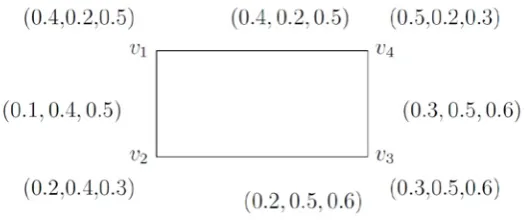
Example 2: Consider the graph 𝐺∗ such that 𝑉= {𝑣1,𝑣2,𝑣3,𝑣4},𝐸= {𝑣1𝑣2,𝑣2𝑣3,𝑣3𝑣4,𝑣4𝑣1}. Let 𝐴 be a single valued neutrosophic subset of 𝑉 and let 𝐵 a single valued neutrosophic subset of 𝐸 denoted by
𝑣1 𝑣2 𝑣3 𝑣4
𝑇𝐴 0.4 0.5 0.3 0.2
𝐼𝐴 0.2 0.2 0.5 0.4
𝐹𝐴 0.5 0.3 0.6 0.3
𝑣1𝑣2 𝑣2𝑣3 𝑣3𝑣4 𝑣4𝑣5
𝑇𝐵 0.4 0.3 0.2 0.1
𝐼𝐵 0.2 0.5 0.5 0.4
Figure 2.2: Single valued neutrosophic graph
in figure 2.2,
1. (𝑣1,0.4,0.2,0.5) is single valued neutrosophic vertex or SVN-vertex. 2. (𝑣1𝑣2,0.4,0.2,0.5) is single valued neutrosophic edge or SVN-edge.
3. (𝑣1,0.4,0.2,0.5) and (𝑣2,0.5,0.2,0.3) are single valued neutrosophic adjacent vertices. 4. (𝑣1𝑣2,0.4,0.2,0.5) and (𝑣1𝑣4,0.1,0.4,0.5) are single valued neutrosophic adjacent edge.
Definition 2.6: A single valued neutrosophic graph 𝑮� is said to be single valued signed neutrosophic graph if
𝝈:𝑬(𝑮�)→{+𝟏,−𝟏} is a function associated from 𝑬(𝑮�) of 𝑮� such that each edges signed to {+𝟏,−𝟏}.
We assign 𝐸(𝐺�)→{+1,−1} on the comparison basis of its truth-membership, indeterminacy-membership and
falsity-membership values. If the truth-membership value is greater than both indeterminacy-membership and falsity-membership values, we assign it positive and in reverse case we assign it negative and in case of equality we keep it unsigned.
Definition 2.7: Let 𝑿 be a space of points (objects) with generic elements in 𝑿 denoted by 𝒙. An interval valued
neutrosophic set (for short IVNS) 𝑨 in 𝑿 is characterized by truth-membership function 𝑻𝑨(𝒙) ,
indeterminacy-membership function 𝑰𝑨(𝒙) and falsity-membership function 𝑭𝑨(𝒙). For each point 𝒙 in 𝑿, we have that 𝑻𝑨(𝒙) = [𝑻𝑨𝑳(𝒙),𝑻𝑨𝑼(𝒙)] , 𝑰𝑨(𝒙) = [𝑰𝑨𝑳(𝒙), 𝑰𝑨𝑼(𝒙)] , 𝑭𝑨(𝒙) = [𝑭𝑨𝑳(𝒙),𝑭𝑨𝑼(𝒙)] , 𝟎 ≤ 𝑻𝑨(𝒙) +𝑰𝑨(𝒙) +
𝑭𝑨(𝒙)≤ 𝟑.
Definition 2.8: Let 𝑿 be a space of points (objects) with generic elements in 𝑿 denoted by 𝒙. An interval valued
neutrosophic set (for short IVNS A) 𝑨 in 𝑿 is characterized by truth-membership function 𝑻𝑨(𝒙) ,
indeterminacy-membership function 𝑰𝑨(𝒙) and falsity-membership function 𝑭𝑨(𝒙). For each point 𝒙 in 𝑿,
we have that 𝑇𝐴(𝑥) = [𝑇𝐴𝐿(𝑥),𝑇𝐴𝑈(𝑥)], 𝐼𝐴(𝑥) = [𝐼𝐴𝐿(𝑥),𝐼𝐴𝑈(𝑥)],
𝐹𝐴(𝑥) = [𝐹𝐴𝐿(𝑥),𝐹𝐴𝑈(𝑥)]⊆[0,1] and 0≤ 𝑇𝐴(𝑥) +𝐼𝐴(𝑥) +𝐹𝐴(𝑥)≤3.
Definition 2.9: An interval valued neutrosophic graph of a graph 𝑮∗= (𝑽,𝑬) we mean a pair 𝑮= (𝑨,𝑩) where
𝑨=< [𝑻𝑨𝑳,𝑻𝑨𝑼], [𝑰𝑨𝑳,𝑰𝑨𝑼], [𝑭𝑨𝑳,𝑭𝑨𝑼] > is an interval valued neutrosophic set on 𝑽 and
𝑩=< [𝑻𝑩𝑳,𝑻𝑩𝑼], [𝑰𝑩𝑳,𝑰𝑩𝑼], [𝑭𝑩𝑳,𝑭𝑩𝑼] > is an interval valued neutrosophic set on 𝑬 satisfies the following condition: 1. 𝑉= {𝑣1,𝑣2. . .𝑣𝑛} such that 𝑇𝐴𝐿:𝑉 →[0,1], 𝑇𝐴𝑈:𝑉 →[0,1], 𝐼𝐴𝐿:𝑉 →[0,1], 𝐼𝐴𝑈:𝑉 →[0,1], and 𝐹𝐴𝐿:𝑉 →
[0,1], 𝐹𝐴𝑈:𝑉 →[0,1] denote the degree of the truth-membership,the degree of indeterminacy-membership and degree of falsity-membership of the element 𝑦 ∈ 𝑉, respectively, and
0≤ 𝑇𝐴(𝑣𝑖) +𝐼𝐴(𝑣𝑖) +𝐹𝐴(𝑣𝑖)≤3 for all 𝑣𝑖∈ 𝑉(𝑖= 1,2, . .𝑛)
2. The functions 𝑇𝐵𝐿:𝑉×𝑉 →[0,1],𝑇𝐵𝑈:𝑉×𝑉 →[0,1], 𝐼𝐵𝐿:𝑉×𝑉 →[0,1],𝐼𝐵𝑈:𝑉×𝑉 →[0,1] and
𝐹𝐵𝐿:𝑉×𝑉 →[0,1], 𝐹𝐵𝑈:𝑉×𝑉 →[0,1] are such that
𝑇𝐵𝐿({𝑣𝑖,𝑣𝑗})≤ 𝑚𝑖𝑛[𝑇𝐴𝐿(𝑣𝑖),𝑇𝐴𝐿(𝑣𝑗)], 𝑇𝐵𝑈({𝑣𝑖,𝑣𝑗})≤ 𝑚𝑖𝑛[𝑇𝐴𝑈(𝑣𝑖),𝑇𝐴𝑈(𝑣𝑗)],
𝐼𝐵𝐿��𝑣𝑖,𝑣𝑗�� ≥ 𝑚𝑖𝑛�𝐼𝐴𝐿(𝑣𝑖),𝐼𝐴𝐿�𝑣𝑗��, 𝐼𝐵𝑈��𝑣𝑖,𝑣𝑗�� ≥ 𝑚𝑖𝑛�𝐼𝐴𝑈(𝑣𝑖),𝐼𝐴𝑈�𝑣𝑗��,
𝐹𝐵𝐿({𝑣𝑖,𝑣𝑗})≥ 𝑚𝑖𝑛[𝐹𝐴𝐿(𝑣𝑖),𝐹𝐴𝐿(𝑣𝑗)] and
𝐹𝐵𝑈({𝑣𝑖,𝑣𝑗})≥ 𝑚𝑖𝑛[𝐹𝐴𝑈(𝑣𝑖),𝐹𝐴𝑈(𝑣𝑗)]
Denotes the degree of truth-membership, indeterminacy-membership and falsity-membership of the edge (𝑣𝑖,𝑣𝑗)∈ 𝐸 respectively, where
0≤ 𝑇𝐵(𝑣𝑖,𝑣𝑗) +𝐼𝐵(𝑣𝑖,𝑣𝑗) +𝐹𝐵(𝑣𝑖,𝑣𝑗)≤3
Example 3: Let consider 𝑮= (𝑨,𝑩) of 𝑮∗= (𝑽,𝑬) where 𝑽= {𝒗𝟏,𝒗𝟐,𝒗𝟑,𝒗𝟒} and 𝑬= {𝒗𝟏𝒗𝟐,𝒗𝟐𝒗𝟑,𝒗𝟑𝒗𝟒,𝒗𝟒𝒗𝟏}
Figure 2.3: Interval Valued Neutrosophic Graph
Definition 2.10: Let 𝑻𝑨(𝒙) = [𝑻𝑨𝑳(𝒙),𝑻𝑨𝑼(𝒙)], 𝑰𝑨(𝒙) = [𝑰𝑨𝑳(𝒙),𝑰𝑨𝑼(𝒙)] and 𝑭𝑨(𝒙) = [𝑭𝑨𝑳(𝒙),𝑭𝑨𝑼(𝒙)] be the interval valued truth membership, interval valued indeterminacy membership and interval valued falsity membership and the relation is
𝑇𝐵𝐿(𝑥,𝑦)≤ 𝑚𝑖𝑛(𝑇𝐴𝐿(𝑥),𝑇𝐴𝐿(𝑦)),𝑇𝐵𝑈(𝑥,𝑦)≤ 𝑚𝑖𝑛(𝑇𝐴𝑈(𝑥),𝑇𝐴𝑈(𝑦)),
𝐼𝐵𝐿(𝑥,𝑦)≥ 𝑚𝑎𝑥(𝐼𝐴𝐿(𝑥),𝐼𝐴𝐿(𝑦)),𝐼𝐵𝑈(𝑥,𝑦)≥ 𝑚𝑎𝑥(𝐼𝐴𝑈(𝑥),𝐼𝐴𝑈(𝑦)),
𝐹𝐵𝐿(𝑥,𝑦)≥ 𝑚𝑎𝑥(𝐹𝐴𝐿(𝑥),𝐹𝐴𝐿(𝑦)),𝐹𝐵𝑈(𝑥,𝑦)≥ 𝑚𝑎𝑥(𝐹𝐴𝑈(𝑥),𝐹𝐴𝑈(𝑦)).
Then interval valued signed neutrosophic graph (IVSNG) A is
𝑆𝑁(𝐺) = (𝑆(𝐺𝐵𝐿),𝑆(𝐺𝐵𝑈)), where 𝑆(𝐺𝐵𝐿) = sign of 𝐺𝐵𝐿 and 𝑆(𝐺𝐵𝑈) = sign of 𝐺𝐵𝑈.
The condition for sign is as follows:
If 𝑇𝐵𝐿 is greater than the both 𝐼𝐵𝐿,𝐹𝐵𝐿 then it assigns positive sign otherwise negative sign. Similarly 𝑇𝐵𝑈 is greater than the both 𝐼𝐵𝑈,𝐹𝐵𝑈 then it assigns positive sign otherwise negative sign.
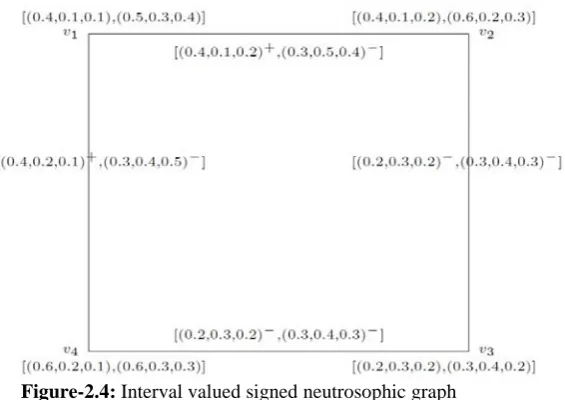
Example 4: Let consider 𝑮= (𝑨,𝑩) of 𝑮∗= (𝑽,𝑬) where 𝑽= {𝒗𝟏,𝒗𝟐,𝒗𝟑,𝒗𝟒} and 𝑬= {𝒗𝟏𝒗𝟐,𝒗𝟐𝒗𝟑,𝒗𝟑𝒗𝟒,𝒗𝟒𝒗𝟏} has the values are given in fig.3.1 then the interval valued signed neutrosophic graph is as follows.
We rewrite here as 𝐿-values and 𝑈-values separately for convenience.
Figure-2.4: Interval valued signed neutrosophic graph
𝑆𝑁(𝐺)(𝑣1,𝑣2) = (+,−)
i.e.𝐿-values has positive sign and 𝑈-values negative sign. In this way
𝑆𝑁(𝐺)(𝑣2,𝑣3) = (−,−), 𝑆𝑁(𝐺)(𝑣3,𝑣4) = (−,−), 𝑆𝑁(𝐺)(𝑣4,𝑣1) = (+,−)
Example 5:
Figure-2.5: 𝐿-balanced IVSNG and 𝑈-balanced IVSNG
Definition 2.12: If an IVSNG’s edge has alternative signs of 𝑳-values and 𝑼-values then it is called as self-balanced.
Example 6: In the figure 3.2, 𝑺𝑵(𝑮)(𝒗𝟏,𝒗𝟐) and 𝑺𝑵(𝑮)(𝒗𝟏,𝒗𝟒) are self-balanced and 𝑺𝑵(𝑮)(𝒗𝟐,𝒗𝟑) and
𝑺𝑵(𝑮)(𝒗𝟑,𝒗𝟒) are not self-balanced.
Definition 2.13: An IVSNG is said to be fully-balanced IVSNG if it has 𝑳-balanced IVSNG and 𝑼-balanced IVSNG.
The fig 3.2, is also an example of fully-balanced IVSNG.
3. SELF-CENTERED INTERVAL VALUED SIGNED NEUTROSOPHIC GRAPH
Throught this paper, we approach some sign for self-centered interval valued neutrosophic graph. i.e. It assigns some positive or negative sign.
Definition 3.1: Let 𝑻𝑨(𝒙) = [𝑻𝑨𝑳(𝒙),𝑻𝑨𝑼(𝒙)], 𝑰𝑨(𝒙) = [𝑰𝑨𝑳(𝒙),𝑰𝑨𝑼(𝒙)] and 𝑭𝑨(𝒙) = [𝑭𝑨𝑳(𝒙),𝑭𝑨𝑼(𝒙)] be the self-centered interval valued truth membership, self-centered interval valued indeterminacy membership and self-centered interval valued falsity membership and the relation is
𝑇𝐵𝐿(𝑥,𝑦)≤ 𝑚𝑖𝑛(𝑇𝐴𝐿(𝑥),𝑇𝐴𝐿(𝑦)),𝑇𝐵𝑈(𝑥,𝑦)≤ 𝑚𝑖𝑛(𝑇𝐴𝑈(𝑥),𝑇𝐴𝑈(𝑦)),
𝐼𝐵𝐿(𝑥,𝑦)≥ 𝑚𝑎𝑥(𝐼𝐴𝐿(𝑥),𝐼𝐴𝐿(𝑦)),𝐼𝐵𝑈(𝑥,𝑦)≥ 𝑚𝑎𝑥(𝐼𝐴𝑈(𝑥),𝐼𝐴𝑈(𝑦)),
𝐹𝐵𝐿(𝑥,𝑦)≥ 𝑚𝑎𝑥(𝐹𝐴𝐿(𝑥),𝐹𝐴𝐿(𝑦)),𝐹𝐵𝑈(𝑥,𝑦)≥ 𝑚𝑎𝑥(𝐹𝐴𝑈(𝑥),𝐹𝐴𝑈(𝑦)).
Then self-centered interval valued signed neutrosophic graph (SCIVSNG) A is
𝑆𝑁(𝐺) = (𝑆(𝐺𝐵𝐿),𝑆(𝐺𝐵𝑈)) where 𝑆(𝐺𝐵𝐿) = signof𝐺𝐵𝐿 and 𝑆(𝐺𝐵𝑈) = signof𝐺𝐵𝑈
The condition for sign is as follows:
If 𝑇𝐵𝐿 is greater than the both 𝐼𝐵𝐿,𝐹𝐵𝐿 then it assigns positive sign otherwise negative sign. Similarly 𝑇𝐵𝑈 is greater than the both 𝐼𝐵𝑈,𝐹𝐵𝑈 then it assigns positive sign otherwise negative sign.
i.e.𝐿-values has negative sign and 𝑈-values negative sign. In this way
𝑆𝑁(𝐺)(𝑣2,𝑣3) = (−,−), 𝑆𝑁(𝐺)(𝑣3,𝑣4) = (−,−), 𝑆𝑁(𝐺)(𝑣4,𝑣1) = (−,−)
Definition 3.2: An SCIVSNG is said to be 𝑳-balanced SCIVSNG if every cycle of 𝑳-values has even number of negative signed edges or all positive signed edges.
An SCIVSNG is said to be 𝑈-balanced SCIVSNG if every cycle of 𝑈-values has even number of negative signed edges
or all positive signed edges.
Example 3.2:
In figure 3.1, the 𝐿-values has even number of negative signs. Therefore it is a 𝐿-balanced SCIVSNG. In figure 3.1, the 𝑈-values has even number of negative signs. Therefore it is a 𝑈-balanced SCIVSNG.
Definition 3.3: An SCIVSNG is said to be fully-balanced SCIVSNG if it has 𝑳-balanced SCIVSNG and 𝑼-balanced SCIVSNG.
The fig 3.1, is also an example of fully-balanced SCIVSNG.
Theorem 3.1: An SCIVSNG’s 𝑳-values is positive if every even length cycles of 𝑳-values having all negative signed edges.
Proof: If all edges contains negative sign in even length cycle then the product of edges sign is always positive. Hence it is always a positive signed graph.
Note: It is also true for also 𝑼-values.
Theorem 3.2: Odd length cycle having all negative signed edges is always a negative signed graphs.
Proof: If all edges contains negative sign in odd length cycle then the product of edges sign is always negative. Hence it is always a negative signed graph.
Theorem 3.3: If an IVNG is a complete INVG then the SCIVSNG’s sign will be always negative. But the converse is need not be true.
Proof: Consider a complete IVNG. By the definition of complete IVNG is all the 𝑳-values and 𝑼-values are equal to 1. i.e, 𝑇𝐿=𝐼𝐿=𝐹𝐿= 1 and 𝑇𝑈=𝐼𝑈=𝐹𝑈= 1.
Since the condition of signs 𝐿-values have positive sign when
𝑇𝐿>𝐼𝐿+𝐹𝐿 and otherwise negative.
Similarly 𝑈-values have positive sign when 𝑇𝑈>𝐼𝑈+𝐹𝑈 and otherwise negative.
In complete IVNG, 𝑇𝐿≤ 𝐼𝐿+𝐹𝐿 and𝑇𝑈≤ 𝐼𝑈+𝐹𝑈.
All its 𝐿-values and 𝑈-values have negative signs.
Hence, if there is a complete IVNG then their SCIVSNG is always negative.
But the converse is need not be true because it is not possible every negative signed IVNG be complete IVNG.
Hence the proof.
REFERENCES
[1] M.Akram and W.A. Dudek, Interval-valued fuzzy graphs, Computers Math. Appl., 61, (2011)289-299.
[2] M.Akram, Interval-valued fuzzy graphs, Neural Computing and Applications, 21, (2012) 145-150.
[3] M. Akram, N.O. Al-Shehrie and W.A. Dudek, Certain types of interval- valued fuzzy graphs, Journal of
Applied Mathematics, 2013, Article ID 857070(2013) 11 pages.
[4] M. Akram, W.A. Dudek and M. MurtazaYousaf, Centered interval-valued fuzzy graphs, AfrikaMatematika,
26,(5-6) (2015) 887-898.
[5] M. Akram and M. Nasir, Concepts of interval-valued neutrosophic graphs, International Journal of Algebra
[6] M. Akram and M. Nasir, Interval-valued neutrosophic competition graphs, Annals of Fuzzy Mathematics and Informatics, 14(1), (2017) 99-120.
[7] M. Akram and R. Akmal, Application of bipolar fuzzy sets in graph structures, Applied Computational
Intelligence and Soft Computing, 2016(2016), Article ID 5859080, 13 pages.
[8] M. Akram and S. Shahzadi, Neutrosophic soft graphs with application, Journal of Intelligent and Fuzzy
Systems, 32(1), (2017) 841-858.
[9] M. Akram and G. Shahzadi, Certain characterization of m-polar fuzzy graphs by level graphs, Punjab
University Journal of Mathematics, 49(1) (2017), 1-12.
[10] K. Atanassov, Intuitionistic fuzzy sets, Fuzzy sets and Systems, 20,(1986) 87-96.
[11] P. Bhattacharya, Some remarks on fuzzy graphs, Pattern Recognition Letter, 6, (1987) 297-302.
[12] S. Broumi, M. Talea, A. Bakali and F. Smarandache, Interval valued neutrosophic graphs, Critical Review,
12,(2016) 5 33.
[13] T. Dinesh, A study on graph structures incidence algebras and their fuzzy analogues[Ph.D.thesis],
Kannur University, Kannur, India, (2011).
[14] T. Dinesh and T.V. Ramakrishnan, On generalised fuzzy graph structures, Applied Mathematical Sciences,
5(4),(2011) 173 180.
[15] M.B. Gorzalczany, A method of inference in approximate reasoning based on interval-valued fuzzy sets,
Fuzzy Sets Syst., 21,(1987) 1-17.
[16] M.B. Gorzalczany, An interval-valued fuzzy inference method some basic properties, Fuzzy Sets Syst.,
31,(1989) 243-251.
[17] J. Hongmei and W. Lianhua, Interval valued fuzzy subsemigroups and sub- groups associated by interval
valued fuzzy graphs, 2009 WRI Global Congress on Intelligent Systems, (2009) 484-487.
[18] J.N. Mordeson and P. Chang-Shyh, Operations on fuzzy graphs, Information Sciences, 79,(3)(1994),
159-170.
[19] J.N. Mordeson and P.S. Nair, Fuzzy graphs and fuzzy hypergraphs, PhysicaVerlag, Heidelberg 1998; Second
Edition, (2001).
[20] H. A. Othman, On fuzzy infra-semiopen sets, Punjab Univ. J. Math., 48, No. 2 (2016)1-10.
[21] Rosenfeld, Fuzzy graphs, Fuzzy Sets and Their Applications, Academic Press, New York, (1975) 77-95.
[22] E. Sampathkumar, Generalized graph structures, Bulletin of Kerala Mathematics Association, 3(2), (2006)
65 123.
[23] F. Smarandache, A unifying field in logics. neutrosophy: neutrosophic probability, set and logic. Rehoboth:, American Research Press, (1999).
[24] F. Smarandache, Neutrosophic set- a generalization of the intuitionistic fuzzy set, Granular Computing. 2006 IEEE International Conference, (2006) 38-42 DOI:10.1109/GRC.2006.1635754.
[25] S. Mathew and M. Sunitha, Types of arcs in a fuzzy graph, Information Sciences, 179,(2009), 1760-1768.
[26] S. Mathew and M. Sunitha, Strongest strong cycles and fuzzy graphs, Fuzzy Systems, IEEE Transactions on,
21,(2013), 1096-1104.
[27] I. Turksen, Interval valued fuzzy sets basedon normal forms, Fuzzy Sets and Systems, 20,(1986)191-210.
[28] H.Wang,F.Smarandache,Y.Q.ZhangandR.Sunderraman, Single-valued neutrosophic sets, Multisspace and
Multistruct, 4,(2010)410-413.
[29] H. Wang, Y. Zhang and R. Sunderraman, Truth-value based interval neutrosophicsets, GranularComputing,
2005IEEEInternationalConference, 1,(2005) 274-277 DOI:10.1109/GRC.2005.1547284.
[30] H. Wang, F. Smarandache, Y.Q. Zhang and R. Sunderram, An Interval neutrosophic sets and logic: theory
and applications in computing, Hexis Arizona, (2005).
[31] L.A. Zadeh, Fuzzy sets, Information Control, 8, (1965) 338-353.
[32] L.A. Zadeh, The concept of a linguistic and application to approximate reasoning I, Information Sci., 8,
(1975) 199-249.
[33] L.A. Zadeh, Similarity relations and fuzzy orderings, Information Sciences, 3(2), (1971) 177 200.
[34] J. Zhan, W. A. Dudek and Y.B. Jun, Interval valued (∈,∈ ⋁ 𝑞) fuzzy filters of pseudo BLalgebras, Soft Computing, 13, (2009)13-21.
[35] J. Zhan, B. Davvaz and K. P. Shum, A new view of fuzzy hypernear-rings, Inform Sciences, 178, (2008)
425-438.
Source of support: Nil, Conflict of interest: None Declared.