1
M.Tech., Ph.D., FIE., Principal, Pannai College of Engg& Tech, Sivagangai, Tamilnadu, India
2
M.Sc., M.Phil, Research Scholar & Lecturer, Dept of Computer Science, Raja Doraisingam Govt Arts College, Sivagangai, Tamilnadu, India
DOI: 10.23956/ijarcsse/V7I7/0151
Abstract - Now-a-days watermarking plays a pivotal role in most of the industries for providing security to their own as well as hired or leased data. This paper its main aim is to study the multiresolution watermarking algorithms and also choosing the effective and efficient one for improving the resistance in data compression. Computational savings from such a multiresolution watermarking framework is obvious. The multiresolutional property makes our watermarking scheme robust to image/video down sampling operation by a power of two in either space or time. There is no common framework for multiresolutional digital watermarking of both images and video. A multiresolution watermarking based on the wavelet transformation is selected in each frequency band of the Discrete Wavelet Transform (DWT) domain and therefore it can resist the destruction of image processing. The rapid development of Internet introduces a new set of challenging problems regarding security. One of the most significant problems is to prevent unauthorized copying of digital production from distribution. Digital watermarking has provided a powerful way to claim intellectual protection. We proposed an idea for enhancing the robustness of extracted watermarks. Watermark can be treated as a transmitted signal, while the destruction from attackers is regarded as a noisy distortion in channel. For the implementation, we have used minimum nine coordinate positions. The watermarking algorithms to be taken for this study are Corvi algorithm and Wang algorithm. In all graph, we have plotted X axis as peak signal to noise ratio (PSNR) and y axis as Correlation with original watermark. The threshold value ά is set to 5. The result is smaller than the threshold value then it is feasible, otherwise it is not.
Keywords: Watermarking, Multiresolution, Watermarking Algorithms, Noise Distortion, DWT
I. INTRODUCTION
Digital watermarking is a process of hiding a watermark (or signature) signal in image or video media by making small changes in the media content. Properties of watermarks include un-obstructiveness and robustness. The former indicates that a watermark should be perceptually invisible; the later means that the watermark should be difficult to remove or destroy before resulting in severe degradation in visual fidelity. To make the watermark invisible, one would intuitively pick a watermark signal with small energy and hide it in the perceptually insignificant regions. However, the main thrust of this part is the placement of the watermark in the perceptually significant regions of an image for robustness.
Digital watermarking is a method of embedding information in an image in such a manner that it cannot be removed. This watermark can be used for ownership protection, copy control and authentication. A digital watermark is a secret message that is embedded into a “cover message”. Only the knowledge of a secret key allows us to extract the watermark from the cover message. A digital watermark can be visible or invisible. A digital watermarking is a method that uses a secret key to select the locations where a watermark is embedded.
II. MULTIRESOLUTION WATERMARKING
The above multiresolution watermarking algorithm uses the techniques from wavelet image compression, namely the Discrete Wavelet Transform DWT. At the resolution level l the coefficients of the approximation image (LL1) will be called as vl(x,y). The coefficients of the detail image H Hl will be called f1,l(x,y), of LHl will be called f2,l(x,y) and of HLl
will be called f3,l(x,y). For some algorithms the coefficients are visited in zig zag fashion. Then call them vl(i), f1,l(i),
f2,l(i), f3,l(i).
A. Corvi Algorithm
This algorithm is one of the non blind watermarking algorithm because the host image is needed for extracting the watermark. The non-blind scheme is the original non watermarked cover-signal, the extraction key and the signal to be tested are required for the detection. It uses a sequence of text to embed as watermark in the image. It belongs to the category of the DWT domain watermarking algorithm. The watermark is a zero-mean unit-variance Gaussian (Normal distribution). The DWT is iterated to a level l, where the approximation image has about one thousand coefficients.
ISSN(E): 2277-128X, ISSN(P): 2277-6451, DOI: 10.23956/ijarcsse/V7I7/0151, pp. 85-89
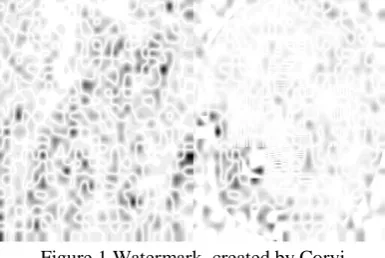
Figure 1 Watermark created by Corvi
B. Wang Algorithm
This algorithm is also the non blind watermarking algorithm. The mark is a Gaussian sequence of pseudo-random real numbers matching the number of selected coefficients.
Figure 2 watermark created by Wang
This algorithm is inspired by the principle for the design of the multi-threshold wavelet co-dec (MTWC). The original image is needed for watermark extraction.
C. Kundur Algorithm
In this algorithm, the host image is not needed for watermark extraction. The watermark consists of a string of bits {-1,1}. The watermark has to cover all available sites. The watermark is embedded into the coefficients of all the detail image up to level L. One bit can be encoded in a triple of coefficients. Random site selection is used.
Figure 3 Watermark created by Kundur
D. Xia Algorithm
In this algorithm, the original host image is needed for watermark extraction. The watermark is a zero-mean unit-variance Gaussian. The large coefficients at the high and middle frequency bands are manipulated.
E. Barni-DWT Algorithm
In this algorithm, the host image is not needed to detect the watermark. The watermark is a pseudo-random sequence of bits siЄ {-1, +1}. The coefficients of the first level detail sub-bands of the image ( f1,l(x,y), f2,l(x,y), f3,l(x,y)) are the possible sites.
III. EXPERIMENTAL RESULTS
distribution curve within the boundaries and within the three steps.
a) The original curve
(b) After extending the co-ordinate (20,0.6) Figure 4 Corvi watermarking algorithm
B. Wang Algorithm
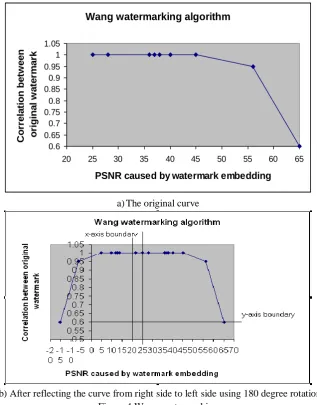
In the algorithm, the curve starts in the lower right corner in the graph. It is similar to a curve Cox algorithm. In this curve, the first and the second coefficients are only inclining then all other coefficients are retained in the same position without inclining or declining. It is viewed like a semi-plotted curve in the right side. To fulfill the left side of the curve there will be the two options are yet to be decided. The first option is, the curve is extended with the dummy co-ordinate and the second option is to form the smooth parabolic curve to extend in right side, make a y-axis reflection (i.e. 180 degree rotation and the change in position of an object that has been reflected about the line x = 0. The matrix for this transformation is
ISSN(E): 2277-128X, ISSN(P): 2277-6451, DOI: 10.23956/ijarcsse/V7I7/0151, pp. 85-89
The distance pair (tx, ty) is called a translation vector or shift vector.
To express the translation equations using matrix by row vectors to represent co-ordinate positions and the translation vector.
P = ( X Y ) and T = ( tx ty ) Then P’ = ( X’ Y’).
Hence in the shortest form as P’ = P + T
Therefore, the smooth curve is formed and it is fit inside the boundaries.
Wang watermarking algorithm
0.6 0.65 0.7 0.75 0.8 0.85 0.9 0.95 1 1.05
20 25 30 35 40 45 50 55 60 65
PSNR caused by watermark embedding
C o rr e la ti o n b e tw e e n o ri g in a l w a te rm a rk
a)The original curve
(b) After reflecting the curve from right side to left side using 180 degree rotation Figure 4 Wang watermarking
Table 1 Resistance level based on threshold (second triples)
Algm No of original Coordi nates No of coordina tes after transfor mation No of proce ss Sup port % status
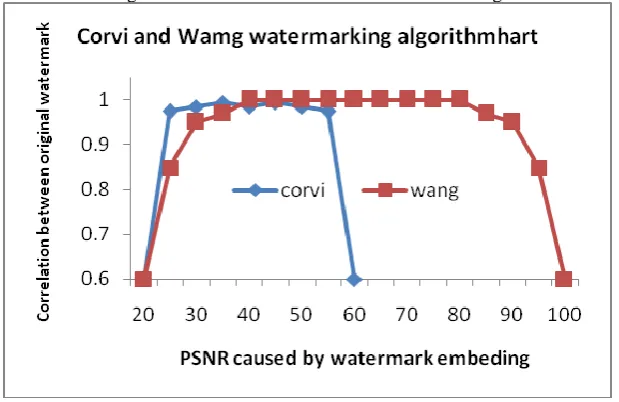
1.0. But the Corvi algorithm reaches the target of the y-axis value is 0.99.
Figure 5 Before modification of Corvi and Wang
Figure 6 After modification of Corvi and Wang
IV. CONCLUSION
In this paper it is clearly understood that noise is unwanted thing for both text and images. This paper clearly identifies that comparatively the effective and efficient watermarking algorithm for improving resistance in data compression. Here the effectiveness and efficiency is measured in Corvi watermarking algorithm for improving resistance in data compression as JPEG.
In near future, we have a proposal to study the ratio between compression rate and correlation between original watermark for JPEG 2000, MPEG-4, SPIHT wavelet and Dartmouth toolbox wavelet. The same work can be extended to object based watermarking by applying critically sampled shape adaptive wavelet transforms where segmentation maps can be used to separate watermarks corresponding to various objects.
REFERENCES
[1] Multiresolution video watermarking using perceptual models and scene segmentation,” in Proc. ICIP10, Santa Barbara, CA, 2010, vol. II, pp. 1151–1154.
[2] W. Zhu, Z. Xiong, and Y.-Q. Zhang, “Multiresolution watermarking for images and video: A unified approach,” in Proc. ICIP98, Chicago, IL, Oct. 1998.
[3] Hsu, C. T. and Wu, J. L., ”Multiresolution watermarking for digital images,” Circuits and Systems II: Analog and Digital Signal Processing, IEEE Trans.,Vol. 45, pp. 1097-1101 (1998).
[4] Niu, X. M., Lu, Z. M. and Sun, S. H., Digital image watermarking based on multiresolution decomposition, Electronics Letters, Vol. 36, pp. 1108-1110 (2000).
[5] Xia, X. G., Boncelet, C. G. and Arce, G. R., “A multiresolution watermark for digital images,” Proc. Int. Conf. on Image Processing 97, Santa Barbara, CA, U. S. A. Vol. I, pp. 548-551, (1997).
[6] Bors, A. G. and Pitas, I., “Image watermarking using DCT domain constraints,” Proc. of Int. Conf. on Image Processing, Vol. 3, pp.
231-234996).
[7] Hsieh, C. T., Lu, Y. L., Luo, C. P. and Kuo, F. J., “A study of enhancing the robustness of watermark,” Proc. IEEE Int. Sym. On Multimedia Software Engineering, Taiwan, pp. 325-327 (2000).
[8] Kuo, C. J. and Chen, M. S., “A new signal encryption technique and its attack study, Proc. Int. Conf. on Security Technology,” Taipei, Taiwan, pp. 149-153 (1991).
[9] Luo, C. P., “A study of the robustness of watermark,” Master Thesis, University of Tamkang, Taiwan, R. O. C. (2001).