ARTIGO ORIGINAL
ABSTRACT
Introduction: Meningococcal infection has a high mortality and morbidity. Recently a new prognostic scoring system was developed for paediatric invasive meningococcal disease, based on platelet count and base excess – base excess and platelets score. The main objective of this study was to evaluate the accuracy of base excess and platelets score to predict mortality in children admitted to intensive care due to invasive meningococcal disease.
Material and Methods: Observational study, with retrospective data collection, during a 13.5 years period (01/2000 to 06/2013). Mortality by invasive meningococcal disease and related factors (organ dysfunction and multi-organ failure) were analysed. The base excess and platelets score was calculated retrospectively, to evaluate its accuracy in predicting mortality and compared with Paediatric Risk of Mortality and Paediatric Index of Mortality2.
Results:Were admitted 76 children with invasive meningococcal disease. The most frequent type of dysfunction was cardiovascular (92%), followed by hematologic (55%). Of the total, 47 patients (62%) had criteria for multi-organ failure. The global mortality was 16%. Neurologic and renal dysfunction showed the strongest association with mortality, adjusted odds ratio 315 (26 - 3 804) and 155 (20 - 1 299). After application of receiver operating characteristic curves, Base Excess and Platelets score had an area under curve of 0.81, Paediatric Index of Mortality2 of 0.91 and Paediatric Risk of Mortality of 0.96.
Discussion: The Base Excess and Platelets score showed good accuracy, although not as high as Paediatric Risk of Mortality or Paediatric Index of Mortality2.
Conclusions: The Base Excess and Platelets score may be useful tool in invasive meningococcal disease because is highly sensitive and specific and is objectively measurable and readily available at presentation.
Keywords: Child; Intensive Care Units, Pediatric; Meningococcal Infections; Portugal; Predictive Value of Tests; Prognosis.
Invasive Meningococcal Disease: Application
of Base Excess and Platelets Score in a
Portuguese Paediatric Intensive Care Unit
Doença Meningocócica Invasiva: Aplicação do Base Excess and Platelets
Score numa Unidade de Cuidados Intensivos Pediátricos Portuguesa
1. Serviço de Cuidados Intensivos Pediátricos. Hospital Pediátrico. Centro Hospitalar e Universitário de Coimbra. Coimbra. Portugal. Autor correspondente: Carla Pinto. [email protected]
Recebido: 29 de Agosto de 2014 - Aceite: 19 de Março de 2015 | Copyright © Ordem dos Médicos 2015
Luís MARTINS1, Patrícia MAÇÃO1, Carla PINTO1, Teresa DIONÍSIO1, Andrea DIAS1, Alexandra DINIS1, Leonor
CARVALHO1, José Farela NEVES1
Acta Med Port 2015 May-Jun;28(3):342-346
RESUMO
Introdução: A infeção meningocócica tem uma elevada mortalidade e morbilidade. Recentemente foi desenvolvido um score de prognóstico para a doença meningocócica invasiva em idade pediátrica, baseado na contagem plaquetar e no excesso de base - o Base Excess and PlateletsScore. O objetivo principal desde estudo foi avaliar a precisão prognóstica do Base Excess and Platelets Score em doentes admitidos em cuidados intensivos pediátricos por doença meningocócica invasiva.
Material e Métodos: Estudo observacional, com colheita de dados retrospetiva, que incluiu um período de 13,5 anos (01/2000 a 06/2013). Foram analisados: mortalidade por doença meningocócica invasiva e fatores associados (disfunção de órgão e falência multi-órgão). Foi calculado o Base Excess and Platelets Score de forma retrospetiva, para avaliar a sua precisão na predição da mortalidade e foi comparado com o Paediatric Risk of Mortality e Paediatric Index of Mortality2.
Resultados: Foram admitidas 76 crianças com doença meningocócica invasiva. O tipo de disfunção mais frequente foi a cardiovascular (92%), seguida da hematológica (55%). Cumpriram critérios de falência multi-órgão 47 doentes (62%). A mortalidade global foi de 16%. A disfunção neurológica e a renal foram as que apresentaram uma maior associação com a mortalidade, odds ratio ajustado 315 (26 - 3 804) e 155 (20 - 1 299). Após aplicação das curvas receiver operating characteristic, o Base Excess and Platelets Score tinha uma area under curve de 0,81, o Paediatric Index of Mortality2 de 0,91 e o Paediatric Risk of Mortality de 0,96.
Discussão: O Base Excess and Platelets Score apresentou uma boa precisão apesar de não tão elevada como o Paediatric Index of Mortality2 ou o Paediatric Risk of Mortality.
Conclusões: O Base Excess and Platelets Score pode ser útil como indicador prognóstico na doença meningocócica invasiva, por apresentar uma elevada sensibilidade e especificidade e ser objetivo e rapidamente disponível na admissão.
Palavras-chave: Criança; Cuidados Intensivos Pediátricos; Doença Meningocócica; Portugal; Prognóstico; Valor Preditivo dos Testes.
INTRODUCTION
Meningococcal infection may rapidly progress to sepsis,
septic shock and multiple organ dysfunction syndrome.1,2
The development of prognostic scoring systems has two major aims: the identification of patients at high risk for quick clinical deterioration and risk stratification for future
trials of new drugs or diagnostic tests.3-5
There are several prognostic scores combining clinical and laboratory data validated for invasive meningococcal
disease (IMD). These include the Glasgow Meningococcal
ARTIGO ORIGINAL
scores to be used in paediatric intensive care, such as the
Paediatric Risk of Mortality (PRISM)7 and the Paediatric
Index of Mortality 2(PIM2).8 There are also prognostic scores
exclusively based in laboratory data, such as the Rotterdam score.9
The ideal score would include a minimum number of variables that could be quickly and objectively measurable
at disease presentation and should be cost-effective.3
It should be mentioned that some scores, like PRISM or GMSPS, use clinical data that depend on a subjective assessment in many aspects, reducing reliability.3,6,7
A new prognostic score has been recently developed and validated by a group of researchers from different European paediatric intensive care centres, based on platelet count and base excess, the BEP (base excess and platelet count) score. This score is obtained by the formula:3
1 / (1 + e(0.18909 × Base Excess, mmol/L) + (0.01015 × Platelet count, 10*12/L)+3.07861)
Our study’s main objective was to assess the BEP score’s precision for mortality prediction in our population and to compare it with other scores used in intensive care. The secondary aims included an analysis of IMD-based mortality and related factors.
MATERIAL AND METHODS
This was an observational study involving retrospective data collection at the Intensive Care Unit of a reference paediatric hospital for the central region of Portugal. All children diagnosed with IMD (confirmed or probable) admitted to the unit between January 2000 and June 2013 (13.5 years) were included in the study.
IMD was defined according to the 2010 CDC (Centers for Disease Control and Prevention) criteria.10
The following variables were obtained from the patient’s clinical records as well as from the unit’s database: year of hospital admission, patient’s age, gender, meningoccus isolation and serogroup, type of organ dysfunction, mortality and outcome indicator (PRISM).
The BEP score was retrospectively calculated for all the patients in whom arterial blood gases (base excess quantification) and blood count (platelet count) were obtained on the first hour upon hospital admission. PIM2
was also retrospectively calculated for the years before the score’s publication.
Data’s statistical analysis used the Statistical Package for the Social Science® version 20 software. Our population
was characterised with central and dispersion measures calculated for quantitative variables and absolute and relative frequencies calculated for qualitative variables. Upon the application of a normality test (Kolmogorov-Smirnov), we found that quantitative variables did not follow a normal distribution and therefore these were characterised with median and interquartile range (IQR). Mann-Whitney’s test was used for the comparison of nominal and quantitative variables with no normal distribution. Chi-square or Fisher exact test, according to Cochran rules, were used for the comparison of nominal variables.
The logistic regression was used for the inference of the association between the different types of organ dysfunction and mortality. A 5% significance level was considered. Receiver operating characteristic (ROC) curves for BEP,
PRISM and PIM2 scores were obtained and Youden’s
formula was applied in order to obtain a cut-off that would maximize mortality-related sensitivity and specificity. This study fully complied with the ethical principles for human medical research substantiated in the World Medical Association’s Helsinki Declaration.
RESULTS
During the study period, 76 children diagnosed with IMD were admitted to our unit, corresponding to 1.6% of the total admissions to intensive care. There was a variable distribution over the years, ranging from zero patients in 2011 to a maximum of 12 patients in 2002 (Fig. 1). A 2.2-year median age (IQR: 0.8 – 4.5) and a male predominance (43/76, 56.6%) were found.
Meningoccus was isolated upon sterile fluid culture in 57.9% of the patients (44/76). The N. meningitidis serogroup was identified in 21 patients (47.2%) and serogroup B was the most frequent (12), followed by C (eight patients) and Y (one patient). No serotype C has been isolated since 2005. Most patients (50/76, 65.8%) presented with rapidly progressive purpura and 40.8% (31/76) with meningitis.
Figure 1 - Patients admitted to the paediatric intensive care by IMD (n = 76)
* Included only 6 months
0
2000 2001 2002 2003 2004 2005 2006 2007 2008 2009 2010 2011 2012 2013*
2 4
6 8 10 12
ARTIGO ORIGINAL
In total, 47 patients (61.8%) met with multiple organ failure criteria. The most frequent type of dysfunction was cardiovascular (70/76, 92.1%), followed by haematological (42/76, 55.3%) and respiratory dysfunction (22/76, 28.9%). Most patients had cardiovascular support (71/76, 93.4%), some required invasive ventilation (21/76, 27.6%) and hemodiafiltration (3/76, 3.9%).
A 3.2% (IQR: 1.1; 20.4%) median PRISM score and
1.1% (IQR: 0.9-3.6%) median PIM2 score were found in the
76 patients included in the study. We were able to get the BEP score calculated in 65 patients (85.5%). A 0.26 (IQR: 0.06 – 0.72) median value was obtained in these.
A 15.6% (12/76) global mortality was found.
A 1.6-year median age (IQR: 0.8 – 2.6) was found in
deceased and 2.4-year (IQR: 0.9 – 5.3; p = 0.176,
Mann-Whitney’s test) in surviving patients.
Rapidly progressive purpura occurred in 91.7% of deceased and in 60.9% of surviving patients (p = 0.049; Fisher’s test).
No significant differences were found regarding the
presence of meningitis (deceased: 33.3% versus surviving
patients: 42.2%; p = 0.71; Fisher’s test).
As regards organ dysfunction, as shown in Table 1, all types were more frequent in deceased patients except cardiovascular dysfunction.
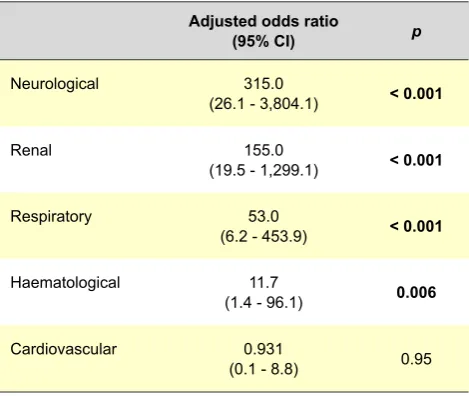
Upon logistic regression, the organ failure more closely associated to mortality was neurological, followed by renal (Table 2).
A 52.4% median PRISM score was found in deceased (IQR: 23.7 – 82.5) and 2.2% in surviving patients (IQR: 1.0 – 10.1) (p < 0.001, Mann-Whitney’s test).
A 13.3% median PIM2 score was found in deceased
(IQR: 3.0 – 76.1) and 1.1% in surviving patients (IQR: 0.9 – 2.3%) (p < 0.001, Mann-Whitney’s test).
A 0.14 median BEP score was found in deceased (IQR: 1.0 – 10.1) and 0.02 in surviving patients (IQR: 0.01 – 0.04) (p < 0.001, Mann-Whitney’s test).
Upon the application of ROC curves to PRISM score, a 0.96 area under curve (AUC) was obtained (0.91 – 1.00)
with 100% sensitivity and 87.5% specificity, obtained through the Youden’s formula for an 18.4% cut-off. A 0.91
AUC (0.84 – 0.98) was obtained for the PIM2 score and a
100 and 70.3% sensitivity and specificity, respectively, for a 1.45 cut-off. A 0.81 (0.66 – 0.97) AUC was obtained for the BEP score and 83% sensitivity and specificity for a 0.06 cut-off (Fig. 2).
DISCUSSION
Despite the technical advances that included vaccine introduction and an improvement in patient’s initial stabilisation, IMD remains a cause for mortality and morbidity in Paediatrics. However, mortality has been reduced in the central region of Portugal, in line with what has been described in other European countries11-13 and
since 2005 there have been no IMD-related death patients in our centre (Fig. 1).
The importance of scores lies in their capacity to objectively assess and identify more severe patients, allowing for decisions regarding hospital admission of Table 1 – Types of organ dysfunction in deceased and surviving patients (n = 76)
Type of organ dysfunction Deceased(n = 12) Surviving(n = 64) p
Renal 83.3% 3.1% (Mann Whitney U)< 0.001
Haematological 91.7% 48.4% (Chi-square)0.06
Neurological 83.3% 1.6% (Mann Whitney) 0.71
Respiratory 91.7% 17.2% (Mann Whitney)< 0.001
Cardiovascular 91.7% 92.2% (Mann Whitney)1
Multiple organ failure 100.0% 54.7% (Mann Whitney)0.02
Table 2 – Organ dysfunction and mortality-adjusted odds ratio (n = 76)
Adjusted odds ratio
(95% CI) p
Neurological 315.0
(26.1 - 3,804.1) < 0.001
Renal 155.0
(19.5 - 1,299.1) < 0.001
Respiratory 53.0
(6.2 - 453.9) < 0.001
Haematological 11.7
(1.4 - 96.1) 0.006
Cardiovascular 0.931
ARTIGO ORIGINAL
patients, as well as for guiding optimal intensive care therapeutic approach. Scores should allow for an adequate stratification in order to optimize patient inclusion in future clinical trials and to select those that may benefit from new therapies, avoiding patient heterogeneity that may have contributed to clinical trial failure in the past.14-16
Most prognostic scores combine clinical and laboratory data while some are only based on laboratorial markers. Not all are specifically designed and seem to currently overestimate mortality regarding healthcare improvement
in meningococcal disease.17
The GMSPS score was used in intensive care for many years, with a sensitivity of approximately 100%.18,19
However, it has some drawbacks, including the high number of analysed variables (seven) and the inclusion of subjective parameters such as the patient’s parents opinion regarding the progression of the disease.
The PRISM score is a generic score used to compare the performance between healthcare centres. It allows for the assessment of mortality risk on the first 24 hours upon hospital admission in intensive care. It is a complex score and 14 clinical and laboratory parameters are required, including arterial blood gases, coagulation tests and serum biochemical tests.
The PIM2 score has the advantage of allowing for its calculation on admission (first hour) although it is time-consuming and, as for the PRISM score, many variables are required. It is also used for comparison between healthcare centres.
PN product (platelet and neutrophil count) only includes two laboratorial parameters and is based on the extent of the inflammatory response. It does not depend on the observer it is quickly obtainable and in the original study it seemed to be accurate in children aged below five; however, it was validated in a small number of patients.17
The Rotterdam score has also no subjective factors involved, is based on base excess, platelet count, potassium and C-protein reactive, all of which are easily obtained on the first hour upon a patient’s admission.
The BEP score only requires two laboratory values, easily obtainable and objective.
More recently, other scores based on biomarkers were proposed; however, these are not easily available in daily clinical practice and are solely reserved for research studies.
All the prognostic scores analysed in our study showed good precision with high sensitivity and specificity, as previously described, despite the small sample.3,20 The
PRISM score showed the best precision, followed by the
PIM2 score. The BEP score also showed a good precision,
although not as high as the other scores. However, we should mention the fact that the BEP score is easily and quickly obtained upon admission from a simple formula, in contrast to the other scores, that require a higher number of observer-dependent data and variables to be obtained. Its specificity was higher in the PIM2 score.3,6-8
The data retrospective collection, preventing the application of the BEP score in all the patients and the small Figure 2 - ROC curves for PRISM (in blue). PIM2 (in green) and BEP score (in red)
0.0 0.0 0.2 0.4 0.6 0.8 1.0
0.2 0.4
1 - Specificity
Sensitivity
0.6 0.8 1.0
ARTIGO ORIGINAL number of patients were limitations to our study, which may be solved with a further multi-centric study.
Despite these limitations, our study contributed to validate the use of the BEP score in the European population, as suggested on a recent review.21 Addition
of renal function tests to this score, as renal dysfunction was more associated to mortality in our analysis, would be useful to improve the precision of the BEP score.
CONCLUSION
Generic prognostic scores like PRISM or PIM2 showed
a good precision in mortality prediction of IMD. However, these are based in combining different clinical and laboratory data, some of which are difficult to obtain upon a patient’s admission to intensive care.
Despite a lower precision when compared to the abovementioned scores, the BEP score has the advantage of being easily and quickly calculated upon a patient’s admission.
ACKNOWLEDGMENTS
The authors wish to thank Margarida Marques from the Departamento de Estatística do Centro Hospitalar e Universitário de Coimbra, EPE for her valuable contribution to the statistical analysis.
HUMAN AND ANIMAL PROTECTION
The authors declare that the procedures followed were in accordance to the regulations established by the responsible body of the Ethics and Clinical Research Committee and according to the Helsinki Declaration of the World Medical Association.
DATA CONFIDENTIALITY
The authors declare that they have followed the protocols of their work centre on the publication of patient data.
CONFLICTS OF INTEREST
The authors declare that there were no conflicts of interest in writing this manuscript.
FINANCIAL SUPPORT
The authors declare that there was no financial support in writing this manuscript.
REFERENCES
1. Pollard A, Finn A. Neisseria meningitidis. In: Long SP, Prober C,
editors. Principals and practice of paediatric infectious diseases. 3rd ed.
Amsterdam: Elsevier: 2008; p. 734-43.
2. Pace D, Pollard A. Meningococcal disease: clinical presentation and sequelae. Vaccine. 2012;30:B3-9.
3. Couto-Alves A, Wright V, Perumal K, Binder A, Carrol E, Emonts M, et al. A new scoring system derived from base excess and platelet count at presentation predicts mortality in paediatric meningococcal sepsis. Crit Care. 2013;17:R68.
4. Castellanos-Ortega A, Delgado-Rodríguez M, Llorca J, Burón P, Bartolomé S, Rubio J, et al. A new prognostic scoring system for meningococcal septic shock in children. Comparison with three other scoring systems. Intensive Care Med. 2002;28:341–51.
5. Inwald D, Peters M. Meningococcal disease: identifying high-risk cases. Crit Care. 2006;10:129.
6. Riordan F, Marzouk O, Thomson A, Sills J, Hart C. Prospective validation of the Glasgow Meningococcal Septicaemia Prognostic Score. Comparison with other scoring methods. Eur J Paeds. 2002;161:531-7. 7. Pollack M, Ruttimann U, Getson P. Pediatric risk of mortality (PRISM)
score. Crit Care Med. 1988;16:1110-6.
8. Leteurtre S, Leclerc F, Martinot A, Cremer R, Fourier C, Sadik A, et al. Can generic scores (Pediatric Risk of Mortality and Pediatric Index of Mortality) replace specific scores in predicting the outcome of presumed meningococcal septic shock in children? Crit Care Med. 2001;29:1239-46.
9. Kornelisse R, Hazelzet J, Hop W, Spanjaard L, Suur M, Van der Voort E, et al. Meningococcal septic shock in children: clinical and laboratory features, outcome, and development of a prognostic score. Clin Infect Dis. 1997;25:640-6.
10. Centers for Disease Control and Prevention. Meningococcal disease (Neisseria meningitidis). In: 2012 nationally notifiable diseases and conditions and current case definition. Atlanta, Georgia. US Department of Health and Human Services, CDC;2012:70. [consultado 2010 Set 22]. Disponivel em: http://wwwn.cdc.gov/nndss/document/2012_case%20
definitions.pdf.
11. Mação P, Januário G, Ferreira S, Dias A, Dionísio T, Pinto C, et al. Doença invasiva meningocócica em cuidados intensivos pediátricos. Acta Med Port. 2014:27:291-4.
12. Maat M, Buysse CM, Emonts M, Spanjaard L, Joosten KF, de Groot R, et al. Improved survival of children with sepsis and purpura: effects of age, gender, and era. Crit Care. 2007;11:R112.
13. Gil-Prieto R, Garcia-Garcia L, Alvaro-Meca A, Gonzalez-Escalada A, Viguera Ester P, Gil De Miguel A. The burden of hospitalizations for meningococcal infection in Spain (1997-2008). Vaccine. 2011;29:5765-70.
14. Levin M, Quint P, Goldstein B, Barton P, Bradley J, Shemie S, et al. Recombinant bactericidal/permeability increasing protein (rBPI21) as adjunctive treatment for children with severe meningococcal sepsis: a randomized trial. Lancet. 2000;356:961-7.
15. Nadel S, Goldstein B, Williams M, Dalton H, Peters M, Macias WL, et al. Drotrecogin alfa (activated) in children with severe sepsis: a multicenter phase III randomized controlled trial. Lancet. 2007;369:836-43. 16. Holinski P, Joff A. A simple meningococcal sepsis prognostic score:
focusing on the human animal. Crit Care. 2013;17:172.
17. Peters M, Ross-Russell R, White D, Kerr S, Eaton F, Keengwe I, et al. Early severe neutropenia and thrombocytopenia identifies the highest risk cases of severe meningococcal disease. Ped Crit Care Med. 2001;2:225–31.
18. Thomson A, Sills J, Hart C. Validation of the Glasgow Meningococcal Septicemia Prognostic Score: a 10-year retrospective survey. Crit Care Med. 1991;19:26–30.
19. Shah A, Matthew D. Glasgow Meningococcal Septicemia Prognostic
Score in meningococcal septicemia.Crit Care Med. 1992;20:1495–6.
20. Oom P, Rossi R, Correia M, Rodrigues G. Avaliação da gravidade da sépsis meningócica em crianças. Acta Med Port. 2003;16:321-6. 21. Montero-Martín M, Inwald D, Carrol ED, Martinón-Torres F. Prognostic
Luís MARTINS, Patrícia MAÇÃO, Carla PINTO, Teresa DIONÍSIO, Andrea DIAS, Alexandra DINIS, Leonor CARVALHO, José Farela NEVES