International Journal Advances in Social Science and Humanities
Available online at: www.ijassh.com
RESEARCH ARTICLE
Use of Electronic Journals among Medical Faculty: A Case Study of
Mamata Medical College Library, Khammam
Doraswamy M
1*, Venkatanarayana A
21Department of Library and Information Science (Bishop Caldwell E-resources Centre) Dravidian University, Srininvasavanam, Kuppam, AP,India.
2Librarian, Mamata Medical College, Khammam, AP, India.
*Corresponding Author:E-mail:[email protected]
Abstract
This paper seeks to examine the use of electronic journals by the medical faculty members of Mamata Medical College Library, Khammam, Andhra Pradesh. A survey was conducted through a structured questionnaire distributed to 150 faculty members. Out 150, 125 faculty members responded. The main objectives of the study are frequency of using electronic journals, reasons for accessing, satisfaction level of faculty members for accessing e-journals etc. It was found that most of the faculty members are accessing electronic journal the college central library. Timeless availability and easy accessibility are the important reasons for accessing e-journals. The study also reveals several problems with the use of e-journals e.g. lack of training, difficult to read from screen etc.
Introduction
Health is a prime desire of man, and history records the efforts of men and nationals to achieve healthy status. In recent years enormous growth has occurred in providing health and medical care to our population. Medical knowledge is being fruitfully applied for improving health and medical care programs and it has expanded at a phenomenal pace as the process of learning for understanding has been enhanced by the applications of technology. The ever changing developments of modern technology made this age different from that of the past age i.e. in the form of new technology, new inventions, virtual labs etc. this type of information is required by the medical professionals at different levels, in the field of medicine, medical research, case studies, health policy statements, medical indicators, vital health statistics, patient care etc. Electronic journals are often referred to interchangeably as ‘electronic publishing’, ‘electronic serials’, ‘online journals’, and ‘electronic journals. Journals in a library play vital role in distributing nascent facts and primary information to users. The publish articles and papers on recent research and development, particularly in the ever changing fields of management, science and technology. Advent of electronic journals during recent years has given librarians a powerful new resource to
support learning and research. Lot of journals, in all fields, both printed as well as electronic, are currently available electronically via web. Availability ranges from table of contents to the full text. Some journals only exist in their online format and others have both printed as well as electronic versions. The impact of electronic journals on library collection, services, and administration is complex.
Definitions- Electronic Journals
According Gail Macmillan “any serials produced, published and distributed nationally and internationally vie electronic networks such as Binet and Internet”.
According to Jones “Electronic journals are available electronically via a compute or a computer network, that they may or may not be published in some other physical medium but that are not CD-ROMs”.
According to Wikipedia “Electronic journals are scholarly journals or magazines that can be accessed via electronic transmission. They are a specialized form of electronic documents, they have the purpose of providing material for academic research and study, they are formatted approximately like printed journal articles, the metadata are entered into specialized database”
Mamata Medical College Library
The Central Library of the Mamata Medical College is started in the year 1998, Library is functioning in two floors with a huge floor area of 29,438 sqft is air-conditioned with provides comfortable learning environment with resource materials of highest quality. Working hours of the library is 9:00AM to 12:00PM week days and 9:00AM to 4:00PM in holidays. Library is enriched with a vast knowledge bank of 15618 medical texts and reference books library has a separate book bank for SC, ST Students, borrowed the books by them only. Digital library with 58 computers is provided with 610 CD- ROMS of medical subjects. And automation of library partially with SOUL software application used. To commensurate with current health care and research for faculty and students library has subscription to total 135 medical journals of which 90 are national and 45 are International journals. Library has a total 9977 issues of back volume journals.25 Departments of Mamata Medical College are provided with departmental libraries with adequate text and reference books for quick reference for faculty and postgraduates. Library has subscription to NTRUHS, MEDNET consortium and digital library through which library has access to 535 e-journals and 998 medical e-books online, for updating research,
clinical knowledge and skills updating is essential in health science education.
Objectives
The specific objectives of the present study are:
To determine the purpose and utilization of electronic journals
To find out frequency of using electronic journals
To find out the preferred to place for accessing the electronic journals
To find out the reasons for accessing electronic journals
To find out the hindrances and problems faced by the users while accessing and using electronic journals
To study the satisfaction level of users for infrastructural facilities provided by the library for accessing electronic journals
To study the preference level of using the electronic journals
To suggest measures for improvement of the use of electronic journals.
Methodology
A questionnaire method was used as the tool for collecting data for the present study. List of questions were formulated keeping in view of the objectives of the study. Two hundred twenty five faculties are working under this institution, one hundred fifty faculty members taken as a sample for this study. These faculties are comprising of Professors, Associate Professors, Assistant Professors, and Tutors.
Analysis of data
The data collected through questionnaires were organized, tabulated and interpreted by using simple statistical methods. A total number of 125 questionnaires were distributed and filled questionnaires were received back immediately. The analyses of the study are presented systematically the following paragraphs.
Designation wise Response of Faculty Members
The distribution of faculty members according to the designation wise is shown in Table 1.
Table 1: Designation wise response of faculty members
S.No Designation
Number of questionnaires
distributed
Number of
questionnaires received Percentage
1 Professors 20 19 15.20
2 Associate Professors 25 21 16.80
It is evident from Table 1 that 35.20 percent of the respondents Tutors, 32.80 percent of the respondents were Assistant Professors, 16.80 percent of the respondents were Associate Professors and only 15.20 percent of respondents were professors.
Frequency of Using Electronic Journals
The distribution faulty members according to their frequency of using electronic journals is shown in Table 2.
Table 2: Frequency of using electronic journals
S.No Frequency Number Percentage
1 Daily 25 20.00
2 Once in a week 31 24.80
3 2-3 times in a week 48 38.40
4 Occasionally 21 16.80
TOTAL 125 100.00
It is evident from Table 2 that 38.40 percent of the faculty members using the electronic journals 2-3 times in a week, 24.80 percent are using once in a week, 20 percent are using daily, and the remaining 16.80 percent are using the electronic journals occasionally.
Purpose of Using the Electronic Journals
The distribution of faculty members according the purpose of using the electronic journals is shown in Table 3.
Table 3: Purpose of using electronic journals
S.No Purpose Number Percentage
1 For writing papers 35 28.00
2 For projects/research 69 55.20
3 For preparing notes 27 21.60
4 For any other 24 19.20
(Multiple answers were permitted)
It is evident from Table 3 that more than half of the faculty members are using the electronic journals for their project/research work, 28 percent are using for their writing papers, 21.60 percent for preparing notes and the remaining 19.20 percent are using for other purposes. It can be concluded that the majority of the faculty members are using the electronic journals for their research purpose.
Places of Accessing Electronic journals
The distribution of faculty members according to the places from which they access of electronic journals is shown in Table 4.
Table 4: Places of accessing electronic journals
S.No Places Number Percentage
1 Internet Café 27 21.60
2 Home 19 15.20
3 Department 44 35.20
4 Library 77 61.60
It is evident from Table 4 that majority (61.60%) of the faculty members’ access electronic journals through library, 35.20 percent access from department 21.60 percent access from internet café and 15.20 percent access electronic journals from home. It can be concluded that the most of the faculty members are accessing the electronic journals from their central library only.
Reasons for Using Electronic Journals
The distribution of faculty members according their reasons for using the electronic journals is shown in Table 5.
Table 5: Reasons for using electronic journals
S.No Reasons Very Important Neutral Irrelevant Total
1 Speed of publication 67 (53.60) 33 (26.40) 25 (20.00) 125 (100.00)
2 Search in easy 67 (53.60) 31 (24.80) 27 (21.60) 125 (100.00)
3 Access for different location 66 (52.80) 36 (28.80) 23 (18.40) 125 (100.00)
4 Timeless availability 77 (61.60) 31 (24.80) 17 (13.60) 125 (100.00)
5 Full text 57 (45.60) 43 (34.40) 25 (20.00) 125 (100.00)
6 Down loading facility 61 (48.80) 41 (32.80) 23 (18.40) 125 (100.00)
7 Archival facility 61 (48.80) 38 (30.40) 26 (20.80) 125 (100.00)
8 Easy accessibility 76 (60.80) 27 (21.60) 22 (17.60) 125 (100.00)
It is evident from Table 5 that 61.60 percent of the faculty members find timeless availability, 60.80 percent of users find easy accessibility and these two reasons as the most important for accessing electronic journals. It is followed by speed of publication (53.60%), search in easy (53.60%), Access for different location (52.80%), Downloading facility and Archival facility (48.80%) and full text (45.60%).
Problems Faced by the Faculty Members in Accessing Electronic Journals
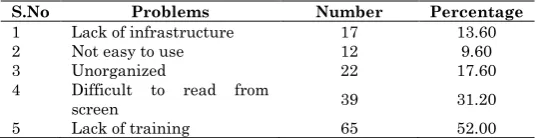
The distribution of faculty members according the problems faced while using the electronic journals is shown in Table 6.
Table: Problems faced by the faculty members in accessing electronic journals
S.No Problems Number Percentage
1 Lack of infrastructure 17 13.60
2 Not easy to use 12 9.60
3 Unorganized 22 17.60
4 Difficult to read from
screen 39 31.20
5 Lack of training 65 52.00
(Multiple answers were permitted)
percent of faculty members found lack of training as the major problem for not using the electronic journals. It is followed by difficult to read from screen (31.20%), unorganized (17.60%), lack of infrastructure (13.60%) and not easy to use (9.60%).
Satisfaction of Electronic Journals
The distribution of faculty members according to the satisfaction of electronic journals is shown in Table 7.
Table 7: Satisfaction of electronic journals
S.No Level of satisfaction Number Percentage
1 Fully satisfied 39 31.20
2 Partially satisfied 51 40.80
3 Dissatisfied 35 28.00
TOTAL 125 100.00
It is evident from Table 7 that 40.80 percent of the faculty members are partially satisfied with the availability of electronic journals, 31.20 percent are fully satisfied, and 28 percent are dissatisfied in this regard.
Preference of Journal Format
The distribution of faculty members according to the preference to access of journal format is shown in Table 8.
Table 8: Preference of journal format
S.No Journal format Number Percentage
1 Print 33 26.40
2 Electronic 49 39.20
3 Both 43 34.40
TOTAL 125 100.00
It is evident from Table 8 that 39.20 percent of the faculty members prefer to access electronic journals, 34.40 percent of them prefer to access both print as well as electronic form of journals, and 26.40 percent prefer to access only print journals [1-5].
Major Findings and Suggestions
Out of 125 faculty members, 35.20 percent of the respondents belonged to Tutors, 32.80 percent of the respondents were Assistant Professors, 16.80 percent of the respondents were Associate Professors and only 15.20 percent of respondents
were professors’ category who access electronic journals.
Majority of the faculty members (38.40%) are access electronic journals 2-3 times in a week. There is less number of faculty members who access electronic journals occasionally. Hence, the number of terminals, notes and printers must be increased in the library for which enhance the use of electronic journals efficiently and effectively.
More than half of the faculty members (55.20%) are using the electronic journals for their project/research work when compared to other purposes.
Majority of the faculty members’ (61.60%) access electronic journals through library and only 15.20 percent access electronic journals from home.
Timeless availability, easy accessibility, speed of publication, searches in easy and access for different locations is the main reasons for access electronic journals by the faculty members. To reduce the slow downloading problem while accessing electronic journals, the library should acquire high speed Internet and intranet connection
Fifty two percent of faculty members found lack of training as the major problem for not using the electronic journals and a considerable percentage of the faculty members find electronic journals difficult to read from screen. Hence, the library should organize regular workshop and sufficient training is required by the faculty members for better assessment of electronic journals.
31.20 percent of the faculty members are fully satisfied with availability of electronic journals in library. Number of journals available through consortia should be increased to access more journals in their respective fields.
Majority of the faculty members prefer to access journals in electronic form.
Conclusion
In the recent times, there has been a remarkable growth of electronic journals. In many consortiums, a large number of electronic journals are introduced which outstrip other electronic resources. The effect of electronic journals in academic world is phenomenal, leading to wide spread availability of them. The study reveals
that electronic journals have become the vigorous part of the information dissemination process. The study also brings out some major suggestions for improving the use of electronic journals. This study will help the information professionals in developing electronic journal services to their users to maximum utilization of electronic journals.
References
1. Chalarat R (2004) The use of electronic journals by faculty members, physicians and medical students of the faculty of medicine, Prince of Songkla University. Journal of Social Sciences and Humanities, 10(3):323-340.
2. Curtis KL, Weller AC, Hurd, JM (1997) Information seeking behavior of health science faculty, the impact of new information technologies. Bulletin of Medical Library Association, 85(4):402-410.
3. Mounissamy P, Kaliammal A, Swaroopa Rani
(2005) Users’ attitude towards electronic journals. IASLIC Bulletin, 50(2):91-95.
4. Naushad AH, Faizual Nisha (2011) Use of e-journals among research scholars at central science library, University of Delhi. Collection Building, 30(1):53-60.