OCCURRENCE AND DISTRIBUTION OF STAPHYLOCOCCUS
AUREUS AND COLIFORM BACTERIA IN THE INNER GULF OF
THAILAND
Phawadee Buathong
[a], Wannisa Leelaruji
[a], Pramot Sojisuporn
[b], Gullaya Wattayakorn
[b],
and Warawut Chulalaksananukul
[c],[d],[e]*Keywords:Staphylococcus aureus, coliform, Gulf of Thailand, flood.
Global warming is a phenomenon that causes many environmental issues, including the frequency of heat waves, severity of storm surges, changes in rain pattern, flooding, and coastal erosion. In Thailand, the worst flooding in 2011 has imposed more impacts to the environment, human life and socioeconomic activities. The exceeding amount of floodwater was drained into the adjoining Gulf of Thailand in order to solve the flooding problem. As a result, the inner Gulf of Thailand was affected by the high volume of floodwater together with pathogenic bacteria such as Staphylococcus aureus and coliform bacteria which are generally used as indicators of a number of other bacteria. The results from this study revealed that total coliforms had higher spread rate toward the west coast of the inner Gulf, while S. aureus was found to be highest at the central part of the inner Gulf of Thailand. In general, the highest abundance of both the examined groups was observed during November 2011 after the high rainfall (flood) event.
* Corresponding Authors
E-Mail: [email protected]
[a] Program in Biotechnology, Faculty of Science, Chulalongkorn University, Bangkok 10330, Thailand. [b] Department of Marine Science, Faculty of Science,
Chulalongkorn University, Bangkok 10330, Thailand. [c] Biofuels by Biocatalysts Research Unit, Chulalongkorn
University, Bangkok 10330, Thailand.
[d] Department of Botany, Faculty of Science, Chulalongkorn University, Bangkok 10330, Thailand.
[e] Aquatic Resources Research Institute, Chulalongkorn University, Bangkok 10330, Thailand.
Introduction
Global warming is caused mostly by increasing concentrations of greenhouse gases in the atmosphere. It is causing climate patterns to change and causes many environmental issues around the world. Important effects due to climate change are the frequency of heat waves, severity of storm surges, more intense droughts, and floods. In addition, sea-level rise is projected to accelerate during the 21st century, with dramatic impacts in low-lying regions where subsidence and erosion problems already exist. These factors also affect the flow of matter, as well as changes in the volume of sediments and nutrients being swept out to the coastal seas, and will affect biological, physical and chemical components of water through different paths thus enhancing the risk of waterborne diseases. Climate change has almost certainly had an impact on Thailand. The coastal area of Thailand is already experiencing the impacts of global climate change, as manifested by the frequency and severity of tropical storms, floods, and coastal erosion over the last several decades. Climate change is causing the rising of sea temperatures and acidity of seawater affecting marine life and coastal aquaculture. It is a threat to food security, public health and the occupation of the coastal communities1.
During the flood season in 2011, Thailand witnessed its worst flooding in many years. Heavy rain combined with multiple tropical storms throughout the extended rainy season played a large part in the extensive flooding. The average precipitation of the Chaophraya watershed area from May to October 2011 was the highest in history, which was 143 % of the average rainy season rainfall of regular years. Some 66 of Thailand’s 77 provinces were reportedly affected by severe, record-high flooding, including the Bangkok metropolitan area and its surrounding areas1. This big flood impacted also the local sewage systems leading to a release of untreated water into the river, posing a severe danger for health. Lower water quality drained from floodwater into rivers and the Gulf of Thailand has been observed by the Pollution Control Department as well as researchers from various universities1. From this incident, the Gulf of Thailand which had been affected by the high volume of floodwater could also be contaminated by some pathogenic bacteria such as Staphylococcus aureus, coliform bacteria and Vibrio spp. which may impose some impacts on marine life and adversely affect the economy of the country.
Staphylococcus is the microbes in the Family Micrococcaceae which are Gram-positive staining with their primary habitat in the skin, glands and mucous membranes of warm-blooded animals including humans. It has a round shape and arrangement is similar to grapes. Anyway, it can be found as single cells, in pairs or short chains. Their colonies have smooth rounded edges and have cream, yellow, orange colour. S. aureus survive well in the environment and may also be isolated from a range of sources that come into contact with man and animals. The optimum temperature range is 30 to 37 °C, pH 4.0-10.0 and tolerate to salt at 18-20 %. S. aureus were classified as “Facultative anaerobe” and can produce eight types of enterotoxin toxin; A, B, C1, C2, C3, D, E and H, which are the most common for food poisoning is A and D. The toxins are heat resistant and may not be destroyed even boiling for half an hour. It’s heat resistant is up to 121°C for 15 minutes, this toxin can be dissolved in water and salt solution. S. aureus can produce the toxin at 37 °C better than at 25 and 10 °C respectively. It also tolerate to gamma radiation that dose permitted for food as well2.
Goodwin et al. (2012)3 studied the spread of S. aureus in seawater and beaches in Southern California. Most of S. aureus were found in the water samples (59 %, n = 328) and in the sand (53 %, n = 358). The cultures were found to be correlated with other variables such as location, temperature and the number of people swimming in that particular area. Viau et al. (2011)4 studied bacterial pathogens in coastal waters of Hawaii in order to understand the distribution of five species of pathogenic bacteria, including Salmonella,
Campylobacter, S. aureus, Vibrio vulnificus and Vibrio parahaemolyticus by collect water samples from 22 rivers in O'ahu coastal area. Total five species of pathogenic bacteria were found. Vibrio is bacteria Genus that are very important in medical, there are four species; V. cholerae, V. parahaemolyticus, V. vulnificus and V. alginolyticus. The two species that was commonly found in Thailand are V. parahaemolyticus and V. cholera. V. cholerae is the cause of cholera and V. parahaemolyticus is the cause of food poisoning5. V. parahaemolyticus outbreaks have increased in the recent 10-20 years, mainly caused by the consumption of raw or uncooked seafood which has reported an outbreak of diarrhoea in several countries including the U.S.A, China, Japan and Korea. This bacterium is pathogenic in humans which are distributed in the tropical ocean and coastal environment6, because it has the ability to tolerate saline water and was isolated from marine sediment, oysters, crabs, lobsters, squid, shrimp and many other species of fish7.
In Thailand, the Office of Water Quality Management, Pollution Control Department conducted the analysis of microbial quality in coastal water collected along the coasts during 2005 to 2012, and found that the levels of bacterial species increased significantly during such period. It was suggested that such bacteria may be transported with the floodwaters which had been accelerated discharges into the sea. However, there have been few studies on human pathogenic bacteria in seawater from the Gulf of Thailand to date. Hence, the present study aims to investigate the occurrence and distribution of Staphylococcus aureus and coliform bacteria in seawater samples from 20 stations in the inner Gulf of Thailand after the big flood in October 2011.
Materials and Methods
Research area
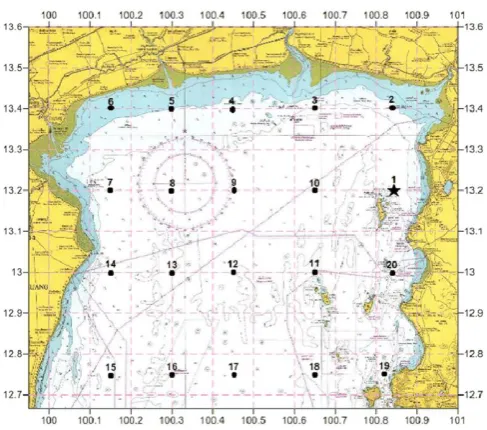
The site of this study is the innermost area of the Upper Gulf of Thailand (inner Gulf), located at 12º40´– 13º36´N and 99º57´-101º00´E (Fig. 1). The inner Gulf is roughly rectangular in shape, about 100 km long and 100 km wide, with an average depth of 15 m. It is the catchment basin of four large rivers on the northern side and two on the western coast. Among them, the Chaophraya River has the biggest volume, with the average runoff per year of 13.22 x 10³ MCM. The Gulf is surrounded by highly populated areas and some heavily polluting industries. Some untreated effluents have been discharged from industrial sites into the small tributaries that feed into the inner Gulf. In addition, domestic wastewater generated by residents in and around the area is discharged into open ditches, which ultimately draining into the inner Gulf8.
Sampling stations and sample collection
Two sampling events were conducted during November 2011(after the big flood event) and February 2012. During each event, seawater samples were collected from the 20 sampling stations in the inner Gulf of Thailand (Fig. 1), at a depth of 1 m from the sea surface in order to avoid contamination from surface micro-layer. The samples were collected into pre-sterilized bottles (100 ml) fitted with tight screw caps. Care was taken to avoid accidental contamination of the water during collection and transportation to the laboratory for analysis. Physical-chemical parameters, including salinity (S), temperature (T), pH, and dissolved oxygen (DO) were measured using a multi-parameter probe (YSI model 650-01m environmental monitoring systems; YSI, Yellow Springs, OH). These parameters were measured in-situ in the surface water of the sea where bacterial pathogens were sampled. Total suspended solids (TSS) were analysed in the laboratory by the standard method.
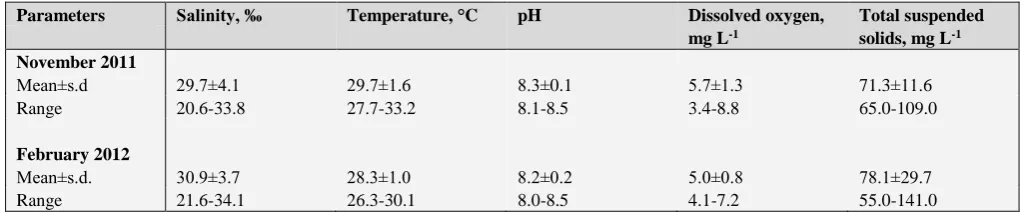
Table 1. Mean±sd and range of the measured physico-chemical parameters of seawater in the study area
Parameters Salinity, ‰ Temperature, °C pH Dissolved oxygen, mg L-1
Total suspended solids, mg L-1 November 2011
Mean±s.d 29.7±4.1 29.7±1.6 8.3±0.1 5.7±1.3 71.3±11.6
Range 20.6-33.8 27.7-33.2 8.1-8.5 3.4-8.8 65.0-109.0
February 2012
Mean±s.d. 30.9±3.7 28.3±1.0 8.2±0.2 5.0±0.8 78.1±29.7
Range 21.6-34.1 26.3-30.1 8.0-8.5 4.1-7.2 55.0-141.0
Bacteriological analysis
Water samples were analysed for pathogenic bacteria by using Petrifilms (3M, St. Paul, MN). The cultures were incubated at 37 °C for 24 hours, then colonies count was carried out as colonies forming unit (CFU) as follows:
Staphylococcus aureus detection
Staphylococcus aureus was detected and enumerated from
surface water samples by pipetting 1 ml sample into the central part of the Petrifilm, which was slowly closed with another film and then placed the pressing sheet on the 3M Petrifilm STX and using index finger pressed them firmly until the sample was spread all over the foam. The films were left to become harden by 1-2 minutes then incubated at 37 °C for 24 hours. The counts were recorded and reported in colony forming units (CFU mL-1).
Total coliform bacteria detection
Total coliform bacteriawas detected and enumerated from surface water samples by pipetting 1 ml sample into the central part of the Petrifilm, which was slowly closed with another film and then placed the pressing sheet on the 3M Petrifilm EC and using index finger pressed them firmly until the sample was spread all over the foam. The films were left to become harden by 1-2 minutes then incubated at 37 °C for 24 hours. The counts were recorded and reported in colony forming units (CFU mL-1).
Statistical analyses
Parameters for correlation analysis included S, T, DO, TSS, and log-transformed concentrations of Staphylococcus aureus and coliform bacteria. Multiple regression analyses were done using Pearson’s correlations between
Staphylococcus aureus and coliform bacteria dataset and T,
S, or S and T combined. Correlations were considered significant at p ≤ 0.05.
Results
and Discussion
Physico-chemical parameters of seawater
Table 1 shows the results of mean values and ranges of physico-chemical characteristics of the seawater in the inner Gulf of Thailand during the two sampling periods. The water temperature during sample collections varied from 27.7 ºC to 33.2 °C in November 2011 and from 26.3 ºC to
30.1ºC in February 2012. pH of water varied between 8.0 to 8.5, DO varied from 3.4 to 8.8 mg L-1 and salinity from 20.6 to 34.1‰. Comparatively salinity was higher in February 2012 than in November 2011. Total suspended solids concentration varied from 55.0 to 141.0 mg L-1 and higher concenrations recorded in February 2012.
Bacterial pathogens
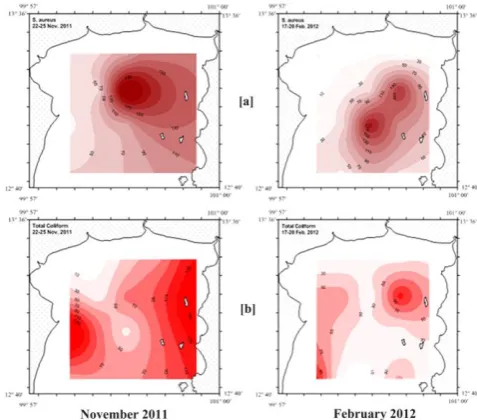
The abundance of Staphylococcus aureus and total coliform in water samples during the two sampling periods is presented in Fig. 2. During the investigated periods,
Staphylococcus aureus varied from 39 to 159 CFU mL-1 in November 2011 and from 4 to 201 CFU mL-1 in in February 2012; while total coliform varied from 5 to 149 CFU mL-1 in November 2011 and from 4 to 121 CFU mL-1 in in February 2012. In general, the over all mean counts of both
Staphylococcus aureus and total coliform were
comparatively higher in November 2011 than in February 2012.
Figure 2. Abundance of S. aureus (a) and coliform bacteria (b) in samples from the inner Gulf of Thailand
Table 2. Correlations of Staphylococcus aureus and coliform bacteria with environmental parameters during the two sampling periods
R: Pearson product-moment correlation coefficients for log-transformed Staphylococcus aureus (in CFU mL-1) and total coliform (in CFU
mL-1); n: number of samples; p: significance, with p ≤ 0.05 considered significant (*); S: salinity, T: temperature, DO: dissolved oxygen, TSS: total suspended solids
Coliform bacteria have been used to evaluate the general quality of water. In November 2011, the total coliform had higher spread rate along the west coast between Cha-am and Huahin; as well as along the east coast between the Bangpakong estuary and Sattahip. In February 2012, it was found that the concentration of total coliform was less abundance and concentrated mostly along the east coast of the inner Gulf (Fig. 3b). The adverse effect of the marine environment on coliforms is manifested by decreased survival of coliform bacteria. When they enter the sea, enteric bacteria are subjected to simultaneous stresses whose impact on cell metabolism will lead to either their maintenance or their decay in marine environments. However, high levels of total coliforms do not necessarily relate specifically to faecal pollution, but to the bacterial loading of enteric within the water system.
Figure 3. Areal distribution of S. aureus (a) and total coliform (b) in the study area
Correlation of environmental variables and bacterial population
The correlation among the bacterial population and environmental variables is presented in Table 2.
Temperature and salinity are often the most important environmental factors controlling bacterial abundance in estuarine and marine waters. Correlations between total coliform bacteria and environmental parameters during both sampling periods however, were not significant (p ≥ 0.05, Table 2). On the other hand, significant and positive correlations were found between Staphylococcus aureus
abundance and salinity and dissolved oxygen in the February 2012 sampling period. The lack of a relationship in November 2011.may be due to the extreme climate event.
This comparative assessment of distribution and abundance of human pathogenic bacteria is helpful to infer that the Gulf of Thailand has experienced the impacts of sewage outfalls and extreme climate events. In the future, as the dataset expands and as more storms are characterized, it will be possible to conduct further analyses that will increase the usefulness of the observed relationships. The observations from this study are useful for managing effluent outfalls into coastal ecosystems. Every effort leading to the reduction in pollution indicating bacteria and microbes of human health concern has to be promoted and implemented.
Acknowledgments
This research was partially supported by the Higher Education Research Promotion and National Research University Project of Thailand, Office of the Higher Education Commission (CC1030A) and the Integrated Innovation Academic Center: IIAC Chulalongkorn University Centenary Academic Development Project (CU56-CC06). We thank Dr. Sompop Rungsupa and the crew of the R/V Chulavijai for their help in the field.
References
1World Bank, Thai Flood 2011: Rapid Assessment for Resilient Recovery and Reconstruction Planning, 2012, 377.
2Abou-Elela, S., Kamel, M. M., Fawzy, M. E., Desalination, 2010, 250, 1-5.
3Goodwin, K., McNay, M., Cao, Y., Ebentier, D., Madison, M.,
Griffith, J., Water Res., 2012, 46, 4195-4207.
Staphylococcus aureus Total coliform
R n p R n P
November 2011
S, ‰ 0.016 13 0.612 0.074 13 0.211
T, °C 0.019 13 0.781 0.043 13 0.727
DO, mg L-1 0.018 13 0.787 -0.011 13 0.930
TSS, mg L-1 -0.005 13 0.395 -0.018 13 0.127
February 2012
S, ‰ 0.125 19 0.042* -0.043 19 0.520
T, °C -0.098 19 0.500 0.109 19 0.521
DO, mg L-1 0.469 19 0.045* -0.353 19 0.177
4Viau, E., Water Res., 2011, 45, 3279-3290.
5Mohammed, R., Marine Pollut. Bull., 2012, 64, 1201-1209. 6Shen, X., Cai, Y., Liu, C., Liu, W., Hui, Y., Su, Y., Int. J. Food
Microbiol., 2009, 136, 129-132.
7Slonczewski, J., Foster, J., Microbiology An Evolving Science, 1st
ed. United States of America: W.W. Norton & Company, Inc., 2009.
8Wattayakorn, G., “Environmental Issues in the Gulf of Thailand”,
In: E. Wolanski (ed.), The Environment in Asia Pacific Harbours, Springer, Netherland, 2005, 497.
9Wikipedia, Coliform bacteria [online], Available from:
http://en.wikipedia.org/wiki/Coliform_bacteria, 2013, 18 Jan.
10Wikipedia, Staphylococcus aureus [online], Available from:
http://en.wikipedia.org/wiki/Staphylococcus_aureus, 2013, 18 Jan.
11Wikipedia, Vibrio [online], Available from:
http://en.wikipedia.org/wiki/Vibrio, 2013, 18 Jan.
12Joseph, S. W., Colwell, R. R., Kaper, J. B., Crit. Rev. Microbiol., 1982, 10, 77–124.
13Hamzah, A., Kipli, S. H., Ismail, S. R., Una, R., Sarmani, S., Microbiological Study in Coastal Water of Port Dickson, Malaysia. Sains Malaysiana. 2011, 40(2), 93–99.
14Elmir, S. M., Wright, M. E., Abdelzaher, A., Solo-Gabriele, H.
M., Fleming,L. E., Miller, G., Rybolowik, M., Shih, M. P., Pillai, S. P., Cooper, J. A., Quaye, E., Water Res., 2007,
41(1), 3–10.
15Solic, M., Krstulovic, N., Marine Pollut. Bull.1992, 24(8),
411-416.
16U.S. EPA (United States Environmental Protection Agency), Ambient water quality criteria for bacteria EPA/440/5-84-002, U.S. Environmental Protection Agency, Office of Water, Regulations and Standards, Criteria and Standards Division, Washington, D.C., 1986.
17Thompson, F. L., Tetsuya, I., Swings, J., Microbiol. Mol. Biol. R., 2004, 68, 403–431.
18Noriega-Orozco, L., Acedo-Félix, E., Higuera-Ciapara, I.,
Jiménez-Flores, R., Cano, R., Rev. Latinoam. Microbiol.,
2007, 49, 60-67.
19Fujino, T., Okuno, D., Nakada, A., Aoyama, A., Fukay, K.,
Mukay, T., Med. J. Osaka Univ., 1953, 4, 299–304.
20Martinez-Urtaza, J., Bowers, J. C., Trinanes, J., DePaola, A., Food Res. Int., 2010, 43, 1780–1790.
21EEC Council Directive of 8 Dec 1975 concerning the quality of
bathing water (76/160/EEC), Offic. J. Eur. Commun., L/031,
1976, 1-7.