ARTIGO ORIGINAL
Pediatric Cataracts: A Retrospective Study of 12 Years
(2004 - 2016)
Cataratas em Idade Pediátrica: Estudo Retrospetivo de 12
Anos (2004 - 2016)
1. Serviço de Oftalmologia. Hospital Pedro Hispano. Matosinhos. Portugal.
Autor correspondente: Jorge Moreira. [email protected]
Recebido: 17 de setembro de 2016 - Aceite: 13 de fevereiro de 2017 | Copyright © Ordem dos Médicos 2017
Jorge MOREIRA1, Isabel RIBEIRO1, Ágata MOTA1, Rita GONÇALVES1, Pedro COELHO1, Tiago MAIO1,
Paula TENEDÓRIO1
Acta Med Port 2017 Mar;30(3):169-174 ▪ https://doi.org/10.20344/amp.8223
RESUMO
Introdução: As cataratas são consideradas uma das principais causas de cegueira evitável em idade pediátrica. O prognóstico visual destas crianças depende de uma abordagem terapêutica atempada, sendo fundamental o conhecimento da sua epidemiologia para a implementação de programas de prevenção primária e diagnóstico precoce das cataratas.
Material e Métodos: Analisámos os processos clínicos de doentes com cataratas diagnosticadas em idade pediátrica, nos últimos 12 anos, no Hospital Pedro Hispano, Porto.
Resultados: Foram diagnosticados 42 casos de cataratas pediátricas, com igual distribuição em ambos os géneros. A média etária no momento do diagnóstico foi de seis anos e em 64,3% das crianças, as cataratas eram bilaterais. A manifestação clínica mais comum foi a diminuição da acuidade visual (36,8%) seguida pela leucocória (26,3%). A etiologia idiopática foi a mais frequente (59,5%), e houve predomínio das cataratas do tipo nuclear (32,5%). As cataratas associaram-se a doenças sistémicas em 23,8% dos casos e a outras anomalias oculares em 33,3% das crianças. Relativamente ao tratamento, 47,6% das crianças foram submetidas a cirurgia. As complicações pós-operatórias registaram-se em 35% das crianças, sendo a opacificação da cápsula posterior a mais comum (25%). Discussão: A descrição de 42 casos reflete, provavelmente, a baixa prevalência das cataratas nesta idade. Apesar das limitações inerentes a uma amostra pequena, o perfil epidemiológico das cataratas pediátricas, neste hospital, apresenta características similares às descritas na literatura.
Conclusão: O elevado número de cataratas de etiologia idiopática observado a nível global e neste estudo, em particular, constitui um desafio ao planeamento de estratégias de prevenção.
Palavras-chave: Adolescente; Criança; Catarata/epidemiologia; Catarata/etiologia; Extração de Catarata ABSTRACT
Introduction: Cataracts are a major cause of preventable childhood blindness. Visual prognosis of these patients depends on a prompt therapeutic approach. Understanding pediatric cataracts epidemiology is of great importance for the implementation of programs of primary prevention and early diagnosis.
Material and Methods: We reviewed the clinical cases of pediatric cataracts diagnosed in the last 12 years at Hospital Pedro Hispano, in Porto.
Results: We identified 42 cases of pediatric cataracts with an equal gender distribution. The mean age at diagnosis was 6 years and 64.3% of patients had bilateral disease. Decreased visual acuity was the commonest presenting sign (36.8%) followed by leucocoria (26.3%). The etiology was unknown in 59.5% of cases and there was a slight predominance of nuclear type cataract (32.5%). Cataract was associated with systemic diseases in 23.8% of cases and with ocular abnormalities in 33.3% of cases. 47.6% of patients were treated surgically. Postoperative complications occurred in 35% of cases and posterior capsular opacification was the most common (25%).
Discussion: The report of 42 cases is probably the result of the low prevalence of cataracts in this age. Although the limitations of our study include small sample size, the profile of children with cataracts in our hospital has characteristics relatively similar to those described in the literature.
Conclusion: Given the high proportion of idiopathic pediatric cataracts, prevention of the disease remains a challenge worldwide. Keywords: Adolescent; Cataract/epidemiology; Cataract/etiology; Cataract Extraction; Child
INTRODUCTION
Cataracts have been considered as one the main causes of avoidable childhood blindness and affecting ap-proximately 200,000 children worldwide.1
Genetic factors, metabolic diseases and intrauterine infections are among the leading causes of cataracts in children, apart from those secondary to injury or iatrogenic (drugs, radiation therapy, laser therapy, etc.). Paediatric cataracts are mostly idiopathic in developed countries.1,2
The first years of life are crucial for the development
of a child’s vision and therefore irreversible amblyopia can be induced by blurred and distorted retinal image over that period.3,4 Vision impairment may still be reverted as long
as an adequate therapy is carried out over the period of sensory plasticity.
ARTIGO ORIGINAL improvement, particularly in favour of an early diagnosis and improved outcome.
MATERIAL AND METHODS
This was a retrospective study based on clinical records of patients attending the Hospital Pedro Hispano, Matosinhos between 2004 and 2016 with cataracts in childhood (patients aged under 18 years).
The following clinical variables were analysed: patient’s gender, age at diagnosis, presenting symptoms, laterality, morphology, aetiology, presence of other ocular and systemic abnormalities, family history of cataract, follow-up time and treatment. In case of surgery, the following parameters were assessed: age at surgery, time from diagnosis to surgery, intra and postoperative complications and pre and postoperative visual acuity.
SPSS version 21 software was used in statistical analysis. Categorical variables were described through absolute (n) and relative frequencies (%) and continuous variables through mean ± standard deviation. Chi-square independence test was used for the analysis of the association between categorical variables and Fisher’s exact test has been used if more than 20% of the cells in the contingency table regarding the analysis of the association between two categories had expected frequencies below five. A 0.05 level of significance has been considered.
RESULTS
In total, 42 childhood cataracts (69 eyes) were diagnosed between 2004 and 2016, corresponding to 42 patients (50% male).
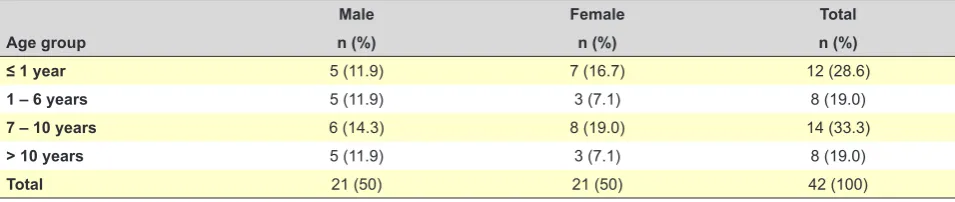
Mean age at diagnosis was 6 ± 4.9 years (2 days - 17 years) and was slightly higher in male patients (7 ± 5.4 vs. 5 ± 4.3 years) (Table 1).
In total, 27 patients (64.3%) presented with bilateral cataracts and a ratio of unilateral to bilateral cataracts of 1:1.8 was found. A slight male predominance was found in bilateral and female predominance in patients with unilateral cataracts, even though with no statistically significant difference. No statistically significant differences as regards laterality were found in patients with unilateral cataracts (8/15 patients presented with cataract in the left and 7/15 in
the right eye). No differences were found between cataract laterality and patient’s age distribution.
Impaired visual acuity (36.8%), followed by leukocoria (26.3%) were the most common clinical manifestations. In 23.7% of the patients, cataracts were diagnosed in routine examinations and eye movement disorders were the first sign in 13.2% of the patients (nystagmus in 5.3% and strabismus in 7.9%, all of the convergent type). No clinical information was available regarding four patients (Table 2). Idiopathic cataracts were most frequently found (59.5% of the patients) and were associated with genetic syndromes or metabolic diseases in 19% of the patients (n = 8), including two patients with trisomy 21 and one patient with Noonan syndrome, tuberous sclerosis, Duchenne muscular dystrophy, type-1 diabetes mellitus, Fabry disease and unclassified polymalformative syndrome (one patient each). Two patients developed cataract secondary to chronic oral corticosteroid therapy for a systemic disease (juvenile rheumatoid arthritis). An exposure to chemical substances during embryogenesis (alcohol) was found in one patient, in another patient cataract was associated with persistent foetal vasculature and one patient presented with a cataract caused by rubella embryopathy. Hereditary cataracts were found in four patients (9.5%), transmitted in an autosomal dominant in three and in an autosomal recessive pattern in another patient (Table 2).
Nuclear cataracts were most frequently found (32.5%), followed by polar (25%, corresponding to eight patients with anterior and two with posterior polar cataracts) and posterior subcapsular (22.5%). Other less frequent morphologies are shown in Table 2.
No statistically significant differences were found between aetiology and laterality as well as between aetiology and morphology.
Cataracts were associated with other ocular abnormalities in 14 patients (33.3%) and microphthalmia being the most frequently found (21.4%), followed by ectopic pupil (14.3%), microcornea (14.3%), congenital glaucoma (14.3%), coloboma (7.1%), posterior lenticonus (7.1%), aniridia (7.1%), persistent foetal vasculature (7.1%) and persistent pupillary membrane (7.1%).
Cataracts that were associated with other ocular
Table 1 - Distribution of patients with cataracts according with the age group
Male Female Total
Age group n (%) n (%) n (%)
≤ 1 year 5 (11.9) 7 (16.7) 12 (28.6)
1 – 6 years 5 (11.9) 3 (7.1) 8 (19.0)
7 – 10 years 6 (14.3) 8 (19.0) 14 (33.3)
> 10 years 5 (11.9) 3 (7.1) 8 (19.0)
ARTIGO ORIGINAL
abnormalities were predominantly unilateral (61.5%; p < 0.05).
In total, 20 patients (33 eyes) underwent surgery (12 [60%] male; 7 [35%] unilateral).
Mean age at surgery was 5.5 ± 5 years (23 days – 13.5 years) (8 ± 4.8 years in patients with unilateral and 4 ± 4.5 years in patients with bilateral cataracts).
Time from diagnosis to surgery was 10.5 ± 16.8 months (4 days - 73 months) (Table 3). Unilateral cataract was on average operated 6.8 ± 5.9 months upon diagnosis and bilateral cataracts 12.6 ± 20.4 months from diagnosis; mean time between surgery in one eye and the other was two months (seven days – nine months).
No statistically significant differences were found between both groups (unilateral and bilateral), namely regarding the number of operated patients, age at surgery or time from diagnosis to surgery.
In total, 13 patients (65%) underwent primary intraocular lens (IOL) implantation and the seven patients who remained aphakic presented with bilateral cataracts and
were aged under 2 years at surgery (mean age: six months; age range between 23 days and 22 months), four of whom subsequently underwent secondary IOL implantation. Mean age at secondary IOL implantation was four years and took place 3.5 years upon cataract surgery, on average.
No intraoperative complications were found. Post-operative complications occurred in 35% of the patients and posterior capsular opacification was the most frequent complication (five patients – 25%) and occurred in patients who did not undergo primary posterior capsulotomy; these patients were aged on average 9.5 years at surgery and were referred for YAG laser capsulotomy on average 14 months (2-24 months) upon the initial surgery. Other complications included posterior synechiae (n = 1) and aphakic secondary glaucoma in a three-year-old patient with bilateral cataracts associated with microphthalmia who underwent surgery at the age of three months.
Information on preoperative visual acuity was available regarding 13 patients and mean preoperative best-corrected visual acuity (BCVA) was 0.3 ± 0.2. At the end of the study, BCVA data were available in 18 patients, corresponding to 0.6 ± 0.4. A lower mean BCVA was found in patients with unilateral cataract (0.3 ± 0.1 in unilateral vs. 0.8 ± 0.1 in bilateral).
Mean follow-up time of the 42 patients was 6 ± 3.6 years and 7 ± 3.5 years upon surgery in the 20 patients who underwent surgery.
DISCUSSION
There are an estimated 1.5 million visually impaired children worldwide, mostly due to preventable causes.1
Cataracts are amongst the leading treatable causes of blindness in children.
An estimated 1-15/10,000 prevalence rate of paediatric cataracts has been estimated worldwide,1 reflecting
different methodologies, group definition and age groups, apart from real differences between populations. In Europe, this prevalence ranges between 2.2 and 4.0/10,000.1 In
Portugal, an estimated 170,000 people with cataracts have been found, including 35,000 visually-impaired people, even though there are no specific data on the prevalence in children.5
Visually impairment from cataracts in children, apart from
Table 3 - Time from diagnosis to surgery
Time from diagnosis to surgery n (%)Total
≤ 1 month 5 (25.0)
1 – 3 months 4 (20.0)
3 – 12 months 6 (30.0)
> 12 months 5 (25.0)
Table 2 - Characteristics of paediatric cataracts according with
cli-nical manifestations, aetiology and morphology
Variable n (%)Total
Clinical manifestations
Visual acuity impairment 14 (36.8)
Leukocoria 10 (26.3)
Strabismus 3 (7.9)
Nystagmus 2 (5.3)
Routine examination 9 (23.7)
Unavailable data 4
Aetiology
Idiopathic 25 (59.5)
Genetic syndromes and metabolic diseases 8 (19.0)
Hereditary 4 (9.5)
Systemic corticoid therapy 2 (4.8)
Exposure to chemical substances 1 (2.4)
Rubella 1 (2.4)
Persistent foetal vasculature 1 (2.4) Morphology
Nuclear 13 (32.5)
Polar 10 (25.0)
Subcapsular 9 (22.5)
Mixed 3 (7.5)
Lamellar 2 (5.0)
Total 1 (2.5)
Cerulean 1 (2.5)
Sutural 1 (2.5)
ARTIGO ORIGINAL having a relevant impact on the psychomotor development as well as on child and family quality of life, is associated with a major social and economic burden and became a public health concern.
Due to its relevance, the ‘Vision 2020’ initiative was jointly developed by the World Health Organization (WHO) and the International Agency for Blindness Prevention (IABP) with the main aim at the elimination of avoidable blindness by the year 2020.6 Therefore, knowledge on the
epidemiological reality within each country is crucial in order to define the best strategies for this type of program. This study aims at the evaluation of clinical and epidemiological characteristics of cataracts diagnosed in children attending our hospital over the past 12 years; in total, 42 patients were included in the study (50% male). The results regarding cataract laterality are in line with other studies,7,8 a predominance of bilateral cases (64.3%)
and an even distribution between both eyes has been found in patients with unilateral cataracts.
Impaired visual acuity was the most frequent symptom (33.3%), which was expected considering that mean age at diagnosis was six years, corresponding to children with the ability to verbalize these complaints.
Different factors may have contributed to the formation of a cataract, even though in many patients this is not a simple task. Idiopathic cataracts were the most frequently found (59.5%), in line with other studies.2,7-9 Hereditary
cataracts were found in 9.5% of the patients, most frequently autosomal dominant; the prevalence of hereditary cataracts ranges from 6.8 to 29% of the patients7,8 and even though
there have been patients with autosomal recessive and X-linked cataracts, autosomal dominant cataracts were most frequently found.
Cataracts are usually isolated or associated with metabolic syndromes or diseases. In this study, these were associated with systemic diseases in 23.8% of the patients and were bilateral in 80% of these, in line with literature.10
Down syndrome was predominant in patients with genetic syndromes. In other studies, the prevalence of cataracts in children with Down syndrome ranged between 1 and 13%.8,11
As expected, due to the inclusion of rubella immunization into the Portuguese National Vaccination Program (Plano Nacional de Vacinação), cataracts caused by an intrauterine rubella infection were rare (only one patient).
Morphological presentations of paediatric cataract usually range from a punctiform opacity to the opacification of the whole lens. The opacification of the lens may only affect the nucleus or the surrounding cortex while in other patients there is an abnormal capsule corresponding to an opacification of the cortical lamella.12 This phenotypic
heterogeneity may impair the morphological classification. In addition, different morphologies may coexist. In this study, nuclear and polar cataracts were the most prevalent, in line with other studies.13
The morphology or laterality of childhood cataracts may reflect their aetiology,7 even though no statistically
significant differences were found in this study, when those variables were analysed.
Ocular abnormalities related to cataracts were found in 33.3% of the patients predominantly in unilateral cataracts, in line with other studies.9,13,14 Microphthalmia was most
frequently found, impairing surgery and subsequent visual rehabilitation, therefore corresponding to a poor outcome factor.15
Specific anatomic and physiologic characteristics of child’s eye have a negative impact on the approach to childhood cataracts. Apart from smaller, child’s eyes have thinner and less rigid sclera, higher capsule elasticity, higher vitreous pressure, changes in corneal curvature and higher predisposition to postoperative inflammatory reactions. Additionally, normal eye development, particularly over the first 18 months of life, has a relevant impact.16,17
Surgery timing and an adequate visual rehabilitation are crucial in order to avoid irreversible amblyopia. The approach to cataracts depends on different factors including the degree of visual impairment, patient’s age, laterality, size, location and morphology of the cataract and concomitant eye or systemic abnormalities.18 Sensory
deprivation caused by cataracts occurring over the first months of life is very relevant and must be removed as soon as possible.19
Surgery is aimed at the promotion and maintenance of visual axis transparency. Phacoaspiration with primary posterior capsulotomy, with or without anterior vitrectomy is currently the most frequently used technique for childhood cataracts.20 Primary intraocular lens (IOL) implantation
has been increasingly used, even in younger children. However, selecting an IOL implantation may be challenging, particularly in children less than two years of age, due to the changes of refractive status in children, with an additional risk for complications.21,22
Apart from intraoperative challenges, postoperative complications are more frequent in children, due to a stronger inflammatory response. Visual axis secondary opacification is the most frequent complication.23 In fact,
the opacification of the posterior capsule, in the absence of primary posterior capsulotomy seems to be universal, particularly in children aged less than four years.24
ARTIGO ORIGINAL line with other studies.25,26 Secondary glaucoma is the
most feared complication in childhood cataract surgery, particularly in children who undergo surgery over the first months of life; as a result, these children must be regularly followed. In addition, the presence of microphthalmia is also a risk factor for glaucoma.27 Secondary glaucoma was
only found in one of our patients who underwent surgery at the age of three months and concomitantly presented with microphthalmia, subsequently referred for glaucoma medical and surgical management.
Visual outcomes of patients submitted to surgery were globally satisfactory and 50% of the patients presented a best-corrected visual acuity of 0.6 of above at the final examination.
CONCLUSION
Paediatric cataracts are still an important and potentially treatable cause of childhood blindness. Despite improvements in surgical techniques and equipments over the past few years, therapeutic success mainly depends on a timely approach. Early diagnosis is therefore crucial and newborn eye examination including red reflex may be easily obtained. Treatment must be individualized and follow-up should be extended in order to manage any complications. This study aimed to become a contribution to the knowledge of epidemiological characteristics of paediatric
cataracts in Portugal. This clinical description of 42 patients probably reflects the low prevalence of cataracts in this age group. Despite the limitations due to a small sample, our results were in line with other international studies. The high number of idiopathic cataracts worldwide and in this study can indeed challenge a planning decision regarding prevention strategies.
HUMAN AND ANIMAL PROTECTION
The authors declare that the followed procedures were according to regulations established by the Ethics and Clinical Research Committee and according to the Helsinki Declaration of the World Medical Association.
DATA CONFIDENTIALITY
The authors declare that they have followed the protocols of their work centre on the publication of patient data.
CONFLICTS OF INTEREST
The authors declare that there were no conflicts of interest in writing this manuscript.
FINANCIAL SUPPORT
The authors declare that there was no financial support in writing this manuscript.
REFERENCES
1. Foster A, Gilbert C, Rahi J. Epidemiology of cataract in childhood: a global perspective. J Cataract Refract Surg. 1997;23:601-4.
2. Lim Z, Rubab S, Chan YH, Levin AV. Pediatric cataract: the Toronto experience- etiology. Am J Ophthalmol. 2010;149:887-92.
3. Elston JS, Timms C. Clinical evidence for the onset of the sensitive period in infancy. Br J Ophthalmol. 1992;76:327-8.
4. Birch EE, O`Connor A. Critical periods for visual development and the timing of congenital cataract surgery. In: Wilson ME, Trivedi RH, editors. Pediatric cataract surgery techniques, complications, and management. 2nd ed. Philadelphia: Lippincott Williams & Wilkins; 2014. p. 48-54.
5. Direcção-Geral da Saúde. Rede de Referenciação de Oftalmologia. Lisboa: DGS; 2007. [consultado 2016 set 06]. Disponível em http://www. acss.min-saude.pt/Portals/0/Oftalmologia.pdf.
6. Gilbert C, Foster A. Childhood blindness in the context of VISION 2020 - the right to sight. Bull World Health Organ. 2001;85:1145-6.
7. Tartarella MB, Britez-Colombi GF, Milhomem S, Lopes MC, Fortes Filho JB. Pediatric cataracts: clinical aspects, frequency of strabismus and chronological, etiological, and morphological features. Arq Bras Oftalmol. 2014;77:143-7.
8. Haargaard B, Wohlfahrt J, Fledelius H, Rosenberg T, Melbye M. A nationwide Danish study of 1027 cases of congenital/infantile cataracts: etiological and clinical classifications. Ophthalmology. 2004;111:2292-8. 9. Fakhoury O, Aziz A, Matonti F, Benso C, Belahda K, Denis D.
Epidemiologic and etiological characteristics of congenital cataract: study of 59 cases over 10 years. J Fr Ophthalmol. 2015;38:295-300. 10. American Academy of Ophthalmology. Childhood cataracts and other
pediatric lens disorders. In: Basic and clinical science course, section 6. San Francisco: Pediatric Ophthalmology and Strabismus; 2014-2015. p. 291-308.
11. da Cunha RP, Moreira JB. Ocular findings in Down`s syndrome. Am J Ophthalmol. 1996;122:236-44.
12. Amaya L, Taylor D, Russell-Eggitt I, Nischal KK, Lengyel D. The
morphology and natural history of childhood cataracts. Surv Ophthalmol. 2003;48:125-44.
13. Perucho-Martínez S, De-la-Cruz-Bertolo J, Tejada-Palacios P. Pediatric cataracts: epidemiology and diagnosis. Retrospective review of 79 cases. Arch Soc Esp Oftalmol. 2007;82:37-42.
14. Rahi JS, Dezaleux C. Congenital and infantile cataract in the United Kingdom: underlying or associated factors. British Congenital Cataract Interest Group. Invest Ophthalmol Vis Sci. 2000;41:2108-14.
15. Wilson ME, Pandey SK, Thakur J. Paediatric cataract blindness in the developing world: surgical techniques and intraocular lenses in the new millennium. Br J Ophthalmol. 2003;87:14-9.
16. Hussain RN, Shahid F, Woodruff G. Axial length in apparently normal pediatric eyes. Eur J Ophthalmol. 2014;24:120-3.
17. Gordon RA, Donzis PB. Refractive development of the human eye. Arch Ophthalmol. 1985;103:785-9.
18. Medsinge A, Nischal KK. Pediatric cataract: challenges and future directions. Clin Ophthalmol. 2015;9:77-90.
19. Forbes BJ, Guo S. Update on the surgical management of pediatric cataracts. J Pediatr Ophthalmol Strabismus. 2006;43:143-51. 20. Ram J, Sukhija J. Pediatric cataract surgery: current concepts. J Int Med
Sci Acad. 2010;23:132-7.
21. Neely DE, Plager DA, Borger SM, Golub RL. Accuracy of intraocular lens calculations in infants and children undergoing cataract surgery. J AAPOS. 2005;9:160-5.
22. Nihalani BR, Van der Veen DK. Comparison of intraocular lens power calculation formulae in pediatric eyes. Ophthalmology. 2010;117:1493-9.
23. Apple DJ, Solomon KD, Tetz MR, Assia EI, Holland EY, Legler UF, et al. Posterior capsule opacification. Surv Ophthalmol. 1992;37:73-116. 24. Stager DR Jr, Weakley DR Jr, Hunter JS. Long-term rates of PCO
ARTIGO ORIGINAL
25. Katina JH, Lyra JM, Souza CD, Trindade FC. Tratamento cirúrgico da catarata pediátrica. Arq Bras Oftalmol. 2002;65:193-7.
26. Oliveira ML, Di Giovanni ME, Porfírio Neto Jr F, Tartarella MB. Catarata congénita: aspectos diagnósticos, clínicos e cirúrgicos em pacientes
submetidos a lensectomia. Arq Bras Oftalmol. 2004;67:921-6. 27. Magnusson G, Abrahamsson M, Sjöstrand J. Glaucoma following