Available online throug
ISSN 2229 – 5046
EFFECT OF UNSTEADY FLOW
IN A ROTATING PARALLEL PLATE CHANNEL WITH A POROUS BED
Dr. V. SURESH BABU
#1, Prof. R. SIVA PRASAD
#2Prof. K. Rama Krishna Reddy
#31
Asst. Professor in Mathematics, Department of GEBH,
G. Pullaiah College of Engineering & Techonology (AT), Kurnool, Andhra Pradesh, India.
2
Professor in Mathematics, Department of Mathematics,
Sri Krishnadevaraya University Anantapuramu, Andhra Pradesh, India.
3
Professor in Department of Mathematics, Raghavendra Institute of Pharmaceutical Education
and Research, Anantapuramu, Andhra Pradesh, India.
(Received On: 24-01-17; Revised & Accepted On: 11-02-17)
ABSTRACT
I
n this Paper we make an initial value investigation of the flow of an incompressible viscous fluid in rotating channel bounded above by a rigid plane and below by the porous bed abutting the impermeable boundary plane. The flow in the non-porous region is governed Navaier-Stokes equations while the Brinkman model is used in the porous bed. The perturbations in the flow are created by the constant pressure gradient along in the plate in addition to non-torsional oscillations of the lower plate. Initial valve problem has been solved making use of transform techniques and exact solution of velocity in the clean fluid and the porous region are evaluated. The velocity field consists of steady state, quasi steady state and the transient components. The time required for the decay of the transient term is discussed and the ultimate quasi steady state solution is analyzed with focus on its physical nature. The stresses on the boundary planes have also been evaluated. The behavior of the velocity and the stress with reference to variations in the governing parameters namely E, the Ekman number, D, the Darcy parameter and h, the non dimensional thickness of bed has been computationally discussed.Keywords: unsteady flow, Porous bed, Brinkman model.
1. INTRODUCTION
The channel flow problems where the flow is maintained by torsional or non-torsional oscillations of one or both the boundaries, throw some light in finding out the growth and development of boundary layers associated with flows occurring in geothermal phenomena. Claire Jacob [4] has studied the transient effects considering the small amplitude torsional oscillations of disks. This problem has been extended to the hydro-magnetic case by Murthy [7], who discussed torsional oscillations of the disks maintained at different temperatures. Debnath [5] has considered an unsteady hydrodynamic and hydromagnetic boundary flow in a rotating viscous fluid due to oscillations of plates including the effects of uniform pressure gradients and uniform suction. The structure of the velocity field and the associated Stokes, Ekman and Rayleigh boundary layers on the plates are determined for the resonant and non-resonant cases. Rao, D.R.V., Krishna, D.V. & Debanath, L. [10] have made an initial value investigation of the combined free and forced convection effects in an unsteady hydromagnetic viscous incompressible rotating fluid between two disks under a uniform transverse magnetic field. This analysis has been extended to porous boundaries by Sarojamma and Krishna [13] and later by Siva Prasad [14,17,18,19] to include the Hall current effects.
All fluid phenomena on earth involve rotation to a greater or lesser extent. Because of the basic rotation of the earth most of the large scale motions of the atmosphere and the sea fall under the category in which rotation is an absolutely essential factor. The atmosphere and the oceans are compressible fluids, but in many cases the essential physical features of atmospheric are oceanic flows are not dependent on this fact and fairly satisfactory theories cab be based on mathematical models assuming an incompressible fluid. The atmosphere and the oceans are located on earth which is a spheroid (almost a sphere) and there scale of motion is relatively small compared to the earth radius.
Effect of Unsteady Flow in a Rotating Parallel Plate Channel with a Porous bed / IJMA- 8(2), Feb.-2017.
© 2017, IJMA. All Rights Reserved 81
The fact that the geophysical fluids are really thin spherical shells is felt in such models in two different ways: a) there are purely geometrical effects associated with any planar map of the sphere and b) the angular velocity vector of the rotating sphere makes different angles with the vertical at different latitudes. The geometrical effects do not seem to be of qualitative importance except when the motions are of a scale comparable to the radius, but the effects of the rotating sphere in some respects create qualitative differences already on an intermediate scale.
Because of the fact that the geophysical flows normally have a horizontal scale large compared to the vertical scale, the velocity vectors are nearly horizontal and in such cases where a small range of latitude is involved, the vertical component may be regarded as constant. A satisfactory model is obtained by considering a plane horizontal layer of fluid rotating about a vertical axis with angular velocity equal to the vertical component Ω Sin λ where λ is the latitude of the earth’s angular velocity. This is commonly called the “f-plane model” because the parameter measuring the rotation which occurs in the equations, for same basic equations as in the f-plane model, except that f is no longer taken as constant, but its variation with latitude is included. A simplified version of this is called the “β-Plane Model” (β is the measure of the rate of change of f with latitude); It does not consider the geometrical effects of the spherical surface, but takes partial account of the variation with the mathematical complexities. There is another interesting aspect of the problem of rotating, viscous fluid. Here viscous boundary layers are formed on the solid bodies and there exists a strong interaction between the boundary layers and the outer flow.
A detailed account of the motion of rotating fluids enclosed within a body or vice versa was given by Greenspan (6). An example relating to such interaction for the flow of a fluid under a constant pressure gradient between two rotating parallel plates was given by Vidyanidhi (16). This rotating viscous flow equations yield a layer flow known as the Ekman boundary layer, named after the Swedish oceanographer V.Walfried Ekman who discovered this phenomenon. Attempts to observe the structure of the Ekman layer in the surface layers of the sea have been successful. Ekman layers are easy to produce and observe them in the laboratory. Such boundary layers, or similar ones, are required to connect principally geostrophic flow in the interior of the fluid to horizontal boundaries where conditions like a prescribed horizontal stress, or no-slip on a solid bottom, are given. In similar way, other kinds of viscous boundary layer have been studied so as to connect geostrophic flows to vertical boundaries (for exampled a vertical well along which the depth varies) on which boundary conditions in consistent with geostrophic flow are given.
There is a considerable interest in past and recent years in the study of flow past a naturally permeable bed, with appropriate boundary conditions at a naturally permeable boundary. The usual conditions are, the normal flux is continuous and the tangential velocity is zero. The former is completely satisfactory but the latter is clearly only an approximation. As an alternative to this no-slip boundary conditions Beavers & Joseph (1) have postulated, for the first time, the slip boundary conditions which they verified it experimentally. The existence of the slip at the porous bed, due to the transfer of momentum from the free flow to Darcy flow which sets up the drag, is connected with presence of a very thin boundary layer of stream wise moving fluid just beneath the nominal surface of the permeable material. The fluid in this layer is pulled along by the flow in the channel.
Although the experiments were performed by Beavers & Joseph (1) to test the validity of the proposed slip boundary conditions, owing to inadequate apparatus and instruments, the accuracy of experimental results was not sufficient to permit conclusive evaluation of the proposed analytical model but the existence of a slip velocity was confirmed qualitatively. Later experiments by Beavers, Sparrow & Magnuson (2), Taylor (15) & Rajasekhara (8) have further confirmed the existence of the slip at the nominal surface. Saffman (12) gave a rigorous theoretical proof for the existence of the slip at the nominal surface postulated Beavers & Joseph (1). Rajasekhara, Ramaiah & Rudraiah (9) have investigated a steady laminar flow of forced convection through a channel having on porous bounding wall. They have taken into account the velocity slip at the surface of the porous medium and the contribution of heat due to viscous dissipation.
Although the slip at the nominal surface was established based on the existence of a thin boundary layer just beneath the nominal surface, attention was not focused on the analytical determination of the boundary layer thickness. Later Rudraiah, Rajasekhara & Ramaiah (9), Channabasappa & Rangann (3) have determined analytically this boundary layer thickness. Rudraiah & Veerabhadraiah (11) extended this analysis to include the buoyancy force.
Effect of Unsteady Flow in a Rotating Parallel Plate Channel with a Porous bed / IJMA- 8(2), Feb.-2017.
2. FORMULATION OF THE PROBLEM
We consider the unsteady flow of an incompressible viscous fluid in a rotating parallel plate channel bounded below by a porous matrix abutting an impermeable wall. The clean fluid region above the porous matrix is bounded by an impermeable wall and is governed by the Navaier – Stokes equations. The flow in the porous region is governed by equations based on Brinkman model. In the undisturbed state both the plates and the fluid rotate with the same angular velocity Ω. At t > 0, the fluid is driven by a constant pressure gradient parallel to the plate and in addition the lower plate performs non – torsional oscillations in its own plane.
We choose a Cartesian Co – ordinate system O(x, y, z) such that the plates are at z = 0 and z = H and the z – axis coincides with the axis of rotation of the plates. The entire region is divided into two zones, Zone – I (clean fluid region) and Zone – II (porous region), the interface of two regions is assumed to be z = h. The unsteady hydrodynamic boundary layer equations of motion with respect to a rotating frame moving with angular velocity Ω are as follows.
The equations governing the clean fluid region (Zone – I i.e., Navaier – Stokes equations) are
2
2
1
2
-
u
p
u
v
v
t
ρ
x
z
∂
∂
∂
+ Ω =
+
∂
∂
∂
(1)2 2
1
2
-
v
p
v
u
v
t
ρ
y
z
∂
− Ω =
∂
+
∂
∂
∂
∂
(2)Where u, v are components of the velocity along O(x , y) directions and -
p
x
∂
∂
and-p
y
∂
∂
are components of the imposedpressure gradient along O(x, y) directions respectively. Here
ρ
is the density andυ
is the coefficient of Kinematic viscosity of the fluid.The equations governing the flow in the porous region (Brinkman model) i.e., Zone – II are
2
2
1
2
=
-p p
p eff p
u
p
u
v
u
t
x
z
k
υ
υ
ρ
∂
+ Ω
∂
+
∂
−
∂
∂
∂
(3)2
2
1
2
=
-p p
p eff p
v
p
v
u
v
t
y
z
k
υ
υ
ρ
∂
∂
∂
− Ω
+
−
∂
∂
∂
(4)Where
u
p,v
p are the components of the velocity along in the porous region along O(x , y) directions respectively.Here
υ
eff is the coefficient of Kinematic Viscosity in the porous medium and k is permeability of the porous medium.In view of the equations of continuity of the fluid flow in either zones, u, v and up, vp are functions of z, t alone, since
the boundary planes extended to infinity along x, y directions. In the absence of any extraneous forces in z – direction,
the pressure is a function of x, y. For practical purposes we may assume
υ υ
=
eff.The boundary conditions relevant to Zone – I are u = 0, v = 0 on z = H, u = up at z = h.
The boundary conditions relevant to Zone – II are up = a exp(i
ω
t) + b exp (-iω
t) on z = 0vp = 0 on z = 0.
At the interface z = h,
p
u
u
z
z
∂
∂
=
∂
∂
,p
v
v
z
z
∂
∂
=
∂
∂
.The initial conditions are
u = 0, v = 0 at t = 0; up = 0, vp = 0 at t = 0.
Effect of Unsteady Flow in a Rotating Parallel Plate Channel with a Porous bed / IJMA- 8(2), Feb.-2017.
© 2017, IJMA. All Rights Reserved 83
Combining (2.1), (2.2), (2.3), and (2.4), we obtain
2 2
1
2
q
q
p
i q
t
υ
z
ρ ξ
∂
− Ω −
∂
= −
∂
∂
∂
∂
(5)2 2
1
2
p p pq
q
p
i q
q
t
z
k
υ
υ
ρ ξ
∂
∂
∂
− Ω −
+
= −
∂
∂
∂
(6)We now define the non-dimensional variables
' '
,
h
h
H
=
z
'z
',
H
=
' 'H
ξ
ξ
=
,' '
qH
q
υ
=
, ' ' p pq H
q
υ
=
, ' 2 ',
t
t
H
υ
=
2 ' ',
wH
w
υ
=
3 ' ' 2pH
p
υ
=
.Substituting these in (2.5) and (2.6), the equations governing the flow in non-dimensional form (on dropping the dashes) are
2 1
2
2
q
q
iE q
p
t
z
−
∂
∂
−
−
=
∂
∂
(7)2 1 1 2
2
p p p pq
q
iE q
D q
p
t
z
− −
∂
∂
−
−
+
=
∂
∂
(8)Where 2
E
h
υ
=
Ω
is the Ekman number and 2k
D
h
=
is the Darcy parameter.The boundary conditions in the non-dimensional form are
q(z,0) = 0 on z = 1 (9) qp = a exp(i
ω
t) + b exp(-iω
t) on z = 0 (10)Where a and b are constants.
The initial conditions are
q(z, 0) = 0; qp(z, 0) = 0.
The interfacial conditions are
(q)z =h = (qp)z = h
(11)
p
z h z h
q
q
z
=z
=∂
∂
=
∂
∂
(12)Taking Laplace Transforms, the governing equations (2.7) and (2.8) reduces to
2 1
[
D
(2
iE
s q
)]
p
s
−+
−
= −
2 1 1
[
D
(
s
2
iE
D
)]
q
pp
s
− −
− −
+
= −
, where D =d
dz
The solutions of (7) and (8) satisfying the boundary conditions are
2 3
1 2 1 2 2 2 1
4 2 4 1 4
(1
)
p
sinh
(1
)
p
sinh
(1
)
q
sinh
z
cosh h
z
cosh h
z
s
s
λ λ
λ
λ
λ
λ
λ
λ
λ
λ λ
λ λ
= −
− −
− +
−
2 2 1 1 1 2 1 1
2 2 2
1 4 1 1 4 1 1 1 1
sinh
(1
)
(1
)
cosh h cosh h
z
sinh h sinh h sinh
z
cosh z
p
p
p
p
s
Cosh
s
cosh
s
cosh
s
λ
λ
λ
λ
λ
λ
λ
λ
λ λ
λ
λ λ
λ
λ
λ
λ
−
−
−
+
−
+
2 3 2 1 2
3 2 2 1
4 2 2 4 2
(1
)
(1
)
p
sinh
z sinh
h
p
sinh
z
q
cosh
z
cosh h
sinh
h
sinh h
s
sinh h
λ λ
λ
λ
λ
λ
λ
λ
λ
λ
λ
λ λ
λ
−
=
−
−
−
2 2 1 2 2 1 2 2
1
2 2
1 4 2 1 4 1 2
(1
)
(1
)
cosh h sinh
h sinh
z
p cosh h cosh h
sinh
z
p
sinh
h
s
sinh h
s
cosh
sinh h
λ
λ
λ
λ
λ
λ
λ
λ
λ
λ λ
λ
λ λ
λ
λ
−
Effect of Unsteady Flow in a Rotating Parallel Plate Channel with a Porous bed / IJMA- 8(2), Feb.-2017.
1 1
2
1 4 1
sin
(1
)
p
sinh h
h
h
sinh
z
s
cosh
λ
λ
λ
λ λ
λ
−
+
−
1 22
1 1 2
p cosh h sinh
z
s
cosh
sinh h
λ
λ
λ
λ
λ
3 2 2
2 2
1 2 2
cosh h sinh
z
p sinh
z
s
sinh h
sinh h
λ
λ
λ
λ
λ
λ
λ
+
−
−
22 2
2 2 2
p sinh
z
p
s
sinh h
s
λ
λ
λ
+
λ
Here
λ
1=
s
−
2
iE
−1,λ
2=
s
−
2
iE
−1+
D
−1 ,3 2
2
a
b
p
s iw
s iw
s
λ
λ
=
+
−
−
+
,4
[
1sinh h cosh
2(1
1h
)
2cosh h sinh
2(1
1h
)]
λ
= −
λ
λ
λ
− +
λ
λ
λ
−
From the above expressions, we note that,
q
&q
p have singularities ats = 0 , s =
±
iw, S = 2iE
−1, s = 2i E-1 – D-1, s = (2i E-1 – (2n+1)22
4
π
).
Evaluating the Laplace inversion, we obtain
q = u + i v =
-1
2
p
iE
− +5 1 5
2
cosha z
p
iE
−cosha
-5 4 5
5 2 5
(1
)
psinha h sinha h sinha
z
a b cosha
−
4 4 5 5
1
2 5
(1
)
2
pa cosha h cosha h sinha
z
b iE cosha
−−
−
+ 4 5 4 52 7 2 4
(1
)
(1
)
pa sinha
z
pcosha h sinha
z
b a
b a
−
+
−
4 4 5 1 2 3
1
2 1
(1
)
(1
)
(1
)
2
i t i t
o
o
pa cosha h sinha
z
aa sinha
z e
ba sinha
z e
ib E
b
b
ω −ω
−
−
−
−
+
+
+
6 a 2 2 0 64
(2
1)
2
e
(2
1)
(2
1)
2
t
n
pcos
n
z
a i
n
sin n
π
π
π
∞ =+
+
+
+
∑
qp = up + i vp =
-7
p
a
-4 4
1
4 7 4
2
p
sinha z
p sinha z
iE
−sinha h
+
a sinha h
4 4
4
7 7 4
p
p cosha h sinha z
cosha z
a
a
sinha h
+
−
5 4 4 5 4
1
5 4 7 2 4
(1
)
2
pcosha h sinha z
pa sinha
h sinha z
iE cosha sinha h
−a b
sinha h
−
+
+
4 4 5
4 2 4
(1
)
pcosha h sinha z sinha
h
a b sinha h
−
−
5 5 45 2 5
(1
)
psinha hsinha
h sinha z
a b cosha
−
−
4 4 5 4
1
2 4 5
(1
)
2
cosha
pa cosha h sinha
h sinha z
ib E sinha h
−−
−
−
(a coshaoz )ei
ω
t+ (b cosha2z) e -i
ω
t1
(1
)
i to o
o o
aa sinha
h sinha z
e
b sinha h
ω
−
+
+
2 3 21 2
(1
)
i tba sinha
h sinha ze
b sinha h
ω −
−
2 2
2
cosh
sinh
cosh
sinha
sinh
sinh
i t
i t
o o
o
a
a h
a ze
b
a h
z
e
a h
a h
ω
ω −
−
−
+ 8 a62 2
1 6 8
(2
1)
4
sinha
2
e
(2
1)
sinha
t
n
n
pcos
h
z
ia
n
h
π
π
∞ =+
+
∑
- 1 1 1 2 2 2 1 2 3 iE taD sinhD ze
b sinhD h
−
− −
−
1 1 3
2 2 2
3
9 10 9
11 2 11 2
3 11 3 11
3 11 11
(
)
120
6 (
)
6
(
)
2
a t
t
t
a
a
a
a
b a
b a
b a
a
π
π
π
Effect of Unsteady Flow in a Rotating Parallel Plate Channel with a Porous bed / IJMA- 8(2), Feb.-2017.
© 2017, IJMA. All Rights Reserved 85
1
1
1 1 1 3
2 2
2 2 2 2
3
9 10 12 9
12 12
1 2 2
3 3 11
3 12 12 2
3
( )
120 6 ( )
6 ( ) 2
iE t
a t a a a
bD sinhD z e t t
a a
b b a
b a a
b sinhD h
π
π
π
− − − − − − − − − − + − −
1 1 3
1 1 3 3
2 2 2
2 2 2 2
9 9 10
1 1 1 2 1
1 2 2 3 3 3
3 1
2
x 1
120
6
2
8
48
2
2
(1
)
iE t
a t
a t
a
psinhD
z e
t
t
t
b
b
iE
E
ib E
iE D
sinhD
hb
coshD
h
π
π
π
π
π
− − − − − − − − − − − − − −
+
−
−
+
−
+
−
3. SHEAR STRESS
The non-dimensional Shear Stress
τ
x andτ
y are obtained at the lower and upper plates from q andq
are given by(
τ
x+iτ
y)z=0 =0 p z
q
z
=∂
∂
(τ
x+iτ
y)z=1 =1 z
q
z
=∂
∂
4 5 1 2 7z
pa a
q
z
=b a
∂
= −
∂
4 5 4 5 5 4 5 4
1
5 2 5 4 2
2
pa a cosha h cosha h
psinha h sinha h
pa cosha h
iE cosha
−b cosha
a b
−
+
−
6
4 5 4 5 5 1 2 3
1 1
1
2 5 1 1 6
2
2
2
(2
1)
a t
i t i t
o
n
pa a cosha h
pa sinha
aa a
ba a
pe
e
e
iE b
iE cosha
b
b
i
n
a
ω ω
π
∞ − − − =−
+
− −
−
−
+
∑
0 p zq
z
=∂
=
∂
4 4 7 4pa cosha h
a sinha h
−
4 4 54 2 4
(1
)
pa cosha h sinha
h
a b sinha h
−
−
+
42 4 51
2 5
(1
)
2
pa cosha h sinha
h
b iE sinha h
−−
2
4 4 5
1
2 4 5
(1
)
2
pa cosha h sinha
h
b iE sinha h cosha
−−
−
−
4 5 5 4 51
5 2 5 5 4
(1
)
2
pa sinha h sinha
h
pa cosha h
a b cosha
iE cosha sinha h
−−
+
4 1 42
pa
iE sinha h
−−
4 47 4
pa cosha h
a
sinha h
+
o o i to
aa cosha h
e
sinha h
ω
−
2 22
i t
ba cosha h
e
sinha h
ω −−
2 21 2 3
1 2
(1
)
i t(1
)
i to
o o
aa sinha
h
ba sinha
h
e
e
b sinha h
b sinha h
ω −ω
−
−
+
+
+ 8 62 2
1 6 8
4
(2
1)
t npa
a
e
i
n
π
a sinha h
∞
=
+
∑
1 3
2 1 1 2
1 2
2 3
9 11 2 2 10 11 11 9
11 11 11
1
3 3 3
2 3
( )
1 1
( ) ( )
6 2 120 6
iE t
a a a a a a
a D e t
a t a t a
b b b
b sinhD h π π π
− − − − − − − − − + − − 1 3 3 1 3 1 1 2 2 3
1 2 2 2 2 2 2 2
9 12 12 12 10 9 12 12 9 12
12 1
3 3 3 3
2 3
( )
( ) 1 ( )
6 240 6 2 12
sin
iE t
a a a t a a t a a a t a a t
bD e t t
a
b b b b
b hD h π π π π π π
− − − − − − − − − − − − + − − + −
1 1 1 3 3 3
2
1 2 2 2 2 2
9 9 10
1 1 2 1
1 2 3 3 3
3 1 2
1 1 1 1
1
6 2 8 48 240
2
(1 )
iE t
a t a a
pD e t t t t
x
b iE E iE b b
iE sinhD hb
coshD h
π
π
π
π
π
− − − − − − − − − − − − − + − − + − + −
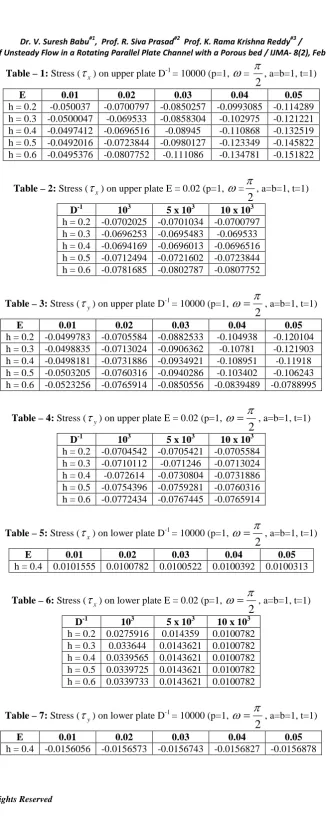
The Stress
τ
x andτ
y on the upper and lower plate are evaluated for variations in E, D-1, h and are tabulated in tables 1to 8. From tables 1 - 4, we notice
τ
x andτ
y increase in magnitude for increase in E while reduces with increase in D-1 for fixed values of the other parameters. The growth of stresses for increase in E is much rapid in comparison to itsdepreciation with increase in D-1. In contrast, on the lower plate (tables 5 - 8)
τ
x reduces to with increase in E whiley
Effect of Unsteady Flow in a Rotating Parallel Plate Channel with a Porous bed / IJMA- 8(2), Feb.-2017.
Table – 1: Stress (
τ
x) on upper plate D-1 = 10000 (p=1,ω
=2
π
, a=b=1, t=1)
E 0.01 0.02 0.03 0.04 0.05
h = 0.2 -0.050037 -0.0700797 -0.0850257 -0.0993085 -0.114289 h = 0.3 -0.0500047 -0.069533 -0.0858304 -0.102975 -0.121221 h = 0.4 -0.0497412 -0.0696516 -0.08945 -0.110868 -0.132519 h = 0.5 -0.0492016 -0.0723844 -0.0980127 -0.123349 -0.145822 h = 0.6 -0.0495376 -0.0807752 -0.111086 -0.134781 -0.151822
Table – 2: Stress (
τ
x) on upper plate E = 0.02 (p=1,ω
=2
π
, a=b=1, t=1)
D-1 103 5 x 10³ 10 x 103
h = 0.2 -0.0702025 -0.0701034 -0.0700797 h = 0.3 -0.0696253 -0.0695483 -0.069533 h = 0.4 -0.0694169 -0.0696013 -0.0696516 h = 0.5 -0.0712494 -0.0721602 -0.0723844 h = 0.6 -0.0781685 -0.0802787 -0.0807752
Table – 3: Stress (
τ
y) on upper plate D-1 = 10000 (p=1,2
π
ω
=
, a=b=1, t=1)E 0.01 0.02 0.03 0.04 0.05
h = 0.2 -0.0499783 -0.0705584 -0.0882533 -0.104938 -0.120104 h = 0.3 -0.0498835 -0.0713024 -0.0906362 -0.10781 -0.121903 h = 0.4 -0.0498181 -0.0731886 -0.0934921 -0.108951 -0.11918 h = 0.5 -0.0503205 -0.0760316 -0.0940286 -0.103402 -0.106243 h = 0.6 -0.0523256 -0.0765914 -0.0850556 -0.0839489 -0.0788995
Table – 4: Stress (
τ
y) on upper plate E = 0.02 (p=1,2
π
ω
=
, a=b=1, t=1)D-1 103 5 x 10³ 10 x 103
h = 0.2 -0.0704542 -0.0705421 -0.0705584 h = 0.3 -0.0710112 -0.071246 -0.0713024 h = 0.4 -0.072614 -0.0730804 -0.0731886 h = 0.5 -0.0754396 -0.0759281 -0.0760316 h = 0.6 -0.0772434 -0.0767445 -0.0765914
Table – 5: Stress (
τ
x) on lower plate D-1 = 10000 (p=1,2
π
ω
=
, a=b=1, t=1)E 0.01 0.02 0.03 0.04 0.05
h = 0.4 0.0101555 0.0100782 0.0100522 0.0100392 0.0100313
Table – 6: Stress (
τ
x) on lower plate E = 0.02 (p=1,2
π
ω
=
, a=b=1, t=1)D-1 103 5 x 10³ 10 x 103
h = 0.2 0.0275916 0.014359 0.0100782 h = 0.3 0.033644 0.0143621 0.0100782 h = 0.4 0.0339565 0.0143621 0.0100782 h = 0.5 0.0339725 0.0143621 0.0100782 h = 0.6 0.0339733 0.0143621 0.0100782
Table – 7: Stress (
τ
y) on lower plate D-1 = 10000 (p=1,2
π
ω
=
, a=b=1, t=1)E 0.01 0.02 0.03 0.04 0.05
Effect of Unsteady Flow in a Rotating Parallel Plate Channel with a Porous bed / IJMA- 8(2), Feb.-2017.
© 2017, IJMA. All Rights Reserved 87 Table – 8: Stress (
τ
y) on lower plate E = 0.02 (p=1,2
π
ω
=
, a=b=1, t=1)D-1 103 5 x 10³ 10 x 103
h = 0.2 -0.0356716 -0.0220561 -0.0156573 h = 0.3 -0.0474457 -0.0220697 -0.0156574 h = 0.4 -0.0478992 -0.0220697 -0.0156574 h = 0.5 -0.0479161 -0.0220697 -0.0156574 h = 0.6 -0.0479166 -0.0220697 -0.0156574
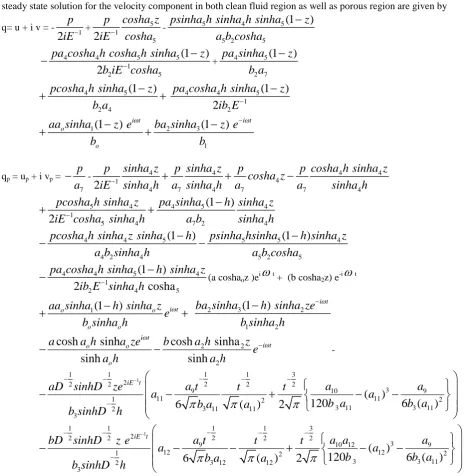
We shall now discuss the velocity in both the clean fluid and the porous regions in the parallel plate channel subjected to a uniform rotation. The resultant flow is due to the inter play between the coriolis force and Darcy force. The velocity field in the clean fluid and porous region consists of the steady state terms, quasi study oscillatory terms due to the non – torsional oscillations of the boundary plate and the unsteady time – decaying terms. In the clean fluid region
the transient terms decay in Dimensionless time of order
4
2π
and in the porous region the infinite series of termsdecay in time or order
1
2 1 2 4
[
D
−+
(
w
−
2
E
−) ]
− , the remaining finite time-dependent terms arising out of branchpoints singularities in the transformed solution decay in time of order
1 2
t
− . When these transient decay term, the quasi steady state solution for the velocity component in both clean fluid region as well as porous region are given byq= u + i v = - 1
2
p
iE
− +5 1 5
2
cosha z
p
iE
−cosha
-5 4 5
5 2 5
(1
)
psinha h sinha h sinha
z
a b cosha
−
4 4 5 5
1
2 5
(1
)
2
pa cosha h cosha h sinha
z
b iE cosha
−−
−
+ 4 52 7
(1
)
pa sinha
z
b a
−
4 5
2 4
(1
)
pcosha h sinha
z
b a
−
+
+
4 4 51 2
(1
)
2
pa cosha h sinha
z
ib E
−−
1 2 3
1
(1
) (1
i t)
i to
o
aa sinha
z e
ba sinha
z e
b
b
ω −ω
−
−
+
+
qp = up + i vp =
7
p
a
−
- 4 4 4 4 41
4 7 4 7 7 4
2
sinha z
sinha z
cosha h sinha z
p
p
p
p
cosha z
iE
−sinha h
+
a sinha h
+
a
−
a
sinha h
5 4 4 5 4
1
5 4 7 2 4
(1
)
2
pcosha h sinha z
pa sinha
h sinha z
iE cosha sinha h
−a b
sinha h
−
+
+
4 4 5 5 5 4
4 2 4 5 2 5
(1
)
(1
)
pcosha h sinha z sinha
h
psinha hsinha
h sinha z
a b sinha h
a b cosha
−
−
−
−
4 4 5 4
1
2 4 5
(1
)
2
cosha
pa cosha h sinha
h sinha z
ib E sinha h
−−
−
(a coshaoz )eiω
t + (b cosha2z) e-iω
t1
(1
)
i to o
o o
aa sinha
h sinha z
e
b sinha h
ω
−
+
+
2 3 21 2
(1
)
i tba sinha
h sinha ze
b sinha h
ω −
−
2 2 2cosh
sinh
cosh
sinha
sinh
sinh
i t
i t
o o
o
a
a h
a ze
b
a h
z
e
a h
a h
ω ω −
−
−
-1 11 1 1 3
2 2
2 2 2 2
3
9 10 9
11 11
1 2 2
3 11 3 11
3 11 11 2
3
(
)
120
6 (
)
6
(
)
2
iE t
a t
a
a
aD sinhD ze
t
t
a
a
b a
b a
b a
a
b sinhD h
π
π
π
− − − − − − −
−
−
+
−
−
1 11 1 1 3
2 2
2 2 2 2
3
9 10 12 9
12 12
1 2 2
3 3 11
3 12 12 2
3
(
)
120
6 (
)
6
(
)
2
iE t
a t
a a
a
bD sinhD
z e
t
t
a
a
b
b a
b a
a
b sinhD h
π
π
π
Effect of Unsteady Flow in a Rotating Parallel Plate Channel with a Porous bed / IJMA- 8(2), Feb.-2017.
1
1 3
1 1 3 3
2 2 2
2 2 2 2
9 9 10
1 1 1 2 1
1 2 2 3 3 3
3
x 1
120
6
2
8
48
2
2
iE t
a t
a t
a
psinhD
z e
t
t
t
b
b
iE
E
ib E
iE D sinhD hb
π
π
π
π
π
− − −
− − − −
− − −
− −
−
+
−
−
+
−
+
1 2
(1
−
coshD h
−)
Expressions for u and v in the clean fluid region consists of rational functions of the hyperbolic terms multiplied by
constants involving
ω
, E and D. The trasient terms however, decay in time of order2
4
π
. It is interesting to observethat in contrast to the single fluid case in the presence of a porous bed, the disturbance does not confine to a layer
abutting the boundary. Infect, it is comparatively large outside the layer
1 1 2
1
− ≤ − − +
z
1
h
ω
2
iE
− and within thislayer, the disturbance is relatively low, with the velocity vanishing on the boundary plate. We also notice that the velocity field depends on the thickness of the porous layer and the hyperbolic terms occurring in the velocity
exponentially decay, provided the thickness of the porous layer is h
1 2
1
1
2
E
< +
. In the absence of porous bed, weobserve the formation boundary layer with thickness
1 1 2
(
ω
−
2
iE
−)
− near the upper plate and1 2
1
2
E
near the lowerplate. Thus we may conclude that the porous bed in a composite medium prevents formation of boundary layers. Even in the porous bed the hyperbolic terms arising in the solution exhibit that the velocity field is the significantly higher in
magnitude in layer
1
2 1 2 2
[
(
2
) ]
z
> −
h
D
−+
ω
−
iE
− − and it gradually dies down in the layer1
2 1 2 2
[
(
2
) ]
z
≤ −
h
D
−+
ω
−
iE
− − .4. RESULTS AND DISCUSSION
Figure-1: u against E I II III IV E 0.01 0.02 0.03 0.04
D-1=10000, h = 0.4, P = 1, t = 1, w =
2
π
Effect of Unsteady Flow in a Rotating Parallel Plate Channel with a Porous bed / IJMA- 8(2), Feb.-2017.
© 2017, IJMA. All Rights Reserved 89 Figure-2: u against D-1
I II III IV D-1 103 3x10³ 5x10³ 104
E=0.05, h = 0.4, P = 1, t = 1, w =
2
π
, a=b=1
Figure-3: u against h I II III IV h 0.2 0.3 0.4 0.5
D-1=10000, E = 0.05, P = 1, t = 1, w =
2
π
Effect of Unsteady Flow in a Rotating Parallel Plate Channel with a Porous bed / IJMA- 8(2), Feb.-2017.
Figure-4:
u
Pagainst E
I II III IV
E 0.01 0.02 0.03 0.04
D
-1=10000, h = 0.4, P = 1, t = 1, w =
2
π
, a=b=1
Figure-5: up against D-1
I II III IV D-1 103 3x10³ 5x10³ 104
E=0.05, h = 0.4, P = 1, t = 1, w =
2
π
Effect of Unsteady Flow in a Rotating Parallel Plate Channel with a Porous bed / IJMA- 8(2), Feb.-2017.
© 2017, IJMA. All Rights Reserved 91 Figure-6: v against E
I II III IV E 0.01 0.02 0.03 0.04
D-1=10000, h = 0.4, P = 1, t = 1, w =
2
π
, a=b=1
Figure-7: v against D-1 I II III IV D-1 103 3x10³ 5x10³ 104
E=0.05, h = 0.4, P = 1, t = 1, w =
2
π
Effect of Unsteady Flow in a Rotating Parallel Plate Channel with a Porous bed / IJMA- 8(2), Feb.-2017.
Figure-8: v against h I II III IV h 0.2 0.3 0.4 0.5
D-1=10000, E = 0.05, P = 1, t = 1, w =
2
π
, a=b=1
Figure-9: vp against E
I II III IV E 0.01 0.02 0.03 0.04
D-1=10000, h = 0.4, P = 1, t = 1, w =
2
π
Effect of Unsteady Flow in a Rotating Parallel Plate Channel with a Porous bed / IJMA- 8(2), Feb.-2017.
© 2017, IJMA. All Rights Reserved 93 Figure-10: vp against D-1
I II III IV D-1 103 3x10³ 5x10³ 104
E=0.05, h = 0.4, P = 1, t = 1, w =
2
π
, a=b=1
Figure-11: vp against h
I II III IV h 0.2 0.3 0.4 0.5
D-1=10000, E = 0.05, P = 1, t = 1, w =
2
π
Effect of Unsteady Flow in a Rotating Parallel Plate Channel with a Porous bed / IJMA- 8(2), Feb.-2017.
The computational analysis has been carried out for variations in the governing parameters E and h, in the particular case the boundary plates are at rest. In figures 1, 2, 3correspond to profiles u with reference to E, D-1,h.We notice that the effect of E is significant on u, with the magnitude of u increasing with E. Thus the rotation affects the clean fluid in comparison to the porous medium. (fig.1). Also from fig.2, we find that u increases with increasing D-1 i.e., lesser the permeability of the porous bed the higher the magniutude of the clean fluid region. This is in contrast to behaviour of the correspond velocity , up in the porous bed (fig. 5), where up reduces with D
-1
.Thus in a densly porous beds the fluid moves with reduced velocity (fig. 5). However with reference to variation in E, the behavior of up in the porous
bed is similar that of u with u enhancing with E. (fig. 4). The thickness of porous bed influence of the flow in the clean fluid region, we observe that the velocity u enhances with increasing the thickness of the bed (fig. 3).
The magnitude of vp in the porous bed is very low compare to it corresponding value in the clean fluid region.
(figs (6-11)). In the porous regions vp decays the faster with increasing the D-1 and at D-1 is of order 104, vp is almost
negligible and does not exhibit variation with other parameters (fig 9-11). In the clean fluid region, v increases with increase in E (fig. 6). We notice that v reduces with increase D-1 (fig. 7) i.e., lesser the permeability lesser magnitude of V, although the depreciationn is relatively to low compare to its enhancement with E. (fig 6&7). We also notice that increasing the thickness of porous bed reduces V in the clean fluid region (fig. 8).
5. REFERENCES
1. Beavers, G.S. and Joseph, D.D. (1967) Boundary Conditions at a Naturally Permeable Wall. Journal of Fluid Mechanics, 30, 197-207.
2. Beavers, G.S., Sparrow, E.V. and Hagnuson, R.A. (1970) Experiments on Coupled Parallel Flows in a Channel and a Bounding Porous Medium. Journal of Basic Engineering, 92, 843-848.
3. Chennabasappa, M.N. and Ramanna (1976) The Effect of the Thickness of the Porous Material on the Parallel Plate Channel. Applied Science Research, 32, 607-617.
4. Claire Jacobs, Q. (1971) Transient Motions Produced by Disks Oscillating about a State of Regid Rotation. Q. Jour. Mech. Appl. Maths., 24, 221.
5. Debnath, L. (1975) Exact Solutions of the Unsteady Hydrodynamic and Hydromagnetic Boundary Layer Equations in a Rotating Fluid System. Zeitschrift für Angewandte Mathematik und Mechanik, 55, 431-438. 6. Greenspan, H.P. and Howard, L.N. (1963) On a Time Dependent Motion of a Rotating Fluid. Journal of Fluid
Mechanics, 17, 385-404.
7. Murthy, K.N.V.( 1979) Appl.Sci.Res., V.35, P.111.
8. Rajashekara, B.M. (1974) Experimental and Theoretical Study of Flow Past a Porous Medium. PhD Thesis, Banglore University, Banglore.
9. Rudraiah, N. and Veerabhadraiah, R. (1977) Temperature Distribution in Couette Flow past a Permeable Bed. Proceedings of the Indian Academy of Sciences, 86A, 537-547.
10. Rao, D.R.V.P., Siva Prasad, R. and Rajeshwara Rao, U. (2003) Hall Effects on Rotating Hydro Magnetic Channel Flows. Bulletin of Pure and Applied Science, 22E, 501-510.
11. Rudraiah, N. and Patil, P. (1971) Universal Stability of the Laminar Dispersion of Solute in a Porous Medium. Current Science, 40, 561-563.
12. Suffman, P.G. (1971) Studies in Applied Mathematics, 93.
13. Sarojamma, G. and Krishna, D.V. (1981) Transient Hydromagnetic Convective Flow in a Rotating Channel with Porous Boundaries. Acta Mechanica, 39, 277-288.
14. Rao, D.R.V.P., Siva Prasad, R. and Rajeshwara Rao, U. (2003) Hall Effects on Rotating Hydro Magnetic Channel Flows. Bulletin of Pure and Applied Science, 22E, 501-510.
15. Taylor.G.I. 1971 J.Fluid Mech., 49, P.319. 16. Vidyanidhi.V. 1969J.Maths.Phys.Sci.3, P.193.
17. Veera Krishna, M., Siva Prasad, R. and Krishna, D.V. (2010) Hall Effects on Steady Hydro Magnetic Flow of a Couple Stress Fluid through a Composite Medium in a Rotating Parallel Plate Channel with Porous Bed on the Lower Half. Advanced Studies in Contemporary Mathematics, 20, 457-468.
18. Veera Krishna, M. and Malashetty, S.G. (2012) Unsteady Flow of an Incompressible Electrically Conducting Second Grade Fluid through a Porous Medium in a Rotating Parallel Plate Channel Bounded by a Porous Bed. International Journal of Applied Mathematics and Mechanics, 8, 61-84.
19. Krishna, M.V. and Prakash, J. (2015) Hall Current Effects on Unsteady MHD Flow in a Rotating Parallel Plate Channel Bounded by Porous Bed on the Lower Half—Darcy Lapwood Model. Open Journal of Fluid Dynamics, 5, 275-294.
Source of support: Nil, Conflict of interest: None Declared.