ELASTIC INCOHERENT NEUTRON SCATTERING FINDINGS
ON HOMOLOGOUS DISACCHARIDES
F. Migliardo
[a]*, M. T. Caccamo
[a], S. Magazù
[a]Keywords:bioprotectant systems, biotechnological applications, neutron scattering, wavelet, disaccharides, trehalose, maltose, sucrose
A new wavevector analysis performed by wavelet transform of Elastic Incoherent Neutron Scattering (EINS) data on three bioprotectant systems, i.e. on the homologous disaccharides trehalose, maltose and sucrose, is presented. The analysis allows to compare the spatial properties of the three systems in the wavevector range of Q = 0.28 - 4.27 Ǻ-1, revealing the existence of different kinds of protons dynamics. It emerges that, differently from previous wavevector analyses, both the low and high wavevector contributions for trehalose, at all the investigated temperature values, are constantly lower and sharper, giving rise to a global energy distribution along the wavevector range markedly less extended. These findings give an account for the bioprotectant effectiveness of trehalose in the medical, pharmaceutical and cosmetic fields.
* Corresponding Author
E-Mail: [email protected]
[a] Dipartimento di Fisica e di Scienze della Terra dell’Università degli Studi di Messina, Viale F. S. D’Alcontres 31, 98166, Messina, Italy
Introduction
In the last years a huge effort has been addressed to understand the molecular mechanisms originating in organisms able to survive under environmental stress
conditions.1 Homologous disaccharides (C
12H22O11), e.g.
trehalose, maltose, and sucrose have been shown to be cryptobiotic-activating substances, since they allow to several organisms under stress conditions to enter in a state of cryptobiosis, i. e. hidden life, where vital functions are reduced to undetectable levels. Trehalose is a nonreducing
disaccharide of glucose (α-D-glucopyranosil
α-D-glucopyranoside) constituted by two pyranose (six-membered) rings in the same a configuration, linked by a glycosidic bond between the chiral carbon atoms C1 of the
two rings. Sucrose (α-D-glucopyranosil
β-D-fructofuranoside) is constituted by a glucose ring (pyranose) in the α configuration and a fructose ring (furanose) in the β configuration; the α and β structures of the same monosaccharide differ only in the orientation of the OH groups at some carbon atom in the ring itself (mutarotation equilibria). Maltose (4-O-α-D-glucopyranosyl-D-glucose) is constituted by two pyranose rings of glucose in the α configuration, the oxygen bridge linking the two carbon atoms C1 and C4 of the two rings; the α and β structures of the same monosaccharide differ only in the orientation of the OH groups at some carbon atom in the ring itself. Contrarily to trehalose and sucrose, maltose is a reducing sugar because the anomeric carbons on the right-hand sugar
are part of a hemiacetal and exhibits mutarotation.2 In
particular, trehalose preserves and maintains activity and leavening capacity of many desiccation resistant organisms.
Some species of soil-dwelling organisms3 can pass, during
dry times, into a state of suspended animation involving a possible chemical action of trehalose. These species can be dehydrated nondestructively and reversibly because of their
ability to synthesize this disaccharide. For example, Wood
Frogs (Lithobates sylvaticus) can survive being frozen. Its
tissues contain high concentrations of simple sugars, including glucose and trehalose, which form a sugar glass keeping the frog's cells intact. Although the disaccharide cryptoprotectant effectiveness is proven, the underlying molecular mechanisms are still cryptic. Although many studies have been focused on ternary systems such as
biostructure/water/disaccharide,4-13 many researchers retain
that the protein dynamics is strongly coupled with, and
depends on, the solvent properties14-22 and, for this reason,
their attention has been mainly addressed to the disaccharide/water mixtures. There are several hypotheses formulated to clarify the bioprotective action of trehalose, making clear that the reasons for its effectiveness should be connected to the physical chemical properties at a molecular scale. Some scattering findings on disaccharide/water mixtures indicate that the molecular mechanisms underlying the trehalose bioprotective effectiveness lie on the peculiar
interaction mechanisms of trehalose with water,
independently on the biostructure nature.
Green and Angell23 suggest that the bioprotectant
effectiveness of trehalose could be ascribed to the higher value of its glass transition and mixtures with water, and this is the only reason for its superior bioprotectant effectiveness in comparison with the other two disaccharides, i.e. sucrose and maltose. However, other similar systems show an even
higher Tg value, but do not show comparable bioprotective
action.
Crowe and Reid24 agree with the hypothesis of a direct
interaction between sugar and biostructure, strengthening this interpretation with the simulation reported by Grigera et
co-workers25 who argue that the structure of trehalose is
perfectly adaptable to the tetrahedral coordination of pure water, whose structural and dynamical properties are not significantly affected by trehalose. As a matter of fact experimental findings obtained by several spectroscopic techniques indicate that the structural and dynamical properties of water, even at relatively low sugar concentration, result drastically perturbed by disaccharides,
and in particular by trehalose.26-33 Neutrons with a 1 Å
wavelength and an energy close to 1 kcal/mol represent an excellent probe to characterize thermal molecular motions
different molecular processes involved in the dynamics of some molecular and macromolecular systems of biophysical interest, for the bioprotectant-water mixtures can be effectively investigated by Elastic Incoherent Neutron
Scattering (EINS)42 by means of the so called
“fixed-windows” method43 where the scattered intensity is
collected at =0 with a fixed “energy windows”
corresponding to the instrumental energy resolution. It is
well known that by a wavelet analysis44-46 is possible to
extract information from a non-stationary signal in terms of functional forms called mother wavelet. More precisely, the translated-version wavelets locate where one concerns, whereas the scaled-version wavelets allows to analyze the
signal at different scales.47 The square of the modulus of the
wavelet transform is called scalogram, which shows how the “energy” of the signal varies as a function of the independent variable and of the scale parameter.
The aim of the present work is to show the results of a new wavelet analysis of EINS data on water mixtures of the three homologous disaccharides trehalose, maltose and sucrose. This analysis allows to compare both the spatial properties of the three systems revealing the existence of different kinds of protons dynamics in different wavevector ranges. These findings furnish useful information on the different nature of the involved dynamical processes in bioprotection that can justify the higher trehalose “cryptobiotic” effectiveness, i. e. the capability of trehalose to create a more rigid environment where biomolecules are better protected.
Methods
EINS measurements have been carried out across the glass transition temperature values on trehalose, maltose, and
sucrose/water (H2O) mixtures by using the backscattering
spectrometer IN13 at the Institute Laue Langevin (Grenoble, France). The IN13 main characteristic is the relatively high energy of the incident neutrons (16 meV) which makes it
possible to span a wide range of momentum transfer Q(≤
4.87 Å-1) with a very good energy resolution (∼8 μeV).
Therefore neutron scattering experiments on IN13 provide information on the motions of the sample hydrogen in a space-time window of 1 Å and 0.1 ns given by its scattering
vector modulus, Q and energy resolution, and allow to
characterize both flexibility (obtained from the fluctuation amplitudes) and rigidity (obtained from how fluctuations vary with temperature and expressed as a mean
environmental force constant). Ultrapure powdered
trehalose, maltose and sucrose, and H2O, purchased by
Aldrich-Chemie, were used to prepare solutions at a weight fraction corresponding to 6 and 19 water molecules for each disaccharide molecule. Measurements were performed in the temperature range of 20–310K on hydrogenated trehalose,
maltose and sucrose in H2O at a weight fraction value of
φ=0.5, corresponding to 19 water molecules for each
configuration the incident wavelength was 2.23 Å and the
Q-range was 0.28 – 4.87 Å-1. Raw data were corrected for
cell scattering and detector response and normalized to unity
at Q= 0.00 Å-1.
Results and Discussions
The main aim of the present work is to highlight the differences in the behavior properties of the aqueous mixtures of three homologous disaccharides, i.e. sucrose, maltose and trehalose, in order to explain the molecular mechanisms that make trehalose the most effective bioprotectant. In order to compare both the spatial properties of the three system, a wavevector analysis of these EINS data through a wavelet approach is performed. Such an analysis puts into evidence, for the three investigated disaccharide mixtures by varying temperature, the existence of different kinds of protons dynamics which interest different wavevector ranges. In this work, the Mexican hat has been considered, which is defined as:
Its form is derived from the second derivative of a Gaussian function, and the multiplicative constant is the normalization factor of mother wavelets. The name, “Mexican hat”, is due at the shape of the function, that is like an upside-down Mexican hat. This function drops to zero very fast and it is limited in a certain range, respecting the conditions of the mother wavelets.
In Fig. 1, as an example, the 3D scalograms as resulting from a wavelet analysis for sucrose/water mixtures, at a
molar ratio of (1 disaccharide)/(19 H2O) at three different
temperatures, i.e. T=19 K, 264 K and 284 K are shown.
Through the wavelet scalogram it is possible to extract the spectral features as well as to highlight the components of the spectral density, i.e. the average energy located in a
given wavevector-scale domain. In particular, the
employment of the wavelet analysis to the entire set of experimental data puts into evidence the presence of two distinct kinds of motions which appear to interest different space ranges; at the lowest investigated temperature, 19 K, only one broad spectral contribution which spans in the
whole investigated wavevector range, i.e. from Q=0.27 Å-1
to Q=4.27 Å-1, is revealed, as reported in fig. 1 (left); such a
spectral contribution can be assigned mainly to the vibration motions of the system protons. As reported in fig. 1 (center), which reports the 3D scalogram at the intermediate
temperature value of T= 264 K, by the rising of temperature
a different contribution, at low wavevector values and
2 2
2
( ) 1 exp
1 / 4 3 2 2
t t
t
Figure 1. 3D scalograms obtained by wavelet analysis for EINS spectra for sucrose water mixtures at three different temperatures, i.e. T=19 K, 264 K and 284 K.
Finally in fig. 1 (right), the 3D scalogram of sucrose water
mixtures at T=284 K is reported. As it can be seen the
weight of the low Q contribution increases with temperature
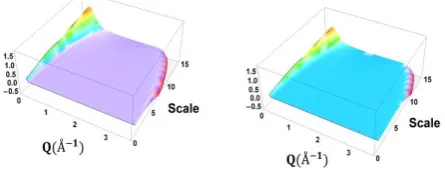
showing a different increasing rate for the three investigated systems. In order to better highlight the different behavior in the investigated systems fig. 2 shows a comparison of the scalogram for trehalose and sucrose at the intermediate
temperature of T=264 K.
Figure 2. A comparison of the 3D scalogram for sucrose (left) and trehalose (right) at the intermediate temperature of T=264 K.
As it can be seen, the spectral energy density as a function of the wavevector distributes itself differently for the two disaccharides; for trehalose by increasing temperature it is constantly sharper while the energy distribution along the wavevector range appears to be markedly less broadened.
Such a scalogram comparison allows to highlight the differences between the two homologous disaccharides, with specific reference to the different explored wavevector ranges. It results that the spectral energy density as a function of the exchanged momentum distributes itself differently for the two disaccharides. More in details, for the
case of trehalose/water mixture the low Q contribution is
less high and wide in respect to sucrose/water mixture. Furthermore the satellite contribution appears to be more pronounced and interests a lower wavevector range. Such results show a higher thermal restrain for trehalose in respect to the other homologous disaccharide.
Summarizing the present study shows that, differently from previous wavevector analyses, both the low and high wavevector contributions for trehalose, at all the investigated temperature values, are constantly lower and sharper, giving rise to a global energy distribution along the wavevector range markedly less extended.
Conclusions
A new wavevector analysis performed by wavelet transform of Elastic Incoherent Neutron Scattering (EINS) data on three glass forming systems, i.e. on the homologous disaccharides trehalose, maltose and sucrose, is presented. The analysis allows to compare the spatial properties of the
three glass forming systems in the wavevector range of Q=
0.28 - 4.27 Å-1, revealing the existence of different kinds of
protons dynamics. The wide explored wavevector range allows to characterize and to compare the systems molecular motions according to their spatial extent and amplitude. The experimental results reveal that, by increasing temperature, the scattered intensity shows an almost linear trend at the
lowest temperature, T=19 K, whereas, at higher temperature
values, drops in Q fulfilling a decaying behavior which
results more marked in the case of sucrose and maltose in respect to trehalose. By the wavelet analysis of the scattered intensity vs exchanged momentum, for the sucrose, maltose
and trehalose/mixtures H2O, the existence of two different
classes of protons dynamics, which interest different wavevector ranges is shown. More precisely, at the lowest temperature, 19 K, only one spectral contribution is revealed; such a wide and flat contribution spans the whole wavevector range and is almost equal for all the investigated disaccharide/water systems; it can be attributed to the vibrational motions of the scatterer particles, i.e. the system’s protons. At higher temperatures the weight of the
low Q contribution tends to rise and shows a different
investigated spatial scales, in respect to maltose and sucrose/water mixtures.
References
1Crowe, J. H., Crowe, L. M. and Chapman, D., Science, 1984, 223, 701–703.
2Branca, C., Faraone, A., Magazu, S., Maisano, G., Migliardo, F., Migliardo, P. and Villari, V., Rec. Res. Develop. Phys. Chem.
1999, 3, 361.
3Crowe, J. H., Crowe, L. M., Effects of dehydration on membranes
and membrane stabilization at low water activities, Biological Membranes, Academic Press, New York, 1985.
4Cordone, L., Galajda, P., Vitrano, E., Gassman, A., Ostermann, A., Parak, F., Eur. Biophys. J.1998, 27, 173-176.
5Cordone, L., Ferrand, M., Vitrano, E., Zaccai, G., Biophys. J.,
1999, 76, 1043-1047.
6Cottone, G., Cordone, L. and Ciccotti, G., Biophys. J., 2001, 80, 931-938.
7Paciaroni, A., Cinelli, S. and Onori, G., Biophys. J., 2002, 83, 1157-1164.
8Frauenfelder, H., Sligar, S.G. and Wolynes, P.G. Proc. Natl. Acad.
Sci. USA, 1991, 254, 1598-1603.
9Frauenfelder, H., McMahon, B. Proc. Natl. Acad. Sci. USA, 1998,
9995, 4795-4797.
10Oliver, A.E., Crowe, L. M. and Crowe, J. H., Seed Sci. Res.,1998,
8, 211-221.
11Branca, C., Magazù, S. and Migliardo, F., Rec. Res. Dev.Phys.
Chem.,2002, 6, 35-73.
12Branca, C., Magazù, S., Maisano, G., Migliardo, F. and Romeo, G., Phil. Mag. B, 2002, 82, 347-355.
13Branca, C., Magazù, S., Maisano, G. and Migliardo, F., Phys.
Rev. B, 2001, 64, 2242041-2242048.
14Branca, C., Magazù, S., Maisano, G., Migliardo, F. and Romeo, G., J. Phys. Chem. B, 2001, 105, 10140-10145.
15Branca, C., Faraone, A., Magazù, S., Maisano, G., Migliardo, F., Migliardo, P., and Villari, V., Rec. Res. Dev. Phys. Chem.,
1999, 3, 361-403.
16Branca, C., Magazù, S., Maisano, G., and Migliardo, P., J. Chem.
Phys., 1999, 111, 281-287.
17Magazù, S., Migliardo, F. and Benedetto, A. J. Phys. Chem. B,
2011, 115, 7736-7743.
18Branca, C., Magazù, S., Maisano, G., Migliardo, F., Migliardo, P. and Romeo, G., J. Chem. Phys. B, 2002, 106, 10272-10276. 19Faraone, A., Magazù, S., Maisano, G., Ponterio, R. and Villari, V.
Macromol.1999, 32, 1128-1133.
20Magazù, S., Migliardo, F. and Ramirez-Cuesta, A. J., J. Roy. Soc.
Interf.,2005, 2, 527-532.
21Magazù, S., Phys. B, 1996, 26, 92-106.
22Magazù, S., Maisano, G., Migliardo, F. and Mondelli, C.,
Biophys. J.,2004, 86, 3241-3249.
23Green, J. L. and Angell, C. A., J. Phys. Chem. B, 1989, 93, 2880-2882.
24Crowe, L. M., Reid, D. S. and Crowe, J. H., Biophys. J., 1996, 71, 2087-2093.
2010, 147, 146-152.
27Barreca, D., Bellocco, E., Laganà, G., Leuzzi, U., Magazù, S., Migliardo, F. and Galtieri, A. Food Chem., 2008, 106, 1438-1442.
28Bellocco, E., Barreca, D., Laganà, G., Tellone, E., Ficarra, S., Migliardo, F., Leuzzi, U., Magazù, S. and Galtieri, A., Intern. J. Biol. Macromol., 2008, 43, 474-480.
29Barreca, D., Bellocco, E., Galli, G., Laganà, G., Leuzzi, U., Magazù, S., Migliardo, F., Galtieri, A. and Telling, M. T., Intern. J. Biol. Macromol.,2009, 45, 120-128.
30Bellocco, E., Barreca, D., Laganà, G., Leuzzi, U., Migliardo, F., La Torre, R., Galli, G., Galtieri, A., Minutoli, L. and Squadrito, F. Chem. Phys. 2008, 345, 191-195.
31Lombardo, D., Langmuir, 2009, 25, 3271-3275.
32Kiselev, M. A., Lesieur, P., Kisselev, A.M. and Lombardo, D., J.
All. Comp., 2001, 328, 71-76.
33Kiselev, M. A., Lesieur, P., Kisselev, A.M., Lombardo, D. and Aksenov, V. L., App. Phys. A-Mat. Sci. Proc,. 2002, 74, S1654-S1656.
34Frauenfelder, H., Chen, G., Berendzen, J., Fenimore, P.W., Jansson, H., McMahon, B. H., Stroe, I. R., Swenson, J. and Young, R. D., Proc. Natl. Acad. Sci. USA, 2009, 106, 5129-5134.
35Lusceac, S. A. and Vogel, M. J. Phys. Chem. B, 2010, 114, 10209-10216.
36Fu, L., Villette, S., Petoud, S., Fernandez-Alonso, F. and Saboungi, M. L., J.Phys. Chem. B, 2011, 115, 1881-1888. 37Schirò, G., Caronna, C., Natali, F. and Cupane, A., J. Am. Chem.
Soc., 2010, 132, 1371-1376.
38Khodadadi, S., Curtis, J. E. and Sokolov, A. P., J. Phys. Chem. B,
2011, 115, 6222-6226.
39Capaccioli, S., Ngai, K. L., Ancherbak, S. and Paciaroni, A., J.
Phys. Chem. B, 2012, 116, 1745-1757.
40Magazù, S., Migliardo, F. and Benedetto, A., J. Phys. Chem B,
2010, 114, 9268-9274.
41Jannelli, M. P., Magazù, S., Migliardo, P., Aliotta, F. and Tettamanti, E. Cond. Matt., 1996, 8, 8157-8171.
42Zaccai, G., Science, 2000, 288,1604-1607.
43Prager, M., Press, W., Alefed, B. and Huller, A., J. Chem. Phys.,
1977, 67, 5126-5132.
44Koo, I. S., and Kim, W. W., ISA Trans., 2000, 39, 309-316.
45Van Den Berg, J. C. Wavelet in physics, Cambridge University Press, Cambridge, 1999.
46Mallat, S. G., IEEE Trans. On Patt. Anal. And Mach. Intel., 1989,
2, 674-682.
47Magazù, S., Migliardo, F. and Caccamo, M. T., J.Phys. Chem. B,
2012, 116, 9417-9423.