Available online throug
ISSN 2229 – 5046
ON ANTI FUZZY IDEALS OF LATTICES
DHANANI S. H.*
Department of Mathematics, K. I. T.’s College of Engineering, Kolhapur. India.
PAWAR Y. S.
Department of Mathematics, Shivaji University, Kolhapur. India.
(Received On: 15-12-15; Revised & Accepted On: 25-01-16)
ABSTRACT
I
n this paper, we introduce the notions of anti fuzzy ideals and investigated some of its basic properties. We also study the homomorphic anti image, pre-image of anti fuzzy ideal. We introduce the notion of anti fuzzy prime ideals of a lattice and some related properties of it are discussed.AMS Classification: 06D72.
Keywords: Fuzzy ideal, Anti fuzzy ideal, Anti fuzzy prime ideal.
1. INTRODUCTION
The concept of fuzzy sets was introduced by Zadeh [19]. Rosenfeld [15] used this concept to formulate the notion of fuzzy groups. Since then many other fuzzy algebraic concepts based on the Rosenfeld's fuzzy groups were developed. Yuan and Wu [18] introduced the concepts of fuzzy sublattices and fuzzy ideals of a lattice. Ajmal and Thomas [1] defined a fuzzy lattice as a fuzzy algebra and characterized fuzzy sublattices.
In [4], Biswas introduced the concept of anti fuzzy subgroups of groups. M. Shabir and Y. Nawaz[16] introduced the concept of anti fuzzy ideals in semigroups and M. Khan and T. Asif [9] characterized different classes of semigroups by the properties of their anti fuzzy ideals. Lekkoksung and Lekkoksung [13] introduced the concept of an anti fuzzy bi-ideal of ordered Γ-Semigroups. Kim and Jun studied the notion of anti fuzzy ideals of a near-ring in [10]. In [5], Datta introduced the concept of anti fuzzy bi-ideals in rings. Anti fuzzy ideals of Γ - rings were studied by Zhou et.al. in [20]. In [17], Srinivas et. al. introduced the concept of anti fuzzy ideals of Γ- near-ring. Dheena and Mohanraaj [6] introduced the notion of anti fuzzy right ideal, anti fuzzy right k-ideal and intuitionistic fuzzy right k-ideal in semiring. In [8], Hong and Jun introduced the notion of anti fuzzy ideals of BCK – algebras. Al-Shehri [3] introduced the notion of anti fuzzy implicative ideal of BCK - algebras. Mostafa et.al [14] introduced the concept of anti-fuzzy sub implicative ideal of BCI-algebra. Akram [2] introduce the notion of anti fuzzy ideals in Lie algebras. In this paper, we introduce the notion of anti fuzzy ideals of lattices and investigate some related properties.
2. PRELIMINARIES
Now onwards X denotes a bounded lattice with the least element 0 and the greatest element 1 unless otherwise stated. For the undefined terms in this paper, the reader is referred to [7] and [11] respectively.
A non - empty subset I of X is called an ideal of X if, for any a, b ∈I and x ∈X, a ∨b ∈I, a ∧b ∈I and for a ∈I, x ∧a = x implies x∈I. A non-empty subset D of X is called a dual ideal of X if, for any a, b ∈D and x ∈X, a ∧b ∈D, a ∨b∈D and for a ∈D, x ∨a = x implies x ∈D. A proper ideal P of X is called a prime ideal of X if, for any a, b ∈X, a ∧b ∈P implies a ∈P or b ∈P.
A fuzzy set
µ
of X is a function μ: X → [0, 1].Corresponding Author: Dhanani S. H.*
Let
µ
be a fuzzy set of X. Then the complement ofµ
, denoted byµ
c, is the fuzzy set of X given byµ
c(x) = 1 −µ
(x) for all x ∈ X. For t ∈ [0, 1], the set, ≤t
µ
= { x ∈ X /µ
(x) ≤ t } is called a lower t-level cut ofµ
and
µ
t≥= { x ∈ X /µ
(x) ≥ t } is called an upper t-level cut ofµ
. If t1 < t2, then≤
1
t
µ
⊆ ≤2
t
µ
and ≥2
t
µ
⊆ ≥1
t
µ
fort1, t2∈ [0, 1].
Also
µ
t≤=( )
≥ −t c
1
µ
for all t ∈ [0, 1].A fuzzy set
µ
of X is proper if it is a non constant function.A fuzzy set
µ
of X is called a fuzzy sublattice of X if for all x, y ∈ X,µ
(x ∧ y) ≥ min {µ
(x),µ
(y)} andµ
(x ∨ y) ≥ min {µ
(x),µ
(y)} (see [12]).A fuzzy sublattice
µ
of X is a fuzzy ideal of X if for all x, y ∈ X,µ
(x ∨ y) = min {µ
(x),µ
(y)} (see [12]).A proper fuzzy ideal
µ
of X is called fuzzy prime ideal of X if for all x, y ∈ X,µ
(x ∨ y) ≤ max {µ
(x),µ
(y)} (see [12]).3. ANTI FUZZY IDEALS
We introduce the notion of anti fuzzy sublattice of X.
Definition 3.1: A fuzzy set
µ
of X is an anti fuzzy sublattice of X if for all x, y ∈ X,µ
(x ∧ y) ≤ max {µ
(x),µ
(y)} andµ
(x ∨ y) ≤ max {µ
(x),µ
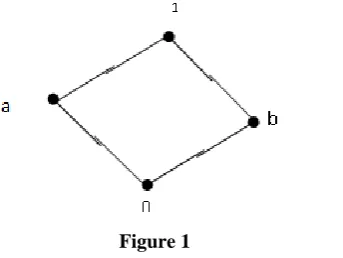
(y)}.Example 3.2: Consider the lattice X = {0, a, b, 1} as shown by the Hasse diagram of Figure 1.
Figure 1
Define a fuzzy set
µ
of X byµ
(0) = 0.1,µ
(a) = 0.2,µ
(b) = 0.3 andµ
(1) = 0.3. Thenµ
is an anti fuzzy sublattice of X. Every fuzzy set of X need not be an anti fuzzy sublattice of X. For this consider the following example.Example 3.3: Consider the lattice X = {0, a, b, 1} as shown by the Hasse diagram of Figure 1. Define a fuzzy set
µ
of X byµ
(0) = 0.5,µ
(a) = 0.2,µ
(b) = 0.3 andµ
(1) = 0.2.µ
is not an anti fuzzy sublattice of X asµ
(a ∧ b) =µ
(0) = 0.5 ≰ max {µ
(a),µ
(b)} =0.3.In Theorem 3.4 we prove that the complement of an anti fuzzy sublattice of X is a fuzzy sublattice of X.
Theorem 3.4: A fuzzy set
µ
of X is an anti fuzzy sublattice of X if and only ifµ
c is a fuzzy sublattice of X.Proof: Let
µ
be an anti fuzzy sublattice of X. Then for x, y ∈ X,µ
c ( x ∧ y ) = 1 −µ
(x ∧ y)≥ 1 – max {
µ
(x),µ
(y)} (sinceµ
is an anti fuzzy sublattice of X) = min {1 −µ
(x), 1 −µ
(y)}and
µ
c (x ∨ y) = 1 −µ
(x ∨ y)≥ 1 – max {
µ
(x),µ
(y)} (sinceµ
is an anti fuzzy sublattice of X) = min {1 −µ
(x), 1 −µ
(y)}= min {
µ
c (x),µ
c (y)}.Hence
µ
c is a fuzzy sublattice of X. The converse is proved similarly.Definition 3.5: Let
µ
be an anti fuzzy sublattice of X. Thenµ
is an anti fuzzy ideal of X ifµ
(x ∨ y) = max {µ
(x),µ
(y)} for all x, y ∈ X.Example 3.6: Consider the lattice X = {0, a, b, 1} as shown by the Hasse diagram of Figure 1. Define a fuzzy set
µ
of X byµ
(0) = 0.1,µ
(a) = 0.2,µ
(b) = 0.3 andµ
(1) = 0.3. Thenµ
is an anti fuzzy ideal of X.Every anti fuzzy sublattice of X need not be an anti fuzzy ideal of X. For this consider Example 3.7.
Example 3.7: Consider the lattice X = {0, a, b, 1} as shown by the Hasse diagram of Figure 1. Define a fuzzy set
µ
of X byµ
(0) = 0,µ
(a) = 0.2,µ
(b) = 0.3 andµ
(1) = 0.2. Thenµ
is an anti fuzzy sublattice of X. Butµ
is notan anti fuzzy ideal of X as
µ
(a ∨ b) =µ
(1) ≠ max {µ
(a),µ
(b)}.Remark 3.8: Let
µ
be an anti fuzzy ideal of X. Asµ
(x) =µ
(x ∨ 0) = max{µ
(x),µ
(0)}. We getµ
(0) ≤µ
(x) for any x ∈ X.In the following theorem we give a necessary and sufficient condition of a fuzzy set of X to be an anti fuzzy ideal of X.
Theorem 3.9: A fuzzy set
µ
of X is an anti fuzzy ideal of X if and only ifµ
c is a fuzzy ideal of X.Proof: Let
µ
be an anti fuzzy ideal of X. By Theorem 3.4µ
c is a fuzzy sublattice of X.For x, y ∈ X,
µ
c (x ∨ y) = 1 −µ
(x ∨ y)= 1- max {
µ
(x),µ
(y)}( sinceµ
is an anti fuzzy ideal of X) = min {1-µ
(x), 1 -µ
(y)}= min {
µ
c (x),µ
c (y)}Thus
µ
c is a fuzzy ideal of X. The converse is proved similarly.In the following theorem we give a characterization of an anti fuzzy ideal of X.
Theorem 3.10: A fuzzy set
µ
of X is an anti fuzzy ideal of X if and only if lower t-level cut ofµ
,µ
t≤ is an ideal of X for each t ∈ [µ
(0), 1].Proof: Let
µ
be an anti fuzzy ideal of X and t ∈ [µ
(0), 1]. Then by Theorem 3.9,µ
c is a fuzzy ideal of X. Hence≤
t
µ
=( )
µ
c 1≥−t is an ideal of X [see 6, Lemma 3.1].Conversely, let lower t-level cut of
µ
,µ
t≤ is an ideal of X for each t∈[µ
(0), 1] and s ∈ [0, 1−µ
(0)] = [0,µ
c (0)]. Then 1− s ∈ [µ
(0), 1] and( )
≥
s c
µ
=µ
1≤−sis an ideal of X. Hence( )
≥
s c
µ
is an ideal of X for all s ∈[0,µ
c(0)], andµ
cis a fuzzy ideal of X [see 1, Lemma 3.1]. This shows that
µ
is an anti fuzzy ideal of X.Theorem 3.11: If I is an ideal of X, then for each t ∈ [0, 1], there exists an anti fuzzy ideal
µ
of X such thatµ
t≤= I. Proof: Let I be an ideal of X. Let t ∈ [0, 1]. Define a fuzzy setµ
of X by
∉ ∈ =
I x if
I x if t
x
1 ) (
Then
µ
s≤ = I for any s ∈[t, 1) = [µ
(0), 1), andµ
1≤ = X. Thusµ
s≤ is an ideal of X for all s ∈[μ(0), 1]. Henceµ
is an anti fuzzy ideal of X from Theorem 3.10, andµ
t≤ = I.Let
µ
be a fuzzy set of X. Define Xµ
= {x ∈ X /µ
(x) =µ
(0)}. Then we haveTheorem 3.12: If
µ
is an anti fuzzy ideal of X, then Xµ
is an ideal of X.Proof: Let
µ
be an anti fuzzy ideal of X. Let x, y ∈ Xµ
thenµ
(x) =µ
(0) andµ
(y)=µ
(0). Thenµ
(x ∨ y) =max {
µ
(x),µ
(y)} =µ
(0). Hence x ∨ y ∈ Xµ
.Let x ≤ a, x ∈ X and a ∈ X
µ
. Then x ∨ a = a andµ
(a) =µ
(0).As
µ
is an anti fuzzy ideal of X,µ
(x ∨ a) = max {µ
(x),µ
(a)}.Thus
µ
(a) = max {µ
(x),µ
(a)}. Thereforeµ
(x) ≤µ
(a) =µ
(0).Also by Remark 3.8,
µ
(0) ≤µ
(x). So we getµ
(x) =µ
(0). Hence x ∈ Xµ
.This shows that X
µ
is an ideal of X.For a family of fuzzy sets {
µ
i | i ∈Λ} in X, the union ii
µ
∨
Λ
∈ is defined by
i i
µ
∨
Λ
∈ (x) = sup {
µ
i (x) / i ∈Λ} for each x ∈ X.Theorem 3.13: If {
µ
i / i ∈Λ} is a family of anti fuzzy ideals of X, then so is ii
µ
∨
Λ ∈ .
Proof: Let {
µ
i / i ∈Λ } be a family of anti fuzzy ideals of X. Let x, y∈X.( i
i
µ
∨
Λ
∈ ) (x ∧ y) = sup {
µ
i (x ∧ y) / i ∈Λ}≤ sup { max{
µ
i (x),µ
i (y)} (sinceµ
i is an anti fuzzy sublattice of X = max {sup {µ
i (x) }, sup {µ
i (y)}= max { i
i
µ
∨
Λ
∈ (x),i i
µ
∨
Λ
∈ (y)}
Also ( i
i
µ
∨
Λ
∈ ) (x ∨ y) = sup {
µ
i (x ∨ y) / i ∈Λ}≤ sup{max {
µ
i (x),µ
i (y)} (sinceµ
i is an anti fuzzy sublattice of X) = max{sup {µ
i (x)}, sup {µ
i (y)}= max{ i
i
µ
∨
Λ
∈ (x) i i
µ
∨
Λ
∈ (y)}
Hence i
i
µ
∨
Λ
∈ is an anti fuzzy sublattice of X.
For x, y ∈ X, ( i
i
µ
∨
Λ
∈ ) (x ∨ y) = sup {
µ
i (x ∨ y) / i ∈Λ}= sup {max {
µ
i (x),µ
i (y)} (sinceµ
i is an anti fuzzy ideal of X)= max {sup {
µ
i (x) }, sup {µ
i (y)}= max { i
i
µ
∨
Λ
∈ (x), i i
µ
∨
Λ
∈ (y)}
Hence i
i
µ
∨
Λ
Let f: X → Y be a mapping where Y is a non – empty set. Let
µ
be a fuzzy set of Y. Then f -1 (µ
) is a fuzzy set of Xand is defined by f -1 (
µ
) (x) =µ
(f (x)) for all x ∈ X.Theorem 3.14: Let f: X →Y be a lattice homomorphism where Y is a bounded lattice. Let
µ
be an anti fuzzy ideal of Y. Then f -1 (µ
) is an anti - fuzzy ideal of X.Proof: Let x, y ∈ X.
Then f -1 (
µ
) (x ∧ y) =µ
(f (x ∧ y))=
µ
(f (x) ∧ f (y)) (since f is a lattice homomorphism)≤ max {
µ
(f (x)),µ
(f (y))} (sinceµ
is an anti fuzzy sublattice of Y) = max {f -1 (µ
) (x), f -1 (µ
) (y)}.Thus f -1 (
µ
) (x ∧ y) ≤ max {f -1 (µ
) (x) , f -1 (µ
) (y)}.Similarly we can prove f -1 (
µ
) (x ∨ y) ≤ max {f -1 (µ
) (x), f -1 (µ
) (y)}.Hence f -1 (
µ
) is an anti fuzzy sublattice of X.Also for x, y ∈ X, f -1 (
µ
) (x ∨ y) =µ
(f ( x ∨ y))=
µ
(f (x) ∨ f (y)) (since f is a lattice homomorphism)= max {
µ
(f (x)),µ
(f (y))} (sinceµ
is an anti fuzzy ideal of Y) = max {f -1 (µ
) (x), f -1 (µ
) (y)}.Thus f -1 (
µ
) (x ∨ y) = max {f -1 (µ
) (x) , f -1 (µ
) (y)}.This shows that f -1 (
µ
) is an anti fuzzy ideal of X.Let f: X → Y be a mapping where Y is a non – empty set. Let
µ
be a fuzzy set of X. Then anti image ofµ
under f is a fuzzy set f (µ
) of Y defined by f (µ) (y) = inf {µ (x) / x ∈ X and f (x) = y} for all y ∈ Y. For f (µ
) we haveTheorem 3.15: Let f: X → Y be an onto lattice homomorphism where Y is a bounded lattice. Let
µ
be an anti fuzzy ideal of X. Then f (µ
) is an anti - fuzzy ideal of Y.Proof: Let
µ
be an anti fuzzy ideal of X. Let a, b∈Y. As f is onto, there exist p, q∈ X such that f (p) = a and f (q) = b.a ∧ b = f (p) ∧ f (q) = f (p ∧ q) (As f is a lattice homomorphism).
Now f (
µ
) (a ∧ b) = inf {µ
(z) / z ∈ X and f (z) = a ∧ b} ≤ inf {µ
(p ∧ q) / f (p) = a and f (q) = b}≤ inf {max {
µ
(p),µ
(q)}/ f (p) = a and f (q) = b} (Asµ
is an anti fuzzy sublattice of X) = max inf {µ
(p) / f (p) = a}, inf {µ
(q) / f (q) = b}}= max {f (
µ
) (a), f (µ
) (b)}.Thus f (
µ
) (a ∧ b) ≤ max {f (µ
) (a), f (µ
) (b)}.Similarly we can prove that f (
µ
) (a ∨ b) ≤ max {f (µ
) (a), f (µ
) (b)}.Hence f (
µ
) is an anti fuzzy sublattice of Y.Let x, y ∈ Y. As f is onto, there exist r, s ∈ X such that f (r) = x and f (s) = y.
Now f (
µ
) (x ∨ y) = inf {µ
(z) / z ∈ X and f (z) = x ∨ y}= inf {
µ
(r ∨ s) / f (r) = x and f (s) = y}= inf {max {
µ
(r),µ
(s)}/ f (r) = x and f (s) = y} (Asµ
is an anti fuzzy ideal of X) = max {inf {µ
(r) / f (r) = x}, inf {µ
(s) / f (s) = y}}= max {f (
µ
) (x), f (µ
) (y)}.Thus f (
µ
) (x ∨ y) = max {f (µ
) (x), f (µ
) (y)}.This shows that f (
µ
) is an anti fuzzy ideal of Y.Theorem 3.16: If
µ
is any fuzzy set of X, thenµ
(x) = inf {t ∈ [0, 1] / x ∈µ
t≤} for each x ∈ X.Proof: For x ∈ X, let Tx = {t ∈ [0, 1] / x ∈
≤
t
µ
} and α = inf Tx. Then for any t ∈ Tx,µ
(x) ≤ t. Henceµ
(x) is a lowerbound of Tx. Therefore
µ
(x) ≤ inf Tx= α. Let β = μ (x). Then x ∈≤
β
µ
and β ∈ Tx. Hence α = inf Tx≤ β = μ(x).Theorem 3.17: Every anti fuzzy ideal of X is order preserving.
Proof: Let
µ
be an anti fuzzy ideal of X.Let x, y ∈ X such that x ≤ y. Thenµ
(y) =µ
(x ∨ y) = max {µ
(x),µ
(y)}. Thusµ
(x) ≤µ
(y).This shows that
µ
is order preserving.Definition 3.18: Let λand
µ
be fuzzy sets of X. The anti Cartesian productλ ×
µ
: X × X →[0, 1] is defined by λ ×µ
(x, y) = max {λ (x),µ
(y)} for all x, y ∈ X.Theorem 3.19: If λand
µ
are anti fuzzy ideals of X, then λ ×µ
is an anti fuzzy ideal of X × X.Proof: Let (x1, y1) and (x2, y2) ∈ X x X. Then λ ×
µ
((x1, y1) ∧ (x2, y2)) = λ ×µ
(x1∧ x2, y1∧ y2) = max{λ (x1∧ x2),µ
(y1∧ y2)}≤ max{max{λ (x1), λ (x2)}, max{
µ
(y1),µ
(y2)}(since λandµ
are anti fuzzy sublattices of X) = max{max{λ (x1),µ
(y1)}, max{λ (x2),µ
(y2)}}= max {λ ×
µ
(x1, y1), λ ×µ
(x2, y2)}.Also λ ×
µ
((x1, y1) ∨ (x2, y2)) = λ ×µ
(x1∨ x2, y1∨ y2)= max {λ (x1∨ x2),
µ
(y1∨ y2)}≤ max{max {λ(x1), λ(x2)}, max {
µ
(y1),µ
(y2)}}(Since λand
µ
are anti fuzzy sublattices of X)= max{max {λ (x1),
µ
(y1)}, max{λ (x2),µ
(y2)}} = max {λ ×µ
(x1, y1), λ ×µ
(x2, y2)}.Thus λ ×
µ
is an anti fuzzy sublattice of X x X. For x, y ∈ X, λ ×µ
((x1, y1) ∨ (x2, y2))= λ ×
µ
(x1∨ x2, y1∨ y2)= max {λ (x1∨ x2),
µ
(y1∨ y2)} (since λandµ
are anti fuzzy ideals of X) = max {max {λ (x1), λ (x2)}, max{µ
(y1),µ
(y2)}}= max{ max {λ (x1),
µ
(y1)}, max{λ(x2),µ
(y2)}} = max {λ ×µ
(x1, y1), λ ×µ
(x2, y2)}.Hence λ ×
µ
is an anti fuzzy ideal of X x X.Lemma 3.21: Let
µ
be a fuzzy set of X. Let x∈X.µ
(x) = s, if and only if x∈µ
s≤ and x∉µ
t≤for s > t and s, t∈ [0, 1]. Proof: Proof is straightforward.Theorem 3.22: Let
µ
be an anti fuzzy ideal of X.µ
is a fuzzy characteristic if and only if for t∈[0, 1], each non -empty lower t-level cut of
µ
,µ
t≤ is characteristic.Proof: Let
µ
be a fuzzy characteristic. Select t∈ [0, 1] such thatµ
t≤≠∅. Asµ
is an anti fuzzy ideal of X,µ
t≤ is an ideal of X (by Theorem 3.10). Let f∈Aut(X) and y∈f (µ
t≤). Thus y=f(x) for some x∈µ
t≤. Thereforeµ
(x) ≤ t. Asµ
is a fuzzy characteristic,µ
(y) =µ
(f (x)) =µ
(x) ≤ t. Hence y∈µ
t≤. So f (µ
t≤) ⊆µ
t≤. y∈µ
t≤ impliesµ
(y) ≤ t. As f is an automorphism of X, there exists x ∈ X such that f (x) = y. Thereforeµ
(f (x)) ≤ t. Asµ
is a fuzzy characteristic,µ
(f (x)) =µ
(x) ≤ t. Hence x ∈µ
t≤.So we get y = f (x) ∈ f (
µ
t≤). Thereforeµ
t≤⊆ f (µ
t≤). Combining both inclusions f (µ
t≤) =µ
t≤. This shows thatµ
t≤is characteristic.Conversely, assume that each non - empty lower t-level cut of
µ
,µ
t≤is characteristic for t ∈ [0, 1]. Select x∈ X and f ∈ Aut (X). Ifµ
(x) = s, then x∈µ
s≤. Hence by assumptionµ
s≤is characteristic i.e. f (µ
s≤) =µ
s≤. x ∈µ
s≤⇒ f (x) ∈ f (
µ
s≤) =µ
s≤ ⇒µ
(f (x)) ≤ s.If µ (f (x)) < s, then f (x) ∈
µ
t≤ whereµ
( f(x)) = t. Again by assumptionµ
t≤is characteristic i.e. f(µ
t≤) =µ
t≤. Thus f(x) ∈ f(µ
t≤). Hence x∈µ
t≤; a contradiction by lemma 3.22. Thusµ
(f (x)) = s i.e.,µ
(f(x)) =µ
(x). This shows thatµ
is fuzzy characteristic.We introduce an anti fuzzy prime ideal of a lattice.
Definition 3.23: Let
µ
be an anti fuzzy ideal of X.µ
is an anti fuzzy prime ideal of X ifµ
(x ∧ y) ≥ min{µ
(x),µ
(y)} for all x, y ∈ X.Example 3.24: Consider the lattice X = {0, a, b, 1} as shown by the Hasse diagram of Figure 1. Define a fuzzy set
µ
of X by
µ
(0) = 0.2,µ
(a) = 0.2,µ
(b) = 0.3 andµ
(1) = 0.3. Thenµ
is an anti fuzzy prime ideal of X. Every anti fuzzy ideal of X need not be an anti fuzzy prime ideal of X. For this consider the following example.Example 3.25: Consider the lattice X = {0, a, b, 1} as shown by the Hasse diagram of Figure 1. Define a fuzzy set
µ
of X byµ
(0) = 0.1,µ
(a) = 0.2,µ
(b) = 0.3 andµ
(1) = 0.3. Thenµ
is an anti fuzzy ideal of X. Butµ
is not ananti fuzzy prime ideal of X as
µ
(a ∧ b) =µ
(0) ≱ min {µ
(a),µ
(b)}.Theorem 3.26: Let P be a non-empty subset of X. Let r, t ∈ [0, 1] such that r < t. Let
µ
pbe a fuzzy subset of X suchthat
( )
∉
∈
=
µ
P
x
if
t
P
x
if
r
x
P for all x ∈ X.
P is a prime ideal of X if and only if
µ
pis an anti fuzzy prime ideal of X.Proof: Let P be a prime ideal of X. Let x, y∈X. If x ∧ y∈P, then
µ
p (x ∧ y) = r ≤ max{µ
p(x),µ
p(y)}. If x ∧ y∉ P,then x∉P and y∉P (since P is a sublattice of X). Then
µ
p(x ∧ y) = t,µ
p(x) = t andµ
p(y) = t.Similarly we can prove that
µ
p (x ∨ y) ≤ max {µ
p(x),µ
p(y)}.This shows that
µ
pis an anti fuzzy sublattice of X.Let x, y ∈ X. If x ∨ y∈P, then x ∈ P and y ∈ P (since P is an ideal of X).
Therefore
µ
p (x ∧ y) = r,µ
p (x) = r andµ
p(y) = r.Hence
µ
p (x ∨ y) = max {µ
p(x),µ
p(y)}. If x ∨ y ∉ P, then x∉P or y∉P (since P is an ideal of X). Thereforep
µ
(x ∧ y) = t,µ
p (x) = t orµ
p (y) = t.Hence
µ
p(x ∨ y) = max {µ
p(x),µ
p(y)}. This shows thatµ
pis an anti fuzzy ideal of X.Let x, y ∈ X. If x ∧ y ∈ P, then x ∈ P or y ∈ P (since P is a prime ideal of X). Therefore
p
µ
(x ∧ y) = r,µ
p (x) = r orµ
p(y) = r.Hence
µ
p (x ∧ y) ≥ min {µ
p(x),µ
p(y)}. If x ∧ y∉P, then x∉P and y∉P (since P is an ideal of X).Therefore
µ
p (x ∧ y) = t,µ
p(x) = t andµ
p(y) = t.Hence
µ
p (x ∧ y) ≥ min {µ
p(x),µ
p(y)}. This shows thatµ
pis an anti fuzzy prime ideal of X.Conversly, let
µ
pbe an anti fuzzy prime ideal of X. Let x, y ∈ P. Asµ
pis an anti fuzzy sublattice of X,p
µ
(x ∧ y) ≤ max {µ
p(x),µ
p(y)} = r. Hence x ∧ y ∈ P. Similarly we can prove that x ∨ y∈ P. This shows that P is a sublattice of X.Let a ∈ P, x ∈X such that x ∧a = x. Thus x ∨ a = (x ∧ a) ∨ a = a.
Therefore r =
µ
p(a) =µ
p (x ∨ a) = max {µ
p(x),µ
p(a)} (Asµ
p is an anti fuzzy ideal of X).Hence
µ
p(x) = r and so x ∈P. This shows that P is an ideal of X.Let x ∧ y ∈ P. Then
µ
p(x ∧ y) = r. Asµ
pis an anti fuzzy prime ideal of X,p
µ
(x ∧ y) ≥ min {µ
p(x),µ
p(y)}. Thereforeµ
p(x) = r orµ
p(y) = r. Hence x ∈ P or y ∈ P.This shows that P is a prime ideal of X.
Using Theorem 3.9 and Theorem 3.26 we get the following corollary.
Corollary 3.27 [12]: A non – empty subset P of X is a prime ideal of X if and only if the characteristic function χP of P is a fuzzy prime ideal of X.
4. CONCLUSIONS
REFERENCES
1. N. Ajmal and K. V. Thomas, Fuzzy lattices, Information sciences, 79 (1994), 271 - 291.
2. M. Akram, Anti fuzzy Lie ideals of Lie algebras, Quasigroups and Related Systems, 14 (2006), 123 − 132. 3. N. O. Al-Shehri, Anti Fuzzy Implicative Ideals in BCK-Algebras, Punjab University Journal of Mathematics,
43 (2011), 85-91.
4. R. Biswas, Fuzzy subgroups and anti fuzzy subgroups, Fuzzy Sets and Sys, 35 (1990), 121-124. 5. S. K. Datta, On anti fuzzy bi-ideals in rings, Int. J. Pure Appl. Math., 51(2009), 375–382.
6. P. Dheena and G. Mohanraaj, On Intuitionistic Fuzzy K-ideals of Semiring, International Journal of
Computational Cognition, 9(2) (2011), 45-50.
7. G. Gratzer, Lattice theory - First concepts and Distributive lattices, Freeman Company, San Francisco (1971). 8. S. M. Hong and Y. B. Jun, Anti fuzzy ideals in BCK-algebras, Kyungpook Math. J., 38(1998), 145-150. 9. M. Khan and T. Asif, Characterizations of semigroups by their anti Fuzzy ideals, J. of Mathematics Research.,
2 (3) (2010), 134-143.
10. K. H. Kim and Y. B. Jun, Anti fuzzy R-subgroups of near-rings, Scientiae Mathematicae, (2),(1999), 147-153. 11. G. J. Klir and Bo Yuan, Fuzzy Sets and Fuzzy Logic: Theory and Applications, Prentice Hall of India Pvt.
Ltd., New Delhi (1997).
12. B. B. N. Koguep, C. Nkuimi and C. Lele, On Fuzzy Prime Ideals of Lattices, SAMSA Journal of Pure and
Applied Mathematics, 3(2008), 1-11.
13. S. Lekkoksung and N. Lekkoksung, On Generalized Anti Fuzzy Bi-Ideals in Ordered Γ-Semigroups, Int. J. Contemp. Math. Sciences, 7(16)(2012), 759 – 764.
14. S. M. Mostafa, A.K. Omar and A. I. Marie, Anti-Fuzzy Sub-Implicative Ideals of BCI-Algebras, Journal of American Science, 7(11)(2011), 274 -282.
15. A. Rosenfeld, Fuzzy Groups, J. Math. Anal. Appl., 35 (1971), 512-517.
16. M. Shabir and Y. Nawaz, Semigroups characterized by the properties of their anti fuzzy ideals, Journal of Advanced Research in Pure Mathematics, 3 (2009), 42-59.
17. T. Srinivas, T. Nagaiah and P. Narasimha Swamy, Anti fuzzy ideals of Γ-near-rings, Annals of Fuzzy Mathematics and Informatics, 3(2) (2012), 255- 266.
18. B. Yuan and W. Wu, Fuzzy ideals on a distributive lattice, Fuzzy sets and systems, 35 (1990), 231-240. 19. L. A. Zadeh, Fuzzy sets, Inform. Control, 8(1965), 338-353.
20. M. Zhou, D. Xiang and J. Zhan, On anti fuzzy ideals of Γ-rings, Ann. Fuzzy Math. Inform, 1 (2011), 197–205.
Source of support: Nil, Conflict of interest: None Declared