ISSN 2307-7743 http://scienceasia.asia
THEORETICAL PROPERTIES OF THE WEIGHTED FELLER-PARETO AND RELATED DISTRIBUTIONS
OLUSEYI ODUBOTE AND BRODERICK O. OLUYEDE
Abstract. In this paper, for the first time, a new six-parameter class of distributions called weighted Feller-Pareto (WFP) and related family of distributions is proposed. This new class of distributions contains several other Pareto-type distributions such as length-biased (LB) Pareto, weighted Pareto (WP I, II, III, and IV), and Pareto (P I, II, III, and IV) distributions as special cases. The pdf, cdf, hazard and reverse hazard functions, monotonicity properties, moments, entropy measures including Renyi, Shannon and s-entropies are derived.
1. Introduction
Pareto distributions provide models for many applications in social, natural and physical sciences and are related to many other families of distribution. A hierarchy of the Pareto distributions has been established starting from the classical Pareto (I) to Pareto (IV) distri-butions with subsequent additional parameters related to location, shape and inequality. A general version of this family of distributions is called the Pareto (IV) distribution. Pareto distribution has applications in a wide variety of settings including clusters of Bose-Einstein condensate near absolute zero, file size distribution of internet traffic that uses the TCP protocol, values of oil reserves in oil fields, standardized price returns on individual stocks, to mention a few areas.
Brazauskas (2002) determined the exact form of the Fisher information matrix for the Feller-Pareto distribution. Rizzo (2009) developed a new approach to goodness of fit test for Pareto distributions. Riabi et al. (2010) obtained entropy measures for the family of weighted Pareto-type distributions with the the general weight function w(x;k, t, i, j) = xketxFi(x) ¯Fj(x),where F(x) and ¯F(x) = 1−F(x) are the cumulative distribution function (cdf) and survival or reliability function, respectively.
1.1. Some Basic Utility Notions. Suppose the distribution of a continuous random vari-ableX has the parameter setθ∗ ={θ1, θ2,· · · , θn}. Let the probability density function (pdf) of X be given by f(x;θ∗). The cumulative distribution function (cdf) ofX, is defined to be F(x;θ∗) = R−∞x f(t;θ∗)dt. The hazard rate and reverse hazard rate functions are given by h(x;θ∗) = 1−fF(x(;xθ;∗θ)∗),andτ(x;θ
∗) = f(x;θ∗)
F(x;θ∗),respectively, where ¯F(x;θ
∗) is the survival or
reli-ability function. The following useful functions are applied in subsequent sections. The gam-ma function is given by Γ(x) = R∞
0 t
x−1e−tdt.The first and the second derivative of the
gam-ma function are given by: Γ0(x) = R0∞tx−1(logt)e−tdt, and Γ00(x) = R0∞tx−1(logt)2e−tdt,
2010Mathematics Subject Classification. 62E15.
Key words and phrases. Weighted Feller-Pareto Distribution, Feller-Pareto distribution, Pareto Distribu-tion, Moments, Entropy.
c
2014 Science Asia
respectively. The digamma function is defined by Ψ(x) = Γ0(x)/Γ(x). The lower incom-plete gamma function and upper incomincom-plete gamma function areγ(s, x) = R0xts−1e−tdt and Γ(s, x) =Rx∞ts−1e−tdt, respectively.
Leta, b > 0, then
(1)
Z 1
0
xa−1(1−x)b−1 ln(x)dx = Γ(a)Γ(b)
Γ(a+b)(Ψ(a)−Ψ(a+b)).
1.2. Introduction to Weighted Distributions. Statistical applications of weighted dis-tributions, especially to the analysis of data relating to human population and ecology can be found in Patil and Rao (1978). To introduce the concept of a weighted distribution, sup-pose X is a non-negative random variable (rv) with its natural probability density function (pdf) f(x;θ), where the natural parameter is θ ∈Ω (Ω is the parameter space). Suppose a realizationxofX underf(x;θ) enters the investigator’s record with probability proportional to w(x;β), so that the recording (weight) function w(x;β) is a non-negative function with the parameterβ representing the recording (sighting) mechanism. Clearly, the recorded xis not an observation on X, but on the rv Xw, having a pdf
(2) fw(x;θ, β) =
w(x, β)f(x;θ)
ω ,
where ω is the normalizing factor obtained to make the total probability equal to unity by choosing 0 < ω = E[w(X, β)] < ∞. The random variable Xw is called the weighted version ofX, and its distribution is related to that ofX.The distribution ofXw is called the weighted distribution with weight functionw.Note that the weight functionw(x, β) need not lie between zero and one, and actually may exceed unity. For example, whenw(x;β) =x, in which case X∗ =Xw is called the size-biased version of X. The distribution of X∗ is called the size-biased distribution with pdf f∗(x;θ) = xf(µx;θ), where 0 < µ= E[X]<∞. The pdf f∗ is called the length-biased or size-biased version off,and the corresponding observational mechanism is calledlength-biased or size-biased sampling. Weighted distributions have seen much use as a tool in the selection of appropriate models for observed data drawn without a proper frame. In many situations the model given above is appropriate, and the statistical problems that arise are the determination of a suitable weight function,w(x;β), and drawing inferences onθ. Appropriate statistical modeling helps accomplish unbiased inference in spite of the biased data and, at times, even provides a more informative and economic setup. See Rao (1965), Patel and Rao (1978), Oluyede (1999), Nanda and Jain (1999), Gupta and Keating (1985) and references therein for a comprehensive review and additional details on weighted distributions.
Motivated by various applications of Pareto distribution in several areas including reliabil-ity, exponential tilting (weighting) in finance and actuarial sciences, as well as in economics, we construct and present some statistical properties of a new class of generalized Pareto-type distribution called the Weighted Feller-Pareto (WFP) distribution.
mean, variance, standard deviation, coefficients of variation, skewness, and kurtosis are read-ily obtained from the moments. Section 4 contains measures of uncertainty including Renyi, Shannon and s−entropies of the distribution. Some concluding remarks are given in section 5.
2. The Weighted Feller-Pareto Class of Distributions
In this section, the weighted Feller-Pareto class of distributions is presented. First, we discuss the Feller-Pareto distribution, its properties and some sub-models. Some sub-models of the FP distribution are given in Table 1 below.
2.1. Feller-Pareto Distribution. In this section, we take a close look at a more general form of the Pareto distribution called the Feller-Pareto distribution which traces it’s root back to Feller (1971).
Definition 2.1. The Feller-Pareto distribution called FP distribution for short, is defined as the distribution of the random variable Y = µ+θ(X−1 −1)γ, where X follows a beta distribution with parameters α and β, θ >0 and γ >0, that is, Y ∼F P(µ, θ, γ, α, β) if the pdf of Y is of the form
(3) fF P(y;µ, θ, γ, α, β) = 1 B(α, β)θγ
y−µ
θ
βγ−1 1 +
y−µ
θ
1γ−(α+β) ,
for −∞< µ <∞, α >0, β >0, θ >0, γ >0, and y > µ, where B(α, β) = Γ(Γ(αα)Γ(+ββ)). The transformed beta (TB) distribution is a special case of the FP distribution. The pdf of the transformed beta distribution is given by
(4) fT BD(x;θ, γ, α, β) =
1 B(α, β)x
γ(x/θ)γβ
[1 + (x/θ)γ]α+β, x≥0.
Therefore, from (4), T B(θ, γ, α, β) =F P(0, θ,1/γ, α, β). The family of Pareto distributions (Pareto I to Pareto IV) can be readily obtained for specified values of the parameters µ, θ, γ, α, and β.
Table 1. Some Sub-Models of the FP Distribution
Family name Symbol Density function
F P(I) F P(y;µ, θ,1, α,1) B(α,11)θ(y−θµ)1γ−1
1 +
y−µ θ
γ1−(α+1)
F P(II) F P(y;µ, θ,1, α,1) B(α,11)θ
y−µ θ
1γ−1 1 +
y−µ
θ
γ1−(α+1)
F P(III) F P(y;µ, θ, γ,1,1) θγ1
y−µ θ
1γ−1 1 +
y−µ
θ
1γ−2
F P(IV) F P(y;µ, θ, γ, α,1) B(α,11)θγ
y−µ θ
γ1−1 1 +
y−µ
θ
2.2. Moments of Feller-Pareto Distribution. The kth moment of the random variable Y−µ
θ under FP distribution is given by:
E
Y −µ θ
k =
Z ∞
µ
1 B(α, β)θγ
y−µ
θ
k+βγ−1 1 +
y−µ
θ
1γ−(α+β) dy.
Let
y−µ θ
γ1
= 1−tt, 0< t <1, then dy=θγ
t
1−t γ−1
dt
(1−t)2, and
E
Y −µ θ
k =
Z 1
0
θγ B(α, β)θγ
t 1−t
γ(k+βγ−1) 1 1−t
−(α+β) t 1−t
γ−1 dt (1−t)2
= 1
B(α, β) Z 1
0
tkγ+β−1(1−t)α−kγ−1dt
= Γ(kγ+β)Γ(α−kγ)
Γ(α)Γ(β) ,
for k = 0,1, ...., α−kγ 6= 0,−1,−2, ...., and α−kγ > 0. If µ = 0, then the kth moment reduces to
E(Yk) = θ
kΓ(kγ+β)Γ(α−kγ)
Γ(α)Γ(β) ,
for −γβ < k < α
γ. Note that if µ= 0 andθ = 1, then we have,
E(Yk) = Γ(kγ+β)Γ(α−kγ)
Γ(α)Γ(β) ,
k = 0,1,2, ...., α−kγ 6= 0,−1,−2, ... The mean, variance, coefficient of variation (cv), coefficient of skewness (cs) and coefficient of kurtosis (ck) of the Feller-Pareto distribution (when µ= 0) are given by
µF P =
θΓ(γ+β)Γ(α−γ)
Γ(α)Γ(β) ,
σF P2 = θ
2Γ(2γ+β)Γ(α−2γ)
Γ(α)Γ(β) −
θΓ(γ +β)Γ(α−γ) Γ(α)Γ(β)
2 ,
CVF P = p
σ2
F P µF P
= r
θ2Γ(2γ+β)Γ(α−2γ) Γ(α)Γ(β) −
θΓ(γ+β)Γ(α−γ) Γ(α)Γ(β)
2
θΓ(γ+β)Γ(α−γ) Γ(α)Γ(β)
,
CSF P =
E(Y3)−3µσ2−µ3
σ3 ,
CKF P =
E(Y4)−4µE(Y) + 6µ2E(Y2)−4µ3E(Y) +µ4
σ4 ,
where µ=µF P, σ = p
σ2
F P, E(Y3) =
Γ(3γ+β)Γ(α−3γ)
Γ(α)Γ(β) and E(Y
4) = Γ(4γ+β)Γ(α−4γ)
Γ(α)Γ(β) . See Arnold
2.3. Weighted Feller-Pareto Distribution. In this section, we present the weighted Feller-Pareto (WFP) distribution. Some WFP sub-models are also presented in this sec-tion. Table 2 contains the pdfs of the sub-models for the WFP distribusec-tion. First, consider the weight function w(y;k) = yk. The WFP pdf f
W F P(y), when µ= 0 and β = 1, is given by
fW F P(y) = ykf
F P(y)
E(Yk) =
Γ(α+ 1)
θγΓ(1 +kγ)Γ(α−kγ)
y θ
k+1γ−1 1 +
y θ
1γ−α−1 ,
for −1γ < k < αγ. The length-biased (k = 1) Feller-Pareto (LBFP) pdf is
fLBF P(y) =
Γ(α+ 1) θγΓ(1 +γ)Γ(α−γ)
y θ
γ1 1 +
y θ
γ1−α−1 ,
forγ < α and µ= 0.In general, with the weight functionw(y;µ, θ, k) =
y−µ θ
k
, we obtain
the WFP pdf as:
(5) fW F P(y) =
Γ(α)Γ(β)
Γ(kγ+β)Γ(α−kγ)B(α, β)θγ
y−µ θ
k+βγ−1 1 +
y−µ
θ
γ1−(α+β) ,
for k = 0,1,2, ....; y > µ, α −kγ 6= 0,−1,−2, ..., and α− kγ > 0. The cdf of WFP distribution is given by:
F(y;α, β, µ, γ, θ, k) = Z y
0
Γ(α+β)
θγΓ(β+kγ)Γ(α−kγ)
x−µ θ
k+βγ−1
1 +
x−µ
θ
γ1α+βdx
=
Γ(α+β)B ( y−µ
θ )
(1/γ)
[1+(y−θµ)(1/γ)];kγ+β, α+γ−kγ
Γ(kγ+β)Γ(α−kγ) (6)
forα−kγ 6= 0,−1,−2, ..., α+γ−kγ 6= 0,−1,−2, ...,whereB(t;a, b) =R0tya−1(1−y)b−1dy
is the incomplete beta function. The plots of the pdf and cdf of the WFP distribution in Figures 1 and 2 suggest that the additional parametersk controls the shape and tail weight of the distribution.
Figure 2. CDF of the Weighted Feller-Pareto with k=1 and different values of k
Table 2. Sub-Models of the WFP Distribution
Family name
Symbol Density function
W P(I) F P(θ, θ,1, α,1, k) Γ(kγ+1)Γ(Γ(αα−)k)B(α,1)θ
1 +
y−θ
θ
−(α+1)
W P(II) F P(µ, θ,1, α, , k) Γ(kγ+1)Γ(Γ(αα−)k)B(α,1)θ
1 +
y−µ
θ
−(α+1)
W P(III) F P(µ, θ, γ,1,1, k)
y−µ θ
1γ−1
Γ(kγ+1)Γ(1−kγ)B(1,1)θγ
1 +
y−µ
θ
γ1−2
W P(IV) F P(µ, θ, γ, α,1, k)
y−µ θ
1γ−1
Γ(α+1)
Γ(kγ+1)Γ(α−kγ)θγ
1 +
y−µ
θ
1γ−(α+1)
2.4. Hazard and Reverse Hazard Functions. In this section, hazard and reverse hazard functions of the WFP distribution are presented. Graphs of the hazard function for selected values of the model parameters are also given. The hazard and reverse hazard functions are given by:
hF(y;k, α, β, µ, γ, θ, k) =
f(y;α, β, µ, γ, θ, k) 1−F(y;α, β, µ, γ, θ, k)
=
Γ(α+β)
θγΓ(β+kγ)Γ(α−kγ)
y−µ
θ
k+βγ−1 1 +
y−µ
θ
1γ−α−β
1− Γ(kγ+Γ(βα)Γ(+βα)−kγ)B ( y−µ
θ )
(1/γ)
[1+(y−θµ)(1/γ)];kγ+β, α+γ−kγ
and
τF(y;α, β, µ, γ, θ, k) =
f(y;α, β, µ, γ, θ, k) F(y;α, β, µ, γ, θ, k)
=
Γ(α+β)
θγΓ(β+kγ)Γ(α−kγ)
y−µ
θ
k+βγ−1 1 +
y−µ
θ
γ1−α−β
Γ(α+β) Γ(kγ+β)Γ(α−kγ)B
(y−µ θ )
(1/γ)
[1+(y−θµ)(1/γ)];kγ+β, α+γ−kγ
,
for α−kγ 6= 0,−1,−2, ..., α+γ−kγ 6= 0,−1,−2, ..., respectively. Graphs of the WFP hazard rate function for selected values of the model parameters are given in Figure 3. The graphs shows unimodal and upside down bathtub shapes.
Figure 3. Hazard function of the Weighted Feller-Pareto with k=0 and
dif-ferent values of k
2.5. Monotonicity Properties. In this section, monotonicity properties of the WFP dis-tribution are presented. The log of the WFP pdf is given by:
ln(fW F P(y)) = nlog Γ(α+β)−nlog Γ(kγ+β)−nlog Γ(α−kγ)−nlogθγ
+
β
γ +k−1
log
y−µ θ
−(α+β) log
1 +
y−µ θ
γ1 .
Now differentiating ln(fW F P(y)) with respect to y, we have
∂lnfW F P(y)
∂y =
k−1 + βγ
y−µ −
(α+β)
y−µ θ
γ1−1
γθ
1 +
y−µ θ
and solving for y, we have
∂lnfW F P(y;θ, γ, α, β, k)
∂y = 0 ⇒y=θ
γ−β−kγ kγ−γ−α
γ +µ.
Note that
∂lnfW F P(y;θ, γ, α, β, k)
∂y <0⇐⇒y > θ
γ−β−kγ kγ−γ−α
γ +µ,
and
∂lnfW F P(y;θ, γ, α, β, k)
∂y >0⇐⇒y < θ
γ−β−kγ kγ−γ−α
γ +µ.
The mode of the WFP distribution is given by y0 =θ
γ−β−kγ kγ−γ−α
γ +µ.
3. Moments of WFP Distribution
Recall that the kth moment of the random variable Y−θµ under the FP distribution are given by
E
Y −µ θ
k
= Γ(kγ+β)Γ(α−kγ)
Γ(α)Γ(β) ,
for k = 0,1, ...., α−kγ 6= 0,−1,−2, ...., α−kγ >0. Now, we derive the rth moments of the random variable Y−θµ under WFP distribution. This is given by
E
Y −µ θ
r =
Z ∞
µ
Γ(α)Γ(β)
Γ(kγ+β)Γ(α−kγ)B(α, β)θγ
y−µ θ
r+k+βγ−1
1 +
y−µ
θ
γ1(α+β)dy.
Let
y−µ θ
γ1
= 1−tt, 0< t <1, then dy=θγ
t
1−t γ−1
dt
(1−t)2, and
E
Y −µ θ
r =
Z 1
0
Γ(α)Γ(β)θγ
Γ(kγ+β)Γ(α−kγ)B(α, β)θγ
t 1−t
γ(r+k+βγ−1)
×
1 + t
1−t
−(α+β) t 1−t
γ−1 1 (1−t)2
dt
= Γ(α)Γ(β)
Γ(kγ+β)Γ(α−kγ)B(α, β) Z 1
0
trγ+kγ+β−1(1−t)α−rγ−kγ−1dt
= Γ(rγ+kγ+β)Γ(α−rγ−kγ)
Γ(kγ+β)Γ(α−kγ) ,
(7)
4. Measures of Uncertainty for the Weighted Feller-Pareto Distribution
The concept of entropy was introduced by Shannon (1948) in the nineteenth century. During the last couple of decades a number of research papers have extended Shannon’s original work. Among them are Park (1995), Renyi (1961) who developed a one-parameter extension of Shannon entropy. Wong and Chen (1990) provided some results on Shannon entropy for order statistics. The concept of entropy plays a vital role in information theory. The entropy of a random variable is defined in terms of its probability distribution and can be shown to be a good measure of randomness or uncertainty. In this section, we present Renyi entropy, Shannon entropy and s−entropy for the WFP distribution.
4.1. Shannon Entropy. Shannon entropy (1948) for a continuous random variableY with WFP pdf fW F P(y) is defined as
(8) E(−log(fW F P(Y))) =
Z ∞
µ
(−log(fW F P(y)))fW F P(y)dy.
Note that
−log(fW F P(y)) = −log
Γ(α+β) Γ(α)Γ(β)θγ
+logΓ(α) +logΓ(β)−logΓ(kγ+β)
− logΓ(α−kγ) +
k+ β γ −1
log
y−µ
θ
− (α+β)log
1 +
y−µ θ
1γ .
Now, Shannon entropy for the weighted Feller-Pareto distribution is
E(−logfW F P(Y)) = −log
Γ(α+β) Γ(α)Γ(β)θγ
+logΓ(α) +logΓ(β)−logΓ(kγ+β)
− logΓ(α−kγ) +
k+β γ −1
E
log
Y −µ
θ
− (α+β)E
log
1 +
Y −µ θ
1γ . (9)
Now, with the substitution
y−µ θ
γ1
= 1−tt for 0 < t < 1, we can readily obtain both
E
log
Y−µ θ
andE
log
1+
Y−µ
θ
γ1
,so that Shannon entropy for the WFP distribution
is given by
E(−logfW F P(Y)) = −logB(α, β) +log(θγ) + Γ(α) + Γ(β)−logΓ(kγ+β)
− logΓ(α−kγ) + (kγ+β−γ)[ψ(β)−ψ(α)]
− (α+β)(ψ(α)−ψ(α+β)), (10)
where ψ(.) = Γ
0
(.)
4.2. s-Entropy for Weighted Feller-Pareto Distribution. The s-entropy of the WFP distribution is defined as
Hs(fW F P) =
1
s−1
1−R∞ µ f
s
W F P(y)dy
, if s6= 1, s >0,
E(−logfW F P(Y)), if s= 1.
Note that
Z ∞
µ
fW F Ps (y)dy =
Z ∞
µ
Γ(α)Γ(β)
Γ(kγ+β)Γ(α−kγ)B(α, β)θγ
y−µ θ
k+βγ−1
×
1 +
y−µ
θ
γ1−(α+β)s dy,
and using the substitution
y−µ θ
γ1
= 1−tt for 0< t <1, so thatdy=θγ
t
1−t γ−1
dt
(1−t)2, we
get
Z ∞
µ
fW F Ps (y)dy = Z 1
0
1 B(α, β)θγt
k+β−γ(1−t)γ+α−k s
θγtγ−1(1−t)−γ−1dt
= (θγ)1−s[Γ(α+β)]
sΓ(ks+sβ−sγ+γ)Γ(sα−ks+sγ−γ)
[Γ(kγ+β)Γ(α−kγ)]sΓ(sβ +sα) , (11)
for s >0, s6= 1. Consequently, s-entropy for the WFP distribution is given by
Hs(fW F P) = 1 s−1
1−(θγ)1−s[Γ(α+β)]
sΓ(ks+sβ−sγ+γ)Γ(sα−ks+sγ −γ)
[Γ(kγ+β)Γ(α−kγ)]sΓ(sβ+sα)
,
fors >0, s6= 1, α−kγ6= 0,−1,−2, ...,sα+sγ−ks−γ 6= 0,−1,−2, ...., ks+sβ−sγ+γ >0, and sα−ks+sγ −γ >0.
4.3. Renyi Entropy. Renyi entropy (1961) for the WFP distribution is presented in this section. Note that Renyi entropy is given by
(12) HR(fW F P) = 1 1−slog
Z ∞
µ
(fW F P(x))sdx
, s >0, s6= 1.
From equation (10), we obtain Renyi entropy as follows:
HR(fW F P) = 1 1−slog
[Γ(α+β)]sΓ(ks+sβ −sγ+γ)Γ(sα−ks+sγ −γ) (θγ)s−1[Γ(kγ+β)Γ(α−kγ)]sΓ(sβ+sα)
,
fors >0, s6= 1, α−kγ6= 0,−1,−2, ...,sα+sγ−ks−γ 6= 0,−1,−2, ...., ks+sβ−sγ+γ >0, and sα−ks+sγ −γ >0.
5. Concluding Remarks
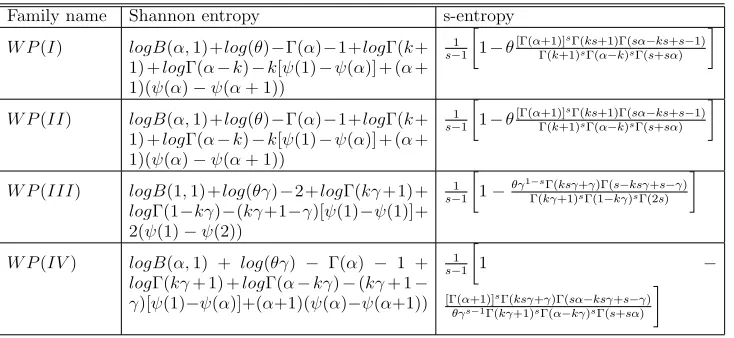
Table 3. Shannon and s-entropies of the sub-models of the FP distribution
Family name
Shannon entropy s-entropy
P(I) logΓ(αθ+1)−Γ(α)−1+(α+1)(ψ(α)−
ψ(α+ 1))
1
s−1∗
1−θ[Γ(αΓ(+1)]α)ssΓ(Γ(ss++αsαs)−1)
P(II) log
Γ(α+1)
θ
− Γ(α) − 1 + (α +
1)(ψ(α)−ψ(α+ 1))
1
s−1∗
1−θ[Γ(αΓ(+1)]α)ssΓ(Γ(ss++αsαs)−γ)
P(III) log
Γ(2)
θγ
−2 + 2(ψ(1)−ψ(2)) s−11∗
1−θγ1−sΓ(s−γs+Γ(2γ)Γ(s)γs+s−γ)
P(IV) log
Γ(α+1)
θγ
−Γ(α)−1−(1−γ)[ψ(1)−
ψ(α)] + (α+ 1)(ψ(α)−ψ(α+ 1)) 1
s−1∗
1−θγ1−s[α]sΓ(sΓ(−γss++αsγ)Γ() γs+αs−γ)
Table 4. Shannon and s-entropies of the WFP Distribution
Family name Shannon entropy s-entropy
W P(I) logB(α,1)+log(θ)−Γ(α)−1+logΓ(k+ 1) +logΓ(α−k)−k[ψ(1)−ψ(α)] + (α+ 1)(ψ(α)−ψ(α+ 1))
1 s−1
1−θ[Γ(αΓ(+1)]k+1)sΓ(sksΓ(+1)Γ(α−k)ssαΓ(−s+kssα+)s−1)
W P(II) logB(α,1)+log(θ)−Γ(α)−1+logΓ(k+ 1) +logΓ(α−k)−k[ψ(1)−ψ(α)] + (α+ 1)(ψ(α)−ψ(α+ 1))
1 s−1
1−θ[Γ(αΓ(+1)]k+1)sΓ(sksΓ(+1)Γ(α−k)ssαΓ(−s+kssα+)s−1)
W P(III) logB(1,1)+log(θγ)−2+logΓ(kγ+1)+
logΓ(1−kγ)−(kγ+1−γ)[ψ(1)−ψ(1)]+ 2(ψ(1)−ψ(2))
1 s−1
1−θγ1−sΓ(ksγ+γ)Γ(s−ksγ+s−γ) Γ(kγ+1)sΓ(1−kγ)sΓ(2s)
W P(IV) logB(α,1) + log(θγ) − Γ(α) − 1 +
logΓ(kγ+ 1) +logΓ(α−kγ)−(kγ+ 1− γ)[ψ(1)−ψ(α)]+(α+1)(ψ(α)−ψ(α+1))
1 s−1
1 −
[Γ(α+1)]sΓ(ksγ+γ)Γ(sα−ksγ+s−γ) θγs−1Γ(kγ+1)sΓ(α−kγ)sΓ(s+sα)
References
[1] Arnold, B. C.,Pareto Distributions, International Cooperative Publishing House, Fairland, Maryland, (1983).
[2] Brazauskas, V.,Fisher Information Matrix for the Feller-Pareto Distribution, Statistics and Probability Letters, 59, 159-167, (2002).
[3] Block, H.W., and Savits, T.H., The Reverse Hazard Function, Probability in the Engineering and Informational Sciences,12, 69-90 (1998).
[4] Chandra, N.K. and Roy, D.,Some Results on Reverse Hazard Rate, Probability in the Engineering and Information Sciences, 15, 95-102 (2001).
[5] Feller, W.,An Introduction to Probability Theory and its Applications, Vol. 2, 2nd Edition, Wiley, New York, (1971).
[6] Gupta, C. and Keating, P.,Relations for Reliability Measures Under Length Biased Sampling, Scandi-navian Journal of Statistics,13(1), 49 - 56, (1985).
[7] Luceno, A.,Fitting the Generalized Pareto Distribution to Data using Maximum Goodness-of Fit Esti-mators, Computational Statistics and Data Analysis, 51, 2, 904-917, (2006).
[9] Oluyede, O.,On Inequalities and Selection of Experiments for Length-Biased Distributions, Probability in the Engineering and Informational Sciences,13(2), 129 - 145, (1999).
[10] Park, S.,The Entropy of Continuous Probability Distributions,IEEE Transactions of Information The-ory,41, 2003 - 2007, (1995).
[11] Patil, P., Encountered Data, Statistical Ecology, Environmental Statistics, and Weighted Distribution Methods,Environmetrics,2(4), 377 - 423, (1991).
[12] Patil, P. and Rao, R., Weighted Distributions and Size-Biased Sampling with Applications to Wildlife and Human Families,Biometrics,34(6), 179 - 189, (1978).
[13] Riabi, M.Y.A., Bordazaran, G. R. M. and Yari, G. H.,β - Entropy for Pareto-type Distributions and Related Weighted Distributions, Statistics and Probability Letters, 80, 1512-1519 (2010).
[14] Rao, R., On Discrete Distributions Arising out of Methods of Ascertainment, The Indian Journal of Statistics,27(2), 320 - 332, (1965).
[15] Renyi, A.,On Measures of Entropy and Information,Berkeley Symposium on Mathematical Statistics and Probability,1(1), 547 - 561, (1960).
[16] Rizzo, M.,New Goodness-of-Fit Tests for Pareto Distributions, Astin Bulletin, 39(2), 691-715, (2009). [17] Shannon, E., A Mathematical Theory of Communication, The Bell System Technical Journal,27(10),
379 - 423, (1948).
[18] Wong, K.M, Chen,S., The entropy of ordered sequences and order statistics, IEEE Transactions of information Theory,36, 276 - 284, (1990).