LOW TEMPERATURE CRYSTAL STRUCTURE AND MAGNETIC
BEHAVIOR OF BIS(N-METHYL-2-PHENYLETHYLAMININIUM)
TETRABROMIDOCUPRATE
L. Li
[a]†, M. M. Turnbull
[a]and B. Twamley
[b]Keywords: tetrabromocuprate, antiferromagnetism, crystal structure
The low-temperature X-ray structure, and magnetic properties of (MePhenetNH2)2[CuBr4] (MePhenetNH2 =N-methyl-2-phenylethylammonium)(1)are reported. The compound was characterized using IR, combustion analysis, X-ray powder diffraction, single crystal X-ray diffraction, and temperature-dependent magnetic susceptibility measurements. Compound 1 crystallizes in the monoclinic space group C2/c. In the structure, the tetrabromidocuprate ions are packed into zig-zag chains parallel to the c-axis which are stabilized by hydrogen bonds between the ammonium cations and bromide anions. Magnetic measurements (1.8-310 K) indicate weak antiferromagnetic interactions propagated via the two-halide exchange pathway through short Br…Br contacts. Fitting the data with the S = ½ uniform chain model gave J = -7.7(1) K with C = 0.403(1).
[a] Carlson School of Chemistry and Biochemistry, Clark University, 950 Main Street, Worcester, Massachusetts 01610
[b] School of Chemistry, Trinity College Dublin, The University of Dublin, College Green, Dublin 2, Ireland.
†Present address: SEQENS/PCI Synthesis 88 Jackson Road Building 649, Devens, MA 01434
INTRODUCTION
The recognition of halogen bonds as a significant factor in intermolecular and interionic interactions, in both biological and laboratory circumstances, has provided a significant impetus for study.1 At the same time, magnetic exchange
through halide ions, both bridging and through halogen bonds,2 has been of significant interest for decades and the
recognition of halogen bonds has provided a uniform framework for presenting such observations.3 In particular,
there has been extensive study of magnetic interactions via the two-halide pathway (a potential halogen bond) for decades.4
The vast majority of magnetic interactions reported via the two-halide pathway are antiferromagnetic, ranging from values of J near zeroHiba! A könyvjelző nem létezik.a to very significant
exchange (J = -234 K).5 The correlation between the X…X
distance as well as Cu-X…X contact angle and Cu-X…X-Cu torsion angle has been established,Hiba! A könyvjelző nem létezik.a,6
but as yet insufficient data is available to provide any quantitative magnetostructural correlations and hence we have continuing interest in the study of such compounds.
The packing of the tetrabromidocuprate anions and hence, the superexchange parameters via the two-halide pathway, are strongly influenced by the nature of the corresponding cation, including its size, charge and hydrogen or halogen bonding capacity. N-Methyl-2-phenylethylammonium (NMPH) is one such counterion that has been employed to good effect previously. Prior work with NMPH has produced a number of complexes with the tetrachloridocuprate anion, including a chloride-bridged tricopper(II) system (Grigereit
et al.7) , a chloride-bridge dicopper(II) complex (Harlow et
al.8) and polymorphs of the monomeric (NMPH) 2CuCl4
compound.9 We are particularly interested in the
corresponding bromide compound, (NMPH)2CuBr4, reported
by Place and Willett10 due to the potential for magnetic
interactions between the tetrabromidocuprate anions via the two-halide pathway. Preliminary work by Willett and Drumheller et al. showed the presence of antiferromagnetic interactions in the sample.11 In an effort to more closely
examine the relationship between the structure and its magnetic properties, we have repeated the synthesis of the compound and present here its low-temperature crystal structure and variable temperature magnetic susceptibility (1.8-310 K).
EXPERIMENTAL
Copper(II) bromide and N-methyl-2-phenylethylamine purchased from Sigma Aldrich. Materials were used as received without further purification. IR spectra were recorded via ATR on a Perkin-Elmer Spectrum 100 spectrometer. X-Ray powder diffraction was carried out on a Bruker AXS-D8 X-ray Powder Diffractometer. Bis(N-methyl(2-phenylethyl)ammonium tetrabromidocuprate (1) was prepared according to the literature.Hiba! A könyvjelző nem létezik.
IR (ν, cm-1): 3024s, 2958s, 2786s, 1561m, 1456s, 1414s,
1374m, 1160m, 1070m, 1011m, 940m, 750vs, 703vs.
X-Ray structure analysis
Data for 1 were collected at 87(2) K using a
Bruker/Siemens SMART APEX instrument (Mo Kα radiation, λ = 0.71073 Å) equipped with a Cryocool NeverIce
low temperature device. Data were measured using omega scans of 0.3 ° per frame for 10 seconds, and a full sphere of data was collected. A total of 2450 frames were collected. Cell parameters were retrieved using SMART12 software and
refined using SAINTPlus13 on all observed reflections. Data
The structure was solved using the SHELXS97 program15
and refined via least-squares analysis via SHELXL-2016.16
Non-hydrogen atoms were refined using anisotropic thermal parameters. Hydrogen atoms bonded to nitrogen atoms were located in the difference Fourier maps and their positions refined using fixed isotropic thermal parameters. The remaining hydrogen atoms were placed in geometrically calculated positions and refined using a riding model and fixed isotropic thermal parameters. Crystallographic information and details of the data collection can be found in Table 1.
Magnetic Susceptibility Data Collection
Magnetization data for 1 were collected using a Quantum Design MPMS-XL SQUID magnetometer. Finely ground crystals were packed into a #3 gelatin capsule and placed in a clear plastic straw for data collection. Data were first collected as a function of field from 0 to 50 kOe at 1.8 K. Several data points were recollected as the field returned to 0 kOe to check for hysteresis effects; none were observed. Magnetization was then measured as a function of temperature from 1.8 to 310 K in a 1 kOe applied field. The data collected were corrected for the background signal of the gelatin capsule and straw (measured independently), the temperature independent paramagnetism of the Cu(II) ion and for diamagnetic contributions of the constituent atoms, estimated via Pascal’s constants.17 All data were fit using the
Hamiltonian H = -J∑S1·S2. The composition of 1 was
analyzed by powder X-ray diffraction and compared to the single crystal structure prior to data collection. No impurities were observed.
RESULTS
Crystal structure analysis
Compound 1 crystallizes in the monoclinic space group C
2/c. The molecular unit is shown in Figure 1.
Figure 1. Thermal ellipsoid plot of the molecular unit of 1 showing 50% probability ellipsoids. Only the asymmetric unit, copper coordination sphere and those H-atoms whose positions were refined are labelled. Symmetry operation for Br1A and Br2A (1-x, y, ½-z).
The Cu1 ion is located along a two-fold symmetry axis bonded to two independent bromide ions (See Table 2 for selected bonds and angles). A significant Jahn-Teller distortion results in a highly flattened tetrabromidocuprate ion with a mean trans angleHiba! A könyvjelző nem létezik. of 141.9°. Comparison of the bond lengths and angles between 87 and 295 K shows only very slight changes.
Table 1. X-ray data of compound 1.
Table 2. Selected bond lengths [Å] and angles [°] for 1 at 87 K (this work) and 295 K (Ref. 10).
Bond Distance (87 K) Distance (295 K)
Cu1-Br1 2.3794(4) 2.364
Cu1-Br2 2.3938(4) 2.395
Bond Angle (87 K) Angle (295 K)
Br1-Cu1-Br1A Br1-Cu1-Br2
96.47(2) 141.91(1)
97.88 142.09
Br1-Cu1-Br2A 96.54(1) 95.77
Br2-Cu1-Br2A 94.89(2) 94.76
Symmetry operation for Br1A and Br2A (1-x, y, ½-z).
The NMPH cation is unremarkable, adopting an antiperiplanar geometry about the C1-C4 and N2-C3-C4-C5 sequences with torsion angles of 179.1(3)° and 174.6(2)°, respectively.
The CuBr42- ions form chains parallel to the c-axis via short
Br…Br contacts between inversion related anions, as shown in Figure 2. Parameters for the two-halide superexchange pathway are given in Table 3. The chains are further stabilized by hydrogen bonds to the ammonium hydrogen atoms.: dN2…Br1C = 3.439(3) Å, dN2…Br2A = 3.395 Å. The
Br2A…Br2B distance is the shorter contact between the ions, making it an ee2-type interaction.Hiba! A könyvjelző nem létezik.
Empirical formula C18H28N2CuBr4
Formula weight 655.60
Temperature 87(2) K
Wavelength 0.71073 Å
Space group C2/c
a 23.854(2) Å
b 9.2120(9) Å
c 10.8726(11) Å
α 90°
β 106.787(2)°
γ 90°
Volume 2287.4(4) Å3
Z 4
Density (calculated) 1.904 Mg m-3 Absorption coefficient 7.947 mm-1
F(000) 1276
Crystal size 0.26 x 0.10 x 0.05 mm3 range for data collection 1.783 to 30.011° Index ranges -32 ≤ h ≤ 32,
-12 ≤ k ≤ 12, -15 ≤ l ≤ 15 Reflections collected 16773
Independent reflections 3280 [R(int) = 0.0506]
Absorption correction Semi-empirical from equivalents
Max. and min. transmission 0.671 and 0.224
Refinement method Full-matrix least-squares on F2 Data / restraints / parameters 3280 / 0 / 121
Goodness-of-fit on F2 1.075
Final R indices [I>2σ(I)] R1 = 0.0356, wR2 = 0.0710
Figure 2. Chain formation via short Br…Br contacts. Dashed lines represent Br…Br contacts and hydrogen bonds. Only the alkyl portions of the NMPH ions are shown for clarity.
Table 3. Two-halide superexchange pathway parameters for 1 at 87 K (this work) and 295 K (Ref. 10).a
Bond d (Å) θ(°)a τ (°)
Cu1-Br1A… Br2B-Cu1A
87 K 4.392 145.60/ 72.4
3.45
295 K 4.404 143.47/
74.25
4.74
Cu1-Br2A… Br2B-Cu1A
87 K 3.997 80.75 180
295 K 4.129 79.93 180
aFor Cu1-Br1A… Br2B-Cu1A, there are two inequivalent interior angles, while for Cu1-Br2A… Br2B-Cu1A, the angles are identical by symmetry. Br2A and Br2B are related by an inversion center which requires τCu1-Br2A… Br2B-Cu1A to be 180° by symmetry.
The tetrabromidocuprate ion chains pack into layers parallel to the bc-plane (see Figure 3). The layers are well separated by a double layer of NMPH cations arranged antiparallel to each other. The shortest distance between CuBr42- ions in
adjacent layers is greater than 9 Å. The closest contacts between the phenyl rings of the NMPH ions is greater than 4.2 Å, indicating the absence of significant π-stacking interactions.
Magnetic study
Magnetization data as a function of applied field (Figure 4) show a linear response throughout the measured region and reach a maximum of 1600 emu mol-1 at 50 kOe. This is well
below the expected saturation magnetization of ~5,800 emu mol-1 for a S = ½ system with g near 2, indicating the presence
of antiferromagnetic interactions in the sample.
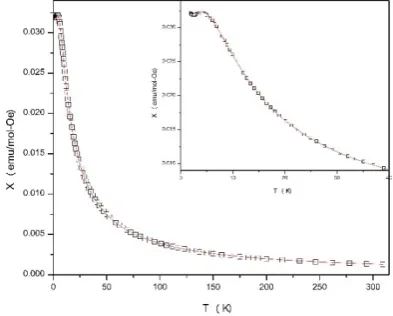
Susceptibility data for 1 were collected in a 1 kOe field from 1.8 K to 310 K. The susceptibility of 1 shows rounded maximum near 4 K, again in support of antiferromagnetic interactions in the sample (Figure 5).
Figure 3. Packing of 1 viewed parallel to the b-axis showing the alternating layer structure.
Figure 4. Magnetization as a function of applied field for 1.
Fitting the data to the S = ½ uniform Heisenberg chain model18 with a Curie-Weiss correction to account for
interchain interactions resulted in a Curie constant (CC) of 0.403(1) emu-K mol-Oe-1, J = -7.77(8) K and θ = -0.09(9) K,
with a 4.0(5) % paramagnetic impurity (seen as the slight
increase in χ below 2.5 K).
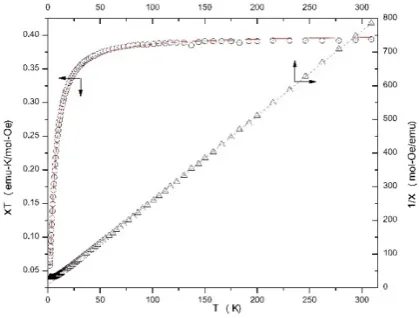
Using the same model to fit the χT(T) data (Figure 6) gave similar results with CC = 0.402 emu-K mol-Oe-1, J = -7.68(11) K and θ = -0.11(7) K with a 4.2(4) % paramagnetic impurity. A fit of the data above 30 K to the Curie-Weiss law yielded CC = .397(1) emu-K mol-Oe-1and θ = -3.05(14) K.
[Note: The value of θ from the Curie-Weiss fit is proportional to S and J. It is not the same as the value obtained from fits
of χ(T) and χT(T) where it represents the interchain interactions.] All are in agreement with modest antiferromagnetic interactions in the compound.
Figure 6.χT(T) (о) and 1/χ(T) (Δ) for 1. The solid lines represent the best fits to the S = ½ uniform Heisenberg chain model and the Curie-Weiss law, respectively.
DISCUSSION
The low-temperature crystal structure of 1 is in good agreement with the room temperature structure of Place and Willett.Hiba! A könyvjelző nem létezik. Bond lengths and angles within the NMPH+ and CuBr
4-2 moieties show negligible
changes over the temperature range. The two-halide exchange pathway parameters (Table 3) show more significant, but non-symmetrical changes. There is only a slight decrease in the Cu1-Br1A…Br2B-Cu1A distance, less than 0.25 %, with commensurately small changes in the corresponding angles. However, the Cu1-Br2A…Br2B-Cu1A distance has decreased by nearly 3 %, suggesting a sliding of the CuBr42- units parallel to the ac-face (Figure 7).
This would affect the two-halide pathway superexchange, but as no quantitative relationships between J and the structure parameters are available as yet, the nature of the change cannot be predicted.
Magnetic data confirm the preliminary report by Drumheller and WillettHiba! A könyvjelző nem létezik. of the antiferromagnetic response in the complex where data was collected from 4.2-60 K. The data was reported as χT(T) and yielded J = -8.0 K, in good agreement with the current value of -7.7(1) K obtained from data fit over the full range of
1.8-310 K. Fits of both χ(T) and χT(T) show negligible interchain interactions as seen by the Curie-Weiss corrections, zero or
virtually so in both fits (θ values) within experimental error, making them excellent approximations of the uniform S = ½ Heisenberg chain.
Figure 7. (Left) The relative motion of adjacent CuBr4-2 distorted tetrahedral from 295 K to 87 K viewed perpendicular to the ac-plane (right). An view of the overlap of the 87 K (red) and 295 K (green) structures. The N-atoms were used as the anchor point.
In summary, (NMPH)2CuBr4 forms well isolated chains via
short Br…Br contacts in the lattice. These contacts support antiferromagnetic exchange through the two-halide exchange pathway and result in modest antiferromagnetic interactions in the compound (-7.7 K) as seen through field and temperature dependent magnetization measurements. Further work is in progress to attempt to quantify the magnetostructural correlations in such materials.
ACKNOWLEDGEMENTS
Financial assistance from the NSF (IMR-0314773) and the Kresge Foundation toward the purchase of the MPMS-XL SQUID magnetometer are greatly appreciated. The Bruker D8-Advance Diffractometer was purchased with the assistance of funds from the Kresge Foundation and PCI Synthesis, Inc. The Bruker (Siemens) SMART APEX diffraction facility was established at the University of Idaho with the assistance of the NSF-EPSCoR program and the M. J. Murdock Charitable Trust, Vancouver, WA, USA.
Supplementary data
CCDC 1914519 contains the supplementary crystallographic data for 1. This data can be obtained free of charge via http://www.ccdc.cam.ac.uk/con-ts/retrieving.html, or from the Cambridge Crystallographic Data Centre, 12 Union Road, Cambridge CB2 1EZ, UK; fax: (+44) 1223-336-033; or email: [email protected].
REFERENCES
1a) Rowe, R. K., Shing, H. P. Acta Crystallogr. Sect. B2017, 73, 255. doi. 10.1107/S2052520617003109. b) Tepper, R., Schubert, U. S., Angew. Chem., Int. Ed.2018, 57, 6004. doi: 10.1002/anie.201707986. c) Bartashevich, E. V., Grigoreva, E. A., Yushina, I. D., Bulatova, L. M., Tsirelson, V. G., Russ, Chem, Bull, 2017, 66, 1345. Doi 10.1007/s11172-017-1898-1. d) Maharramov, A. M., Shixaliyev, N. Q., Gurbanov, A. V., Mahmudov, K. T., Nenajdenko, V. G., Pombeiro, A. J. L., Kopylovich, M. N.; Ed. A. M. Maharramov, Non-covalent Interactions in the Synthesis and Design of New Compounds
2a) Turnbull, M. M., Landee, C. P., Wells, B. M., Coord. Chem. Rev., 2005, 249, 2567. Doi 10.1016/j.ccr.2005.01.015. b) Landee, C. P., Turnbull, M. M., Eur. J. Inorg. Chem., 2013, 2266. Doi 10.1002/ejic.201300268
3Cavallo, G., Metrangolo, P., Pilati, T., Resnati, G., Terraneo, G.,
Top. Curr. Chem.,2015, 358, 1. Doi 10.1007/128_2014_573. b) Desiraju, G. R., Ho, P. S., Kloo, L., Legon, A. C., Marquardt, R., Metrangolo, P., Politzer, P., Resnati, G., Rissanen, K., IUPAC Commission Pure Appl. Chem., 2013, 85, 1711.
4a) Moeller, J. S., Lancaster, T., Blundell, S. J., Pratt, F. L., Baker, P. J., Xiao, F., Williams, R. C., Hayes, W., Turnbull, M. M., Landee, C. P., Phys. Rev. B 2017, 95, 020402/1-5. Doi 10.1103/PhysRevB.95.020402. b) Gale, A. J., Landee, C. P., Turnbull, M. M., Wikaira, J. L., Polyhedron,2013, 52, 986. Doi 10.1016/j.poly.2012.06.083. c) Alemany, P., Rodriguez-Fortea, A., Canadell, E. Inorg. Chem.,2011, 50, 6399. Doi 10.1021/ic200679x. d) Cizmar, E., Ozerov, M., Wosnitza, J., Thielemann, B., Kraemer, K. W., Rueegg, Ch., Piovesana, O., Klanjsek, M., Horvatic, M., Berthier, C., Zvyagin, S. A., Phys. Rev. B:2010, 82, 054431/1-5. 10.1103/PhysRevB.82.054431. e) Luque, A., Sertucha, J., Castillo, O., Roman, P., Polyhedron,
2002, 21, 19. Doi 10.1016/S0277-5387(01)00961-5. f) Zhou, P., Tuthill, G. F., Drumheller, J. E., Phys. Rev. B,1992, 45, 2541-4. Doi 10.1103/PhysRevB.45.2541
5Butcher, R. T., Turnbull, M. M., Landee, C. P., Wells, B. M.; Novoa, J. J., Ribas-Ariño, J., Sandvik, A. W., Awwadi, F. F., Chem. Commun., 2009, 1359. doi 10.1039/B819894B
6Li, L., Turnbull, M.M., Landee, C.P., Jornet, J., Deumal, M., Novoa, J.J., Wikaira, J. L., Inorg. Chem., 2007, 46, 11254. Doi 10.1021/ic701645y
7Grigereit, T. E., Ramakrishna, B. L., Place, H., Willett, R. D., Pellacani, G. C., Manfredini, T., Menabue, L., Bonamartini-Corradi, A., Battaglia, L. P., Inorg.Chem., 1987, 26, 2235. Doi 10.1021/ic00261a015.
8Harlow, R. L., Wells III, W. J., Watt, G.W., Simonsen, S. H., Inorg.
Chem., 1974, 13, 2860. Doi 10.1021/ic50142a018.
9a) Harlow, R. L., Wells III, W. J., Watt, G. W., Simonsen, S. H.,
Inorg. Chem., 1974, 13, 2106. Doi 10.1021/ic50139a012. b) Kelley, A., Nalla, S., Bond, M. R., Acta Crystallogr. B, 2015, 71, 48. Doi 10.1107/S2053229614025650.
10Place, H., Willett, R. D., Acta Crystallogr.C, 1988, 44, 34. Doi 10.1107/S010827018700831X
11Zhou, P., Drumheller, J. E., Rubenacker, G. V., Halvorson, K., Willett, R. D., J. Appl. Phys., 1991, 69, 5804. Doi 10.1063/1.347883
12SMART: v.5.626, Bruker Molecular Analysis Research Tool, Bruker AXS, Madison, WI, 2002.
13SAINTPlus: v. 6.45a, Data Reduction and Correction Program, Bruker AXS, Madison, WI, 2003.
14SADABS: v.2.01, An empirical absorption correction program, Bruker AXS Inc., Madison, WI, 2004.
15Sheldrick, G. M., Acta Cryst. A, 2008, 64, 112. Doi 10.1107/S0108767307043930
16Sheldrick, G. M., Acta Cryst. C, 2015, C71, 3. Doi 10.1107/S2053229614024218.
17Carlin, R. L., Magnetochemistry, Springer-Verlag, Berlin, (1986).
18Landee, C. P., Turnbull, M. M., J. Coord. Chem.,2014, 67, 375. Doi 10.1080/00958972.2014.889294.
![Table 2. Selected bond lengths [Å] and angles [°] for 1 at 87 K (this work) and 295 K (Ref](https://thumb-us.123doks.com/thumbv2/123dok_us/7824485.2088140/2.595.70.265.535.625/table-selected-bond-lengths-a-angles-work-ref.webp)