Reference & User Services Quarterly, vol. 57, no. 4, pp. 266–73
© 2018 American Library Association. All rights reserved.
Permission granted to reproduce for nonprofit, educational use.
Using concepts from Catherine Sheldrick Ross’s “Finding without Seeking: The Infor-mation Encounter in the Context of Read-ing for Pleasure,” a convenience sample of 129 romance novels about secret babies is examined to determine what informa-tion is imparted about the processes by which adoptees and birth parents search for each other.
E
fforts by adoptees to locate their birth parents and other natal relatives form a central theme in both fiction and nonfiction adoption narratives. These efforts have a long history in the United States, where the difficulties involved in such searches were, and often still are, com-pounded by legally mandated confi-dentiality and sealed records; causing even adoptees themselves to be denied access to records such as original birth certificates after World War II. Over the same time period, search and reunion have been prominent features of adoption reform and activism, and they appear as central themes in many true adoption narratives.One of the most familiar tropes in romance fiction is the story of the “secret baby,” whose existence, when discovered, becomes the dominant barrier to be overcome in the rela-tionship and potential commitment of
the unmarried, or formerly married, parents, regardless of the manner in which the secret of the child is kept or revealed. The popularity of the stories seems to stem from the readers’ love of second chances, and the opportunity to present a ready-made family as a “pack-age deal” for the story’s protagonists.1
An unknown percentage of the secret baby romance stories involves adoption. A memorable example is Emilie Richards’s All Those Years Ago, in which a night school teacher falls in love with an exemplary student who he later learns dropped out of Vassar when she got pregnant. Their romance is unable to proceed until she finds the whereabouts of her adopted baby, which he helps her do.
The presence of adoption themes and issues in romance fiction inspired a study to discover if the information included was similar to or different from factual information on adoption.
REVIEW OF RELEVANT
LITERATURE
Information-Seeking
and Fiction
Fiction has usually not been con-sidered a source of information in
Mary K. Chelton
Dr. Mary K. Chelton (mchelton@ optonline.net) is a retired professor who formerly taught at the Graduate School of Library and Information Studies, Queen’s College, CUNY.
The author sends her thanks to Roberta Brody at GSLIS, Queens College, and Catherine Ross, Retired, Faculty of Information and Media Studies, University of Western Ontario, for help in shaping and revising this article.
Searching for Birth Parents or
Adopted Children
and formulaic because in a literal sense, marriage does not necessarily mean happiness for women in real life. There is an additional issue: the question of the legitimacy of the romance novel as “literature.” The sense of cultural hierar-chical distinctions has plagued romance fiction to its detri-ment for years.8
One of the earliest studies of the appeal of romance fic-tion by Snitow analyzes Harlequin romances not as “art” but as “leisure activities that take the place of art” that “fill a place left empty for most people.” While hardly compli-mentary, unlike many feminist analyses of the genre, Sni-tow makes several points germane to adoption as a topic for romance fiction, namely that “the books . . . reflect—some-times more, somereflect—some-times less consciously, somereflect—some-times amaz-ingly naively—commonly experienced psychological and social elements in the daily lives of women.”9 Fear of and actual unplanned pregnancies are among these elements. Snitow’s categorization of reading romances as “leisure activities” also presages current studies of information seek-ing and casual leisure.10
Reading the Romance is a classic study of the genre using reader response, feminist theory, and textual analysis. Through a key informant in a bookstore, Radway gains access to a cluster of romance readers and, through an analy-sis of their favored and unfavored titles, concludes that “the romance genre is precisely that: a genre, . . . that, for a little while, assures its readers of their own self-worth and ability to affect a patriarchic world, so by the end of the novel the female readers, often mothers, feel invigorated and ready to take on the day-to-day tasks of managing the home and family.” She further asserts that “it is the individual woman’s choice to read romance novels, and that this selection not only fabricates a predictable, happy ending but depicts a her-oine who discovers her own individuality through her ability to care for others, as opposed to unique personal qualities.”11
Dangerous Men and Adventurous Women: Romance Writers on the Appeal of Romance is a collection of essays by romance writers on the genre and was compiled to refute many of the negative feminist analyses of the genre prevalent at its time of publication. It coalesces around several themes that attempt to explain the encoded information in romance texts.
The fifth and sixth themes identified in the essays are most germane to adoption. The fifth theme is that romance novels celebrate life with a deep-rooted optimism in happy endings. Of particular note is the comment that “the celebration of life is expressed also in the frequency with which happy end-ings include the birth of a child. Babies are always treated as a cause for joy in romance, whether a writer has chosen to have children or not, whether she is in favor of abortion rights or not.” The sixth theme is reader identification with both the hero and heroine as the romance progresses, sometimes identifying with both simultaneously, sometimes alternately. Editor and compiler Jayne Anne Krentz concludes, “For those who understand the encoded information in the stories, the books preserve elements of ancient myths and legends that are particularly important to women. They celebrate female library-and-information information-seeking studies but
more a use of casual leisure time or a source of entertain-ment.3 Whereas information-seeking studies have usually assumed some work- or student-related purposeful search-ing, studies on fiction have mostly looked at how people select the fiction they read. Their fiction selections are seen as the end result of either an information behavior process using available outside resources, a successful database search retrieval using specific indexing terms, book and genre appeal characteristics intrinsic to individual fiction works themselves sometimes converted into indexing terms, or reader-driven appeal characteristics associated with read-ers’ social milieus.4 In other words, locating and retrieving fiction, or fulfilling readers’ reading desires, is seen as more important than the factual information content found in fiction, except for Ross’s work on finding without seeking.5
Adoption in Literature
Secret babies and adoption have been used as plot and character devices in literature for years, Oliver Twist being a notable example. Yet specific attention to adoption in liter-ary texts as it intersects with culture had been sparse until the Alliance for the Study of Adoption and Culture, estab-lished in 1998, founded its journal, Adoption and Culture. The resulting literary studies emerging from members of the Alliance, such as Marianne Novy and Margaret Homans, use adoption as a lens through which to examine cultural myths and views on family and kinship.6
While these studies offer insights into how adoption is treated topically and thematically in literature, they usually ignore most popular culture texts such as romance fiction. In this genre, the unplanned pregnancy, and the secrecy surrounding it, is primarily used as a plot device to create a barrier that must be surmounted to bring the hero and heroine together, not as an examination of the deeper mean-ings of biological versus socially constructed kinship, or the role of adoption in society. Romance fiction does somewhat mirror the deeper cultural conflicts over adoption treated in more literary works, but through a popular culture lens constrained by genre conventions.
Romance Fiction
With the establishment of the interdisciplinary Journal of Popular Romance Studies in 2001, scholarship on romance fiction has expanded. Scholarship published in this journal includes a special section on “Romancing the Library” in 2010 and an article on romance collection development in academic libraries in 2012; however, no studies in this jour-nal have covered adoption or secret babies.
A convenience sample of 129 romance fiction titles was generated through the investigator’s own reading, ongoing perusal of Romance $ells (a quarterly catalog of upcoming romance releases for booksellers and librarians), a monthly search of reviews in Romantic Times, queries on several romance online lists, a search on Goodreads, and the assis-tance of a secondhand romance fiction bookseller and sev-eral romance authors with knowledge of the project. To be included, the book had to (1) involve an actual adoption reunion search, regardless of which person in the adoption triad initiated it; (2) include a reunion, or at least an identi-fication of someone deceased as the person sought; and (3) be published as a romance, or be written by a notable author associated with the romance fiction genre.
The titles were then organized into various categories, both bibliographic and plot-driven: author, title, publisher, date, who was searching, who was searched for, the gender of the searcher, the gender of the protagonist, and the love interest of the protagonist. From these categories, an overall statistical portrait of the sample was compiled, followed by an analysis of individual texts to gather exemplars of how adoption reunions were depicted by various authors. Lists of the sample and subsample titles are appended.
FINDINGS AND DISCUSSION
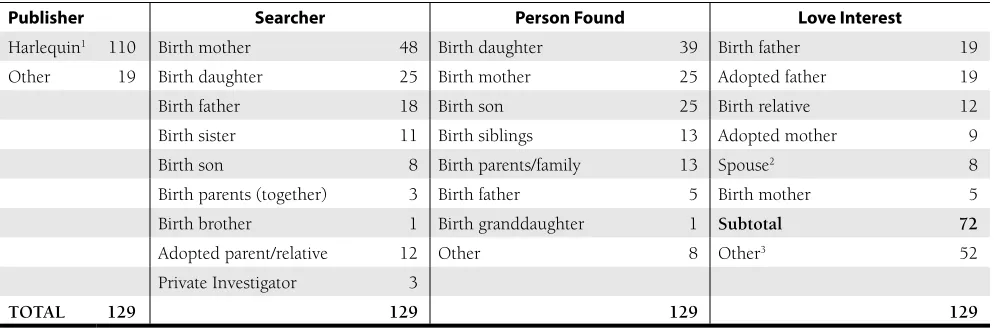
The 129 romances studied, published between 1978 and 2013, are cumulatively described in table 1.
The final sample was pared down to 129 titles from the original 160 collected using a strict definition for inclusion, suggesting that adoption stories, whether they involve a reunion or not, are not necessarily rare within the romance genre. This is not surprising, given the almost classic status of the secret baby trope within romance fiction, but also it must be noted that the predominance of female searchers in the stories lends itself well to a genre that emphasizes female protagonists with a strong appeal for female readers. This female predominance also mirrors real-life adoption search narratives, as Herman points out: “One thing that has changed very little in adoption narratives is the female voice. Stories by male adoptees and adoptive fathers are rare, and birth fathers’ stories are even rarer. Adoption memoirs are still overwhelming[ly] authored by women.”17
While most of the stories are single titles published by Harlequin, some authors do write multiple books on adop-tion reunion themes—Anna Adams, Georgia Bockoven, Annette Broadrick, Sandra Brown, Marie Ferrarella, Lisa Jackson, Arlene James, Janice Kay Johnson, Susan Mallery, Jule McBride, Tara Taylor Quinn, Dani Sinclair, and Ruth Wind. In some cases the books are deliberately produced as a series, like Annette Broadrick’s, for example, in which each book is about one of three triplets separated at birth, or Gina Ferris’s Family Found series (also published under the name Gina Wilkins) about the separately recounted reunions of seven siblings separated at birth. But most others are power, intuition, and a female worldview that affirms life and
expresses hope for the future.”12
Similarities and Differences between
Fictional and Factual Narratives
There are similar themes and issues in all adoption nar-ratives, whether fictional or factual, such as secret babies, identity, kinship, loss, search, reunion, and reconciliation. Romance fiction usually privileges conventional heterosex-ual marriage; true adoption narratives privilege the impor-tance of blood relationships. Besides this difference and the fact that one type of narrative is fiction and the other nonfic-tion, the other main difference is that while romance fiction is construed within conventional and predictable reader expectations of a fairy-tale happy ending, real-life adoption reunions can be very unpredictable.13 Adoptees who search want truth, not fairy-tale endings, because their fantasies may be worse than what they may find, regardless of what that is.14 As one author puts it, “few adoption reunions are simply happy endings; they are often fraught beginnings.”15 Since romance readers demand a happy ending, anything they learn about real-life adoption searching in the reading process can definitely be presumed to be “accidental.”
The gendered nature of romances as a subcategory of “women’s fiction” should be noted, since it also overlaps with adoption. Romances are written and read primarily by women, and adoption search and reunion activities are also dominated by women. Similarities between romance narra-tives and adoption in real life break down though, since a real-life unplanned pregnancy might suggest anything but a happy ending for the pregnant woman. One need only to read a memoir like Roessle’s Second-Chance Mother, which is about a very difficult birth mother–birth son reunion, or the overwhelming disappointment of Steve Pemberton’s search, to appreciate the difference between real-life adoption search and reunion and its counterparts in romance fiction. The optimistic romance notion of a happy ending, even with the arrival of an unplanned pregnancy, is a notable contrast.16
METHODS
Using Ross’s finding-without-seeking analytical framework, this study attempts to describe through topical textual analy-sis how true adoption search and reunion issues are pre-sented in a sampling of romance fiction stories about secret babies, by answering the following questions:
1. How have the adoption reunion storylines been used within the context of the overall romance narrative? 2. How do the fictional stories compare to true adoption
reunion narratives?
Born, where it takes a long time for the husband to forgive his wife’s deception.21
The happy ending mandated by the conventions of romance fiction creates a general level of implausibility and optimism in this genre, both greatly desired by its fan read-ers, if unrealistic in the real-life adoption reunion context. Tara Taylor Quinn’s Sara’s Son is especially noteworthy in this regard. Her adult birth son finds Sara, who surrendered him after getting pregnant through being raped at a party in high school by three boys. The son is a cop and helps her solve a mystery about the rape. Over the course of their investigation, she falls in love with one of the men accused and convicted of raping her, who turns out to have been drugged at the time, but is also proven to be her son’s birth father. He is exonerated as a sex offender before they marry. The book is unusual not only for the love interest, but also because of the noted objection of romance readers to rape in the genre.22
One aspect of these stories that is totally congruent with real-life adoption narratives is the overwhelming presence of secrets and deception, whether keeping knowledge of the conception and birth of a child from the birth father, as in Margaret Daley’s A Daughter for Christmas; telling the birth mother that the child died when she was actually placed for adoption, as in Leandra Logan’s Happy Birthday, Baby and Terese Ramin’s Her Guardian Agent; the actual placement of the surrendered child with people different than those told to the birth mother, as in Kathleen Creighton’s One More Knight or Christine Flynn’s A Father’s Wish; the deceptive relationship of the birth mother as “aunt” to the birth child, as in Rebecca Daniels’s Father Figure and Susan Wiggs’s Home Before Dark; or that the adoptee was actually kidnapped as a baby, as in Nora Roberts’s Birthright.23
In addition to deception and secrets, however, an amazing stand-alone titles, even if the stories within the book involve
siblings, such as Sisters Found by Joan Johnston.18 Whether any of the sample authors is herself a member of the adoption triad (birth parent, adoptive parent, or adoptee) is unknown without further investigation.
Since adoption is fraught with kinship issues and impli-cations for the definition of family, the love interests in these books are revealing. The protagonist is expected to fall in love in a romance, and given the fact that many of these books are “category” romances with strict length limita-tions, that is, “published in clearly delineated categories, with a certain number of books being published in each category every month,” the availability of a potential love interest is limited to a reduced number of characters to be selected from among those found or those who help with the search.19
While reunion with the other birth parent is common, the number of widowed (and therefore available) adoptive parents can seem like a convenient contrivance, and the frequency with which private investigators and law enforce-ment officers fall for searchers possibly exceeds credulity outside the confines of any individual story. Of particular interest are the spouses who have to overcome the family and relationship disruption of a reunion. For example, in Jennifer Greene’s Born in My Heart, Ann, the menopausal adoptive mother suffering from empty nest syndrome, has to grit her teeth to appear happy for her daughter’s reunion, when she actually feels frumpy, threatened, and rejected, an outsider in her daughter’s life—a state not lost on her husband Jay, who is feeling that he’s lost his wife emotion-ally while suffering for her vicariously. Their finding each other again after the reunion makes an exquisitely told love story.20 The reconciled spouse story has a more difficult, and possibly more realistic, telling in Robin Lee Hatcher’s First Table 1. Description of Sample and Findings (N = 129 titles)
Publisher Searcher Person Found Love Interest
Harlequin1 110 Birth mother 48 Birth daughter 39 Birth father 19
Other 19 Birth daughter 25 Birth mother 25 Adopted father 19
Birth father 18 Birth son 25 Birth relative 12
Birth sister 11 Birth siblings 13 Adopted mother 9
Birth son 8 Birth parents/family 13 Spouse2 8
Birth parents (together) 3 Birth father 5 Birth mother 5
Birth brother 1 Birth granddaughter 1 Subtotal 72
Adopted parent/relative 12 Other 8 Other3 52
Private Investigator 3
TOTAL 129 129 129 129
1. Includes all Harlequin imprints: Harlequin Silhouette, Mira, and Steeple Hill.
2. Some stories involve husbands and wives experiencing a reunion or a reunion-induced disclosure of an adoption for the first time, which strains their marriages. In these books, the romance is the recommitment of the affected spouses after they have dealt with the reunion occurrence.
baby books on adoption reunion themes over the specific time period studied. Histories of Mills and Boon, the UK publisher acquired by the more recently established Harle-quin in 1971, are unfortunately not specific enough on this topic to determine the status of secret baby books prior to the period sampled.27 If records exist, possibly somewhere in the paper archives of Mills and Boon at Reading University in the United Kingdom, this comparison would be warranted in future studies to answer the question of the growth of and changes within the trope over time, even if the specific ques-tion of the growth of adopques-tion-themed secret baby books may still not be answerable.
What these books seem to demonstrate is what Snitow recognized, despite her otherwise scorn for the genre and its readers, which is that romance novels “reflect . . . com-monly experienced psychological and social elements in the daily lives of women . . . [and] may well be closer to describing women’s hopes for love than the work of fine women novelists.”28 Beyond Snitow’s observations, though, many of the books on this theme echo what romance author Jennifer Greene, one of whose stories is included in the sample, says: “I have always believed that the romance field has a choice to be less about romance and more about love/what real love means/what real love takes to survive and thrive. In an ideal world, adoption and reunion sto-ries would use that ‘power’ to reach readers in a positive constructive way.”29 Moreover, in the context of adoption searches, which like love and romance in real life, can be fraught with confusion, uncertainty, and disappointment, the searchers in romance books win. Even if they cannot find the person they are looking for, they find love and acceptance. Readers of the romance genre in general, and these books in particular, can hardly be faulted for enjoying such stories, even as they themselves recognize that many of them are pure fantasy.30
Through their strong emotional appeal, adoption reunion stories mirror many real-life adoption reunion stories in fact, albeit with the imposition of a requisite happy ending. In doing so, they also provide yet another topical touchstone for what the romance genre has always done well: provide a momentary escape from real life, while offering reassurance and wish fulfillment to women readers on a serious topic of great resonance in their lives.
In terms of information-seeking, adoption reunion romances do provide in the aggregate mostly the same information on adoption searching as that recounted in true memoirs and adoption search manuals, even if the information is not the primary reason for reading the books, and even if the accurate factual information is framed by romance conventions. What is missing from this textual study and might be the topic of future studies is the reader response to the information incidentally provided. Possi-bilities might be validation of feelings, help with accepting a situation unable to be changed, getting the courage to make a change, or just increasing empathy for women who have surrendered children, or for their children. Regardless, array of plot devices are employed. These range from the
mundane to the preposterous, extending well beyond the most common situation of starting to search after discov-ering one is adopted after the adoptive parents die, as in Rebecca Stratton’s Lost Heritage or Gina Ferris’s Full of Grace. These include, for example, a birth father tracking down the woman inseminated with his sperm in Pamela Toth’s The Baby Legacy; finding or protecting various family members from Mob connections in Patricia Potter’s Twisted Shadows and Catherine Anderson’s Without a Trace; discovering that one is the long-lost child of an affluent family in Phyllis A. Whitney’s Woman without a Past, or the descendant of a famous jazz singer in Ruth Wind’s In the Midnight Rain; birth parents disguising themselves and their motives to be near their adopted birth children in Margaret Daley’s A Daughter for Christmas or Lynn Erickson’s Laurel and the Lawman; health crises involving a need for bone marrow transplants in Bonnie K. Winn’s Family Found and Andrea Edwards’s On Mother’s Day; and adoptive parents threatened (at first) by impending or real reunions such as Jennifer Taylor’s The Consultant’s Adopted Son.24 About the only adoption reunion issues not included among the stories are synchronicity, genetic sexual attraction, and any mention of adoption reunion registries such as Soundex.25
CONCLUSION
The actual number of published romances that deal with adoption in some way, not just reunions, is unknown, although obviously larger than the definition-restricted sample studied here. Thus it is difficult to claim with any certainty that this topic has overwhelming popularity and demand among romance readers, although it is clear that secret babies do, given the persistence of the trope in the genre. The thirty-five-year span of publication dates in the sample leads to an average of four books a year specifically on adoption reunion themes during that time. Further inquiry gleaned from editors’ records reveals that Harle-quin published 909 secret baby books, variously called by editors “plots with secret baby,” “secret child,” “secret baby/ child,” and “secret pregnancy” from 1981 to 2013, which averages twenty-eight per year. While this seems a very small percentage of overall Harlequin publishing produc-tion, since publishing output totaled 1,320 titles in 2013 alone, the consistent production of these types of stories over that time period is noteworthy not only to demonstrate the enduring popularity of the trope but also of adoption reunion themes.26
or Agony? (Christies Beach, South Australia: Clova Publications, 2009).
14. Jayne Schooler, Searching for a Past: The Adopted Adult’s Unique Process of Finding Identity (Colorado Springs: Pinon Press, 1995). 15. Susan Dominus, “Adoption, Reunion, Connection,” Big
City, New York Times, August 6, 2010, http://www.nytimes.
com/2010/08/07/nyregion/07bigcity.html.
16. Denise Roessle, Second-Chance Mother: A Memoir (Tsu T’ina,
Canada: Red Willow, 2011); Steve Pemberton, A Chance in the
World (Nashville: Thomas Nelson, 2012).
17. Ellen Herman, “Adoption Narratives,” The Adoption His-tory Project, Department of HisHis-tory, University of Oregon, last updated February 24, 2012, http://darkwing.uoregon. edu/~adoption/topics/adoptionnarratives.htm.
18. Joan Johnston, Sisters Found (Don Mills, Ontario: Mira, 2002). 19. “Category Romance,” RomanceWiki, last modified January 3,
2012, 20:51, http://www.romancewiki.com/Category_Romance. 20. Jennifer Greene, Born in My Heart (Don Mills, Ontario:
Harle-quin, 2007).
21. Robin Lee Hatcher, First Born (Carol Stream, IL: Tyndale House, 2002).
22. Tara Taylor Quinn, Sara’s Son (Don Mills, Ontario: Harlequin, 2007); Radway, Reading the Romance, 74.
23. Margaret Daley, A Daughter for Christmas (Don Mills, Ontario:
Harlequin, 2010); Leandra Logan, Happy Birthday, Baby (Don
Mills, Ontario: Harlequin, 1994); Terese Ramin, Her Guardian
Agent (New York: Silhouette, 2001); Kathleen Creighton, One More Knight (New York: Silhouette, 1998); Christine Flynn, A Father’s Wish (New York: Silhouette, 1995); Rebecca Daniels,
Father Figure (New York: Silhouette, 1996); Susan Wiggs, Home Before Dark (Don Mills, Ontario: Mira, 2003); Nora Roberts,
Birthright (New York: Putnam, 2003).
24. Rebecca Stratton, Lost Heritage (Don Mills, Ontario: Harlequin, 1978); Gina Ferris, Full of Grace (New York: Silhouette, 1993);
Pamela Toth, The Baby Legacy (New York: Silhouette, 2000);
Patricia Potter, Twisted Shadows (New York: Jove, 2003); Cath-erine Anderson, Without a Trace (Don Mills, Ontario: Harlequin, 1989); Phyllis Whitney, Woman without a Past (New York: Faw-cett, 1991); Ruth Wind, In the Midnight Rain (New York: Harp-ertorch, 2000); Margaret Daley, A Daughter for Christmas (Don Mills, Ontario: Harlequin, 2010); Lynn Erickson, Laurel and the Lawman (Don Mills, Ontario: Harlequin, 1994); Bonnie Winn,
Family Found (Don Mills, Ontario: Harlequin, 2001); Andrea
Edwards, On Mother’s Day (New York: Silhouette, 1996);
Jen-nifer Taylor, The Consultant’s Adopted Son (Don Mills, Ontario: Harlequin, 2006).
25. LaVonne H. Stiffler, Synchronicity and Reunion: The Genetic Con-nection of Adoptees and Birthparents (LaVonne Stiffler, 1992); Susan Donaldson James, “Adoptees Who Reunite with Lost Parent Risk Genetic Sexual Attraction,” Good Morning Amer-ica, May 17, 2012, https://gma.yahoo.com/adoptees-reunite-lost -parent-risk-genetic-sexual-attraction-203754464--abc-news -wellness.html; International Soundex Reunion Registry, http:// www.isrr.org.
26. Don Lucey, e-mail message to author, January 27, 2014. 27. Jay Dixon, The Romance Fiction of Mills & Boon, 1909–1990s
(Lon-don: UCL Press. 1999); Laura Vivanco, For Love and Money: The Literary Art of the Harlequin Mills & Boon Romance, Humanities-Ebooks Genre Fiction Monographs Series, edited by John Len-nard (Tirril, Penrith: Humanities-Ebooks LLP, 2011); Joseph McAleer, Passion’s Fortune: The Story of Mills and Boon (Oxford: Oxford University Press, 1999).
28. Snitow, “Mass Market Romance,” 143, 160.
29. Jennifer Greene, e-mail message to author, February 27, 2014. 30. Doreen Owens Malek, “Mad, Bad and Dangerous to Know: The
Hero as Challenge,” in Krentz, Dangerous Men and Adventurous
Women, 74–75.
adoption reunion romances provide a rich trove for future research in this area.
References
1. Carol J. Stephenson, “The Anatomy of the Secret Baby,” Florida Romance Writers (archived newsletters) (1999), http://www.sme delstein.com/creative/frw/anatomy1.htm; Tori Benson, “Pack-age Deals: The Appeal of Ready-Made Families in Romance,”
Heroes and Heartbreakers (blog), September 2012, http://www .heroesandheartbreakers.com/blogs/2012/09/package-deals -the-appeal-of-ready-made-families-in-romance.
2. Emilie Richards, All Those Years Ago (New York: Silhouette
Books, 1991).
3. David Elsweiler, Max L. Wilson, and Brian Kirkegaard Lunn, “Understanding Casual-Leisure Information Behav-iour,” in New Directions in Information Behaviour, Library and Information Science, Volume 1, ed. Amanda Spink and Jan-nica Heinström (Bingley, West Yorkshire, UK: Emerald Group, 2011): 211–41; Jarkko Kari and Jenna Hartel, “Information and Higher Things in Life: Addressing the Pleasurable and the Profound in Information Science,” Journal of the American Society for Information Science and Technology 58, no. 8 (2007): 1141–47. 4. Catherine Sheldrick Ross, “A Model for the Process of Choos-ing a Book for Pleasure” (Handout) Public Library Association Spring Symposium, Chicago, 1999; Kamy Ooi and Chern Li Liew, “Selecting Fiction as Part of Everyday Life
Information-Seeking,” Journal of Documentation 67, no. 5 (2012): 748–72;
Joyce G. Saricks, Readers’ Advisory Service in the Public Library,
3rd ed. (Chicago: American Library Association, 2005); The
Secret Language of Books: A Guide to Appeal (Durham, NC: NoveList, 2017), https://www.ebscohost.com/uploads/novelist/ pdf/NoveList_Appeal_2017.pdf; Keren Dali, “From Book Appeal to Reading Appeal: Redefining the Concept of Appeal in Readers’ Advisory,” Library Quarterly 84, no. 1 (January 2014): 22–48. 5. Catherine Sheldrick Ross, “Finding without Seeking: The
Infor-mation Encounter in the Context of Reading for Pleasure,” Infor-mation Processing and Management 35 (1999): 783–99.
6. Marianne Novy, Reading Adoption: Family and Difference in Fiction and Drama (Ann Arbor: University of Michigan Press, 2005); Margaret Homans, Imprint of Another Life: Adoption Narratives and Human Possibility (Ann Arbor: University of Michigan Press, 2013). 7. Pamela Regis, A Natural History of the Romance Novel
(Philadel-phia: University of Pennsylvania Press, 2003), 9–16.
8. A. Dana Ménard, “Note from the Field: Reflecting on Romance Novel Research: Past, Present and Future,” Journal of Popular Romance Studies 3, no. 2 (June 14, 2013), http://jprstudies. org/2013/06/note-from-the-field-reflecting-on-romance-novel -research-past-present-and-future-by-a-dana-menard/.
9. Ann Barr Snitow, “Mass Market Romance: Pornography for Women Is Different,” Radical History Review, no. 20 (Spring/ Summer 1979): 142–43.
10. Elsweiler, Wilson, and Lunn, “Understanding Casual-Leisure Information Behaviour,” 211–41; Kari and Hartel, “Informa-tion and Higher Things in Life,” 1141–47.
11. Janice Radway, Reading the Romance (Chapel Hill: The University of North Carolina Press, 1991), 209.
12. Jayne Ann Krentz, ed., Dangerous Men and Adventurous Women:
Romance Writers on the Appeal of the Romance (Philadelphia: Uni-versity of Pennsylvania Press. 1992), 7–8.
13. Linda J. Lee, “Guilty Pleasures: Reading Romance Novels as Reworked Fairy Tales,” Marvels and Tales 2, no. 1 (2008): 52–56; Janet Carsten, “Knowing Where You’ve Come From: Ruptures and Continuities of Time and Kinship in Narratives of Adoption Reunions,” Journal of the Royal Anthropological Institute 6, no. 4
APPENDIX A. TITLES IN THE SAMPLE EXAMINED
Abbot, Laura This Christmas Harlequin 1996 Adams, Anna Her Daughter’s Father Harlequin 2000 Adams, Anna The Prodigal Cousin Harlequin 2004 Adams, Kat Thursday’s Child Silhouette 1993 Alexander,
Carrie
A Family Christmas Harlequin 2004 Alsobrook,
Rosalyn
Questing Heart Harlequin 1991 Anderson,
Catherine
Without a Trace Harlequin 1989 Anzelon, Robyn Searching Harlequin 1986 August,
Elizabeth
The Rancher and the Baby
Silhouette 1996
Baxter, Mary Lynn
Sweet Justice Warner 1994 Benjamin, Nicki My Baby, Your Child Silhouette 1994 Blackstock, Terri Never Again Goodbye Zondervan 1996 Bockoven,
Georgia
An Unspoken Promise Harper 1997 Bockoven,
Georgia
A Marriage of Convenience
Harper 1991
Boswell, Barbara Sensuous Perception Bantam 1984 Bowen, Judith Like Father, Like
Daughter
Harlequin 1998
Broadrick, Annette
Too Tough to Tame Silhouette 2003 Broadrick,
Annette
MacGowan Meets His Match
Silhouette 2003
Brown, Sandra A Treasure Worth Seeking
Warner 1982
Brown, Sandra A Secret Splendor Silhouette 1983 Cameron, Stella Finding Ian Zebra 2001 Carroll, Marisa Gathering Place Harlequin 1988 Collins, Mary
Smith
Baby Makes Three Silhouette 1996 Creighton,
Kathleen
One More Knight Silhouette 1998 Daley, Margaret A Daughter for
Christmas
Harlequin 2010
Dalton, Margot A Family Likeness Harlequin 1996 Daniels, Kayla Her First Mother Silhouette 1998 Daniels, Rebecca Father Figure Silhouette 1996 Darcy, Emma Merry Christmas Harlequin 1997 David, Kay Desperate Silhouette 1995 De Vita, Sharon The Marriage Promise Silhouette 2000 Duncan, Judith Better than Before Silhouette 1992 Edwards, Andrea On Mother’s Day Silhouette 1996
Erickson, Lynn Laurel and the Lawman Harlequin 1994 Evans, Ann Home to Stay Harlequin 1998 Faith, Barbara Echoes of Summer Silhouette 1991 Ferrarella, Marie Heroes Great and Small Silhouette 1993 Ferrarella, Marie Desperately Seeking
Twin . . .
Silhouette 1997
Ferrarella, Marie Baby Came C.O.D. Silhouette 1997 Ferrarella, Marie Holding Out for a Hero Silhouette 1993 Ferris, Gina Full of Grace Silhouette 1993 Field, Sandra The Mother of His Child Harlequin 1999 Flynn, Christine A Father’s Wish Silhouette 1995 Fossen, Delores Undercover Daddy Harlequin 2007 Frazier, Amy Celebrate the Child Silhouette 1999 Frazier, Amy The Secret Baby Silhouette 1995 Garrett, Sally Desert Star Harlequin 1989 Glenn, Victoria One of the Family Silhouette 1987 Gordon, Lucy This Is My Child Silhouette 1996 Greene, Jennifer Born in My Heart Harlequin 2007 Halldurson,
Phyllis
Father in the Middle Silhouette 1995 Hannay, Barbara Adopted: Outback Baby Harlequin 2008 Hatcher, Robin
Lee
Firstborn Tyndale 2002 Jackson, Brenda Slow Burn St. Martin’s 2007 Jackson, Lisa D is for Dani’s Baby Silhouette 1995
Jackson, Lisa Wishes Zebra 1995
James, Arlene Child of Her Heart Silhouette 1995 James, Arlene Baby Boy Blessed Silhouette 1994 Jensen, Muriel Bridge to Yesterday Harlequin 1991 Johnson, Janice
Kay
Lost Cause Harlequin 2006 Johnson, Janice
Kay
Open Secret Mills and Boon
2007
Johnston, Joan Sisters Found Mira 2002 Kaiser, Janice Lotus Moon Harlequin 1986 Kaiser, Janice The Big Secret Harlequin 1992 Kay, Patricia Family Album Berkley 2002 Laurence, Anne Remember When Harlequin 1993 Leigh, Allison Hard Choices Silhouette 2003 Logan, Leandra Happy Birthday, Baby Harlequin 1994 Lohmann,
Jennifer
First Move Harlequin 2013 Major, Ann A Knight in Tarnished
Armor
Silhouette 1992
Mallery, Susan Their Little Princess Silhouette 2000 Mallery, Susan Cowboy Daddy Silhouette 1994 Marton, Sandra Roarke’s Kingdom Harlequin 1991 McBride, Jule Verdict: Parenthood Harlequin 1997 McBride, Jule Mission: Motherhood Harlequin 1997 McKenna,
Lindsay
Shadows from the Past Harlequin 2009 McLinn, Patricia A Stranger in the
Family
Silhouette 1995
Merritt, Jackie The Secret Daughter Silhouette 1998 Mignerey,
Sharon
Too Close for Comfort Silhouette 2001 Mikels, Jennifer Child of Mine Silhouette 1995 Molay, Mollie Like Father, Like Son Harlequin 1996 Monroe, Mary
Alice
The Four Seasons Mira 2001 Morse, Nancy A Child of His Own Silhouette 1997 Novak, Brenda Taking the Heat Harlequin 2003 O’Brien,
Kathleen
The Homecoming Baby Harlequin 2004 Paige, Laurie The One and Only Silhouette 2003 Palmer,
Catherine
For the Love of a Child Silhouette 1994 Perry, Marta Desperately Seeking
Dad
Steeple Hill 2000
Pickart, Joan Elliott
Mac Allister’s Return Silhouette 2005 Potter, Patricia Twisted Shadows Jove 2003 Quinn, Tara
Taylor
The Rancher’s Bride Harlequin 2001 Quinn, Tara
Taylor
The Birth Mother Harlequin 1996 Quinn, Tara
Taylor
Sara’s Son Harlequin 2007 Ramin, Terese Her Guardian Agent Silhouette 2001 Ray, Francis When Morning Comes St. Martin’s 2012 Reavis, Cheryl A Crime of the Heart Silhouette 1988 Richards, Emilie All Those Years Ago Silhouette 1991 Richer, Lois Blessed Baby Steeple Hill 2001
Riggs, Paula Detmer
Daddy by Choice Silhouette 2000 Riggs, Paula
Detmer
Taming the Night Fawcett 1999 Rinehold,
Connie
Silken Threads Harlequin 1989 Roberts, Kelsey Her Mother’s Arms Harlequin 1998 Roberts, Nora Birthright Putnam 2003 Ross, JoAnn No Regrets Mira 1997 Sharpe, Isabel You Belong to Me Harlequin 2009 Shay, Kathryn Michael’s Family Harlequin 1997 Sinclair, Dani The Sheriff Gets His
Lady
Harlequin 2002
Sinclair, Dani Word of Honor Harlequin 2003 Sinclair, Tracy Does Anybody Know
Who Allison Is?
Silhouette 1995
Spindler, Erica Baby Mine Silhouette 1992 Stevens, Amanda A Baby’s Cry Harlequin 1996 Stewardson,
Dawn
His Child or Hers? Harlequin 2001 Stratton,
Rebecca
Lost Heritage Harlequin 1978 Taylor, Jennifer Consultant’s Adopted
Son
Harlequin 2006
Toth, Pamela The Baby Legacy Silhouette 2000 Victor, Cindy Kindred Spirits Harlequin 1987 Warren, Linda Truth about Jane Doe Harlequin 2000 Warren, Pat Nobody’s Child Silhouette 1995 Wells, Robin Still the One Hachette 2010 Wentworth,
Sally