General Object-oriented Framework
for Iterative Optimization Algorithms
Zvonimir Vanjak and Vedran Mornar
Faculty of Electrical Engineering and Computing, University of Zagreb, Croatia
It is usually impossible to exactly solve the hard op-timization problems. One is thus directed to iterative algorithms. In implementation of these iterative algo-rithms, some common characteristics can be observed, which can be generalized in an object-oriented frame-work. This can significantly reduce the time needed for implementation of an iterative algorithm.
Keywords: object-oriented framework, iterative algo-rithms, optimization
1. Introduction
When developing any kind of system with the purpose to solve some optimization problems, one is confronted with the following common issues:
— representation of results
— tracking of the algorithm progress
— implementation of stop criteria to limit the algorithm duration
— preservation of intermediate results
The first issue can be handled easily. With the use of modern object-oriented programming languages, it is simple to define data structures that preserve the results of the calculation in ap-propriate form. But, this straightforward con-cept can be further improved. It is easy to define structures that represent not only the final solu-tion, but also hold information on intermediate solutions which algorithm produced. Accord-ingly, the algorithm progress towards the final solution can be analyzed as well.
The second issue appears when calculations that need to be performed to reach solution are time
consuming. It is not user-friendly to leave a blank screen in front of the user until the very moment when the calculation is done. So, it is necessary to find a way to periodically refresh screen with current solution to the problem. The third issue is related to the fact that sometimes it is extremely convenient to limit the duration of the algorithm. The number of iterations could be the stop criterion, but the total execution time is more natural.
Preservation of intermediate results is related to the representation of results and the tracking of the algorithm’s progress. Its implementation depends on solutions to those two problems. When defining the representation of results, we implement the data structures that keep the in-termediate results. But, besides the definition of the structure composition, it is necessary to de-fine when the intermediate results will be saved. The formal definition of an iterative optimiza-tion algorithm is now presented. In this work the iterative optimization algorithm is defined as any algorithm that can be stated by the fol-lowing pseudo-code:
generate initial solution do
improve solution using iterative step while condition is satisfied
end
One iteration of the algorithm can be a step of arbitrary complexity, as long as calculation in theithiteration depends only on the results
ob-tained in the(i;1)
th iteration. Condition for
reaching some predefined number of iterations, reaching solution of a given quality, or elapsed time.
2. The Classes for Representation of the Results
Whenever we are confronted with a problem of optimization, whether it is a traveling sales-man problem, quadratic assignment problem, or simply the problem of finding the maximum of some function, there is always (1) a goal
function to optimize,(2) the value of the goal
function and(3)the values of problem variables
that present the solution.
Mathematically, we could define the goal func-tion as OptFunc : X ! Y, where X is a set of
variables of type
TypeValue
andY is a set of variables of typeTypeSol
. This can be per-formed using templates, which is the way of doing generic programming in C++1],2].In correspondence with declaration of the op-timization function, it is immediately obvious that the classes that will be used to hold the rep-resentation of our problems will have to be pa-rameterized. Two parameters will be involved: first one that will define the type of the value of the function(which will usually be a
float-ing point number, float ordoublein C++and
C), and the second one to define the type of the
solution.
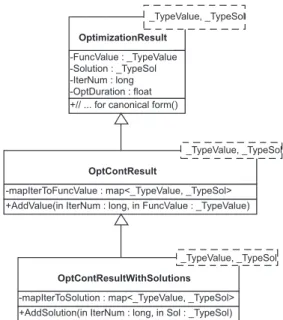
We can define a general class
OptimizationRe-sult
, which can be used to represent the result of any kind of optimization problems. Except for the defined member variables, it is neces-sary to add a few more members to satisfy thecanonical form3]that enables the usage of
de-clared classal pariwith any predefined type in C++ (required members include constructor,
destructor, copy constructor). Since this class
represents the result of an iterative algorithm, two more members are added: one to represent the total number of iterations, and one to repre-sent the total calculation time in milliseconds. As mentioned in the introduction, sometimes it is convenient to have the possibility of recording some (or all) solutions that the iterative
algo-rithm has achieved on its way to the final solu-tion. This can be useful to analyze the progress
of the algorithm, or to observe how the modifi-cation of algorithm parameters affects the algo-rithm performance. A class with capability of saving such results would have to enclose some kind of container where those results could be stored. For this purpose, a group of classes defined in Standard Template library (STL),
which is the part of standard C++, can be very
useful. Since we are interested in retrieving the data by some key (in our case it is the ordinal
number of iteration for which we have saved the solution), the parameterized class
map
<class
Key, class T
> is perfectly suited. HereKey
rep-resents the type of the key used for retrieving the data, and T is the type of data to be saved in the container, So, we can define the classOpt-ContResult
(also parameterized in concordancewith type of optimization problem), which
in-herits the class
OptimizationResult
. Addition-ally, we can define another class, namedOpt-ContResultWithSolutions
. This class, besides the values of goal function during the iterations, saves the associated solution. Distinction be-tween these two classes is necessary because sometimes we are interested only in goal func-tion values, as preservafunc-tion of the solufunc-tions of-ten comes at extra cost in memory space. The hierarchy of these classes is shown inFig. 1.3. The Classes for Encapsulation of the Iterative Algorithm
Since we have given the definition of an iter-ative algorithm, we can immediately write an interface that such an algorithm must satisfy:
Fig. 2.Interface for iterative algorithms.
But, encapsulation of this kind is meaningless unless it facilitates the implementation of issues mentioned in the introduction: the termination of optimization, display of the current solution and preservation of intermediate results.
3.1. The Termination of Optimization
The length of iterative calculation is commonly expressed with the number of iterations to per-form. However, sometimes it is more con-venient to have the possibility of defining the maximum duration of the calculation. Also,
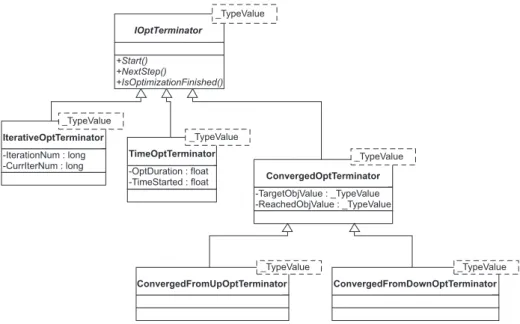
sometimes it is necessary that the calculation is performed until some desired solution is found. This can be commonly solved by writing the separate control routines for different versions of duration control. The object-oriented para-digm offers another solution. We can define different objects that will handle different ways of control of the algorithm. What is even more important, all of these objects will have the same interface, which means that with the use of poly-morphism we can handle all of them in the same way.
Such an interface is shown in Fig. 3. All ob-jects that define their own criteria for termina-tion will have to implement this interface. At the beginning of the optimization, the object must receive the messageStart() in order to
perform the necessary initializations. The func-tion
NextStep()
is called after each iteration so that the object can adjust its state to the per-formed calculation, e.g. increase iteration num-ber, refresh current time, or remember current solution (the argumentvoid *pData
isneces-sary because some objects that will implement this interface will have to pass some data to this function in order to adjust its state). The
func-tion
IsOptimizationFinished()
implements the criterion for decision whether optimization has come to an end or not. The objects that imple-ment this interface could beIterativeOptTermi-nator
, that terminates optimization when some predefined number of iterations is reached, orTimeOptTerminator
that does the same when apredefined interval of time has passed. Also, as in class hierarchy diagram shown on theFig. 3, we can define
ConvergedOptTerminator
object that terminates optimization when some defined objective function value has been reached(twodistinct classes are defined since it provides a more elegant solution for handling minimiza-tion and maximizaminimiza-tion problems).
3.2. The Progress Tracking
As mentioned earlier, when lengthy calculations are performed, it is necessary to periodically refresh user screen with the current solution, so that the user has some sense of progress of the calculation. Also, the opportunity to ob-serve the advance of the algorithm in search for solution sometimes comes handy. It becomes natural that there should be several ways to de-termine the refreshing period:
— refreshing after determined number of itera-tions
— refreshing after time interval
— refreshing when objective function has im-proved by some amount.
A simple solution, such as direct coding of all those possibilities in code and choosing one of the options depending on the function argument, would result in repetition of the same program code. Therefore, another approach has been im-plemented. As in the previous paragraph, where we have defined an object that takes care of op-timization termination, here we define an object
Fig. 4.Class hierarchy for IOptRefresher.
that handles the refreshing. The interface, to-gether with two simple objects that implement it, is shown inFig. 4.
Like in the case of
IOptTerminator
interface, we define objects that implement theIOptRe-fresher
interface and provide different ways to determine the refreshing period.IterativeOptRefresher
would implement the functionIsTimeToRefresh
in a way that returns true each time when algorithm has performed some number of iterations. The classTimeOpt-Refresher
implementsIsTimeToRefresh
in such a way that value true is returned after pre-determined period of time has passed.3.3. The Preservation of Intermediate Results
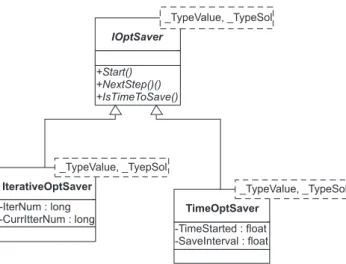
The approach to this problem is similar to those mentioned above. We define an interface that objects must implement, and then define those objects with appropriate criteria implemented.
Fig. 5.Class hierarchy for IOptSaver.
Defined object handles only the timing of preser-vation, i.e. when intermediate results will be saved. Of course, the space for these results must be allocated, which can be done in dif-ferent ways: we can simply declare one mem-ber variable in our class of type
Fig. 6.Class hierarchy for IIterativeOptimization class.
After defining all these interfaces, we can com-plete the definition of class
IIterativeOptimiza-tion
. We’ll add three member variables, point-ers to objects that implement interfacesIOpt-Terminator
, IOptRefresher andIOptSaver
.Now the complete class hierarchy is shown on
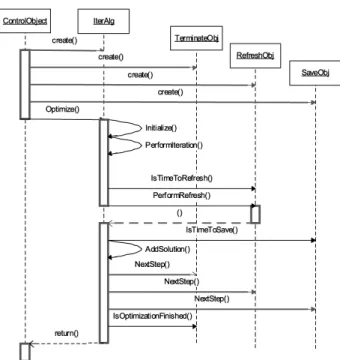
Fig. 6. InFig. 7. interaction diagram for func-tion
Optimize()
is shown.4. The Application
As an example of usage of the described class hierarchy, a method for solving the quadratic assignment problem can be given. Quadratic assignment problem is defined as
min
π2Sn
n
X
i=1
n
X
j=1
aπ(i)π(j)bij
where A = (aij) andB = (bij) are matrices of
dimensions nn, and Sn is set of all
permu-tations of f1 2 ::: ng. Quadratic assignment
problem first occurred in 4], and it consisted
of assigning n facilities to n locations, where matrixaij represented flow between facilitiesi
andj, andbkl represented distance between
lo-cations k andl. Exact methods of solving fail for problem instances withn > 20, because of
NP-complexity of the problem, so one is di-rected to the use of iterative algorithms. Most
Fig. 7.Interaction between objects in function Optimize.
often, QAP is solved with tabu search methods
5], simulated annealing6], genetic algorithms 7], or some hybrid techniques that combine
dif-ferent approaches.
The tabu search algorithm works on the follow-ing principle: the best solution in the neigh-borhood of current solution is selected, and is chosen as the next solution. If algorithm reaches a local optimum, all solutions in the neighbor-hood are worse that the current one. In this case the least degrading solution is chosen. To pre-vent from returning to the local optimum, most recently visited solutions are placed in the tabu-list of forbidden moves, which is implemented as a circular list of predefined length. When the list is full, the oldest move is taken out from the list, which makes the associated solution a candidate for selection again.
In implementation of tabu search optimization routine, solutions were first randomly generated in function
Initialize()
, which classTabuSe-archQAPSolver
inherited from interfaceIIter-ativeOptimization
(see Fig. 8). The functionPerformIteration
implements the code for one step of tabu-search algorithm.Fig. 8.Class TabuSearchQAPSolution.
quadratic assignment problem with basic tabu-search method, with all features described in the text, was written in 135 lines of code in func-tions
Initialize()
,PerforIteration()
andFind-BestMove()
.The presented example is just a fraction of the class hierarchy that was developed by the au-thors, where various methods of solving the exam scheduling problem at the authors’ insti-tution were implemented. Several approaches to this problem, which is a special case of quadratic assignment problems, were tested. Besides the tabu-search, the problem was solved by simulated annealing and genetic algorithms, which were successfully incorporated in the proposed framework. All algorithms were im-plemented in the same way, as objects imple-menting the described
IIterativeOptimization
interface. In this way we achieved the goal of separating implementation of the algorithm from program code for refreshing, saving results and control of duration of algorithm execution. Another advantage of this approach is that new objects can be added to the class hierarchy, im-plementing some new criteria for refreshing or optimization termination, without changing the implementation of algorithm itself, i.e., algo-rithm can readily use all new objects as long as they comply with the described interfaces.5. Conclusion
When implementing any kind of iterative algo-rithms, it is always necessary to devote a certain amount of time and effort to write the program code that is not directly associated to the actual problem solving, but is common to all iterative algorithms. This code should handle the screen refreshment with the current solution, the inter-mediate results storage and examination of the stop criteria.
This paper presents a class hierarchy, which can be used as an object-oriented framework for the solutions of the iterative problems. Uti-lizing the options available in object-oriented languages, it separates the class interface from the implementation. This framework defines the interfaces for the objects, which will imple-ment their own criteria for the common issues described above.
This framework was utilized to facilitate the so-lution of the exam-scheduling problem at the authors’ institution. This problem, which is a special case of the quadratic assignment prob-lem, was solved by several iterative methods. Besides the tabu-search, which is described in this paper, the simulated annealing and vari-ous genetic algorithms where implemented. All methods were easily fitted into the described framework, resulting in the significant decrease of number of lines of code and simpler program maintenance.
Work is in progress to extend this framework to enable the multithreaded execution, which would greatly improve framework usability and make it useful for development of applications in domain of numerical optimization.
References
1] STROUSTRUP, B. (1997), The C++
Program-ming Language, Addison-Wesley, Reading, Mas-sachusetts.
2] AUSTERN, M. H.(1998),Generic Programming and
the STL, Addison Wesley, Reading, Massachusetts.
3] COPLIEN, J. O.(1992),Advanced C++,
4] KOOPMANS, T. C.ANDBECKMANN, M. J. (1957),
“Assignment problems and location of economic activities”,Econometrica25, pp. 53–76.
5] SKORIN-KAPOVJ.,(1990), “Tabu search applied to
the Quadratic Assignment Problem”,ORSA Journal on Computing2, pp. 33–45.
6] WILHELM, M. R.ANDWARD, T. L. (1987),
“Sol-ving quadratic assignment problems by simulated annealing”,IIEE Transactions, pp. 107–119. 7] AHUJAR. K., ORLINJ. B.ANDTIWARIA.(2000), “A
greedy genetic algorithm for the quadratic assign-ment problem”,Computers & Operations Research 27, pp. 917–934.
Received:June, 2001 Accepted:September, 2001
Contact address: Zvonimir Vanjak Faculty of Electrical Engineering and Computing University of Zagreb Unska 3 10000 Zagreb Croatia e-mail:[email protected]
Vedran Mornar Faculty of Electrical Engineering and Computing
University of Zagreb Unska 3 10000 Zagreb Croatia e-mail:[email protected]
ZVONIMIRVANJAKreceived his B.Sc and M.Sc degrees at the Faculty of Electrical Engineering and Computing, University of Zagreb, in 1997 and 2001, respectively. He works at the same faculty as a researcher and was involved in the development of several projects. His main interests are object-oriented programming and numerical methods.