Introducing Polymorphic Features
into a Scripting Model of Generator
Danijel Rado
sevi´c and Ivan Magdaleni´c
ˇ
Faculty of Organization and Informatics, University of Zagreb, Varazdin, Croatiaˇ
Generative programming is a discipline of Automatic programming which strives to make application and the generator development process flexible and generated program code optimized. Because of the lack of appro-priate graphic and aspect based generator models, we developed the Scripting model of generator, as a static generator model based on higher level scripts. This paper gives a formal definition of the Scripting model and describes how basic object model properties, like encapsulation, inheritance, and now, polymorphism are achieved. This offers some advantages in generative ap-plication development, such as more precise apap-plication specification, better generator reusability, and simpler generator model and its easier implementation. The introduced polymorphic features are presented in an illustrative example of a Java application generator.
Keywords: generative programming, scripting model, polymorphism
1. Introduction
Generative programming [2] is a discipline of Automatic programming introduced, under this name, in the late 1990’s. According to a defi-nition, Generative programming represents de-signing and implementing software modules which can be combined to generate specialized and highly optimized systems fulfilling specific requirements[5]. The main specific difference from other techniques of automatic program-ming is aspect orientation of the model and independency from the targeted programming language. The programming code contains only instructions necessary for execution of desired task, which makes programming code more op-timized.
The Scripting model of generator is a graphic model, originally developed for the needs of
Generative programming based on the script-ing languages by Radoˇsevi´c[17]. Different to the object model given by the UML diagrams, it is aspect-oriented, i.e. oriented to define the specific aspects of a future application within its problem domain. Aspects represent the features that are not closely connected to the individual program organizational units, like functions or classes. Consequently, they can appear within different application parts which require a con-nection model, according to Kiczales[10]. The Scripting model is a kind of a Join point model
[9] known from the Aspect oriented program-ming. A specific difference is in that Script-ing model is not type-based i.e. it represents a type-free system because its connecting points are only the connections between the metapro-grams and the properties defined in the applica-tion specificaapplica-tion rather than classes and their objects[15].
The Scripting model, introduced in [17], in-cludes properties which can be compared with object-oriented concepts: encapsulation and in-heritance. Introduction of polymorphic features into Scripting model offers all main object-oriented concepts to Generative programming. The expected scientific contribution of this pa-per is in:
• Formal definition of Scripting model. The formal definition of Scripting model is de-scribed in Section 3. Previous version of Scripting model presented in [17] was de-fined as a graphic model.
becoming alternative regarding Object ori-ented paradigm.
The paper is organized as follows: The related work is presented in Section 2. The formal def-inition of the Scripting model is presented in Section 3. Section 4 describes implementation of the object model properties in the Scripting model and Section 5 presents polymorphism in the Scripting model. Section 6 deals with open implementation issues. Section 7 gives illustra-tive example of usage of polymorphism in the Scripting model. The conclusion is given in Section 8.
2. Related Work
Generative programming is mostly observed as a discipline based on the Object-oriented pro-gramming (OOP). Advanced OOP concepts, like generic classes, along with techniques of object modelling, such as UML, are used in building generators and automatization of pro-gramming [2]. Except the OOP, there some other disciplines in the base of generative pro-gramming. Aspect oriented programming(AOP)
was marked by Guerray [8] as one of the pos-sible successors of OOP. AOP deals with so called crosscutting concerns i.e. features that are shared among more program organizational units like functions or classes[9]. Crosscutting concerns can hardly be handled by parameters, so appropriate code fragments, called aspects, have to appear within different application parts which require a connection model, according to Kiczales [10]. The Scripting model is a kind of Join point model[6][9]known from AOP. A specific difference from original AOP approach is that the Scripting model is not type-based i.e. connecting points have only their names, with-out any property.
Generators use so called Domain-specific lan-guages(DSL)to specify applications to be gen-erated i.e. DSL can be used to generate mem-bers of a family of systems in an application domain [4]. A Domain engineering as a dis-cipline which deals with DSL-s is in the base of Generative programming[2]. The Scripting model uses hierarchical tree-like specification form to propose elements of DSL to be used in generation of applications, which is described in chapter 3.1.
Metaprogramming is, according to Cordy and Shukla [1], the process of specifying generic software source templates from which classes of software components, or parts thereof, can be automatically instantiated to produce new soft-ware components. The source templates used in the Scripting model are called metascripts. Metascripts are code fragments(or scripts)which have to be completed by elements of applica-tion specificaapplica-tion and other metascripts by an automatized process of generation.
After OOP languages, the scripting languages are also introduced into Generative program-ming, as announced by Sells [18]. The ad-vantages of the scripting languages should be reached by avoidance of certain weaknesses of the Object-oriented programming, which are, according to Ousterhout[16], rigidity of the ob-ject model, high level of typing and the need of the translation/compilation phase during the program development. There are some script-ing language characteristics that could be use-ful for Generative programming: a scripting language abilities in the character strings pro-cessing[13][19], the possibilities of connecting completed components written in the target pro-gramming languages[19]and flexibility of the scripting languages syntax which arise from a low typing level[16][19]. Except of using exist-ing scriptexist-ing languages, some projects on mak-ing specialized scriptmak-ing languages aimed at Generative programming were conceived, such as Open Promol[19]and CodeWorker[13]. The idea of the Scripting model is to offer model of generator with good properties of scripting languages, primarily to avoid the rigidity of ob-ject model. Complex classes, which are used as connection points in Join point model [9], are replaced with simple links which are type-less. A program code is assembled from fragments of source code called metascripts. On the other hand, introducing properties which are charac-teristic to object model, like encapsulation, in-heritance, and polymorphism, could be interest-ing to achieve higher level of model elements reusability(so less complex model)and easier upgrading of generator.
Consequently, there is a difference in relation to metaclass-based approaches, as described by Grigorenko et al.[7]Tolvanen and Rossi[20]and De Lara and Vangheluwe [3]. Metascripts are not strictly tied to particular classes and other program units to be generated. Their purpose is to implement some crosscutting concern in all needed parts of the program. Another impor-tant difference between the object model and the Scripting model is that the latter is based on the dealing with crosscutting concerns, which is recognized as a problem within the object model by K¨uhl[11]and Lee[12]. Furthermore, an object model is aimed to define the individual application, while a Scripting model defines the application generator for a proposed problem domain.
3. Scripting Model Definition
Scripting model is oriented to produce software variants i.e. building Software Product Lines
(SPL). According to the Scripting model, the generator is software that produces a source code of a one particular application from a fam-ily of possible applications. Scripting model defines generator as a multi-level structure( Fig-ure 1) consisting of three kinds of elements: application Specification (S), Metascripts(M; code templates in Scripting model) and Links
(L), where links are base elements containing all lower-level structures. Each level starts with its base Metascript and defines one particular generator. For each particular application the Scripting model is defined by this 6-tuple:
SM={S,M,L,P,m0,g}.
where
S is a whole specification (of particular appli-cation to be generated),
M is a set of metascripts(program code tem-plates in Scripting model),
M= {m0,m1, . . . ,mm}
L is a set of links(each link occurs0..N times in0..Mmetascripts). The link is a user defined mark, which is replaced with the source code in the process of generation.
L={l1,l2, . . . ,ln}
Pis a generated program(source code)
m0 is a highest-level metascript (base of the
appropriate generator)
gis a function that produces source code( gen-erator)
Generated program is a function of Specifica-tion(S), Links(L)and highest level metascript
m0:
P=g (S, L, m0)
Generator(g)is a recursive function. Each par-ticular metascript(mi)can contain fragments of
a program code (p) and subset of links (Lmi), from all possible links in L, toward lower-level structures:
mi ={p,Lmi}
pare fragments of the program code(to be in-cluded in generated source code)
Lmiis a set of links(connections toward
lower-level structures)in this particular metascript,
Lmi ={l0,l1, . . . ,lk}.
Each link (li ∈ Lmi) in metascripts mi is
re-placed in the process of generation with one of the following:
• appropriate three elements groups
{S,Lmj,mj}, which can be observed as a
new generator or
• a fragment of program code(p)from meta-scriptmi.
Higher-level generator is given as a superposi-tion of lower-level generators (Figure 1). Par-ticular links can be used more times, in different templates, enabling reuse of whole connected sub-levels.
3.1. Graphic representation of Scripting model
Figure 1.Generator as a multi-level structure.
3.1.1. Specification diagram
The Specification diagram gives the structure of application specification in the form of a tree-like feature model(similar approach: Limbourg and Kochs [14]). The application specification consists of attributes, defining particular fea-tures of application to be generated within its problem domain and their values, as shown in Figure 2. All attributes are optional, so they can be omitted or replicated as many times as required.
Figure 2.Application specification.
An example of the concrete application specifi-cation is shown later in Figure 12.
The hierarchy of the attributes is given by the Specification diagram(Figure 3). Higher-level attributes are containers for the lower-level at-tributes.
Figure 3. Example of the Specification diagram.
The attribute database <type> is a container for all other specification attributes. It can be repeated an arbitrary number of times. The attributes db name, db file, table, XPath, user
andpasswordare optional and can appear only once perdatabase <type>, while the attributes from the group field (field int, field float and field string)can appear an arbitrary number of times. As shown in Figure 2, containers are marked by square brackets, or end by ‘ ’ sign, which is used for groups e.g.field int,field float
and field stringcould be treated in both ways: separately and as members of groupfield . This diagram is used later to describe example appli-cation in subsection 6.1.
3.1.2. Metascripts diagram
The Metascripts diagram defines generator con-figuration, i.e. connections between application specification and metascripts (code templates in Scripting model). Specification attributes, given in the Specification diagram, represent
sourcesin the Metascripts diagram, whilelinks
represent replacing tags in metascripts.
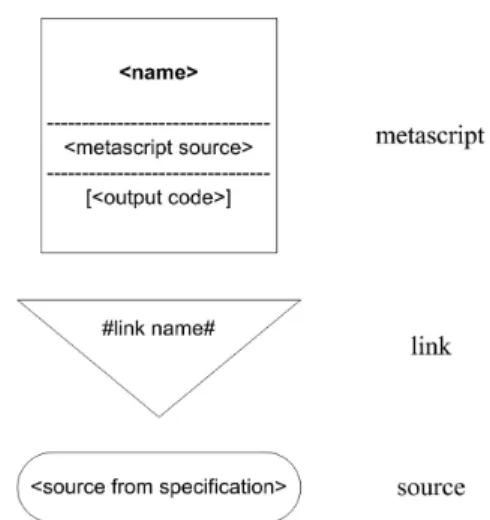
There are three basic elements used in the Meta-scripts diagram(Figure 4):
Ametascriptis a template used in generation of its implementation – a program code in the tar-get programming language. It is represented by a rectangle. The element contains data such as:
metascript name, metascript source (filename or the name of another used source), and out-put code (filename or name of another output which contains the generated program code).
Metascriptcontain replacing tags, calledlinks, in form of ‘#’ marks. Linksphysically belong to theirmetascripts, but it is shown outside. A
linkconnects the metascript(s)with the feature source from the application specification and
(optionally)to the lower level metascript(s). It is represented by a triangle with one corner ori-ented downwards. A link is typeless and has only its name. During generation process, the
links inside metascripts are replaced with the data or a program code in either of the two pos-sible ways. The first way is the direct replace-ment of a link with the source data (if there are no connected lower-levelmetascripts). The second way is the replacement of alinkwith a lower-level metascript. It is important that the
linksinside a particular metascript could appear more than once. All appearances are shown by a single triangle in the Metascripts diagram. The
sources can be defined as containers. In that case, their further use must be defined on the lower levels of the Metascripts diagram.
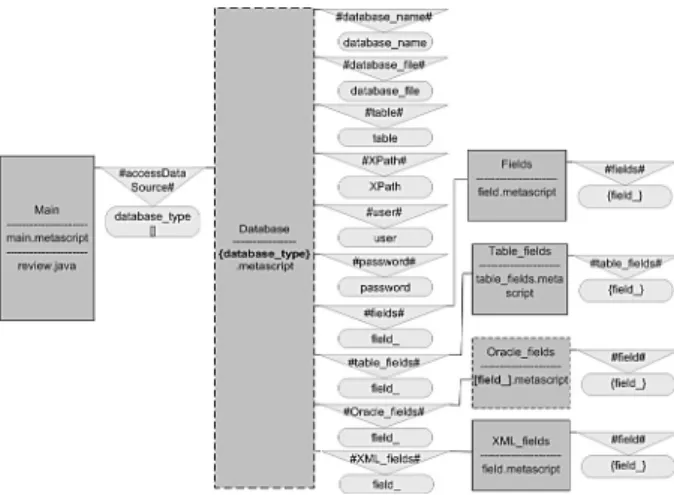
The example of the Metascripts diagram is shown in Figure 5. MetascriptMainhas link to meta-scriptDatabase. MetascriptDatabasehas links to metascriptsFields,Table fields,Oracle fields, andXML fields.
Figure 5.Example of the Metascripts diagram.
Dashed line representsvirtual metascript( me-tascript subjected to late binding process), as described in Section 5. This diagram is used later to describe example application in subsec-tion 6.2.
4. Implementation of the Object Model Properties in the Scripting Model
Object-oriented programming uses encapsula-tion, inheritance and polymorphism as its basic concepts. Similar concepts are used in Script-ing model at generation level. These object-oriented features are applied in the context of generation of the source code regardless of the target programming language.
Implementation of some features that are char-acteristic for object-oriented programming could be interesting in achieving better features of the generator system, like higher reusability of model elements, more precise application spec-ification and simpler model of particular gener-ator.
The Scripting model, as introduced in[17], cludes basic concepts of encapsulation and in-heritance. These two features of the Scripting model are shortly described in next two subsec-tions.
4.1. Encapsulation
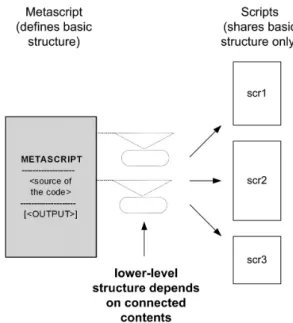
The basic unit of encapsulation in the Script-ing model of generator is a metascript. The metascript encapsulates a program code together with links(replacing marks). A program code of the metascript is static and serves as interface for combining with other metascripts. Links in metascripts can be observed as full implemen-tation, which depends on application specifica-tion. Unlike a class, the metascript is a dy-namic structure, which means that its instances
Figure 6.Metascript and its instances.
The structure of scripts depends on its meta-scriptsand their connected contents(thesources
from a specification and, possibly, the inherited
metascripts).
4.2. Inheritance
Inheritance in the Scripting model occurs when a basemetascriptinherits the lower-level meta-scripts. The lower-lever metascripts in con-text of Scripting model are parents regarding the base metascript. In Figure 7 metascripts A and B are parents of metascript Base. The inheritance is selective and inclusion of every particular parentmetascriptdepends on the ex-istence of the appropriatesourcefrom the pro-gram specification (Sources S1 and S2 in the example in Figure 7).
Figure 7. Inheritance in a Scripting model.
The Scripting model inheritance mechanism differs from standard function call mechanism
(used in structural programming and OOP) in several ways: in the level of inheritance, in selective inheritance, and using of application specification values instead of function param-eters. Function calls exist at application runtime level and are used for process sharing. Inheri-tance in the Scripting model exists at the gener-ation level and is oriented on static structure of generated application. The selective inheritance is a base for achieving optimization(in relation to generic approaches): final application could use only a subset of available metascripts, de-pending on its specification.
4.3. Polymorphism in the Scripting model
Polymorphism in the Scripting model is based on the use of the virtual metascripts. These
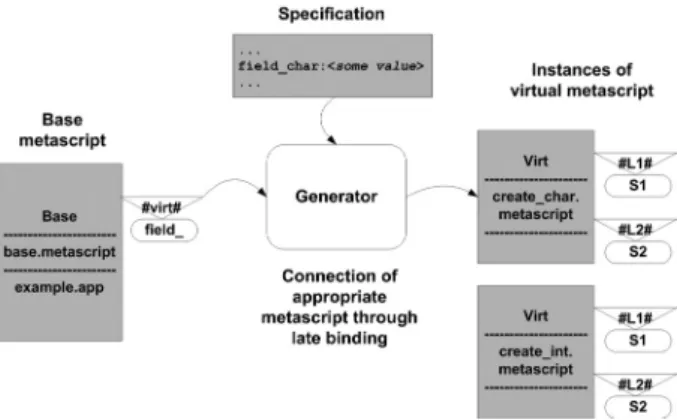
metascripts are invoked by the mechanism of late binding during the program generation( ac-cording to the program specification, as de-scribed further; Figure 8).
Figure 8.The principle of using virtual metascripts.
The advantage of introducing polymorphism is expandability in a way that does not touch the model of generator and its implementation. Ad-dition of new functionality by using polymor-phism requires specifying new values in the ap-plication specification and adding the appropri-atemetascripts.
Thevirtual metascriptis represented by a dashed line rectangle(Figure 9).
Figure 9.Virtual metascript.
A metascript source contains a variable part marked by the square brackets. The follow-ing example shows the usage of attribute name for invocation of appropriatevirtual metascript:
create [field ].metascript
Figure 10 shows such definition ofvirtual meta-script.
Figure 11 shows how invocation ofvirtual meta-scripts works. Specification defines the usage of attribute field char. During the process of generation, generator uses this value to create name of metascriptcreate char.metascript and then invokes it.
Figure 10.An example of virtual metascript definition.
Figure 11.An example of virtual metascript invocation.
In some other cases the real metascriptsource could be e.g.create field int.metascript, depend-ing on the specification attributes used.
5. Open Implementation Issues
The upgraded Scripting model of generator de-fines the way of building and documenting of generator by its specification (represented by the Specification diagram), configuration( rep-resented by the Metascripts diagram)and set of
metascripts(code templates within the Script-ing model). Some issues regarding checking consistency that concern implementations of the model still remain for future work. There are three kinds of inconsistencies that could happen in implementation of the model: the inconsis-tent syntax of the model, syntactic incorrectness of the generated code and logical incorrectness of the generated code.
Inconsistent syntax of the modelcould be, in the simplest form, a result of using unsupported specification attributes or disregarding of the specification hierarchy. Referencing of non-existingmetascriptscould be a circumstance of polymorphism if some of thevirtual metascripts
have not their implementation. It’s possible to use replacingmetascripts, or to stop the gener-ation process. Dealing with links in generator configuration could cause two kinds of errors:
• usage of connections that don’t appear in used metascripts. Could be wrong connec-tion or redundant generator configuraconnec-tion,
signs)remaining in generated code resulting in syntax and/or logical errors.
Syntactic incorrectness of the generated code
often comes from insufficient specification, where some necessary attribute values are not specified. This results in links remaining in generated code. Usage of unsafe names in metascripts (variables, functions, classes etc.)
could cause the collision with attribute values in specification. Some programming languages require that e.g. functions have to be defined prior to their calls. Order of specification at-tributes could cause breaking of that rule.
Logical incorrectness of the generated code
could be violated by usage of unsafe names or by links remaining in generated code (if these do not cause the syntactic incorrectness)or by breaking program restrictions. For example, ex-ceeding of size limits for attribute values could cause improper work or instability of generated applications.
6. Illustrative Example
The problem domain of an illustrative example is a small Java application for reviewing data from different data storages (Oracle database and XML). The generator uses attribute names for handling different data types by invocation ofvirtual metascripts.
6.1. Specification of the example application
The Specification diagram of the example appli-cation is presented in Figure 3 and described in subsection 3.1.1. It defines main parameters of the used data storage and the used fields together with their types. The appropriate specification is shown in Figure 12.
Figure 12.The specification of the example application.
The specification consists of two parts: the first part defines the structure of Oracle database, and the second part defines XML data structure. Attribute group ‘database ’ is connected to vir-tual metascript marked as ‘database [ database-type].metascript’. The real metascript(Oracle or XML)is attached during the process of gen-eration.
6.2. Working with the metascripts
The example generator generates only one pro-gram file, which has the part for handling appro-priate data storage. The Metascript diagram of the example application is presented in Figure 5 and described in subsection 3.1.2.
Hence the main metascript contains the parts common to all generated applications, includ-ing its general structure:
The link #accessDataSource#, from Figure 13, is replaced by a program code in the process of generation. The virtual metascriptDatabase
is used for generating a code and it has two in-stances(for Oracle database and for XML docu-ment). The metascriptOracle fieldsfor gener-ating theOraclecode that handles different data types is also virtual because of the three field
types used(field int,field floatandfield string; Figure 5).
Some of the links onDatabasevirtual metascript are not common to all instances of the virtual metascript. Therefore, they are ignored in these instances. Finally, the generated code for the example specification is shown in Figure 14. Figure 14 shows the source code which is used for access data about students from two different data sources. The first data source is table in Or-acledatabase and the second data source isXML
file in file system. The source code used for ac-cessing these data sources differs significantly because data sources are of different kinds. The source code for each data source comes from separate metascripts. The element data-base <type> of application specification, as shown in Figure 12, specifies which metascript
file is used. The bolded words in source code come from application specification presented in Figure 12.
Because some fields in Oracle table are of differ-ent types, differdiffer-ent source code should be gener-ated. That is the reason whyOracle.fi leds.meta-scriptis virtual metascriptwhich can generate source code for different data types depending on application specification, e.g. type int and typeStringin Figure 14.
The main benefits of using polymorphism in this example are simpler application specifica-tion and simpler extension of the generator. The application specification(shown in Figure 12)is simplified by usage of virtual metascript
([database].metascript). This enables usage of same specification attributes (e.g. field int, field string etc.) after the type of database is
specified(database Oracleordatabase XML).
Addition of new type of data source requires building a new metascript for this type and ad-dition of appropriate elements into application specification.
This and some other examples are available1.
7. Conclusion
This paper gives formal definition of the Script-ing model and introduces polymorphic features into the Scripting model. Scripting model has preserved all of previously obtained features, such as aspect orientation and type-less join points. The paper shows that the basic con-cepts of the Object-oriented programming, e.g. encapsulation, inheritance and, finally, poly-morphism can be implemented within Scripting model of generator.
The main goals of introducing polymorphic fea-tures in the Scripting model are: a more pre-cise application specification, a better reusabil-ity of generator elements, and a simpler gen-erator model and its implementation. A more precise application specification is enabled by variety of metascripts under the same name that are subjected to late binding. The problem do-main covered by a generator can be extended by usage of virtual metascripts and change of a generator aimed at introducing new program templates is not always necessary. The vir-tual metascript covers more real metascripts, which reduces the number of metascripts in the Metascripts diagram.
The advantage of introducing polymorphism is expandability in a way that does not touch the model of generator and its implementation. Ad-dition of new functionality by using polymor-phism requires specifying new values in the ap-plication specification and adding the appropri-atemetascripts.
In our future work we plan to focus on the prob-lems of checking consistency of the model im-plementation.
References
[1] J. R. CORDY, M. SHUKLA, Practical Metaprogram-ming.Proceedings of the 1992 Conference of the Centre for Advanced Studies on Collaborative Re-search,(November 09–12, 1992), Toronto, Ontario, Canada.
[2] K. CZARNECKI, U. W. EISENECKER, it Generative, Programming: Methods, Tools, and Applications, Addison Wesley, 2000.
[3] J. DE LARA, H. VANGHELUWE, Defining visual notations and their manipulation through meta-modelling and graph transformation. Journal of Visual Languages and Computing, Vol. 15(2004), pp. 309–330.
[4] A. V. DEURSEN, P. KLINT, Domain-specific Lan-guage Design Requires Feature Descriptions. Jour-nal of Computing and Information Technology (CIT), Vol. 10, No. 1(2002).
[5] U. EISENECKER, Generative Programming: Beyond Generic Programming.Proc. Dagstuhl Seminar on Generic Programming, (April 27–May 1, 1998), Schloß Dagstuhl, Wadern, Germany.
[6] J. GRAY, Y. LIN, J. ZHANG, Levels of Independence in Aspect-oriented Modelling. Available on:
http://www.gray-area.org/Pubs/middle-ware-2003.pdf, 2003.
[7] P. GRIGORENKO, A. SAABAS, E. TYUGU, Visual Tool for Generative Programming. Proc. of the Joint 10th European Software Engineering Conference (ESEC) and the 13th ACM SIGSOFT Symposium on the Foundations of Software Engineering (FSE-13), ACM Publ.,(2005), pp. 249–252.
[8] R. GUERRAOUI, Strategic directions in object-oriented programming. ACM Computing Surveys, Baltimore, December 1996.
[9] M. M. KAND´E, J. KIENZLE, A. STROHMEIER, From AOP to UML – A Bottom-Up Approach.1st Inter-national Conference on Aspect-oriented Software Development,(2002), Enschede, The Netherlands. [10] G. KICZALES, J. LAMPING, A. MENDHEKAR, C.
MAEDA, C. VIDEIRALOPES, J.-M. LOINGTIER, J.
IR-WIN, Aspect-oriented Programming. InProceedings
of the European Conference on Object-oriented Pro-gramming (ECOOP),(June 1997), Springer-Verlag LNCS 1241, Finland.
[11] D. K ¨UHL, STL and OO Don’t Easily Mix. Pro-ceedings of the GSCE,Workshop on C++ Template Programming, Erfurt 2000, Available on:
http://www.oonumerics.org/tmpw00/
kuehl.html, 2000.
[12] K. W. K. LEE, An Introduction to Aspect-oriented Programming. COMP610E: Course of Software Development of E-Business Applications, (Spring 2002), Hong Kong University of Science and Tech-nology.
[13] C. LEMAIRE, CODEWORKER Parsing tool and Code generator – User’s guide & Reference manual, (Release 4.4.),
http://codeworker.free.fr-/CodeWorker.pdf, 2007.
[14] P. LIMBOURG, H. D. KOCHS, Multi-objective opti-mization of generalized reliability design problems using feature models – A concept for early design stages. Reliability Engineering & System Safety, Volume 93, Issue 6(2008), pp. 815–828.
[15] I. MAGDALENI´C, D. RADOSEVI´ˇ C, Z. SKOCIR, Dy-ˇ namic Generation of Web Services for Data Re-trieval Using Ontology, INFORMATICA, Vol. 20, No. 3 (2009), pp. 397–416, ISSN 0868-4952, In-stitute of Mathematics and Informatics, Vilnius, Lithuania.
[16] J. K. OUSTERHOUT, Scripting: Higher Level pro-gramming for the 21st Century, IEEE computer magazine,(March 1998).
[17] D. RADOSEVI´ˇ C, B. KLICEK, J. DOBˇ SA,ˇ Generative Development Using Scripting Model of Application Generator. DAAAM International Scientific Book 2006, DAAAM International, Vienna, Austria 2006. [18] C. SELLS, Generative programming: Modern Tech-niques to Automate Repetitive Programming Tasks.
MSDN Magazine,(December 2001). Available on:
http://msdn.microsoft.com/msdnmag/issu-es/01/12/GenProg/GenProg.asp, 2001.
[19] V.STUIKYS, R. DAMAˇ SEVIˇ CIUS, G. ZIBERKAS,ˇ Open
PROMOL: An Experimental Language for Target Program Modification, Software Engineering De-partment, Kaunas University of Technology, Kau-nas, Lithuania, 2001.
[20] J. P. TOLVANEN, M. ROSSI, Metaedit+: Defining and using domain-specific modeling languages and code generators. In OOPSLA 2003 demonstration, 2003.
[21] UNIFRAME WEB SITE. Available on:
http://www.cs.iupui.edu/uniFrame/, last
ac-cessed 05-13-2008.
Received:October, 2009
Revised:December, 2010
Accepted:February, 2011
Contact addresses:
Danijel Radoˇsevi´c Faculty of Organization and Informatics University of Zagreb Pavlinska 2 42000 Varazdinˇ Croatia
e-mail:[email protected]
Ivan Magdaleni´c Faculty of Organization and Informatics University of Zagreb Pavlinska 2 42000 Varazdinˇ Croatia
e-mail:[email protected]
DANIJELRADOˇSEVIC´, PhD, is an associate professor at the University of Zagreb, Faculty of Organization and Informatics. He teaches at dif-ferent programming courses. His research focuses on programming languages, generative programming and educational software.
IVANMAGDALENIC´, PhD, is an assistant at the University of Zagreb,