Keywords:
Phaseolus vulgaris L., physiological quality, dry matter, isozymes
How to cite this article:
Dubal et al. Effect of temperature on bean seed germination: vigor and isozyme expression. American Journal of Agricultural Research, 2016,1(5): 0001-0009.
eSciPub LLC, Houston, TX USA. Website: http://escipub.com/
American Journal of Agricultural Research
(ISSN:2475-2002)
Research Article AJAR (2016), Vol. 1, Issue 05
Effect of temperature on bean seed germination: vigor and isozyme
expression
This research aimed to evaluate the physiological quality of seeds and isozyme expression in seedlings of bean’s genotypes under influence of germination temperatures. Seeds of Cario-ca, BRS Expedito and IPR Tuiuiú genotypes were subjected to five germination temperatures (15, 20, 25, 30 and 35 °C). Seeds were submitted to tests of germination, first count, germination speed index, cold test, isozyme expression and the total dry matter of seedlings. Germination was altered due to the differ-ent temperatures. As the temperature rose, seeds of IPR Tuiuiú and BRS Expedito had reduced germination. The increase on temperature significantly affected the germination speed index of the three genotypes, leading to a greater increase in the values of this attribute. Bands of esterase from the cold test showed less intensity compared to other tests. Due to the exposure to different temperatures, there are similarities between the number and intensity of bands on esterase, with lower enzyme expres-sion at 30 and 35 °C, changes in the number and intensity of peroxidase expression at all temperatures, and practically none expression of the acid phosphatase enzyme in higher evaluated temperatures. Therefore, the seeds exhibit better performance when exposed to temperature of 30 °C compared to use of lower temperatures, while on temperatures above 30 °C isozymes ex -pression is reduced for both genotypes.
Ítala Thaísa Padilha Dubal1, Cristian Troyjack1, Geison Rodrigo Aisenberg1, Felipe Koch1, Vinicius Jardel Szareski1, João Roberto Pimentel1, Maicon Nardino2, Ivan Ricardo Carvalho, Tiago Olivoto2, Velci Queiróz de Souza3, Francisco Amaral Villela1, Tiago Zanatta Aumonde1, Tiago Pedó1
1University of Pelotas, Pelotas, Rio Grande do Sul, 96010-900, Brazil. 2Federal University of Santa Maria, Frederico Westphalen, Rio Grande do Sul, 98400-000, Brazil. 3Federal University of Pam -pa, Dom Pedrito, Rio Grande do Sul, 96450-000, Brazil.
Introduction
Beans (Phaseolus vulgaris L.) is a species of great importance in human food because its grains present high protein content and energy. It is a crop that has diversified farming systems, being produced in all Brazilian Regions. Nation-al production of beans in 2015/2016 growing season was 3.3281 million tons, an increase of 6.8% compared to the previous (CONAB, 2016). The low grain yield is related to the low rate of use of certified seed, corresponding to 19% in 2013/2014 growing season (ABRASEM, 2014). In order to obtain high quality seeds is neces-sary to have an appropriate and uniform stand of plants in the production field, as this can reflect on seed quality. The seeds have different quality attributes, among them stands out the physiolog-ical. Seed quality can be influenced by inherited genetic aspects of their parents, and environ-mental conditions of the growth site (ANDRADE et al., 2001).
Seeds physiological quality is a decisive point in seed development and can be reduced through the process of deterioration that occurs during germination (ABREU et al., 2014). Germination is the resumption of embryo growth in optimal conditions of temperature (PESKE et al., 2012), while the vigor is expressed in adverse condi-tions during seedling emergence (CARVALHO; NAKAGAWA, 2012), being influenced by condi -tions environment in which the seeds are pro-duced.
Climatic variations affect plant development. The temperature is the climatic element that most influence the beans crop; it can delay / re -duce seed germination and seedling emergence (TEIXEIRA, 2000). Temperatures below 15 °C negative influence on germination and hypoco -tyl elongation (ZABOT et al., 2008), while high temperatures can cause abscission of flowers and lower final retention of the pods (BARBOSA; GONZAGA, 2012).
Seed’s exposure to high temperatures can re-duce germination due to deteriorative processes (MARINI et al., 2013), protein denaturation and inactivation of enzymes (VIEIRA, et al., 2010). In lower temperatures, however, seeds’ enzymat-ic activity is reduced, restrenzymat-icting the germination process (MATHEUS; LOPES, 2009). The stress caused in the seedlings by temperature can be associated with the hydrolysis of reservations
(DEVI et al., 2007) and enzymatic expression. Enzymes act in the synthesis and degradation of molecules during seed germination and ear-ly seedling growth (MUNIZ et al., 2007; VEIGA et al., 2010; PIMENTEL, 2012). In recent years, unfavorable environmental conditions have been affecting the initial establishment and develop -ment of crops in the field, being essential to assess the effects caused by adverse tempera -tures on seed germination and isozyme profile of bean’s seedlings.
In this context, the aim of this study was to eval-uate the physiological quality of seeds and seed-lings isozyme expression of different beans gen -otypes under germination temperature effect. Material and methods
Seeds were produced in the city of Ametista do sul (Latitude 27 ° 20’20.98 “S and Longitude 53 ° 11’5.32” W), in the state of Rio Grande do Sul. Since the climate of the region characterized by being tempered with rains well distributed and hot summer, according to Köppen. After harvest-ing, quality analysis was performed in laboratory of the Graduate Program in Seed Science and Technology of Faculty of Agronomy “Eliseu Ma -ciel”, Federal University of Pelotas.
The experimental design was a randomized complete block in a factorial treatment design 3 x 5, where three genotypes (Carioca (Ca); BRS Expedito (Ex) and IPR Tuiuiú (Tu)) and five ger -mination temperatures (15; 20; 25; 30 and 35 ºC) arranged in eight replications. To evaluate the physiological quality of seeds and isozyme expression of seedlings, they were subjected to the following tests:
First germination count (FGC): conducted to-gether with the germination test, where assess-ments were made four days after sowing, ac-cording to Rules for Seed Testing. The results were expressed as percentage of normal seed-lings.
Germination speed index (GSI): was carried out together with the germination test, by count-ing the seedlcount-ings with minimal root protrusion of 3 to 4mm. Annotations were daily-obtained, at the same hour, and the assessment carried out up to stabilization of values. The GSI was calcu-lated according to Vieira; Carvalho (1994). Total dry mass (TDM): estimated by determin-ing the mass of four replicates of 10 seedldetermin-ings at the end of the germination test. Seedlings were placed in brown-paper envelopes and dried in forced-ventilation oven under temperature of 70 °C up to constant mass. Passed this time, dry mass of seedlings was assessed with precision scale, where results were expressed in milli-grams per organ (organ mg-1).
Cold test (CT): Carried out in four replications with four replicates of 50 seeds each, germinat-ing in rolls formed by three sheets of germitest paper, wetted with distilled water 2.5 times the dry weight of the paper. After sowing, the rolls were kept in the type germination chamber B.O.D. under temperature of 10 °C for five days (KRZYŻANOWSKI et al., 1999). After this peri -od, seeds were transferred to B.O.D. chamber, regulated at 25 °C, where assessments were carried out according to Rules for Seed Testing (BRASIL, 2009).
Isozyme expression: the expression of ester-ase, acid phosphatase and peroxidase isoen-zymes was determined on 10 seedlings coming from germination and cold test and are expressed by vertical electrophoresis system on 7% poly-acrylamide gels, applying 20μL of each sample. Coloring systems used were based on Scandali-os (1969) and Alfenas (1998). The results were visually-evaluated in the gels by the presence or absence and intensity of bands’ expression. Data were subjected to two-way ANOVA by F test at 5% probability error aiming discovering interaction between genotypes x germination temperatures. When observed significant inter -action, the traits were partitioned into simple
ef-fects. For quantitative factor, linear regression analysis was carried out considering the larg-est-polynomial degree significant.
Results and discussion
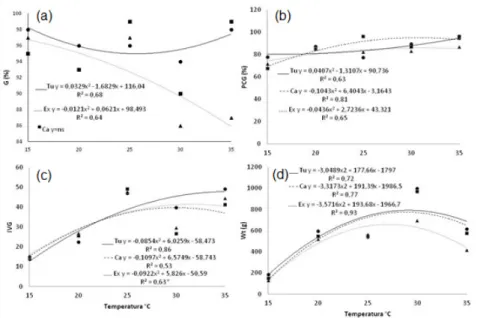
According to two-way ANOVA, it was observed significant interaction between genotype x ger -mination temperature for ger-mination (G), first count (PCG), germination speed index (GSI) and total dry matter (TDM).
Bean’s seed germination under different tem -peratures showed quadratic curve trend being changed depending on germination temperature (Figure 1a). By analyzing IPR Tuiuiú genotype, germination increased with increasing tempera-ture, whereas increase in temperature has re-duced the germination of BRS Expedito. How-ever, germination of Carioca genotype did not present significance.
Variations in the germination values for both gen-otypes can be related to the tolerance of different genotypes on wide temperature interval, due to the high temperatures cause denaturation of pro-teins and increase the fluidity of the lipid mem -brane (WAHID et al., 2007). Similar results were found by Machado Neto et al. (2006), studying the effect of temperature on germination of bean seeds, obtained a decrease of this attribute at a temperature of 35 °C, becoming null at the tem -perature of 39 °C.
First count values had fitted the quadratic curve for the three beans genotypes, with tendency to increase due to the increase in temperature (Fig-ure 1b). The largest number of normal seedlings in the evaluation of the first count of germination occurred with the use of temperatures of 30.7; 31.2 and 35 °C, for the genotypes Carioca, BRS Expedito and IPR Tuiuiú respectively.
Sharp decrease in germination rate as the tem-perature gradually decreases, is explained by the low rate of water imbibition, affecting mo -bilization of reserves’ seeds for embryo growth (MARCOS FILHO, 2015).
Tuiuiú, Carioca and BRS Expedito genotypes, respectively. According to Bewley et al. (2014) GSI, is sensitive to temperature, generally in-creasing until it reaches the ideal temperature, and decreasing sharply above the optimum tem-perature.
Total dry mass was fitted by a quadratic curve, with coefficients of determination (R²) above 0.70. The genotypes tended to show higher TDM with increase on temperatures tested (Fig-ure 1d). Overall, for the three genotypes, TDM of seedlings showed an increase between 25 to 30 °C. The highest point was 28.8; 27.1 and 29.1 °C for Carioca BRS Expedito and IPR Tuiuiú geno-types, respectively.
Dry mass accumulation can be reduced by low temperatures (GUERRA et al., 2014). According to Marcos Filho (2015) at low temperatures, re-duced seedling growth can occur, and this dam-age is usually proportional to the period of expo-sure at that temperature, and can also extend the problem during the rest of the crop develop-ment cycle.
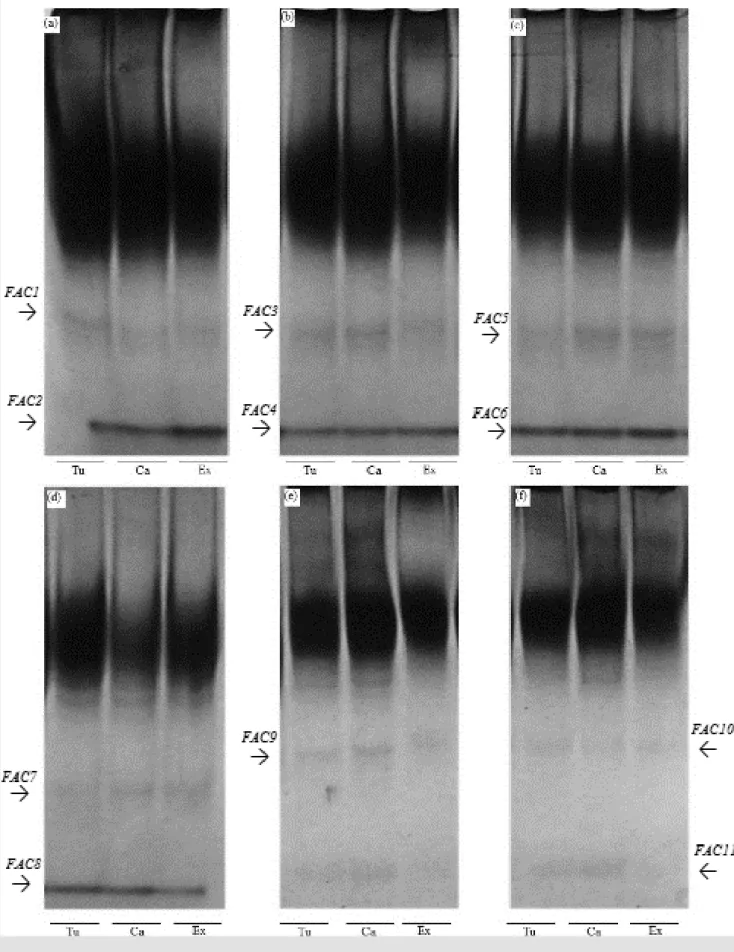
Esterase isozyme showed similar number and intensity of bands for genotypes when subjected to different germination temperatures (Figure 2). In the cold test the intensity of the bands was lower than the other (Figure 2a) when can be ob-served low expression of esterase enzymes by allele view (EST1 and EST2). Already, at tem-peratures of 15, 20 and 25 °C bands expression was similar, with largest intensities (Figure 2b, 2c and 2d).
It was possible to identify the presence of three alleles at temperatures of 15 and 25 °C, and of two alleles using 20 ºC. However, when seed-lings were exposed to high temperatures (30 to 35 ºC) there was a reduction in enzyme expres -sion (EST11 up to EST15) (Figure 2e and 2f) observing reduction in expression of the EST11
and EST15 alleles in all genotypes. Given that, the esterase is an enzyme that acts on ester hy-drolysis reactions, being directly related to iso-zymesthe metabolism of lipids (SANTOS et al., 2004), the reduction of the intensity of bands in-dicates a possible deterioration of seed, result-ing from its exposure to high temperatures. According to Basavarajappa et al. (1991), lipid peroxidation is a phenomenon related to damage
membrane of the seeds; the changes may be ex-pressing the occurrence of deteriorative events, which can result reduction on seed germination, to the extent that temperature and water content seed are increased.
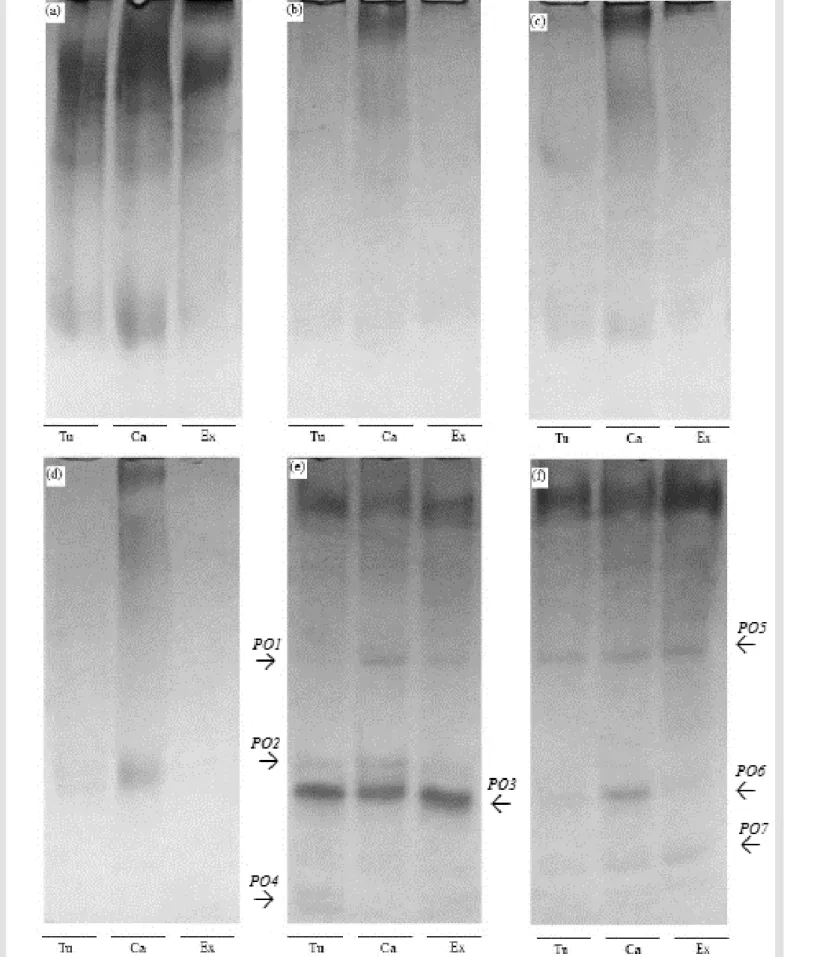
Peroxidase isozyme had altered the number and expression of their bands when subjected to different temperatures of germination. There was no expression of peroxidase in seedlings coming from cold test and at temperatures of 15; 20 and 25 °C (Figure 3a, 3b, 3c and 3d). There was greater intensity of this bands in seedlings growing under higher temperatures for the three genotypes. However, changes in enzyme ex-pression was markedly started at temperature of 30 °C, where it is observed the presence of four alleles (Figure 3e). At the temperature of 35 °C, however, there was decreasing in expression and under presence of only three alleles (Figure 3f).
The greater expression of peroxidase on tem-perature up to 30 °C may be related to lipid per -oxidation and alterations in the permeability of cell membranes by temperature (ROSSI; LIMA, 2001).
Acid phosphatase isozyme showed a higher number and intensity of bands in seedlings at cold test and at temperatures of 15; 20 and 25 ºC, being possible to identify the presence of two alleles in each temperature (Figure 4a, 4b, 4c and 4d). When higher temperatures are used, there was reduction of acid phosphatase expres-sion, and the presence of only one allele at 30 °C (Figure 4e) and two alleles at 35 °C (Figure 4f). Acid phosphatase acts on ester hydrolysis and may act on phospholipid membranes, causing lipid peroxidation (SILVA et al., 2000). This en-zyme is associated with the mobilization of stor-age proteins, especially during germination and seedling growth (GOMES et al., 2000). Accord-ing to Spinola et al. (2000) the decrease in the number and intensity of bands of acid phospha-tase enzyme, when corn seeds were subjected to accelerated aging is characterized by lipid peroxidation, fact that may have reduced the ex-pression of this isoenzyme in bean seedlings in higher germination temperatures.
thus causing increases in the first count of ger -mination, germination speed index and total dry mass of seedlings. Thus, for conditions in which this research was performed, when higher it was the stress provided to seeds, smallest it was the expression of the isoenzymes.
Conclusion
Bean genotypes have different germination char -acteristics when subjected to elevated tempera-tures. Generally, the seeds exhibit better perfor-mance when exposed to higher temperatures, compared to use of lower temperatures, except for the BRS Expedito. The use of temperatures above 30 °C negatively affects the expression of esterase and acid phosphatase isozymes for all genotypes.
References
Abrasem. Associação brasileira de sementes e mu-das, 2014. < http://www.abrasem.com.br/wp-content/
uploads/2013/09/Anu%C3%A1rio-Abrasem-2014.
pdf>
Abreu, V.M.; Pinho, E.V.R.V.; Pinho, R.G.V.; Naves, G.M.F.; Neta, I.C.S.; Guimarães, R.M.; Carvalho, M.R. Physiological performance and expression of isozymes in maize seeds subjected to water stress. Journal of Seed Science, 2014; 36(1): 040-047. <http:// dx.doi.org/10.1590/S2317-15372014000100005>
Alfenas, A.C. Eletroforese de isoenzimas e proteínas
afins: fundamentos e aplicações em plantas e micror -ganismos, Viçosa: UFV, 1998. 574p.
Andrade, R.V.; Auzza, S.A.Z.; Andreoli, C.; Netto,
D.A.M.; Oliveira, A.C. Qualidade fisiológica das se -mentes do milho híbrido simples hs 200 em relação
ao tamanho. Ciência e Agrotecnologia, 2001; 25(3):
576-582.
<http://ainfo.cnptia.embrapa.br/digital/bit-stream/item/78263/1/Qualidade-fisiologica-1.pdf>
Barbosa, F.R.; Gonzaga, A.C.O. Informações técni -cas para o cultivo do feijoeiro-comum na Região Central-Brasileira: 2012-2014 - Santo Antônio de Goiás: Embrapa Arroz e Feijão, 2012, 247 p.
Basavarajappa, B.S.; Shetty, H.S.; Prakash, H.S. Membrane deterioration and other biochemical changes, associated with accelerated ageing of maize seeds. Seed Science and Technology, 1991; 19(2): 279-286.
Bewley, J.D.; Bradford, K.J.; Hilhorst, H.W.M.; Non-ogaki, H. Seeds: physiology of development, germi-nation and dormancy. New York: Springer, 2014. 407 p.
Brasil. Ministério da Agricultura e Reforma Agrária.
Regras para Análise de Sementes. Brasília: SNAD/
CLAV, 2009. 398p.
Carvalho, N.M.; Nakagawa, J. Sementes: ciência, tecnologia e produção. Jaboticabal: Funep, 2000. 588p.
Conab. Companhia Nacional de Abastecimento. Acompanhamento as safra brasileira de grãos.v. 6,
safra 2015/16, sexto levantamento, Brasília, p. 1-138,
março 2016. <http://www.conab.gov.br/OlalaCMS/
uploads/arquivos/16_03_10_09_17_17_boletim_
graos_marco_2016.pdf>
Devi, R.; Munjral, N.; Gupta, A.K.; Kaur, N. Cadmi-um induced changes in carbohydrate status and en-zymes of carbohydrate metabolism, glycolysis and pentose phosphate pathway in pea. Environmental and Experimental Botany, 2007; 61(2): 167-174. DOI: 10.1016/j.envexpbot.2007.05.006.
Gomes, M.S.; Von Pinho, E.V.R.; Von Pinho, R.G.;
Vieira, M.G.G.C. Efeito da heterose na qualidade fisi
-ológica de sementes de milho. Revista Brasileira de
Sementes, 2000; 22(1): 7-17. <http://www.scielo.br/
pdf/rbs/v33n2/13.pdf>
Guerra, A.; Barbosa, A.M.; Guidorizi, K.A.; Souza, G.M. Efeitos da temperatura do ar na fotossíntese da cana-de-açúcar na fase inicial do desenvolvimento. Revista Agrarian, 2014; 7(24): 211-217.
Krzyzanowski, F.C.; Vieira, R.D.; França Neto, J.B. Vigor de sementes: conceitos e testes. Londrina: (Ed.) Abrates, 1999. 218p.
Machado Neto, N.B.; Prioli, M.R.; Gatti, A.B.;
Cardo-so, V.J.M. Temperature effects on seed germination
in races of common beans (Phaseolus vulgaris L.). Acta Scientiarum Agronomy, 2006; 28(2): 155-164.
<https://www.researchgate.net/profile/Nelson_Mach -ado_Neto/publication/45088183_Temperature_ef -fects_on_seed_germination_in_races_of_common_ beans_Phaseolus_vulgaris_L_Efeitos_da_tem- peratura_na_germinacao_de_sementes_em_cul-turas_de_feijoes_comuns_Phaseolus_vulgaris_L/ links/5465e62b0cf2052b50a08a5b.pdf>
Marcos filho, J. Fisiologia de sementes de plantas
cultivadas. Londrina: Abrates, 2015. 659p.
Marini, P.; Moraes, C.L.; Larré, C.F.; Lima, M.C.; Mo -raes, D.M. Amarante, L. Indicativo da perda de qual-idade de sementes de arroz sob diferentes
tempera-turas através da atividade enzimática e respiratória. Interciência, 2013; 38(1): 54-59. <http://www.inter
-ciencia.org/v38_01/054.pdf>
Matheus, M.T.; Lopes, J.C. Temperaturas cardi-nais para a germinação de sementes de Erythrina-variegata L..Revista Brasileira de Sementes, 2009;
a13v31n3.pdf>
Muniz, F.R.; Cardoso, M.G.; Pinho, E.V.R.V.; Vilela,
M. Qualidade fisiológica de sementes de milho, fei -jão, soja e alface na presença de extrato de tiririca. Revista Brasileira de Sementes, 2007; 29(2): 195-204. < http://www.scielo.br/pdf/rbs/v29n2/v29n2a26. pdf>
Pimentel, M.A.; Vasconcellos, M.C.; Penha, R.O.; Guerra, E.P.; Silva, A.L.L. Ação de diferentes en-zimas na germinação de sementes de alface (Lactu-ca sativa L.) – Asteraceae. Journal of Biotechnology
and Biodiversity, 2012; 3(3): 1-4. <http://revista.uft.
edu.br/index.php/JBB/article/viewFile/288/201>
Rossi, C.; Lima, G.P.P. Cádmio e a atividade de per-oxidase durante a germinação de sementes de feijo-eiro. Scientia Agricola, 2001; 58(1): 197-199. < http://
dx.doi.org/10.1590/S0103-90162001000100030.>
Santos, C.M.R.; Menezes, N.L.; Villela, F.A.
Alter-ações fisiológicas e bioquímicas em sementes de feijão envelhecidas artificialmente. Revista Brasileira
de Sementes, 2004; 26(1): 110-119. < http://www. scielo.br/pdf/rbs/v26n1/a17v26n1.pdf>
Scandálios, J.G. Genetic control of multiple molec-ular forms of enzymes in plants: a review.
Biochem-ical Genetics, 1969; 3(1): 37-79. DOI: 10.1007/ BF00485973.
Silva, E.A.A.; Pinho, E.V.R.V.; Vieira, M.G.G.C.;
Carvalho, M.L.M.; Machado, J.C. Alterações dos pa
-drões de isoenzimas em sementes de milho infect -adas por fungos. Pesquisa Agropecuária Brasileira,
2000; 35(9): 1725-1732. < http://www.scielo.br/pdf/ pab/v35n9/v35n9a04.pdf>
Spinola, M.C.M.; Cicero, S.M.; Melo, M. Alterações bioquímicas e fisiológicas em sementes de milho
causadas pelo envelhecimento acelerado. Scientia
Agricola, 2000; 57(2): 263-270.
< http://www.scielo.br/pdf/sa/v57n2/v57n2a11.pdf>
Teixeira, I.R. Resposta do feijoeiro (Phaseolus
vul-garis L. cv. Pérola) a diferentes densidades de se -meadura e doses de nitrogênio. Ciência e
Agrotec-nologia, 2000; 24(2): 399-408. <http://www.editora. ufla.br/index.php/component/phocadownload/cate
-gory/30-volume-24-numero-2?download=246:vol -24numero2.>
Vieira, E.L.; Souza, G.S.; Santos, A.R.; Santos Silva, J. Manual de Fisiologia Vegetal. São Luis: Edufma,
2010. 230p.
Vieira, R.D.; Carvalho, N.M. Testes de vigor em se-mentes. Jaboticabal: Funep. 1994. 164p.
Veiga, A.D.; Pinho, E.V.R.V.; Veiga, A.D.; Pereira, P.H.A.R.; Oliveira, K.C.; Pinho, R.G.V. Influência
do potássio e da calagem na composição química, qualidade fisiológica e na atividade enzimática de sementes de soja. Ciência e Agrotecnologia, 2010; 34(4): 953-960. < http://dx.doi.org/10.1590/S1413-70542010000400022>
Zabot, L.; Dutra, L.M.C.; Garcia, D.C.; Menezes, N.L.
Ludwig, M.P. Temperatura e qualidade fisiológica no
crescimento de plântulas de feijoeiro. Revista Bra-sileira Agrociência, 2008; 14(4-4): 60-64. < https:// periodicos.ufpel.edu.br/ojs2/index.php/CAST/article/ download/1956/1787.>
Peske, S.T.; Villela, F.A.; Meneghello, G. E.
Se-mentes: fundamentos científicos e tecnológicos. 3.ed. Pelotas: Ed. Universitária/UFPel, 2012. 573p.
Wahid, A.; Gelani, S.; Ashraf, M.; Foolad, M.R. Heat tolerance in plants: An overview.
Environmen-tal and ExperimenEnvironmen-tal Botany, 2007; 61:199-223.
Figure 2 - Isozyme expression of esterase activity in bean seedlings growing under different temperatures. Where: Cold test (a), 15 (b), 20 (c), 25 (d), 30 (e) and 35 °C (f). Where: Carioca (Ca), BRS Expedito (Ex) and IPR Tuiuiú (Tu). Figure 1 - Germination (a) first count (b) germination speed index (c) and total dry mass (d) of bean’s genotypes sub
-jected under different germination temperatures. Where: Carioca (Ca), BRS Expedito (Ex) and IPR Tuiuiú (Tu). ns = not