Wan Nurshazelin Wan Shahidan1*, Nur Atikah Nadzri2, Nordianah Jusoh@ Hussain3,Nur Syuhada Muhammat Pazil4,andSaida Farhanah Sarkam5
1,2 Faculty of Computer & Mathematical Sciences, Universiti Teknologi MARA, 02600 Arau, Perlis,
Malaysia
3 Faculty of Computer & Mathematical Sciences, Universiti Teknologi MARA, 78000 Lendu, Alor Gajah,
Melaka, Malaysia
4Faculty of Computer & Mathematical Sciences, Universiti Teknologi MARA, 77300 Jasin, Melaka,
Malaysia
5 Faculty of Business and Management, Universiti Teknologi MARA, 78000 Lendu, Alor Gajah, Melaka,
Malaysia
Corresponding author: *[email protected]
Received Date: 29 Mac 2019 Accepted Date: 15 May 2019
ABSTRACT
Malaysia is the second largest palm oil production in the world. Malaysian Federal Land Consolidation and Rehabilitation (FELCRA) is an important agency to nurture local palm oil industry by involving local community. However, in 2017, FELCRA Seberang Perak at the Northern Malaysia reported a decreasing of 5% palm oil production as compared to the previous year. FELCRA Seberang Perak has four palm planted areas yet the administrators had not fully utilized the areas for optimum production. Thus, the study applied goal programming model in order to find the optimal palm planted area at FELCRA Seberang Perak. The study has three-fold objectives, which are: 1) to maximize each planted area; 2) to maximize the number of palm trees; and 3) to maximize the palm fruit production for each area. The study analyzed data using QM for Window version 5.3. The findings show that the optimal planted area for FELCRA Seberang Perak is 5,662.80 hectares while the maximum number of palm trees are 845,829 which may annually produce 224,120.20 tonnes of palm oil. The result of the study can be applied by FELCRA Seberang Perak’s administrators as to increase its palm oil productivity at the most optimum level as well as to spur the Malaysian economy in the global commodity market.
Keywords: Optimization planted area, palm fruit production, goal programming model
INTRODUCTION
in 2018 which may led to insufficient supply for export. The decreasing figure could be solved by optimizing the palm planted areas in the country.
Malaysian Federal Land Consolidation and Rehabilitation (FELCRA) is an important agency to nurture local palm oil industry by involving local community. One of the most affected FELCRA land with decreasing production of palm oil was FELCRA Seberang Perak at the Northern Malaysia. In 2017, the production of palm oil was decreased to 5% from 178,258 tonnes to 169,769 tonnes (Department of FELCRA Seberang Perak, 2017). Even though the shrinking may due to external factors like weather and pests, the production number could hike up or maintain by optimizing the planted plantation area of palm fruit (Haque & Asami, 2014). The decreasing production might affect the local community’s income as well as for FELCRA’s annual revenues. The largest crop planted at FELCRA is the palm trees. FELCRA Seberang Perak has four areas of palm plantation. Every area has different optimum number of planted trees and FELCRA Seberang Perak’s administrator has to aware about the correct number of trees to be planted at each area as to optimize the annual palm oil production.
Therefore, this study aims to maximize the total palm planted area in FELCRA Seberang Perak by using goal programming method. The study has three-fold research objectives: 1) to maximize each planted area; 2) to maximize the number of palm trees; and 3) to maximize the palm fruit production for each area.
LITERATURE REVIEW
Generally, agriculture sector problems involves multiple goals such as maximizing the total profit, maximizing crops production, minimize the cost, and minimize labor and others that related in agriculture. Normally, the goals are conflicting in nature and it is not possible to maximize or minimize all the goals simultaneously (Sharma et al., 2007). Certain goals can be achieved by expenses the other sectors. Mostly, the application in agriculture sector corresponds to the problem of determining the optimum crop with multiple goals. So, this study used goal programming model to dealing with multiple or conflicting objectives function.
Hassan et al. (2013) used goal programming method to optimize the land area and productions. In their research, they stated two goals which are optimizing the rubber productions and maximizing the land area. Hence they are focused on the land area of plantation. The land is set up to 50,000 hectare. There will be no decrement in each of the planted area. However, to get the data is a bit difficult, the scope of this research is limited to increase the planted area without covering the economic perspective. The weights were assigned based on the percentage of rubber production per area in each country. From the result, by increasing the land area for rubber plantation, the production of rubber can increase.
In agriculture sector, farmer is more concerned about the economic issue since agriculture is the one of the income contributors to them. It is necessary for all the farmers to do their best to make as much effort as possible to increase the production and protect their crops (Dave, 2015). Management of agricultural sector faced many problems in order to achieve the goal of production. One of the ways to solve agriculture sector problem is by applying the mathematical programming model as Dave (2015) used goal programming model in his research. The goal programming model is the best model to apply in various aspects of agricultural. He also stated that in the agricultural objectives depend on the labor, cost water, weather condition and others.
planning, the shadow prices were introduced with the concept of standardized dual variable in goal programming.
According to Satkhed, Vatsala, & Ghanashyam (2018), small increase in the yield per acre can easily result in huge increase in the overall production efficiency in the particular region in the given time. The agriculture planning problem are not able to deal with any single goal of the maximizing the output or the profit. Previous studies have discusses applied goal programming model with weighted goals and goal programming using ranking goals with priority levels. Therefore, this study was aims to apply goal programming approach tested using equal important multiple goals to maximize palm fruit production based on the optimization of the area of palm tree planted for FELCRA Seberang Perak.
METHODOLOGY
In formulating the Goal Programming model, there are three important characteristics that must be considered. First, Goal Programming models are all minimization problems. Second, there is no single objective but multiple goals and constraints to be achieved. Third, deviations variables of goals must be minimized to be considered. All three goals are set to be equal important. The step of GP model formulation procedure are as follows:
Step1: Setting
goals
There are three goal to be achieved. The first goal is to maximize the planted areas (hectares) for four planted area in FELCRA Seberang Perak by maximize the palm fruit planted for each area. The total area is aimed to reach 5662.8 hectare. The target to maximize the planted areas is based on the availability of land in FELCRA Seberang Perak where there is only 1812 hectares. Therefore, the target is 20% from the availability of the total area of FSP 12 and FSP 13 and target 40% from the availability of the total area of FSP 10&11 and FSP 14&15.
The second goal of this study is to maximize the number of palm trees up to 845828 based on the increasing number in planted area. Target number of palm trees for FSP 12 and FSP 13 up to 20% increased and for FSP 10&11 and FSP 14&15 up to 40% increased from number of palm tree planted in 2017. The third goal is to maximize productivity of palm fruit for four planted areas by increasing the production up to 20% for FSP 12 and FSP 13 and for FSP 10&11 and FSP 14&15 up to 40% increment. Table 1 summarized the data set used in this study from the four planted areas in FELCRA Seberang Perak.
Table 1: Planted areas, production of palm fruit and number of palm tree
Area Planted
area of palm tree
in 2017 (hectare)
Target planted
area
No. of palm
tree
No. palm tree per
area
Target no. of palm
tree
Palm fruit Production
(tonne)
Palm fruit production
per area
Target palm fruit production
FSP
10&11 794 1111.6 114210 144 159894 32857 41.38 32857.15 FSP 12 1044 1252.8 154370 148 185244 33232 31.83 33232.25 FSP 13 868 1041.6 132765 153 159318 34558 39.81 34558.33
FSP
Step 2: Identify constraints requirement
For planted area constraints is required each planted area to be greater than equal to amount of target planted area for each area.
For number of palm tree for each area constraints is required each planted area to be greater than equal to amount of target number of palm tree for each area.
For palm fruit production constraints is required each planted area to be greater than equal to amount of target palm fruit production for each area.
Step 3: Define deviational variables
There are two deviational variables which are overachievement of goal ( ) and underachievement of goal ( ). For GP model for this study, overachievement for three goals are not important since this GP model is only want to minimize the underachievement of the objective function.
Step 4: Formulate objective function
The objective of GP model is to optimize all goals and constraints. The objective function is designed to minimize deviation from three goals. The objective function is defined by Hassan et.al 2013.
Complete GP model
With three equal important goals to be achieved and the deviations variable been set up to minimize underachievement ( ) of objective functions, the goal programming model is as follows:
Minimize Z = 𝑑"#+ 𝑑
%#+ 𝑑&# (1)
Goals equation:
𝑥"+ 𝑥%+ 𝑥&+ 𝑥(+ 𝑑"#− 𝑑"*= 5662.8 (total planted area)
(total number palm tree)
41.38𝑥"+ 31.83𝑥%+ 39.81𝑥&+ 42.88𝑥(+ 𝑑&#− 𝑑
&*= 196770.22 (total production palm fruit)
Constraint:
(planted area for each area)
794𝑥" ≥ 1111.6
1044𝑥%≥ 1252.8
868𝑥&≥ 1041.6
1612𝑥(≥ 2256.8
(Number of palm tree for each area)
144𝑥" ≥ 159894
148𝑥%≥ 185244
153𝑥&≥ 159318
151𝑥 ≥ 341372
i d+
i d
-i
d
-1 2 3 4 2 2
(production for each area)
41.38𝑥"≥ 32857.15
31.83𝑥% ≥ 33232.25
39.81𝑥& ≥ 34558.33
42.88𝑥( ≥ 69122.49
𝑥", 𝑥%, 𝑥&, 𝑥(, 𝑑"#, 𝑑
"*, 𝑑%#, 𝑑%*, 𝑑&#, 𝑑&*≥ 0
where
𝑥"=FSP 10&11
𝑥% = 𝐹𝑆𝑃 12
𝑥& = 𝐹𝑆𝑃 13
𝑥( = 𝐹𝑆𝑃 14&15
𝑑"#=underachievement of total planted areas
𝑑"*=overachievement of total planted areas
𝑑%#=underachievement of total palm trees
𝑑%*=overachievement of total palm trees
𝑑&#=underachievement of total palm fruit production
𝑑&*=overachievement of total palm fruit production
RESULTS AND DISCUSSIONS
The Goal Programming model formulated is then being solved by QM for Windows 5.3. Table 3 below shows the analysis for each goal. The results in QM for window’s shows 0 values for d- which means the result is achieved and d+ values is 0 meaning that the target has been fully utilized. Positive deviation (d+) for the total planted area and production palm fruit with respective values 1.26 hectare and 27411.61 production of palm fruit have exceeded the target for each goal. The result from QM for windows shows 0 value for d+ for number of palm tree plated goal means the target has been fully utilised.
Table 2: Goal Analysis from the Deviation
Goal Current achievement in 2017 Target in 2018 d+ d-
Total Planted Area 4318 5662.8 1.26 0
Number Palm Tree 645182 845828 0 0
Production Palm Fruit 169769 196770.2 27411.61 0
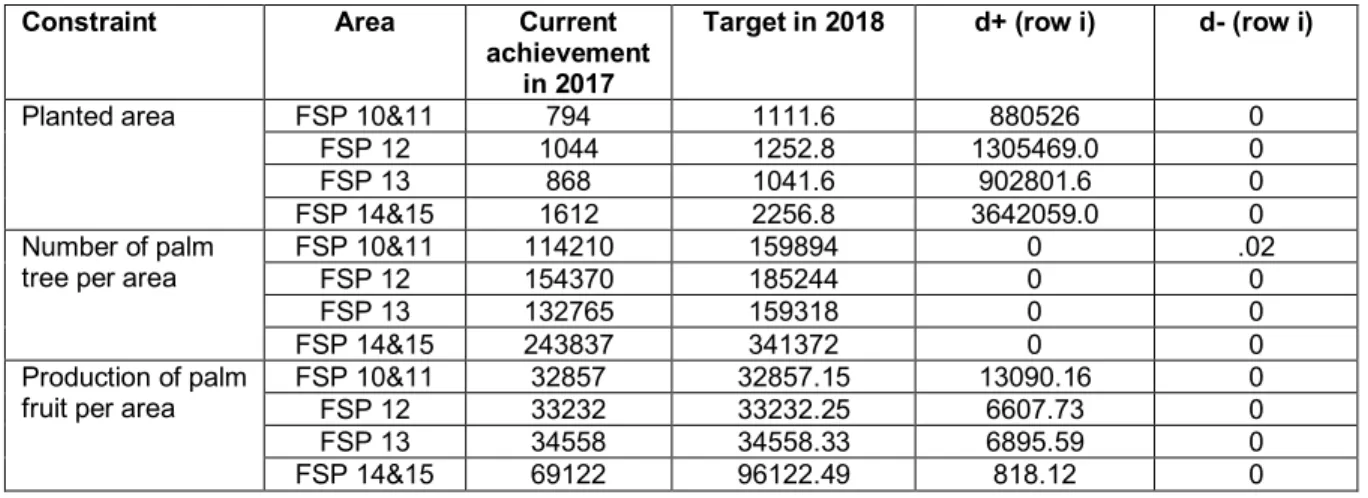
For number of palm tree to be planted constraint, the result’s in QM for Windows shows 0 values for d+ for each planted area which mean the target to maximize the number of palm tree to be planted has been fully utilised. It shows that in Table 3, from current achievement for number of palm tree to be planted can be increase up to 185244 number of palm tree for FSP12, 159318 number of palm tree for FSP 13 and 341372 number of palm tree for FSP 14&15. However, underachievement by 0.02 (negative deviation d-) for FSP 10&11 shows that there is surplus of number of palm tree of 0.02 from target 159894 number of palm tree. Table 3 also shows the result for production of palm fruit constraint. The results can be concluded that the current production of palm fruit for each planted area can be maximize to target values in 2018. The achievement was noted by positive deviation (d+). It shows that increasing the production up to 20% for FSP 12 and FSP 13 and for FSP 10&11 and FSP 14&15 up to 40% increment successfully achieved.
Table 3: Constraints Analysis from the Deviation
Constraint Area Current
achievement in 2017
Target in 2018 d+ (row i) d- (row i)
Planted area FSP 10&11 794 1111.6 880526 0 FSP 12 1044 1252.8 1305469.0 0
FSP 13 868 1041.6 902801.6 0
FSP 14&15 1612 2256.8 3642059.0 0 Number of palm
tree per area FSP 10&11 FSP 12 114210 154370 159894 185244 0 0 .02 0
FSP 13 132765 159318 0 0
FSP 14&15 243837 341372 0 0 Production of palm
fruit per area FSP 10&11 FSP 12 32857 33232 32857.15 33232.25 13090.16 6607.73 0 0 FSP 13 34558 34558.33 6895.59 0 FSP 14&15 69122 96122.49 818.12 0
CONCLUSION
REFERENCES
Banitalebi, A., Aziz, M. I. A., Aziz, Z. A., Nasir, N. 2016. Modelling and optimization for palm oil plantation management. In AIP Conference Proceedings Vol. 1750, No. 1, p. 030046). AIP Publishing. Dave, D. A. (2015). Goal programming applications in agricultural management. International Research
Journal of Engineering and Technology (IRJET), 02 06, p. 883.
Department of FELCRA Seberang Perak. (2017). Annual palm statistic in FELCRA Seberang Perak. Perak, Malaysia: FELCRA.
Hassan, N., Hamzah, H.M.M., Zain, M.M.S. 2013. A goal programming approach for rubber production in Malaysia. American-Eurasian Journal of Sustainable Agriculture, 7, p.50.
Haque, A., & Asami, Y. (2014). Optimizing land use location for planner and real estate developers. Computer, Environment and Urban System, 46, p. 57.
MPOB. (2017). Malaysia Palm Oil Berhad - Production of palm oil product. Retrieved from http://bepi.mpob.gov.my/index.php/en/statistics/production/177-production-2017/791-production-of-oil-palm-products-2017.html
Satkhed, A., Vatsala, G. A., Ghanashyam, K.J., 2018. A new approach to optimize the production of crop using compost from solid waste. International Journal of Advances in Science Engineering and Technology, 6.
Sharma, D. K., Jana, R.K., Gaur, A. (2007). Fuzzy goal programming for agricultural land allocation problems. Yugoslav Journal of Operation Research, 17 , p. 31.
Vashistha, P.K., (2011). Application of goal programming in farm agricultural planning. International Journal of Research in Science & Technology, 1