Systematization of functional elements of the structure of
complex mechanization at careers
Sh. A. Makhmudov
Department of Mining, Navoiy State Mining Institute, P.M.B. 210100, Galaba 127, Navoiy, Uzbekistan
ABSTRACT
The development of the structure of complex mechanization of technological processes in quarries, which involves justifying the choice of means of mechanization, the peculiarity of which is obviously determined by the presence of structural elements and the types of relationships between them in accordance with the peculiarities of the structural formulas of technological processes and operations.
Keywords: Complex mechanization, complex, connection of elements, mining equipment, processing equipment, quarry, set,
structural elements, structural formula, technological process, transport equipment
Submitted: 10-02-2020, Accepted: 18-02-2020, Published: 29-03-2020
INTRODUCTION
The expansion of the scope of mining and transportation equipment, as well as primary processing equipment, is
accompanied by the appearance of new modernized specific
designs. Therefore, the rational choice, acquisition, and determination of the efficiency of equipment use based
on their systematization are a very relevant scientific and
practical task.
PURPOSE OF WORK
The development of the structure of complex mechanization of technological processes in quarries, which involves justifying the choice of means of mechanization, the peculiarity of which is obviously determined by the presence of structural elements and the types of relationships between them in accordance with the features of the structural formulas of technological processes.
DISCUSSION OF THE ISSUE
The task of choosing the type and model of open-pit mining, transport, and processing equipment for natural technological
ore zones from the entire variety of equipment presented is very relevant and is an integral part of the complex of tasks to justify the structure of complex mechanization of quarries. In recent years, problems have specialized in solving a set of tasks aimed at developing a strategy for the technical reequipment
of quarries, which is based on the justification of the structure
of complex mechanization of quarries and its dynamics for the long term.
The essence of one of the classifications of technological
equipment proposed by Prof. Poderni consists in the following that the equipment used in quarries is divided into seven classes according to their functional purpose (i.e., according to technological characteristics): Equipment for preparing rocks for excavation, mining loading, mining transport, transport, dump forming, sorting and processing, and equipment for
auxiliary works.[1] The equipment of each class is divided into
groups, each of which includes types that differ in design. Each
type of equipment has several standard sizes that coincide
mainly in design, differing in productivity, size of working
equipment, weight, etc.
All mining equipment according to the classical system is
classified by the type of energy used, method of production,
mass, and structure.
Address for correspondence: Sh. A. Makhmudov, Navoiy State Mining Institute, P.M.B. 210100, Galaba 127, Navoiy, Uzbekistan.
E-mail: [email protected]
Original Article
The classification proposed by Prof. Anistratov and Anistratov, laid signs that reflect the nature of the operation of the main
equipment, the composition of the mining, and transport
equipment. The advantage of the classification of Anistratov
and Anistratov[2] is that it takes into account the continuous,
discrete, and mixed nature of the equipment, which reflects
the relationship between functional machines.
In the classification of Acad. Rjevskiy, complexes of
equipment for open work are separable into six classes.[3] The
structure of complex mechanization according to Rjevskiy consists of links corresponding to production processes performed by mining and transport equipment. Such processes are preparation of rocks for excavation, excavation, loading, transportation, dumping, warehousing, interim storage and transshipment, and primary processing. Depending on the technology adopted, the structure of mechanization may include all or part of these technological units. Further
differentiation of the structures of mechanization is carried
out in close connection with the technology of mining. Moreover, the determining role belongs to the type of transport, the name of which is included in the name of the
complex. Transport equipment, in turn, is classified according
to the following criteria: By purpose, nature of work, method of moving goods, and structures.
SOLUTION OF THE PROBLEM
The above classifications indicate only the presence of functional elements in the systems of technological equipment. However, in these classifications, there is no nature of the relationship between the elements. It follows that the systematization of technological equipment should be based on technological development schemes, i.e., it is necessary
to first systematize the technological processes and then the
equipment and operators.
The main technological processes during the introduction of mining operations include mining, transportation, and primary processing of minerals.
The technological process of excavation consists of preparing the face for excavation – the subject of labor P, the process of excavation – the means of labor B, the process of controlling
the excavator – the executor of I. periodicity (−), periodic (~)
with the established periodicity, and continuous (÷).
These relationships, together with the functional elements of technological processes, form a structural model of a workplace in quarries. Using the letter designations, it is possible to carry out a structural systematization of the technological processes of the workplace according to the
functional attribute of the following set of PM = {P, C, I, −, ~, ÷}, Table 1.
The extraction of minerals can be made either directly from the array or from the collapse. The process of excavating strong and rocky rocks includes drilling, blasting, and excavating the fossil. The transportation process consists of loading, transportation, and unloading itself. The essence of the primary processing
process is crushing, screening, and mineral processing.[4]
The nature of the interaction of functional processes (episodic, periodic, and continuous) essentially represents the relationship between functional production processes. The presence of functional elements and the relationships between them allows us to consider the structure of technological processes as a set of functional (structural) processes and the relationships between them.
Based on the application of the well-known classification of
Solod et al.,[5] we consider the structure of the technological
process of mining mineral resources in an open way.
Technological connection according to Solod et al.[5]
is understood as the mutual logical dependence of the implementation of functional processes in the general technological process of mining of minerals by separate means of mechanization. Kinematic connection provides for the coordination of the implementation of functional processes in the general technological process of mining, indicated by the means of mechanization, retaining the ability to separately perform their functions. Constructive communication characterizes the combination and consistency of the implementation of functional processes in the general technological process of mining, linked in terms of parameters and coordinated actions by means of mechanization, having lost the ability to separately perform their functions.
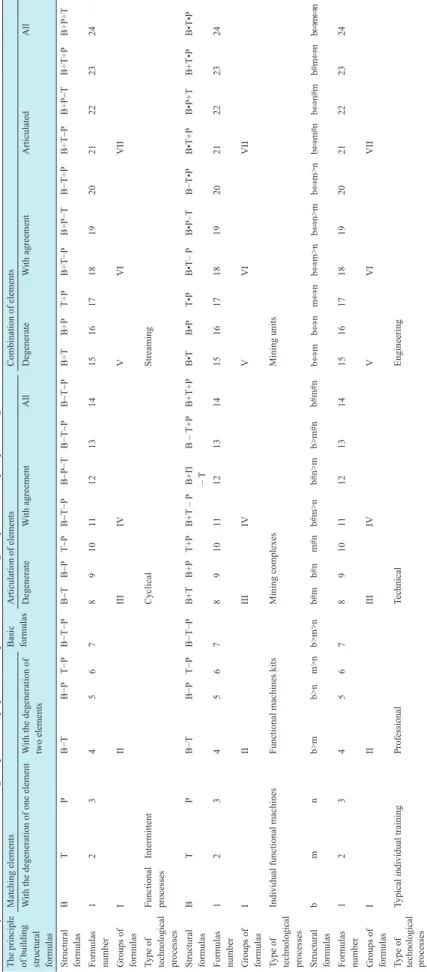
Table 2 (upper part) presents the structural formation and systematization according to the functional attribute of the open-cast mining process.
Structural formulas (1-3) are built on the principle of degeneration (the state is the same value of a physical quantity [usually energy] as well as such actions and states) of two
structural elements and reflect only the performance of one
of the three functional subprocesses. In real conditions, these may be mining sites, on each of which the corresponding technological processes are carried out.
Structural formulas (4-6) are constructed taking into account the possible degeneration of only one structural element, and
there is an episodic relationship (−) between the remaining
ones. This group of formulas can be used to describe the technological process of a quarry site in which two structural elements function.
the dominant dependent action) since the structure determines only the sequence of work. Functional processes that are not in the formulas (4-6) can be performed by other production units that are not subordinate to the considered technological processes. The presence of an intermittent connection between the structural elements of formulas (4-7) does not mean at all that the functional processes associated with it are carried out in one place, a site, an enterprise. Fundamentally functional processes can occur at various related enterprises associated with technological processes.
In structural formulas (8-14), along with the main periodic
(~) link, there is an episodic link (11-13). The main type of
communication in structural formulas (15-24) is continuous communication (÷), i.e., all formulas are built on the principle of combining (performing work on two or more processes and technological operations) of structural elements. However, in structural formulas (15-17), there is a degeneration of structural elements, in structural formulas (18-20) – matching, and in formulas (21-23) – articulation (the process of action and the method of connection, fastening of individual parts,
parts, etc.).Therefore, when combining elements in formulas
(15-23), episodic and periodic connections are possible along with continuous. Only in the formula (24), there are continuous connections with a functionally complete process, which corresponds to a continuous technological process.
The unevenness of work is set by the adopted technology and equipment that implements this technology. An analysis of recent work shows that, when examining the quality of preparedness of the faces, they took into account primarily the quality of equipment and the quality of technological processes.
Each structural formula of the technological process of production corresponds to a structural diagram of technological equipment. Symbols denoting the structural elements of technological processes can be used as symbols denoting the structural elements of technological equipment. The connections between the structural elements of the
mechanization of the mining process can be technological (−),
kinematic (+), and constructive (*).
GENERALIZATION AND DISCUSSION
Structural formulas of means of mechanization of the process of extraction of minerals by an open method, Table 1 (middle part).The structural formulas of the technological equipment of the mining process are also divided into seven groups and four types.
The group of formulas describing the structure of mechanization
means includes a family of isolated technological equipment, Table 1: Structural formation and qualification of technological pr
ocesses of bottom workplace at car
eers
The principle of building structural formulas
Matching elements
Basic formulas
Articulation of elements
Combination of elements
W
ith the
degeneration of one elements
W
ith the
degeneration of two elements
Degenerate
W
ith agreement
All
Degenerate
W
ith agreement
Articulated
All
Structural formulas
P
C
I
P−С
P−I
C−I
P−C−I
P~C
P~I
C~I
P~C−I
P~I−C
П−С~И
P~C~I
P~С
P~I
С~I
P~С−I
P~I−С
P−С~I
P~С~I
P~I~С
P~С~I
P~С~I
Formulas number
1
2
3
4
5
6
7
8
9
10
11
12
13
14
15
16
17
18
19
20
21
22
23
24
Groups of formulas
I
II
III
IV
V
VI
VII
Type of technological processes
One stage
Episodic
Cyclic
Streaming
Features of technological processes
Isolated
Functionally incomplete
Full
Functionally incomplete
Complete with isolated
Full
Functionally incomplete
Complete with isolated
Complete with isolated
Full
Structural elements: P:
The process of preparing the rock mass for excavation – as a subject of labor
, C:
The process of using a career excavator – as a mean of labor
, I:
The process of functioning of the excavator driver – as
a performer of labor
. Relations of structural elements: (−) intermittent, (~) perio
Table 2: Systematization of the technological pr
ocess, equipment, and pr
ofessional training of operators at open-pit mining
The
principle
of building structural formulas
Matching elements
Basic formulas
Articulation of elements
Combination of elements
W
ith the degeneration of one element
W
ith the degeneration of
two elements Degenerate W ith agreement All Degenerate W ith agreement Articulated All
Structural formulas
В Т P В−Т В−P Т−P В−Т−P В~Т В~P Т~P В~Т−P В~ P− Т В−Т~P В~Т~P В÷Т В÷P Т÷P В÷Т−P В÷P−Т В−Т÷P В÷Т~P В÷P~Т В÷Т÷P В÷P÷Т
Formulas number
1 2 3 4 5 6 7 8 9 10 11 12 13 14 15 16 17 18 19 20 21 22 23 24
Groups of formulas
I II III IV V VI VII
Type of tech
no log ic al processes Functional processes Intermittent Cyclical Streaming
Structural formulas
В Т P В−Т В−P Т−P В−Т−P В+Т В+P Т+P
В+Т – P
В+П – Т
В – Т+P
В+Т+P В•Т В•P Т•P В•Т– P В•P–Т В−Т•P В•Т+P В•P+Т В+Т•P В•Т•P
Formulas number
1 2 3 4 5 6 7 8 9 10 11 12 13 14 15 16 17 18 19 20 21 22 23 24
Groups of formulas
I II III IV V VI VII
Type of tech
no
log
ic
al
processes
Individual functional machines
Functional machines kits
Mining complexes
Mining units
Structural formulas
b m n b>m b>n m>n b>m>n b#m b#n m#n b#m>n b#n>m b>m#n b#m#n b ⇔ m b ⇔ n m ⇔ n b ⇔ m>n b ⇔ n>m b ⇔ m>n b ⇔ m #n b ⇔ n#m b#m ⇔ n b ⇔ m ⇔ n
Formulas number
1 2 3 4 5 6 7 8 9 10 11 12 13 14 15 16 17 18 19 20 21 22 23 24
Groups of formulas
I II III IV V VI VII
Type of tech
no
log
ic
al
processes
Typical individual training
Professional
Technical
i.e., machines with individual functional features, mechanizing the process of mining rock mass. For this reason, they are called individual functional machines.
The second group covers sets of technologically interconnected machines, called sets of functional machines.
The third group is a family of kinematically connected machines.
The fourth group combines kinematically and technologically connected, but retaining their individual characteristics of technological equipment, they are called mining complexes.
The fifth, sixth, and seventh groups of formulas describe
mining units.
The fifth group presents structurally integrated machines.
In the sixth group – structurally interconnected and technologically coordinated machines operating together with individual means; in the seventh group – technologically coordinated, kinematically interconnected, and constructively combined machines operating in combination with individual means.
The systematization performed shows that each subsequent group of formulas represents at the same time a qualitative stage in the development of the structure of schemes and means of mechanization of the technological process of mining mineral resources in an open way, i.e., each subsequent group of structural formulas describes a family of machines at a higher stage of development.
Using the same principles of structure formation, structural formulas for the professional preparedness of mining operators in open-cast mining are obtained, Table 2 (lower part). The structural formulas of the professional preparedness of the operators of equipment for the mining process are also divided into seven groups and four types, the nature of the interaction of the processes of professional preparedness of the operators
is phased/>/, parallel/#/, and simultaneous/⇔/.[6-13]
The first group of formulas includes the type of isolation of
preparation, i.e., operators with individual functional features master the mechanization of the mining process. In this regard, typical individual features of operator preparedness are named. Symbols b, m, and n denote the structural elements of labor performers, operators of excavation B, transport T, and processing equipment P, respectively. The second group of formulas encompasses groups of phased interconnected operators having the form of professional training, i.e., received relevant knowledge, skills, and abilities. The third and fourth groups combine phased and parallel interconnected operators who have not retained their individual characteristics. They are called
technically trained operators. The fifth, sixth, and seventh groups
of formulas describe the engineering/polytechnic/preparedness
of operators. The fifth group presents simultaneously jointly
combined operators. In the sixth group – jointly coordinated and phased agreed operators on preparedness. In the seventh group – phased and coordinated linked in parallel and at the same time, i.e., jointly combined operators having individual characteristics of the preparedness of labor performers/ operators, specialists/, i.e., their full harmonization is achieved. The results of systematization indicate that each subsequent group of formulas represents the level of the development of the professional preparedness of operators. For an objective assessment of the quality of professional preparedness of labor performers/operators, specialists/, an analysis, systematization and proposals for improving the organization of specialist training have been made.
CONCLUSION
Studies show that the stability of workplaces in the general
form of PM = {P, C, I, −, ~, ÷} or, in particular, P = B, C = B, I = b, then PMo = {B, B, b, −, ~, ÷} – the workplace of the
operator – the operator of the excavator is determined, other things being equal, mainly by the accepted level of technology
of the production process (subject of labor) P = {B, T, P, −, ~, ÷}, the quality level of equipment (means of labor) С = {В, Т, П, −, +, ·}, professional preparedness and activity of people (labor performer) И = {b, m, n, >, #, ·} serving this
equipment or governing pr the production process, taking into account the level of environmental quality of the environment/ environment/environment where equipment and people work,
which may be different for equipment and people (working
conditions)-harmful, permissible, comfortable.
REFERENCES
1. Poderni RY. Quarry Machinery: Textbook for Students. Moscow: Moscow State Mining University; 2007. p. 680.
2. Anistratov YI, Anistratov KY. Quarry Design. Moscow: GEMOS Limited; 2003. p. 168.
3. Rjevskiy VV. Open Cast Mining: Textbook for Students. Moscow: Nedra; 1985. p. 549.
4. Solod GI. Assessment of the Quality of Mining Machines. Moscow: MGI; 1978. p. 72.
5. Solod GI, Morozov VI, Rusixin VI. Engineering Texnology and Repair of Mining Machines. Moscow: Nedra; 1988. p. 421. 6. Kvaginidze VS, Kozovoy GI, Chakvetadze FA, Antonov YA.
Excavators in quarries. In: Designs, Operation and Calculation: Tutorial. Moscow: Mountain Book; 2011. p. 409.
7. Inamov U. Quality Management of Mining Equipment Operation and Repair. Tashkent: Science; 1988. p. 88.
8. Tomakov PI. Intensification of the use of Equipment in Quarries. Moscow: Nedra; 1980. p. 219.
10. Repin NY, Repin LN. Rock Handling and Storage: Tutorial. Moscow: Mountain Book; 2013. p. 221.
11. Chalifoux A. In: Chalifoux A, Baird J, editors. Reliability Centered Maintenance (RCM) Guide: Operating a More Effective Maintenance Program. Champaign, III: US Army Corps of Engineers, Construction Engineering Research Laboratories,
CERL Technical Report 99/41; 1999. p. 99.
12. Gleason W. Mining at the Lowest Cost Per ton: Innovations for large Shovels. Gleason: Mining Engineering; 2013. p. 2-3. 13. Márquez AC. The Maintenance Management Framework:
Models and Methods for Complex Systems Maintenance. London: Springer-Verlag Ltd.; 2007. p. 333.