EUROPEAN JOURNAL OF PURE AND APPLIED MATHEMATICS Vol. 7, No. 4, 2014, 472-485
ISSN 1307-5543 – www.ejpam.com
The Linear Span of Four Points in the Plücker’s Quadric in
P
5Jacqueline Rojas
1,∗, Ramón Mendoza
21CCEN - Departamento de Matemática - UFPB Cidade Universitária, 58051-900,
João Pessoa - PB - Brasil
2CCEN - Departamento de Matemática - UFPE Cidade Universitária, 50740-540, Recife - PE - Brasil
Abstract. Given four (distinct) lines ℓ1,ℓ2,ℓ3,ℓ4 inP3. Let P
i (i = 1, . . . , 4) be the image ofℓi in the Plücker’s quadricQ ⊂P5under the Plücker embedding P (in (1)). SetΛ =P
1, . . . ,P4
be the linear span of those four points inP5. The purpose of this article is to write specifically what kind of quadricΛ∩ Qcan be, taking under considerations all possible configurations of these four lines inP3. In particular, having in mind the classical problem in Schubert Calculus:How many lines in 3-space meet four given lines in general position? whose answer is 2 (see p. 272 in[3]or p. 746 in[4]). We verified that four lines inP3are in general position if and only ifΛis a 3-plane andΛ∩ Qis an irreducible quadric surface. In fact, we prove that there are exactly two solutions if and only ifΛis a 3-plane and
Λ∩ Qis a nonsingular quadric.
2010 Mathematics Subject Classifications: AMS 14N05, 14N20
Key Words and Phrases: Plücker’s quadric, linear span, 4-line problem.
1. Introduction
Plücker’s coordinates were introduced by the German geometer Julius Plücker (1801-1868) in the 19th century, as a way to assign six homogenous coordinates to each line in the complex projective 3-spaceP3. Since they satisfy a homogeneous quadratic equation, it follows an embedding of the 4-dimensional space of lines inP3(denoted byG1(P3)and called
grassmannian of lines inP3) onto a nonsingular quadric hypersurfaceQ in P5 (see Proposi-tion 3). Thus, reminding the Schubert’s classical enumerative problem: How many lines in 3-space meet four given lines in general position? Whose answer can be found in many texts and is given by: “there are two lines in P3 which meet 4 given lines in general position” (see Example 14.7.2 at p. 272 in [3]). In fact, if you want to know an algorithm to determine explicit solutions, then see[7]. On the other hand, any beginner in the art of solving enumer-ative problems will ask: what does general positionmeans? In Algebraic Geometry, general position is a notion of genericity for a set of points, or other geometric objects. It means the
∗Corresponding author.
Email addresses:[email protected](J. Rojas),[email protected](R. Mendoza),
general case situation, as opposite to some more special or coincident cases that are possible. Its precise meaning differs in different settings. For example, in[8]the authors imposed the conditionℓi∩ℓj=;(1≤i< j≤4) to the four given linesℓ1,ℓ2,ℓ3,ℓ4inP3and, even under this assumption they found (in one case) infinitely many solutions for the 4-lines problem (cf. 3.1in the last subsection). So, this condition is not enough for the four given lines to be in general position.
In this article, we use the identification between lines in P3 and points in the quadric hypersurfaceQ to explain what is the precise meaning of general position for that problem. Nevertheless, the emphasis in our work lies on to take under considerations all possible config-urations of these four lines inP3and write specifically what kind of quadricΛ∩Qcan be. One key ingredient in this work lies on the well known description of all linear subspaces contained in a quadric hypersurface inP3andP5 (see subsection 2.1 and 3.1).
Finally, we note that Plücker was a geometer that firmly believed in the importance of the applications of Mathematics to the physical sciences. So, in 1847 he turned to Physics, accepting the chair of Physics at Bonn and working on magnetism, electronics and atomic physics. He anticipated Gustav Kirchhoff and Robert Wilhelm Bunsen in announcing that the lines of the spectrum were characteristic of the chemical substance which emitted them, and in indicating the value of this discovery in chemical analysis. According to Johann Hittorf he was the first who saw the three lines of the hydrogen spectrum, which a few months after his death were recognized in the spectrum of the solar protuberances.
2. Notations and Preliminary Results
We denote by C the field of complex numbers. Let V be an n-dimensional vector space overC. Denote by[v1, . . . , vk]the subspace ofV generated by the vectors v1, . . . , vk∈V.
Thek-grassmannian associated to the vector spaceV. For each integerk,
0≤k≤n=dimV, we denote byGk(V)the set of allk-dimensional linear subspaces ofV and
call it the k-grassmannianassociated to V. In the particular casek =1, the 1-grassmannian associated toV it is also calledprojective space associated to V and it is denoted byP(V)(i.e. P(V) := G1(V)). We use the notation Pn instead of P(Cn+1) and p = [a0 : . . . : an] for
p= [(a0, . . . ,an)]∈Pn, just for the sake of simplicity.
IfW ∈Gk+1(V)thenP(W)⊆P(V)will be calledk-linear subspaceofP(V). The set of allk -linear subspaces ofP(V)will be denoted byGk(P(V)), thegrassmannian of k-linear subspaces ofP(V). Moreover, we shall callG1(P(V)), G2(P(V)) andGn−1(P(V))the grassmannian of lines, planes and hyperplanes inP(V), respectively. So, since a lineℓinP3 is equal toP(W) for someW ∈G2(C4), we have the correspondence
G2(C4) −→ G1(P3)
W 7−→ P(W),
Next we introduce the notion of algebraic projective set inPn. We will see in Proposition 1 thatk-linear subspaces ofPn are examples of algebraic sets.
Algebraic projective sets inPn. LetC[X] =C[X0, . . . ,Xn]be the polynomial ring overCin the variables X0, . . . ,Xn. Now, for each integer d ≥ 0 consider the vector subspace C[X]d, generated by all monomials in X0, . . . ,Xn of degreed. Each element in C[X]d will be called
an homogeneous polynomial of degreed. IfF ∈C[X]d, then we define,Z(F),the zero setof
F inPnby
Z(F) =¦[v]∈Pn|F(v) =0©.
For example, if L∈C[X]1, thenZ(L) =P(W)withW ={v∈Cn+1|L(v) =0}. Therefore, Z(L)is a hyperplane ofPn, if L6=0 elseZ(L) =Pn.
Ifd≥1, then an element[F]in the projectivization ofC[X]d will be calledhypersurface of
degree d inPn. From here on, when we say: LetX ⊂Pn be the reduced hypersurface defined byF ∈C[X]d, that means thatX=Z(F)⊂Pn andF is square-free.
A subset X ofPn will be calledalgebraic projective set, if there exist homogeneous polyno-mialsF1, . . . ,Fk inC[X]such thatX =Z(F1)∩ · · · ∩ Z(Fk).
Next we show that any r-linear subspace inPn is the intersection of exactly n−r hyper-planes.
Proposition 1. LetΛ be an r-linear subspace inPn with n> r. Then, there are exactly n−r
linearly independent linear forms L1,. . . ,Ln−rinC[X]such that
Λ =Z(L1)∩ · · · ∩ Z(Ln−r).
Proof. Assume thatΛ =P(W)withW ∈Gr+1(Cn+1). Letα={e1, . . . ,en+1}be the canon-ical base ofCn+1 and letβ ={e∗
1, . . . ,e
∗
n+1}be the associated dual base of(C
n+1)∗. Next we
consider the linear isomorphism
ϕ: (Cn+1)∗ → C[X]1
e∗i 7→ Xi−1.
Now, letW0be the annihilator ofW, thenϕ(W0)is an(n−r)-dimensional linear subspace of C[X]1. Finally, an easy verification show that any base{L1, . . . ,Ln−r}ofϕ(W0)verified that
Λ =Z(L1)∩ · · · ∩ Z(Ln−r).
Incidence ofr-linear subspaces with reduced hypersurfaces inPn. The following proposi-tion will play an important role in our investigaproposi-tions.
Proposition 2. Let Z⊂Pn be the reduced hypersurface defined by the homogeneous polynomial
F of degree d andΛbe an r-linear subspace ofPnwith r≥1. Then the following conditions are
(1) Z∩Λ6=;;
(2) Z∩Λconsists of infinitely many points, ifΛ⊂ Z or r≥2, else Z∩Λconsists of at most d points.
Proof. To arrive at statements (1)and first part of(2) have in mind that dimZ = n−1, dimΛ = r and apply Theorem 7.2 at p. 48 in[5]. Already, the last part of statement (2)
follows easily from the fundamental theorem of algebra.
Projective Tangent Space and Nonsigular Reduced hypersurface. LetZ⊂Pnbe the reduced hypersurface defined byF ∈C[X]d andp= [v]∈Z. LetF′
v:C
n+1−→Cbe the differential of
F at v. We define theprojective tangent space,TpZ, to the hypersurface Zat pby
TpZ=P(ker(F′
v)) =
¦
[u0: . . . :un]∈Pn| n
X
i=0 ∂F
∂Xi(v)·ui=0
©
.
Now, note that:
• follows from the Euler relationPni=0∂∂XF
i ·Xi=d F that p∈
TpZ.
• TpZis a hyperplane inPnif and only if p6∈ ∩n
i=0Z(
∂F
∂Xi).
A pointp∈Zsatisfying the last condition above will be called anonsingular pointofZ, elsep
will be called asingular pointofZ. If all the points inZare nonsingular, thenZwill be called anonsingularhypersurface inPn.
For example, after a linear change of coordinates (see Theorem 4 at p. 411 in [2]) we concluded thatZ(X02+X12+X22+X32)is the unique nonsingular quadric surface inP3, whereas the singular reduced quadric surfaces inP3correspond either to the union of two planes or a quadric cone. Moreover, it is straightforward to show that the vertex of a quadric cone is its unique singular point. In the case of the union of two (distinct) planes, it is verified that the points in the line where the two planes meet are their singular points.
2.1. Lines on Reduced Quadrics Surfaces in
P
3Next, we present some observations about lines contained on reduced quadrics surfaces in P3.
• Union of two planes. Of course any line in this surface will be contained in one of the planes. Thus this surface could have at most two disjoint lines.
• Quadric cone. Any line in this surface passes through its vertex. Thus this surface does not contain disjoint lines.
Lemma 1. Let Q be a nonsingular quadric surface inP3. Then there exist two families of lines L ={Lp}p∈P1 andM={Mp}p∈P1in Q such that
(1) Lp∩Lq=;and Mp∩Mq=;for all Lp,Lq∈ L, Mp,Mq∈ M and p6=q∈P1. (2) Lp∩Mq6=;for all Lp∈ L, Mq∈ M and p,q∈P1.
(3) Ifℓis a line contained in Q thenℓ∈ L orℓ∈ M.
(4) Given x∈Q there exist unique lines Lp(x)∈ L and Mq(x)∈ M such that{x}=Lp(x)∩Mq(x).
One other simple but important fact which will help us to prove our main result (Theorem 1) is the next Lemma.
Lemma 2. Given the linesℓ1,ℓ2andℓ3inP3such thatℓi∩ℓj=;for1≤i< j≤3, there exists
a nonsingular quadric surface Q inP3containingℓ1,ℓ2andℓ3.
Proof. Take 3 points p1i,p2i,p3i on each lineℓi (i=1, 2, 3) and note that W={G∈C[X]2|G(pi j) =0 for all 1≤i,j≤3}(heren=3)
is a subspace ofC[X]2 of dimension greater than or equal to 1. So we can chooseG 6= 0 in
W and takeQ =Z(G). Now follows from Proposition 2 that each line ℓi is contained inQ. Finally, sinceQcontains three pairwise disjoint lines, thenQmust be a nonsingular surface in P3.
3. The Plücker’s Quadric
Q
in
P
5The Plücker embeddingP :Gk(P(V))−→P(Λk+1V)is the map that enable us to identify the grassmannianGk(P(V))with a projective variety inP(Λk+1V)(Λk+1V denotes the(k+1) -th exterior power ofV). It is defined byP(W)7→[u0∧. . .∧uk], ifW = [u0, . . . , uk].
The Plücker’s quadricQinP5. In what follows we will considerV =C4. Now, fix the base {ei∧ej}1≤i<j≤4 ofΛ2C4 where{ei}4i=1is the canonical basis ofC
4. Let us consider
W = [u, v]∈G2(C4)with u= (u0,u1,u2,u3)and v= (v0,v1,v2,v3), then we see that
u∧v= X 1≤k<l≤4
wk−1,l−1ek∧el wherewi j=uivj−ujvi for 0≤i< j≤3.
Thus the Plücker embeddingP above in coordinates is given by P :G1(P3) −→P5
P([u, v]) 7−→[w01:w02:w03:w12:w13:w23]. (1) Proposition 3. The Plücker map P : G1(P3) −→ P5 defined in (1) is an embedding of the
grassmannianG1(P3)over the nonsingular quadric hypersurfaceQ=Z(F)⊂P5where
Proof. See Theorem 11 at p. 409 in[2]or p. 209-211 in[4].
We will refer toQ in Proposition 3 as the Plücker’s quadricQ(inP5).
Next, we will make a remark that tells us who is the image of the families of linesL and M of a nonsingular quadric surface inP3, under the Plücker embeddingP (cf. Lemma 1).
Remark 1. It can be shown thatP(L) =Z(X0+X5,X1−X4,X2+X3,F)and
P(M) =Z(X0−X5,X1+X4,X2−X3,F), so the image of the families of linesL andM, under
the Plücker embeddingP (in(1)) are nonsingular conics lying in complementary planes (also see p. 196 in[6]).
3.1. Linear Subspaces in the Plücker’s quadric
Q
We begin by proving a simple result, which allows us to conclude that the Plücker’s quadric Q does not contain 3-planes or hyperplanes. In fact, it is verified thatQ only contains lines and planes, and this will be described in Propositions 5 and 6, respectively (see[1]).
Proposition 4. Let Z ⊂Pn be a nonsingular quadric hypersurface defined by G∈C[X]2 andΛ a r-linear subspaces ofPn . IfΛ⊂Z, then we have2r<n.
Proof. SetΛ =P(W)whereW = [w0, . . . , wr]. Assume thatG=Pn
i=0X2i (otherwise make
a linear change of coordinates). SoG induz the bilinear formB:Cn+1×Cn+1→C given by
B(v, w) =v0w0+· · ·+vnwn, if v= (v0, . . . ,vn)and w= (w0, . . . ,wn). Let
W⊥={v∈Cn+1|B(v, w) =0 for all w∈W}
be the the orthogonal subspace associated toW.
Note thatW⊥ =ker(T0)∩ · · · ∩ker(Tr)where Ti is the linear functional overCn+1 given
by Ti(v) =B(v, wi),i∈ {0, . . . ,r}. Since these linear functionals are linearly independent we
conclude that dimW⊥=n+1−dimW =n−r.
On the other hand, Λ⊂ Z if and only if G(w) =B(w, w) =0 for all w∈W. ThusΛ⊂ Z
if and only if W ⊆ W⊥. So, if Λ ⊂ Z then dimW ≤ dimW⊥ = n+1−dimW. Therefore, 2 dimW≤n+1 which implies 2r<n.
In what follows, we denoted by ℓ1, . . . ,ℓkthe smallest linear subspace ofPn containing the linesℓ1, . . . ,ℓk ofPn. For example, ifℓ1 andℓ2 are two distinct lines inPn having a com-mon point, thenℓ1,ℓ2is a plane, elseℓ1,ℓ2is a 3-plane.
Next we give the description of lines and planes inQ.
Lines in the Plücker’s quadricQ. The lines in the Plücker’s quadricQare parametrized by the incidence varietyΓ ={(p,Π)| p∈Π} ⊂P3×G2(P3). In fact, let p∈P3 andΠ⊂P3 be a plane throughp. Set
Proposition 5. Let P :G1(P3) → P5 be the Plücker embedding in (1). If L is a line in P5
contained inQ, then we have:
(i) P(Ωp(Π))is a line inP5contained inQfor all(p,Π)∈Γ.
(ii) If P0,P∈L are two different points such that P0=P(ℓ0)and P=P(ℓ), thenℓ0∩ℓ={p}
and they determine the planeΠ =ℓ0,ℓ. In fact, for every point Q=P(m)∈L holds that m∈Ωp(Π).
Planes in the Plücker’s quadric Q. There are two families of planes in the Plücker’s quadricQparametrized by P3 and its dual
∨
P3=G2(P3), respectively. In fact, let p∈P3 and
Π⊂P3 be a plane. Set
Ωp=¦ℓ∈G1(P3)|p∈ℓ©andΩ(Π) =¦ℓ∈G1(P3)|ℓ⊂Π©.
Proposition 6. LetP :G1(P3) → P5 be the Plücker embedding in (1). If Λ is a plane inP5
contained inQ, then we have:
(i) P(Ωp)andP(Ω(Π))are planes inP5contained inQ.
(ii) The pre-image ofΛunder the Plücker embeddingP is either: Ωpfor some p∈P3 orΩ(Π)
for someΠ∈G2(P3). In fact, if Pi=P(ℓi), i=0, 1, 2are three points inQwhose linear
span it is equal toΛ, then Λ = Ωp if p ∈ ∩2i=0ℓi (and these lines are non-coplanar)else Λ = Ω(Π)withΠ =〈ℓ0,ℓ1,ℓ2〉.
4. Description of
Λ
∩ Q
According to the Relative Position of the Four Given
Lines in
P
3We begin this section by introducing some more notation. As we did for lines we denote by 〈p1, . . . ,pk〉the linear spanofp1,. . . ,pk∈Pn(i.e. the smallest linear subspace ofPncontaining
these points). Moreover, if pis a point andℓis a line inPn, then〈p,ℓ〉also denote the linear span ofpandℓinPn. So〈p,ℓ〉=ℓ, if p∈ℓelse〈p,ℓ〉is a 3-plane.
Letℓ1,ℓ2,ℓ3 andℓ4 be four distinct lines inP3. LetPi ∈ Q (i=1, . . . , 4) be the image of
ℓi under the Plücker embeddingP (in (1)) andΛ =〈P1,P2,P3,P4〉 ⊂P5. SetS be the set of solutions of the 4-lines problem in Schubert calculus, i.e.
S =ℓ∈G1(P3)|ℓ∩ℓi6=;for 1≤i≤4 .
We have three major cases to be considered (cf. subsections 4.1, 4.2 and 4.3). In each of these cases, the linear spaceΛ andΛ∩ Q are reported in tables, whose rows are labeled according to the position that the lines can have inP3. Next, we determineΛandΛ∩ Qin some of these cases, which we believe are sufficient to illustrate the technique used in this computations, we left to the reader the other cases
4.1. The Four Lines are Concurrent, Say
p
∈ ∩
4i=1ℓ
i.
Table 1: Four Lines are Concurrent.
Subcase Position of the lines S Λ Λ∩ Q
1.1 ℓ1,ℓ2,ℓ3andℓ4are contained
in the planeΠ Ωp∪Ω(Π) Line Ωp(Π)
1.2 ℓ1,ℓ2,ℓ3 andℓ4 are non
coplanar lines Ωp Plane Ωp
1.1 Naturally any line passing trough p is a solution. On the other hand, ifℓ∈ S is a solution such that p6∈ℓ, it certainly meets the linesℓ1 andℓ2 at two different points, which implies that ℓ ⊂ Π. Therefore S = Ωp∪Ω(Π). On the other hand, since Pi ∈ Ωp(Π) for
i=1, . . . , 4, thenΛ≡Ωp(Π)is a line contained inQ.
Figure 1: Case 1.1
4.2. The Four Lines have no Common Point and at Least Two are Coplanar.
Of course in all the subcases listed below we consider an index reordering if necessary.
Table 2: Four Lines have no Common Point and at Least Two are Coplanar.
Subcase Position of the lines S Λ Λ∩ Q
2.1 ℓ1,ℓ2,ℓ3andℓ4are contained
in the planeΠ Ω(Π) Plane Ω(Π)
Table 3: 2.2 Exactly Three Lines are Coplanar. Assume thatℓ1,ℓ2andℓ3are contained in the planeΠand
Π∩ℓ4={q}.
Subcase Position of the lines S Λ Λ∩ Q
2.2.1 T3i=1ℓi={p} Ωp(〈p,ℓ4〉)∪Ωq(Π) Plane
Union of two lines
2.2.2 T3i=1ℓi =; Ωq(Π) 3-plane Union of
two planes
2.2.1Letℓ∈ S be a solution which meets the linesℓ1andℓ2 at two different points, then ℓ∈Ωq(Π) (sinceΠ∩ℓ4 = {q}). Else ℓmeetsℓ1 andℓ2 at p andℓ4 at some point different ofp, thenℓ⊂ 〈p,ℓ4〉. Soℓ∈Ωp(〈p,ℓ4〉). Therefore, S = Ωq(Π)∪Ωp(〈p,ℓ4〉)and it can be identified with two projective lines having a common point (just a cross!). On the other hand, sinceP1,P2andPilies on the lineΩp(Π)andP46∈Ωp(Π)(p6∈ℓ4) we conclude thatΛis a plane inP5not contained inQ. SoΛ∩ Q is a conic. Note that the line L1,2=〈P1,P2〉 ⊂Λ∩ Q and
P46∈L1,2. Therefore,Λ∩ Q is the union two lines. In fact,Λ∩ Q=L1,2∪LwhereL=〈P4,M〉 withM=P(〈p,q〉).
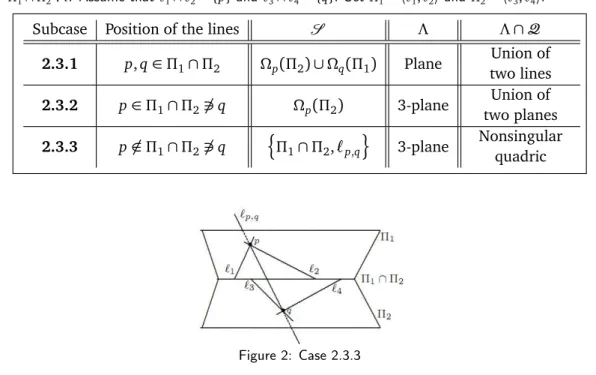
Table 4: 2.3 Any Three Lines are non Coplanar and at Least Two Pair of Lines are Coplanar with
ℓi6= Π1∩Π2∀i. Assume thatℓ1∩ℓ2={p}andℓ3∩ℓ4={q}. SetΠ1=〈ℓ1,ℓ2〉andΠ2=〈ℓ3,ℓ4〉.
Subcase Position of the lines S Λ Λ∩ Q
2.3.1 p,q∈Π1∩Π2 Ωp(Π2)∪Ωq(Π1) Plane Union of two lines 2.3.2 p∈Π1∩Π26∋q Ωp(Π2) 3-plane Union of two planes 2.3.3 p6∈Π1∩Π26∋q ¦Π1∩Π2,ℓp,q© 3-plane Nonsingular
quadric
Figure 2: Case 2.3.3
2.3.3Letℓbe a solution. Next we consider the following two cases.
(ii) Assume that p 6∈ℓ andq 6∈ℓ. Thenℓ meets the linesℓ1 andℓ2 (respectively, ℓ3 and ℓ4) at two different points which implies thatℓ⊂Π1 (respectively, ℓ⊂Π2). Therefore, ℓ= Π1∩Π2.
Now, note that the line L1,2 = 〈P1,P2〉 ⊂ Λ∩ Q and Pi 6∈ L1,2, i = 3, 4. So 〈P1,P2,P3〉is a plane not contained inQ (sincep6∈ℓi andℓi 6⊂Π1 fori=3, 4). On the other hand, the line
L3,4=〈P3,P4〉is also contained inΛ∩ Qand we observe that L1,2and L3,4are disjoint (since
L1,2= Ωp(Π1)and L3,4= Ωq(Π2)), soP4 does not belong to the plane〈P1,P2,P3〉. Therefore, Λis a 3-plane. Keeping in mind thatΛ∩ Q is a quadric surface containing four non coplanar points and two disjoint lines, we conclude thatΛ∩Qis a union of two planes or a nonsingular quadric. Suppose thatΛ∩ Q is a union of two planes, say Λ∩ Q = Λ1∪Λ2. Thus we can assume that L1,2 ⊂ Λ1 and L3,4 ⊂ Λ2. Then necessarilyΛ1 it is either Ωp or Ω(Π1), and in the same formΛ2it is eitherΩq orΩ(Π2). But in any case,Λ1∩Λ2 will be empty or a point. Therefore,Λ∩ Qis a nonsingular quadric surface.
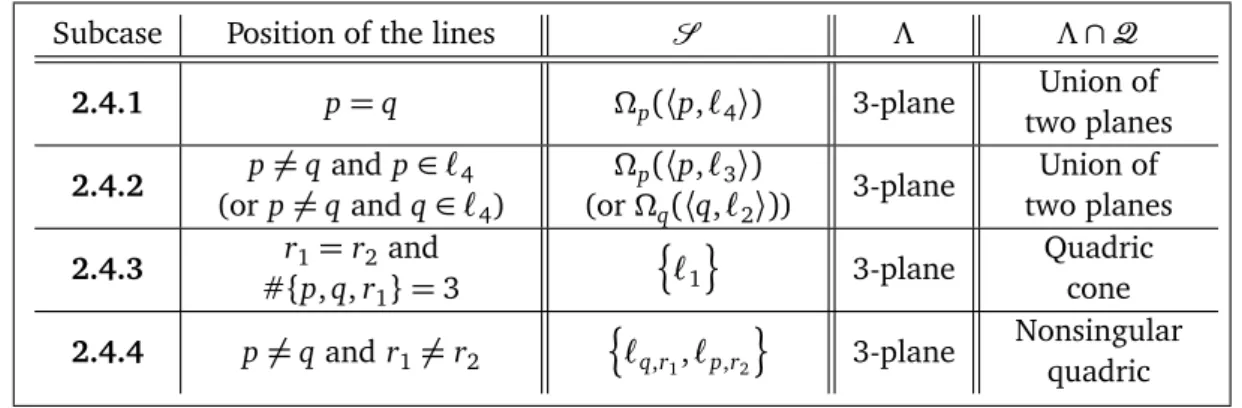
Table 5: 2.4 Any Three Lines are non Coplanar and at Least Two Pair of Lines are Coplanar withΠ1∩Π2=ℓ1. Assume thatℓ1∩ℓ2={p}andℓ1∩ℓ3={q}. SetΠ1=〈ℓ1,ℓ2〉andΠ2=〈ℓ1,ℓ3〉. Let{ri}= Πi∩ℓ4fori=1, 2.
Subcase Position of the lines S Λ Λ∩ Q
2.4.1 p=q Ωp(〈p,ℓ4〉) 3-plane Union of
two planes 2.4.2 p6=qandp∈ℓ4
(orp6=qandq∈ℓ4)
Ωp(〈p,ℓ3〉)
(orΩq(〈q,ℓ2〉)) 3-plane
Union of two planes 2.4.3 r1=r2 and
#{p,q,r1}=3
¦
ℓ1
©
3-plane Quadric cone 2.4.4 p6=qandr16=r2 ¦ℓq,r
1,ℓp,r2
©
3-plane Nonsingular quadric
2.4.4Letℓ∈ S. Here we have two possibilities:
(i) p6∈ℓ. Thenℓ∩ℓ1 6=ℓ∩ℓ2 and we have thatℓ⊂Π1. Thusℓ∩ℓ3⊂Π1∩ℓ3 ={q}and ℓ∩ℓ4⊂Π1∩ℓ4={r1}. Therefore,ℓ=ℓq,r1(q6=r1 sinceℓ46⊂Π1).
(ii) p ∈ ℓ. Note that ℓ meets the lineℓ3 at a point p1 (p1 ∈ Π2) different from p. Thus ℓ⊂Π2. On the other handℓ∩ℓ4⊂Π2∩ℓ4={r2}. Therefore,ℓ=ℓp,r2.
As in case2.3.3we have that〈P1,P2,P3〉is a plane not contained inQ. Since the lines
L1,2=〈P1,P2〉and L1,3=〈P1,P3〉are contained in〈P1,P2,P3〉 ∩ Q we conclude that
〈P1,P2,P3〉 ∩ Q= L1,2∪L1,3. So P46∈ 〈P1,P2,P3〉. Therefore,Λis a 3-plane. Keeping in mind that Λ∩ Q is a quadric surface containing four non coplanar points, {P1} = L1,2∩L1,3 and
L1,4=〈P1,P4〉 6⊂Λ∩ Q(sinceL1,46⊂ Q), we conclude thatΛ∩ Qis a union of two planes or a nonsingular quadric. Suppose thatΛ∩ Qis a union of two planes, sayΛ∩ Q= Λ1∪Λ2. Thus we can assume that L1,2 ⊂ Λ1. Now, note that L2,3 6⊂Λ∩ Q (since L2,3 6⊂ Q). So P3 6∈Λ1, which implies L1,3⊂Λ2. Finally, observe that L2,4 andL3,4 are not contained inΛ∩ Q. Thus
Figure 3: Case 2.4.4
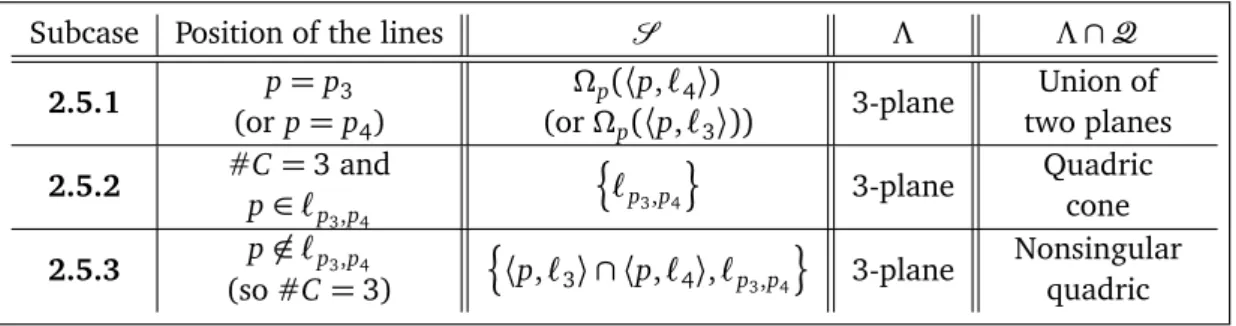
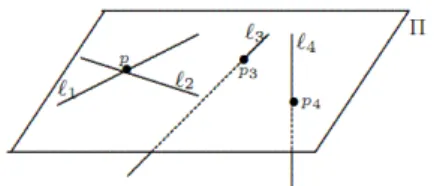
Table 6: 2.5 Exactly Two Lines are Coplanar. Assume that ℓ1 and ℓ2 are contained in the plane Π, ℓ1∩ℓ2={p},Π∩ℓi={pi}for i=3, 4andp36=p4. LetC={p,p3,p4}.
Subcase Position of the lines S Λ Λ∩ Q
2.5.1 p=p3
(orp=p4)
Ωp(〈p,ℓ4〉)
(orΩp(〈p,ℓ3〉)) 3-plane
Union of two planes 2.5.2 #C=3 and
p∈ℓp
3,p4
¦
ℓp3,p4
©
3-plane Quadric cone 2.5.3 p6∈ℓp3,p4
(so #C =3)
¦
〈p,ℓ3〉 ∩ 〈p,ℓ4〉,ℓp3,p4
©
3-plane Nonsingular quadric
2.5.3Letℓbe a solution and consider the following two possibilities.
(i) ℓ⊂Π. Sinceℓ∩ℓi ⊂Π∩ℓi={pi}thenpi∈ℓfori=3, 4. Thereforeℓ=ℓp
3,p4.
(ii) ℓ6⊂Π. Now having in mind thatℓ∩ℓi 6=;fori=1, 2 andℓ6⊂Πwe concluded thatp∈ℓ. On the other handℓ∩ℓi ={qi} ⊂ℓi ⊂ 〈p,ℓi〉fori=3, 4. Note thatqi6=p(sincep6∈ℓi fori=3, 4) which impliesℓ=ℓp,q
i ⊂ 〈p,ℓi〉fori=3, 4. Therefore,ℓ=〈p,ℓ3〉 ∩ 〈p,ℓ4〉. Note that Pi 6∈ L1,2 =〈P1,P2〉 ⊂ Q for i=3, 4. Thus 〈P1,P2,P3〉 is a plane not contained in Q since p6∈ℓ3 6⊂Π. Since L1,2∪ {P3} ⊂ 〈P1,P2,P3〉 ∩ Q, ifP4∈ 〈P1,P2,P3〉thenP4∈ L1,2or
P4belong to the componentLpassing throughP3in the conic〈P1,P2,P3〉 ∩ Q =L1,2∪L. But
P46∈ L1,2 becauseℓ4 6⊂Π. Moreover, P4 6∈L sinceℓ4∩ℓ3=;. Thus Λis a 3-plane. Keeping in mind thatΛ∩ Q is a quadric surface containing four non coplanar points and L1,3 is not contained inΛ∩ Q, we conclude thatΛ∩ Q is a union of two planes or a nonsingular quadric. Suppose thatΛ∩ Q is a union of two planes, sayΛ∩ Q= Λ1∪Λ2. Thus we can assume that
Figure 4: Case 2.5.3
4.3. No Pair of Lines is Coplanar
LetQbe a nonsingular quadric surface inP3containingℓ1,ℓ2andℓ3(as stated in Lemma 2). Since ℓi∩ℓj = ;for 1 ≤ i < j ≤ 3 then they belong to the same family of lines in Q (cf. Lemma 1). So we will assume thatℓ1,ℓ2 andℓ3 belong to the familyL.
Note that any solutionℓ∈ S meets the lineℓi at a point pi ∈ℓi ⊂Qfori=1, 2, 3. Since this three points p1,p2 and p3 are different and belong toℓ∩Q. Then follows from Proposi-tion 2 thatℓ⊂Q, which implies thatℓ∈ M. Therefore any solution belong to the familyM.
In order to determine the set of solutionsS and the linear spaceΛ, we will consider the following two subcases.
3.1 ℓ4⊂Q . In this caseℓ1,ℓ2,ℓ3 andℓ4 belong to the same familyL (sinceℓ4if disjoint to the others three). ThereforeS =M.
Now, since the lineLi,j =Pi,Pj6⊂ Q for 1≤i< j≤3, we conclude from Proposition 6 that P1,P2,P3
is a plane not contained in Q. But, from Remark 1 we conclude that
P1,P2,P3∩ Q=P(L). Consequently, Λ =P1,P2,P3(keep in mind that P4∈ P(L)
too) andΛ∩ Q is a nonsingular conic.
3.2 ℓ46⊂Q . In this case follows from Proposition 2 thatℓ4∩Qis non empty and
ℓ4∩Q={x,y}(withx and y do not necessarily distinct). LetMx andMy be the unique lines in the familyM passing throughx and y, respectively (cf. (4) in Lemma 1). Indeed
Mx and My are solutions (in fact, if p∈ {x,y}thenMp∩ℓi is non empty fori=1, 2, 3
becauseℓi∈ L andMp∩ℓ4 ={p}). Now, we will show that Mx andMy are the unique solutions. Letℓ∈ M be a solution, thenℓ∩ℓ4⊂Q∩ℓ4={x,y}which implies thatx ∈ℓ or y∈ℓ. Therefore follows from (4) in the Lemma 1 thatℓ=Mx orℓ=My.
Again, since the line Li,j =
Pi,Pj
6⊂ Q for 1≤ i< j ≤3, we conclude thatP1,P2,P3
is a plane not contained inQandP1,P2,P3∩ Q is a nonsingular conic. On the other hand, the conditionℓ4 6⊂Q implies thatℓ4 6∈ L. So, we are left to conclude that P4 6∈
P1,P2,P3
Assume that ℓ4 is tangent to Q. Let x ∈ℓ4∩Q be the tangent point. Let Mx ∈ M and
Lx ∈ L be the (only) lines inQpassing through x. It is verified thatℓ4 ⊂ TxQ =〈Mx,Lx〉. Therefore, ℓ4 ∈ Ωx(TxQ). Set M = P(Mx),L = P(Lx) ∈ Q. Thus L belong to the conic
P1,P2,P3∩ Q=P(L). Moreover M ∈ 〈L,P4〉 ⊂Λ∩ Q(since, x ∈ℓ4 ⊂ 〈Mx,Lx〉). On the
other hand the linesLi=〈M,Pi〉 ⊂Λ∩ Q,i=1, . . . , 4. Therefore,Λ∩ Q is a quadric cone.
Thus we have proved the following Theorem. Theorem 1. Given four linesℓ1,ℓ2,ℓ3,ℓ4inP3. Set
S =ℓ∈G1(P3)|ℓ∩ℓi 6=;for1≤i≤4 .
Let Pi (i = 1, . . . , 4)be the image ofℓi in the Plücker’s quadricQ ⊂P5 under the Plücker
em-beddingP (in(1)). SetΛ =P1, . . . ,P4
be the linear span of those four points inP5. Then the
cardinal of the setS is either 1, 2 or infinite. Moreover we have.
(i) #S=2if and only ifΛis a 3-plane andΛ∩ Q is a smooth quadric. (ii) #S=1if and only ifΛis a 3-plane andΛ∩ Q is a quadric cone. (iii) If#S=∞then
(a) S is a line if and only ifΛis a 3-plane andΛ∩ Q is a union of two planes.
(b) S is a conic if and only ifΛis a plane andΛ∩ Qis a nonsingular conic.
(c) S is a reduced and reducible conic if and only ifΛis a plane andΛ∩ Q is a reduced and reducible conic.
(d) S is a plane if and only ifΛis a plane inQ.
(e) S is a union of two distinct planes if and only ifΛis a line inQ.
In terms of the lines position Theorem 1 tell us:
#S=2⇐⇒
• ∩4
i=1ℓi =;and any three lines are non coplanar.
(i) ℓ1∩ℓ2={p},ℓ3∩ℓ4={q}withp6=qandp6∈Π1∩Π26∋q, ifΠ1=〈ℓ1,ℓ2〉,Π2=〈ℓ3,ℓ4〉.
(ii) ℓ1∩ℓ2={p},ℓ1∩ℓ3={q}withp6=q. IfΠi=〈ℓ1,ℓi+1〉 fori=1, 2, then it is verified thatΠi∩ℓ4={ri}i=1, 2
andr16=r2.
(iii) ℓ1∩ℓ2={p}. IfΠ =〈ℓ1,ℓ2〉then it is verified fori=3, 4 thatΠ∩ℓi={ri},r36=r4 andp6∈ 〈r3,r4〉.
• No pair of lines is coplanar.
Note that (i), (ii) and (iii) above correspond to subcases2.3.3,2.4.4and2.5.3in subsec-tion 4.2. Already (iv) corresponds to subcase3.2in subsection 4.3.
#S=1⇐⇒
• ∩4
i=1ℓi=;and any three lines are non coplanar. (α) ℓ1∩ℓ2={p},ℓ1∩ℓ3={q}withp6=q. IfΠi =〈ℓ1,ℓi+1〉
fori=1, 2, then it is verified thatΠi∩ℓ4={ri}i=1, 2.
withr1=r2and #{p,q,r1}=3.
(β) ℓ1∩ℓ2={p}. IfΠ =〈ℓ1,ℓ2〉then it is verified fori=3, 4 thatΠ∩ℓi={ri}, r36=r4, p∈ 〈r3,r4〉andp6=ri.
• No pair of lines is coplanar.
(γ) The non singular quadric surfaceQ⊂P3containingℓ1,ℓ2 andℓ3, meetsℓ4exactly in one point.
Note that (α) and (β) above correspond to subcases2.4.3 and2.5.2 in subsection 4.2. Already (γ) correspond to subcase3.2in subsection 4.3.
ACKNOWLEDGEMENTS The first author wishes to express her gratitude to I. Vainsencher (DM-UFMG) for a helpful conversation about the subject of this paper.
References
[1] D. Avritzer. Introdução à Geometria Enumerativa via Teoria de Deformações, 2aBienal da Sociedade Brasileira de Matemática, Mini Course, Salvador, Universidade Federal da Bahia. 2004.
[2] D. Cox, J. Little, and D. O’Shea. Ideals, Varieties, and Algorithms, New York: Springer-Verlag. 1996.
[3] W. Fulton.Intersection Theory. Graduate Texts in Math, Springer-Verlag. 1977. [4] P. Griffiths and J. Harris.Principles of algebraic geometry. Wiley-Interscience. 1994. [5] R. Hartshorne.Algebraic Geometry. Graduate Texts in Math.52, Springer, New York. 1977. [6] J. Harris and D. Eisenbud.The Geometry of Schemes. Graduate Texts in Math.197, Springer,
New York. 1999.
[7] M. Hohmeyer and S. Teller. Determining the Lines Through Four Lines.Journal of Graphics Tools, 4(3):11–22. 1999.