Experiences with Designing a Team
Project Module for Teaching
Teamwork to Students
M´aria Bielikov´a and Pavol N´avrat
Institute of Informatics and Software Engineering, Faculty of Informatics and Information Technologies, Slovak University of Technology in Bratislava, Slovakia
Team projects play an important role in the education of engineers. This paper describes a team project module that is part of a postgraduate course in informatics. Its main objective is to give students a hands-on experience with different aspects of working in a team on a problem. We discuss several issues that should be considered in designing such module as a part of a curriculum: team formation, team communication, team assessment, problem statement and assignment, development process and team supervision. We outline several different alternatives, analyse their pros and cons and describe our approach and related experiences.
Keywords: teaching, teamwork, team formation, team communication, team assessment, software development process.
1. Introduction
The main objective of a good curriculum is to prepare students for their professional career so that they will be able to cope with the changing nature of the world and to solve demanding and complex tasks as required by practice. There is a growing recognition that work in teams is critical in managing the complexity of solved tasks(e.g., developing software systems). Team projects play an important role in the education of engineers. The students should acquire and display abilities to communicate within a team, to plan a relatively large project, and to cooperate in order to develop the re-quired output of such a project. One question is how this requirement is reflected in the ex-isting curricula. One of perhaps the most
dis-tinguished features related to teamwork of the CMU course is the software development stu-dio17], which runs throughout the whole four-semester course. Students work closely with instructors and other students to carry out a sig-nificant development project. Another possi-bility of incorporating teamwork into software engineering curriculum relates to the module entitled “Setting up and Running your own I.T. Company” at the University of Sheffield 8]. Diversity of course methods are apparent from the Forum for Advancing Software Engineer-ing Education June 2001 issue, where academic project courses taught at thirteen universities are described10].
While many aspects of existing approaches are attractive, it may be difficult to adopt them, be-cause each is designed within a specific context. We deal with aspects, which should be consid-ered in the design of a team project module aimed at software projects. We discuss variabi-lity of different approaches to implement such a module and present the team project that is part of a postgraduate course in software engineer-ing (formerly informatics) at the Slovak Uni-versity of Technology. Module named Team Project was introduced in the academic year 1997/1998. The Team Project module was strongly influenced by the team software pro-cess9, 7]. Its intake each year is 15-17 teams of 5-6 students. The main objective of the mod-ule is to give students a hands-on experience with different aspects of working in a team, on a relatively large task.
2. Teamwork Dynamics
The objective of any good curriculum design is to prepare the graduates for their envisaged professional careers by providing them with ap-propriate education. In software engineering, the essential feature is that software developers develop and maintain software of such a com-plexity that these tasks cannot be handled at an individual level. Such tasks can only be accom-plished in groups or teams. Engineers need to join their efforts to complete the tasks in a real-istic time. Moreover, they usually need to join experts in other fields to be able to understand and analyze the problem domain and to design a system solution for it.
One comment is appropriate to explain the dif-ference that is sometimes made between a group and a team. Both groups and teams comprise individuals who have a common task and who collaborate to accomplish it. A team is distin-guished by complementary efforts of its indi-viduals that induce a synergic effect. Groups are often used in educational modules, which concern acquiring knowledge, skills and expe-riences related to a particular subject(software analysis, programming, etc.). One approach to practice the real teamwork within an educa-tional module is to design it in such a way that
teamwork is one of the main goals of the module
(or the only goal of the module). We describe experiences with such approach.
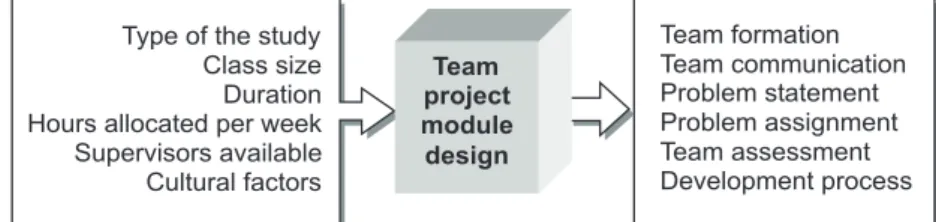
In designing a team project as a part of a curricu-lum, several aspects should be considered and decided. We focus on the following ones: team formation, team communication, team assess-ment, problem statement and assignassess-ment, de-velopment process and team supervision. De-sign of these aspects is influenced by several factors(see Figure 1). Note that the team pro-cess(as defined, for example, in9])is only one aspect of the organization of a team project.
Organization of a team project is influenced mainly by a class size(very focused module for 10-25 chosen students3] versus large module of more than 300 students in 50 teams2]). In fact, size of the class mainly determines choice and organization of supervisors. For example, at the Vienna University of Technology, 5 pro-fessors, together with 20 senior student super-visors, guide 50 teams, each consisting of 5-7 students. A professor takes the role of a middle management, a supervisor acts as a quality as-surance person, and team members are to work as project managers and software engineers. Type of the study(either postgraduate or under-graduate)influences mainly complexity of the assigned problem and requirements regarding quality of the solution. Performed activities, their extent and the number of cycles of the de-velopment process depend strongly on duration of the team project and the number of hours allocated per week. Our experience with such projects is that a satisfiable solution(in terms of the team project objectives, i.e. experience with different aspects of team work on a large prob-lem)requires time longer than one term. Super-visors, who are available(either academic staff or an industry partner), determine problems be-ing solved. Cultural factors and context of the whole curriculum should also be considered. Design of a team project module requires de-ciding on all mentioned aspects. We shall dis-cuss them in the following paragraphs. We outline different alternatives, analyze their pros and cons and describe our approach and expe-riences.
3. Team Formation
The way teams are formed can have a great influence on a project. There are two basic methods of forming teams:
Team formation Team communication Problem statement Problem assignment Team assessment Development process Type of the study
Class size Duration Hours allocated per week Supervisors available Cultural factors
Team project module design
1. students create teams by themselves or 2. students are assigned to the teams.
Several variations of these methods can be adop-ted for team projects. For example, assigning students to teams can follow different goals: a) to equalize different project-specific knowledge and skills of teams, b)to balance team member-ship according to different psychological pro-files(using the results from known psycholog-ical studies15]).
Our approach during the first two years of run-ning the Team Project was to let students as-semble their teams. The advantage of such ap-proach is simplicity(from the managerial point of view). If students can sign up for the teams, there is a tendency to base the choice on personal acquaintance. The advantage of such behavior is that time periods needed for a team “storm-ing” and “norm“storm-ing” activities are minimized. Team efficiency in such cases is usually high. Acquaintance-based teams often overcome, or at least tend to minimize many of the prob-lems which can arise in a team life cycle: little effort is needed to get teams started; schedul-ing and arrangements of out-of-class meetschedul-ings are easier when students know each other well and often have similar preferences. Moreover, in many cases, there is more pressure on each member of the team “not to let down one’s friends”. On the other hand, there is a risk that team quality can vary quite significantly across teams. In our team project this risk was a reality. One possible solution is forming teams in two steps. First, students express their preferences according to team compositions. Then, supervi-sors rearrange those teams where an undesirable mixture of skills can be recognized2]. A justi-fication for this procedure is that working with people one already knows and is a friend with is only one of the possible scenarios encountered in practice. It may not be a prevailing char-acteristic of teams formed ad hoc in industrial conditions for a particular project1].
The first arrangement based on freedom in team creation for students is useful when the main goal of the module is to gain knowledge and skills in particular technical topic of engineering and practicing teamwork is only a minor goal
(e.g., in the case of projects, which are a cap-stone experience intended to reinforce what has
been taught previously in the curriculum). Af-ter gaining some experience with teaching team skills, we recommend to make rearrangements when big differences between teams become apparent.
At the moment, we provide active control in the process of teams formation. A team composi-tion is based on students’ previous experience and the potential role of each individual in the team. We also consider their preferences(each student can specify one student to become a member of the same team). Using such arrange-ment, we observed higher number of conflicting situations within teams. We believe that having experienced such situations, our students are better prepared for their professional careers. One particular aspect concerns the size of a team. The bigger the team, the more difficult it is for its members to fully participate in its ac-tivities. In a big team, there are subgroups that start to work independently. Individual roles in a team become fuzzy and they overlap, which can be a source of possible conflicts. For a team leader it is more difficult to perceive individuals and atmosphere in the team.
Our experience endorses the frequent sugges-tion to have the size of a team between 4 and 8 (with 5 or 6 as optimum). If the size of a team is smaller, its creativity and flexibility decreases. If the size is bigger, number of in-teractions among its members increases rapidly and the team becomes less manageable.
4. Problems to be Solved
4.1. Problem Statement
Problem complexity, its breadth and depth are interrelated, above all, with the expected work-load attributed to the team project module. Prob-lems to be solved should meet the criterion that they are too complex for one, or even two ex-cellent students to complete all the work needed for the team’s assignment.
of information systems development and two different projects of simulation software system development11]. Later(1999/2000), besides software development projects, we also offered two kinds of software reengineering projects. Now we offer a mixture of different topics, which depends on our teaching staff capacity. Within the Team Project, our students were also involved in an international research project in which two teams of students worked with physi-cians(customers)and developed a software for collection and management of electromyogra-phy data. Other themes include:
a RoboCup simulation league soccer team, human walking animation,
on-line university admission application, computer support of a programming contest, submission and evaluation of on-line home-work assignment,
multimedia presentation of history of com-puting at the university,
editorial processing support for scientific journal submissions.
4.2. Problem Assignment
A problem assignment can be such that each team works on different projects during each standard project completion phase or cycle. For example, a team designs a system that was de-fined in another team’s specifications. It im-plements another team’s design and tests yet another team’s implementation. This approach causes students to participate seriously in all phases. They realize the importance of a well developed documentation, possibility of incor-porating changes, etc. Such an approach can be effectively adopted only if the module is spread across at least two semesters. One difficulty with such a pipelined approach is that it is very demanding. Students must swiftly become fa-miliar with several different domains.
We assign one problem to more than one team
(usually two teams work on the same assign-ment). The advantage is increase of competi-tion, more competent mutual reviewing, more intensive and focused class discussions among
several teams and more transparent evaluation and assessment. We have positive experience with such an approach.
Similar methods as those for assembling teams can be adopted for assigning problems to them. The basic possibilities are:
assign randomly;
get teams to bid for problems;
let teams indicate their preferred choices and assign so that the maximum number of teams is assigned their preferred problems;
apply the first-come-first-served approach. We use the second method because this is prob-ably the most realistic approach. At least some of the teams will work on the problem they are interested in and often have previous experi-ence. Moreover, healthy competition between teams can be established and students have the opportunity to exercise writing and presenting the bid. The students bid with their knowledge, skills and achievements related to the selected problem, and with a preliminary sketch of solu-tion, based on the open question-answer session with a customer.
Things become a little bit complicated by the fact that the bidding period delays starting to work on the project. On the other hand, this method also helps students to become aware of the fact that they cannot, and should not try to solve all problems. They should set goals that are reachable within the amount of time available. In our opinion, students underesti-mate the complexity of problems to be solved and often overestimate their own capacity. We observed that activities towards giving the stu-dents more detailed instructions and advice, in order to make accurate estimations, work only partially. In most cases, students have to make this mistake(i.e., offer a grandiose solution) be-fore they realize they have underestimated the problem.
5. Team Communication
monitored include time planning, product pre-sentation, decision making, keeping personal log on work hours, negotiating and keeping work contracts, managing priorities and dead-lines, acquiring information(e.g., by interview-ing people)and accessing information(e.g., by searching documents). Communication plays a crucial role, especially in cooperation projects where students work in teams consisting of team members from remote places3, 5].
To facilitate communication among team mem-bers (and also among teams), more and more Internet or an intranet are used. We encourage this practice, not to speak about such elementary means of electronic communication as e-mail, which is indispensable. Moreover, each team should create and regularly maintain its web page that includes the team “official” presenta-tion of the project. Communicapresenta-tion through the web works in both directions: students inform about the project progress, and are informed about details of the organization of the module, time schedule, frequently asked questions, etc. Team documents are another form of commu-nication among team members and, more im-portantly, among the teams during reviewing results of work. Our students have also access to the documentation of past team projects. Students within a team should meet on a reg-ular basis. Our teams meet with their project supervisor (who takes the role of a facilitator instead of that of a manager) at least once a week. There are also regular private meetings of team members. All major decisions should be recorded in a project log.
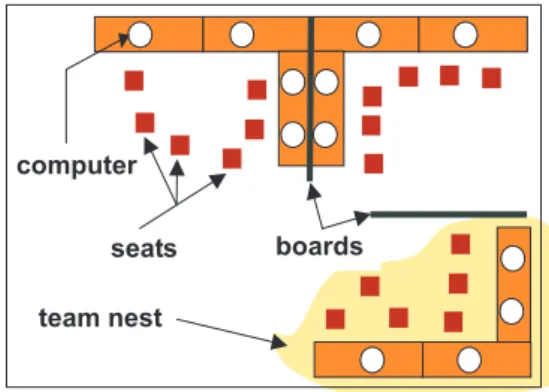
The university is important as a meeting place for team discussions. It is important to have meeting room designed and furnished in such a way that it supports teamwork. Figure 2 depicts arrangement of our software studio. Part of the overall project work is accomplished in small subteams of two or three students, and some time is spent in individual work (in Figure 3 see average distribution during autumn semester 2002/2003, based on the evaluation of question-naires completed by 68 students). Most of the time this work is carried out at home. Individ-ual work increases as the project proceeds. In software projects, most of the implementation phase is done individually. However, at the end
computer
seats boards
team nest
Fig. 2.Outline of our software studio.
Fig. 3.Teamwork distribution.
of the project, during integration and testing, students spend most of the time in teamwork. We adopted an approach where students should experience various responsibilities for different parts of the system that is being developed. Dis-tributing the work evenly among team members is a precaution against possible excessive indi-vidual workload and against problems caused by one team member quitting the Team Project, for whatever reasons.
6. Assessment
Methods of team assessment should be based on some objective criteria. A supervisor is usually responsible for determining students’ grades. There are two common approaches and their combinations18]:
to give each team member the same grade and
to give each team member a grade based on his/her individual contribution.
we perform regularly each term) none of our students selected the option to evaluate all team members equally. 30% of students reported that efforts of individual team members were rather different. Only 2 students(out of 74)reported that the efforts of all team members were equal. In the first years of offering the Team Project with teams formed by students, “equality syn-drome” was quite common.
Assessment in our Team Project comprises the following components: product quality, docu-mentation, quality and topicality of a web page, reviewing, individual team members’ activity, presentation and answers to questions on prod-uct and software engineering methods used, ac-tive participation in the presentation of compet-ing team(s).
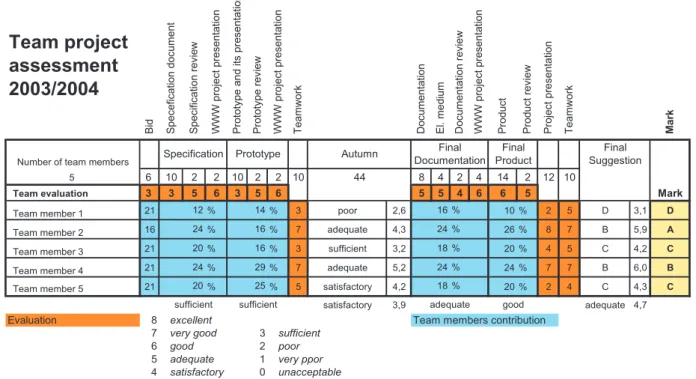
The supervisor evaluates each component on a predefined 8 points scale(excellent, very good, good, adequate, satisfactory, sufficient, poor, very poor, unacceptable). Particular component is either related to an individual or to the team as a whole. In the latter case, part of the work performed by each team member(in %) is de-termined(using peer evaluations as a help). We created Excel sheet for assessment evaluation – an example is depicted in Figure 4.
A supervisor fills colored cells: orange cells are for evaluating particular outcome(numbers from 0 to 8 correspond to 8 points scale), and blue cells are for evaluating contribution of each team member. Note that contribution of a team member is not assigned for each particular out-come, but for a group of outcomes related to the particular milestone(see next section, De-velopment Process). Teamwork is assessed in both semesters, individually, for each team member, and it constitutes 10+10% of overall assessment. Assessment is recommended au-tomatically (columns Autumn and Final Sug-gestion), based on evaluated outcomes for the whole team, contribution of a member, individ-ual assessments(teamwork and project presen-tation) and their importance. Finally, consid-ering all factors (not only those expressed by numbers in the table)the supervisor determines final mark(last column).
We use several methods for students peer eval-uation: students are asked to classify their team mates; they assess each of their team mates on a predefined point scale; students explicitly deter-mine part of the work performed by each team mate. The last method seems to be the most effective.
Team project assessment 2003/2004
Bid Spec
e fi c a ti o n d o c umen t Sp e c ific a tio n re v iew WWW proj ec t p res e n ta ti o n P rototy p e a nd it s p re s e ntati o n P rototy p e rev ie w WWW proj ec t p res e n ta ti o n Te am work D o c u me nt at ion El. m e d iu m D o c u me nt at ion rev ie w WWW proj ec t p res e n ta ti o n P rod uc t P rod uc t rev ie w Pr o jec t p re s e nta tio n Te am work Mark
Number of team members
5 6 10 2 2 10 2 2 10 8 4 2 4 14 2 12 10
Team evaluation 3 3 5 6 3 5 6 5 5 4 6 6 5 Mark
Team member 1 21 % % 3 poor 2,6 10 % 2 5 D 3,1 D
Team member 2 16 % % 7 adequate 4,3 26 % 8 7 B 5,9 A
Team member 3 21 % % 3 sufficient 3,2 20 % 4 5 C 4,2 C
Team member 4 21 % % 7 adequate 5,2 24 % 7 7 B 6,0 B
Team member 5 21 % % 5 satisfactory 4,2 20 % 2 4 C 4,3 C
satisfactory 3,9 adequate 4,7
Evaluation 8 excellent Team members contribution 7 very good 3 sufficient
6 good 2 poor
5 adequate 1 very ppor
4 satisfactory 0 unacceptable
good adequate % 18 % % % 24 18 24 Specification Prototype sufficient sufficient 16 14 25 29 16 20 16 24 20 24 12 Final Product Autumn 44 % Final Suggestion Final Documentation
7. Development Process
Project phases and number of cycles used for a particular project are mainly influenced by the problem domain and project resources. Usu-ally, the life cycle ends with implementation, integration and system testing phase. There are also reported approaches where a maintenance phase is involved. For example, a module can consist of two parts: the first part is the devel-opment of a new system, and in the second part the teams are required to make certain modifi-cations to those systems14].
In our experience, the most important factor is the time (how long the project lasts and how many hours per week it is allocated). If a team project module is just one out of several mod-ules taken concurrently, covering all phases of the software life cycle, together with several it-erations in 2 or even 3 semesters, is hardly pos-sible. From the point of the educational module design, stress should be put on the team process, communication, etc. rather than on concentrat-ing on particular phases of software develop-ment. However, this is an open issue. If the module objective is formed as an aggregation of effective teamwork and software engineer-ing topics(such as software processes, software architecture or methods of software analysis), one should balance these objectives(often with a priority given to software engineering top-ics). Providing effective teamwork as the
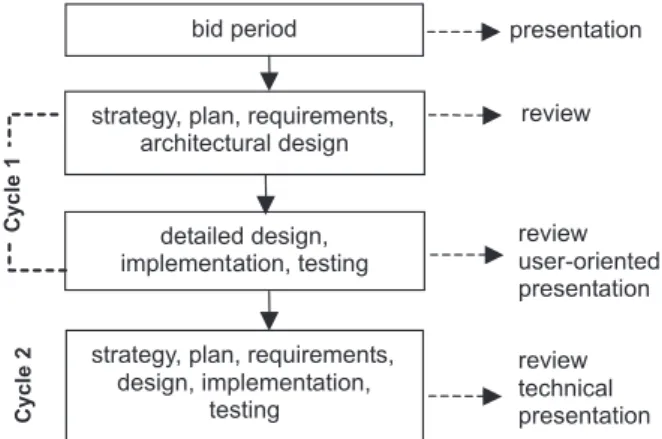
pri-mary goal, we warn against expecting too much from the team project in the sense of teaching students ne w methods, tools or technologies. Although the quality of the final result(e.g., a software system)is an important indicator of the success of a team, we concentrate on the process applied. Figure 5 illustrates main phases ac-complished in our Team Project, as adopted for a project of developing a software system from the Team Software Process 9]. Bid period, together with first iteration (Cycle 1), is per-formed during the first semester and the second iteration is the scope of second semester. We be-lieve that classic process-oriented development methods are more suitable for educational pur-poses than agile approaches such as eXtreme Programming, Lean Programming, Scrum or Crystal4]. However, this statement should be more elaborated and real experience with agile methods should be acquired.
bid period
strategy, plan, requirements, architectural design
detailed design, implementation, testing
strategy, plan, requirements, design, implementation,
testing
review
review user-oriented presentation
review technical presentation presentation
C
ycle
2
Cyc
le
1
Fig. 5.Main phases of the software process.
Each team of students must present the project in a seminar, to an audience consisting of de-partment staff and students(mainly those who worked on similar assignments). An important part of the development process is reviewing the work of another team. For each team a competing team is assigned. Students should write a review document with its structure spec-ified beforehand. Results are then discussed in a joint meeting where students of one team are supposed to present their review and respond to another team’s review of their work. Different kinds of review can be adopted with different frequency. The main constraint here is dura-tion of the module. We adopted the approach where the project is reviewed by another team after completing first specification, first worked system (Cycle 1), and final software product
(including review of a source code).
8. Team Supervision
The amount of freedom and supervision should be balanced in order to create a true learning experience for students. To simulate the reality, students should have a considerable amount of freedom. On the other hand, since students usu-ally have no project experience, some amount of supervision, monitoring and guidance is needed to ensure sufficient progress and a successful re-sult.
1 chief module
supervisor for software engineering projects
15 supervisors
16 teams 85 students
course synch., guidance/ briefing, problems
assignments, assessment/ products
reviews, presentations
1 technician Clients
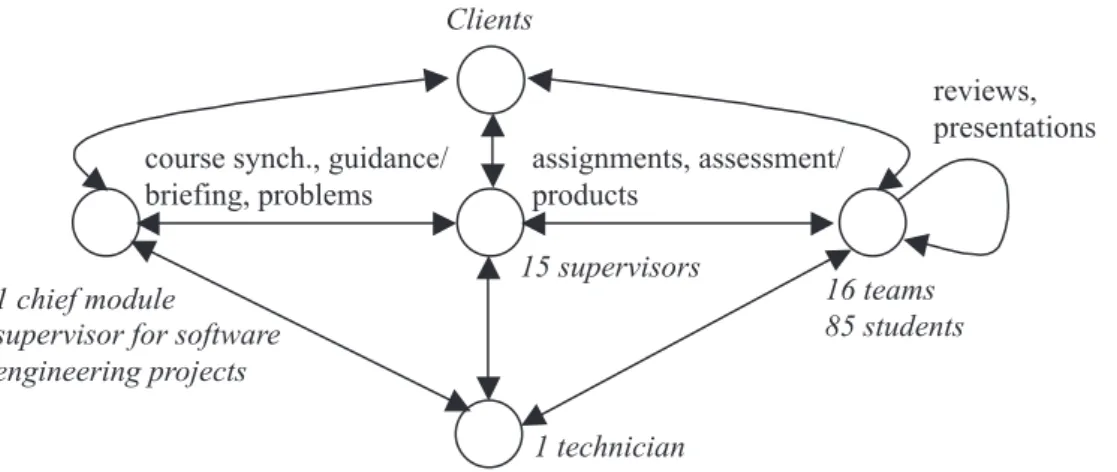
Fig. 6.Roles and numbers of people involved in the 2002/2003 Team Project.
project group of 6 to 10 students, a customer from an existing company, a steering commit-tee formed by university staff, and mentors. The steering committee plays a role of project super-visor, provides students with advice, and mon-itors progress of the project. Mentors contact with students on a daily basis, review docu-ments produced by the students and coordinate the practicum from a didactic point of view. Figure 6 shows roles and numbers of people in-volved in our module during the academic year
(2002/2003). To discuss issues that concern the whole module, all supervisors meet with a chief module supervisor about once a month, or as the situation demands. Our experience shows that it is more effective for students to have a different supervisor for each team. From the organizational point of view such approach makes the level of supervisors and their coor-dination not an easy task. On the other hand, it is not easy to supervise several teams in such a large project, without influencing one team with ideas devised during sessions of the other team.
In order to reach balance between freedom of students and supervision, we specify in advance certain requirements on the content of documen-tation to be produced. Students have to prepare and follow a detailed project plan. We prescribe certain parts of the project plan, such as list of activities, milestones, dependencies, and re-sponsibilities according to established team pro-cess9]. Students are free to define the activities that are necessary for successful accomplishing of the project. We accompany the Team Project by lectures on project management, teamwork, and quality assurance.
9. Conclusions
From the above it follows that the idea of incor-porating a teamwork practice usually in a form of some kind of a team project has been adopted by and large. However, there are many issues that remain open. To name a few, organizing projects as truly real-life ones, mirroring the in-dustrial conditions including the problem tasks defined by an industrial partner is discussed as clearly a desirable, but hardly a completely re-alistic goal. On the other hand, curricula de-signers should be careful when relying solely on academic environment and should seek at least some kind of an industrial involvement.
problem with underestimating the documenta-tion in software projects. In line with others’ experience2], most teams complained that the module demanded significantly more work than they were credited for in their curriculum. In spite of initial problems the students responded well to the challenge and several commented that this was one of the most exciting activities of their student career. Most of them valued experience with system integration and reengi-neering.
References
1] S. BECKER ANDA. LASALLE, Translating software
engineering principles into practice: team frame-works, in P. Klint and J. R. Nawrocki, editors,Proc. Software Eng. Education Symposium, pages 54–61, Pozna´n, Poland, Scientific Publishers OWN, 1998.
2] S. BIFFL AND G. THOMAS, Preparing students for
industrial teamwork: a seasoned software engineer-ing curriculum, IEE Proc. Softw., 145(1):1–11,
1998.
3] O. P. BRERETON ET.AL, Student group working
across universities: a case study in software en-gineering, IEEE Trans. on Education, 43(4):394–
399, November 2000.
4] A. COCKBURN AND J. HIGHSMITH, Agile
soft-ware development: The people factor, Computer, 34(11):131–133, November 2001.
5] J. FAVELA ANDF. PENA-MORA, An experience in
collaborative software engineering education,IEEE Software, 18(2):47–53, March/April 2001.
6] J. GORDIJN ANDF. NIESSINK, Balancing freedom
and supervision in a real-life educational project, in P. Klint and J. R. Nawrocki, editors,Proc. Software Eng. Education Symposium, pages 77–84, Pozna ´n, Poland, Scientific Publishers OWN, 1998.
7] T. B. HILBOURN ANDW. S. HUMPHREY, Teaching
teamwork, IEEE Software, 19(5):72–77,
Septem-ber/October 2002.
8] M. HOLCOMBE AND A. STRATTON, Vici:
Expe-riences in introducing student run software com-panies into curriculum, in M. Holcombe et.al., editor,Proc. Project 98 Workshop, Projects in the Computing Curriculum, pages 103–116, Springer, 1998.
9] W. S. HUMPHREY, Introduction to the Team
Soft-ware Process, Addison Wesley. Reading, Mas-sachusetts, 2000.
10] S. JARZABEK(GUESTEDITOR), Teaching software
project courses, Forum for Advancing Software engineering Education (FASE), 11(6), 2001.
Avail-able athttp://www.cs.ttu.edu/fase.
11] P. N ´AVRAT ANDM. BIELIKOV´A, The context and the
contents of software engineering education in Slo-vakia, in P. Klint and J. R. Nawrocki, editors,Proc. Software Eng. Education Symposium, pages 141– 148, Pozna´n, Poland, Scientific Publishers OWN, 1998.
12] P. N ´AVRAT ANDM. BIELIKOV´A, Software
engineer-ing education: different contexts, similar contents,
SIGSCE Bull., 31(2):55–59, 1999.
13] P. N ´AVRAT AND L. MOLN´AR, Curricula
transfor-mation in the countries in transition: an experi-ence from Slovakia, IEEE Trans. on Education, 41(2):88–91, 1998.
14] L. OHLSSON ANDC. JOHANSSON, A practice driven
approach to software engineering education, IEEE Trans. on Education, 38(3):291–295, 1995.
15] R. H. RUTHERFOORD, Using personality inventories
to help form teams for software engineering class projects, SIGCSE Bull., 33(3):73–76, 2001.
16] I. SOMMERVILLE, Learning from the impossible:
the case for wicked problems in teaching systems engineering, in P. Klint and J. R. Nawrocki, editors,
Proc. Software Eng. Education Symposium, pages 275–283, Pozna ´n, Poland, Scientific Publishers OWN, 1998.
17] J. E. TOMAYKO, Carnegie Mellon’s software
de-velopment studio: a five year retrospective, in
Proc. 9th Conf. on Software Eng. Education, pages 119–129, Florida, IEEE Computer Society Press, 1996.
18] D. E. WILKINS AND P. B. LAWHEAD,
Evaluat-ing individuals in team projects, SIGCSE Bull., 32(1):172–175, March 2000.
Received:January, 2003 Accepted:September, 2004
Contact address: M´aria Bielikov´a Pavol N´avrat Institute of Informatics and Software Engineering Faculty of Informatics and Information Technologies Slovak University of Technology in Bratislava Ilkovicova 3, 842 16 Bratislava 4, Slovakiaˇ e-mail:[email protected]
M ´ARIA BIELIKOVA´ received her Ing.(Master)summa cum laude in
1989 from Slovak University of Technology in Bratislava, and her PhD. degree in 1995 from the same university. Since 1998, she is an asso-ciate professor, presently at the Institute of Informatics and Software Engineering at Slovak University of Technology Bratislava. She(co-)
PAVOLN´AVRATreceived his Ing.(Master)summa cum laude in 1975,
and his PhD. degree in computing machinery in 1984, both from Slovak University of Technology. He is currently a professor of informatics at the Slovak University of Technology. During his career, he was also with other universities over-seas. His research interests include related areas from software engineering, artificial intelligence, and informa-tion systems. He published numerous research articles and several books. He co-edited and co-authored monographs: Knowledge-Based Software Engineering(Amsterdam, IOS-Press, 1998)and Advances in
Databases and Information Systems(Berlin, LNCS Springer, 2002).