VOLUME 18 ISSUE 2 (2020), Page 24 – 36
THE TYPOLOGY OF RUMAH LIMAS BUMBUNG PERAK (RLBP)
Iryani Abdul Halim Choo 1, Mohd. Sabrizaa Abdul Rashid 2 & Nazrul
Helmy Jamaluddin 3
1Department of Architecture 2,3Department of Interior Architecture 1,2,3Faculty of Architecture, Planning and Surveying
MARA UNIVERSITY OF TECHNOLOGY (UiTM) PERAK
Abstract
One of the treasured heritages of Perak is the traditional house of Rumah Limas Bumbung Perak (RLBP). With the current wave of rapid development and the other contributing factors, RLBP is threatened with extinction. Besides, the lack of research and documentation effort has made this threat worsen. The objective of this research is to analyze the typology and classify the style of RLBP throughout the state of Perak. The research is conducted using the on-site field survey where the data was collected through observation. An overall of 260 RLBP houses has been analyzed using typological analysis. The research findings have identified an overall of 5 styles of RLBP, namely, Rumah Limas Bumbung Perak Gaya Utara (RLBPGU), Rumah Limas Bumbung Perak Gaya Perak (RLBPGP), Rumah Limas Bumbung Perak Gaya Kembar (RLBPAK), Rumah Limas Bumbung Perak Agam (RLBPA) and Rumah Limas Bumbung Perak Gaya Selatan (RLBPGS). The findings of this research contribute towards the understanding of identity and the enhancement of architectural theory from the perspective of architectural typology and evolution of the traditional Malay house architecture, especially in Perak.
INTRODUCTION
Perak is one of the states that has a rich and long history in the overall history of Malaysia. The enthronement of its first Sultan, Sultan Muzzaffar Shahstarted in Tanah Abang (of what is now Teluk Bakong) (Basri, 2016) and since then, the early settlement had started to flourish along the fertile riverbanks of the main river of Perak– the Sungai Perak. Along with the flourishing of this settlement is its architecture, and for this reason, many architectural traces and remnants of traditional houses, palaces, mosques and royal tombs are scattered along the main stretch of Sungai Perak(Rashid, Mat, & Amat, 2009). From previous research, there are two 2 types of traditional Malay houses of Perak- the Rumah Kutai and the Rumah Limas Bumbung Perak (Abd Rashid, Fadzil, & Mat, 2010). Rumah Kutai is the oldest type of the traditional Malay houses in Perak, while Rumah Limas Bumbung Perak (RLBP) is the latest version of the traditional house of Perak which has started to become popular in the architectural landscape of Perak since the 1900s. For this historical and architectural significance that it offers, Perak has become one of the preferred areas of research. It is understood from the previous research, most research focused on the design of Kutai house and only a few on the Rumah Limas Bumbung Perak (RLBP).
A recent research published in 2019 had identified a few types of Rumah Limas Bumbung Perak (RLBP) that exist in the small area of Kampung Aji. In addition, the research warned about the extinction and damages of many Rumah Limas Bumbung Perak (RLBP). It should be noted that most of the past research, focused only on a small vicinity of a kampong in the Perak Tengah district. As recommended by previous research, (Rashid, Mat & Amat, 2009, Abd Rashid, Fadzil, & Mat, 2010, Saleh, Mahat & Nayan, 2018, Rashid, Choo, Ramele, Baharuddin & Alauddin, 2018, Rashid, Alauddin, Baharuddin, Choo, 2019), there is an urgent need in studying the architectural typological pattern of Rumah Limas Bumbung Perak(RLBP) in the whole of Perak. Considering the historic architectural significance of the Rumah Limas Bumbung Perak (RLBP) as the traditional Malay house of Perak, the objective of this research is to analyse and categorise the typologies of Rumah Limas Bumbung Perak (RLBP) which is vital in safeguarding the architecture history of Perak.
Traditional Malay Houses of Perak
throughout the whole of the Peninsula are governed by the two major types of roof, the bumbung panjang (long roof) and bumbung limas (limas roof) (Nasir & Aziz, 1985). Bumbung panjang is the oldest form of roof which is mostly used by the Malays to build houses in the early period (Rasdi, 2005). It is characterized by a simple yet practical form of roof. Nevertheless, with the coming of the westerners during the colonization period, bumbung limas were slowly introduced. From the aspects of construction, bumbung limas is easier to build than bumbung panjang (Rashid, 2017) which makes it quickly become a favorite roof design by the carpenters and the people.
Rumah Limas Bumbung Perak (RLBP)
Bumbung Limas Perak has originated from the simple, early version of the limas roof where the roof form is known as “Perabung Lima”. This roof is characterized by the 3-dimensional character where it consists of 1 main ridge in the middle of the roof followed by the smaller ridge, descending down to the roof eaves (Nasir & Teh, 1996). The origin of bumbung limas remains unknown. Nevertheless, according to an old carpenter in Lenggong Perak, the word “limas” has originated from the word “lima”, depicting the five ridges of the limas roof (Nasir & Teh, 1996). Bumbung Limas also known as Bumbung Potong Belanda (Rashid, 2017).
The basic spatial characteristic of Rumah Limas Bumbung Perak (RLBP) is that it comprises several spaces. The entrance of the house started with a serambi or a balcony. The serambi is attached to the anjung. Anjung is a public space in the house. This is the space where the guests are entertained and activities such as reading Quran, festivity celebration, circumcision ceremony and other public activities took place. This is also a space where the male guest enters the house (from serambi to the anjung). The middle of the house comprises the rumah ibu or the main house area. Rumah ibu is attached directly to the anjung and this is the space for the female guest. Next to Rumah ibu is the rumah selang. Rumah selang functions to connect the rumah ibu and the kitchen. It also functions as the secondary entrance of the house where it is used by the female guest to enter the house (Rashid, Alauddin, Baharuddin & Choo, 2019). The kitchen is located at the back of the house and functions as a cooking space and a food preparation area for the household. This spatial characteristic of the Rumah Limas Bumbung Perak (RLBP) is not fixed and changes based on the increasing needs of the household (the growing family members of the household). Nevertheless, any extension work to the house is extended from the back portion of the house, and not to the side portion of the house. This is said to relate to the “humble” culture and principle of the Malay of being moderate, shy and not being extravagant and showing off (Saleh, Mahat, & Nayan, 2018). The roof of the anjung comprised the Bumbung Limas Perak, while the serambi adjacent to the anjung is roofed with a simpler roof, that is the bumbung pisang sesikat. The façade of the Rumah Limas Bumbung Perak (RLBP) is enhanced with decorative elements. Overall, there are nine decorative elements that exist in the Rumah Limas Bumbung Perak (Rashid, Choo, Baharuddin, & Alauddin, 2018). The serambi is decorated with a decorative gerbang of jejala motif. It is one of the prominent characteristics of the decorative elements of Rumah Limas Bumbung Perak (Rashid et al., 2018). Nevertheless, the availability of the decorative elements in the house depends on
the house owner’s status where a house with completed decorative elements is commonly owned by the rich or the noble people of the community.
RESEARCH METHOD
On-Site Field Survey
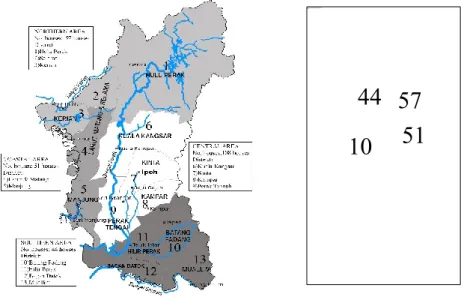
This study was conducted based on the exploratory research basis. The primary data collection was done using the on-site field survey approach through observation. The field survey conducted covers the whole region of Perak where 13 districts in the state were explored. The districts were grouped into 4 areas: Northern, Coastal, Central and Southern Area. All houses identified in these 4 areas were recorded in the form of visual and physical data. This methodology allows the researcher to explore, experience, and record the data at the site and to gain a more accurate data.
Observation - Visual and physical data
The data gained during the field visit survey were in the form of photos and technical sketches. Photos were collected using the DSLR digital camera and on-site freehand technical sketches. The photos taken covered the front, rear and side view of the houses as well as detailed interior components such as the entrance, door, window and decorative elements. The location of each of the houses was recorded and tracked using the GPS coordinates through Google Maps. The selection of RLBP houses selected for this study was based on several criteria as per described below;
i. The roof of the house (the rumah ibu) is of the Limas Bumbung Perak roof
ii. The house demonstrates the identifiable visual and spatial characteristic of a Rumah Limas Bumbung Perak (RLBP)
iii. The house is decorated with decorative elements
Data Analysis – Typological Analysis
in architecture has been defined as the classification or archiving of certain types of form based on architecture styles which then reduced to architectural elementary forms and elements (Altaş, 1997). It is a systematic analysis that is used to identify and clarify certain phenomena, that include “reduction, abstraction and schematization” (Ayyildiz, Ertürk, Durak, & Dülger, 2017). In the field of traditional Malay architecture, from the review conducted, the typological analysis was employed by prominent researchers such as Ali (1983), Talib (2006) and Utaberta et al., (2012).
FINDINGS AND DISCUSSIONS
Typology of Rumah Limas Bumbung Perak (RLBP) in Perak
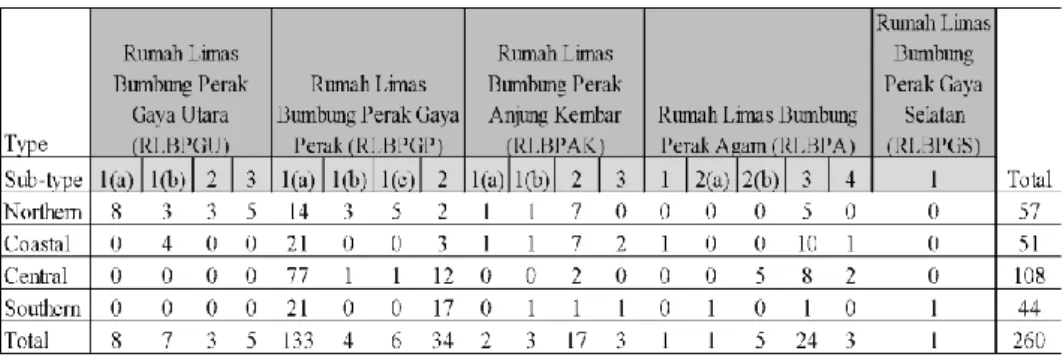
Based on the analyses of 260 houses conducted in this research, revealed that there are 5 major styles of Rumah Limas Bumbung Perak (RLBP) existed in the state of Perak. The styles are Rumah Limas Bumbung Perak Gaya Utara (RLBPGU), Rumah Limas Bumbung Perak Anjung Kembar (RLBPAK), Rumah Limas Bumbung Perak Gaya Perak (RLBPGP), Rumah Limas Bumbung Perak Gaya Agam (RLBPGA) and Rumah Limas Bumbung Perak Gaya Selatan (RLBPGS). Based on each style, there are several sub-categories defining the character of the major styles.
Figure 2. Classification of district per area and number of RLBP identified per area.
Source: Author
57
44
51
10
Rumah Limas Bumbung Perak Gaya Utara (RLBPGU)
The research has identified 4 variations of houses under the RLBPGU style. From the analysis, a common front characteristic that existed in all houses under the RLBPGU is the spatial position of its serambi. The serambi of the house is attached directly to the rumah ibu, as opposed to the common RLBP where the serambi is attached to the front anjung. Other variations existed in this style were that some houses were found to have a porch at the entrance where it has an open or semi-open characteristic of serambi; the location of the entrance stairs can be found either at the front, side or under the serambi; the roof types of the serambi used either bumbung panjang or bumbung limas; the height of the serambi were lower or at the same height with rumah ibu; and lastly the absence of the anjung. In all 4 types of houses under the RLBPGU style, it can be identified that Type 1a has the most visually and attractive façade compared to the other houses under the RLBPGU style. Meanwhile, the simplest house within this style is Type 3, where the house has no anjung and its serambi is stylized with the Bumbung Limas Gajah Menyusu. The façade of Type 1a is highly decorated with decorative elements such as ande-ande (papan manis), kepala pintu, kepala tingkap as well as the lubang angin styled with intricate carving panels. In terms of its architectural characteristic, this type closely resembles the traditional Malay house of Kedah (e.g; Rumah Seri Banai, Alor Setar). From the research conducted, most of the houses with the RLBPGU style are mostly found to be located in the northern area. This locational pattern explains the reason behind the concentration of RLBPGU in the northern area. The architectural style of RLBPGU is influenced by the northern style of the Traditional Malay House of Kedah. This may be due to the location and the background of the tukang rumah (the house carpenter) are mostly from the north ie Kedah.
Rumah Limas Bumbung Perak Gaya Perak (RLBPGP)
types of the anjung – bumbung limas perak or bumbung panjang. From the study, it can be found that most of the RLBPGP houses in the southern region are from the RLBPGP Type 1. Nevertheless, there is a slight variation where the roof for the anjung is styled with a bumbung panjang roof. The gable end of the southern houses are decorated with the rising sun motifs, a motif widely used in the traditional house of Selangor. From the cross review conducted, this variation of the RLBPGP located in the southern area is influenced with the southern style of the traditional Malay house of Selangor. From the summary table, it is found that the Central Area recorded the most houses in the RLBPGP style. The reasoning behind this is because the central area (specifically along the vicinity of Sungai Perak) is the site of the early settlement of Perak and had continuously become the preferred settlement area due to the ease of river transportation, until the modern road was introduced in the later years.
Rumah Limas Bumbung Perak Anjung Kembar (RLBPAK)
From the analysis that has been conducted, the Rumah Limas Bumbung Perak Anjung Kembar (RLBPAK) style consists of 4 types. The common characteristic shared by all of the types is as per its name, the number of anjung is more than one and its number ranges from 2-3 anjung in a house. It is found that type 1(a) and 1(b) consist of separated anjung while Type 2 and Type 3 have the attached type of anjung. The other variations are the position of the serambi where some are attached to the rumah ibu or the anjung; the position of serambi where it is located in the middle or side; and the roof types of the serambi either using the bumbung limas or bumbung panjang or, bumbung pisang sesikat. The front spatial form of Type 2 and Type 3 is the same as the spatial form of the RLBPGP. The only difference is the number of anjung, which have more than one compared to the RLBPGP which consists of only one anjung.
Rumah Limas Bumbung Perak Agam (RLBPA)
For the Rumah Limas Bumbung Perak Agam (RLBPA), there are 5 types that exist in this style. Architecturally, RLBPA differs slightly from the rest of the 4 styles where the design is a fusion with colonial-style architecture. Nevertheless, from the analysis it can be identified that the front spatial characteristic of most of the RLBPA types resembles closely to the common style of RLBPGP. The obvious differences of the common type of RLBPA with RLBPGP are the absence of the serambi (in most of RLBPA common type) and the height and scale are slightly higher and bigger due to influence of colonial design. The common characteristic of RLBPA is that the house is of two-storey building where the entrance for the house is from the ground level and the size and the height of the house is higher and bigger. From the analysis conducted, there are 5 various types of RLBPA. Those variations include the position of serambi- attached to rumah ibu or anjung; the shape of the anjung- octagonal or rectangular anjung; the characteristic of serambi– no serambi or semi open serambi like in RLBPGU; the number of storeys; availability of entrance porch and the absence of the serambi. Type 3 is the most common type where it can be found in all of the 4 areas that have been explored. This is because most of the buildings built during the colonial period were two or more storey buildings. Most of the aristocrats and elite during that period tended to build their house bigger and in a two-storey building which showed their social status and income.
Rumah Limas Bumbung Perak Gaya Selatan (RLBPGS)
From the analysis, it is found that there is only one type of Rumah Limas Bumbung Perak Gaya Selatan (RLBPGS). In the RLBPGS, there are 2 serambi with an anjung located in the middle. Based on the analysis of all RLBP types, it was found that the RLBPGS is the only building that has 2 serambi attached to the middle anjung. The roof of the middle anjung is styled with the bumbung panjang roof. The entrance stair is located under the serambi (under the house). This type is the rarest type and it is only found in the southern area. However, in terms of the decorative elements of the RLBPGS the study found that it is almost similar to the RLBPGU, where the decorative elements of the house are focused on the intricate carvings of the kepala tingkap and pintu.
CONCLUSION
Furthemore, the people of different ethnicities (example ethnicity of Siak, Kampar, Mandaling, Jawa and etc in Perak) residing in Perak do influence and contribute to the spatial, façade and character RLBP building. The advancement of traditional construction technology, as well as the availability of materials and machines, has made the variation in the design of RLBP possible for the builder. The colonization period has influenced the design and led to the colonial fusion style of the RLBP. The novelty of this research lies in the classification of RLBP styles and types and this classification of RLBP contributes to the enhancement of the architectural theory from the perspective of architectural typology and the traditional Malay architecture evolution. In conclusion, it is recommended that continuous research and conservation effort be done by relevant authorities in order to preserve this national and cultural heritage in the future.
ACKNOWLEDGEMENTS
The authors would like to express their gratitude to the Centre for Knowledge and Understanding of Tropical Architecture and Interior (KUTAI), UiTM Perak. Thanks also go to the owner of the houses that are studied in this research for allowing their house to be recorded in this study for academic purposes.
REFERENCES
Abd Rashid, M. S., Fadzil, F. A. S., & Mat, N. (2010). Memartabat Sungai Perak Sebagai Koridor Warisan Negeri Perak. Simposium Nusantara Ke - 7 : Warisan Budaya Negeri Perak, 1–9. Retrieved from https://www.academia.edu/2033816/Memartabatkan_Sungai_Perak_Sebagai_Ko ridor_Warisan_Negeri_Perak_Mohd_Sabrizaa_B_Abd_Rashid_Firdaus_Al-Siddiq_Fadzil_Norhasandi_B._Mat
Ali, K. (1983). A Vanishing Heritage: The Old Traditional Malay Houses. University of York.
Altaş, N. (1997). Tipoloji. In Eczacıbaşı Art Encyclopedia. Istanbul: YEM Publishe.
Ayyildiz, S., Ertürk, F., Durak, Ş., & Dülger, A. (2017). Importance of Typological Analysis in Architecture for Cultural Continuity: An Example from Kocaeli (Turkey). IOP Conference Series: Materials Science and Engineering, 245(7). https://doi.org/10.1088/1757-899X/245/7/072033
Basri, M. A. F. (2016). Cempaka Sari: Sejarah Kesultanan Negeri Perak. Kuala Lumpur: Penerbit Geroda Merah Press.
Harun, S. N. (2005). Perkembangan Sejarah dan Pengaruh ke Atas Senibina di Malaysia: Sebuah Tinjauan Ringkas. Buletin Perancang, Jabatan Perancang Dan Daerah, 100.
Nasir, A. H., & Aziz, M. Z. H. A. (1985). Pengenalan rumah tradisional Melayu Semenanjung Malaysia. Kuala Lumpur: Darulfikir, Kuala Lumpur.
Nasir, A. H., & Teh, H. H. W. (1996). The Traditional Malay House. Institut Terjemahan Negara Malaysia.
Rashid, M. S. A. (2017). Rumah KUTAI: Documentation of Memories (M. Kamis, Ed.). Institut Darul Ridzuan.
Rashid, M. S. A., Mat, N., & Amat, S. C. (2009). Reinventing Sungai Perak: An issue on Socio-Cultural Marginalisation. (July), 1–9.
Rashid, S., Choo, I. A. H., Ramele, R. B., Baharuddin, M. N., & Alauddin, K. (2018). Decorative elements of traditional Malay houses: Case study of Rumah Limas Bumbung Perak (RLBP). Journal of Social Sciences Research, 2018(Special Issue 6). https://doi.org/10.32861/jssr.spi6.105.115
Rashid, Sabrizaa, Alauddin, K., Baharuddin, M. N., & Choo, I. (2019). Architectural Design Evolution of the Malay Traditional Houses Along Sungai Perak. Borneo Journal of Social Sciences and Humanities, 1(1), 1–10. https://doi.org/10.35370/bjssh.2019.1.1-08
Saleh, Y., Mahat, H., & Nayan, N. (2018). The Traditional Malay Houses in the District of Muallim, Perak: A Lost Legacy. International Journal of Academic Research in Business and Social Sciences, 8(2), 698–712. https://doi.org/10.6007/ijarbss/v8-i2/3978
Talib, A. (2006). The Perak Kutai Asli Malay House: Form, Function and Meaning. Universiti Teknologi Mara, Shah Alam, Selangor.
Utaberta, N., Sojak, S. D.., Surat, M., Che-Ani, A, I., & Tahir, M. M. (2012). Typological Study of Traditional Mosque Ornamentation in Malaysia – Prospect of Traditional Ornament in Urban Mosque. International Journal of Civil, Architectural Science and Engineering, 6(7), 43–50.
Yuan, L. J. (1987). The Malay House: Rediscovering Malaysia’s Indigenous Shelter System. Institut Masyarakat.
Received: January 2020. Accepted: 1st April 2020
YUAN, L. J. (1987). THE MALAY HOUSE: REDISCOVERING MALAYSIA’S