40
Review of Electronic and Semi-Electronic
Timber Tracking Technologies
OCTOBER 2012
I N T E R N A T I O N A L T R O P I C A L T I M B E R O R G A N I Z A T I O N
International Organizations Center, 5th Floor, Pacifico-Yokohama, 1-1-1, Minato-Mirai, Nishi-ku, Yokohama, 220-0012, JapanTel 81-45-223-1110 Fax 81-45-223-1111 Email [email protected] Web www.itto.int © ITTO 2012 G SUS TAINABILIT Y IT TO T EC H N IC A L S ER IE S 4 0
TECHNICAL SERIE S
Review of Electronic and Semi-Electronic Timber
Tracking Technologies
TRACKING
SUSTAINABILIT Y
ITTO TECHNICAL SERIES #40
Tracking Sustainability
Review of Electronic and Semi-Electronic Timber Tracking
Technologies
ITTO Technical Series No. 40
By Felix Seidel with Emily Fripp, Annie Adams and Ian Denty
The International Tropical Timber Organization (ITTO) is an
intergovernmental organization promoting the conservation and
sustainable management, use and trade of tropical forest resources.
Its members represent the bulk of the world’s tropical forests and
of the global tropical timber trade. ITTO develops internationally
agreed policy documents to promote sustainable forest management
and forest conservation and assists tropical member countries to
adapt such policies to local circumstances and to implement them
in the field through projects. In addition, ITTO collects, analyzes
and disseminates data on the production and trade of tropical
timber and funds projects and other actions aimed at developing
industries at both community and industrial scales. Since it became
operational in 1987, ITTO has funded over 1000 projects valued
at around US$350 million. All projects are funded by voluntary
contributions, with major donors to date the governments of
Japan, Switzerland, the United States of America, Norway and the
European Union.
CITES (the Convention on International Trade in Endangered
Species of Wild Fauna and Flora) is an international agreement
between governments. Its aim is to ensure that international trade
in specimens of wild animals and plants does not threaten their
survival.
Front cover photo: Helveta
Back cover photo: A. Sarre/ITTO
© ITTO 2012
This work is copyright. Except for the ITTO and CITES logos,
graphical and textual information in this publication may be
reproduced in whole or in part provided that it is not sold or put to
commercial use and its source is acknowledged.
Disclaimer
The views expressed in this publication are those of the authors
and do not necessarily reflect the views of ITTO or CITES.
The designations employed and the presentation of material do
not imply the expression of any opinion whatsoever concerning
the legal status of any country, territory, city or area, or of its
authorities, or concerning the delimitation of its frontiers and
boundaries.
ISBN 4-902045-95-8
FOREWORD
The evolution of timber tracking systems has been rapid in recent years, both in terms of the technologies
employed and the scope of products and forests covered by them. This evolution has been driven by the desire
of forest managers and administrations to have reliable information on flows of forest products in order to
improve forest management and to ensure that all relevant forest fees and taxes are captured. It has also been
driven by a strong desire by many importers to ensure that forest products entering their markets are legally
and sustainably produced.
ITTO has a quarter-century of experience in supporting tropical countries to implement sustainable forest
management (SFM), defined as the process of managing a forest to achieve one or more clearly specified
objectives of management with regard to the production of a continuous flow of desired forest products
and services without undue reduction of its inherent values and future productivity and without undue
undesirable effects on the physical and social environment. Since the early years of its establishment, ITTO
has assisted countries to improve statistical systems to monitor timber and forest products flows as an essential
component of SFM, initially based on paper-based systems and moving more recently to support for advanced
physical (e.g. RFID tags and bar-coding) and chemical (e.g. isotope and DNA analysis) tracking technologies.
ITTO’s extensive work in this field convinced it that there was a need for a compendium of existing timber
tracking technologies to provide countries with detailed information on the features of different systems
that are becoming widely available in the forest sector from a range of providers. A generous grant from the
government of Japan to ITTO’s Biannual Work Programme allowed for the study that led to the publication
of this review, and for an expert meeting that reviewed it and contributed to the recommendations contained
herein.
ITTO’s work on timber tracking has been funded through various windows, including activities under its
Biannual Work Programmes, its regular project cycle and under its thematic programme on Tropical Forest
Law Enforcement, Governance and Trade (TFLET). Since 2007, ITTO has also been implementing a
collaborative program with CITES (funded by the European Commission and other donors) to improve the
implementation of CITES regulations for international trade in tropical tree and timber species that are listed
in the CITES appendices. This close collaboration (which has included support to countries for tracking
CITES-listed timber species) led to an offer from the CITES Secretariat to co-fund the consultancy which
gave rise to this report, which was gratefully accepted by ITTO.
CITES has nearly 40 years of experience in ensuring that international trade in species of wild flora and fauna
listed in its appendices does not threaten their survival. Its objective is to regulate the international trade in
CITES-listed species to ensure it is sustainable, legal and traceable. Effective tracing and tracking systems for
monitoring trade in such species are essential for the effective implementation of the Convention.
The number of tree species listed in the CITES appendices has significantly grown from 18 species in 1975 to
more than 300 today, the majority of them from tropical countries. Some of these countries face great challenges
in demonstrating that they have a robust chain of custody for products derived from their CITES-listed species.
Tracking technologies are a key tool to strengthen the quality of the CITES non-detriment finding required
for exports of Appendix II listed species. This scientific finding, which is issued by the CITES Scientific
Authority of exporting countries, together with the subsequent export permit issued by the CITES Management
Authority, assures importing countries that such timber can be regarded as having been sustainably and legally
sourced.
As the scope of forest products in international trade continues to increase in tandem with the complexity of
global supply chains, timber and forest product tracking technologies will play an increasing role in ensuring
sustainable and legal supplies of these essential products. We thank the donors, consultants and service
providers who made this report possible and hope that all Parties to CITES and Members of ITTO find it a
useful guide to these rapidly evolving technologies.
ACKNOWLEDGEMENTS
We would like to thank Milena Sosa Schmidt (CITES) and Steve Johnson (ITTO) for giving us the
opportunity for writing this report. Further thanks go to Jussi Lounasvouri (EFI EU FLEGT) and Phil
Guillery (FSC International) for their technical input and helping us to complete the list of electronic timber
tracking systems that are available on the market. We would like to thank Thomas Pichet (EFI EU FLEGT)
for his technical inputs and update on timber tracking systems used in VPA countries. The input for the
needs of the private sector for modern electronic timber tracking systems largely came from Outi Marin and
Caroline Stein, Alastair Herd (TFT, TTAP) and Michael Berger (PEFC International). We would also like
to thank all private timber tracking companies that responded to questionnaires and who provided inputs
through face to face meetings and phone interviews. Finally, thank you to Lucy Cullinane and Liz Betser
(Efeca) for their contributions and editing support.
Felix Seidel, Emily Fripp, Annie Adams and Ian Denty
September, 2012
CONTENTS
FOREWORD
3
ACKNOWLEDGEMENTS
4
CONTENTS
5
ACRONYMS
6
EXECUTIVE SUMMARY
7
1. INTRODUCTION
8
Objectives
8
Scope
8
Methodology
8
2. DRIVERS OF ELECTRONIC TIMBER
TRACKING SYSTEMS
10
Background
10
Policy and market drivers
10
Legislative approaches
10
Purchasing policies
12
NGO pressure
13
Scope and scale of timber tracking systems 13
Overview of current technologies
13
Overview of types of systems
13
Description of a generic typical timber and
timber products electronic tracking system 17
System constraints
17
System advantages
18
System costs
19
Considerations for choosing a timber
tracking service provider
19
3. CASE STUDIES
21
Africa case study (Liberia)
21
Aim
21
Partners
21
Scope of project
21
Functionality
21
Costs
21
Outcomes
21
Tracking system description
22
Asia/Pacific case study (Indonesia)
22
Aim
22
Partners
22
Scope of project
22
Functionality
23
Costs
23
Outcomes
23
Tracking system description
24
South America case study (Brazil)
24
Aim
24
Partners
24
Scope of project
24
Functionality
25
Costs
25
Outcomes
25
Genetic fingerprinting case study (South
America and Central America)
25
Aim
25
Partners
25
Scope of project
26
Functionality
26
Costs
26
Outcomes
26
Tracking system description
26
South Pacific case study
(New Zealand)
26
Aim
26
Partners
27
Scope of project
27
Functionality
27
Costs
27
Outcomes
27
Tracking system description
28
4. CONCLUSIONS ON SYSTEMS
29
Commonalities
29
Enabling factors (those highlighted as a
Strength or Opportunity in two or more
systems)
29
Limiting factors (those highlighted as a
Weakness or Threat in two or more
systems)
30
5. RECOMMENDATIONS
31
Recommendations for choosing a timber
tracking system
31
Recommendations for supporting the
development of timber tracking systems
31
6. OUTLOOK
32
ACRONYMS
ATPF
Forest Product Transport Authorization
CITES
Convention on International Trade in Endangered Species of Wild Flora and Fauna
CLO
Certificate of Lumber Origin
CoC
Chain of Custody
CTF
Federal Technical Registry, Brazil
CTO
Certificate of Timber Origin
DOF
Forestry Origin Document
ERP
Equipment Resource Planning Systems
EUTR
European Union Timber Regulation
FLEGT
Forest Law Enforcement, Governance and Trade
FSC
Forest Stewardship Council
GIS
Geographic Information System
GPS
Global Positioning System
HCVF
High Conservation Value Forest
IBAMA
Brazilian Institute for Environment and Renewable Natural Resources
INF
Intact Natural Forest
ISO
International Organisation for Standards
ITTO
International Tropical Timber Organization
LAS
Legality Assurance System
NGO
Non-Governmental Organisation
OR
Official Receipt
PEFC
Programme for the Endorsement of Forest Certification
RFID
Radio Frequency Identification
RPP
Responsible Purchasing Policy
SFM
Sustainable Forest Management
TFT
The Forest Trust
TTAP
Timber Trade Action Plan
UNECE
United Nations Economic Commission for Europe
VPA
Voluntary Partnership Agreement
EXECUTIVE SUMMARY
T
imber tracking and timber products tracking
technologies are very new and are gaining increasing
importance through changing consumer and policy
demands.
Key points raised in this review are summarised
below:
• When certain attributes such as quality and origin
are separately linked with a product made of
timber or wood fibre, a timber tracking system
needs to be implemented. Electronic timber
tracking systems are systems which constantly,
during a period of timber material flow in a chain,
collect information on timber and timber products
and link this information either to a batch of
products or to an individual item. Usually the
information is stored in a database and can be
accessed if needed and reports which present the
data in different ways can be generated. The
information which is collected depends on the
layout of the timber tracking system which is
steered by the customer demands, certification
schemes or areas binding by local law.
• The nature of timber tracking systems varies
according to the technology that is involved from
using modern electronic timber tracking systems,
semi electronic systems to paper based systems.
Currently all of these are being used in one form or
another. There is a limited number of companies
on the market which offer electronic timber
tracking services with each company specialising in
different software products and timber tracking
applications (e.g. from physical tracking to
tracking of finished timber product at a batch level
without individual marking). The most complex
systems incorporate full Equipment Resource
Planning (ERP) systems with timber tracking
modules and the more basic systems only use
semi-electronic elements if needed.
• Electronic tracking systems have capabilities that
make them an asset in tackling illegal logging and
the trade in illegal timber. These capabilities also
have a wider variety of advantages in business
productivity and management. Benefits of
implementing an electronic timber tracking system
stem from having a greater command over the
physical flow and associated information of timber
and timber products from point of harvest through
to processing and subsequent supply chains. These
advantages include providing a mechanism to
ensure that processes comply with local and
international policies and regulations as well as
reducing the risk of illegal or otherwise
non-compliant material entering the system and
supply chains. They also reduce the likelihood of
human error and improve effectiveness and
efficiency in harvest and manufacturing.
• There have been frequent trials of electronic
systems which are now reaching operational level.
Large scale usage of these systems have not yet
been achieved due to the delicate balance between
costs and benefits in many markets. However, new
policies such as the EU Timber Regulation and the
revised Lacey Act 2008 are providing renewed
impetus for companies to implement timber
tracking systems on a large scale as a way to obtain
regulation compliance. Several electronic timber
tracking systems that will be deployed on regional
or even national basis are currently in preparation.
• Some forest owners and some factory owners,
together with timber tracking service providers,
have undertaken timber tracking trials but there is
still a reliance on research and public funding.
Only a few companies are currently able to cover
their costs completely through customer payments.
• Stand-alone timber and timber products tracking
systems do not always make sense. It can be more
useful to consider these systems within the broader
context of related areas of forestry and timber
operations such as forest inventories and other
forest management systems, accounting systems,
auditing, sales, payment and tax systems. Interfaces
between timber tracking software and the software
used in the related areas should be planned from
inception. During development, actors involved in
the verification of timber tracking data need to
have access to data and the potential to work with
it, either in the software platform, or a simplified
version of the timber tracking system.
• The technology and experience of most timber
tracking companies is capable of delivering
adequate results in countries with simple supply
chains and a limited set of involved companies.
Countries with larger scales of production and very
complex supply chains will represent a new
challenge for electronic timber tracking systems in
terms of sustained funding and results, requiring
new approaches to handle such cases. Currently all
timber tracking companies are small scale, an
increase in new and large clients might put a strain
on the sector requiring it to grow to meet demand
(e.g. staff for support services).
1. INTRODUCTION
This review is intended to provide guidance
to anyone who is planning to implement an
electronic timber and timber products tracking
system but it also details general information on
tracking technologies and the drivers behind it.
The audience for this document is expected to
be for non-specialists as well as for forest experts.
Whilst historically in many areas there have been
paper-based methods of timber tracking and
forest monitoring, electronic timber tracking is
a relatively new development in the forest sector
which is being used in order to address many of
the inherent limitations of paper-based systems
(such as limited data sharing and access, risks of
forgery and corruption) and are developing in line
with other technological advances. In order to take
stock of these rapid developments, there is a need
for independent information on a whole array of
technologies which are available on the market
and that are currently being employed for the use
of tracking of timber and timber products; such as
physical tracking of logs, the tracking of timber on
a batch level, to genetic and isotopic methods used
for origin verification.
Today with increasing sustainability concerns,
global trade and opaque supply chains, it is difficult
to know the source of timber and timber products,
however there is an increasing interest to be able to
track this information. The reasons why companies
or governments implement tracking systems can be
very varied. A company in the timber sector may
simply wish to know more about their supply chain
or there could be a need to reduce the risk of any
illegal or unsustainable material entering the supply
chain. A timber tracking system can be used to fulfil
the requirements of Chain of Custody certification
for forest certification schemes and it can also be
implemented as part of a due diligence system,
to gain knowledge of the supply chain structure
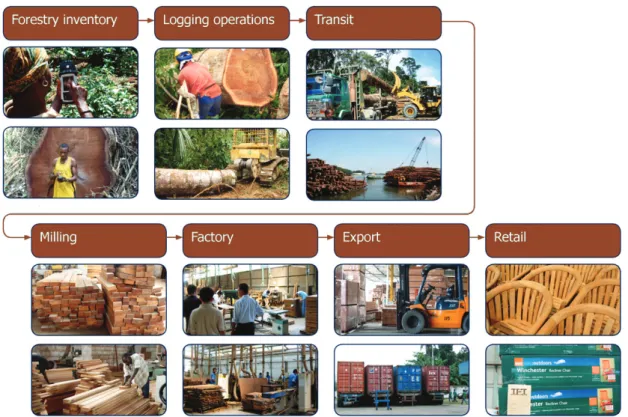
(Figure 1). Timber tracking systems are able to link
timber with new attributes such as ‘sustainably
sourced’ or ‘proof of origin’. Therefore companies
can show they are being different (better) than
their competitors by using tracking systems.
Governments implement timber and timber
product tracking systems in order to regain control
over their forest and timber sector to increase tax
revenue as a positive side effect or to have trade
advantages such as increased access to premium
markets.
Users of tracking systems are wood producing,
transforming, and converting, trading and selling
companies. Stakeholders within the product chain
include a wide variety of organizations and those
involved in verifying information or end-users
who scan a code and are able to see a photo of the
forest. Access rights secures confidentiality and
provides access to as much and as little information
as necessary, i.e. actors in the supply chain can
simply have access solely to the node underneath,
and auditors to full supply chain information
or different staff within a company to only the
attributes that are of relevance to them.
Objectives
1. Review and summarise all timber tracking
systems currently in use;
2. Develop five timber tracking systems case
studies, including at least one from each tropical
region (Africa, Asia-Pacific, and Latin America/
Caribbean).
Scope
The scope of this report considers all electronic
timber and timber products tracking systems
currently on the market by private service
providers which are in use in the global forest
sector, including log and finished product tracking
systems.
Methodology
Tracking systems were identified based and
selected on knowledge and sector experience.
A questionnaire was designed to frame the
information requirements for the system
review and sent to 23 organizations (Table 1).
Out of these 23 companies, 14 replied with
completed questionnaires, 3 did not reply and 5
companies had tracking systems which are not
currently designed to track timber. Out of the
13 organizations which replied, two (Double
Helix, Agroisolab) considered their system not
as a standalone timber tracking system but as an
additional verification system. Exact Modus has
tracked timber in the past but has now shifted to
other areas. The questionnaires were followed up
by telephone or face to face interviews to verify
information gathered and complete any missing
sections of the analysis. Completed questionnaires
are contained in the Annex.
Five case studies (Chapter 3) were identified and
selected covering all tropical regions and, for
consistency, basic information requirements were
assessed. However, each case study was structured
according to the particular project involved.
Information was gathered during the system
analysis where possible and bolstered by interviews
with other key stakeholders, such as donors and
forest sector professionals.
Figure 1: Typical supply chain
Source: Helveta
Table 1: Tracking system information requirements
survey response
Timber Tracking System for Analysis
Completed Questionnaire
Agroisolab received
Ata Marie Group received Cambium - Log Tracking System received Delta Informatique received Double Helix received
Factline received
Global Traceability Solutions received
Helveta received
Historic Futures received Radian Tekno received Rainforest Alliance – Credit 360° received
Sipca received
Timbersmart received
Track Record Global received Exact Modus no timber tracked ExlmWare no timber tracked Muddy Boots no timber tracked One Network no timber tracked Traceregister no timber tracked
UTZ no timber tracked
Data Concept no reply
GTS Global no reply
2. DRIVERS OF ELECTRONIC TIMBER TRACKING
SYSTEMS
Background
Semi-electronic systems started to be used in
forestry in the 1990s when digital technology
became more accessible, affordable and portable.
One of the first examples of this was the
utilisation of digital handheld tablets to record log
dimensions after felling operations. The adoption
of digital technology had many advantages over
traditional techniques in reducing sources of
error and increasing efficiency for user operators
and businesses. For instance, digital technology
provided legible readings where calculations could
be automatic and readily stored, transferred or
copied. Timber tracking systems largely remained
semi-electronic for a variety of reasons including:
• Inconsistency of computer and internet
availability throughout the supply chain;
• Large areas of forest lying in very remote areas
with weak infrastructures; and
• Forestry being a sector in which manual work
input still played a very important role.
Recently, there has been a steadily rising number
of systems moving away from paper-based systems
towards semi-electronic or fully electronic systems.
Although the advantages of electronic tracking
systems are widely understood, their uptake has
lagged behind in comparison to other sectors such
as that of food. This may be in part attributed to
the high initial cost of developing a fully electronic
timber tracking system in an industry which is
being squeezed by the stagnation of timber prices
combined with increasing material and labor costs.
Technological advances have been increasingly
used as tools for improving forest law enforcement
and governance in order to overcome the inherent
challenges of monitoring and managing forests
from on the ground. Forests are often vast and
inaccessible areas where remote sensing technology
such as satellite and aerial imagery has been readily
employed to provide an increasingly cost effective
source of data and information. Geographic
Information Systems (GIS) are used to model
geospatial data, including those derived from
remote sensing, and are increasingly adopted for
forestry applications as computer capabilities
have increased in power and accessibility. The
combination of remote sensing and GIS provide
models of the forest area and forest characteristics,
which can be used in forest monitoring,
management and inventories (e.g. rates of
deforestation, timber volume estimates, identifying
illegal felling, and species type identification)
without the need for infrastructure on the ground.
Although these technologies have many useful
applications in forestry, particularly in assessing
rates of deforestation, they are unable to directly
track the flow of timber from forest stands along
supply chains, which require data to be inputted
directly from the ground. These technologies are
increasingly becoming integrated, where timber
tracking systems record geospatial information in
order to provide an important and centralised tool
for forest law enforcement and governance.
Policy and market drivers
There are increasing legal requirements and market
demands on the timber sector to be accountable
throughout the whole of the supply chain. The
challenge for tracking systems is now not only to
be able to track from certain points but to track
the flow of timber and timber products throughout
the supply chain from the point of harvest, often in
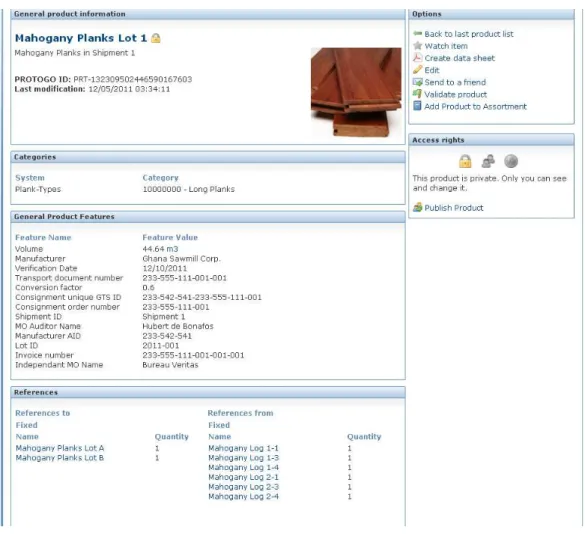
highly complex supply chains (Figure 2).
Legislative approaches
US Lacey Act
The US extended the Lacey Act in May 2008 to
ban commerce from illegally sourced plants and
their products, including all timber and wood
products. Illegally sourced is defined by the content
of sovereign nations’ own laws and applies equally
to imports and to timber produced in any of the 50
states in the US. The Lacey Act requires importers
to provide a basic declaration to accompany every
shipment of timber and timber products. The
declaration must contain:
• The scientific name of any species used;
• The country of harvest;
• The quantity and measure; and
• The value of the shipment.
All timber and timber products and, since April
2010, all paper and furniture products are subject to
the declaration of these requirements. Penalties vary
depending on whether the operator ‘knowingly’ or
‘unknowingly’ engages in trading of illegal timber
and timber products. Consequently it will become
increasingly important for importers to demonstrate
that they required and received adequate evidence
of legality.
EU Timber Regulation
The EU Timber Regulation (EUTR) makes it
illegal to place illegally harvested timber and timber
products on the EU market, the requirements come
into force as of 3
rdMarch 2013. The regulation
requires ‘operators’ who first place timber on the
EU to put in place due diligence systems in order to
mitigate the risk that the product does not contain
illegally harvested timber. The components of the
due diligence system must include:
• Information on the description of the type of
product and species of the wood used, country
of harvest and where applicable sub-national
region and concession of harvest, unit quantity
by weight or volume, contact details of supplier,
contact details of the purchaser of the material,
any other documentation indicating the legality
of the timber;
• Risk assessment measures to interpret the
information collected about the product against
relevant risk criteria such as assurance of
compliance with applicable legislation,
prevalence of illegal logging of tree species, or
country of harvest, UN and EC sanctions and
complexity of the supply chain; and
• Risk mitigation procedures that must be put in
place to tackle risk identified from the risk
assessment.
Figure 2: Timber tracking software showing the origin of timber
For traders who buy and sell timber and timber
products already placed on the EU market the
regulation requires them to maintain a 5 year record
of transactions of timber and timber products
that detail the operator or trader who supplied the
timber and timber products and where applicable
the trader to whom the timber and timber products
were sold.
To facilitate the adoption of the regulation,
Monitoring Organizations will provide operators
with ready-made due diligence systems, and act
as a mechanism for evaluating their performance.
Monitoring Organizations had to be formally
recognized by the European Commission by March
2012.
Each Member State will designate a Competent
Authority who will act as the leading authority
on the regulation and will be responsible for
monitoring its implementation and its enforcement.
FLEGT-licences or CITES export permits
(Figure 3) automatically meet the requirements of
the legislation.
EU Forest Law Enforcement Governance and
Trade Voluntary Partnership Agreements
(FLEGT VPA)
Voluntary Partnership Agreements (VPAs) form a
key component of the EU FLEGT Action Plan and
are bilateral agreements with the EU and producer
country partners. VPAs aim to guarantee that wood
exported from partner countries to the EU is legal
in origin. This is achieved by developing robust
legal frameworks which are enforceable and that
reflect the social, economic and environmental
objectives of the partner country. A fundamental
component of the agreement is a Legality Assurance
System (LAS) with the function to identify,
monitor and license legally-produced timber,
ensuring that only timber of legal origin is exported
to the EU market. Mechanisms of controlling the
supply chain and its verification are core to the LAS
where timber tracking systems can demonstrate
the legality of timber at each stage and mitigate
the risk of unverified timber entering the supply
chain. Currently 6 countries are developing systems
agreed under the VPA, with 4 countries negotiating
with the EU and 15 countries from Africa, Asia
and Central and South America are expressing an
interest in the process.
Purchasing policies
Public procurement policies
Public procurement accounts for between 15
and 25% of all timber products purchased in
most EU Member States. Several Member States
have developed public procurement policies for
timber and timber products: Belgium, Denmark,
France, Germany, the Netherlands and the UK
with other European countries in the process of
developing a policy. These public procurement
policies are mandatory for most central government
departments and agencies, while local governments
and authorities are encouraged to follow them.
Outside of the EU, the Norwegian Government has
prohibited the import and use of tropical timber
by the Government and in Switzerland there is a
mandatory declaration requirement to give full
transparency in the trading of timber and timber
products. Japan, Australia and New Zealand also
Figure 3: CITES permits provide proof of timber
identification
have public procurement policies. The minimum
requirement for all current procurement policies is
for the timber to be proven legal in origin, although
some encourage or require proof that the timber is
derived from sustainable sources.
Private sector policies or Responsible Purchasing
Policies (RPPs)
Many private sector companies and timber trade
associations have also developed purchasing
policies. In some consumer countries such
as the UK, companies and the Timber Trade
Federation (UK TTF) have worked closely with the
Government to ensure a degree of consistency and
alignment in the requirements of policies. Many
large retailers such as B&Q, IKEA, Walmart, Home
Depot, Castorama, Carrefour, and traders such as
Danzer and DLH have developed company level
purchasing policies, with ‘legally verified’ frequently
used as the minimum contract requirement. This
is often the beginnings of a ‘stepwise approach’ to
gradually eliminate unwanted timber and increase
the proportion of certified timber.
NGO pressure
Directly, environmental NGOs such as WWF in
the early 2000s started to explore timber tracking
systems as a tool to combat illegal logging, where
the technology could provide a solution to some
of the many problems inherent to operations in
forests of poor governance and communication
infrastructure. The trialling of this technology,
largely with the financial support of international
donors, demonstrated its viability as a management
tool, where continued improvements in technology
such as the availability of handheld GPS devices
improved operations in the field, such as linking
spatial data with that of the quantity and
characteristics of timber being harvested. Indirectly,
the campaigning and scrutiny conducted by some
NGOs provides continual pressure on companies
and governments to exhibit accountability and
transparency in business throughout timber supply
chains at the risk of their reputations and image.
Scope and scale of timber tracking
systems
Timber tracking systems vary in their scopes and
scales. They can be implemented on a company
level only being pushed into the upstream supply
chain. The company can either choose an existing
system from a timber tracking service provider
(Table 1) or self-develop its own company system
(Box 1). A timber tracking system can also be
implemented by a service provider on a national
level (e.g. Africa case study, page 21) or can be
self-designed and operated by country authorities
(Box 2). A mix between the two where both agree
what the government authorities cover and what the
service provider covers is also possible. Any system
has to comply with the existing national laws and
regulations. A government can adopt new laws
and regulations or adapt the existing ones before
implementing a timber tracking system. Systems
also vary in the intensity the products are being
followed ranging from physical tracking systems
where each item is being traced, to systems where
only sample checks in the case of doubt are taking
place. These are the so called ‘additional verification
methods’ which can be combined with physical
tracking systems to make them even more secure.
Overview of current technologies
The role of technology involved in timber tracking
systems is to provide a means of modelling and
recording the physical flows of timber and timber
products throughout the supply chain. These have
developed to cater for a range of different niche
functions whilst serving specific client needs.
Current timber tracking technologies vary in
complexity, being governed by funding, project
objectives and the technology that is available.
For example, a tracking system might be a simple
database recording paint markings and represented
in an Excel spread sheet, or custom built software
simulating complex international flows of timber,
based on electronic or DNA sampling. In either
case, a key function of tracking systems is to link
the physical timber or timber products to the
database model. In many situations documentation
accompanying timber and timber products alone
does not satisfy market requirements; there is a need
to directly trace the movement of material through
the supply chain and this is largely achieved by
product identification mechanisms.
Overview of types of systems
Mass balance
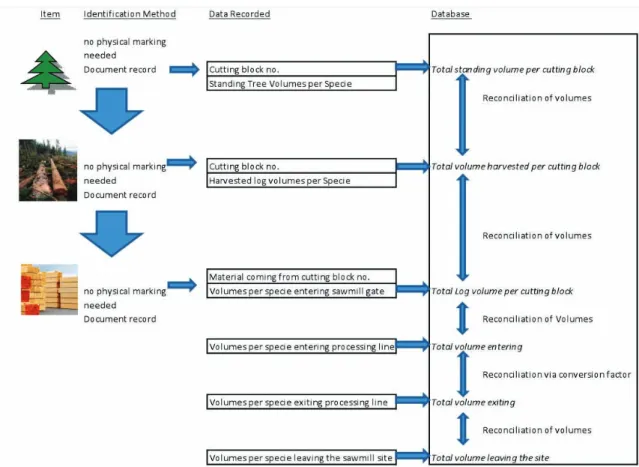
The mass balance (also known as inventory
management methods) is one method employed
to monitor the flows of timber throughout
production, based on a systematic understanding
of inputs, outputs and accumulations of timber
material without physical tracking (Figure 4).
Mass balance analysis monitors whole batches of
timber rather than tracking individual products.
The advantage of the mass balance method is that
small sized products can be tracked (e.g. wood
chips) and because of the batch basis this is usually
at lower tracking cost. Although mass balance is the
most commonly practiced method for monitoring
the movement of timber and timber products,
where tracking the individual product or lot back
to its physical origin is required mass balance
systems are inappropriate, particularly where there
is a possibility that high risk material could be
inadvertently included.
Physical product identification methods
Physical tracking is usually carried out with larger
sized timber items such as roundwood and usually
ends at the first processing facility; from this point
the mass-balance method is typically applied. Physical
tracking has the advantage that individual items can
be linked with attributes and can be sold individually.
The disadvantage is the higher running costs of such
a system since these methods are generally more labor
Box 1: Example of two self-developed company systems
Metsä Group
Whether the wood originates from certified or non-certified forests, the origin is always known at Metsä Group through certified Chain-of-Custody systems and the ISO 14001 environmental system. Metsä Group’s internal auditing procedures and wood origin tracing system are implemented for all wood suppliers and harvesting contractors. It is adapted to the needs of the different operating environments: Most of the wood used in Metsä Group originates from Finland and from privately owned, mostly PEFC certified forests, harvested by entrepreneurs working for Metsä Group. In Finland, wood origin can be traced by GIS by the harvesters and mobile devices of Metsä Group forest specialists responsible for the harvesting operation or controlling the logging.
In Russia, Metsä Group purchases wood from its own forest lease areas, certified against both PEFC and FSC, and from external wood suppliers. In the case of external suppliers, Metsä Group includes requirements concerning the origin of wood in the contract. The contract clause excludes certain forest origins, i.e. where environmental values are being damaged. The contract obliges the wood supplier to provide wood origin information to Metsä Group.
Based on the wood supplier lists and wood origin information, an annual supplier audit plan covering the whole supply chain from the logging company to Metsä is established for all wood supplier companies. The audits are undertaken by Metsä Group’s experienced auditors, who have access to the GIS system. They can verify that the logging sites are outside protected areas, where logging is prohibited. Results of the audits are used in the evaluation of wood suppliers and are the basis for further negotiations.
The wood origin tracing system allows Metsä Group to identify the legal and sustainable origin of the wood and officially define the share of certified wood in the wood raw material used in the Group’s production units.
IKEA
IKEA has developed its own forestry standard that all suppliers using wood in IKEA production are required to fulfil. The standard covers both solid wood and wood based-panels, and applies to the wood material as well as supplier’s procurement routines.
Minimum requirements are to avoid wood material which originates from forests: where the timber has been illegally harvested; with forest related social conflicts; are uncertified and recognized as Intact Natural Forests (INF) or other geographically identified High Conservation Value Forests (HCVF); in tropical and sub-tropical regions being converted to plantations or non-forest use; which are officially recognized and geographically identified commercial Genetically Modified (GM) tree plantations.
“Preferred” wood requirements are voluntary and comparable to FSC.
IKEA suppliers are required to transfer IKEA demands up their supply chains, maintain an incoming wood register that includes documented wood origin data, analyze risks in accordance with IKEA guidelines, make verification of wood compliance if risks are high, and separate noncompliant wood from IKEA production.
For each new business relationship, wood origin information is requested and evaluated by one of the 15 IKEA forestry specialists. Every supplier signs a legally binding compliance commitment.
Every ongoing supplier provides data about sub-suppliers, materials, species, country/region of origin, and volumes used in the IKEA Forest Tracing Survey three times a year. Suppliers sourcing from high risk areas are included in the auditing plan. IKEA audits do not only cover the 1st tier suppliers but follow a selected supply chain all the way to the logging site. Where non-compliant wood is discovered, deliveries are stopped and termination of business with IKEA may be the consequence. At least one audit a year in each of the 15 Trading Areas is performed by a 3rd party. Suppliers sourcing from low risk areas are audited by IKEA every 2 years. These audits are only done at supplier premises and involve incoming wood register checks. The overall costs which arise are being estimated by IKEA for the region of the Russian Federation of €0.06 - €0.10 per cubic meter of wood.
intensive. Where physical tracking is achieved by
marking all timber items individually, the following
marking methods are available:
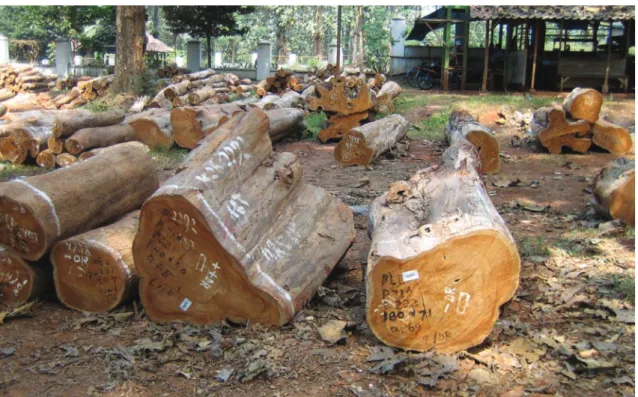
Paint markings
Paint markings are the mostly commonly used
identification technique because of its low cost,
easy application and durability. This typically uses
a serial number hand painted or stamped onto
individual logs and timbers. However, the practice
is labor-intensive and prone to misreading and
forgery. These systems are increasingly being used in
collaboration with electronic systems.
Plastic tags
Plastic tags are cheap and easy to apply to timber
and have advantages compared to paint markings.
Each plastic tag is printed with its own unique
identification number which increases legibility
and avoids duplication in issuance of identification
numbers (Figure 5). Despite the unique
identification numbers, plastic tags are still prone
to forgery and lack the durability of paint markings
where they can become damaged or detach from
the timber.
Barcoding
Barcodes are fixed to the timber or timber products
and provide a scannable identification number
where the readings can be readily transferred
electronically to the timber tracking database
(Figure 6). The system requires trained staff to
operate the readers and often connection to the
internet or mobile phone networks. They offer a
relatively low cost mechanism which is difficult
to forge however the barcodes themselves often
become detached from the product that they are
meant to identify.
Radio Frequency Identification (RFID)
Similar to barcoding, RFID systems offer a way
of providing uniquely referenced timber products
where the ID number and other product data is
wirelessly transmitted between the tag and the
RFID reader. The mechanism is resistant to forgery.
However it is relatively expensive and requires
trained staff and often connection to the internet or
mobile phone networks.
Chemical identification methods
DNA sampling
DNA sampling, unlike other product identification
methods, does not require direct physical tagging
of the timber product, but uses the genetic
information contained within the timber as the
method of identification. This makes the technique
very resistant to forgery and is not affected by
the inherent problems associated with tagging.
DNA samples can be taken at any stage in the
supply chain. There are two approaches to using
DNA. Firstly, the DNA sample is compared
with genographic maps in order to establish the
material’s area of origin. This approach is relatively
expensive and data intensive, requiring a reference
database to be established for all species of interest.
The second approach is to take wood samples from
the same tree and its timber at various control
points in the supply chain. These samples are
physically paired and tested to verify that they come
from the same tree. This approach can help to verify
and strengthen a paper-based or electronic tracking
Box 2: Timber tracking system operated by a government agency
Since 2011 permit holders of wood processing plants in the Philippines have been required to install a close circuit television (CCTV) camera system at their factory gate which is then broadcasting the images over the internet to the Department of Environment and Natural Resources (DENR).
In addition, all wood processing plants can only process logs or timber covered by a valid Certificate of Timber Origin (CTO) and a confirmation order to proceed with the transport. The wood processing plant holder records the entry of timber or logs and keeps the CTO. Shipments of round timber or logs or lumber must always be accompanied by a valid Certificate of Lumber Origin (CLO) or CTO. All CTOs and CLOs must be accompanied with a supporting document called tally sheet detailing the quantity, volume, species being transported and the Official Receipt (OR) for payment of forest charges for naturally grown trees or trees harvested in natural forests. Finally, all wood processing plants must submit monthly reports of logs or timber delivered into the processing plant as well as the lumber disposition to the nearest DENR Field Office. The monthly reports include clear photocopies of CTOs and CLOs and a summary of timber and lumber stocks in the wood processing plant yard duly signed and attested by the wood processing plant, the authorized officer and the DENR Field forest officer. This enables DENR Field Offices to closely monitor the entry and disposition of legal timber into and out of all the wood processing plants.
The export of finished wood or semi-finished wood products requires an Export Compliance Certificate that the exporter needs to obtain from the DENR Community Environmental and Natural Resources Office responsible for the port of export.
system and has the advantage of not requiring a
genetic database to be developed.
Isotopic sampling
Just like DNA sampling, isotopic sampling does
not require physical marking of timber products.
Isotopes found in the soil are analysed to identify
an isotope profile for a geographic area. Samples
taken from timber products can then be traced
to the location by analysing the isotope profile.
The tracking or additional verification method
has to fit the purpose. If tracking of Non Timber
Forest Products is required, one of the easiest
methods to use is the isotopic method. Isotopes
originate from the soil and are specific to a certain
region. Plants take isotopes from the soil and store
them in all plant material, e.g. leafs, oil, bark.
Identifying isotopes in plant material is therefore
an effective way of identifying the region of origin.
The precondition for using the isotopic method
is that the isotopes of the respective region are
already known, defined and registered. The isotopic
method is already in use in the agricultural sector,
when for example supplier A contests that a certain
Figure 4: Illustrated concept of a mass balance system
Figure 5: Plastic tag applied to the face of a log
Source: F. Seidel
Figure 6: Examples of paint marking and barcoding
product such as potatoes is from a certain field on
their farm, but the final product is labelled in store
as being from Supplier B’s farm supplier B’s name.
The isotopic method could then be used to act as
a proof of origin. For animals that feed on plants,
certain parts of the animal body e.g. ivory from
elephants can also be used to identify where the
animal lived using the isotopic method
1.
Due to the
wide range of applications for plants, animals and
parts of them, the method could be used for many
CITES listed species.
Description of a generic typical
timber and timber products
electronic tracking system
At each control point in the supply chain the product
information (such as length, species, value etc.) will
get recorded and transferred to the database. A staff
member enters all details either into a handheld
device or records it on paper and, later, enters it into
the database via a web browser into a web based
timber tracking software. Once the data is stored
on the database, it can be analysed. The analysis of
the data detects any non-conformities, verifying that
1 TRAFFIC, 2010 . Development of a spatial reference library for ivory. TRAFFIC Bulletin Vol. 23 No. 1.
the timber items and /or the volume flow is logical
and ensures that the volume does not increase at any
time. This safeguards that no timber can enter the
chain at a later stage where the source is unknown.
The main steps are shown in Table 2.
Table 2: Core elements of an electronic timber and
timber products tracking system
Steps Description
1. Data collection The product information is collected at each stage of the supply chain. 2. Data transfer The data is transferred into the
database.
3. Data storage Data storage in database in order to generate reports and reconcile the data. 4. Data Analysis Non conformities are detected through
reconciliation of the data.
Note that genetic and isotopic systems function in a different way than to the above systems described in Table 2.