Business Model Framework:
Private Sector Facility
GCF/B.04/07
12 June 2013
Meeting of the Board
26-28 June 2013
Songdo, Republic of Korea Agenda item 4 (e)
Recommended action by the Board
It is recommended that the Board:
a) Takes note of the information presented in document GCF/B.04/07 Business Model
Framework: Private Sector Facility;
b) Provides guidance on the policy matters and options regarding the Private Sector Facility of the Fund; and
Table of contents
I. Introduction 1
II. Global setting: Energy and climate finance and private sector participation 2
III. Barriers to private sector investment 3
IV. Role of the Private Sector Facility: Objectives, results and
performance indicators 4
4.1 Private Sector Facility objectives 4
4.2 Private Sector Facility result areas 5
4.3 Private Sector Facility performance indicators 5
V. Financial instruments and modalities for Private Sector Facility financing 6 VI. Institutional arrangements for the Private Sector Facility 9 VII. Models for the delivery of Private Sector Facility resources 11
7.1 Working through intermediaries during the first phase 12
7.2 Adding direct financing over time 12
VIII. Early-start launch of the Private Sector Facility 13
8.1 Early-start institutional arrangements 13
8.2 Early-start financial instruments and modalities 13
Annex I: Draft decision of the Board 15
Business Model Framework: Private Sector Facility
I.
Introduction
1. At its March 2013 meeting in Berlin, Germany, the Board requested the Interim
Secretariat to undertake work on a number of documents on the Fund’s business model framework, with the assistance of consultants (decision B.01-13/06). One of the documents to be prepared for consideration at the June 2013 Board meeting was to address the Private Sector Facility (PSF) of the Fund, including:
“(i) An assessment and implications of various institutional models for the PSF; (ii) Objectives, results and performance indicators for the Fund’s private sector
engagement; and
(iii) An assessment and implications of models for the delivery of the PSF resources,
including direct, indirect or a combination, and the financial instruments that could be utilized.”
2. The purpose of this document is to present to the Board an assessment of options for the
design of the PSF that the Fund could adopt to attain its objectives. This document should be read in conjunction with the other five documents on the business model framework.1
3. The Governing Instrument for the Fund provides specific guidance on several key
private sector-related features of the Fund:
“Paragraph 41. The Fund will have a private sector facility that enables it to directly and indirectly finance private sector mitigation and adaptation activities at the national, regional and international levels.
Paragraph 42. The operation of the facility will be consistent with a country-driven approach.
Paragraph 43. The facility will promote the participation of private sector actors in developing countries, in particular local actors, including small and medium-sized enterprises and local financial intermediaries. The facility will also support activities to enable private sector involvement in SIDS and LDCs.
Paragraph 44. The Board will develop the necessary arrangements, including access modalities, to operationalize the facility.”
4. Decision B.01-13/06 “noted convergence that the Fund should also:
(i) Recognize that a country driven approach is a core principle to build the business
model of the Fund;
(ii) Commence as a fund that operates through accredited national, regional and
international intermediaries and implementing entities;
(iii) Focus initially on grants and concessional lending, and employ additional financial
instruments as necessary to effectively achieve the objectives of the Fund; and
(iv) Enhance transparency and accountability.”
5. Initial discussions on the Fund’s structure and organization by the Board have
highlighted three fundamental considerations. First, the Fund needs to be made operational
quickly. Second, it should have the flexibility to evolve over time as it grows in response to country-driven demand. Third, the Fund’s structure and organization should be cost-effective and therefore as simple as possible.
6. This guidance and principles from the Governing Instrument, as well as the
considerations put forward by the Board, have been reflected in the options for the design of the Fund’s PSF presented in this document.
II.
Global setting: Energy and climate finance and private
sector participation
7. The evolution of policies and markets for renewable and clean energy has been
remarkable over the past decade. Policies to support renewable energy are now in place in 120 countries, of which more than half are developing. This compares to 40 countries in 2004. Renewable power feed-in tariff (FiT) policies were in place in at least 65 countries and 27 states worldwide by early 2012. These and similar policies, combined with technology cost reductions, have driven markets in unprecedented ways. Bloomberg New Energy Finance (BNEF) estimates that US$ 280 billion in new investment went into clean energy companies and projects
worldwide in 2011. Of this, asset finance (mainly for utility-scale renewable power plants) accounted for US$ 165 billion (60%) of the total. The increase in solar investment is particularly striking. In 2011, the annual solar photovoltaic (PV) market was 30-fold greater than in 2004.
8. Nonetheless, global CO2 emissions increased by approximately three per cent per year
over the last decade. Coal met nearly half of the rise in global energy demand during this period, even though steam coal import prices among Organisation for Economic Co-operation and Development (OECD) member countries – a proxy for international coal prices – have risen sharply from just over US$ 40 per tonne (t) in 2004 to more than US$ 100/t in 2011.
9. Decarbonizing the world’s energy system, moving towards a resource-efficient economy
and providing energy access for all will require a massive increase in investment. A summary of recent studies presented at the July 2012 workshop on long-term climate finance organized by the United Nations Framework Convention on Climate Change (UNFCCC) secretariat included projections by the International Energy Agency (IEA) that there would be US$ 15.2 trillion of additional global mitigation costs (for both developed and developing countries) relating to a new policies scenario, growing from US$ 160 billion presently to US$ 1.1 trillion per year in 2035. Reports from the IEA indicate that annual global investments for power generation only, in a two degrees Celsius scenario, would involve an additional annual average of US$ 370 billion from 2010 to 2020, US$ 630 billion from 2020 to 2030, and US$ 760 billion from 2030 to 2050. Due to the limited availability of public funds, investments at such scale will require private sector funding.
10. Out of the US$ 280 billion of clean energy investment in 2011 cited by BNEF,
approximately 35 per cent was investment in developing countries. The vast majority of the investment in developing countries took place in just a few countries, notably China, India, Brazil, Mexico, South Africa and Turkey. In most of the less advanced economies, there is a lack of “deal flow” or bankable low-carbon projects, reflecting an overall poor investment climate resulting from an overall lack of adequate legal and regulatory systems, energy access,
institutional infrastructure and capital markets and institutions in many of these countries. Of the US$ 44.3 billion of clean energy investment deployed across borders in 2011, it is estimated that just 13 per cent (or US$ 5.8 billion) was sourced from public funds. The bulk of the
financing for renewable energy assets has come from the private sector, accounting on average for 90 per cent of cross-border investment since 2004.
III.
Barriers to private sector investment
11. Depending on their stage of development, private investment in developing countries
typically faces many broad economic challenges, including unattractive investment environments, under-developed and non-competitive markets for goods and services,
non-existent or insufficiently developed capital markets with limited private participation, and weak regulatory and legal regimes. However, these challenges are generic in nature and can only be addressed through broad economic reform and economic development.
12. Therefore, the Board could consider how the PSF can support private investment from
small and medium-sized enterprises and local financial intermediaries’ initiatives in mitigation and adaptation despite difficult local investment environments. PSF interventions that
successfully address specific barriers to private sector investments should be pursued in support of national strategies or plans.
13. Some of the specific barriers to private sector investment in mitigation and adaptation
in developing countries that the PSF can address are those that are responsive to financial and technical support and are highlighted below:
(a) Higher up-front costs: Most climate-related investments impose higher up-front costs.
This is true for projects that help abate carbon as well as projects that raise adaptive capacity. Even where an analysis of life-cycle costing shows that the costs are similar to, or less than, the costs associated with current alternatives over the life of a project, commercial interest is often dampened due to the longer pay-back periods and therefore the lower immediate return;
(b) Greater technological risks, especially under local conditions: Most climate-related
technologies have not penetrated local developing country markets. The technological risks in private investment can therefore be high;
(c) Limited relevant expertise/capacity among the actors involved in delivering
climate actions: A lack of capacityand expertise can be seen in every element of the value chain of investments designed to address climate change, and extends to relevant financing, regulatory and governance institutions;
(d) Nascent stage of climate-related technologies: The supply chain for most
climate-related technologies is in an emerging state and thus underdeveloped in most countries. The lack of scale and mature ecosystem of players along all relevant segments of the value chain of climate-related investments increases transaction costs and dents the confidence of potential private investors. This is aggravated by an absence of transparency as evidenced by the lack of strong regional aggregators along the value chain;
(e) Lack of awareness: Industry, especially micro, small and medium industries, and also
consumers and communities are often unaware of options for addressing climate change. This lack of awareness also extends to municipal and local bodies, financial and regulatory bodies and local governance institutions;
(f) Limited capital market instruments: Due to underdeveloped capital markets,
financial instruments that correctly price risk are either unavailable or unaffordable;
(g) Third party risks: Many local and foreign investors perceive foreign exchange
availability, regulatory uncertainty and the risk of default by local institutions (such as energy and water utilities) in honouring their obligations as major impediments to private investment in general and costlier climate investments in particular; and
(h) Absence of adequate local institutional capacity: In many developing countries, local
institutions that can lead the fight against climate change are either absent or, when present, lack the required technical and financial capacity to make a difference.
IV.
Role of the Private Sector Facility: Objectives, results and
performance indicators
4.1
Private Sector Facility objectives
14. As outlined in the Governing Instrument, the PSF will enable the Fund to “directly and
indirectly finance private sector mitigation and adaptation activities at the national, regional and international levels”.2 Consistent with country-driven approach, “the facility will promote
the participation of private sector actors in developing countries, in particular local actors, including small and medium-sized enterprises and local financial intermediaries. The facility will also support activities to enable private sector involvement in small island developing States (SIDS) and least developed countries (LDCs).”3
15. The overarching objective of the Fund is to bring about a “paradigm shift” towards
low-emission and climate-resilient development pathways. The objective(s) of the PSF will need to be consistent with this overarching objective. A range of design considerations towards this overreaching objective are set out in document GCF/B.04/03. These design considerations can also be applied when considering how to make the PSF operational.
16. In light of the barriers identified in Chapter III, the Board may also wish to consider
some of the following PSF-specific objectives, which are not mutually exclusive:
17. Option 1. Increasing the viability of investments. The PSF could deliver different
types of mechanisms that incentivize action and innovation by private sector actors. The PSF could buy down the incremental costs to improve the economics of specific activities by supporting or enabling intermediaries to offer a range of financial instruments that effectively improve the viability of investments, hence attracting private sector investment into such activities. For example, the PSF could seed local capital markets by standing behind and thereby enabling intermediaries to offer financial products, such as partial risk guarantees or
subordinated debt with first-loss provisions, that would improve the capital structure of projects, making them more attractive to private sector investors. Access to PSF support could be competitive and, where possible, clearly linked to performance, in order to ensure that the PSF does not over-subsidize activities and that the impact of PSF support can be quantified.
18. Option 2. Reducing investment risk. The PSF could under-write demonstration
projects or set up pilots to establish the efficacy of available technologies under local conditions. The PSF could also consider investing in the adaptation of an available technology to local conditions. Further, the PSF could significantly enhance the role of private insurance in
agriculture by standing behind un-assessed or ill-assessed risks and taking on limited first-loss liability, thereby enhancing access to insurance products by making them affordable. The PSF could also partly and selectively stand behind policy and regulatory uncertainty and the risk of default by local institutions to raise the level of private climate-related investments. In the energy sector, the PSF could also work with private insurance to provide products to insure power purchase agreements.
19. Option 3. Building capacity and readiness. The PSF could fund appropriate
building efforts, as required, under individual country-specific circumstances. Such capacity-building exercises would aim to provide the various stakeholders with the necessary tools to pursue climate-related opportunities. Furthermore, the PSF could support the expansion of institutions that lead efforts to address climate change.
20. Option 4. Supporting technology development. The PSF could fund strong regional
and sub-regional technological initiatives in relevant fields, and help build the required
2 Paragraph 41 of the Governing Instrument.
ecosystems to support the technological development of climate-related investment options in both mitigation and adaptation. The PSF could also support advance market commitments to encourage such technological development.
21. Option 5. Supporting information dissemination. Achieving a paradigm shift will
involve investing in the design and implementation of transformative and catalytic policy and regulatory frameworks. It will, however, also involve the business community’s better
understanding of their exposure to climate risks and how best to manage and mitigate such exposure. The PSF could fund a major information dissemination initiative targeted at industry, especially micro, small and medium industries, through both electronic and printed media. Such an initiative would provide a platform offering information on adaptation and mitigation
options relevant to local environments, disseminating details of successful initiatives, detailing best practices and providing necessary links to actors in every element of the value chain relevant to climate-related investments.
4.2
Private Sector Facility result areas
22. The result areas for the PSF could mirror the result areas for the Fund as a whole, which
are discussed in document GCF/B.04/03.
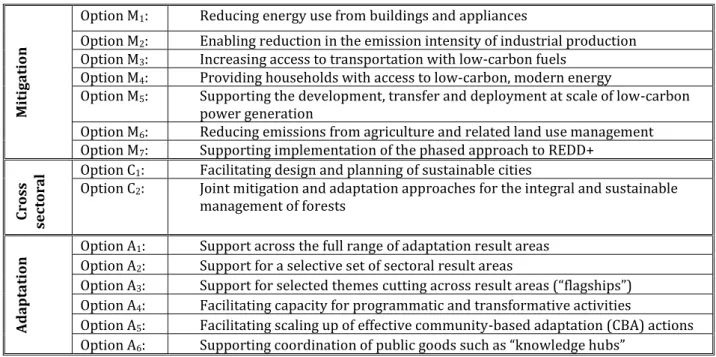
23. Table 1 lists the Fund’s priority result areas identified in document GCF/B.04/03. That
document goes further to discuss the pros and cons of using these priority results areas. Once the specific objectives of the PSF are defined, the Board may wish to consider PSF-specific result areas in light of those objectives. However, the priority result areas for the Fund as a whole, as listed below in Table 1, provide a basis for an initial discussion of result areas for the PSF.
Table 1: Overview of priority result areas for the Green Climate Fund
Mi
ti
ga
tio
n
Option M1: Reducing energy use from buildings and appliances
Option M2: Enabling reduction in the emission intensity of industrial production
Option M3: Increasing access to transportation with low-carbon fuels
Option M4: Providing households with access to low-carbon, modern energy
Option M5: Supporting the development, transfer and deployment at scale of low-carbon
power generation
Option M6: Reducing emissions from agriculture and related land use management
Option M7: Supporting implementation of the phased approach to REDD+
Cr
os
s
sect
or
al Option COption C12: : Facilitating design and planning of sustainable cities Joint mitigation and adaptation approaches for the integral and sustainable
management of forests Ad ap ta ti on
Option A1: Support across the full range of adaptation result areas
Option A2: Support for a selective set of sectoral result areas
Option A3: Support for selected themes cutting across result areas (“flagships”)
Option A4: Facilitating capacity for programmatic and transformative activities
Option A5: Facilitating scaling up of effective community-based adaptation (CBA) actions
Option A6: Supporting coordination of public goods such as “knowledge hubs”
4.3
Private Sector Facility performance indicators
24. Given the range of objectives and priority result areas for the Fund as a whole, there are
a wide range of performance indicators that the Fund could adopt. These performance
indicators, or a selection of them, could also be applied to the PSF. Importantly, the criteria and selection of performance indicators for the PSF must be seen as an iterative process, as relevant
indicators will depend on the result areas selected for the PSF and may need to be revisited as the PSF develops and its specific objectives are defined.
25. For example, if the PSF covers the incremental risks that the private sector is unwilling
to take in the Fund’s key result areas (see document GCF/B.04/03) by paying the required risk premiums, it will succeed in mobilizing additional private sector climate finance. However, not all risk premiums may be worth paying. It is therefore important that the PSF adopts
performance indicators and metrics that can ensure that the PSF is maximizing leverage and is cost-effective and effective in the use of scarce resources. The choice of which performance indicators should apply to the PSF is a key policy matter for the Board.
26. The Board faces a choice between a defined climate impact (for possible indicators,
refer to document GCF/B.04/03) and capital leverage performance metrics and broadly defined development impact metrics to measure and assess the performance of the PSF. Specifically, high-level categories and combinations of performance indicators that would benefit from further elaboration and consideration by the Board in future include:
(a) Dollars and carbon: Applying PSF resources to maximize the dollars of private capital
leveraged by the Fund’s resources in any class of activity or any country/region and reporting outcomes as dollars of new, predictable and additional private capital actually mobilized per dollar of PSF grant equivalent funding disbursed for mitigation and adaptation activities. In the case of mitigation investments, such a metric would also yield the imputed overall cost per tonne of CO2 equivalent mitigated by dividing the
grant equivalent dollars disbursed by the tonnes of CO2 equivalent actually mitigated;
(b) Weighting for development impacts: Using the same dollar leverage metrics as
above, including a weighted dollar equivalent of all development co-benefits resulting from the mitigation and adaptation investments made at the country or regional level for assessing performance in respect of new, predictable and additional sums mobilized. In assessing the imputed overall cost per tonne of CO2 equivalent abated, the Fund
would subtract the weighted dollar equivalent of all development co-benefits from the grant equivalent disbursed to arrive at the net cost per tonne of CO2 equivalent abated;
and
(c) Dollars, carbon and disclosure of development impacts: As per the dollars and
carbon performance indicator, along with a listing of all significant development co-benefits of each mitigation and adaptation investment made.
27. The advantages of measuring dollars and carbon would be that, for the most part, these
are readily quantifiable and not subject to controversies resulting from measuring dollar equivalents of co-benefits and giving weightings to different types of co-benefits. The challenge of weighting for development impacts would be the difficulty in quantifying all co-benefits and weighting them in a decision-making framework on PSF projects and programmes. Measuring dollars and carbon and disclosing development impacts would combine the measurement of easily quantifiable parameters with a listing of development co-benefits, which would help to inform choices that implicitly weight development co-benefits.
V.
Financial instruments and modalities for Private Sector Facility
financing
28. Examples of instruments and modalities that the PSF could use to catalyse and leverage
private capital for both mitigation and adaptation are provided below, along with a focus on the special cases of micro-finance and crowd-sourcing, and the use of the global carbon market to drive private capital and climate finance to the riskier business environments of poorer regions of developing countries and LDCs and SIDS. None of the instruments and modalities are
mutually exclusive. Instruments and modalities could be employed or phased in based on the identification of needs and priorities.
(a) Tariff support and guarantees for small scale renewables: There are many
examples of already identified but undeveloped small to medium scale renewable energy resources arising from resource assessments funded by multilateral
development banks (MDBs), United Nations (UN) agencies and bilateral aid agencies, as well as by agencies in developing countries. Common barriers include the affordability of the incremental tariff for a less carbon-intensive power supply and the
credit-worthiness of the utility that would contract the supply from the private sector under a long-term power purchase agreement. The PSF could fund the incremental tariff (which might be determined through a reverse auction involving pre-qualified bidders) and the insurance arm of a PSF partner institution, such as the Multilateral Investment
Guarantee Authority (MIGA) or the International Finance Corporation (IFC), could provide insurance to cover the counterpart credit risk for the balance of power purchase payments. Such insurance could be made affordable in riskier country environments by a first-loss provision from the PSF. The demand for such products is high. The leverage ratio that could be achieved by applying PSF resources in this way would similarly be high;
(b) Viability-gap support for low carbon power sector infrastructure: Where the costs
of carbon emissions abatement are low, the PSF could support the incremental cost of the interconnection of existing large and under-utilized hydropower resources, for example, in southern African countries, reducing the dependency on coal and oil and stabilizing low-cost power supply to the subregion. After pre-qualification of private sector developers on a build, own, operate and transfer model, the PSF financial
instrument partner(s) could run a competitive bidding process for the incremental grant capital necessary to ensure the project is financed and implemented;
(c) Country risk insurance for low carbon infrastructure in risky country business
environments: Parallel to the generic low carbon infrastructure described above is the opportunity to provide country risk insurance for private sector investment in business environments that are perceived to carry a high risk for the private sector but,
nevertheless, need private capital to develop low carbon energy and infrastructure. An important example illustrating the PSF’s potential is the recently approved Conflict-Affected and Fragile Economies Facility (CAFEF) of the World Bank’s MIGA. Focused on restoring and catalysing private sector investment in infrastructure to rejuvenate these economies, individual donors have provided US$ 80 million in first and second loss provision capital alongside MIGA’s US$ 20 million first-loss provision. This draws in both MIGA mainstream and re-insurance industry resources, multiplying the first-loss capital threefold to a total of US$ 400 million in coverage enabling an
estimated US$ 600-800 million of equity and debt financing through the private sector that would not otherwise flow to these economies. The PSF could provide similar first-loss funding for targeted lower-income, riskier business environments, leveraging private capital into low carbon energy infrastructure development with the quantum of first loss required for a given level of private sector coverage bid out; and
(d) PSF guarantees on carbon prices: Regardless of the fate of carbon credits as
compliance instruments in a post-2020 world, the Clean Development Mechanism (CDM) has created a credible and transparent framework for results-based (pay-for-performance) financing of low cost mitigation activities, in poor rural and urban communities in developing countries. Using reverse auctions to establish required floor prices, the PSF could provide price guarantees on certified emission reductions (CERs) from CDM projects that supply clean efficient cook stoves, high-efficiency lighting, solar photovoltaic supply and solar energy appliances, small-scale biomethanation projects and the like, driving private capital into
marketplaces and countries where the product and services are unaffordable and private capital is rarely deployed at scale. The PSF could retire the CERs to avoid double-counting by re-use of these CERs for compliance purposes.
29. As noted above, there are many opportunities to expand private sector capital into
managing the risks of climate change and underwriting the transformation of agriculture and land and water resource management into more climate-resilient practice and infrastructure. Some examples of adaptation financing that can be managed through competitive processes are as follows:
(a) Climate-related risk insurance: Increased climate variability is undermining food
security and investment in more climate-resilient production systems, such as no-till, residue retention and composting systems, with or without agroforestry elements. Farmers will experiment beyond their comfort zones of traditional practices to try new cropping systems and new crops better adapted to changing local climate regimes, if they have confidence that this will not come at great financial risk. In consultation with the international insurance industry, a PSF partner financial instrument(s) could bid out access to first-loss provisions on a scale that would enable the insurance industry to develop new products and make insurance affordable to more farmers to catalyse greater risk-taking and adoption of demonstrated higher-yield technical packages and practices. In parallel, the Fund could channel resources through partner development finance institutions to microfinance institutions and conservation agriculture non-governmental organizations (NGOs) to enable farmers to purchase inputs to shift practices to higher-yielding, more climate-resilient crops and farming practices;
(b) Fund/PSF guarantees on carbon prices for agriculture, forestry and other land use
projects that can be verified as increasing climate resilience: The argument here is the same as for the use of such competitively determined carbon price guarantees through the CDM for mitigation activities, but extends beyond the CDM to those high quality carbon standards, such as Voluntary Carbon Standard and American Carbon Registry Standard, that have developed an extensive range of guidance for each land use type supported by specific methodologies and protocols. PSF resources used in this way would be equally catalytic in leveraging private capital for climate resilient
conservation-farming systems, agroforestry and silvi-pastoralism, and community level forestry, as the CDM has been in providing energy access to the poor. In taking this path to draw private capital into individual projects, the PSF could screen and pre-approve projects presented by private developers in advance of reverse auctions for carbon floor prices. In these cases, emissions reductions purchased by the Fund could be cancelled;
(c) PSF leverage of micro-credit markets: Micro-finance institutions (MFIs) have the
capacity to provide credit to poor communities and at a scale of lending that is unaffordable to commercial banks and local development banks. With its mandate to provide support to LDCs and SIDS, the Fund and its PSF could pay special attention to the opportunity to provide liquidity, capacity building and risk management products through partner financial institutions supporting MFIs. Common constraints include capacity to deliver available funding, growing delinquency risk, and inability to afford marketing of climate friendly products. Working through MDBs, liquidity could be increased to MFIs for targeted technologies and activities, and requests for proposals could be launched for incremental funding to overcome capacity constraints, design and test market new products, or cover the incremental risk of expanding credit to already successful climate-friendly product lines. Whether by enhancing support from crowd-sourcing platforms for low cost debt, or by expanding credit and lowering risk to MFIs for mitigation and adaptation, underwriting the growth of MFIs, accredited by PSF partner financial intermediaries, could be a low-cost first step to deliver PSF resources quickly and efficiently to LDC and SIDS;
(d) Crowd-sourcing platforms: Crowd-sourcing online lending platforms are expanding in
size and number. They offer the opportunity for private individuals to lend to
entrepreneurs in developing countries, including via auctions that result in the lowest-cost financing of projects, from offers from tens to thousands of dollars. Such platforms can be supported on the project origination side by MFIs screening for projects that mitigate carbon or contribute to climate resilience. Through PSF partner financial institutions, the PSF could offer virtual stand-by lending pools for specific types of projects to ensure that more of them are financed or could use other tools to attract private investors in targeted asset classes and markets, such as offering principal protection products for online investors that would draw more of the available capital into climate-friendly micro-projects. Priority could be given to dialogue with crowd-sourcing platforms early in the PSF’s life to understand how to maximize leverage of this rapidly expanding source of private capital, while taking advantage of the branding opportunity for the Fund and its work through a high-profile presence on these online platforms; and
(e) Carbon as a PSF-funded output: Examples on how to use the CDM and other carbon
market infrastructure to leverage private capital into climate finance are provided above. The PSF could use carbon market regulation and infrastructure to quickly expand private investment in communities that rarely benefit from private investment, and especially foreign direct investment. A key advantage of putting a price on carbon credits through reverse auctions in priority activities in the poorest countries and communities is that the sole source of revenue that drives private investment is delivered off-shore in a foreign currency (US dollars or Euros typically), mitigating convertibility risk and most of the country risk. In addition, ten years of carbon asset development activity through the private sector under the CDM has led to a wide understanding of the opportunity in the private sector and substantial investment, though now dormant for the most part, in platforms and processes to source and monetize carbon assets under the CDM and other carbon standards. An important additional benefit is third-party verification of the results delivered using the metric of carbon emissions reductions and the proxy this presents for multiple co-benefits on the ground.
VI.
Institutional arrangements for the Private Sector Facility
30. In considering options for structuring the PSF, cost-effectiveness, transaction costs and
risks have been considered, as well as the implications in terms of costs and skillsets required. The following analysis reviews and compares other global funds and initiatives, both inside the realm of climate finance and outside. Particular focus was given to how the private sector has engaged in these funds and initiatives, where this was relevant to their mandate, and how that should inform the structure and function of the PSF. An overview of these other funds and initiatives is provided for reference in Annex II.
31. Under any of these arrangements, and in order to simplify the discussion of options, it is
assumed there are some universal requirements consistent with the structure of the Fund, according to its Governing Instrument and good practice.
32. Each option requires some consideration of the volume of resources to be provided to
the PSF and the relative distribution of these resources between countries or groups of
countries, such as LDCs and SIDS, and priority activities. Within any PSF structure, decisions will need to be taken to clarify how risks will be managed, for example, whether there will be a risk management advisory function, and if private sector representation would be standard in order to ensure best practice commensurate with finance industry standards.
33. Taking these common features into account, it seems useful to reflect on two broad
options, with the understanding that there are in fact many possible variants:
(a) Option 1. PSF as a business unit of the Fund, with its own governing body to which the Board delegates authority.
Under this structure:
(i) The PSF would have its own governing body, such as a Credit Committee,
comprising members of the Board and private sector representatives, to which the Board could delegate authority to approve PSF projects and programmes within particular bounds. Bounds set by the Board could include funding
approval guidelines and targets (for example, targets relating to SIDS and LDCs), as well as limits on the pool of funding to be allocated within a certain period of time. The Board would have to take a decision on the extent of the role of the private sector representatives on the governing body;
(ii) The PSF could employ a Chief Executive Officer (CEO) as part of the independent
Secretariat that would report directly to the Board; and
(iii) A separate PSF Accreditation Committee could accredit partner private
sector-facing financial intermediaries at the global, regional and national levels. This option would provide the Board with the freedom to decide on a separate policy matter: whether to outsource the establishment of the PSF. This, and where the PSF would be located, is considered further below.
Option 1 is proposed in the context of the PSF requiring particular governance and Secretariat expertise and, possibly, specific policies and procedures that differ from those of the rest of the Fund. In this context, it should not be seen as having implications for the structure and governance of the windows of the Fund.
(b) Option 2. PSF as a business unit that is fully integrated within the Fund’s governance and management structure.
Under this structure:
(i) Full responsibility for approving PSF projects and programmes could remain
with the Board;
(ii) The PSF CEO could report to the Fund Secretariat’s Executive Director; and (iii) Accreditation of PSF partner private sector-facing intermediaries could rest with
the Fund’s Accreditation Committee.
34. Under either option, the PSF would not have juridical personality separate from the
Fund. However, the institutional framework required in each option would be different. Under Option 1, the PSF would be endowed with some autonomy, while under Option 2, the PSF would be fully integrated within the organizational structure of the Fund.
35. The advantages of Option 1 appear to be as follows:
(a) Mechanisms for drawing on the skills and experience gained through successful
investment in the private sector, such as in private equity, project finance, private sector project development, energy trade, and private investment in emerging markets in particular, will be key to ensuring the success of the PSF. However, it may prove difficult to attract experienced professionals with this background unless the PSF can provide competitive compensation packages to bring the best people, experience and practice together;
(b) Drawing advice and active participation from senior management of relevant banks and
well-informed dialogue and that the PSF would have a mandate and authority to act on their advice;
(c) Option 1 reflects that the Board might agree, inter alia, on PSF-specific objectives, results
and financial instruments that differentiate the PSF from other parts of the Fund in terms of its character, qualities and ways of doing business; and
(d) A PSF with delegated decision-making and the engagement of the private sector would
lend credibility to the commitment to engage the private sector in the Fund. Experience from relevant climate finance funds and facilities demonstrates that lack of meaningful engagement by the private sector in facilities seeking to engage and support the private sector has been seen as a weakness (see Annex II).
36. The disadvantage of Option 1 and advantage of Option 2 is: The proposed structure of
Option 1 might create institutional silos within the Fund, which could restrict the exchange of learning and lead to a sub-optimal use of skilled staff across the Fund, including technical specialists in mitigation and adaptation and regional specialists, and also be a barrier to sharing the accumulated learning and opportunities for public-private partnerships key to the Fund’s success.
37. The importance of drawing on private sector engagement and expertise and the
different characteristics that the PSF is likely to have in comparison to the rest of the Fund suggests the Board may wish to consider putting into place Option 1. In that case, the Board would need to consider how best to determine the governance structure of the PSF under the overall authority of the Board. In order to address concerns about internal cross-fertilization, collaboration, and knowledge sharing, the Board could consider having the PSF CEO report to the Fund’s Executive Director.
38. If Option 1 is preferred, the Board may wish to consider whether to outsource the
establishment and/or on-going operation of the PSF to an existing qualified institution. The advantages of outsourcing this work would include:
(a) An operational PSF could be established much more quickly because the challenges of
establishing new administrative functions and processes would be lessened; and
(b) It might be easier to recruit suitably experienced staff for the Secretariat, and the pool of
skills in-house in the sponsoring institution could be an existing resource for the PSF.
39. The disadvantage of outsourcing would be a further lessening of the integration of the
PSF within the rest of the Fund. Learning and knowledge exchange between professionals in the PSF and other areas of the Fund would be made all the more challenging. Modern
communication technology could overcome this to a large extent, but special provisions would have to be made for face-to-face exchanges between managers and key staff of the PSF and the rest of the Fund.
VII.
Models for the delivery of Private Sector Facility resources
40. This Chapter addresses the distribution of resources by the PSF. In line with both the
Governing Instrument, which states that “[t]he Fund will have a private sector facility that enables it to directly and indirectly finance private sector mitigation and adaptation activities”, and the Board’s convergence at its March 2013 meeting that the Fund will “[c]ommence as a fund that operates through accredited national, regional and international intermediaries and implementing entities”, it is proposed that the Board decides that the PSF commences its operations through intermediaries and moves to a mix of direct and indirect financing over time.
7.1
Working through intermediaries during the first phase
41. Under this proposal, the PSF would initially be established as a specialized, agile
business unit, working entirely through accredited partner financial institutions. It could initially:
(a) Employ a small permanent core staff;
(b) Employ a number of other staff on short-term contracts from the capital markets and
private sector-facing development finance institutions; and
(c) Depending on the Board’s decision on the use of financial instruments by the PSF during
the first phase of the Fund, transfer the Fund’s resources to partner financial intermediaries as grants and concessional debt.
42. There is adequate capacity at almost all levels – global, regional, and local – in private
sector-facing development finance intermediaries to provide the necessary coverage to deliver the Fund’s resources to the private sector during the initial phase of the Fund.
43. Restricting the PSF to initially channelling grant and concessional resources to financial
intermediaries would greatly simplify its role in the short-term, enabling it to focus its initial staffing efforts on dialogue with developed country partners and accredited intermediaries.
44. By keeping the PSF small and its financial management task simple, the PSF could
become effective almost immediately in delivering resources through the earliest accredited intermediaries.
45. While the number of potential intermediaries might be relatively low in the early years
of the PSF, their number and diversity might expand over time as the resources available to the PSF increase, its geographic scope expands, and its product line diversifies. A possible starting array of intermediaries could include the following categories of institutions:
(a) Private sector arms of multilateral development banks (such as the IFC, MIGA and the
Multilateral Investment Fund (MIF) of the Inter-American Development Bank (IADB));
(b) Private sector-facing national development banks from developed countries (such as
DEG of Germany (a subsidiary of KfW), Proparco of France, the Overseas Private
Investment Corporation (OPIC) of the United States and the Japan Bank for International Cooperation (JBIC));
(c) Private sector-facing development finance intermediaries from developing countries
(such as the Infrastructure Development Finance Company of India, the Brazilian Development Bank (BNDES) and the Development Bank of Southern Africa (DBSA); and
(d) Private sector mobilization funds (such as OPIC and the Private Infrastructure
Development Group (PIDG), which commit and channel resources through specialized sub-funds).
46. In the few instances in which there are no established and eligible private sector-facing
intermediaries for the delivery of PSF resources, such as in certain LDCs and SIDS or recent post-conflict environments, the PSF could work through UN agencies.
7.2
Adding direct financing over time
47. Given that the intention under this proposal would be to evolve the PSF into a
full-service entity over time, some consideration would need to be given to the phasing-in of different capacities that would facilitate the evolution to a full-service facility. The size and complexity of the kind of institution necessary to deal with the private sector directly, without
intermediation by existing financial institutions, would be very different to that of a facilitating body that delivers resources only through financial intermediaries.
48. As a fully self-sufficient financial intermediary delivering resources directly through the
private sector as well as indirectly through accredited intermediaries, the PSF would in time:
(a) Build the fully-fledged capacity of an existing global private sector-facing development
finance institution, such as the IFC; and
(b) Use the Fund’s resources to support private sector mitigation and adaptation
investments via a range of financial instruments, as decided by the Board.
49. Moving to a full-service model over time would ensure that the PSF could deliver
benefits to all eligible countries, including LDCs and SIDS. It would also address any other gaps in delivery capacity that might arise under the first phase model due to the exposure limits, lending headroom restrictions or narrower range of innovative financing instruments of key partner financial intermediaries.
VIII.
Early-start launch of the Private Sector Facility
8.1
Early-start institutional arrangements
50. In considering alternatives for launching the PSF quickly and efficiently during the first
phase of the Fund, the Board may wish to consider drawing upon the capacity of an existing institution with broad competence and established credibility, such as the IFC. Amongst other support, the institution could, with an adequate resource endowment:
(a) Provide an initial core staff on secondment for the start-up phase and support the
recruitment process of key staff and managers in consultation with the Secretariat and Board;
(b) Provide advice on the accreditation process for PSF intermediaries;
(c) Provide advice on project eligibility and screening criteria and the form of early work
programmes to enable the Fund to begin the process of review and provision of initial funding to the first group of accredited PSF partner financial intermediaries; and
(d) Elaborate on the various alternative designs and procedures for competitive processes
to discover and fund the required risk premiums for private sector climate finance in the most likely activities and structures for PSF support at the country level.
8.2
Early-start financial instruments and modalities
51. There are a number of interventions that offer early wins to the Fund and PSF, as they
build on widely established practice, modified only to supply the resources and means to cover the incremental risk to the private sector that it has been unwilling to take in target markets. Documents GCF/B.04/05 and 06 identify how some of the practices described below may be consistent with the initial use of grants and concessional lending. The following illustrates the kinds of established practices that the Board may consider:
(a) PSF funding of the incremental feed-in tariffs of small to medium scale renewables using
reverse auctions to select the lowest incremental cost to tariffs that make non-fossil fuel-based power economically viable, and using insurance products with PSF first-loss support to cover the payment risk for counterparty utilities with poor credit ratings. This opportunity can be demonstrated in two or three low-income countries, including high priority LDCs or SIDS where renewable energy sources are well-defined but
investment has been stalled by credit risk and inability to afford the higher costs of renewable energy supply. Notably, the Scaling-Up Renewable Energy in Low-Income Countries Program (SPREP) of the CIFs expects to have prepared investment
programmes of this kind in selected countries by November 2013 (see Annex II);
(b) Providing PSF-guaranteed floor prices determined through reverse auctions for carbon
credits necessary to increase energy access in poorer smaller countries, such as for the supply of efficient cook-stoves, efficient lighting or solar photovoltaic power supply in rural areas for countries that have very limited market penetration of clean efficient energy use and supply technologies; and
(c) Funding a variant of the MIGA Conflict-Affected and Fragile Economies Facility (CAFEF)
to support low carbon energy infrastructure development, such as rehabilitation and/or connection of stranded low-carbon power assets, new low-carbon power sector
development, improved water resource management and climate-proofing.
52. With the Board’s approval of an initial set of focus areas and geographies for early
investment, such as those described above, the PSF could run a fast-track process leading to proposals from the first set of accredited financial intermediaries. Subsequently, the Fund could resort to a regular annual work programming modality for supporting partner financial
intermediaries of the PSF, while moving forward and learning from the fast-track, early-start experience.
Annex I: Draft decision of the Board
The Board, having reviewed document GCF/B.04/07 Business Model Framework: Private Sector Facility:
(a) Notes that the short-term vision of the Fund as set out in draft decision [x] (Annex I of
document GCF/B.04/03) also applies to the Fund’s Private Sector Facility;
(b) Notes that the result areas of the Fund as set out in draft decision [x] (Annex I of
document GCF/B.04/03) also apply to the Fund’s Private Sector Facility;
(c) Decides that the Private Sector Facility will play a role in addressing barriers to private
sector investment in adaptation and mitigation in developing countries, including:
(i) The higher up-front costs of climate-related investments; (ii) The greater technological risks of climate-related investments; (iii) The limited expertise and capacity amongst relevant actors; (iv) The nascent stage of climate-related technologies;
(v) The lack of awareness of options for addressing climate change; (vi) The limited availability or affordability of capital market instruments; (vii) Third party risks, including those relating to foreign exchange, regulatory
uncertainty and risk of default by local institutions; and
(viii) The limited capacity of relevant local institutions;
(d) Further decides that the Private Sector Facility will have the following specific objectives
to complement the Fund-wide short-term vision set out in draft decision [x] (Annex I of document GCF/B.04/03):
(i) Increasing the viability of private sector investments in adaptation and
mitigation, including by buying down incremental costs and otherwise improving the economics of investments;
(ii) Reducing adaptation and mitigation investment risks, including risks associated
with demonstration projects, pilots, the localization of technologies, insurance, policy and regulatory uncertainty and the risk of default by local institutions;
(iii) Building the capacity and readiness of relevant national, regional and
international actors;
(iv) Supporting technology development, including by funding initiatives, supporting
necessary systems and using advance market commitments; and
(v) Supporting information dissemination, particularly to the private sector; (e) Further decides that the Private Sector Facility will focus initially on grants and
concessional lending but, over time, will also draw on a broad range of innovative financial instruments and modalities to achieve its objectives;
(f) Further decides that for the institutional structure the Private Sector Facility will be
established as [Option X: description; Option Y: description], as described in Chapter IV of document GCF/B.04/07;
(g) Further decides that the Private Sector Facility will commence its operations through
accredited national, regional and international implementing entities and
Sector Facility can also directly finance private sector mitigation and adaptation activities at the national, regional and international levels; and
(h) Requests the Interim Secretariat to prepare for the Board’s consideration at its fifth
meeting, in September 2013, in line with the decisions and convergence reached and the views expressed by the Board and drawing on inputs from private sector stakeholders and civil society organizations, a document analysing and proposing:
(i) Results specific to the Private Sector Facility;
(ii) Performance indicators specific to the Private Sector Facility;
(iii) The terms and conditions of the grants and concessional lending to be employed
by the Private Sector Facility in its initial phase; and
(iv) A full range of financial instruments and modalities that could be effectively
Annex II:
Private sector engagement by selected multilateral funds
I.
Global Environment Facility (GEF)
“Review of GEF Engagement with the Private Sector” (GEF Evaluation
Office, May 2011)
1. Five conclusions were drawn:
(a) The GEF has engaged with a wide variety of for‐profit entities that vary in their industry
focus, size, and approach to environmental issues;
(b) GEF did not adopt a fixed strategy for private sector engagement, even within the same
focal area. Given the different circumstances of the countries and regions eligible for GEF support, this has been advantageous;
(c) Linkages exist between GEF’s enabling activities, especially the funding of
improvements by governments in legal, regulatory and policy frameworks, and private sector interest to participate in GEF interventions;
(d) Instances of private sector engagement do not match expected prevalence across Focal
Areas, all of which clearly identify a role for the private sector. Most private sector engagement has been in the Climate Change, Biodiversity and the Chemicals focal areas;
(e) GEF’s efforts to engage with the private sector were hampered by the introduction of the
Resource Allocation Framework (RAF). The new system led to a more active involvement of government agencies and as a result a lower engagement with the private sector; and
(f) GEF’s first investment fund and single biggest initiative dedicated to the needs of the
private sector, “The Public‐Private Partnership Initiative” (PPPI), later renamed the “GEF Earth Fund” (EF), received final approval as a pilot initiative from the GEF Council in 2008 with a separate trust fund and an advisory Board (with four members, of which three were from the private sector and with the GEF CEO as Chairperson). GEF
Evaluation Office (EO) review of GEF’s approachto the establishment of the Earth Fund was conducted in October 2010. The “Review of the Global Environment Facility Earth Fund” noted successful engagements, however, overall, it suggested a need for greater interaction between GEF and the private sector for both co‐financing and governance of the EF. The fact that the EF’s Board did not have decision-making authority was
criticized in the 2010 GEF EO review. The PPPI model was continued and moderately expanded for the current GEF-5 phase, however it is now designated as a “programmatic approach” and without the advisory Board which was disbanded. At the November 2010 GEF Council meeting, not all donor participants were willing to agree to the (former) GEF CEO’s proposal to create a decision-making EF Board with private sector voting participation, and the GEF CEO indicated her unwillingness to continue the initiative with an advisory Board only.
II.
Climate Investment Funds (CIFs)
2. The CIFs are relatively new (having commenced in 2008) and the first independent
evaluation of their operations is currently being prepared. Information relating to specific CIF funds and programmes is provided below based on documents accessible on the CIFs website and feedback from staff at the CIFs Administrative Unit.
2.1
Clean Technology Fund (CTF)
3. The CTF was designed to address two key issues facing greater private participation in
climate-related activities: the gap between perceived and real risks in the assessment of lenders and investors, and the high costs associated with being one of the first movers in a new market or technology (CTF/TFC.11/11). As at April 2013, the CIF Trust Fund Committee has endorsed 16 investment plans. Within these plans, the CTF has approved US$ 730 million specifically for private sector programmes in 10 countries which will be channelled through the private sector arms of MDBs. This sum represents around a third of all CTF approvals. It was noted in a document prepared for the May 2013 Trust Fund Committee (TFC) meeting that the CTF business model is based on country investment plans which work well for the public sector, but may be too restrictive for private sector financing. Accordingly, a proposal for a “Global Private Sector Programme” was put forward for TFC decision. The TFC requested that further work be undertaken on the proposal, including elaboration of a programme utilizing up to US$ 150 million of current CTF resources for private sector activities in existing pilot countries. The Committee also agreed to consider proposals for other programmes that could be applied at a regional or global scale should new contributions become available. The CIF Lessons Learned document of November 2011 highlighted 10 lessons from the early experience of the CIFs. In addition to the factors noted above, the document identifies opportunities for increasing engagement with the private sector.
2.2
Pilot Program for Climate Resilience (PPCR)
4. For private sector interventions, identifying adaptation projects has proven to be a
challenge given the novelty of the topic, difficulties in identifying appropriate counterparts and unfavourable investment climates (PPCR/SC.12/3, PPCR Semi-Annual Operational Report). The private sector is perceived as crucial for national development goals; it offers innovative, break-through instruments and strategies; and needs to change its business model to address impacts of climate variability and change. In November 2012, the PPCR Sub-Committee approved a “Competitive Private Sector Set Aside”, and agreed to set aside about US$ 70 million in
near-zero interest credits, which will be allocated to programmes and projects in pilot countries through a competitive process. Private sector clients working through MDB private sector arms are the principle target of the set asides. Public sector entities working through the MDB public sector arms are eligible, provided that the projects are focused on the removal of barriers for the private sector to engage in adaptation activities. Proposals for utilizing these funds will be reviewed and selected on a competitive basis by the PPCR Sub-Committee, taking into account the recommendations of an expert group. The first round of funding will be agreed in November 2013.
2.3
Forest Investment Program (FIP)
5. Given that the FIP was operationalized only in 2010, results so far are limited with
regard to private sector engagement. As at March 2013, two project proposals aimed at channelling FIP financing to the private sector were submitted to, and approved by, the FIP Sub-Committee. In order to further incentivize private sector participation, a competitive set-aside (FIP Private Sector Set-Aside) was approved for over US$ 50 million in concessional funding to contribute to the financing of innovative programmes and projects in pilot countries that engage the private sector in reducing emissions from deforestation and forest degradation and promote sustainable forest management. Proposals for utilizing these funds will be
reviewed and selected on a competitive basis by the FIP Sub-Committee, taking into account the recommendations of an expert group. The first round of funding will be agreed in November 2013.
2.4
Scaling Up Renewable Energy Program in Low-Income Countries
(SREP)
6. SREP financing supports technologies such as solar, wind, bio-energy, geothermal, and
small hydro technologies. It stimulates economic growth by working with governments to build renewable energy markets, engage the private sector and explore productive energy use.
7. Under the SREP, US$ 90 million in concessional funds have been set aside to contribute
to financing for innovative programmes and projects in six pilot countries that engage the private sector in piloting and demonstrating the economic, social and environmental viability of low carbon development pathways in the energy sector by creating new economic
opportunities and increasing energy access through the use of renewable energy. Proposals for utilizing these funds will be reviewed and selected on a competitive basis by the SREP
Sub-Committee, taking into account recommendations of an expert group. The Sub-Committee will agree to the first round of selection of concepts for further development in November 2013. Private sector engagement can include solely private sector projects, public-private
partnerships and public sector projects financing private sector entities. Projects must be innovative in terms of technology, business model, financial instruments or structure, and the innovation must add value to the project.
III.
Adaptation Fund
8. The Adaptation Fund and the UN Foundation have established a partnership that will
for the first time allow the Adaptation Fund to accept donations from the private sector and individuals. The announcement was made at the eighteenth session of the Conference of the Parties to the UNFCCC in Doha, Qatar. Traditionally, the Adaptation Fund has been financed through sales of CERs, and through donations from governments, but has had no mechanism for accepting donations from the public at large or the private sector. The downward trend in the prices of CERs, which are the Adaptation Fund’s primary funding source, has severely limited the ability of the adaptation Fund to continue its work and led the Adaptation Fund Board to set a fundraising target of US$ 100 million with the goal of raising the money by the end of 2013. The Board has bolstered that initiative by enabling the involvement of anyone who would like to donate, from schoolchildren to private corporations.
IV.
Multilateral Fund for the Montreal Protocol
9. Since its inception, the Multilateral Fund has approved activities including industrial
conversion, technical assistance, training and capacity building worth over US$ 2.7 billion. The successful meeting of phase-out targets has meant that since the adoption of the treaty, there has been an aggregate fall in consumption and production of ozone depleting substances (ODS) by about 98 per cent from baseline levels. Substantial investments have been made by both domestic companies and multinational corporations in ODS-consuming industries in developing alternative technologies and in other ODS phase-out activities. This is particularly the case in developed countries, while in Article 5 countries, the scope for private sector investment has been smaller, although Multilateral Fund and GEF-funded projects have stimulated co-financing in some cases. For example, Multilateral Fund- financed refrigerator conversion projects in Mexico, Thailand and Turkey were co-funded through use of a revolving fund with contributions typically amounting to about 40 per cent of total project costs.
V.
GAVI Alliance
10. The GAVI Alliance is a public-private global health partnership committed to saving
children’s lives and protecting people’s health by increasing access to immunization in poor countries. The Alliance brings together developing country and donor governments, the World Health Organization, United Nations Children Fund (UNICEF), the World Bank, the vaccine industry in both industrialized and developing countries, research and technical agencies, civil society, the Bill and Melinda Gates Foundation and other private philanthropists.
5.1
International Finance Facility for Immunization (IFFIm)
11. One of the key initiatives launched by GAVI Alliance is the International Finance
Facility for Immunization (IFFIm), which uses long- term donor pledges to issue vaccine bonds on the capital markets. The IFFIm front-loads financing needed for immunization programmes in the poorest countries. Using legally binding, long term, donor commitments to issue bonds, IFFIm makes more money available now for vaccine purchase and delivery. IFFIm was able to front-load US$ 1 billion of future donor commitments in the first year of operations, which would have taken nearly seven years to raise otherwise. It followed that success with an
additional US$ 2.4 billion in the next four years that would not have been available for a further decade. The early investment of this US$ 3.4 billion into vaccinating children will have a
tremendous leveraging effect for the recipient countries. The benefit of frontloading funds to vaccinate children is felt (leveraged) well beyond the initial reduction in child mortality.
5.2
Pneumococcal Advance Market Commitment (AMC)
12. Pneumococcal vaccines are new, complex vaccines that would normally reach
low-income countries 10-15 years after their introduction in industrialized countries. The AMC is a “pull” mechanism designed to incentivize private sector pharmaceutical companies to produce and sell vaccines for markets in which they would otherwise not enter, by guaranteeing a minimum level of demand and a stable product price for a set period of time. Drawdowns under long-term, legally-binding donor commitments are structured to accommodate the disbursement schedule of the AMC. The AMC is an example of pooling to bring together the resources of traditional donor countries with an emerging donor country (Russian Federation) and the Bill and Melinda Gates Foundation to achieve a coordinated project and objective of meaningful scale. From a non-existent market to a current contracted market of 60 million doses of per year (and rising), the AMC has been successful in pooling US$ 1.5 billion of traditional donor funds to engage significant investment of private sector funds.
VI.
The Global Fund to Fight Aids, Tuberculosis and Malaria
(Global Fund)
13. Private businesses and foundations have played a fundamental role in the design and
development of the Global Fund, as well as a critical part in advocating for multi-stakeholder participation in all areas of the Global Fund architecture. Financial contributions are one element of support from private donors. The role of the private sector also includes governance at the global level and valuable resource contributions in addition to on-the-ground
engagements. Private sector organizations have proved effective members of the Global Fund Board, where they hold equal voting rights alongside civil society, donor and recipient
governments; and of Country Coordinating Mechanisms (CCMs), where they represent the needs of marginalized groups affected by the three diseases as well as improve the
contributes to Global Fund processes, through participation as Principle Recipients and
Sub-Recipients of the grants money. The private sector has often extended the services offered to their employees to neighbouring communities and beyond. While, in some cases, the private sector is an engaged partner and implementer, in most cases the private sector plays a minor role in many CCMs and the national disease response. The Global Fund has developed a strategy to enhance partnership with the private sector as an implementer of, and contributor to, good governance.