Modeling on Supply Chain Optimization with
Destruction and Disruption Risk Considering Finance
KyoungJong Park1, Gyouhyung Kyung2
1 Gwangju University, 277 Hyodeok-ro, Nam-gu, Gwangju, Republic of Korea
2
UNIST, UNIST-gil 50, Ulsan, Republic of Korea [email protected]
Abstract. To increase its validity, a supply chain model should take into account destruction and disruption risks. In addition to these risks, another factor to consider is the financial condition of a supply chain as it is also as important as product and information flows. The aim of the current study was to optimize a supply chain network while considering destruction and disruption risks as well as its financial condition. A proposed supply chain model in the current study was constructed by utilizing the Game Theory based agent model in order to simulate each tier’s dynamic decision making, as well as the Particle Swarm Optimization method in order to optimize the overall model by allowing for all three factors (i.e., destruction and disruption risks, and supply chain finance) simultaneously.
Keywords: Supply chain finance, Destruction, Disruption, Particle swarm optimization
1 Introduction
Previous studies on supply chain management (SCM) have mainly focused on the effects on the supply chain of information sharing [1], inventory policy [2], and/or demand prediction [3]. In other words, the mainly addressed research issues were all related to goods and information flows involved in the supply chain [4]. Actual supply chains, however, are more likely to face with destruction and disruption risks due to supply uncertainty and other external factors, which can adversely affect the performance of the organizations involved [5]. Supply chains of Ford and Toyota, for example, were severely influenced by the September 11 attacks [6].
For its construct validity, the supply chain model should take into account both product information and financial issues simultaneously. Although the financial flow of a supply chain is as important as other topics such as inventory policy, it has not been addressed sufficiently [4][7]. The current study, hence, aims to develop a financially optimized supply chain model that reflects both supply and demand uncertainty as well as destruction and disruption risks.
[5][8]. In addition, some other studies were about modeling a more efficient supply chain starting from a more upstream stage [9].
Disruption of the supply chain, on the other hand, has been studied from a resilience perspective as its inventory and manufacturing capacity can function as a buffer [10]. To the authors’ knowledge, however, few studies have considered both destruction and disruption risks of a supply chain, though these are more likely to take place in real-life situations, and in a more complex way (e.g., sequentially, simultaneously, or at multiple tiers).
The financial perspective of the supply chain has been mainly studied in terms of the effects of the finance sectors on the supply chain [4]. It is necessary to study financial issues of the supply chain rather at a macro level, in terms of optimization of supply chain finance (SCF).
3 Modeling and Optimization Process
3.1 Model Construction
The supply chain model considered in the current study consists of suppliers, manufacturers, distributors, and wholesalers. Each company in the supply chain was assumed to have their own financial company. For example, Manufacturer1 has a financial company called FC1, whereas Distributor1 and Wholesaler1 can have a common financial company called FC2.
A typical supply chain (e.g., suppliers-manufacturers-distributors-wholesalers) involves many different types of financial elements or cash flows such as inventory cost, stock-out cost, cash retention capability, accounts receivable, disbursement. These financial elements occurring at each tier are important as these can affect the overall supply chain.
In the current study, the supply chain model with destruction and disruption risks were constructed by treating each tier as an agent using a simulation model [11][12]. Disruption cycle and duration were determined by using both deterministic and stochastic distributions.
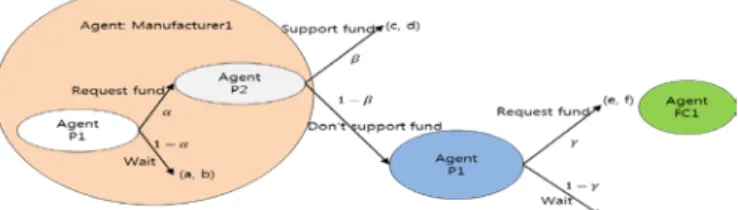
An agent model for the decision made by Manufacturer1 and FC1 is described in Figure 1. According to a tier (e.g., Manufacturer1)’s priority set for fund usage, dispute between its internal organizations (e.g., P1 and P2) or financing from a financial company (e.g., FC1) can lead to conflicting results for its benefits and/or its customer satisfaction. The current study reflected this in the agent model by using the Game Theory [13].
Fig 1. An agent model that considers financial conditions of a supply chain
Manufacture1 in the supply chain is described as an agent, and the projects (P1 and P2) it can select from are described as sub-agents. In (x, y), x (or y) is the reward when P1 (P2) is selected. Each agent has its own probabilities to propose and accept negotiation conditions, and the sum of which is equal to 1. If we set the overall benefit when accepting P1 (P2) to 𝑃𝑃1(𝑃𝑃2), P1 (P2) can be formulated as Equation 1 (2), which shows the total benefit and customer satisfaction of the supply chain [13].
𝑃𝑃1= (1− 𝛼)𝑎+𝛼[𝛽𝑐+ (1− 𝛽)[𝛾𝑒+ (1− 𝛾)𝑎]] (1)
𝑃𝑃2= (1− 𝛼)𝑏+𝛼[𝛽𝑑+ (1− 𝛽)[𝛾𝑓+ (1− 𝛾)𝑏]] (2)
The financial area of the supply chain can be factored in by analyzing its cash flow. The current study used the cash-to-cash method, in which a positive (negative) value means there is cash to receive from a company (send to a company). The cash-to-cash value is regarded as optimal when it is ≤ 0, which indicates that the company’s financial status is efficient and profitable. As such, this condition can be used to financially optimize the overall supply chain [14]. Cash-to-Cash Cycle can be formulated using the inventory turnover period (ITP), the receivable turn-over period (RTP), and the trade payable turnover period (TPTP) as in Equation 3.
Cash-to-Cash Cycle = ITP(c2c) + RTP(c2c) - TPTP(c2c) (3)
3.2 Optimization Process
The PSO method [15] was used for financial optimization of a supply chain that has destruction and disruption risks. As one of meta-heuristics methods comprised of simplistic concepts, its algorithm can be easily programmed and usually requires only several lines of code.
The probability to select each agent, α, β, or δ, and the corresponding reward, (x, y) when selecting a specific agent corresponds to the kth element of a decision variable used in the PSO (Figure 1). 𝑥𝑛𝑘(𝑡+1) denotes the kth element of the nth decision variable for the population group consisting of N particles. If 𝑥𝑛𝑘(𝑡+1) has the velocity to determine the location of the next generation (t+1), a particle, or a decision value in the PSO method, can be described as Equation 4 [16].
𝑣𝑛𝑘(𝑡+1)=𝑤𝑣𝑛𝑘(𝑡)+𝑐1𝑟1�𝑃𝑛𝑘− 𝑥𝑛𝑘(𝑡)�+𝑐2𝑟2(𝐺𝑛𝑘− 𝑥𝑛𝑘(𝑡)) (5)
4 Conclusion and Future Work
The current study considered destruction and disruption risks and financial condition during supply chain optimization, as these are crucial for the sustainability of a supply chain, as well as for the validity of the corresponding model. The simulation model developed in the current study for supply chain optimization also possesses the dynamic and stochastic characteristics of a typical supply chain. An agent model based on the Game Theory was used for financial decision making, and the PSO method was used for the overall optimization of the supply model. The results from the simulation model and the agent model were used as a population). It is warranted, however, to test in the field the proposed model for a supply chain with destruction and disruption risks and to further improve it if needed.
References
1. Chatfield, D. C., Kim, J. G., Harrison, T. P., Hayya, J. C.: The Bullwhip Effect- Impact of Stochastic Lead Time, Information Quality, and Information Sharing: A Simulation Study. Production and Operations Management 13(4), 340--353 (2004)
2. Kelepouris, T., Miliotis, P., Pramatari, K.: The Impact of Replenishment Parameters and Information Sharing on the Bullwhip Effect: A Computational Study. Computers and Operations Research 35, 3657--3670 (2008)
3. Zhang, X.: The Impact of Forecasting Methods on the Bullwhip Effect. International Journal of Production Economics 88, 15--27 (2004)
4. Pfohl, H. C., Gomm, M. L.: Supply Chain Finance: Optimizing Financial Flows in Supply Chains. Logistics Research 1, 149--161 (2009)
5. Nair, A., Vidal, J. M.: Supply Network Topology and Robustness Against Disruptions- An Investigation Using Multiagent Model. International Journal of Production Research 49(5), 1391--1404 (2011)
6. Sheffi, Y., Rice, J.: A Supply Chain View of the Resilient Enterprise. MIT Sloan Management Review 47(1), 41--48 (2005)
7. Gomm, M. L.: Supply Chain Finance: Applying Finance Theory to Supply Chain Management to Enhance Finance in Supply Chains. International Journal of Logistics: Research and Applications 13( 2), 133--142 (2010)
8. Thadakamalla, H. P., Raghavan, U. N., Kumara, S., Albert R.: Survivalbility of Multiagent-Based Supply Networks: A Topological Perspective. IEEE Intelligent Systems 19(5), 24--31 (2004)
9. Baghalian, A. B., Rezapour, S., Farahani, R. Z.: Robust Supply Chain Network Design with Service Level against Disruptions and Demand Uncertainties: A Real-Life Case. European Journal of Operational Research 227, 199--215 (2013)
10. Schmitt, A. J., Singh, M.: A Quantitative Analysis of Disruption Risk in a Multi-Echelon Supply Chain. International Journal of Production Economics 139, 22--32 (2012)
11. Arena, http://www.arenasimulation.com/Arena_Home.aspx (2013) 12. NetLogo, http://ccl.northwestern.edu/netlogo/ (2013)
13. Lam, R. B.: Agent-Based Simulations of Service Policy Decisions. In: Proceedings of the 2007 Winter Simulation Conference, pp. 2241--2246 (2007)
14. Randall, W. S., Farris II, M. T.: Supply Chain Financing: Using Cash‐to‐Cash Variables to Strengthen the Supply Chain. International Journal of Physical Distribution & Logistics Management 39(8), 669-‐689 (2009)
15. Eberhart, R., Kennedy, J.: A New Optimizer Using Particles Swarm Theory. In: Proceedings of Sixth International Symposium on Micro Machine and Human Science, pp. 39--43 (1995)
16. Julio, E. A., Everson, R. M., Fieldsend, J. E.: A MOPSO Algorithm Based Exclusively on Pareto Dominance Concepts. Evolutionary Multi-Criterion Optimization, 1--15 (2005)