Research Note
Improving Mechanical Properties of High
Strength Concrete by Magnetic Water Technology
H. Afshin
1, M. Gholizadeh
2;and N. Khorshidi
3Abstract. The most important challenge for concrete technologists is to improve the properties of concrete. In the last two decades, in Russia and China, a new technology, called magnetic water technology, has been used in the concrete industry. In this technology, by passing water through a magnetic eld, some of its physical properties change and, as a result of such changes, the number of molecules in the water cluster decrease from 13 to 5 or 6, which causes a decrease in the water surface tension. Using magnetized water in concrete mixtures causes an improvement in the workability and compressive strength of concrete. Also, this processed water causes a reduction in the cement content required for the specied compressive strength value. In this research, in the concrete laboratory of Sahand University of Technology, the eects of magnetic water on some mechanical properties of high strength concrete, such as workability and compressive strength, have been studied. For the production of magnetic water, a magnetic treatment device (made in Germany) has been used. This device mostly is used for the softening of water and, for the rst time in this research, it has been used by the authors for the production of concrete. The results of tests showed that, in most cases, concrete made with magnetic water (magnetic concrete), has higher slump values than those of control concrete (up to 45%). Also in some cases, the compressive strength of the magnetic concrete samples was higher than that of the control concrete samples (up to 18%). Also, in some cases, with the same slump and compressive strength, cement content can be reduced by 28% in the case of magnetic concrete.
Keywords: High strength concrete; Magnetic water; Compressive strength; Slump; Clean concrete.
INTRODUCTION
The initial research and scientic testing regarding the application of a magnetic eld to concrete man-ufacturing were commenced in Russia in 1962 for military constructions such as airports and jetties. This research was continued step by step in other institutes, such as the VNLL Jelezobeton Research and Scientic Institute in Russia, and some positive results were found in this regard.
Magnetic devices include one or more permanent magnets, which induce changes and eects on ions and
1. Department of Civil Engineering, Sahand University of Tech-nology, Tabriz, P.O. Box 51335-1996, Iran.
2. Department of Chemistry, Sabzevar Tarbiat Moallem Univer-sity, Sabzevar, P.O. Box 161, Iran.
3. Tamavan Consulting Engineers, P.O. Box 51335-1996, Iran. *. Corresponding author. E-mail: m [email protected] Received 3 February 2008; received in revised form 16 May 2009; accepted 13 October 2009
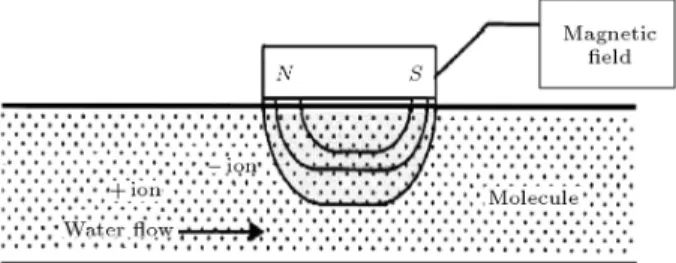
water molecule clusters passing through its magnetic eld. A magnetic eld has a considerable eect on clusters of water molecules and causes the decrease of such a mass from 13 molecules to 5 or 6 molecules (Figure 1).
Such a decrease of molecules causes more partic-ipation of water molecules in the cement hydration reaction [1-3]. Also, when water is mixed with cement, cement particles are surrounded by water molecule
Figure 1. Eect of a magnetic device with permanent magnet on ions passing through its magnetic eld.
clusters. In the case of magnetic water in which the clusters have a smaller size and lower density, the thickness of the water layer around the cement particle is thinner than in the case of normal water. This fact results in a decrease in water demand for concrete mixing and, subsequently, in reducing the W/C ratio, which has positive eects on hardened concrete properties, such as strength, durability etc. [4-7].
EXPERIMENTAL DESIGN
Several tests on HPC samples, such as slump and compressive strength tests, were undertaken in the concrete laboratory of Sahand University [8].
Materials and Instruments
Materials such as aggregates, silicafume, superplasti-cizer, water and cement were used for tests. Aggregates were prepared from mines around Tabriz city (Table 1).
Table 1. Specications of coarse and ne aggregates used for tests.
Aggregate Type
Maximum Diameter (mm)
Specic Gravity (kg/m3)
Coarse 19 2805
Fine 4 2460
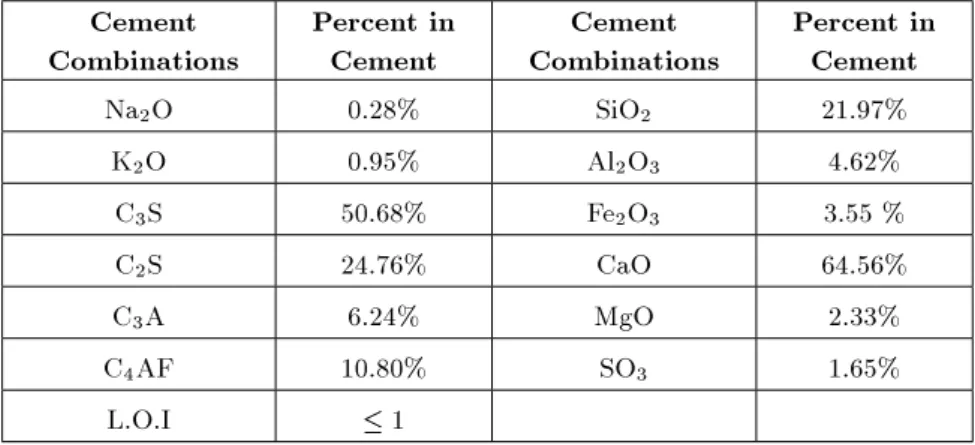
Cement type 2 (Table 2) was used and silicafume was prepared from the Azna mine of Lorestan state (Table 3). Melamine Lignosolphonate superplasticizer was also used.
For magnetization of water, equipment made in Germany (generally used for treatment of water) was used for the rst time in the production of concrete. Also, a pump was used for the circulation of water in the magnetizer. The water ow value was 2.26 liter/min and the water circulation time in the device was equal to 15 minutes.
Mixture: Proportioning of Samples
To study the eects of cement content, w/c ratio, superplasticizer percent and age of samples, 21 mix designs were performed. 350,400 and 450 kg of cement content; 0.35, 0.4, 0.45 and 0.5 w/c ratios; 1, 2 and 3% superplasticizer and 10% silicafume were used.
Two types of water, normal and magnetic, were used for the production of concrete samples.
Experimental Methods
Produced magnetic water was used for the concrete mixing. After mixing the concrete for two minutes, a slump test (according to ASTM C-143-90a) was un-dertaken on the concrete mixture. Then, the produced concrete was poured into 10 10 10 cm3moulds and,
Table 2. Specications of cement used for tests. Cement
Combinations
Percent in Cement
Cement Combinations
Percent in Cement
Na2O 0.28% SiO2 21.97%
K2O 0.95% Al2O3 4.62%
C3S 50.68% Fe2O3 3.55 %
C2S 24.76% CaO 64.56%
C3A 6.24% MgO 2.33%
C4AF 10.80% SO3 1.65%
L.O.I 1
Table 3. Specications of silicafume.
Name Azna-Lorestan
Structure Non-crystallized (amorphous) Particle Shape Conic
Approximate Diameter Micron 1.0
Specic Surface Area Approximate 20 m2
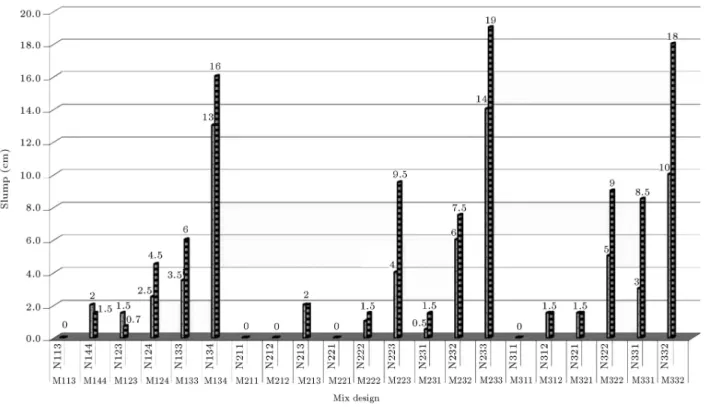
Figure 2. The slump values of magnetized and non-magnetized concrete samples.
after curing, compressive strength tests were done on the concrete cubes.
RESULTS AND DISCUSSION Eect on Slump
Figure 2 shows the slump values of the magnetized and non-magnetized concrete samples. As shown, the slump values of the magnetized concrete were higher than those of non-magnetized concrete. Figures 3 to 5 show the slump variations in the concrete samples with various cement content. It can be concluded that the eect of the magnetic eld will increase at higher cement content, w/c ratio and superplasticizer percent, and the slump of the samples will improve. The reason for this phenomenon can be explained as follows.
In mixtures with higher cement content, we also need more water for surrounding the cement partici-pates and, faced with the low gathering of molecules in magnetic water and, in this regard, in the case of magnetic water, we need to lower the water volume for the surrounding cement particles and, as a result, a high rate of water shall be applicable for more eciency.
Subject to more lubrication of the magnetic con-crete mixtures with a rate of water higher than the amount of cement, it should be mentioned that an eective part of the magnetic eld in the concrete
Figure 3. Slump variations in concrete samples with 350 kg cement content.
mixture is changed to mixed water and, for as long as the higher rate of this water in the concrete mixture exists, its eect also shall be higher. It is observed that in mixtures with higher water to cement ratios, the eect of the magnetic eld is higher to improve the mixture eciency.
But, subject to the eect of the superplasticizer, due to the eect of magnetic water on the properties
Figure 4. Slump variations in concrete samples with 400 kg cement content.
Figure 5. Slump variations in concrete samples with 450 kg cement content.
of concrete, we can say that the super lubricant has an eect on the electrical loan of the cement particles and is the cause for their separation from each other, facilitating its movement. Magnetic water particles also, due to loading, aid the work of the lubricator and, on the whole, we can say that magnetic water particles and a super lubricant have a special eect on cement particles, prevent its compressing and, due to separation, may cause better lubrica-tion.
Eect on Compressive Strength
Values of the compressive strength at 28 days and the variation percentage of magnetic concrete strength in comparison with non-magnetic concrete, were pre-sented in Table 4. In the 28-day sample, we observed an increase of compressive strength in the 400 and 450 cement content. At an age of 90 days, the strength values of magnetic concrete are higher than that of ordinary concrete (Table 4).
Eect of Magnetic Superplastizer
The operation of the superplasticizer is as follows. These molecules have two positive and negative parts. In the concrete combination, the positive part shall be loaded onto the cement particles and surround it. This changes the electrical charges on the surface of cement particles into negative and results in separation and dispersion of cement particles from each other; and nally causes a better lubricating of the concrete. When the superplasticizer and water pass from the magnetic processing unit, the magnetic eld rates pass from the electron pair of oxygen atoms and cause a layer with 8 electrons to surround the superstructure molecules, i.e. free electron parts ll in the positive part of the superplasticizer by binding with the water molecules. Filling or neutralizing the positive part of the superplasticizer prevents the collection and absorption of these molecules and, as a result, causes lower operation, in comparison with concrete that has been prepared with a non-magnetic superplasticizer and magnetic water.
The result of lubricating and pressure strength of concrete samples with magnetic SP shows that concrete with magnetic SP has an application operation of non-magnetic SP concrete without SP and concrete without SP. The reason for this is a decrease of the magnetic eld on the water due to the availability of a superplasticizer. In this case, the superplasticizer absorbs the solution of the magnetic eld and, as a result, causes a decrease in the magnetic eld of the water molecules.
Saving of Cement Consumption
Suppose that we wish to produce concrete with a xed amount of plasticizer and pressure strength and, in this regard, oer a mixture (combination) plan. Because of the higher rate of lubrication and pressure strength of magnetic concrete in comparison with non-magnetic concrete, we use this plan to increase the lubricating and high pressure operation and we can present another plan that has a lower neness of cement and dierent characteristics from gures presented in the initial plan. Table 5 is a comparison between magnetic and
Table 4. Values of compressive strength at 28 days and variation percentage. No. Mix Design B
(kg) W=B
S:P=B (%)
Non-Magnetic (kg/cm2)
Magnetic (kg/cm2)
Variation Percentage (%)
1 N113 M113 350 0.45 1 672.3 623 -7.3
2 N114 M114 350 0.5 1 594 604.5 1.8
3 N123 M123 350 0.45 2 667.7 603.3 -9.6 4 N124 M124 350 0.5 2 583.3 511.3 -12.3
5 N133 M133 350 0.45 3 650.7 615 -5.5
6 N134 M134 350 0.5 3 606 557 -8
7 N211 M211 400 0.35 1 631.7 608.5 -3.6
8 N212 M212 400 0.4 1 649 690 6.3
9 N213 M213 400 0.45 1 621.7 601 -3.3
10 N221 M221 400 0.35 2 658.3 735.7 11.8
11 N222 M222 400 0.4 2 722.5 665 -8
12 N223 M223 400 0.45 2 551.7 607.7 10.2
13 N231 M231 400 0.35 3 706.7 786 11.2
14 N232 M232 400 0.4 3 659.3 747 13.3
15 N233 M233 400 0.45 3 587.3 671.5 14.3
16 N311 M311 450 0.35 1 675 708.3 4.9
17 N312 M312 450 0.4 1 566.3 744 31.4
18 N321 M321 450 0.35 2 688 817 18.8
19 N322 M322 450 0.4 2 576 773 34.2
20 N331 M331 450 0.35 3 722 662 -8.3
21 N332 M332 450 0.4 3 626.7 721.7 15.2 Table 5. Comparison between specications of magnetic and non-magnetic concretes.
non-magnetic concrete and it is understood that, in a number of cases, we can save approximately 50 kg of cement in each cubic meter of concrete. In some cases, such a saving will attain 100 kg per cubic meter.
CONCLUSION
1. It can be said that, approximately, in all the plans, the rate of lubrication of magnetic concrete in comparison with ordinary concrete is higher. 2. With an increased neness of cement, its lubricating
is also increased. Also, magnetic water, in the presence of a plasticizer, shows better operation. 3. The pressure strength of the magnetic concrete
samples at nenesses of 400 and 450 is higher than that of ordinary concrete.
4. In the case of adding a superplasticizer to water, passing the solution through the magnetic unit and beneting from the nal solution to produce concrete, the plasticizer of the produced samples is lower than that of non-magnetic concrete.
a superplasticizer is higher than that of ordinary concrete and lower than that of magnetic concrete. 6. In the case of using magnetic water instead of ordinary water to produce concrete, a considerable amount of saving will occur in the rate of consumed cement.
ACKNOWLEDGMENT
We are grateful to Sahand University of Technology of Tabriz and Sabzevar Tarbiat Moallem University for nancial support of this work.
REFERENCES
1. Gabrielli, C., Jaouhari, R., Maurin, G. and Keddam, M. \Magnetic water treatment for scale prevention", Wat. Res., 35(13), pp. 3248-3259 (2001).
2. Kronenberg, K.J. \Experimental evidence for eects of magnetic elds on moving water", J. of Trans. On Mag., 21(5), p. 2059 (1985).
3. Al-Qahtani, H. \Eect of magnetic treatment on gulf seawater", Desalination, 107, pp. 75-81 (1996). 4. Yuanbao, Z. et al. \Physical and chemical properties
of magnetized water", Journal of Hunan University, 26(1), p. 290 (1990).
5. Eshaghi, Z. and Gholizadeh, M. \The eect of mag-netic eld on the stability of (18-crown-6) complexes with potassium ion", Talanta, 65(2), p. 558 (2004). 6. Nan Su, Yeong-Hwa. Wu and Chung-Yo Mar \Eect
of magnetic water on the engineering properties of concrete containing granulated blast furnace slag", J. of Cement and Concrete Research, 30, pp. 599-605 (2000).
7. Nan Su and Chea-Fang Wu \Eect of magnetic eld treated water on mortar and concrete containing y ash", J. of Cement and Concrete Composites, 25, p. 269 (2003).
8. Iwasaka, M. and Ueno, S. \Structure of water molecules under 14T magnetic eld", Journal of Ap-plied Physics, 83(11), p. 560 (1998).