Science: Process and Product
Philip BalcaenUniversity of British Columbia, Okanagan, Kelowna, Canada
Abstract: In this paper, I describe a professional development approach and a conceptual framework used to create critically thoughtful and media-rich science learning resources. Greater clarity about the nature of critical thinking and how to support teachers in learning to implement it are needed if we are to respond to broader calls for critical thinking both as a central goal in science education and as a key aspect in the ecology of 21st Century e-learning environments. The conceptual framework is a model of critical thinking developed by the Canadian Critical Thinking Consortium that involves embedding the teaching of five categories of intellectual tools into the teaching of curriculum content. The “tools for thought” include addressing the need for focused and relevant background knowledge, criteria for judgment, thinking concepts, thinking strategies and the development of habits of mind. The professional development approach engages practicing teachers through focused inquiry groups in collaboration with rich media technicians to develop the e-critical challenges (lessons). Aspects of this “comet approach” include a series of face-to-face sessions, gradual and planned for introduction to use of laptop computers, developing inquiry oriented writing teams and expert mentorship between large group face-to-face sessions. I explain the unique aspects of both the development process and the challenges in the context of a project involving twelve teachers in the creation of media-rich critical thinking lessons in science for Grade 7 students. Although project assessment data analysis is currently underway, I offer several initial conclusions in relation to the four goals of the project.
Keywords: Critical thinking, science teaching, media-rich, professional development, one-on-one laptop, collaboration
1. Introduction
Many institutions such as the National Academy of Science in the US, provincial Ministries of Education in Canada, the Queensland Board of Secondary School Studies in Australia, educators in India and China and others identify critical thinking (CT) as a desired goal for science education (Balcaen 2006). However, as Nobel Laureate Carl Wieman (2006) observes, conventional science classrooms from elementary school through to university are generally failing to provide most students with opportunities to think about and understand science. He goes on to argue that carefully constructed e-learning opportunities can help with this dilemma. Speaking from the perspective of cognitive science, Willingham (2007) argues that teaching critical thinking is a means of improving scientific thinking while engaging more powerfully with the factual content. Based on his work with several thousand Canadian and international teachers, Case (2005) takes the position that, rather than compete with the teaching of subject matter and other thinking skills, teaching critical thinking can support their development. Case also argues that this support depends on two distinguishing features allowing teachers to place critical thinking “on the main stage”—using a curriculum
embedded approach and emphasizing teaching the intellectual tools required for critical thinking. These two
features underpin the approach to teaching science and CT described below.
In addition, proponents of e-learning argue that critical thinking should play a central role within the ecology of 21st century e-learning environments (MacKnight 2000; Garrison & Anderson 2003, Drinkwater et. al 2004). Despite these and other strong urgings, too little attention has been paid to “how” this goal might be accomplished (Balcaen 2008). The literature suggests that rather than improving thoughtfulness, participation in e-learning often leads to confusion and loss of interest unless there are strategies designed to enhance CT opportunities (MacKnight 2000). Drinkwater et. al. (2004) add that one of the challenges for ICT users is to understand how e-learning technologies can “improve thinking.” Based on extensive research, Finkelstein et. al. (2006) conclude that research-based simulations can be “as productive, or more productive, for developing student conceptual understanding as real equipment, reading resources, or chalk-talk lectures” (p.1).
Those involved in the project described here believe that such simulations and other rich media combined with a sound method of teaching CT, can help teach critical thinking while also teaching content knowledge. This approach differs from the normal one where teaching thinking is considered an add-on or enrichment activity. As Case (2005) and Willingham (2007) posit, it makes no sense to try to teach content without giving students opportunities to think about it and also makes no sense to try to teach CT devoid of content.
critical thinking “while” addressing science content goals. The project involves collaboration between The Critical Thinking Consortium’s (tc2), COOLSchool’s successful use of emerging media-rich technologies and an opportunity provided by a School District’s (www.sd23.bc.ca) implementation of a one-on-one laptop initiative. The three “initial goals” of the project include:
1. providing effective in-service about teaching critical thinking for participating teachers; 2. enhancing teacher’s expertise in use of media rich technologies;
3. and improving the effectiveness of laptop use Grade 7 classrooms.
Following the narrative framing the project, I provide a description of the development process, explain the pedagogical framework including examples of teacher-developed lessons, outline our limited successes and problematic aspects of the development process and the e-challenges, and finally offer several concluding comments.
2. Framing the project
The current project began as a “spin-off” from The British Columbia Central Okanagan’s overarching one-on-one initiative focused on “improving the quality of e-learning opportunities for Grade 7 students” by providing effective in-service for teachers. Central Okanagan is a small school district comprised of 29 elementary, 6 middle and 5 senior secondary school students enrolling approximately 22000 students. The district has invested heavily in various e-learning technologies. Recognizing that a “one-on-one” (placing lap top computers in the hands of all students) project would not magically transform teaching and learning, an administrator from the district invited the author and a team to work with interested teachers to include critical thinking as an explicit improvement goal in their practices.
The initial plan provided for a two-year in-service training program involving four elements of tc2’s professional development work with teachers:
̇ Regular face-to-face sessions where teachers were taught about aspects of the tc2 approach ̇ A gradual move towards a focus on use of laptop computers to support teaching CT
̇ Organizing curriculum writing teams around common interest areas of inquiry
̇ Providing school-based mentorship for the inquiry teams between large group sessions
This approach to professional development takes account of the criticism of conventional curriculum development practices where facilitators “workshop” teachers who are then expected to return to the classroom and infuse new ideas into practice. This understanding of professional development is widely viewed as having limited value in transforming practice (Cranton and King, 2003; Fullan, 2002; Fullan, 1996; Wideen, 1994). The approach taken here is constructed around an alternative understanding borrowed from Field Programs at Simon Fraser University’s Faculty of Education. This “comet” approach conceptualizes workshops as only the head of the comet where participants are introduced to a set of ideas about teaching CT but then adds providing teachers with time away from the classroom and support such as peer review opportunities and mentorship to help develop effective curriculum—constituting the tail of the comet. This approach has been highly successful in tc2’s work with teachers in India, Hong Kong, the USA and across Canada.
A spin-off of the “Critically Thoughtful i-Learn” project is a common interest group of science teachers working to use rich media to teach science. This partnership involves tc2’s curriculum specialists using the innovative method of embedding critical thinking within conventional text-based curriculum, the educational
media development group COOLSchool’s success using emerging technologies to develop and deliver
curriculum and a group of twelve science teachers from the school district. This partnership led to the addition of the following fourth goal to the overarching i-Learn project:
4. The development of a collection of media-rich elementary science lessons (deliverables) including elements of The Critical Thinking Consortium’s approach to teaching the tools for thought.
2.1 The deliverables
Specifically, the development project is to develop 12 multimedia and feature-rich science (Grade 7) lessons intended to better engage individual and groups of students in science learning, support their development as critical thinkers and encourage effective use of emerging technologies. The e-based critical challenges (lessons) address the newly developed BC elementary science curriculum and are now available for general
use after and. The science curriculum is similar to that used in many other jurisdictions in Canada and elsewhere making the critical challenges useful for many teachers.
The e-based critical challenges present the science curriculum in a “problematic” way requiring that students learn and use elements of five categories of “intellectual tools” elaborated on later. While proven to be highly engaging, this approach helps students develop the tools needed to address Nobel Laureate Carl Wieman’s (2006) concern that most science students are not learning what we hope they are learning; they aren’t learning to think about the curriculum.
The format of the critical challenges takes advantage of current Internet technology involving use of multimedia content including flash animations, simulations, and interactive media pieces to better engage students and support science concept development. From his research into science teaching, Wieman (2007) observes that the use of such technology offers the hope of some revolutionary improvements in education for all students, whether they’re going into science or anything else. We expect that as teachers and individual students become comfortable using the critical challenges as intact lessons, they will begin to edit and re-author materials adding their ideas to improve and extend their science teaching and learning. In this way, the feature rich project is intended to fortify teachers’ abilities to use new technologies and offer online students and teachers more engaging material to enhance distributed learning experiences while teaching thinking.
3. The development process
The process was organized into three phases—knowledge and community building, curriculum development though inquiry and final revision phases—outlined below. During phase one, September 07 to March 08, tc2 provided face-to-face in-service for contracted teacher-writers and then met with smaller groups to help develop text-based outlines of the Science 7 critical challenges (lessons). This involved contracted teacher-writers and COOlSchool design expert’s working collaboratively then meeting with the author to critique and edit works in progress. While taking full advantage of COOlSchool’s current expertise, these initial face-to-face sessions helped build competence with the tc2 model and allowed for collaborative design of the media rich aspects before being piloted by other teachers.
Phase Two was a piloting and evaluation period from March 08 to June 08 involving 12 Grade 7 teachers (elementary and middle school) piloting and critiquing the e-based critical challenges. Towards the end of this phase, I collected quantitative and qualitative feedback about technical (i.e. navigation, ease of use, accessibility, multimedia features) and pedagogical aspects (i.e. engaging; conceptual clarity, support collaboration) of the critical challenges to inform changes during the final revision phase.
Phase Three involved revisions during the July /08 to September /08 period in preparation for release of the materials in October 08. During this phase the team collaborated to take account of feedback from the piloting teachers and to make revisions to the pedagogical and technical aspects of the challenges using standards set by tc2 Senior Editors, COOLSchool media developers and the following British Columbia Digital Learning Content Standards for Distributed Learning (2007).
̇ experienced educators plan the learning activities
̇ effective teaching strategies are used to engage students
̇ the lessons employ a variety of approaches to learning addressing different learning styles ̇ the design activates prior knowledge of the learner
̇ the design is suitable to the cognitive and memory load of the learner
During the first year of general use we intend to collect feedback from both classroom teachers and individual student users about the technical and pedagogical features of the challenges as a means of further improving the lessons and following through on our commitment to writing quality curriculum.
4. Conceptual framework: The four fronts
The tc2 approach to critical thinking is founded on the belief that people are attempting to think critically when they thoughtfully seek to assess what would be sensible or reasonable to believe or do in a given situation. This need to reach reasoned judgments may arise in countless kinds of problematic situations such as the following examples developed by teacher-writers.
̇ Based on the findings around the "crime scene", what do you think is the defensible factor leading to a decrease in salmon populations?
̇ Using the information provided, develop an urban area plan with least negative impact on the surrounding natural environment.
̇ Using the tools provided, determine which member of a food web would have the biggest impact on the web if it were removed?
̇ Outline the most ecologically responsible land use plan for the outlined area.
̇ Which form of rock, sedimentary, metamorphic, or igneous has added the greatest value to human experience in the 20th century?
̇ Which member of the food web would have the biggest impact on the web if it were removed?
These situations require critical thinking because there is some doubt as to which is the most appropriate of several plausible responses and because these situations involve criterion thinking (e.g. ecologically responsible, feasible, biggest impact, most effective, least negative, greatest value). It is important to note that the focus is on the “quality of thinking” and not on a requirement that students must arrive at “the correct answer.” The power of the model is that it offers four coherent fronts providing a method for encouraging, teaching, and assessing the qualities of good thinkers.
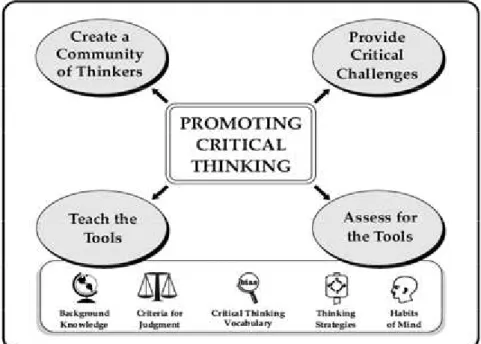
The tc2conception of critical thinking outlined in Figure 1 and described below, focuses teachers on four fronts to help students improve as thinkers: 1) providing challenging questions, 2) teaching required intellectual tools, 3) assessing the intellectual tools, and 4) supporting the development of communities of thinkers.
Figure 1: The four fronts (Used with permission from tc2)
4.1 Asking challenging questions
The first front is infusing opportunities to think critically by asking the kinds of complex questions identified above—what we call challenging questions. This involves the development of a question form that requires judgment between viable alternatives; involves subject matter that is meaningful to students; addresses key aspects of the curriculum; and require that students either possess or can reasonably acquire the thinking tools needed to competently address the challenge. For example, the question on the right in Table 1 below is such a challenging question. This question contrasts with the two other kinds of questions commonly found in textbooks, on the Internet and within classrooms. These are:
̇ questions merely asking students to express “how they feel” about something
Table 1: Kinds of questions
Basic Knowledge Questions
How do you feel questions Intellectually Challenging Questions
List four examples of igneous, metamorphic and sedimentary rocks.
What are your favourite igneous, metamorphic and sedimentary rocks?
What are the most valuable examples of igneous,
metamorphic and sedimentary rocks found on the earth?
Such “challenging” questions are the key invitations encouraging students to engage with the curriculum more enthusiastically and to thinking critically—base decision on warranted criteria—about it.
4.2 The tools for thought
The second and most crucial front is helping students nurture the use of five categories of intellectual tools used by competent thinkers. Much of what makes this approach unique and powerful is the explicit focus on the development of these tools within learning activities and the complimentary assessment process. Below, I define each category and provide linked examples based on several of the challenging questions listed earlier.
̇ Background knowledge—the information about a topic required for thoughtful reflection about a solution
to the question. Here students learn about the life cycle of salmon and both natural and man-made factors
threatening salmon survival. In one of four activities, they learn the details about four important factors known to have a significant impact: human garbage, over fishing, storm drain and water run off pollution, and
stream habitat destruction.
̇ Criteria for judgment—the considerations or grounds for deciding between viable alternatives. The
example provided is part of the “What key factor do you think is the most responsible for the increase or decrease of the carbon dioxide levels in the atmosphere?” challenge. Here the criteria for judgment is the
most responsible factor including a variety of “sources” and “sinks” effecting the total concentration of CO2. Students participate in activities using the above criteria allowing them to assess the relative impact of the
various factors.
̇ Critical thinking vocabulary—the range of concepts and distinctions that are helpful when thinking critically. The example provided is part of the “What key factor do you think is the most responsible for the
increase or decrease of the carbon dioxide levels in the atmosphere?” challenge. Within this challenge, there are both science specific and thinking specific concepts needing to be taught. The example linked below involves teaching the concept of a CO2 “sink.” Other examples of thinking vocabulary used within other challenges include assumption, evidence, inference, fact, hypothesis, and argument.
̇ Thinking strategies—organizing devices, models, and algorithms useful in making a decision. In this
case, the example provided is part of the “Which member of the food web would have the biggest impact if it were removed?” challenge. The web of effects illustrated provides information then used to help make a sound judgment based on justifiable criteria. Other examples of strategies include identifying positive and negative factors, comparing similarities or differences rating and ranking options.
̇ Habits of mind—the values and attitudes of a careful and conscientious thinker. For example, students
have to be consciously open-minded as they consider evidence that might oppose their opinions and
fair-minded as they consider different possibilities as they work to answer the challenging questions. At the
same time, making an argument might include being independent-minded as students look for more information to help make a decision.
̇ In the “Plan an urban area, according to the specifications provided, to have the least negative impact on a chosen environment” challenge, students will have to be open- and independent-minded to develop a
justifiable plan
̇ Other examples of habits of mind include is persistent, reflective, shows initiative, flexible or attends to detail.
Together, these five categories provide a comprehensive and extensive list of intellectual tools that support the development of sound thinking abilities. While I have included only a few examples for each category, tc2 has identified many examples of each category found in the e-resources
4.3 Assessing for thinking
The third front is regular assessment of students’ competence in using the intellectual tools to think through responses to challenging questions. This requires the careful development and use of appropriate criteria and standards to assess students’ background knowledge; use of the criteria for judgment, thinking vocabulary, thinking strategy, and habits of mind. Each challenge includes criteria and standards in rubric form for self/peer/teacher assessment of aspects of the lesson. Other examples of approaches to assessing
aspects of critical thinking may be fou
4.4 Building critically thoughtful communities
The fourth and final front is building communities of thinkers where the focus is on developing thoughtful classroom, institutional and broader communities where critical thought is a goal. For classrooms, this involves instructors regularly posing questions and developing assignments requiring students to think through the implications of what has been learned; creating ongoing opportunities to engage in a critical and cooperative dialogue; employing peer and self evaluation; and modelling use of the critical thinking tools. I discuss the implications of this aspect of the model for distributed learning communities found at
The technology resources developed for this project are provided for two target audiences: individual distributed learners and teacher-use with their conventional classes. While the focus on this community aspect is not addressed for individual learners. The modular nature of the e-critical challenges allows teachers to use the complete lessons or to repurpose objects and activities and to embed them into their own teaching resources. In this way, teachers may fit the challenges into their own practices and tsupport development of more thoughtful communities within their classrooms.
I argue here and elsewhere that taken together, these Four Fronts provide a coherent approach to practice supporting teachers with a method of modelling and teaching critical thinking.
5. Addressing the goals
The three initial goals of the overarching Critically Thoughtful i-Learn project were assessed through the collection of project baseline and exit data using mixed methods involving two surveys (Inventory of the
Pedagogy of Critical Thinking & The Critically Thoughtful iLearn Questionnaire), interviews and direct
observation. Exit data was collected in June 2008, compared to base-line data and reported in a Final Project Report to the Central Okanagan School District that will be the basis of an upcoming paper reporting the research in detail. Below, I provide aspects of the data linked to my discussion of the four goals of the project.
5.1 Goal 1
While several teachers have participated in the in-service about teaching CT and computer use and then moved on to other things, a core group (N=18) of self-selected participants are using the ideas within their practices. These teachers are integrating CT methods with their use of lap top computers. This is evident in their development and use of e-challenges identified earlier and other computer-based teaching activities we observed within their daily practice. In their meta-analysis, Sung and Lesgold, (2007) identify three key factors limiting such increased use of computers in classrooms. These are 1) high expectation on the part of policy makers versus lack of preparedness on the part of teachers; 2) high availability of technology versus low use in conventional classrooms; and 3) on-going advances in technology versus teachers’ tendency to keep doing what they are already doing.
In this case and as indicated by Q. 1-3 on the iLearn Questionnaire, there were no “statistically significant” changes in participants’ knowledge of and attitudes towards use of laptops. However, this is the expected outcome as these “volunteer” teachers joined the project because they already had high skill levels and were motivated to use laptops in their practice. One teacher’s comment sums up the group’s general point of view. She suggests that laptops “just open up the whole world of research for our students. You know, if a student wants to know something about the world, it’s just there at their fingertips.” In addition, all of these participants suggested in the base-line survey data that computer use in general had a positive impact on their teaching.
However, when we take account of the descriptive data and field observations it is clear that these teachers gradually used their laptops in different ways as they implemented critical thinking methods. One participant described this shift in practice when stating, “I think that students are getting a much deeper understanding…but it’s not something that I’m just telling them. They’re discovering it through use of electronic media as they do their critical challenges.” Despite being predisposed towards computer use these teachers run against the grain when considered in relation to Sung and Lesgold’s three factors.
5.2 Goal 2
The issue of enhancing teacher’s expertise in use of media rich technologies has been evident during “sharing works in progress” sessions held at the end of day-long or after-school in-service events. Several teachers have demonstrated what Sung and Lesgold (2007), call “instructional maturity” which is evident when they integrate new and emerging technologies into their practices. During these sharing sessions participants often began collaborating with others to use and extend newly developed understandings about various applications such as Google Earth and various simulations.
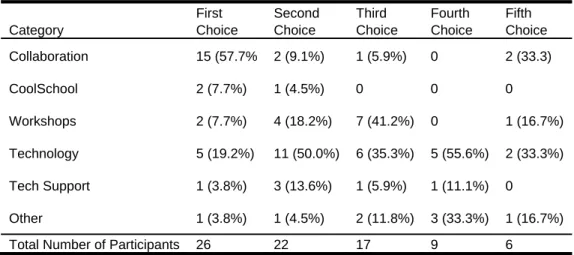
The research form the project shows that “collaboration” with other teachers was chosen by 57.7% (Table 2) of respondents when asked to identify “the best” source of help as they implemented use of laptops in their classrooms. Based on comments within our qualitative data, the important role tha collaboration played in teacher learning is not about being dissatisfied with those providing technical assistance but rather a comment on how these teachers learned most effectively through collaborative inquiry with their colleagues—a key aspect of this approach to professional development. (An explanation of the table is found below.)
Table 2: Frequency of each category of possible help according to participant choice.
Category
First Choice
Second Choice
Third Choice
Fourth Choice
Fifth Choice Collaboration 15 (57.7% 2 (9.1%) 1 (5.9%) 0 2 (33.3)
CoolSchool 2 (7.7%) 1 (4.5%) 0 0 0
Workshops 2 (7.7%) 4 (18.2%) 7 (41.2%) 0 1 (16.7%) Technology 5 (19.2%) 11 (50.0%) 6 (35.3%) 5 (55.6%) 2 (33.3%)
Tech Support 1 (3.8%) 3 (13.6%) 1 (5.9%) 1 (11.1%) 0
Other 1 (3.8%) 1 (4.5%) 2 (11.8%) 3 (33.3%) 1 (16.7%)
Total Number of Participants 26 22 17 9 6
Explanatory Note: For this question, responses from both the base-line and exit groups were looked at together. Therefore, the sample consisted of 29 participants each eligible to list five “help” sources. Responses were coded into one of 6 categories. The first category was Collaboration, this category included all responses in which the participants mentioned collaborating or talking with other colleagues. The second category was CoolSchool, which included all references to CoolSchool (the rich media consultant group.). The third category was Workshops, which included all references to workshops or professional development opportunities. The fourth category was Technology, which included all references to software programs, the Internet, or specific websites. The fifth category was Tech Support, which included references to technical support. The final category was Other, which included responses that did not fit the other categories. Such responses included “journals,” “research,” and “playing around on my own” for example.
5.3 Goal 3
The goal of improving the effectiveness of laptop use in Grade 7 classrooms was addressed through the exit data collected in June. In addition, during our interactions with teacher participants and writers we observed use of a greater variety of software (i.e. Google Earth, various web-based simulations and COOLSchool’s on-line materials) as well as examples of dramatically increased frequencies of students’ use of laptops. These uses include accessing information about subjects being studied; representing their work—making presentations to the class and using design-related applications; using various forms of social software, and providing digitised peer assessment information to assess each other.
The qualitative data indicates that throughout phases two and three computer applications in combination with CT methods had a dramatic positive impact on teachers’ use of the laptops. Some even experienced
what might be seen as transformation in their understanding of teaching practice. As one teacher explained when comparing his new and old approaches to teaching, “I had less variety in lessons before, it was more your typical teacher at the front and do these computer activities. And now …there’s more variety and like I said, I’m more aware of the level of thought that the students need for their work.” Another participant described how reverting to old methods “feel[s] like I’m cheating the students.” Another sees the approach to teaching thinking as learning to “coach thinking” as students use their laptops. A fourth participant talked about teaching critical thinking as teaching a set of tools and that her “role is about teaching them tools…to think critically.” Finally, one participant identified the ultimate goal of such an approach saying that implementing CT methods is about “creat[ing] a community of thinkers” in the classroom.
Several participants acknowledged the difficulties they had in learning about the tc2 approach and implementing it within their practice. For example, one wrote “Despite being an experienced teacher, I feel like a novice when it comes to using critical thinking,” while another stated that “I find that thinking of and setting up a challenge or focus question is the most difficult.”
The researchers’ field observations and work with participating teachers confirms the views expressed above. Teachers struggled to learn about teaching CT and about integrating the methods into their use of laptops but persisted and in many cases changed their practices. Results from The Inventory of Critical
Thinking Pedagogy indicates “significant” improvements in several areas.
A total of 17 participants completed the intake inventory and 10 participants completed the exit inventory. Participants were asked to assess their pedagogy of critical thinking on a scale with values of 1 (novice), 2 (aware), 3 (familiar), 4 (capable), 5 (adept), 6 (fluent), and 7 (master). A series of ANOVAs were conducted to identify significant statistical changes in participants’ self-assessment of the pedagogy of critical thinking between the intake and exit questionnaires. The analyses showed that there were no significant statistical changes between participants on the following categories:
Nurturing classroom expectations about thinking F(1, 25) = 3.493, p = .073
Teacher modelling of good thinking F(1, 25) = 1.749, p = .198
Using classroom communication to enhance thinking F(1, 24) = 0.754, p = .394
Nurturing habits of mind F(1, 25) = 2.002, p = .169
Teaching critical thinking vocabulary F(1, 25) = 3.013, p = .095
However, analyses did indicate that there were “significant” increases in participants’ self assessment of the pedagogy of critical thinking from the intake inventory to the exit version on the following questions:
Establish classroom routines to support thinking F(1, 25) = 4.364, p = .047
Teaching the tools for participation in a "critical" community F(1, 25) = 4.284, p = .049
Incorporating criteria for judgment F(1,,25) = 27.055, p = .000
Developing background knowledge F(1, 25) = 13.345, p = .001
While these teachers have much more to learn about the integration of CT methods into their use of laptops, they have made significant changes and with support from their peers and others can develop a high degree of expertise.
5.4 Goal 4
The major focus of this paper, the development of a collection of media rich elementary science e-challenges deserves consideration of both process and product.
The process, based on the comet model outlined earlier, has involved several unique aspects resulting from
the e-learning dimension of the critical challenge. First is the expectation by teachers that session facilitators make use of rich media approaches during their sessions. This resulted in a hybrid form of workshop approach where facilitators engaged participants in the collaborative critique of several tc2 projects using
e-learning approaches and digital examples
benefited from lessons learned as these hybrid sessions informed aspects of their e-challenges by providing ideas and examples of what is possible.
Next, we found that teachers had a difficult time writing curriculum from an individual learner’s perspective rather than from the more conventional teacher’s view. This difficulty seemed to reflect the required shift in practice that some participants spoke of—the shift from a teacher-centred classroom to one where students are more at the centre of things because of their use of technology. In their work at MIT, Dori and Belcher
(2005) found that such a student centred or “active learning” classroom combined with technology use had a significant positive effect on science learning and we hope this will be the case with the e-challenges when they are used more generally by teachers.
The third aspect is time. School District and Inukshuk funds provide for releasing teachers from their classrooms to write the e-challenges and to meet and collaborate with rich-media experts. Surprisingly, many of the writers were reluctant to leave their classrooms and sometimes chose to use evenings and weekends to work on their challenges. This resulted in an extended development time-line and limited opportunities for collaboration across the group. Despite these limitations, and to their credit, teacher writers found time to develop their ideas and met with media designers after school hours as problems arose. One group committed to regular after school sessions for a period during the implementation phase.
The fourth aspect making the in-service process unique was teachers’ general inability to visualize the technological possibilities associated with their lesson ideas. This aspect was addressed by providing exemplars from COOLSchool’s prior work and more importantly bringing teacher-writers and technology design technicians together to “imagine the possibilities.” As shown by the e-challenges, this form of collaboration between experienced science teachers and design experts resulted in ideas that are doable and that meet the needs of Grade 7 students.
The products (e-critical challenges) also involve significant differences when compared to most conventional lessons. Aside from the obvious differences between print and web accessed materials, the challenges offer a unique approach to learning. They provide a method for classroom teachers to place critical thinking, as Case (2005) suggested, “on the main stage.” Although Case did not mean it in this way, we see the new “main stage” as the Internet. The modular nature of the challenges allows teachers to be selective and have individuals or groups of students use particular strategies within lessons to help teach about criteria for judgment, or specific thinking concepts, or habits of mind. For “distance” learners the challenges provide engaging opportunities to think about the curriculum in ways they may otherwise only experience in a classroom setting. This opportunity begins addressing MacKnight’s (2000) concern about finding ways of improving thoughtfulness in e-learning environments and Drinkwater’s (2004) challenge to use e-learning technologies to “improve thinking.”
Despite our excitement about the e-challenges described here, I have reservations about several aspects of their use. First is the concern raised by Case (2005) that teaching critical thinking needs to become embedded in teaching across the curriculum as opposed to the “added on” approach found in many classes, textbooks and e-resources. Developing the e-critical challenges only provides an opportunity to embed teaching critical thinking while these lessons may still just be used as “add-ons.” Second, is the opportunity provided by the modular structure of the challenges—the fact that individual parts can be used independent from the complete e-challenges. The building background knowledge module might be used in a conventional approach to teaching while the “tools for thought”—using criteria to make judgments or distinguishing between observations and making inferences or paying attention to detail—are neglected altogether. Finally, is my concern that a lack of background knowledge and understanding about the tc2 approach to teaching thinking will prevent classroom teachers and distance learners from using the e-challenges effectively. We hope that data collected during the first full year of use will provide some further insight and possible solutions to these concerns.
6. Concluding comment
In the paper, I have outlined the development process and provided a short description of the science e-critical challenges produced by participating teachers with linked examples to illustrate the outcomes of the project. The “comet” approach involving inquiry, on-going support and collaboration between practicing teachers and media developers was successful despite several limiting factors such as available time, tension between use of individual learner’s perspective and the teacher’s, and visualizing technological possibilities. The success is evident in the development of the critical challenges (lessons) produced and in the limited significant changes in teachers’ practice as a consequence of participating in the project. The e-challenges provide a method for classroom teachers to place critical thinking on the new “main stage”—the Internet, and the modular nature of the challenges allows teachers to be selective about aspects of the lessons while offering distance learners pedagogically superior opportunities to “improve thinking.”
Acknowledgements
I would like to acknowledge and thank InukshuK Wireless (
) and Central Okanagan School District (http://www.sd23.bc.ca/) for funding this project.
References
Cranton, P., & K. King (2003). “Transformative learning as a professional development goal”, New Directions For Adult and Continuing Education, 98, Summer, 31-37.
Balcaen, P. and Hirtz, J. (2008) “Developing Critically Thoughtful e-Learning Communities of Practice”, [online], Academic Conferences Limited,
Case, R. and Wright, I. (1999) Taking seriously the teaching of critical thinking, R. Case and P. Clark (Eds.) The Canadian Anthology of Social Studies, Pacific Educational Press, Vancouver, pp179-193.
Case, R. (2005) “Moving critical thinking to the main stage”, Education Canada, 45(2), 45-49.
Case, R. and Balcaen, P. (2008) ‘Supporting a community of critical thinkers’, in R. Case and P. Clark (Eds.) The Anthology of Social Studies: Issues and Strategies for Elementary Teachers, Pacific Educational Press, Vancouver. Dori, Y and Belcher, J. (2005) “How does technology-enabled active learning affect undergraduate students’
understanding of electromagnetism concepts?”, The Journal of the Learning Sciences, 14(2), 243-279.
Drinkwater, P., Adeline, C., French, S., Papamichail, K., Richards, T. (2004) “Adopting a Web-Based Collaborative Tool to Support the Manchester Method Approach to Learning”, [online], Academic Conferences Limited,
.
Fullan, M. (1996) “Professional culture and educational change”, School Psychology Review, 25, 496-501. Fullan, M. (2002) “The change”, Educational Leadership, May, 16-20.
Garrison, D. and Anderson, T. (2003) E-learning in the 21st century. A framework for research and practice, Rutledge Falmer, London.
Hurn, J. (2005) “Beyond point and click: taking web based pedagogy to a new level”, Proceedings of the 2005 ASCU
conference,
Lipman, M. (1991) Thinking in education, Cambridge University Press, Cambridge.
MacKnight, C. (2000) “Teaching Critical Thinking through Online Discussions”, Educause Quarterly, 4, 38-41. Mandinach, E. (2005) “The Development of effective evaluation methods for e-learning: a concept paper and action
plan”, Teachers College record, www. tcrecord.org.
MCCombs, B. and Vakili, D. (2005) “A learner- centred framework for e-learning”, Teachers College Record, 107(8), 1582-1600.
Sung, Y. and Lesgold, A. (2007) “Software infrastructure for teachers: a missing link in integrating technology with instruction”, Teachers College Record, www. tcrecord.org .
Wideen, M. (1994) The struggle for change: the story of one school. London: Falmer Press.
Laura Czerniewicz
University of Cape Town, South Africa [email protected]
Abstract: Drawing on what researchers and professionals in the field internationally report, this paper reviews educational technology as an emergent field. The review reveals the continuum of perspectives on what the field is, and how it is bounded or fragmented. The paper describes the field from two perspectives: the professional and scholarly and considers how the forms of knowledge differ and overlap in each domain. It posits some dichotomies which may frame the field such as science/ social science and positivist/ post-modernist. Finally the paper provides conceptual frameworks for distinguishing fields from each other and suggests what the categorisation of the field might mean, especially considering its emergent status in a rapidly changing context.
Keywords: Educational technology, e-Learning, profession, discipline, field, knowledge
1. Introduction
This paper considers the field of educational technology in terms of its nature and its distinctiveness. Drawing on the views of researchers and professionals in the field itself, the paper reviews the forms the field takes, and describes the basis on which it can be differentiated from other fields. That educational technology is an acknowledged field around the world is not in doubt. It is called a young field by numerous researchers (Conole, Dyke et al., 2004, De Vaney & Butler, 1996, Dueber, 2004, Jones, 2004, Luppicini, 2005) and acknowledged as a field across the world: from Portugal (Coutinho & Gomes, 2006) and Spain (Graells, 2004) to South Africa (Czerniewicz, Ravjee et al., 2006) and Australia (Alexander, Harper et al., 2006).
Although there is general consensus that the field exist, its nascent state is evident in the lack of agreement about its name1 Depending on context, community and related factors, it may be called by such variants as Elearning, Networked Learning, Telelearning, Instructional Design or Telematics. An umbrella term, educational technology –one increasingly common- is used in this paper, and encompasses the activities and knowledge domain where education and technology intersect.
While such activities and such a domain are acknowledged to exist, there is disagreement about the extent to which the field is coherent, contained and bounded. Impressions of the field seem to lie along a continuum, ranging from a perspective on one end which considers the field to be unified with common postulates, ranging to a version of the field as one coming out of its infancy to a point of maturity where it is possible to seriously formalise it. The far end of the continuum sees it as fragmented and incoherent.
The “unity” view is framed by a belief in consensus, and agreement about the nature and precepts of the field. Thus a confident statement from Dutch researchers asserts “the consensus about substantial elements of the knowledge base and about the nature of I.D [instructional design]”(Elen & Clarebout, 2001) and related views align themselves with a Kuhnian version of a field which states that “Despite occasional ambiguities, the paradigms of mature scientific communities can be determined with relative ease” (Kuhn, 1962). The most explicit of these positions is expressed by Merril and the ID Group who insist that:
There is a scientific discipline of instruction and a technology of instructional design founded on this science. Like all science, the science of instruction is based on specific assumptions about the real world. The technology of instructional design is founded on scientific principles verified by empirical data. Instructional science is concerned with the discovery of the natural principles involved in instructional strategies; and instructional design is the use of these scientific principles to invent instructional design procedures and tools (Merrill, Drake et al., 1996).
Another view is that the field is “growing up” and is ready to reach agreement on key elements. An example of this process to reach agreement regarding the rules and elements of the field can be seen in a 2006 IT (Instructional Technology) Forum paper which set out to explicitly formalise and confirm key aspects of the field. The authors invited the more than 2000 members of 45 countries (at the time) to “a dialogue about the specific language of instructional design and some new ideas we’ve developed about how to describe our field.” They “propose that Instructional Theory has now reached a level of development where a common
1
knowledge base with a consistent terminology would greatly facilitate the future development of knowledge in this important area” (Reigeluth & Carr-Chelman, 2006).
Another perspective is expressed by authors noting and decrying lack of coherence in the field. The field has been described as “amorphous” (De Vaney & Butler, 1996) and “disjointed” (Bruce & Levin, 1997). The fluidity of the field in Australia led two authors to suggest that it is hard to distinguish the field from any other related field. They said that the current enterprise has neither simple nor singular parameters that distinguish it from other disciplines or fields of study (Hedberg & McNamara, 2002). Another Australian article begins with the suggestion that there is virtually no body of knowledge underpinning work in the field.
Despite the fact that e-learning research (variously referred to as Computer-Based Learning, interactive multimedia, online learning etc at different times) has a history of some 50 years, there is little evidence of the emergence of a “body of knowledge” to support practice in the field (Alexander et al., 2006).
And finally, on a note of despair is the doubt that the field exists at all:
Given the available evidence, it unfortunately does not seem to be an overstatement to claim that professionals of all types in the field of IDT, including academics, practitioners and students, do not see the field as having a consensus definition, clear focus, distinct boundaries, established links between research and practice, or any obvious added value when compared to other fields (Bichelmeyer, 2004).
One might have thought that location on the continuum of perspectives would be clustered by specific groupings, countries or location: this is not the case. The range of views - the differences and agreements - regarding the coherence of the field is spread across the globe.
2. The field as professional
Simultaneously and in overlapping ways, a new professional field is coming into being and a new knowledge field (or professional discipline) is emerging. The differentiation is not clearly demarcated because in educational technology, the scholars and professionals in the field may well be the same people2. A profession is associated with an occupation, and often with specific sites (such as law with the courts). What adds confusion to the emerging profession of educational technology is that the university is one of the key contexts in which that occupation is located (the others being schools, and other sites where training and education take place). It is likely that professionals are employed in universities on non-academic conditions of service, thus differentiating those working as academics in the new scholarly field in some ways. Depending on the status of the practitioner’s position, the work may be invisible and professional knowledge unacknowledged.
Attention is increasingly being paid to professionalisation of the field especially in the UK and the US (Beetham, Jones et al., 2001, Oliver, 2003, Richey, Fields et al., 2001, Surrey & Robinson, 2001). This work addresses matters such as competencies, job standardisation, career paths, sanctions, accountability and so on. The process of formalising job descriptions is still relatively new itself. While career paths were only mapped in 2001 in the UK (Beetham et al., 2001), the US has been setting out the competencies of the work for years, with the third edition of the key text in instructional design competencies being published in 2001 (Richey et al., 2001). The professional demarcation and the regulation of professional knowledge are key indicators of the emergence of the professional field, since professional knowledge is certified and credentialed (Weber, quoted in Macdonald 1995).
While knowledge is central, in both the professional and the scholarly, its role and focus differs. Professions are knowledge based occupation described as a form of cultural work where the tasks addressed are human problems amenable to expert advice (Macdonald, 1995). Professional work is thus distinguished from other work by the fact that it is underpinned by abstract knowledge (Macdonald, 1995). In a scholarly field, knowledge - through production, synthesis and dissemination - is the raison d’etre with the goal or outcome being academic knowledge itself.
The kinds of knowledge valued and foregrounded in the professional and the scholarly, will both overlap and differ. Thus understanding the field requires engaging with the different forms and expressions of professional and scholarly knowledge. What do professionals in the field do and know and how do they
2
It has been noted that the field in the UK is now reaching a second generation division of labour Conole, G. 2004. The Role of Learning of Learning Technology Practitioners and Researchers in Understanding Networked Learning
communicate that knowledge? What are the differences between the way knowledge is experienced and expressed in scholarly and professional contexts? Writing in the field of teacher education, Hargreaves (1996) differentiates the different forms of knowledge (see table below) and lobbies for a new order where professional knowledge is regarded as a valued resource.
Epistemology
Scholarly Knowledge Professional Knowledge
generalised context-specific codifiable difficult to codify
rational also moral and emotional
public private or inter-personal
written oral explicit tacit question-oriented practical propositional in form metaphorical, narrative in form Adapted from (Hargreaves, 1996)
The existence of substantial research over many years is testimony to the importance of tacit knowledge in professional practice3. In educational technology this is an important and neglected area of study in two ways, as we need to analyse both how educational technology professionals express and share their knowledge, as well as how technology mediates forms of knowledge within professional academic communities.
Rare commentary on these issues in the educational technology literature is found in Jones who draws on the work of Barley and Orr to suggest that educational technologists may draw on new knowledge but not produce it (Jones, 2004). This raises a crucial point about the relationship between research (knowledge production) and professional practice with one view in the field of educational technology decrying the lack of research and theory to inform and support practice (Alexander et al., 2006) and another concerned that “instructional design theory is not grounded in practice” (Bichelmeyer, 2004). This too raises issues worth of research attention i.e. the relationship between research and policy; and the relationship between research and professional practice.
Ironically, because the field is so new and so rapidly forming as technology shifts, the gap existing between professionals and scholars may not be as wide as in other fields such as teacher education. It is quite possible that new knowledge may be emerging from professional fields in ways that needs to be tested by scholarly research, rather than the other way round, as is the usual assumption.
A useful way of categorising professions in relation to academe has been suggested by Greaves who suggests the following typology (Greaves, 2007):
1. Profession Type 1: Emerges outside the university and then moves into it eg law, accountancy and medicine
2. Profession Type 2: Emerges outside the university and remains outside the university eg estate agents. Such types have professional bodies and a knowledge domain, but it are not studied as a scholarly undertaking.
3. Profession Type 3: “Near professions” eg trades with tacit knowledge, accreditation and professional bodies, eg artisans and traders boiler makers fitters and turners
4. Profession Type 4: Emerges inside the university, gains status and moves out eg business studies through modern business schools
5. Profession Type 5: Emerges inside the university and stay inside – this results in a close relationship between communities of practice and scholars eg higher education studies or higher education leadership studies
Where might educational technology be located? Assuming it to be framed by higher education issues and in that context, it would be an example of Type 5. Whatever the classification, the challenge is to ensure that different forms of knowledge and new practices feed into one another. Its very emergence makes this more difficult, and viewing the field in its scholarly form may provide a more accessible lens.
3
Jaffer, S. 2007. Tacit Knowledge- a Literature Review University of Cape Town). mentions an abundance of literature on the topic ranging from philosophical theorizing of the concept (Polanyi, 1958 & 1966; Ryle, 1949) to current research studies (Gamble 2004; Waagenaar 2004; Welsh & Lyons 2001).
3. The field as scholarly
The most common way to describe a scholarly field in a higher education institution is as a discipline. A discipline has been described as
[…] a relatively stable and delimited field, easy to identify, has an academically and socially recognised name (eg found in library classifications) inscribed in institutions, labs universities, international journals, conferences, procedures (Bourdieu, 2004).
and
The term, discipline, is usually reserved for areas of inquiry and application that have been established over time and follow established paradigms. There is likely to be a consistency in their basic beliefs, rationales and common principles that define the scope and structure of the discipline (Ely, 1999).
Stability, recognition and boundaries are therefore generally associated with the concept of a discipline. Given that these are still so contested, it is unsurprising that educational technology seems more often referred to as a field than as a discipline.
Yet the field is also described in disciplinary terms of one kind or another. Thus, a discussion paper published on a online forum makes the case forcefully that it is a discipline and indeed a scientific one. The paper opens with the statement that, “There is a scientific discipline of instructional design” (Merrill et al., 1996). Elsewhere it is referred to as a relatively new discipline (Conole et al., 2004) or as a new “inter-discipline”(de Laat, Lally et al., 2005), multidisciplinary (Whitworth & Benson, 2004) and inter-disciplinary (Jones, 2004).
The distinctions between these terms are relevant to a framing of the field. Stathern usefully disentangles them when she defines multi-disciplinarity as the alignment of skills from different disciplines but interdisciplinarity as involving a common framework shared across disciplines to which each contributes its bit. She says that “interdisciplinarity …is ….a tool (a means) to address problems (Strathern, 2005).
She suggests that trans-disciplinarity involves bringing disciplines together in contexts where new approaches arise out of the interaction between them, but to a heightened degree. “The focus is on [the] context of application, and on a particular approach to problem-solving as one which creates its own theoretical impetus”; trans-disciplinarity requires “a common theoretical understanding” and a “mutual interpenetration of disciplinary epistemologies” (Gibbons et al., 1994: 29). Here the reach into core disciplinary practices carries the expectation of new theoretical models and new institutional forms.
By this definition, the achievement of trans-disciplinarity would mean the creation of and consensus about a new, in- depth shared paradigm for educational technology. As can be seen from this review, there is no evidence of any such consensus or such depth. Therefore the terms inter and multi disciplinarity prove more promising to describe the ways that educational technologist draw on and contribute to allied disciplinary fields. Exactly how this is manifest is worthy of research attention.
The consequences of the field being inter-disciplinary must therefore also be considered. It has been observed for example that because educational technology draws on so many disciplines, the community of educational technologists may only be familiar with “feeder disciplines”, each of which has its own theoretical domain, and indeed these outlooks may be incommensurable (Jones, 2004). He adds, crucially that there is no one meta-theory linking the feeder disciplines or unifying the discipline internally, confirming that the field cannot be called transdisciplinary.
Indeed, some researchers regard this ability to draw on associated disciplines as both desirable and necessary:
I think in general we need to break down disciplinary barriers and view ourselves as a community examining issues and learning from one another. How do we break down those barriers – what is there to learn from one another? That is the first question. Then the question is how do we promote a culture change to change the focus from “defining instructional technology” to identifying important issues to be studied. And also identifying where other work is being done on those issues – finding collaborators (Duffy, 2003).
and
In reflecting on one’s discipline it is important to draw on closely related and even distally related disciplines to both inspire new ideas and sharpen boundaries….A discipline that draws on its own
practices as the primary inspiration of its research and theory risks stagnation and decline (Kozma, 2000).
and
The discussion so far suggests that research in open and distance learning needs to be grounded in theory, that there are often benefits in drawing theory from outside narrow educational confines and that research will suffer unless this is done (Perraton, 2000).
This approach is a problem for those who have taken a traditional empiricist view of the field, as succinctly expressed by a well known US professor:
Those persons who claim that knowledge is founded on collaboration rather than empirical science, or who claim that all truth is relative, are not instructional designers. They have disassociated themselves from the technology of instructional design. We don’t want to cast anyone out of the discipline of instructional science or the technology of instructional design; however, those who decry scientific method, and who deride instructional strategies, don’t need to be cast off; they have exited on their own (Merrill et al., 1996).
Although this statement may appear extreme, the aspiration for the field to be considered as a science with a single overarching paradigm as the natural sciences are believed to have, seems to be a common one. There are however, many researchers who consider the field to be a social science with all its attendant challenges:
The field of Educational Technology shares many of the same struggles in defining itself and substantiating its foundations, as do other social sciences and applied social sciences. (Luppicini, 2005).
and
Research into e-learning brings together a broad range of social science researchers (Whitworth and Benson et al 2004).
The issue is not yet resolved. This observation made almost two decades ago remains true today:
It is unsurprising that the tensions between the sciences and humanities antecedents are manifest in the field. In some circles this is expressed as a tension between what is called learning sciences or behavioural science and between physical and technological sciences (Banville & Landry, 1989).
The tension is also expressed as a positivist/ modernist and post-modern dichotomy. On the whole the most significant cluster of approaches to scholarly work in the field internationally could be described as positivist. (This impression itself would be worth verifying.) However, there is a cluster of research examples which are based on post modernist principles and argue that post-modernist approaches provide valuable lenses to the field (Bryson & de Castell, 1994, De Vaney, 1998, De Vaney & Butler, 1996, Hlynka, 2003). These views argue for pluralism, criticism rather than evaluation, constant rethinking of beliefs and technology, a focus on power relationships and the highlighting of the relationship between corporate interests and technologies in the classroom (De Vaney, 1998, Hlynka & A, 1992).
As a field educational technology (often in the guise of instructional technology or instructional design) is most established in the USA where it has been observed that six studies from 1970 to 1994 have already examined its identity as a field (Carr-Chellman, 2006). The USA is the only place where books on the nature of the field have been written; interestingly those too tend to refer to the field rather than to the discipline. It is of note that the more recent books Instructional Technology, the Definition and the Domains of the Field (Seels & Richey, 1994) and Educational Technology The Development of a Concept (Januszewski, 2001) refer predominantly to the field as professional and applied. While this might suggest that their focus is largely on professional knowledge and domains, the references to research agendas and to scholarly pursuits also suggest that the overlaps of the professional and scholarly in the US are substantial.
4. Differentiating knowledge fields
Academic fields or disciplines are defined partly in terms of what they are not, how they are distinguished from other fields or disciplines. Although writing about the formation of anthropology, Clifford’s observations are pertinent. He notes that a discipline most actively defines itself at its edges, in reaction to what it says it is not. It does this by selectively appropriating and excluding elements that impinge, influences that must be managed, translated, incorporated. It draws lines to mark frontiers (Clifford, 2005).
The way the universities are structured may be crucial to the identity of the field in terms of where it is located and concomitantly where it is not located. Clifford notes that structural issues are linked to ‘disciplinary patriotism’ and that disciplines are sub cultures of a wider polity, in this case the university. The setting of such boundaries is not a neutral activity. Using Bourdieu as a lens to understand the scholarly field of Career, Lellatchitch et al argue that a field is a social sub system based on historically generated system of shared meaning. The boundaries of a field are where the effects of empirical research cease to have meaning, where the stakes of the game lose their impact (Lellatchitch, Mayrhofer et al., 2001).
Educational technology research, courses and new departments may be located in education departments, in computer science departments or in media studies departments. In South Africa it has been noted that they are increasingly located in higher education development structures or higher education studies (Czerniewicz et al., 2006). Given that structural location may significantly determine the influences a field is both exposed to and identified with (and thus what becomes valued), such structural decisions may have profound effects on the nature of the field in certain settings.
The way that bureaucracies are organised may also be key determinants in field formation. The classification schemes of state information systems or research body clusters may play a role in the development of a field’s identity. Indeed, government and funding organisations devise systems to suit particular agendas (White & Liccardi, 2006); the location or indeed the invisibility of educational technology is these classifications is also worthy of research attention. In South Africa for example, disciplines are classified under the 2004 Classification of Educational Subject Matter (CESM) taxonomic coding scheme (Education, 2004). This organises subject matter into 22 (first order) categories and a wide variety of categories to the fourth order. State funding is partly determined by CESM classification (the Teaching Input Grid being a dimension of the funding formula), with for example the social sciences receiving half of the funding of the physical sciences. A new Masters in Educational technology programme located in Computer Science would receive more state funding than the same programme located in Education. Thus which kind of science the field is defined as being, has profound resource implications, as well as identity implications.
The most common classification within higher education for differentiating disciplines was developed by Biglan in 1973 (Biglan, 1973a, Biglan, 1973b) and extended and popularised by Becher and Trowler in their book Academic Tribes and Territories (Becher & Trowler, 2001). Biglan’s original classification suggested three dichotomies, with the three continuums being: practicality (Pure/applied); paradigm development (Hard/soft); and object of study (Life/non –life).
The life/non life continuum has been dropped from the work of researchers who extended this model and fields are usually located in categories such as in the table below.
Hard Soft
Pure e.g. chemistry e.g. History Applied e.g. Engineeringe.g. Accounting
There are no examples of educational technology as a discipline having been classified using the Biglan table, an activity which would be a challenge given its nature. If the Life/Non-life continuum were to be resurrected it would also force a choice between the two key concepts as the primary object of study: education (life) or technology (non-life). Biglan has, however, been used for studies on ICTs and disciplinary differences ; and Biglan and Becher’s frameworks have been used to classify the associated fields of computer science and information science (Clark, 2003, Webber, 2003).
Another fairly common classification scheme, Whitley’s, is also long-standing and still in use today (Whitley, 1984). Whitley distinguishes between fields on the basis of task certainty/ uncertainty and strategic certainty/ uncertainty. This refers to the degree of problem variability and instability which influences the conduct, co-ordination and control of research in the field. While Whitley’s framework has not been used to map the field of educational technology, it has been valuable in descriptions of the related field of academic development and computer science (Bath & Smith, 2004, Clark, 2006, Moses, 1990).
Finally, disciplines have been distinguished on the basis of whether they are convergent (with tightly knit and clearly defensible boundaries) or divergent (with ill defined boundaries)(Becher & Trowler, 2001), with educational technology clearly providing an example of the latter.