Catalogue number TE215 ISBN 978-0-478-32017-6 Tertiary Education Commission
S
tar
ting Point
S
:
a
S
SE
S
SME
nt
g
U
iDE
STArTINg POINTS
Assessment Guide
Ma- te mo-hio ka ora:
ma- te ora ka mo-hio
Through learning there is life:
through life there is learning!
the tertiary Education Commission would like to thank the many people who have contributed their time and expertise to this document, in preparation, design and development, consultation and review.
Published 2010 by the tertiary Education Commission. all text and illustrations copyright © Crown 2010.
STArTINg POINTS
Assessment Guide
Contents
introduction 3
What to assess? 4
Knowing the learner: a suggested approach 6
initial survey 8
Eliminating questions 10
Dyslexia and other reading and writing difficulties 10
oral language 11
Vocabulary 13
Phonological awareness 14
ESOL learners 1 4
Syllable awareness 1 4
Onset-rime awareness 1 5
Phonemic awareness 1 6
Concepts about print 18
Letter identification 20
Letter-sound and sound-letter knowledge 20
Decoding 21
Word analysis 22
Sight word recognition 23
Letter formation 25
Encoding/spelling 26
Phoneme-grapheme (sound-letter) knowledge 26
Encoding knowledge 26
Visual memory 26
Orthographic and morphological knowledge 27
Fluency 28
Listening comprehension 29
Planning and recording, using assessment information, and reporting
31
Planning and recording 3 1 Using assessment information 3 1
reporting 3 1
appendices 32
appendix a 32
A.1: Initial survey 33
A.2: Eliminating questions 37
A.3: Oral language 39
A.4: Syllable awareness 40 A.5: Onset-rime awareness 4 2 A.6: Phonemic awareness 44 A.7: Concepts about print 46 A.8a: Letter identification (learner’s copy) 48 A.8b: Letter identification (educator’s copy) 49 A.9a: Decoding (learner’s copy) 50 A.9b: Decoding (educator’s copy) 5 1 A.10a: Sight word recognition (learner’s copy) 54 A.10b: Sight word recognition (educator’s copy) 55 A.11:a Spelling (learner’s copy) 56 A.11:b Spelling (educator’s copy) 57 A.12: Listening comprehension 58
appendix B 59
B.1: Individual learner assessment plan and profile 59 B.2: Individual learning plan 60 B.3: Individual progress report (example) 6 1
references 62
introduction
This guide has been developed to support Starting Points: Supporting the Learning Progressions for Adult Literacy (Tertiary Education Commission, 2008c). It provides suggestions for assessing adults who are operating below the steps described in the Learning Progressions for Adult Literacy (Tertiary Education Commission, 2008a). Some of these adults may be learning English as a second or other language. Although parts of this guide may be useful for assessing these learners, depending on their particular profile, we suggest that you refer to the English Language Partners New Zealand website www.englishlanguage.org.nz in the first instance. An assessment of an adult literacy learner aims: 1. to identify the learner’s strengths and areas
that need to be worked on in order to set appropriate goals and plan instruction 2. to continuously inform instruction, with
relevant feedback provided to both the learner and the educator
3. to study the outcomes of instruction for reporting purposes (to identify the learner’s gains over time and provide information for evaluating adult literacy programmes). When an adult has very low reading and writing skills, any assessments must be fine-grained and specific to determine exactly what the learner’s skills and needs are in order to maximise the effectiveness of future instruction.
What to assess?
Learning Progressions for Adult Literacy sets out progressions in each of the main areas for learning that together describe the expertise needed for reading and writing. In the reading strand, these progressions are:
• Decoding • Vocabulary
• Language and text features • Comprehension
• reading critically.
In the Writing strand, the progressions are: • Purpose and audience
• Spelling • Vocabulary
• Language and text features • Planning and composing • revising and editing.
The two strands’ progressions overlap and are interconnected. However, they are underpinned by the specific sets of knowledge and skills that a learner draws on to read and write. For an adult who is not yet operating within the progressions, it is necessary to assess each of these sets of knowledge and skills in order to be able to address and prioritise areas to work on. Most general assessments will only have two or three items at the lowest level and therefore will not yield the detailed information you need for planning instruction.
Some components of knowledge and skills are relatively finite and usually can be taught and mastered quickly, for example, reading and writing from left to right, learning the names of letters of the alphabet, and forming letters. However, others may take some adults longer to master, in particular developing awareness of the letter-sound relationships in English.
Still other components of essential knowledge and skills develop over a much longer period of time and are more dynamic. These include vocabulary knowledge and comprehension skills.
Most readers and writers gain these essential sets of knowledge and skills in their earliest years of schooling, but many adults who have difficulty with reading and/or writing have not yet mastered them. Until such sets of knowledge and skills are in place and being used automatically, most of the learner’s cognitive resources will be absorbed in dealing with them, leaving little capacity for comprehending or constructing meaning. These sets of knowledge and skills – the components – are described in more detail in Starting Points.
Although assessment and subsequent instruction need to focus on these areas, reading and writing development is multifaceted: vocabulary and comprehension instruction (where it is found to be necessary) should not wait until decoding or encoding are secure. As a learner masters the specific set of skills involved in decoding, their reading typically becomes more fluent, which frees them to use their cognitive resources for the more complex tasks of working out word and text meanings (see for example, Pressley, 2006, page 68). Similarly, if a learner is able to encode (write and spell) fluently, they can focus more on conveying meaning.
The procedures described in this guide will help to identify what a learner does and does not know in relation to these components so that you can focus instruction on just those items that are lacking (for example, specific letter/sound associations, specific concepts about print).
In contrast to school-age learners, adults come to literacy instruction with a long history and a variety of compensatory strategies. For example, some adults are able to draw on long-term memory of letters, words and signs, which may mask their reading difficulties. This means that any assessment of an adult literacy learner needs to be particularly sensitive and focused so that you are able to determine an accurate profile that is specific to each learner.
Without effective assessment, it is impossible to know where to target instruction. One size does not fit all: valuable instruction time may be wasted if it is not focused on the specific knowledge and skills needed by a particular learner (see Snow et al., 2005, chapter 4).
Knowing the learner: a suggested approach
As with any assessment, it is important to have some general information about the learner before you begin drilling down into specific items of knowledge and skill. The initial survey is a good place to start. That survey, along with other information gathered from, for example, informal observations, might highlight persistent difficulties, which you should explore further by running through the set of ‘eliminating questions’ offered in Appendix A.2. When an adult has had persistent difficulties with reading and writing, some or all of these eliminating questions can help you work out possible causes for the difficulties.
The next step is to conduct a general assessment of the learner’s oral language abilities. This is because all learners need to be able to draw on their oral language knowledge and skills in order to develop their expertise in reading and writing.
Once you have some sound information about the learner’s general profile and their oral language abilities, you’re ready to start looking more closely at the specific components of knowledge and skills. Most of these components relate to decoding and encoding (spelling).
The suggested procedures to be followed for assessing specific components are not contextualised for three reasons:
1. Assessment that is conducted to guide teaching and learning is meaningful in itself. The purpose is to support both the learner and yourself, the educator, as you work together to realise the learner’s potential. By selecting tools carefully and explaining the purpose of each tool to the learner, you provide both the purpose and the context for a specific assessment to take place.
2. The components assessed usually need to be known and recognised or used in any context. For example, the letters of the alphabet and high-frequency words will be the same no matter what the context. An adult who is able to recognise these components automatically in isolation will be able to recognise them in all the contexts in which they find them. These contexts are important for teaching but not for assessment.
3. The situations, experiences, cultures and languages of the learners who might use this guide will vary enormously. It is up to you as the educator to make the best decisions for your situation about if, when and how to situate assessments in specific contexts. We suggest that contextualisation is best done in the teaching and learning that results from an assessment rather than in an assessment itself.
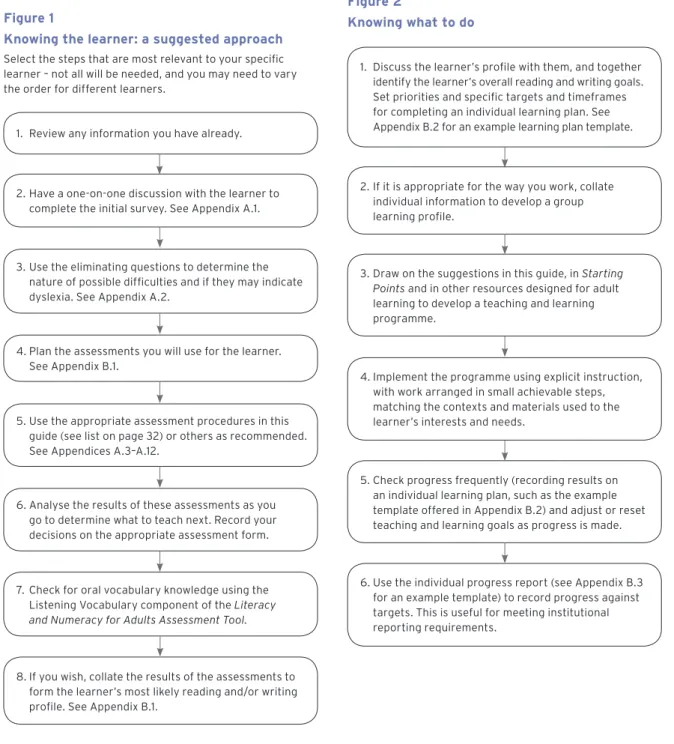
A suggested approach to knowing the learner is set out in Figure 1 below.
Figure
Knowing the learner: a suggested approach
Select the steps that are most relevant to your specific learner – not all will be needed, and you may need to vary the order for different learners.
Figure 2 provides some suggestions for next steps. Figure
Knowing what to do
1. review any information you have already.
2. Have a one-on-one discussion with the learner to complete the initial survey. See Appendix A.1.
3. Use the eliminating questions to determine the nature of possible difficulties and if they may indicate dyslexia. See Appendix A.2.
4. Plan the assessments you will use for the learner. See Appendix B.1.
5. Use the appropriate assessment procedures in this guide (see list on page 32) or others as recommended. See Appendices A.3–A.12.
6. Analyse the results of these assessments as you go to determine what to teach next. record your decisions on the appropriate assessment form.
7. Check for oral vocabulary knowledge using the Listening Vocabulary component of the Literacy and Numeracy for Adults Assessment Tool.
8. If you wish, collate the results of the assessments to form the learner’s most likely reading and/or writing profile. See Appendix B.1.
1. Discuss the learner’s profile with them, and together identify the learner’s overall reading and writing goals. Set priorities and specific targets and timeframes for completing an individual learning plan. See Appendix B.2 for an example learning plan template.
2. If it is appropriate for the way you work, collate individual information to develop a group learning profile.
3. Draw on the suggestions in this guide, in Starting Points and in other resources designed for adult learning to develop a teaching and learning programme.
4. Implement the programme using explicit instruction, with work arranged in small achievable steps, matching the contexts and materials used to the learner’s interests and needs.
5. Check progress frequently (recording results on an individual learning plan, such as the example template offered in Appendix B.2) and adjust or reset teaching and learning goals as progress is made.
6. Use the individual progress report (see Appendix B.3 for an example template) to record progress against targets. This is useful for meeting institutional reporting requirements.
initial survey
Adult learners bring a lifetime of lived experiences with them (based on their culture, language and identity), and many will come from cultures where written language and formal learning may be valued differently from how these are valued in your own culture.
An initial survey of an adult learner’s education and language background will provide you with information that can set the scene for more detailed assessments. It also gives the learner an opportunity to share their experiences and aspirations, thus starting a conversation that will enable you to take their social and cultural background into account in future learning and assessment situations.
Use the survey with sensitivity, especially if you become aware that the learner has had little or no formal education or comes from an oral/aural tradition. The adult learner may have chosen to attend literacy classes, but the value they attach to reading and writing may be very different from your own or from that of the institution they attend. The initial survey offered in Appendix A.1 should be conducted as a one-on-one informal interview (rather than as a test), preferably early in the year or early in the course. Try to help the learner feel comfortable and relaxed, and complete the survey in stages for those learners who are new to the classroom environment. Conduct the survey orally and note down the learner’s responses yourself; learners are not expected to read the survey themselves or to write their own responses.
How to administer and use the initial survey The initial survey should be conducted in a relaxed, informal, private atmosphere.
Explain what the survey involves (27 questions that will give you a greater understanding of the learner’s background) and why you are using it (to help you develop a learning programme that will best meet the learner’s specific needs).
reassure the learner about confidentiality and explain how anything you write down will be used. Questions in bold-faced italics are for English as a second/other language adults only. Questions 13, 14, 15 are not appropriate for adults who have yet to experience any formal schooling, for example, some refugees. read each question aloud and make brief notes about the learner’s response each time. Check that what you write is what the learner meant: read back your notes to the learner if necessary.
If there are too many questions for one session, agree to meet again to finish the survey. If you think it appropriate, work through the eliminating questions (Appendix A.2) together at the end of the initial survey or at a later stage. Draw the conversation to a close and answer any questions the learner has about the survey or their learning programme. Explain that you will probably be using further assessments to find out exactly what the learner knows. Describe how these assessments will help you to plan goals and instruction together.
You may want to offer the learner a copy of the survey to take away and share with others.
What to do next
go over the notes you made and highlight areas you think will be important to pursue, for example, you may need to use the eliminating questions or explore English language knowledge further.
As you carry out further assessments, refer to the survey to help you make connections that will be useful (for example, a lack of schooling in their early years may have impacted on the adult learner’s ability to form letters legibly). File your copy of the survey immediately and securely.
You may also choose to use the Attitude to reading Survey in Teaching Adults to read with Understanding (Tertiary Education Commission 2008d), but the reading level in that survey may be beyond your learner’s abilities.
Eliminating questions
Educators need to determine if any other factors may have affected the adult learner’s ability to learn to read; such factors include hearing loss, poor vision or specific speech/language problems or attention difficulties.
Appendix A.2 contains a list of eliminating questions that can provide further support when you are trying to determine the possible causes of persistent difficulties that an adult learner is experiencing in reading and writing.
dyslexia and other reading and writing
difficulties
Dyslexia in children has been defined by Tunmer (2009) as “persistent literacy learning difficulties (especially difficulties with word recognition, spelling and phonological recoding) in otherwise
typically developing children (ie, those who do
not satisfy the standard criteria for being excluded from the diagnosis of dyslexia) despite exposure to high-quality evidence-based instruction
and intervention due to an impairment in the
phonological processing skills required to learn to read and write.” (Emphasis added.)
The emphasis has been added to help us understand that dyslexia is not a catch-all term that can be applied to all children and adults who have failed to learn to read and write adequately; there are several important factors to consider before applying the term.
One model that is useful for understanding reading difficulties compares two factors in terms of their impact on reading: listening comprehension and decoding (word identification). In this model, ‘dyslexia’ only applies to the second group described below: 1. Adults who have good listening comprehension
and good decoding skills will be competent readers. 2. Adults who have good listening comprehension
but poor decoding skills will be able to understand texts they hear but will not be able to read such texts efficiently themselves;
3. Adults who have poor listening comprehension and good decoding skills will be able to decode texts but will not understand them well; this may include adults whose first language is not English.
4. Adults who have poor listening comprehension and poor decoding skills will have multiple instructional needs, and educators will need to use careful assessment to determine a suitable sequence and mix of learning goals. (Adapted from Tunmer, 2008)
The eliminating questions in Appendix A.2 (for the educator not the adult learner) can be used in conjunction with the initial survey (see above and Appendix A.1) to build a more complete picture of the learner in the context of the social, cultural and educational aspects of their life.
oral language
Oral language underpins all learning and all social, community and workplace interactions.1 It is the medium through which most adult learning (formal and informal; in, on and off the job) is conveyed. The ability to use oral language effectively enables adults to learn, apply their learning and address the challenges of social, community, workplace and technological changes.
The Ma–ori culture is underpinned by an oral history, and oral language is the mode through which most teaching and learning is conveyed. A strong listening and speaking culture continues in many contemporary extensions of Ma–ori life today. This may be an area of relative strength for Ma–ori learners in particular, and one you can build on to develop oral language further.
readers’ understanding of a written text is based on their understanding of the meanings of most words in the text and on their understanding of the structures of language. readers need to have an extensive and extending oral vocabulary and knowledge of how words work together to be able to comprehend the range and variety of reading they want and/or need to do.
Writers need to communicate their ideas, information and thoughts. They need to have something to say. Without the ability to use and understand oral (or signed) language, a person will not be able to convey anything meaningful in writing.
For these reasons, oral language assessment is an important step in finding out about adult learners who have reading and/or writing problems. Keep in mind that assessing expressive oral language is complicated by the assessment context and by the relationship between the assessor and the person being assessed. Even fluent speakers are daunted in some situations, such as in an assessment. When an adult learner is feeling anxious and fearful about talking, there is a danger of assuming they lack oral language. An adult learner may have some
gaps, for example, in vocabulary, but still be an effective oral communicator. A gap in one area does not mean a person has ‘weak’ oral language.
How to assess oral language
Use the indicators of listening and speaking issues on page 9 of Teaching Adults to Listen and Speak to Communicate (Tertiary Education Commission, 2009) to assess the learner’s oral language and, if necessary, follow up this assessment with observations of listening and speaking behaviours, using Appendix A.3: Oral language as a guide.
This assessment should not be conducted as a checklist. Make brief notes as you observe the learner, using the prompts or suggestions that are most appropriate for that learner. Observe the learner in a variety of situations and contexts. You may also be able to use the initial survey discussion as a basis for observing the learner’s oral language skills.
What to do next
If your observations show that the learner is having difficulties with some areas of oral language or contexts, follow up with more specific observations or carry out diagnostic speaking or listening assessments as described in Teaching Adults to Listen and Speak to Communicate, pages 62–81. Questions that will help you assess listening comprehension can be found in Appendix A.12.
If your observations show that the learner requires a lot of work on oral language structure and use, it will probably be more productive to spend time building the learner’s control of these skills before proceeding into reading and writing assessment and instruction. refer also to other English language learning resources.
What to do next (continued)
Focus on the aspects of oral language that are most important for the learner, for example, extending academic or topic-specific vocabulary. Provide many and varied opportunities for the learner to engage in oral language, for example, through discussions, group work, speaking on a topic, listening to texts that are read aloud then discussing the texts, etc.
Use the teaching suggestions in Teaching Adults to Listen and Speak to Communicate, pages 19–55.
Vocabulary
Vocabulary refers to the words and phrases that a person knows and uses. Vocabulary is often referred to as receptive (listening and reading) and productive (speaking and writing). A person’s receptive vocabulary will usually be larger than their productive vocabulary. Knowledge of vocabulary includes understanding how words work in relation to each other and within specific contexts.
New Zealand adults need a vocabulary of around 9,000 word families in order to read everyday texts such as newspapers and websites.2 This vocabulary also enables adults to meet most of the writing demands they encounter.
How to assess listening vocabulary From early 2011, the Literacy and Numeracy for Adults Assessment Tool (Tertiary Education Commission, 2010) is including an assessment for listening vocabulary.
You may want to use the oral language assessment suggestions offered in this guide (Appendix A.3) to ascertain a learner’s understanding of words in familiar contexts. What to do next
If your assessment shows that the learner’s listening vocabulary is well below the expected level, you will need to plan for a lot of oral language work. This should include a variety of activities, such as listening to texts read aloud (taped books are helpful), explicitly teaching words that the learner needs to know, analysing words, building word banks for different contexts and purposes, and offering many opportunities for the learner to listen as they read.
rather than waiting for the learner’s reading skills to catch up, you can provide them with access to a large supply of materials they can listen to in order to increase their exposure to vocabulary. This can include encouraging the learner to listen to audio recordings and the radio and by routinely reading a wide and eclectic variety of materials aloud to the learner.
Most ESOL resources will give advice on ways of extending English vocabulary knowledge in adults who are learning English.
See the suggestions in Starting Points (pages 14-17) and in the resource book, Teaching Adults to Listen and Speak to Communicate. See also the teaching notes that accompany the reading Collections resources that are available at the Literacy and Numeracy for Adults website (see Useful sources and links).
Phonological awareness
syllable awareness
A syllable is a unit of speech that has a vowel phoneme. Words can be heard (and spoken) as segments or parts, where each segment has a vowel sound alone, or as a vowel sound with one or more consonants. These are units of speech not of writing. The different vowel phonemes heard in syllables are coded in a special way in English writing so speakers know how to pronounce their sounds. Here are six main ways in which syllables are coded: 1. Closed syllables, which have a consonant after
the vowel sound and the vowel is usually short (end, tap, sit, hop, pup)
2. Open syllables, which have a vowel sound at the end and the vowel is usually long (me, we, see, high/hi, low, be/fore, the syllables u and a in sit/u/a/tion)
3. Vowel-consonant-e syllables, which have a final e that makes the vowel long (take, these, use, home, ice, Pete)
4. Vowel digraphs or vowel pair syllables, which have a pair of vowels that make a long, short or diphthong sound (rain, plait, greed, eat, toil, out, cause)
5. Consonant-le syllables, which usually start with a consonant that is part of the syllable; the preceding syllable will be open, if it does not have a final consonant (tum/ble, ta/ble, twin/kle, sta/ble)
6. r -controlled syllables in which the presence of the r after a vowel controls the sound of the vowel (star, corn, fern, bird, church). (Adapted from Henry, 2003, page 37, and Fry and Kress, 2006, pages 7 and 47)
The ability to hear and work with the sounds in words is known as phonological awareness. It is an awareness that operates at different levels and becomes increasingly fine-grained, involving awareness at the levels of whole word, syllable, onset rime and, finally, phoneme. See Starting Points, page 18 for more information about these four levels of awareness.
Note that knowledge of letter-sound relationships and sound-letter relationships are dealt with separately in this guide because phonological awareness does not involve print. It is important that the learner can distinguish and manipulate sounds aurally before they can be expected to relate the sounds to print representations, although working with sounds and letters together becomes helpful as the learner develops their awareness of sounds.
Most of the skills or rules needed for developing phonological awareness are finite – this means that although such knowledge is essential, there is a relatively small set of items to be learnt. This includes knowledge of the 42–46 phonemes in standard English. The skills can be assessed and taught in terms of knowledge of initial consonants, final consonants, onset-rime patterns, vowel patterns, segmentation and blending.
Once assessment has revealed the true level of a learner’s knowledge, instruction can focus on missing items in a structured and sequential way.
esOL learners
An adult whose first language is not English may need to overcome considerable barriers in order to develop phonological awareness. refer to Learning Progressions for Adult Literacy and Numeracy: Background Information, page 19 (Tertiary Education Commission, 2008b). If necessary, seek advice and support for assessment from specialist ESOL educators.
Find opportunities in a wide variety of contexts and materials to highlight syllables.
See the activities on page 21 of Starting Points.
Onset-rime awareness
Onsets and rimes are heard within the syllable, and this is therefore a finer-grained level of phonological awareness. A starting point for this awareness is the ability to detect rhyming words: the popularity of rhyming in hip hop and rap music may have a positive spin-off in helping learners to listen for rhyme. ‘rhyme’ usually refers to the whole word (night, fight), but the rime is the vowel and last part of the syllable or word (-ight). Exploring onsets and rimes within syllables can help establish a learner’s awareness for hearing individual phonemes, an essential skill for decoding and encoding text.
The onset in a syllable is the consonant or set of consonants that come before the vowel, and the rime contains the vowel that follows the onset plus any following consonants. Here are some examples of onsets and rimes:
• In the word cat, the onset is /c/ and the rime is /at/. • In the word black, the onset is /bl/ and the rime
is /ack/.
• In the first syllable of the word contact, the onset is /c/ and the rime is /on/.
• In the second syllable of the word contact, the onset is /t/ and the rime is /act/.
Note that a syllable can have a rime without an onset, for example:
• In the word air, there is no onset and the rime is /air/.
How to assess syllable awareness Use the ideas in Starting Points, page 20. Using a copy of the Appendix A.4: Syllable awareness assessment, read the words aloud, with the learner clapping out the syllables, repeating or finishing incomplete words. Use the bolded words as examples to practise with, supporting and giving feedback as necessary. Do not use this activity as a reading exercise for the learner.
Circle words the learner finds difficult. repeat the assessment after a period of instruction and note changes.
What to do next
Syllables in English are easy to hear. Each succeeding syllable in speech is either stressed or unstressed; the breaks can be heard easily. Use this feature to help the learner detect the syllables in the words you say aloud, for example, long words from the newspaper or a notice. Ask the learner to clap the syllables as they hear them.
The same activities suggested for assessment can also be used for instruction. Be aware of the kinds of syllables the learner has trouble with (using the list in Appendix A.4: Syllable awareness) and teach the ‘rules’ or types of syllable explicitly. Do not teach items the learner is already using.
A learner who is not able to segment long words into syllables can be taught to identify different kinds of syllables in monosyllabic words first. They can then use this knowledge to hear syllables within multisyllabic words. For example: John/ny (two syllables); Depp (one syllable); po/lice (two syllables); crack/ down (two syllables); as/sault (two syllables); in/tim/id/a/tion (five syllables).
How to assess onset-rime awareness Using a copy of the Appendix A.5: Onset-rime awareness assessment, check that the learner can detect and/or manipulate these parts of words. There are examples that you can model and let the learner practise.
The first section checks for the learner’s ability to detect rhymes. If the learner cannot do this, do not proceed with the assessment; your instruction should now focus on developing a general awareness of rhyme before moving on to having the learner separate onsets from rimes. It is not necessary to work through all the examples given in the assessment. It will quickly become clear if a learner is or is not aware of the onsets and rimes in words. record the items the learner can hear. Complete the analysis section to determine your next teaching steps.
What to do next
The activities in Appendix A.5 can be used for instruction as well as assessment. Adapt and add examples that are relevant to the learner, using words from contexts that are meaningful for them. Whenever possible, use wordplays and manipulate onsets and rimes for fun, for example, pick up on accidental rhymes that occur and extend them into a brief onset- rime game.
It is important to spend time making sure a learner who is just developing phonological awareness has the time and opportunities to consolidate and gain sound control over the identification of sounds within syllables before moving on to identifying individual phonemes.
Take advantage of any interest your learner might show for rap or hip hop music to focus on the ways in which rhyme can be used. Learners can work together to create their own raps by manipulating the onsets and rimes in familiar raps. Oral onset and rime activities can be linked with reading and spelling as the learner develops awareness, giving support for making connections between hearing sounds and recognising them in print. They also support making analogies (If I know the sounds of the words blue and hand, I can work out the word bland), exploring morphological (spelling) patterns and word families.
See Starting Points, pages 21–22, for further teaching ideas.
Phonemic awareness
Phonemic awareness is the most difficult level of phonological awareness. It is gained through hearing language used. Most children pick it up easily, but some do not acquire it naturally. Many adults who experience difficulties in reading lack phonemic awareness. This, in turn, impacts on their ability to decode. Often, instruction ends at initial recognition of the sounds that letters represent, but if a learner is not able to blend and manipulate phonemes, they will experience decoding difficulties. research shows that adults who have not learnt to read will have little or no phonemic awareness, but they can benefit from instruction aimed at building this awareness (McShane, 2005, page 35). For some learners, you will need to go back to the whole-word, syllable or onset-rime level to develop awareness before you can assess or work with them on developing an awareness of individual phonemes.
How to assess phonemic awareness Check that the learner is able to manipulate sounds at this level, then use the tasks in Appendix A.6: Phonemic awareness to determine the extent of the learner’s phonemic awareness. This is an extended version of the assessment tasks in Starting Points, page 21, and includes some overlaps with the onset-rime tasks in Appendix A.5. Thus you can also use that assessment activity to help indicate a learner’s knowledge of the sounds of phonemes, in particular the phonemes that form many common onsets.
Take time to explain and model what you want the learner to do before recording their responses to the tasks.
It is not necessary to have the learner complete all the examples.
Whenever possible, check for awareness in ‘real’ situations, for example, use a discussion of workplace safety rules to focus on the /p/ sounds in “Personal Protective Equipment”. record results, noting how difficult or easy the learner found each task. Enter the next teaching steps in the analysis part of Appendix A.6.
What to do next
If the learner is able to detect and manipulate phonemes with ease, move onto associating sounds with letters and other components of reading and writing such as vocabulary development and comprehension. There is no point teaching a person something they already know.
For a learner whose performance on these tasks is erratic, focus on building whatever strengths the learner does have, using a wide variety of contexts and materials that are relevant to them.
Focus on one or two types of phonemic awareness tasks (these are the same as those used for assessment) at a time.
Introduce the phonemes of initial consonants before final consonants, then vowel patterns (for example, th/ing, s/ing; th/ing, th/ink). Segmenting and blending are probably the most useful phonemic awareness skills for adult learners to develop (for example, /b-a-g/; /t-r-u-ck/). Start to introduce letters as well as sounds. For example, use letter cards as the learner produces the sounds represented by the letters.
Concepts about print
The conventions and practices of using print in English form a body of knowledge that every reader and writer needs to master. These include: the parts of a book, left to right text direction, return sweep at the end of a line, one-to-one matching, word and sentence boundaries and simple text features. This knowledge usually develops through exposure to print from an early age. Where an adult does not have this knowledge (or if their knowledge is incomplete), the concepts can be taught and learnt relatively quickly.
Some adults will have experiences and knowledge of reading in languages that have other conventions. For example, Arabic texts are read from right to left. Finding out about the print experience and knowledge that a learner has already can provide points of comparison that will help you explain and teach English print conventions.
How to assess concepts about print You can assess a learner’s knowledge of print concepts by observation, either as the learner handles and uses a variety of print examples or by using the assessment process described in Appendix A.7: Print concepts.
Using observations
Combine observations with teaching activities so you can model, assess and teach concepts at the same time.
Look for the ways the learner demonstrates their knowledge of how texts work. For example, recognising that print carries a message; holding books, magazines, papers correctly; turning pages in order; seeking information (pictures or words) in a text; identifying titles and authors; following with their eyes on the text when you are reading out loud to them.
Note any areas that you think may need closer observation and use the assessment tool for this. Using the assessment tool in Appendix A.7 Use the story “Volunteer Work” from
Collections 4: Someone I Could Look Up To (see Useful sources and links, page 64) and work with a copy of Appendix A.7. Alternatively, you could use the same questions from Appendix A.7 on a different, less-dense text, first making sure that the questions will still ‘work’.
read the story through yourself first to make sure you know where the items discussed in the assessment can be found. For example, for question 12, locate the capital letters and matching lower case letters on the page. Be sensitive to the needs of the learner while conducting the assessment and make sure the learner is in a comfortable learning environment that provides some privacy. Explain the purpose of the assessment to the learner (to find any aspects of using texts that might be confusing for them). Tell the learner that this is not a reading test; you will read aloud to them and ask them questions about the text as you go.
Show the learner the book and turn to page 21. Hold the book so you can both see it clearly. read the text aloud from the book and follow the instructions and questions given in Appendix A.7. Use the analysis section to note the learner’s responses as you go, or use a voice recorder (with the learner’s permission). Once you have completed the assessment activity, recap briefly on items the learner knows well and those you could work on together. Set teaching targets and record these targets on the assessment form.
What to do next
The adults who are most likely to lack confidence with print are those who have come from a non-English and/or non-written language background.
Spend time using approaches such as shared and paired reading and reading aloud, using a wide variety of books, magazines and other texts that are relevant to the learner.
See Starting Points, pages 28–29, for suggestions for teaching.
Letter identification
Knowing the names of the letters of the alphabet is one part of becoming a reader and a writer. Along with learning the names, a learner needs to know the sounds associated with each letter. An adult who cannot yet recognise all the letters in both upper and lower case is at a disadvantage when they need to make connections between the sounds of English words and the representation of those sounds in print. The more control the learner has over this basic information, the more flexibility they will have when making connections between print and sounds.
Luckily, this is a finite information set. A learner can be assessed for their knowledge quickly, and any gaps can be filled with specific instruction.
Letter-sound and sound-letter
knowledge
Letter-sound correspondences are the relationships between letters (or graphemes) and sounds (or phonemes). Knowledge of letter-sound relationships means knowing, for example, that the letter t represents the sound /t/. It also means knowing that the letter c can represent more than one sound, for example, the sound /k/ as in cat and the sound /s/ as in city. Knowledge of sound-letter relationships means knowing which letters to use in order to encode the sounds of words.
To decode (sound out) unfamiliar words, a learner needs to have a level of phonemic awareness (see page 16) and know the relationships between the written forms of letters and the sounds they represent (the common letter-sound relationships). The same is true in reverse for writing: a writer needs to be able to write the correct letters for the sounds of the words they wish to encode (the sound-letter relationships).
Many adults who are non-readers and/or writers have trouble identifying these relationships between letters and sounds.
A learner’s knowledge of the names of letters and the sounds made by the letters of the alphabet can be checked using a letter identification tool. It is important to identify letters that need to be taught and not to waste time ‘teaching’ those the learner already knows.
How to assess letter identification
Use the list of letters supplied in Appendix A.8: Letter identification, showing all the letters in the English alphabet in both upper and lower case forms. Make two copies of the page and laminate one copy. Use the other copy to record the learner’s results in the analysis section of Appendix A.8.
Don’t try to complete all the assessment at one time if the learner shows any signs of having difficulties. Work through a few rows only, then return to the next rows on subsequent occasions. Explain that the activity will determine the letters the learner knows and will show any they need to learn.
record the letters that need to be taught and set teaching targets for them.
See Starting Points, page 24, for more detailed instructions on using this tool.
Alternatively, you may wish to use an assessment such as the Letter-Sound Knowledge check in Spelling Under Scrutiny (Allcock, 2002), page 39.
What to do next
Use a variety of methods to teach the letter names and sounds the learner does not know, making sure that both upper and lower case letters are secure. This can be done across a wide variety of contexts and using materials that are relevant to the learner.
See Starting Points, pages 24–25, for suggestions for instruction.
Decoding
Decoding is the ability to read words by translating the written symbols into the sounds of spoken language (orally or silently).
“Even if we keep in mind the caveat that reading is more than word recognition, … the active processing of sentences and paragraphs cannot occur unless the reader can recognise individual words reliably and efficiently. That is why learning to decode is so important.” (Pressley, 2006, page 52) In order to decode, a learner needs to have some basic understandings about print and how it relates to spoken English. These understandings include knowledge of the alphabetic principle. This means knowing that speech can be turned into print, that print can be turned into speech and that letters are the symbols used to represent sounds in the English language.
Other understandings include phonological awareness, concepts about print, grapheme-phoneme knowledge, word analysis and the use of visual memory to store a bank of words that can be retrieved automatically (sight word recognition). Assessment of decoding is best conducted using non-words. That is, made-up words for which ‘sounding out’ letter by letter will work. reading these words tests a learner’s ‘cipher’ knowledge – the ability to map letter-sounds to spoken words. Tools for assessment use made-up (non-) words and are carefully constructed to ensure most of the possible sounds in English and the ways they can be represented in phonetically regular writing are checked.
Non-words (also known as pseudowords) are used to avoid a learner relying on their existing knowledge of written, real words. These
pseudowords will be unfamiliar and unsupported by meaning and therefore must be sounded out. The assessment tools can show exactly which letter-sound relationships a learner knows or does not
How to assess decoding
Select one of the two tools described below to use in your assessment.
1. Bryant Test of Basic Decoding Skills (Bryant, 1975)
The Bryant Test takes about five minutes to administer. The purpose of the test is to assess a learner’s knowledge of letter-sound relationships (such as single consonants, short vowels, long vowels, consonant blends, consonant digraphs). It does this by using 50 made-up or pseudowords (non-words). An adapted version of this test appears in Appendix A.9: Decoding. Use a copy of the learner’s version (Appendix A.9a) (you may wish to laminate it for reuse) and one recording sheet for each learner. The Bryant Test words have been arranged in three lists of increasing complexity.
Explain that the task is to read the non-words on the sheet. Tell the learner to use what they know about how words work, but not to spend too long on any single word. It is ok to move on rather than stay stuck.
Show the words from one list at a time, covering the other lists to minimise confusion. Mark the recording sheet by writing down the exact sounds made by the learner as they say each non-word.
Stop when the learner is struggling or when you feel they have had enough for the session. Tell the learner you will ask them to try some more words on another occasion.
On the recording sheet, place a tick next to correctly read non-words. Use the pronunciation guide to determine the correct reading of each non-word. If a non-word is not read correctly, write down what the learner says. Later, when
How to assess decoding (continued) you will want to note the sounds the learner was not able to identify correctly and/or any confusions they have. For example, a learner may say bef instead of buf (indicating there may be confusion between short /e/ and short /u/ sounds), or they may say job instead of jod, indicating confusion with the consonants /b/ and /d/.
These errors will indicate the letter-sound relationships you need to teach. Complete the analysis by using your judgment to decide the degree of mastery shown.
2. Sylvia greene’s Informal Word Analysis Inventory, available at www.nifl.gov/ readingprofiles/PF_Sg_All_Docs.htm This tool uses real words (including some names) organised into two levels. It has clear instructions for checking both decoding and encoding (spelling) and lists the knowledge that is being tested for each item. For example, rig tests for the short /i/ sound and the sound of the letters /r/ and /g/.
What to do next
The results of assessments such as these will show which letter-sound relationships are secure and which need to be taught. If a learner can get well through the lists of words, then you will not need to spend any more time teaching letter-sound relationships.
Teach the specific sounds a learner had trouble with, giving many opportunities for the learner to identify the sounds and map them onto words in print. This should include examples found in many different materials that the learner uses or sees in their daily work. reassess the learner as they increase their knowledge, recording results in the same way each time.
Word analysis
As the learner develops their decoding abilities, they will also be building their morphological awareness, for example, that -ed means past tense; that a final -s means plural; that -er and -ian mean someone who does something (plumber, technician). This is the ability to identify meaningful units within a word. This awareness is important for word analysis in reading and spelling because morphemes tend to be spelt consistently across words, despite changes in phonology. More evidence is emerging on the effectiveness of integrating phonological and morphological knowledge for adults with reading difficulties (gillon et al., n.d., page 18).
Adults with very low reading skills will start to gain and use this awareness and will be able to operate on the early steps of the learning progression for decoding (reading) and spelling or encoding (writing). It is not necessary or appropriate to assess word analysis with the adult learners for whom this guide is designed.
Sight words are those that a person recognises instantly, on sight, without needing to pause to decode. They are stored in visual memory, and this instant retrieval is known as ‘automaticity’. recognising words automatically in written English is a key skill in literacy development because it produces faster reading. The ability to recognise even a few words automatically also gives the learner a point from which to increase the number of words they know. Moreover, it helps with the development of phonological awareness. High-frequency words (the words that appear most frequently in written English) need to be recognised instantly simply because they appear so often in reading. Fluency and comprehension both rely heavily on the reader’s ability to recognise words without needing to pause and use valuable cognitive capacity to decode before reading on. Many words commonly found in the environment are recognised on sight (see Starting Points, “Environmental print”, page 33 ff.). Likewise, many words that are of particular significance to a person, such as their name and address, and words they have to read very often, will be recognised instantly (see Starting Points, page 36 ff.). Alongside learning to decode, learners have to be able to draw on their visual memory for the high-frequency words that do not conform to regular sound/letter relationships. These are words that are not phonetically regular. You can assess for knowledge of these words, then teach the missing essential words systematically. Most common words just need to be learnt.
Learning by rote (for example, with words written on index cards) is important because if the learner can’t say the word in isolation, they will usually not be able to recognise it in context.
“The ability to read words even when there are no semantic context cues (e.g. on a flash card with only
How to assess sight word recognition Make two copies of Appendix A.10: Sight word recognition in this guide and laminate one copy. Use the other copy for recording a learner’s individual assessment. The appendix lists 60 words from Fry and Kress’ first 100 words (2006). These are the high-frequency words and include some words that are not in Dolch (1948). Some simple decodable words have been omitted.
Tell the learner the list they will be shown contains 60 of the most common words found in reading and explain why it is important to know these words off by heart. Tell the learner that by going through the list, you will find out which words they know already and which ones you will teach.
Mask the list to show only one row at a time and ask the learner to read the words as quickly as they can. If the learner pauses for very long on a word, ask them to move onto the next word. Stop the assessment if it is obviously too difficult.
Mark the words that the learner gets correct as you go. You may wish to use a stopwatch and time the reading as an incentive for the learner. At the end, point out the words the learner knows and discuss the ones you will be teaching. Set teaching targets (for example, if there are several words to be taught, group them and specify the words you will be teaching as separate targets) and record these words on the analysis section of Appendix A.10.
How to assess sight word recognition (continued)
If you work with the learner daily, you could select one group of unknown words to check at a time. Write the words on index cards for the learner to memorise. Each day, check the words they have learnt along with more words from the list (to make up to 10 words in total). This keeps the tasks manageable and current and easy to complete very quickly.
What to do next
To demonstrate the importance of high-frequency (often short, single-syllable words such as for, was, is), ask the learner to skim a page of any text and notice the words that appear over and over. They don’t need to be able to read the words to do this. Explain that there are about 100 words that account for half of all the words in print. Knowing these words means being able to read a lot more than they might think!
Use a variety of methods to teach the words a learner needs to know.
Words written on index cards, with each learner having their own set of 5 to 10 words to learn, provide a quick and efficient way to give a learner a manageable task.
review the cards daily until the learner can read the words quickly.
reinforce the learning by asking the learner to look in other places for the words they are learning, for example, in the newspaper, on posters and in advertisements.
If it is appropriate to the teaching situation and the learner’s needs, use a word wall. Arrange word cards, in alphabetical order, on a space on a wall. Write the words large enough to be read from a distance. The learners can place words on the wall, and you can refer to the wall for rapid revision many times throughout the day. Adapt the suggestions in Starting Points for teaching environmental print (pages 34–35) and high-interest words (pages 37–38).
Letter formation
The prerequisite skill for writing by hand is to be able to form the letters of the alphabet.
See the section on letter formation in Starting Points, pages 30–32.
remember the importance of identifying exactly which letters need to be taught and only teaching those letters.
Encoding/spelling
Writers use a variety of knowledge, skills and awareness when they encode or spell words, including: • phonemic awareness
• phoneme-grapheme (sound-letter) knowledge • encoding knowledge of whole words that are
phonetically regular
• visual memory to write an increasing number of words automatically (especially high-frequency words)
• orthographic and morphological knowledge. It is not appropriate to assess all of these in a learner who is at or below the first step of the spelling progression.
Phonemic awareness has been discussed earlier in this guide; the other four skills are described in more detail below.
Phoneme-grapheme (sound-letter)
knowledge
To form words, a writer needs to be able to turn the sounds they wish to convey into letters. A learner needs to use knowledge of letter formation and phonemic awareness to do this.
How to assess phoneme-grapheme (sound-letter) knowledge
Use a tool such as “Sound-Letter Knowledge” (Allcock, 2002). This tool asks the learner to write down the letter that makes the sound that is highlighted in each word that is read aloud to them from a list. It is important to note that this is not a spelling test: it is a way of checking the learner’s ability to write an acceptable letter for a sound.
What to do next
Most of the suggestions for teaching letter-sound knowledge are suitable for teaching a learner the letters that relate to the sounds they hear and wish to record.
encoding knowledge
To determine a learner’s ability to encode (spell) words that are phonetically regular, use selected parts of a decoding assessment such as that supplied in Appendix A.9: Decoding. You can then focus instruction on the letter combinations and spelling patterns that the learner does not know. See also “Pseudoword Spelling” (Allcock, 2002, pages 41–43).
Allcock also provides tests that can be used to check for knowledge of blends and ‘H’ digraphs (pages 44–46).
Visual memory
As well as having a bank of words for reading stored in their visual memory, a learner needs to have a bank of words in their visual memory they can retrieve for writing quickly and accurately. This may be one and the same bank of words, but a learner’s ability to retrieve a word from visual memory for spelling might lag behind their ability to retrieve the same word for reading.
Many of the most frequently used words in written English are not phonetically regular and so must be learnt by heart.
How to assess the writing of high-frequency words
The list of words in Appendix A.10: Sight word recognition can also be used to assess a learner’s ability to write these high-frequency words quickly and accurately.
Make a copy of Appendix A.11: Spelling for the learner to write the words on as you read them out loud from the list in Appendix A.10.
Then develop a similar list of words to that supplied in Appendix A.10 and again read the list aloud, with the learner writing down each word as they hear it. You may wish to conduct this assessment in sections over a period of time (for example 20 words or fewer at a time). You can also assess the high-frequency words in other work completed by the learner and note any incorrectly spelt words.
Prompt the learner to move on if they are stuck on a word, and stop them if they are struggling to write several words in succession. Note that the words are not listed in order of difficulty. At the end, point out the words the learner knows and discuss the ones you will be teaching. Alternatively, if you work with the learner daily, you could select 10 words from the list to check once a day. Write the unknown words on index cards for the learner to memorise. Each day, check the words they have learnt along with more words from the list (to make up to 10 words in total). This keeps the tasks manageable and current, and easy to complete very quickly. Analysis of errors is an important way of identifying a learner’s knowledge.
What to do next
Use the list of the essential words the learner needs to be taught, based on the assessment. give the learner a copy and use a variety of methods to ‘drill’ these words so they become automatic. Many of the teaching methods used can be the same as those used for reading sight words.
For writing other words, encourage the learner to use their phonological skills to spell words according to each sound, for example, rid for ride; kros for cross. Over time, encourage the learner to notice spelling patterns (for example, pointing out the silent e rule), then show the learner how to use this knowledge to work towards correct spelling.
As more words are committed to memory, encourage the learner to use the words frequently in writing for a variety of purposes and in many different contexts.
Orthographic and morphological
knowledge
As well as being able to spell based on sound-letter knowledge and visual memory, a writer uses their knowledge of spelling patterns (orthographic knowledge) and the rules or conventions of spelling (morphological knowledge) to write words. Knowledge and use of these aspects of spelling increase as a learner increases the amount of reading and writing they are able to do.
Although there are many aspects of spelling that can and will need to be taught, the scope of this guide is limited to learners who are operating at or below the first step of the spelling progression. See other resources such as Investigations (on the Literacy and Numeracy for Adults website) and Spelling Under Scrutiny (Allcock, 2002) for assessment and instructional support.
Fluency
A fluent reader is one who can read a text accurately and quickly. A fluent reader can focus on meaning because they are not using excessive cognitive capacity to decode individual words. Likewise, a fluent writer is able to carry an idea in their head and write it down at the same time. Although fluency is an important component of reading and writing, it is not appropriate to assess for it with a learner who is operating at or below the first step of the learning progressions. Before fluency can develop, a learner needs to have mastered basic decoding/encoding and automaticity of word retrieval. They will be reading and writing little connected text beyond simple sentences. As the learner builds up their skills and concepts of print carrying meaning, they will be working towards the overall goal of becoming fluent readers and writers.
This does not mean fluency should be ignored: as you read aloud or write to demonstrate skills, you will be modelling fluency. This may also be observed as the learner listens to others read and speak or writes for others. As the learner’s skills develop, you can, for example, support fluent reading by supplying taped versions of texts they can listen to at the same time as they read. The reading Collections books (found at www. literacyandnumeracyforadults.ac.nz/Learner-resources) all include audio support. repeatedly reading and listening to a text can help cement the relationship between the individual words on the page and the meaning of the text.
Practitioner guide: Improving reading Phonics and Fluency (Burton et al., 2008) offers many excellent suggestions for developing fluency. The authors stress that fluency should not be taught instead of phonics; rather they are both important factors in reading (and writing) success.
Listening comprehension
In the earliest stages of reading, an adult learner will not be ready for a full assessment of their reading comprehension skills because they will not be able to decode enough connected text for such assessment to be meaningful.
It is appropriate and important though to check a learner’s understandings about text.
Pressley (2006) describes the different actions, attitudes or behaviours that good readers use when they read. For a learner who is below or at the first step of the reading comprehension progression, you can expect that they will at least:
• have some awareness of their purposes for reading
• expect that texts will make sense
• use strategies to read short, simple texts with support.
The listening vocabulary component of the Literacy and Numeracy for Adults Assessment Tool (Tertiary Education Commission, 2010) will help you identify the extent of a learner’s vocabulary, a prerequisite for reading comprehension.
There are other ways in which you can assess aspects of a learner’s comprehension in order to build a relevant learning programme. In particular, it is important to find out if the learner is aware of why they are reading a text and that texts should make sense.
How to assess listening comprehension Appendix A.12: Listening comprehension lists a variety of prompts and questions that you can use to find out what a learner knows and expects from printed texts.
Work through a few of the questions at a time, possibly weaving them into a situation such as shared reading or a group discussion about a text. Use a wide variety of texts, for example, notices and posters, short articles and stories, job advertisements, newspaper items, emails, text messages, instructions and manuals, directions, explanations, recipes and many other materials the learner may be interested in – within limits of course.
Make notes and try to find out what is going on for the learner as they approach and engage (or do not engage) with each text. Why are they interested or not interested in it? Why might they need to read it? Is the text making sense to them? If not, what is going on? Did they understand the purpose? Did they know about the topic?
Choose a selection from one of the reading Collections books (see Useful sources and links, page 64) to read aloud, giving the learner a copy to follow along with as you read. For some adults, you will need to select a simpler, age-appropriate text.
Tell the learner that, as you read the story, you’ll be thinking aloud, asking yourself questions (for example, to predict what might happen) and asking the learner to tell you what they are thinking. As you read, check for understanding by asking some of the questions listed in Appendix A.12.
record areas for explicit instruction on the analysis part of Appendix A.12.
What to do next
Many of the suggestions for assessment can also be used for instruction. Approaches that are particularly useful for developing comprehension are shared reading, reading aloud and using a simple graphic organiser for a specific purpose (such as mapping all the words and ideas the learner already knows about a topic).
Thinking aloud can be done with all of these approaches: when you pause to voice your own processes as you read, the learner can ‘observe’ what an expert reader does. As you read a text out loud, you can stop to reread or restate a tricky part; summarise long sentences using your own words; look back to find a person or thing that a pronoun relates to; identify important and not-so-important information; or use strategies to work out the meaning of an unknown word.
Look through the activities in Teaching Adults to read with Understanding (Tertiary Education Commission, 2008d) and use those that will support your learner, even if you are only able to use very small pieces of text.
Planning and recording, using assessment
information, and reporting
The templates in Appendix B are designed to help you record and collate information for planning. As with the assessment procedures, the reports focus on specific components and are more fine- grained than those in the Learning Progressions for Adult Literacy. They are suggestions only.
Planning and recording
Appendix B.: Decide which assessments you wish
to work through with a learner and enter the date on which you intend to conduct the assessment in the column for each one. After you have conducted each assessment, enter the results (using the scale described below) and note a date on which you would like to reassess, if appropriate. Include any notes or comments on the form.
Develop a learner profile by using a simple three-point scale to guide your actions for different areas of assessment:
SCALE rESULT ACTION
3 The learner is secure on all items.
Move on to regular assessments. 2 The learner is
almost secure on most items.
Continue instruction and practice to consolidate. 1 The learner is
not yet secure on the items.
Provide explicit instruction and many opportunities for practice. This is an oversimplification for some assessments (such as comprehension), but it will give you an indication of whether the learner needs to have more input at the level assessed or if they can now be assessed with the components from the Literacy
using assessment information
Appendix B.: In discussion with the learner, set
individual reading and writing goals. Based on the assessment results, discuss the achievable, small-step targets that will take the learner towards their goals and note the strengths that the learner can build on. Focus first on the essential skills with which the learner will achieve success relatively easily or quickly, for example, letter-sound relationships; a set of 10 sight words; letter formation. For each target, the strengths to build on will usually be the items the learner knew in the assessment.
Make brief notes about the materials and activities you and the learner will be using to meet the targets and set a date for review.
review as decided, noting the progress towards each target. You may need to revisit some of the assessment tools in this guide to determine the exact progress that the learner has made. You may wish to collate information from your learners’ individual profiles to develop a picture of the needs of a group of learners. Use this to help you make decisions about the kind of instruction different learners will need, the materials and activities you can use, and the timeframes you can put around the learning events.
Reporting
Appendix B.: Use this form (or adapt it to meet
your specific needs) when you are required to report on progress and assess outcomes (gains over time). Draw information from the review section of each learner’s individual plan. You may need to reassess to be certain that the targets set have been met. record exactly the items (skills, knowledge, awareness) that have been achieved.
appendices
Contents
appendix a 32
A.1: Initial survey 33
A.2: Eliminating questions 37
A.3: Oral language 39
A.4: Syllable awareness 40 A.5: Onset-rime awareness 4 2 A.6: Phonemic awareness 44 A.7: Concepts about print 46 A.8a: Letter identification (learner’s copy) 48 A.8b: Letter identification (educator’s copy) 49 A.9a: Decoding (learner’s copy) 50 A.9b: Decoding (educator’s copy) 5 1 A.10a: Sight word recognition (learner’s copy) 54 A.10b: Sight word recognition (educator’s copy) 55 A.11:a Spelling (learner’s copy) 56 A.11:b Spelling (educator’s copy) 57 A.12: Listening comprehension 58
appendix B 59
B.1: Individual learner assessment plan and profile 59 B.2: Individual learning plan 60 B.3: Individual progress report (example) 6 1