arXiv:1710.06088v1 [cond-mat.stat-mech] 17 Oct 2017
H. W. J. Bl¨ote1, W.-A. Guo2 and M. P. Nightingale3
1
Instituut Lorentz, Leiden University, P.O. Box 9506, 2300 RA Leiden, The Netherlands
2
Physics Department, Beijing Normal University, Beijing 100875, P. R. China
3
Department of Physics, University of Rhode Island, Kingston RI 02881, USA
E-mail: 1
[email protected], [email protected],
3
Abstract. We study a self-dual generalization of the Baxter-Wu model, employing results obtained by transfer matrix calculations of the magnetic scaling dimension and the free energy. While the pure critical Baxter-Wu model displays the critical behavior of the four-state Potts fixed point in two dimensions, in the sense that logarithmic corrections are absent, the introduction of different couplings in the up-and down triangles moves the model away from this fixed point, so that logarithmic corrections appear. Real couplings move the model into the first-order range, away from the behavior displayed by the nearest-neighbor, four-state Potts model. We also use complex couplings, which bring the model in the opposite direction characterized by the same type of logarithmic corrections as present in the four-state Potts model. Our finite-size analysis confirms in detail the existing renormalization theory describing the immediate vicinity of the four-state Potts fixed point.
PACS numbers: 02.30.Ik, 05.50.+q, 75.10.Hk
1. Introduction
Once upon a time, the idea originated [1] that marginally irrelevant scaling fields can introduce logarithmic corrections to scaling. The two-dimensional, four-state Potts model, for which some exact analysis is possible [2], is a celebrated example of this kind of behavior. Cardy [3] investigated the presence of such corrections to the finite-size scaling behavior of this model. If we denote by v the marginal field, and by L the linear dimension of the system, Cardy considered the effects of multiplicative logarithmic correction factors of the form ckvk/[1−vln(L)/π]k. His approach assumed that v < 0 and lnL ≫ |v|−1, so that the v-dependence vanishes to lowest order of 1/lnL. The numerical data upon which Cardy’s based his analysis were obtained from transfer matrix computations for strips of a limited range of widths L [4], and his analysis was predicated on the assumption that |v|was sufficiently large.
In this paper we study a generalized Baxter-Wu model in which that condition is not always satisfied. As a matter of fact, in our case |v| can be made arbitrarily small, as discussed in greater detail in Sec. 2. Our purpose is to verify the precise form of these logarithmic correction factors, without expanding in 1/lnL.
Other ways to vary the marginal field are the introduction of vacancies [5, 6], of four-spin interactions [7], and of interactions of a sufficiently long range [8]. The marginal field for aq= 4 Potts model with 16 interacting neighbors was found to be very small [8]. However, our analysis will require high-precision data generated by a transfer-matrix method, which would be restricted to small system sizes for the latter model.
Sec. 2 also provides a summary of the scaling theory near the four-state Potts fixed point. It also provides a short description of the generalized Baxter-Wu model, and of the transfer-matrix method employed to generate the finite-size data.
The scaled magnetic gaps are analyzed in Sec. 3, and the free energy data in Sec. 4. We conclude this paper with a short discussion in Sec. 5.
2. Theoretical results
2.1. Renormalization description of the q= 4 Potts model
The relevant theory is based on the renormalization flow scenario as proposed by Nienhuis et al. [5] for the two-dimensional Potts model. For theq= 4 Potts universality class, one considers three scaling fields, namely the temperature field t, the magnetic field h, and the marginal dilution field v. The critical range of the q = 4 Potts model corresponds to v < 0. For q = 4, the renormalization equations of Nauenberg and Scalapino [9] and Cardy [10, 3], and of Salas and Sokal [11], reduce to
dv(x)
dx =πbvv
2(x), dt(x)
dx =
3
2 + 2πbtv(x)
t(x), dh(x) dx =
15
8 + 2πbhv(x)
h(x), (1)
where x parametrizes the scale reduction factor b as ex = b. The coefficients b v = 4/√3, bt =
√
3/2, bh =
√
this renormalization approach leads, for normalized v and a rescaling factor L, to the following scaling equations for t,h and v:
t→t′ =Lyt
z3/4t , h
→h′ =Lyh
z1/16h , v
→v′ =zv , (2)
where the scaling factor z(L) of v depends on Las
z(L) = 1/[1− √4π
3vlnL]. (3)
The consequences of these equations are as follows. For a model with a negative marginal field, |v| will decrease under renormalization, but with an anomalously slow rate if v is small. This leads to the logarithmic corrections seen in the q = 4 Potts model. But for v > 0 the marginal field grows under renormalization, at an increasing rate when v becomes larger. Then, the model renormalizes towards a discontinuity fixed point [12] and the transition becomes discontinuous, as seen in the dilute Potts model [5, 6], in a Potts model with four-spin interactions [7], and in models with interactions of sufficiently long range [8].
Thus the singular part fs of the free energy density f = lnZ scales as
fs(t, h, v, L) =L−2fs(Lyt
z3/4t, Lyh
z1/16h, zv,1), (4)
Here we consider the case of a model wrapped on an infinitely long cylinder with circumference L. According to Cardy [3], for this geometry, expansion of fs in its argument zv leads to vanishing contributions in first and second order. Thus, at t=h= 0,
fs(0,0, v, L) = π 6L2
(
1 + c3v 3
[1− √4π
3vln(L)]
3 +. . .
)
. (5)
Nevertheless, the analytic part of the free energy may still contain contributions in first-and second order of v. As noted by Cardy [3],c3 = 4π3bv is universal if v is normalized. The ratio c3/(bvπ)3 = 3/4 is still universal if v is not normalized. Therefore, if v < 0 and L sufficiently large, one has |vlnL| >> 1 and one may expand in 1/lnL. Then, the lowest-order logarithmic correction term π/[8L2(lnL)3] is independent of v, i.e., universal. However, in the present work, we will also be interested in the extension of this range to|vlnL| ≪1.
The scaling behavior of the scaled, inverse magnetic correlation length Xh(v, L)≡ L/[2πξ(L, v)] can also be expressed as an expansion of the scaling function in the marginal field. In this case there exists a contribution that depends to first-order on v [3]:
Xh(v, L) =Xh+
p1v 1− √4π
3vlnL
+. . . . (6)
where Xh is the magnetic scaling dimension [13]. The ratio p1
√
2.2. The generalized Baxter-Wu model
The proper Baxter-Wu model has been solved exactly [14]. It belongs to the universality class of the four-state Potts model in two dimensions, and has the special property that the marginal scaling field v is exactly zero. Thus, apart from irrelevant fields, the Baxter-Wu model sits precisely at the q = 4 Potts fixed point, and the logarithmic factors mentioned in Sec. 2.1 are absent. Here we consider a generalized Baxter-Wu model with different couplings in the up- and down triangles:
H=−Kup
X
△
σiσjσk−Kdown
X
▽
σlσmσn (7)
where the sums are on the up- and down triangles of the triangular lattice, and the spins σ take the values ±1 and carry a label denoting their lattice site. This model has a line of self-dual points located at [15, 16]
sinh 2Kupsinh 2Kdown= 1 (8)
Defining
Kup=K+ ∆K, Kdown =K −∆K, (9)
the condition for the self-dual line is rewritten as
sinh 2K = cosh 2∆K (10)
Numerical investigation [16] of the model (7) has shown that, for ∆K 6= 0, the model still undergoes a phase transition at the self-dual point, but its location moves away from the q = 4 Potts fixed point, in the direction of positive v. Thus the transition becomes discontinuous for ∆K 6= 0.
Since ∆K is a variable parameter, the generalized Baxter-Wu model enables exploration of the renormalization equations for a range of values of the marginal field v, while the critical point remains exactly known. In view of the symmetry of the model under interchange ofKup and Kdown, one expects thatv ∝∆K2 to lowest order. It may thus seem that this approach is restricted to the range v ≥ 0, but we may also include complex couplings with ∆K =±iφ, so that
Kup=K+ iφ, Kdown =K−iφ . (11)
The condition for the self-dual points of the model, Eq. (10), then translates into
sinh 2K = cos 2φ . (12)
0
0
1
2
3
4
5
BW
∆ K2<0
∆ K2>0
q=4 Potts
v
q
Figure 1. The renormalization flow diagram as proposed by Nienhuis et al. [5] in the critical surface of the Potts model, parametrized by its number of states q and the activity of the Potts vacanciesv. The blue curve is a line of fixed points, consisting of a Potts critical branch (lower part) and a tricritical branch (upper part). Forq= 4,v
assumes the role of the marginal scaling field. We thus setv= 0 at theq= 4 fixed point. Forv <0 the scaling field is marginally irrelevant atq= 4, forv >0 it is marginally relevant. As argued in the text,v∝∆K2
for the generalized Baxter-Wu model, thus enabling investigation of finite-size scaling in the presence of a continuously variable marginal fieldv. The positions of theq= 4 Potts model, the Baxter-Wu model (BW) and the generalized Baxter-Wu model with two arbitrary values of ∆K2
are indicated in the figure (red squares).
2.3. The transfer matrix
We employ the transfer-matrix method to calculate the free energies and the scaled magnetic gaps mentioned in Sec. 2.1. The Ising spins of the Baxter-Wu model are simply coded as binary digits. We computed the largest two eigenvalues by means of a sparse-matrix method [18], which enabled us to handle the Baxter-Wu model with finite sizes up toL= 27, with transfer perpendicular to a set of edges of the triangular lattice. We adopt the nearest-neighbor distance as the length unit. For real couplings, we used the algorithm employed in Ref. [16]. For the generalized Baxter-Wu model with complex couplings, the transfer matrix is complex but Hermitian. The eigenvalue spectrum remains real, and the conjugate-gradient method [19] could be adapted to handle this case.
the two leading eigenvalues.
The transfer-matrix method was also applied to the four-state Potts model on the simple quadratic lattice. We employed the random cluster representation [17] combined with the transfer-matrix methods described in Ref. [4]. With transfer along a set of edges, we handled system sizes up to L = 16, and with transfer along a set of face diagonals, system sizes up to L = 16√2 (only up to L = 15√2 in the computation of the scaled magnetic gap).
These transfer-matrix algorithms apply to systems that are periodic with the finite sizeLin one direction, in the limit of infinite size for the other direction. Let the largest eigenvalue of the transfer matrix that adds one layer of the system be Λ0. Then the free energy density follows as
f(L) = ζ
Lln Λ0 (13)
where ζ is the geometrical factor, defined here as the inverse of the area per site, expressed using the nearest-neighbor distance as the length unit. It takes the value ζ =p4/3 for the Baxter-Wu model. The magnetic correlation length ξm(L) associated with the second eigenvalue Λ1 of the transfer matrix follows as
ξ−1
m (L) =ζln Λ0
|Λ1|
(14)
This quantity enables the calculation of the scaled magnetic gaps Xh(L, v) ≡ L/[2πξ(L, v)]. For conformally invariant models these quantities are equal [13] to Xh, but here there are corrections due to being a nonzero distance away from the conformally invariant fixed point of the q = 4 Potts model.
3. Numerical analysis of the scaled magnetic gaps
Finite-size data for Xh(∆K, L) were derived for a series of real and imaginary values of ∆K, using the transfer matrix with transfer perpendicular to a set of edges, for finite sizes L = 3, 6, . . . , 27. Before attempting to fit the numerical data with Eq. (6), we shall check for the possible presence of further corrections to scaling in Sec. 3.1. On this basis we shall perform the actual analysis for the generalized Baxter-Wu model in Sec. 3.2.
3.1. Preliminary inspection of combined data
The numerical results for the scaled gapsXh(0, L), obtained by setting ∆K = 0, are in a good agreement with the exact limit Xh = 1/8. Extrapolation of the finite-size data reproduces this value with an apparent precision in the order of 10−8. This part of the analysis also included data obtained by a transfer matrix with transfer along a set of edges as well as one with transfer in the perpendicular direction. The corrections to scaling are well described by
Xh(0, L) =Xh+X i
aiLyi
0.1 0.11 0.12 0.13 0.14
5 10 15 20 25 30
0.32 0.30 0.28 0.25 0.20 0.17 0.1 0.0 0.1i 0.17i 0.20i 0.25i 0.28i 0.30i 0.32i
Xh
L
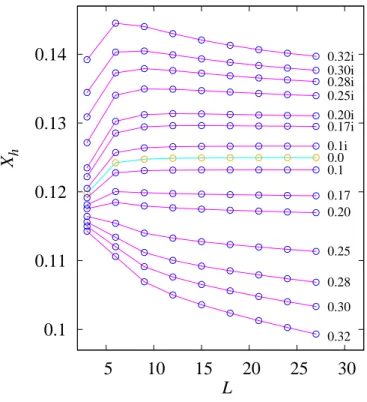
Figure 2. Finite-size results for the scaled magnetic gapsXh(L) of the generalized
Baxter-Wu model with several values of ∆K, as indicated at the right-hand side of the figure.
We found clear signs of corrections with exponents y1 = −4 and y2 = −6, and an indication for one with y3 = −8. No evidence was seen for other exponents. The amplitudes of these corrections are different for the two transfer directions; further we observe that a1 ≈0 for transfer along a set of edges.
In Fig. 2 we show the finite-size data for the magnetic scaled gaps of the critical generalized Baxter-Wu model for several real and imaginary values of ∆K. These data are obtained with the transfer direction perpendicular to a set of edges. These results reveal a clear picture of the renormalization flow in the vicinity of the four-state Potts fixed point. For ∆K = 0 one observes fast convergence to the exact dimension Xh = 1/8. The scaled gaps for imaginary ∆K display an anomalously slow decrease, indeed suggestive of a marginally irrelevant scaling field, corresponding to v ∝ ∆K2 < 0 in Eqs. (2), (3) and (6). The results for real values of ∆K display that the renormalization flow, which is still quite weak for small ∆K, becomes progressively stronger when ∆K and v increase, just as expected for a marginally relevant scaling field.
0.125 0.13 0.135 0.14 0.145 0.15
5 10 15 20 25 30
0.0 0.20i 0.25i 0.28i 0.30i 0.32i Xh
L
Figure 3. Finite-size estimates of the magnetic scaling dimension Xh of the q = 4
Potts model on the simple quadratic-lattice, and for the generalized Baxter-Wu model with several values of ∆K as indicated at the right-hand side of the figure. The red squares show data for the q = 4 Potts model, with transfer directions along a set of edges (upper squares) and along a diagonal direction (lower squares). These data apply to finite sizes (horizontal axis) up to 16 and 15√2 respectively. The data for the generalized Baxter-Wu model are shown as circles, and are obtained using a transfer matrix perpendicular to a set of edges, for system sizes up toL= 27.
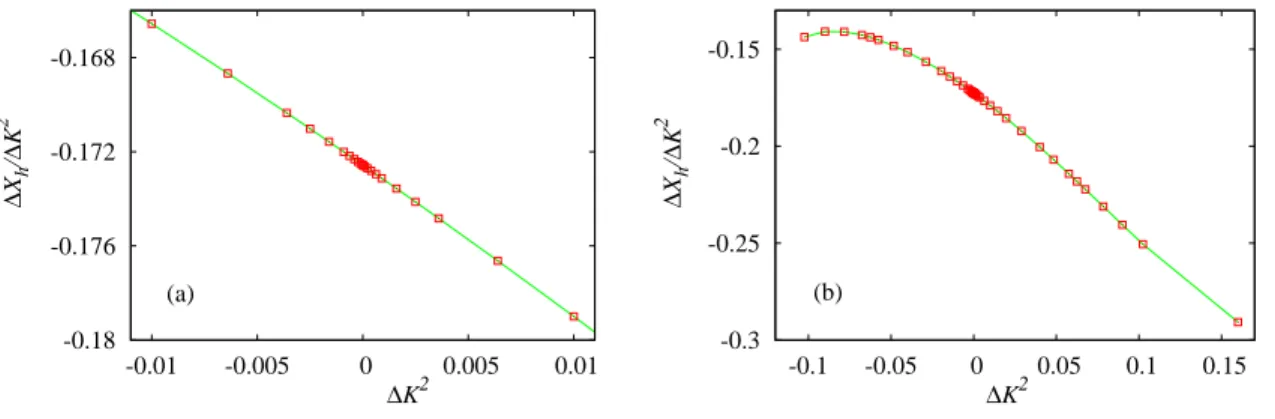
dependence, indicating the presence of terms with power-law dependence on L. For larger L the dependence becomes rather weak, similar to the generalized Baxter-Wu results. These data suggest that the marginal field in the Potts model with nearest-neighbor interactions on the simple quadratic lattice corresponds to about ∆K = 0.28i in the generalized Baxter-Wu model. Our next task is to check to what extent Eq. (6) can describe these data. At the largest system size L = 27 and small marginal fields v, one expects that ∆Xh ≡Xh(∆K, L)−Xh(0, L) is proportional to ∆K2 ∝v, with a next order contribution as ∆K4 due to the v in the denominator. Dividing out ∆K2, the expected linear behavior is reproduced in Fig. 4a. For larger marginal fields, higher-order terms become important. The maximum in Fig. 4b indicates that we will require extra terms in addition to the term proportional to ∆K2.
3.2. Fitting the Xh data for the generalized Baxter-Wu model
After obtaining the finite-size data for ∆Xh(∆K, L), and thus having suppressed the power-law corrections to scaling that still occur in the ∆K = 0 Baxter-Wu model, we applied least-squares fits to the quantity ∆Xh/∆K2, based on Eq. (6) as follows:
[∆Xh(∆K, L)]/∆K2 ≈X k
sk∆K2k−2
[1−uln(L)∆K2]k + X
l
al∆K2l−2
-0.18 -0.176 -0.172
-0.01 -0.005 0 0.005 0.01
(a)
∆
Xh
/
∆
K
2
∆K2
-0.3 -0.25 -0.2
-0.1 -0.05 0 0.05 0.1 0.15
(b)
∆
Xh
/
∆
K
2
∆K2
Figure 4. Dependence of the scaled gap, expressed by the quantity ∆Xh/∆K 2
on the marginal field parametrized by ∆K2
. These data apply to a fixed finite sizeL= 27 in ∆Xh =Xh(∆K, L)−Xh(0, L). For small marginal fields (a), one finds almost linear
behavior, but on a larger scale (b), nonlinearities become prominent.
+b1 L2 +
b2
L3 +. . . . (16)
The parameter u, which remains to be determined, fixes the relation in lowest order between the marginal field v and ∆K2 as u∆K2 = 4πv/√3.
The amplitude of thek = 1 logarithmic term in the first sum is independent of ∆K2 and should, for relatively small ∆K2, yield the dominant contribution to ∆Xh/∆K2. The amplitude s1 should thus be easily be resolved, without much interference from the second-order term which is proportional to ∆K2, and without much interference from the denominator. Then, the next step is to include larger |∆K2|, in the hope that the fit can disentangle the contribution with amplitude s2 from the ∆K dependence of the denominator of the first logarithmic term, which also behaves as ∆K2 for not too large
|∆K|.
In addition to the unknown parameters in the fit formula, we are also interested in their margin of uncertainty. Since the deviations between numerical data ∆Xh(∆K, L) and ∆cXh(∆K, L) as computed from the fit formula are not of a statistical origin, the usual procedure is not applicable. We first define the residual as
R=X|∆K|2[∆Xh(∆K, L)
−∆cXh(∆K, L)]2/L4 (17)
which takes into account the data with small |∆K| can be fitted very precisely with small contributions to higher-order terms in ∆K2. The additional weight factor L−4 accounts for the reduced precision of the transfer-matrix results for the largest L. After minimizing R, the scale of the deviations between the actual and computed values of ∆Xh follows as L2p
(R/n)/|∆K| where n is the number of data points. Next we ask the question what deviations in the fit parameters are still acceptable. For data with errors of a random nature, the answer is provided by standard statistical analysis based on numerical errors in ∆Xh of magnitude L2p
Table 1. Least-squares fits to the finite-size data for ∆Xh/∆K 2
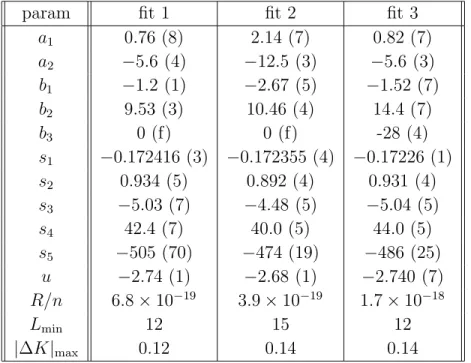
of the generalized Baxter-Wu model with transfer perpendicular to a set of edges. Estimated uncertainties in the last decimal place are shown between parentheses, “f”means that the parameter was fixed. These error margins are based on statistical analysis and may, at most, serve as an order-of-magnitude estimate. A better indication of these errors is provided by the differences between the fits. The residualR, defined in the text, is also listed.
param fit 1 fit 2 fit 3
a1 0.76 (8) 2.14 (7) 0.82 (7)
a2 −5.6 (4) −12.5 (3) −5.6 (3)
b1 −1.2 (1) −2.67 (5) −1.52 (7)
b2 9.53 (3) 10.46 (4) 14.4 (7)
b3 0 (f) 0 (f) -28 (4)
s1 −0.172416 (3) −0.172355 (4) −0.17226 (1)
s2 0.934 (5) 0.892 (4) 0.931 (4)
s3 −5.03 (7) −4.48 (5) −5.04 (5)
s4 42.4 (7) 40.0 (5) 44.0 (5)
s5 −505 (70) −474 (19) −486 (25)
u −2.74 (1) −2.68 (1) −2.740 (7) R/n 6.8×10⁻¹⁹ 3.9×10⁻¹⁹ 1.7×10⁻¹⁸
Lmin 12 15 12
|∆K|max 0.12 0.14 0.14
answer does not apply, but it may still serve as an order of magnitude estimate. A more reliable estimate of the margin in the fit parameters is obtained by varying the number of fitted parameters, the range of ∆K2, and the cutoff L
min at small system sizes. We included fits with only one logarithmic term, the one with amplitudes1. These yielded only consistent results in a rather narrow range of ∆K2, so that the parameters
u and s1 could not reliably be determined. Results of various other fits with more than one logarithmic term rather consistently yielded s1 ≈ −0.1724, and u ≈ −2.74. For a few of these fits, the parameters are listed in Table 1. We also investigated the effects of a nonlinear term in u proportional to ∆K4. Its influence is very similar to that of adding a next term in the sum onkin Eq. (16), and we were unable to find a significant result for its amplitude. Since the coefficients bi may depend on the marginal field, we also included a term proportional to L−2∆K2, but its amplitude is small and did not significantly reduce R.
then determines the marginal field as v ≈ −0.380∆K2.
3.3. Analysis of the q= 4 Potts model
In analogy with Sec. 3.2, the finite-size data forXh(L) were fitted by
Xh(L) =Xh+a1/L2+a2/L4+a3/L6+
X
k
pk/(1−wlnL)k+. . . . (18)
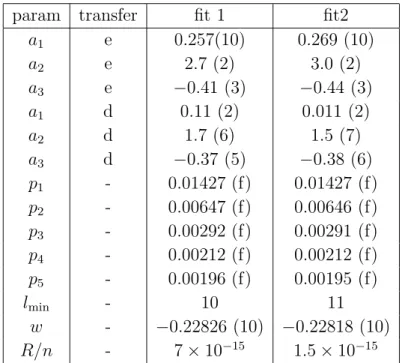
The residualRis simply defined as the sum of the squared deviations between the actual and computed values if Xh(L). The value of χ2 increases rapidly when the minimum system size Lmin is decreased below 10. We were unable to find reliable results from fits with all parameters left free. For this reason, we fixed the known amplitude ratio p1/w = 1/16, and p2/w2 = 0.124, p3/w3 = 0.245, p4/w4 = 0.7804, and p5/w5 = 3.15, as found from the amplitudes for the generalized Baxter-Wu model.
Table 2. Least-squares fits to the finite-size data forXh(v, L) of the four-state Potts
model for two transfer directions. The second column specifies the transfer direction, along a set of edges (e) or diagonals (d). These fits use a small system-size cutoff at
Lmin=lminfor the transfer matrix along a set of edges, and atLmin=
√
2lmin for the
diagonal transfer matrix. The amplitudespiare fixed with respect to the parameterw,
using the amplitude ratio as found for the Baxter-Wu model. Althoughwis the only adjustable parameter describing the logarithmic correction in this fit, the residuals per data point, listed as R/n, are rather small. The error margins in the last decimal place, shown between parentheses, are based on statistical analysis and may, at most, serve as an order-of-magnitude estimate.
param transfer fit 1 fit2
a1 e 0.257(10) 0.269 (10)
a2 e 2.7 (2) 3.0 (2)
a3 e −0.41 (3) −0.44 (3)
a1 d 0.11 (2) 0.011 (2)
a2 d 1.7 (6) 1.5 (7)
a3 d −0.37 (5) −0.38 (6)
p1 - 0.01427 (f) 0.01427 (f)
p2 - 0.00647 (f) 0.00646 (f)
p3 - 0.00292 (f) 0.00291 (f)
p4 - 0.00212 (f) 0.00212 (f)
p5 - 0.00196 (f) 0.00195 (f)
lmin - 10 11
w - −0.22826 (10) −0.22818 (10) R/n - 7×10⁻¹⁵ 1.5
While the numerical uncertainties as listed in Table 2 depend on the somewhat arbitrary procedure followed here, and may be underestimated, a comparison between a number of different fits still suggests that the value of w is approximately correct. The value also determines the marginal field via 4πv/√3 = w as v ≈ −0.0315, with the normalization mentioned in Sec. 2. We note that the value ∆K ≈ 0.28i, suggested by the data in Fig. 3, for the generalized Baxter-Wu model that has a marginal field comparable to that of the q= 4 Potts model, corresponds tow=−0.22. This is indeed close to the values in Table 2.
4. Numerical analysis of the free energy
4.1. Preliminary result for the generalized Baxter-Wu model
The critical free energy density is exactly known [20] for ∆K = 0 as f(∆K = 0, L =
∞) = ζ/2 ln 6. The geometric factor ζ is included because the free energy per lattice site is not equal to the free energy density. We can thus estimate the conformal anomaly cfrom the finite-size data f(∆K = 0, L), from the relation [21, 22, 23]
f(∆K = 0, L)−f(∆K = 0,∞)≃6c/(πL2). (19)
Analysis of the finite-size data forf(∆K = 0, L)−f(∆K = 0,∞) reproduces the exactly known value c= 1 within a margin of the order of 10−8. Next we check to what extent Eq. (5) describes the v dependence of the critical free energy. We attempt to get rid of the bulk free energy at ∆K = 0, and of the conformal contribution by defining
p(∆K)≡[f(∆K,27)−f(∆K,24)−f(0,27) +f(0,24)]/∆K2 (20)
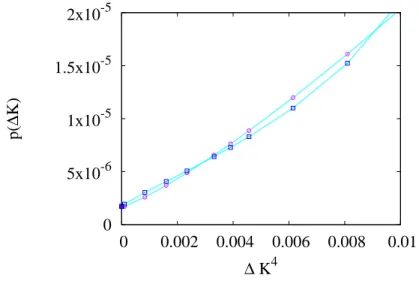
Since the finite sizes L= 24, 27 are presumably large enough, it is supposedly justified to interpretp(∆K) in terms of the asymptotic scaling properties of singular part of the free energy. Since the marginal field v ∝∆K2, one may expect, on the basis of Eq. (5), that p(∆K) behaves as z3(L)v2. Then, for sufficiently small values of ∆K2, p(∆K) should be proportional to ∆K4. This is supposed to hold for real as well as complex couplings. In order to check for possible corrections to scaling not included in Eq. (5), the quantity p(∆K) is plotted in Fig. 5 versus ∆K4. The smallest value of |∆K| is 0.005, yielding points at an unresolved distance to the vertical axis in Fig. 5. One can make the following observations:
• In the limit ∆K → 0, the line does not pass through the origin. This can be simply explained by another L-dependent term in the free energy, for instance one proportional to vL−4, and thus also proportional to ∆K2, which contributes a constant top(∆K).
0
5x10⁻⁶
1x10⁻⁵
1.5x10⁻⁵
0 0.002 0.004 0.006 0.008 0.01
p(
∆
K)
∆ K4
Figure 5. Plot of the quantityp(∆K) versus ∆K4
. It describes the dependence of the singular part of the free energy of the generalized Baxter-Wu model on the square of the marginal field which relates to ∆K asv∝∆K2
. ¿From Eq. (5) one would expect, as long asv is not too large, a straight line through the origin. The data points for real couplings are shown as red circles, those for complex couplings as blue squares.
• The two branches display intersections. The curvature leading to the first intersection is in line with the presence of a term with amplitude v in the denominator. The second intersection corresponds to a higher odd power of v.
• The branches display a general upward curvature that indicates the existence of an L-dependent contribution in f with a higher even power of ∆K.
• Apart from the above observations, the expected linear dependence on ∆K4, as predicted by Eq. (5), is still visible to some extent in this plot for ∆K4
∼
<0.005.
These findings provide some useful information for a more detailed analysis of the free energy.
4.2. Preliminary results for the q= 4 Potts model
Finite-size data were calculated for the free energy of the square-lattice model, using transfer directions along a set of edges as well as along a diagonal. These transfer matrices add layers consisting up to 16 spins. Since L denotes the strip width in units of lattice edges, the data from the diagonal transfer matrix apply to finite sizes up to L= 16√2. In order to find out what contributions to the free energy occur, in addition to the bulk term f(∞) and the conformal term π/6L2, we define the quantity g(L) as
g(L)≡L2[f(L)
−f(∞)]−π/6. (21)
-0.01 -0.005 0 0.005 0.01 0.015 0.02 0.025 0.03 0.035
0 0.01 0.02 0.03 0.04 0.05 0.06 0.07
g(L)
1/L2
Figure 6. Excess critical free energy of the square-latticeq= 4 Potts model, shown as the quantityg(L)≡L2
[f(L)−f(∞)]−π/6 versusL−2. The upper set of data points
is obtained using the transfer matrix for transfer parallel to a set of lattice edges, the lower set uses transfer in the diagonal direction. The latter data use a finite size as√2 times the strip width in units of face diagonals.
The data do not approach the limit g = 0 at L=∞ linearly, which is in line with the expected existence of a contribution with a logarithmic dependence on L.
4.3. Comparison of the generalized Baxter-Wu and the Potts model
The bulk free energy is, unlike the q = 4 Potts model, not known for the generalized Baxter-Wu model. But we can remove it, by taking differences between consecutive finite sizes. To this purpose we define
r(L)≈[f(L1)−f(L2)]/(L−12−L− 2
2 )−π/6 (22)
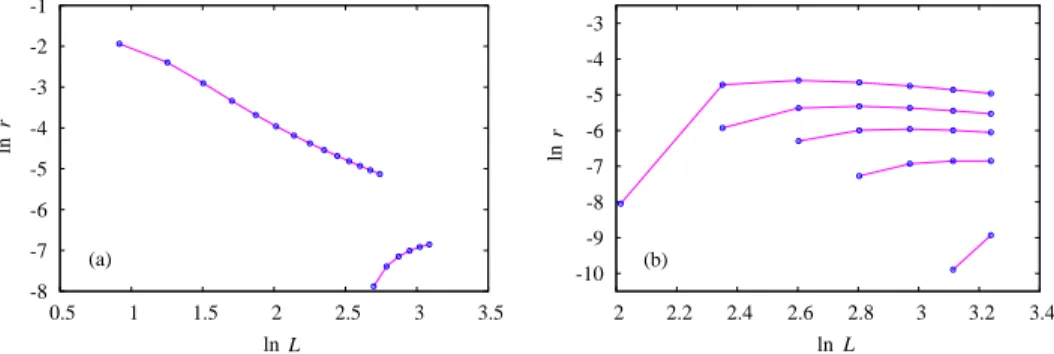
where L= (L1+L2)/2. This eliminates, at the same time, the conformal contribution at the Potts fixed point. Figures 7 show the numerical results for r(L) for the q = 4 Potts model, and for the generalized Baxter-Wu model with ∆K/i = 0.2, 0.25, 0.28, 0.3 and 0.32. The figure suggests that the magnitude of the correction to f due to the marginal field in the q = 4 Potts model corresponds roughly to ∆K = 0.28i in the generalized Baxter-Wu model, consistent with the results from the Xh(L) analysis.
4.4. Fit of the generalized Baxter-Wu free energies
First we define
y(L,∆K)≡[f(L,∆K)−f(L,0)]/∆K2 (23)
¿From Eq. (5), and the observations made in Sec. (4) we expect that
y(L,∆K) = X j=0,1,...
aj∆K2j+ X k=3,4,...
L−2 tk∆K 2k−2
-8 -7 -6 -5 -4 -3
0.5 1 1.5 2 2.5 3 3.5
r
L
(a)
ln
ln
-10 -9 -8 -7 -6 -5
2 2.2 2.4 2.6 2.8 3 3.2 3.4
r
L
(b)
ln
ln
Figure 7. Excess critical free energy of the square-lattice q = 4 Potts model, as expressed by the quantity lnr(L), for two transfer directions (a), and for the generalized Baxter-Wu model (b) with ∆K/i = 0.2, 0.25, 0.28, 0.3 and 0.32. Larger ∆K/i
corresponds to larger lnralong the vertical scale. The quantityr(L) changes sign as a function ofLfor the Potts model with diagonal transfer, and also for the generalized Baxter-Wu model. The negative entries occur at small L and are left out of these figures.
+ X
l=1,2,...
hl∆K2l/L4+. . . , (24)
In the numerical analysis, we found that is not well feasible to clearly resolve the logarithmic contributions with amplitudes t3, t4, ... when all fit parameters are left free. For this reason we fixed the parameteru=−2.74 as found in Sec. 3 and fitted the amplitudes tk. Since the universal amplitude ratio t3/u3 =π/8 is exactly known [3, 24] we have a consistency check available. The fitting procedure involved the minimization of the residualR defined byR =P
(yc−y)2/∆K4 where yc is computed from Eq. (24). The roughly estimated accuracies are, in analogy with those in Table 1, based on the assumption of randomness. Also for these results one has therefore to estimate the error margins independently by applying several variations of the fitting procedure.
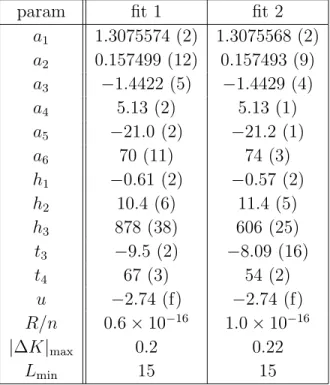
The parameter values as found from two typical fits are listed in Table 3.
The condition t3/u3 =π/8 appears to be approximately satisfied, but there is still an uncertainty margin of the order of ten per cent.
4.5. Fit of the q = 4 Potts free energy
Taking into account the logarithmic correction term in Eq. (5), and a few other terms that were found necessary, we fitted the following expression to the data forg(L) defined by Eq. (21)
g(L) =a1L−2+a2L−4+a3L−4/lnL+
X
i=3,4,...
si/(1−wlnL)i +. . . , (25)
Table 3. Results of least-squares fits to the quantity y(L) describing the dependence of the generalized Baxter-Wu free energy on ∆K2
which parametrizes the marginal field. Errors following from the least-squares criterion are shown between parentheses, “f”means that the parameter was fixed.
param fit 1 fit 2
a1 1.3075574 (2) 1.3075568 (2)
a2 0.157499 (12) 0.157493 (9)
a3 −1.4422 (5) −1.4429 (4)
a4 5.13 (2) 5.13 (1)
a5 −21.0 (2) −21.2 (1)
a6 70 (11) 74 (3)
h1 −0.61 (2) −0.57 (2)
h2 10.4 (6) 11.4 (5)
h3 878 (38) 606 (25)
t3 −9.5 (2) −8.09 (16)
t4 67 (3) 54 (2)
u −2.74 (f) −2.74 (f) R/n 0.6×10⁻¹⁶ 1.0×10⁻¹⁶
|∆K|max 0.2 0.22
Lmin 15 15
Satisfactory fits could be obtained to free-energy data for finite sizes of 8 and more lattice edges or face diagonals. The residual is defined here byR =P
[g(L)−gc(L)]/L2, wheregc(L) is the value found from Eq. (25). The residual is used again to get a rough idea about the numerical error margins in the results for the fitted parameters. These fits were unable to simultaneously determine the parametersw andsi, in the sense that the estimated error margins exceeded the actual values. We thus set w = −0.2282 as found in Sec. 3.3. Some typical results for the fitted parameter values are listed in Table 4.5.
These data lead to a result for the universal ratio s3/w3 ≈0.39, again close to the exact [3] value π/8.
5. Discussion
direction, along a set of edges (e) or diagonals (d).
param transfer fit1 fit 2
a1 e 0.3911 (2) 0.3918 (2)
a2 e −2.39 (2) −2.53 (3)
a3 e 5.49 (3) 5.70 (4)
a1 d −0.2528 (2) −0.2519 (2)
a2 d −3.26 (3) −3.59 (4)
a3 d 5.88 (6) 6.5 (1)
s3 - −0.00463 (2) −0.00459 (2)
s4 - 0.02164 (3) 0.02159 (3)
w - −0.2282 (f) −0.2282 (f) R/n - 8.8×10⁻¹⁷ 1.9
×10−17
Lmin - 8 9
the Potts fixed point. Each of these contributions displays a differentL-dependence. The numerical analysis has to separate all these effects, while the range of finite sizes is quite limited. Under these conditions a reasonably accurate and independent determination of the parameters u and s1 in Eq. (16) was only possible because of the accuracy of the finite-size data forXh(v, L), the knowledge of the self-dual points of the generalized Baxter-Wu model, and the fact that in this model the marginal field is continuously variable. Furthermore, the independent determination of uand the si yielded universal amplitude ratios that were used in the analysis of the four-state Potts model, ad thus enabled a determination of its marginal field. It appears that higher-order logarithmic terms in the expansion of Xh(L) with amplitudes si and pi are not negligible.
In the analysis of the free energy, we were not able to determine the parameters t3 and u in Eq. (24) independently, but using the result u =−2.74 from Sec. 3 we could still provide confirmations of the universal amplitude ratio [3] t3/u3 =s3/w3 =π/8.
Our numerical work used real×8 floating-point arithmetic and required a computer memory of several tens of Gb. This represents what is reasonably achievable with today’s PC’s. More accurate results could be obtained in the future by using real×16 floating-point arithmetic instead, which would allow a better separation of contributions in different orders of the marginal field.
Acknowledgments
[1] F. J. Wegner, Phys. Rev. B5, 4529 (1972). [2] R. J. Baxter, J. Phys. C6, L445 (1973).
[3] J. L. Cardy, J. Phys. A19, L1093 (1986); Erratum20, 5039 (1987).
[4] H. W. J. Bl¨ote and M. P. Nightingale, Physica A (Amsterdam)112, 405 (1982).31, 1294 (1973). [5] B. Nienhuis, A. N. Berker, E. K. Riedel, and M. Schick, Phys. Rev. Lett.43, 737 (1979).
[6] X.-F. Qian, Y. Deng and H. W. J. Bl¨ote, Phys. Rev. E72, 056132 (p.1-15) (2005). [7] R. H. Swendsen, D. Andelman, and A. N. Berker, Phys. Rev. B24, 6732 (1981).
[8] X.-F. Qian, Y. Deng, Y. Liu, W.-A. Guo, and H. W. J. Bl¨ote, Phys. Rev. E94, 052103 (2016). [9] M. Nauenberg and D. J. Scalapino, Phys. Rev. Lett.44, 837 (1980).
[10] J. L. Cardy, M. Nauenberg, and D. J. Scalapino, Phys. Rev. B22, 2560 (1980). [11] J. Salas and A. D. Sokal, J. Stat. Phys.88, 567 (1997).
[12] B. Nienhuis and M. Nauenberg, Phys. Rev. Lett.35, 477 (1975). [13] J. L. Cardy, J. Phys. A17, L385 (1984).
[14] R. J. Baxter and F. Y. Wu, Phys. Rev. Lett.31, 1294 (1973); Aust. J. Phys.27, 357 (1974). [15] C. Gruber, A. Hintermann and D. Merlini,Group Analysis of Classical Lattice Systems(Springer,
Berlin 1977).
[16] Y. Deng, W.-A. Guo, J. R. Heringa, H. W. J. Bl¨ote and B. Nienhuis, Nucl. Phys. B827, [FS], 406 (2010).
[17] P. W. Kasteleyn and C. M. Fortuin, J. Phys. Soc. Jpn.46, (Suppl.), 11 (1969); C. M. Fortuin and P. W. Kasteleyn, Physica (Amsterdam)57, 536 (1972).
[18] M. P. Nightingale, Proc. Kon. Ned. Akad. Wet. B82, 235 (1979).
[19] M. R. Hestenes and E. Stiefel, Journal of Research of the National Bureau of Standards 49 (6) (1952); see also K. A. Atkinson, An Introduction to Numerical Analysis, 2nd ed., John Wiley and Sons (1988). Also see M. P. Nightingale, V. S. Viswanath and G. M¨uller, Phys. Rev. B48, 7696 (1993).
[20] G. S. Joyce, Proc. R. Soc. Lond. A343, 45 (1975).
[21] J. L. Cardy, in Phase Transitions and Critical Phenomena, Vol. 11, eds. C. Domb and J. L. Lebowitz (Academic, London, 1987).
[22] H. W. J. Bl¨ote, J. L. Cardy and M. P. Nightingale, Phys. Rev. Lett.56, 742 (1986). [23] I. Affleck, Phys. Rev. Lett.56, 746 (1986).
![Figure 1. The renormalization flow diagram as proposed by Nienhuis et al. [5] in the critical surface of the Potts model, parametrized by its number of states q and the activity of the Potts vacancies v](https://thumb-us.123doks.com/thumbv2/123dok_us/8300985.2198452/5.918.219.648.157.470/figure-renormalization-proposed-nienhuis-critical-parametrized-activity-vacancies.webp)

![Figure 6. Excess critical free energy of the square-lattice q = 4 Potts model, shown as the quantity g(L) ≡ L 2 [f (L) − f(∞)] − π/6 versus L − 2](https://thumb-us.123doks.com/thumbv2/123dok_us/8300985.2198452/14.918.256.611.143.389/figure-excess-critical-square-lattice-potts-quantity-versus.webp)