SECOND LANGUAGE
IDIOM LEARNING IN A
PAIRED-ASSOCIATE PARADIGM
Effects of Direction of Learning,
Direction of Testing, Idiom
Imageability, and Idiom
Transparency
Margarita P
+
Steinel and Jan H
+
Hulstijn
University of Amsterdam
Wolfgang Steinel
Leiden University
In a paired-associate learning (PAL) task, Dutch university students (n= 129) learned 20 English second language (L2) idioms either receptively or productively (i.e., L2-first language [L1] or L1-L2) and were tested in two directions (i.e., recognition or production) imme-diately after learning and 3 weeks later. Receptive and productive performance was affected by direction of learning. This finding par-allels findings from PAL experiments on L2 individual-word learning. On a productive test, productive learners had a sizable advantage over receptive learners, whereas on recognition, receptive learners outperformed productive learners. Two idiom characteristics, image-ability (capacity to evoke a mental image) and transparency (over-lap between literal and figurative meaning), as assessed in a norming
This study is based on the first author’s MA research+We would like to thank the four anonymous SSLAreviewers for their helpful comments on this manuscript+Any errors or omissions remain our own+
Address correspondence to:Jan H+Hulstijn,Amsterdam Center for Language and Communi-cation,University of Amsterdam,Spuistraat 134,1012 VB Amsterdam,The Netherlands;e-mail: j+h+hulstijn@uva+nl;or Margarita P+Steinel,Amsterdam Center for Language and Communication, University of Amsterdam,Spuistraat 134,1012 VB Amsterdam,The Netherlands;e-mail:m+p+steinel@ uva+nl+
study by an independent sample (n = 80), qualified these findings. Indicating the importance of dual coding in idiom learning, image-ability predicted performance, and receptive learning was particu-larly inefficient for low imageable idioms. Transparency was a weaker predictor of performance and only affected recognition.
Much of lexis consists of sequences of words that have a strong tendency to occur together in discourse, including a wide and motley range of
expres-sions such as phrasal verbs, compounds, idioms, and collocations~referred
to collectively as multiword lexical items,prefabricated units,prefabs,
phra-seological units,fixed phrases,formulaic sequences,etc+!+Phraseological
per-formance is,by general consent,an important component of second language ~L2! fluency, yet nonnative speakers’ speech and writing display a
signifi-cantly lower collocational density~Howarth,1998!and their knowledge of
com-plex lexical units in their L2 is limited compared to that of native speakers
~Arnaud & Savignon, 1997;Moon, 1997!+ L2 learners’ knowledge of L2
multi-word units such as idioms and collocations is not on a par with their knowl-edge of L2 vocabulary in general+ Clearly,this constitutes a major difficulty
for L2 learners+The investigation of which conditions facilitate learning and,
consequently,comprehension and production will help us find out more about
the locus of this difficulty+ In the setting of a paired-associate learning~PAL!
experiment,we investigate,in particular,the effects of direction of learning,
direction of testing, imageability, and transparency of L2 idioms on
immedi-ate and long-term retention+We will first situate our study in the literature on
PAL,imageability,transparency,and long-term retention+
PAIRED-ASSOCIATE LEARNING
Paired-associate learning has been the subject of a copious amount of empir-ical research,in particular in the 1950s and the 1960s~e+g+,Crothers & Suppes,
1967;Underwood & Schulz,1960!+In early studies that applied the PAL
para-digm, participants learned to pair a familiar first language ~L1! word ~the
response!to another familiar L1 word~the stimulus!+The aim of these studies
was to investigate the establishment of within-language associative connec-tions+As Griffin and Harley~1996!summarized,evidence from earlier PAL
stud-ies is inconclusive+The bone of contention seems to be the question of which
element of the paired associate has a more important role to play in the estab-lishment of a memory association between the two+ Some studies stressed
the importance of the element in the response position, others did not find
any differences,and yet others claimed that the element in the stimulus
posi-tion was the more important one+
The PAL paradigm has also been used in studies on L2 vocabulary learning in which participants paired an unfamiliar L2 word with a familiar L1 word+
Both the learning and the testing task can be either receptive or productive,
with the L2 word in the stimulus or response position,respectively+The results
of a study conducted by Schuyten~1906!with Dutch pupils learning French,
German, and English indicated that ~a! receptive retention was always
sub-stantially higher than productive retention and~b!receptive learning led to a substantial amount of productive knowledge and vice versa+The results of a
study conducted by Stoddard~1929!, who asked American high school
stu-dents without any prior knowledge of French to learn French words,
sug-gested that~a!receptive performance was significantly higher than productive performance;~b! the best results on the receptive test were obtained when
participants learned receptively,and,similarly,the best results on the
produc-tive test were obtained when participants learned producproduc-tively;and~c!
pro-ductive learning led to a considerable amount of receptive knowledge and vice versa+
More recently,Griffin and Harley~1996!,Schneider,Healy,and Bourne~2002!,
and Mondria and Wiersma~2004!revived the full PAL paradigm by investigat-ing the effects of direction of learninvestigat-ing and direction of testinvestigat-ing in L2 vocabu-lary learning+Griffin and Harley asked British comprehensive school students
aged 11–13,who had had 6 months of formal instruction in French,to learn 20
word pairs~either L1-L2 or L2-L1!in 8 min and tested them either in the same direction as in the learning session or in the opposite direction+Testing took
place immediately after learning and,without prior announcement,3, 7,and
28 days after learning+From the results of their study,Griffin and Harley
con-cluded that the L1-L2 direction of learning is “the better all-purpose direction,
more effective than the L2-L1 for the more difficult production task”~p+454!+
With regard to retention over time,direction of learning was not found to
influ-ence the strength of the association over time+
Schneider et al+ ~2002! manipulated translation direction within a
paired-associate task framework in order to explore rates of retention and transfer+
In their first experiment,25 cue-target vocabulary pairs each involving a French
word and its translation were presented to American college students with-out prior knowledge of French+Retention and transfer were measured in two
sessions+ In the first session, the direction of learning for half of the
partici-pants was L2-L1,whereas the direction of learning for the other half was L1-L2+
In all cases,the direction of learning and the direction of testing at the
imme-diate test at the end of the first session were the same;that is,in the
imme-diate test session, Schneider et al+ did not collect data on what Griffin and
Harley~1996!would call backward association+In the second session,one half
of each of the two groups was tested and retrained in the same direction as during the first session and the other half was tested and retrained in the reverse direction+
One of the main claims of the Schneider et al+~2002!study was that
infe-rior initial performance, an advantage on the delayed test, especially when
they had to do the more difficult L1-L2 test+This interpretation of the results
supports the general assumption that learning tasks under more difficult con-ditions ~in this case L1 cues and L2 responses! yields inferior learning and immediate retention but less loss across retention intervals than learning tasks under easier conditions+
Schneider et al+’s~2002! second experiment had a similar design+ One of
the few differences was that participants were pretrained on the orthography of half of the L2 words+ In accordance with their previous assumptions and
findings,Schneider et al+found that pretraining by decreasing task difficulty
enhanced initial learning but not retention and transfer+Again,initial
perfor-mance was better when participants were trained with L2 cues, but this did
not lead to better delayed retention and transfer+In summary,Schneider et al+’s
main conclusion was that greater difficulty of the learning task decreased ini-tial performance but led to better delayed performance when the difficulty was manipulated by translation direction+
Mondria and Wiersma~2004!studied the effect of the combination of recep-tive and producrecep-tive learning versus receprecep-tive learning alone or producrecep-tive learning alone on receptive and productive retention,respectively+According
to the combination hypothesis, learning both receptively and productively
should lead to better and more stable receptive retention performance than receptive learning alone+Dutch secondary school students learned 16
French-Dutch pairs of words ~without context! in one of three learning conditions
~receptive,productive,or both!and were tested twice~immediately and about
2 weeks later!in either direction of testing~receptive vs+productive!+On the
delayed receptive retention test,no significant difference was found between
the receptive and the receptive plus productive learning condition+Similarly,
on the delayed productive retention test,those who learned both receptively
and productively did not differ significantly from those who only learned pro-ductively+However,against the authors’ expectations,productive learning alone
led to significantly better performance than the combination of receptive and productive learning on the immediate productive test+ With regard to
recep-tive retention, participants who had learned receptively did better than
par-ticipants who had learned productively+ Finally, concerning productive
retention, productive learning led to significantly better results than
recep-tive learning+
Mondria and Wiersma~2004!also explored an issue that all other related studies have shied away from discussing in detail—the issue of the degree of difficulty inherent in the direction of learning~productive vs+receptive!+The
authors suggested that relevant studies provide evidence for the relative dif-ficulty of productive learning compared to receptive learning+ This, they
claimed,is “evidenced by the fact that in all the experiments the mean scores
on the productive retention tests were lower than those on the receptive reten-tion tests”~Mondria & Wiersma, p+86!+By comparing receptive and
learning, Mondria and Wiersma found that receptive retention was
signifi-cantly higher,and they concluded that productive learning~in terms of
reten-tion!is indeed more difficult+Two explanations are put forth for this finding+
The “amount of knowledge” explanation ~Nation, 2001, p+ 28! suggests that
the greater difficulty of productive retention is due to the necessity of having more precise knowledge of word form in order to use a word in a productive way+The so-called “access explanation” ~Nation,p+29!is based on the idea
that a new L2 word is only~receptively!linked to its L1 equivalent and not to other L2 words in the lexical system, unlike the L1 equivalent, which has a
host of links to other L1 words,all of which can be conceptualized as
differ-ent competing paths along which the L1 word can be accessed+
Taking as a starting point the idea that the best performance can be achieved when the direction of learning is the same as the direction of test-ing,Mondria and Wiersma~2004!explored the question of whether the effect
of type of test ~productive vs+ receptive! overrides the effect of
correspon-dence between type of learning and type of test+By comparing receptive and
productive delayed retention resulting from productive learning,they found
that receptive retention was higher,which they interpreted as evidence that
the effect of type of test is greater than the effect of correspondence between type of learning and type of test+ On the immediate test, however,the
oppo-site pattern emerged:Productive learning led to significantly better
produc-tive than recepproduc-tive retention,which suggests that on retention,the effect of
correspondence between type of learning and type of test is greater than the effect of type of test+
A practical conclusion suggested in the study is that when productive knowl-edge is the measure and goal of L2 vocabulary learning,learning words
pro-ductively is the more effective approach+ Griffin and Harley ~1996! also
concluded that learning L2 vocabulary productively is the more versatile direc-tion for the demands of both receptive and productive performance+
One alternative perspective on the question of how direction of learning prepares learners for performance on different tests could be provided by the notion of transfer-appropriate processing~TAP!,which accounts for
reten-tion performance in terms of the~in!compatibility between learning and reten-tion tasks~Bransford,Franks, Morris, & Stein,1979;see also Hulstijn, 2003!+
In essence, the TAP principle suggests that the type of initial processing of
specific stimuli will facilitate subsequent processing of the same stimuli,
depending on the extent to which the two overlap;that is,productive
learn-ing, which can be assumed to share more common processes with
produc-tive testing than recepproduc-tive learning does, is likely to meet the requirements
of the more difficult test more efficiently because of the greater similarity between the two tasks+
Thus, it seems sound to assume that the general principles and
to more elaborate processing and more remembering+ An implication of the
TAP principle would be that receptive learning,on the one hand,will possibly
be adequate for the demands of the receptive test but less so when produc-tive knowledge is tested+Productive learning,on the other hand,will
proba-bly be much less disadvantaged by the more difficult productive test because this would correspond to the direction in which knowledge was initially acquired+ We therefore propose two hypotheses related to the direction of
leaning and testing:
~1! Directionality hypotheses
a+ Performance on a productive test~i+e+,L1-L2!will be better when idioms have
been learned productively~L1-L2!rather than receptively~L2-L1!+
b+ On a receptive test~i+e+,L2-L1!,the performance of L1-L2 learners will not be
superior to the performance of L2-L1 learners+
IMAGEABILITY
In this section,we look at some studies that have examined imageability as a
determinant of learning+Paivio,Yuille,and Smythe~1966!looked at the effects
of an image-evoking potential or imagery of words on recall in monolingual PAL experiments+ Their results suggested that imagery of both the stimulus
and the response were found to be good predictors of learning~e+g+,shoe-idea
andidea-shoe were learned better thanidea-truthortruth-idea!+ The effect of
imagery on learning was explained as a two-code representational mecha-nism in which information can be encoded as visual images,verbal
represen-tations,or both+The information required for recall can then be retrieved from
either of the two codes or from both+The nonverbal code is conceived of as
“a supplementary coding system,which enhances the probability that items
will be correctly retrieved on test trial”~Paivio,1969,p+257!+This is the gist
of the so-called dual-coding theory+
In addition to notions of concreteness and meaningfulness,as proposed by
Paivio et al+ ~1966!, similar constructs have been proposed, such as ease of
predication ~Jones, 1985! and context availability ~Schwanenflugel,
Harnish-feger,& Stowe,1988!+One common feature of these different theories is that
things that are grounded in perceptual experience and are analyzed visually or perceptually are imageable and meaningful+ Ellis and Beaton~1993!
sug-gested that imageability effects in verbal learning reflect the fact that visual imageability confers meaning~cf+Lakoff & Johnson,1980!+In word learning it
can indeed be difficult to distinguish precisely between concreteness~the avail-ability of direct sensory referents for a concept! and imageability+ De Groot
and Keijzer ~2000!and De Groot and Poot ~1997!,for example, used the two
terms interchangeably+The distinction is probably easier to uphold with regard
to idioms,in that concreteness would be a relevant characteristic at the level
of constituent words,whereas imageability would provide a particularly good
perspective to the idiom as a whole+ As the main emphasis of this study is
idiom learning rather than word learning,imageability is a more relevant
char-acteristic than concreteness+
There is an ongoing debate on the issue of how lexical and conceptual rep-resentations are related in the bilingual lexicon~see Kroll & Tokowicz,2005,
for a review!+ In the revised hierarchical model~Kroll & Stewart, 1994!, the
links between L1 and L2 words and conceptual memory differ in strength in such a way that the link between L1 and conceptual memory is stronger than the link between L2 and conceptual memory+An implication of this model for
studies investigating the role of imageability of words in bilingual experi-ments might be that the effect of imageability is greater when the L1 words are given and the L2 words have to be produced~i+e+,when productive
reten-tion is needed!than when the L2 words function as stimuli~i+e+,when
recep-tive retention is tested!+
De Groot and colleagues~De Groot,2006;De Groot & Hoeks,1995;De Groot
& Keijzer, 2000;De Groot & Poot, 1997! investigated the role of imageability
on learning and translation performance+Overall,their results demonstrated
that words with higher imageability were learned better and facilitated trans-lation more than words with lower imageability+
In a study on word learning using the keyword method, Ellis and Beaton ~1993! found that keyword imageability is more important when translating from L2 to L1 than from L1 to L2+As the keyword belongs more clearly to the
stimulus side of the association when translating from L2 to L1, this finding
parallels one recurrent conclusion of PAL experiments:The imageability of
the stimulus is more important than that of the response~e+g+,Paivio,1971!+
The role of images evoked by L2 idioms was discussed by Boers,
Demechel-eer,and Eyckmans~2004!+They conducted two experiments that investigated
whether the learning strategy of etymological elaboration~EE!—raising learn-ers’ awareness of the literal origins or source domains of figurative expressions—is equally effective for the retention of etymologically opaque idioms as for the retention of etymologically transparent ones+ “Barking up
the wrong tree,” for instance,can be traced back to the domain of hunting~in
a foxhunt,the dogs sometimes corner the fox in a tree and bark up at that
tree! and would be an example of an etymologically transparent idiom+ The
results revealed that EE could be successfully applied to both types of idioms+
The beneficial mnemonic effect of EE can be explained with reference to dual-coding theory:Awareness of the origins or a source domain of an idiom might
help form a mental image of the specific context that motivated the first occur-rences of that idiom+ Storing verbal information as a mental image provides
an extra pathway for recall,as information is encoded in a dual fashion+Also,
EE is likely to help learners realize that some idioms are motivated, as the
figurative meaning becomes more easily explicable in the light of information about the etymological origin of those idioms+Bortfeld~2002!suggested that
The facilitating effect of imageability,combined with our assumption that
the component that can benefit more from dual coding is actually the initially unfamiliar L2 expression, might lead to a greater facilitating effect of
image-ability in the L2-L1 learning condition+As such,we propose three hypotheses
related to imageability in L2 idiom learning:
~2! Imageability hypotheses
a+ In each of the two test conditions~production and comprehension!,
perfor-mance on idioms that are high on imageability will be better than perforperfor-mance
on idioms that are low on imageability+
b+ This effect will be stronger for idioms that have been learned in the L2-L1
learn-ing direction+
c+ In each of the two test conditions,high positive correlations will be observed
between test performance and the~rating of one’s!ability to visualize the
idi-oms to be learned+
TRANSPARENCY
Geeraerts~1995!distinguished syntagmatic transparency,or isomorphism,from
motivation,or paradigmatic transparency+Syntagmatic transparency is the
one-to-one correspondence between the formal structure of the
expres-sion and the structure of its semantic interpretation,in the sense that there
exists a systematic correlation between parts of the semantic value of
the expression as a whole and the constituent parts of that expression+
~Geeraerts,p+61!
An example would be “to take the bull by the horns,” which is isomorphic
because there is a one-to-one mapping between the meanings of the constitu-ent parts of the idiom and the elemconstitu-ents of the global idiomatic meaning,which
can be paraphrased as “to tackle a problem or a difficulty at the central,most
dangerous, or most difficult point+” For a classification of idiomatic
expres-sions based on syntagmatic transparency,see Cacciari and Glucksberg~1991!
and Glucksberg~1993!+Paradigmatic transparency refers to the “transparency
of the semantic extension that leads from the original meaning of an expres-sion to its transferred reading”~Geeraerts,p+61!+In this type of relation,the
degree of derivability of the idiomatic meaning from the literal one depends on the availability of a motivating image+ Examples of idioms with high and
low paradigmatic transparency are “to keep a straight face” and “to hang fire,”
respectively+ Transparency in the present study is operationally defined as
the degree of overlap between the literal and the figurative meaning of an idiom,which comes closer to paradigmatic than to syntagmatic transparency+
tation of the sum of their constituent parts~e+g+,Fraser,1970!+Early accounts
of idiom structure and analysis~e+g+,Weinreich, 1969! took an extreme
posi-tion on the issue of idiom analyzability by claiming that idioms are noncom-positional~i+e+,that the meaning of the individual words does not contribute
to the meaning of the idiomatic whole!+Nunberg, Sag,and Wasow~1994!,on
the other hand,argued that idioms are compositional+This view has received
support from a number of psycholinguistic studies such as Gibbs~1985,1993!
and Gibbs and Nayak~1989!+ In the context of these studies,the concept of
transparency and especially its paradigmatic dimension in Geeraerts’s~1995!
terms have been investigated:Depending on the degree of semantic overlap
or similarity between its literal and its figurative meaning,an idiom could be
classified as transparent,opaque,or situated somewhere in between+This
char-acteristic of idioms might be responsible for different learning and retention patterns with regard to comprehension and production,which is the reason
why it is included in the current study+
According to Gibbs,Nayak,and Cutting~1989!,idioms can be divided into
three groups depending on their analyzability:normally decomposable,
abnor-mally decomposable,and nondecomposable+The first group is comprised of
idioms whose figurative meaning is related in a transparent way to their lit-eral meaning~e+g+,“to beat somebody at their own game”!;the two are close
enough semantically that the figurative meaning can be worked out on the basis of the composite literal meaning+ Idioms belonging to the abnormally
decomposable group display a less straightforward relationship between their literal and figurative readings~e+g+,“to get off the hook”!+Metaphorical
map-pings between the two,however,imbue these kinds of phrases with meaning+
The resulting idiomatic meaning is related in a less transparent way to the literal meaning than is the case with normally decomposable idioms+The
lit-eral interpretation of nondecomposable idioms bears even less resemblance to their intended figurative meaning~e+g+,“to paint the town red”!+Such
idi-oms are hardly transparent, unless one is able to trace them back to their
possibly obscure origin or to some context that helped establish a certain culturally specific usage but is beyond recall for the lay language user and for L2 learners+
Culturally specific knowledge or the lack thereof might contribute to indi-vidual language users’ perception of how analyzable idioms are+Bortfeld~2003!
suggested that native speakers are guided by their “pre-established biases stemming from the phrases they have analyzed~or failed to analyze!from their own language”~p+219!when they consider the degree of analyzability of L2
idioms+Therefore,the degree of analyzability~and thus transparency!
neces-sarily remains a subjective measure,biased by the linguistic and cultural
back-ground of informants+
Irujo~1986!found that advanced L2 learners use their L1 knowledge to com-prehend and produce L2 idioms+Idioms that were transparent,simple in terms
of vocabulary and structure,and frequently used were the ones that were
asked Spanish learners of English to translate texts containing idioms into everyday English+ No clear support was found for Kellerman’s claim ~1983!
that the less transparent an idiom is, the less likely it is to be transferred
from the L1 to the L2+
Transparency might be expected to have a greater facilitating influence on performance when receptive knowledge is tested+ The more the literal and
the figurative meanings of an idiom are felt to be related,the likelier it might
be that one can decipher the figurative meaning of the idiom, basing one’s
interpretation on the clues that the literal meaning might make available+In
the same vein,the literal meaning of a transparent idiomatic expression might
also constitute a memory aid+A plausible interaction would be that
perfor-mance is better for transparent idioms than for opaque ones,especially under
L2-L1 testing conditions~i+e+,that comprehension is easier for transparent
idi-oms than for opaque ones!+ To illustrate this, imagine that one is given an
idiom in the L2 and is required to provide a L1 equivalent or paraphrase:
When the figurative,idiomatic meaning of the expression is substantially
dif-ferent from its literal meaning,starting off by considering the potential literal
meaning might not be particularly helpful+In this line of reasoning,we
pro-pose two hypotheses related to the transparency of L2 idioms:
~3! Transparency hypotheses
a+ Performance on more transparent idioms will be better than performance on
less transparent ones+
b+ The effect of transparency on performance will be stronger when receptive
knowl-edge~L2-L1!is tested+
LONG-TERM RETENTION
One of the most important issues from a practical point of view in vocabulary acquisition is L2 learners’ ability to recall words over long periods of time+A
substantial amount of evidence suggests that when initial learning takes place under more difficult conditions,retention might be boosted in the long run ~e+g+, Battig,1979;Jacoby & Craik, 1979;Schmidt & Bjork, 1992!+Griffin and
Harley~1996!claimed that the “depth of processing argument”~Craik & Lock-hart,1972!, despite being “unsatisfactory as an explanation for learning~+ + +!
does have heuristic value” ~p+ 447!:When initial learning takes place under
more difficult conditions, it is possible that in order to compensate for this,
participants engage in more varied and elaborate processing,which,in turn,
helps establish stronger and more durable word-pair links+
The argument that more difficult learning would lead to better retention and less loss over time is not supported by De Groot and Keijzer’s~2000! empir-ical findings+In a study that compared forward and backward translation~i+e+,
direction of testing;they did not investigate the effects of direction of
learn-ing!,they found that words that were easier to learn were less susceptible to
forgetting in the period between the immediate and the delayed test than words that were difficult to learn+The title of their article encapsulates this finding
in the words “what is hard to learn is easy to forget”~p+1!+
The lack of uniformity within studies that have applied the PAL paradigm makes it difficult to find a common conclusion in the literature+ Griffin and
Harley~1996! reported a decrease in performance over time, irrespective of
learning condition+ However,the authors focused on the difference between
forward and backward association and,therefore,did not analyze which
direc-tion of testing would be more informative for the purpose of detecting time effects of direction of learning+Schneider et al+~2002!concluded that less loss
over time was observed as a result of productive learning+ Mondria and
Wiersma~2004!focused on delayed performance because their immediate per-formance data showed a ceiling effect, which makes comparisons between
immediate and delayed tests problematic+
Still, looking at the raw data ~whenever available! instead of the
conclu-sions each author drew from their respective data,it can be observed that
delayed and immediate performance followed a very similar pattern+
Perfor-mance varied to some extent on the receptive test depending on direction of learning,but much more so on the productive test+Performance on the
pro-ductive test profited substantially from learning propro-ductively+This indicates
that despite the natural forgetting over time, there remains a major
advan-tage of productive learning when productive knowledge is required+Because
we expect to find the same pattern of results on immediate performance for both idiom and word learning,it is interesting to investigate whether this
pat-tern can also be found for delayed performance with regard to idiom learning+
As such,two hypotheses are proposed for long-term retention effects:
~4! Delayed performance hypotheses
a+ Delayed performance on a productive test~i+e+,L1-L2!will be better when
idi-oms have been learned productively~L1-L2!rather than receptively~L2-L1!+
b+ On a delayed receptive test~i+e+,L2-L1!,however,the performance of L1-L2
learn-ers will not be superior to the performance of L2-L1 learnlearn-ers+
ASSESSMENT OF IDIOM IMAGEABILITY AND TRANSPARENCY
The design of the experiment required that we obtain independent imageabil-ity and transparency ratings for the 20 English idioms used in the main exper-iment+1Because the sample used in the main experiment consisted of university
students who were L2 learners of English,we had to use a similar sample to
gather the ratings+Thus,to collect data on the imageability and transparency
of the stimulus material,we asked participants other than the ones who
Method
Participants. Eighty native Dutch-speaking students~51 female, 29 male!
aged 18–29~M⫽21+5,SD⫽2+46!at the University of Amsterdam participated
in the rating session,which was conducted as part of a 1-h test session at the
Department of Psychology+Participants receivedY7~approximately US$8!for
their participation+University students in the Netherlands have typically had
6–7 years of English in high school;all participants could therefore be expected
to have at least an intermediate level of proficiency in English+
Stimulus Material. Twenty idiom pairs~i+e+,an English idiom and a Dutch
equivalent;see Appendix! were used as stimulus material+The idioms were
selected to fulfill three criteria+The main selection principle was frequency of
the constituent words of the English idioms+Generally speaking,high-frequency
words are more likely to be familiar to participants than low-frequency ones+
Consequently,using expressions composed of high-frequency words
guaran-tees that the form and meaning of the expressions as a whole rather than the form and meaning of the individual constituent words will constitute the focus of learning+TheCollins Cobuild English Dictionary,which provides
word-frequency information, was used to inform the choice of words used in the
task+In this dictionary,word frequency is rated on a scale of 0–5 diamonds,
which reflect the classification of words into six frequency bands~words with no diamonds are the least frequent in English!+Only words with three to five
diamonds were deemed acceptable constituents of the expressions to be used as learning and testing material in the study+ The second criterion was the
availability of a Dutch equivalent such that no one-to-one correspondence~in terms of literal translation! between the English and the Dutch constituent words of each idiom pair existed+ The third criterion for selection was that
the expressions had to be unfamiliar to intermediate and upper-intermediate nonnative speakers of English,so that these expressions could serve as
tar-gets in the learning experiment+Let us illustrate these criteria with the idiom
“to hang fire”:both “hang” and “fire” are high-frequency words,no one-to-one
Dutch equivalent idiom~such asvuur hangen! exists,and it can be expected
that this English idiom is not familiar to intermediate and upper-intermediate learners of English,such as the present sample+
Procedure and Instructions. Participants were given an English example
of an idiom assumed to be familiar ~“to pull someone’s leg”!+Subsequently,
the example was used to illustrate the difference between the literal and fig-urative meanings of idiomatic expressions~in general!,and participants were
made aware of the fact that these two meanings could differ from each other to varying degrees in different idioms+ Participants were then instructed to
rate a list of idioms by indicating on a 7-point scale~1⫽completely disagree,
7⫽fully agree! their agreement with three statements regarding each of the 20 English idioms+In each case,along with the English idiom,a Dutch
equiv-alent and a paraphrase in Dutch were given~see Appendix!+Judgments with
respect to transparency ~“The figurative meaning of this idiom has a lot in common with its literal meaning”!,imageability~“I could easily visualize this
idiom”!,and participants’ prior knowledge~“I already knew precisely what this
idiom means”!were elicited+Participants were neither instructed to learn the
expressions they had to rate nor were they tested in any way subsequent to the rating+Idioms were presented in random order+Participants saw one idiom
at a time on a computer screen and could not return to review or change their previous ratings+
Results
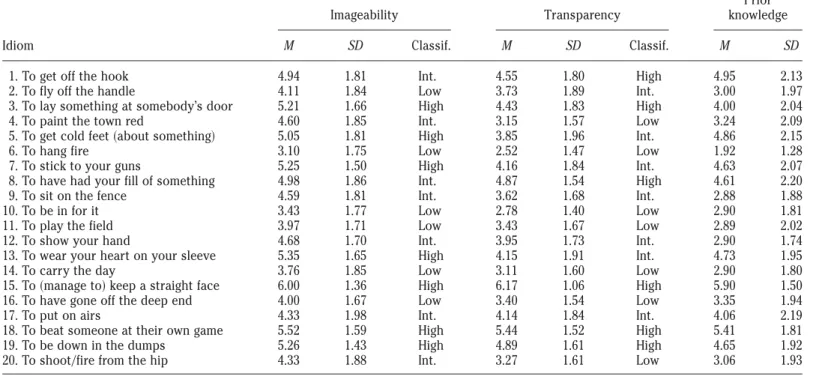
Table 1 summarizes the results of the study in the form of descriptive statis-tics+On the basis of participants’ ratings of imageability,the 20 idioms were
classified into three almost equally sized groups~low,intermediate,and high!+
Similarly, the 20 idioms were grouped into three classes according to their
respective ratings for transparency+
THE LEARNING EXPERIMENT
As outlined previously,the first set of hypotheses are concerned with the
influ-ence of direction of learning on receptive and productive testing+The second
and third sets of hypotheses are related to possible moderating effects of two idiom characteristics: imageability and transparency+ The last two
hypoth-eses address the effect of direction of learning on delayed performance+
Method
Participants.One hundred twenty-nine Dutch-speaking students2~96 female
,
32 male! at the University of Amsterdam, aged 18–28~M⫽21+0,SD⫽3+50!,
participated in the experiment,which was conducted as a part of a 1+5-h test
session at the Department of Psychology+The students receivedY10~
approx-imately US$11!for their participation+University students in the Netherlands
have typically had 6–7 years of English in high school;all participants could
therefore be expected to have at least an intermediate level of proficiency in English+
Design. The experiment was conducted in a 2⫻2⫻ 2 design with two
between-subjects factors—direction of learning ~L1-L2 vs+ L2-L1! and
direc-tion of testing~L1-L2 vs+L2-L1!—and one within-subject factor—time of
test-ing+ A list of 20 pairs of English idiomatic expressions and their Dutch
equivalents was presented in the same order to all participants+Based on the
ratings provided in the rating session, the English idioms differed in their
degree of transparency~low vs+intermediate vs+high!and in their degree of
transpar-Table 1. Rating measures of the 20 stimulus idioms
Imageability Transparency
Prior knowledge
Idiom M SD Classif+ M SD Classif+ M SD
1+To get off the hook 4+94 1+81 Int+ 4+55 1+80 High 4+95 2+13 2+To fly off the handle 4+11 1+84 Low 3+73 1+89 Int+ 3+00 1+97 3+To lay something at somebody’s door 5+21 1+66 High 4+43 1+83 High 4+00 2+04 4+To paint the town red 4+60 1+85 Int+ 3+15 1+57 Low 3+24 2+09 5+To get cold feet~about something! 5+05 1+81 High 3+85 1+96 Int+ 4+86 2+15 6+To hang fire 3+10 1+75 Low 2+52 1+47 Low 1+92 1+28 7+To stick to your guns 5+25 1+50 High 4+16 1+84 Int+ 4+63 2+07 8+To have had your fill of something 4+98 1+86 Int+ 4+87 1+54 High 4+61 2+20 9+To sit on the fence 4+59 1+81 Int+ 3+62 1+68 Int+ 2+88 1+88 10+To be in for it 3+43 1+77 Low 2+78 1+40 Low 2+90 1+81 11+To play the field 3+97 1+71 Low 3+43 1+67 Low 2+89 2+02 12+To show your hand 4+68 1+70 Int+ 3+95 1+73 Int+ 2+90 1+74 13+To wear your heart on your sleeve 5+35 1+65 High 4+15 1+91 Int+ 4+73 1+95 14+To carry the day 3+76 1+85 Low 3+11 1+60 Low 2+90 1+80 15+To~manage to!keep a straight face 6+00 1+36 High 6+17 1+06 High 5+90 1+50 16+To have gone off the deep end 4+00 1+67 Low 3+40 1+54 Low 3+35 1+94 17+To put on airs 4+33 1+98 Int+ 4+14 1+84 Int+ 4+06 2+19 18+To beat someone at their own game 5+52 1+59 High 5+44 1+52 High 5+41 1+81 19+To be down in the dumps 5+26 1+43 High 4+89 1+61 High 4+65 1+92 20+To shoot0fire from the hip 4+33 1+88 Int+ 3+27 1+61 Low 3+06 1+93
Note+Imageability,transparency,and prior knowledge ratings are assessed on a 7-point scale~1⫽not at all;7⫽very much!+Classif+⫽classification for the main experiment;Int⫽intermediate+
462
Margarita
P
.
Steinel,
Jan
H.
Hulstijn,
a
nd
W
olfgang
ency constituted two within-subject factors+ To make sure that potentially
present prior knowledge would not affect the experimental results,
partici-pants were randomly assigned to the four conditions that resulted from the between-subjects factors+ Participants received all 20 stimulus idioms in a
mixed order and were tested immediately after the learning session and then 3 weeks later+In the L1-L2 learning condition,the Dutch equivalent and a
para-phrase in Dutch were presented first, followed by the English idiom+ In the
L2-L1 learning condition,the English idiom appeared on the screen first,
fol-lowed by the Dutch equivalent and a paraphrase in Dutch+
Procedure and Instructions.It took participants approximately 25 min to
complete the experiment,which was conducted in one uninterrupted session
together with four unrelated psychological experiments+ Upon arrival of the
participants in the computer lab,the experimenter explained that all
instruc-tions would be given via the computer and then withdrew but remained nearby in order to be able to give assistance if necessary+Prior to the learning
ses-sion,participants filled out a questionnaire eliciting proficiency-related
infor-mation such as average secondary school grade in English and self-assessment of their current knowledge of English+
After completing the questionnaire,participants proceeded with the
learn-ing session+The instructions were given in Dutch+To start,participants were
given an English example of an idiom assumed to be familiar to them:“to pull
someone’s leg+” Subsequently, the example was used to illustrate the
differ-ence between the literal and the figurative sense of idiomatic expressions~in general!,and participants were made aware of the fact that these two senses
could differ from each other to varying degrees in different idioms+ It was
emphasized how important it is for foreign language learners to have some knowledge of idiomatic expressions for both comprehension and production purposes+The difficulty that foreign language learners often experience with
idioms was addressed briefly,and it was highlighted that this kind of
knowl-edge could contribute to nativelike fluency+ The ensuing task was then
pre-sented as an opportunity to learn some more of these useful expressions+
In the instruction immediately preceding the learning task, participants
were informed that the idiom pairs that they were supposed to learn would be presented one at a time in two successive presentations+ Each pair
remained on the screen for 30 s during the first round and 10 s during the second presentation round+ A clock that remained on the screen above the
text section throughout both sessions helped participants keep track of time+
No mention was made of the variations in direction of learning and test-ing,and participants were not informed of the number of idioms they would
be given to learn+Participants were instructed to try to learn the idioms as
well as they possibly could+ Several learning strategies were briefly
sug-gested, such as paying attention to both the individual words used and the
structure of the expressions as a whole,trying to think of situations in which
expressions+ Participants were told that they could use whichever strategy
they preferred+
Before the second round of presentation,participants were reminded that
the expressions would be presented at a faster rate than the first time and that it might help for them to recall what image~if any!they had associated with each expression and try to visualize it once again+ During the second
round of learning,the expressions were given in the same order and the
direc-tion of learning was the same as in the first round+ Depending on the
direc-tion of the learning manipuladirec-tion, the idiom pairs were presented either in
the order of Dutch-English ~the L1-L2 learning condition! or in the order of English-Dutch~the L2-L1 learning condition!+
The test session began immediately after the second presentation of the idiom pairs+Depending on the direction of testing manipulation,participants
had to type in either the Dutch equivalent or the Dutch paraphrase~both given during the learning session! of the English idioms learned~the L2-L1 testing condition!, or the English equivalent of the Dutch idioms ~the L1-L2 testing
condition!+Following the test session,participants were asked to indicate on
a 7-point scale~bounded by 1⫽completely disagree,and 7⫽fully agree,with
the midpoint 4⫽neither agree nor disagree!their agreement with four state-ments with respect to each of the English idioms+Perceived ease of learning ~“I found it easy to commit this idiom to memory”!, transparency~“The
figu-rative meaning of this idiom had a lot in common with its literal meaning”!
and imageability of the idioms~“I could easily visualize this idiom”!,and
par-ticipants’ prior knowledge~“I already knew precisely what the idiom means”!
were thus assessed+Finally,participants could sign up for feedback~by
enter-ing their e-mail address!+
Delayed Test. Three weeks after the last session of the main experiment,a
delayed test was conducted in an attempt to collect data on the retention of idiomatic expressions over time+This time the participants were approached
by e-mail and were requested to e-mail back their answers to the test+ They
were given a short explanation of the purpose of the follow-up test along with the instructions+The format of the test was the same as in the main
experi-ment and all participants were tested in the same direction as in the first test+
Fifty-eight participants responded~45+0% of the original sample!+The
major-ity of them responded to the first e-mail~n⫽44!+A second e-mail was sent to
those who had not responded within 8 days, and another 14 participants
responded as a result+All participants received feedback via e-mail,including
the list of expressions they were tested on and some suggestions for online resources on idioms+
Scoring. The English answers ~i+e+, in the L1-L2 testing condition! were
scored on a 5-point scale in accordance with two basic rules: ~a! One point
use of prepositions~including the absence of prepositions in some examples!,
plural versus singular form of nouns,and other elements of the phrase~i+e+,
aspects that relate to the accuracy with which the overall phrase structure was produced!+As a rule of thumb,when all content words and prepositions
were used correctly but the use of singular versus plural forms or the use of articles deviated from the original,one point was subtracted from the
maxi-mum+The smaller the number of words in an idiom,the more such deviations
weighed+Spelling mistakes were ignored in all cases+
To illustrate these scoring rules,we will now consider several of the actual
responses subjects gave on the test when they were supposed to produce the idiom “to stick to your guns+” No points were given for “stubborn” and “don’t
move your hips+” One point was awarded to,for instance,“to stick with,” “to
hold the guns,” “to stick by,” or “to stick on your+ + + +” Examples of responses
that received two points were “to stay with your guns,” “to stick to it,” and
“to plug to your gun,” whereas “to stay to your guns,” “to stick to your own
gun,” “to stick your guns,” and “to hold to your guns” were awarded three
points+Finally,four points were given to “sticking to your guns,” “to stick to
ya guns,” and,of course,“to stick to your guns+”
A 5-point scale was also used for the scoring of the Dutch answers+ No
answer or a wrong answer were scored as zero, a correct answer~be it the
Dutch idiom suggested as an equivalent of the expression to be learned or the complete paraphrase!was awarded four points,and there were three
lev-els of approximation of meaning in between,depending on the extent to which
different aspects of the meaning were correctly and fully reflected in the response+
Two raters independently assigned performance scores to the responses of 129 participants in the immediate test~2580 scores!and of 58 participants in the delayed test~1160 scores!+Of the 3740 scores that each rater assigned
in total,the two raters assigned identical scores in 3115 cases~83+3%!+To judge
the interrater reliability,four intraclass correlation coefficients~ICCs!were
cal-culated for the ratings of each idiom, separately for the two directions and
the two moments of testing+ In one case ~immediate receptive performance
on idiom 4!,both raters assigned the same score to all participants~n⫽57!+
In the remaining cases,65 ICCs were greater than+80 and nine ICCs were above
+60+Only five ICCs were below+60 and therefore pointed to low interrater
reli-ability, but three of them referred to delayed performances in the receptive
test+ Because of this high agreement between the raters, the scores of the
first rater were used for subsequent analyses+
Dependent Measures.Total immediate performance was calculated by
add-ing up the performance scores for all 20 idioms~which resulted in a total max-imum score of 80!+Immediate performance on the low,intermediate,and high
imageable idioms was calculated by averaging the respective performance scores of the idioms that were ranked as low~six in total!,intermediate~seven
Table 1!+Immediate performance on the low,intermediate,and high
transpar-ent idioms was calculated by averaging the respective performance scores of the idioms that were ranked as low ~seven in total!, intermediate~seven in
total!,and high~six in total!on transparency in the norming session+In the
case of delayed performance scores,collected via e-mail,sum scores of total
delayed performance, delayed performance on low, intermediate, and high
imageable idioms, and delayed performance on low, intermediate, and high
transparent idioms were calculated in the same way+
Results
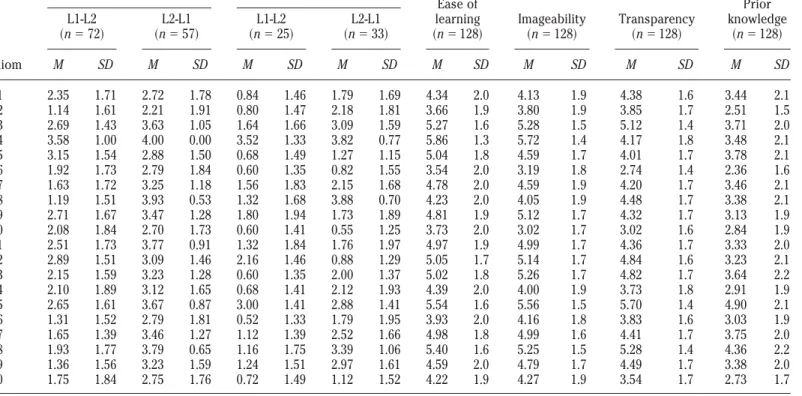
Descriptive Statistics.Table 2 presents the immediate and delayed
perfor-mance scores on the 20 idioms and their ratings of ease of learning,
imageabil-ity,transparency,and prior knowledge+In the rightmost column of Table 2,it
is apparent that,overall,participants indicated that their prior knowledge of
the 20 stimulus idioms was rather low:The reported means were above the
scale midpoint 4 for only two idioms+ The means reported in Table 2
there-fore indicate that participants rejected the statement “I already knew pre-cisely what the idiom means” in 18 out of 20 cases+
Effect of Direction of Learning and Direction of Testing on Immediate
Performance. The first set of hypotheses predicted that direction of learning
would affect immediate performance,especially for the productive test+
Hypoth-esis 1a predicted that performance on the productive test ~L1-L2!would be better when idioms were learned productively~L1-L2!rather than receptively
~L2-L1!+ According to hypothesis 1b, however, productive learning was not
expected to improve performance on the receptive test~L2-L1!+
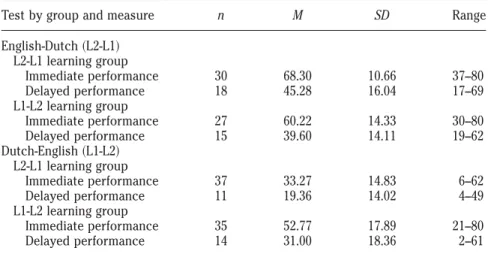
The results of the present study are summarized in Table 3+ Comparing
these results with the results of earlier studies on paired-associate word learn-ing gives initial support to our expectations+ As in all prior studies, a large
difference in performance between the two directions of learning was observed in the productive test~M⫽52+77 vs+M⫽33+27!,whereas the difference between
the two directions of learning observed in the receptive test was smaller in size ~M⫽60+22 vs+ M⫽68+30!+However, it should be noted that this
dif-ference cannot be analyzed in terms of statistical significance due to the fact that the comparison is between two different scales ~one for the L1-L2 responses and one for the L2-L1 responses!+ These two scales, although
bounded by the same numbers,reflect different kinds of performance+Due to
the similar range and division of the scales, however, a careful comparison
should be possible as long as its result is considered indicative of differences rather than as proof of differences+
To test hypothesis 1a, we compared immediate performance on the
pro-ductive test of participants who learned receptively with the performance of participants who learned productively+ Thettest revealed that participants
Table 2. Performance and rating measures of the 20 stimulus idioms
Immediate performance Delayed performance
L1-L2
~n⫽72!
L2-L1
~n⫽57!
L1-L2
~n⫽25!
L2-L1
~n⫽33!
Ease of learning
~n⫽128!
Imageability
~n⫽128!
Transparency
~n⫽128!
Prior knowledge
~n⫽128!
Idiom M SD M SD M SD M SD M SD M SD M SD M SD
1 2+35 1+71 2+72 1+78 0+84 1+46 1+79 1+69 4+34 2+0 4+13 1+9 4+38 1+6 3+44 2+1 2 1+14 1+61 2+21 1+91 0+80 1+47 2+18 1+81 3+66 1+9 3+80 1+9 3+85 1+7 2+51 1+5 3 2+69 1+43 3+63 1+05 1+64 1+66 3+09 1+59 5+27 1+6 5+28 1+5 5+12 1+4 3+71 2+0 4 3+58 1+00 4+00 0+00 3+52 1+33 3+82 0+77 5+86 1+3 5+72 1+4 4+17 1+8 3+48 2+1 5 3+15 1+54 2+88 1+50 0+68 1+49 1+27 1+15 5+04 1+8 4+59 1+7 4+01 1+7 3+78 2+1 6 1+92 1+73 2+79 1+84 0+60 1+35 0+82 1+55 3+54 2+0 3+19 1+8 2+74 1+4 2+36 1+6 7 1+63 1+72 3+25 1+18 1+56 1+83 2+15 1+68 4+78 2+0 4+59 1+9 4+20 1+7 3+46 2+1 8 1+19 1+51 3+93 0+53 1+32 1+68 3+88 0+70 4+23 2+0 4+05 1+9 4+48 1+7 3+38 2+1 9 2+71 1+67 3+47 1+28 1+80 1+94 1+73 1+89 4+81 1+9 5+12 1+7 4+32 1+7 3+13 1+9 10 2+08 1+84 2+70 1+73 0+60 1+41 0+55 1+25 3+73 2+0 3+02 1+7 3+02 1+6 2+84 1+9 11 2+51 1+73 3+77 0+91 1+32 1+84 1+76 1+97 4+97 1+9 4+99 1+7 4+36 1+7 3+33 2+0 12 2+89 1+51 3+09 1+46 2+16 1+46 0+88 1+29 5+05 1+7 5+14 1+7 4+84 1+6 3+23 2+1 13 2+15 1+59 3+23 1+28 0+60 1+35 2+00 1+37 5+02 1+8 5+26 1+7 4+82 1+7 3+64 2+2 14 2+10 1+89 3+12 1+65 0+68 1+41 2+12 1+93 4+39 2+0 4+00 1+9 3+73 1+8 2+91 1+9 15 2+65 1+61 3+67 0+87 3+00 1+41 2+88 1+41 5+54 1+6 5+56 1+5 5+70 1+4 4+90 2+1 16 1+31 1+52 2+79 1+81 0+52 1+33 1+79 1+95 3+93 2+0 4+16 1+8 3+83 1+6 3+03 1+9 17 1+65 1+39 3+46 1+27 1+12 1+39 2+52 1+66 4+98 1+8 4+99 1+6 4+41 1+7 3+75 2+0 18 1+93 1+77 3+79 0+65 1+16 1+75 3+39 1+06 5+40 1+6 5+25 1+5 5+28 1+4 4+36 2+2 19 1+36 1+56 3+23 1+59 1+24 1+51 2+97 1+61 4+59 2+0 4+79 1+7 4+49 1+7 3+38 2+0 20 1+75 1+84 2+75 1+76 0+72 1+49 1+12 1+52 4+22 1+9 4+27 1+9 3+54 1+7 2+73 1+7
Language
Idiom
Learning
ticipants who had learned receptively,t~70!⫽5+05,p,+001+To test
hypoth-esis 1b, the same comparison was made for immediate performance on the
receptive test+ Confirming the prediction that L1-L2 learners would not
out-perform L2-L1 learners,thettest revealed that participants who had learned
receptively performed even better than participants who had learned produc-tively,t~55!⫽2+43,p,+05+
The reasoning that led us to propose this first set of hypotheses,however,
also suggests that direction of learning would be especially relevant in the more demanding productive test+To address this, we compared the
magni-tude of the effects found for both hypotheses+We calculated the two
respec-tive effect sizes by dividing the difference between the producrespec-tive learners and the receptive learners ~as displayed in Table 3!by the overall standard deviation on each test+The effect size of the finding related to hypothesis 1a
is~52+77⫺33+27!019+00⫽ ⫹1+03+That means that on the productive test,the
productive learners outperformed the receptive learners by more than one standard deviation, which can be considered a very large effect+ The effect
size of the finding related to hypothesis 1b is~60+22⫺68+30!013+06⫽ ⫺0+62+
This effect size is negative,which shows that productive learners performed
worse than receptive learners on the receptive test+ More importantly, this
second effect size is considerably smaller than the first:Receptive learners
outperformed productive learners by less than two thirds of a standard devi-ation+ All in all,the results support the first set of hypotheses:Direction of
learning affected immediate performance,and its effect was particularly large
on the productive test+
Table 3. Total immediate and total delayed performance by experimental condition
Test by group and measure n M SD Range
English-Dutch~L2-L1!
L2-L1 learning group
Immediate performance 30 68+30 10+66 37–80
Delayed performance 18 45+28 16+04 17–69
L1-L2 learning group
Immediate performance 27 60+22 14+33 30–80
Delayed performance 15 39+60 14+11 19–62
Dutch-English~L1-L2!
L2-L1 learning group
Immediate performance 37 33+27 14+83 6–62
Delayed performance 11 19+36 14+02 4–49
L1-L2 learning group
Immediate performance 35 52+77 17+89 21–80
Delayed performance 14 31+00 18+36 2–61
Note+The maximum possible score is 80+Different scales were used for scoring the Dutch and English responses+ Thus,although for both tests the maximum score is 80,the figures in the English-Dutch group cannot be compared with those in the Dutch-English group+
Moderating Effects of Imageability and Transparency. The second and third sets of hypotheses addressed potential moderating effects of two idiom characteristics:imageability and transparency+ For reasons of efficiency, we
first report on the findings with respect to hypothesis 2c and then on those concerning hypotheses 2a and 2b+To test hypothesis 2c,predicting that high
positive correlations would be observed between performance and the rating of one’s ability to visualize the idioms to be learned,we calculated three sets
of correlation scores+
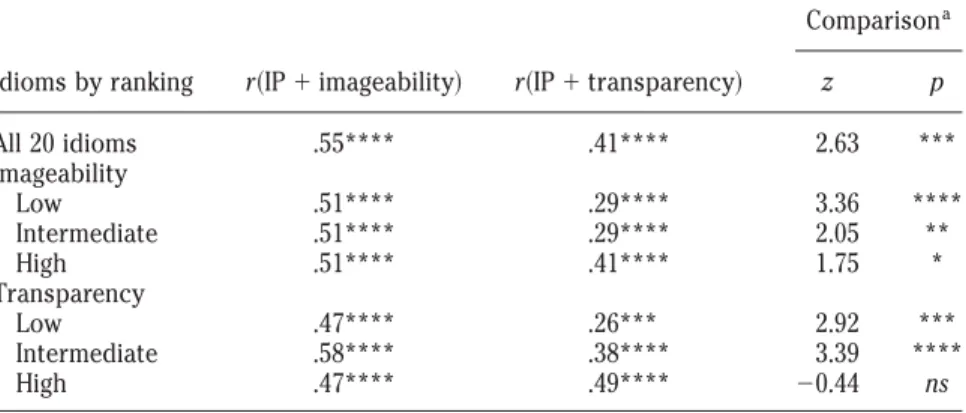
The first set of correlations,displayed in the first row of Table 4,is based
on the mean immediate performance scores~collapsed over both tests! and ratings over all 20 idioms+ Performance is significantly and positively
corre-lated with both ratings,which shows that participants who performed better
rated it less difficult to visualize the idioms and considered the idioms to be more transparent+We compared the two correlation coefficients~i+e+,the
cor-relation between immediate performance and imageability and the correla-tion between immediate performance and transparency! using the formula proposed by Olkin and Siotani~1964,in Bortz,1989!to find out whether the
first correlation is significantly higher than the second one+ As shown in the
third and fourth columns of Table 4,this was the case;3that is,although
per-formance is significantly correlated with both ratings, the relation between
performance and imageability is even stronger than the relation between per-formance and transparency+ The remaining rows of Table 4~rows 2–7!break
down this general finding for each separate class of idioms+ Recall that the
subcategorization into three classes of imageability and three classes of trans-parency was based on the ratings of imageability and transtrans-parency provided in the preliminary assessment study,independent of the ratings by students
Table 4. Correlation of mean immediate performance scores and mean ratings of imageability and transparency summarized per class of idioms
Comparisona
Idioms by ranking r~IP⫹imageability! r~IP⫹transparency! z p
All 20 idioms +55**** +41**** 2+63 ***
Imageability
Low +51**** +29**** 3+36 ****
Intermediate +51**** +29**** 2+05 **
High +51**** +41**** 1+75 *
Transparency
Low +47**** +26*** 2+92 ***
Intermediate +58**** +38**** 3+39 ****
High +47**** +49**** ⫺0+44 ns
Note+IP⫽Immediate performance+N⫽128+
aComparison of the two correlation coefficients in columns 2 and 3
in the learning experiment+For each subgroup of idioms,performance is
sub-stantially and positively correlated with both ratings+ This lends additional
support to the finding that participants who performed better rated it easier to visualize the idioms and considered the idioms to be more transparent than participants who did not perform as well+
Hypotheses 2a and 2b predicted that imageability would facilitate immedi-ate performance,especially when the idioms were learned in the L2-L1
direc-tion+ In order to analyze these predictions, we compared three dependent
variables per participant; that is, their mean performance score on the six
low imageable idioms,the seven intermediate imageable idioms,and the seven
high imageable idioms+In terms of multivariate analysis of variance~MANOVA!,
this adds the three-level within-subject factor imageability to the experimen-tal design+
As the second set of hypotheses predicted within-subject effects,a 2⫻2⫻
3 MANOVA with the between-subjects factors of direction of learning and direc-tion of testing and the within-subject factor of imageability was performed+
Note that this analysis does not compare performances on different tests
~receptive vs+ productive! but different performances within each
partici-pant’s dataset+Thus,finding an interaction that involves the between-subjects
factor direction of testing would not indicate that performances on the differ-ent tests differ,but it would indicate that direction of testing differentially
influ-enced participants’ performance on low, intermediate, and high imageable
idioms+ Still, the comparison is between performances on identical tests
because performances are compared within each participant+The thorny issue
of whether recognition is an easier test than production is not central to this study,as comparing different tests yields complications in terms of the
scor-ing of the performance+
To test hypothesis 2a,the mean performance scores on low,intermediate,
and high imageable idioms were entered into a 2⫻2⫻3 MANOVA with direc-tion of learning~L2-L1 vs+L1-L2! and direction of testing~L2-L1 vs+ L1-L2! as
between-subjects factors and imageability~low vs+intermediate vs+high!as a
within-subject factor+A main effect was obtained for imageability,F~2,250!⫽
31+42, p, +001+ Paired-samplesttests revealed that participants performed
worse on low imageable idioms ~M⫽2+31, SD⫽1+22! than on intermediate ~M⫽2+76,SD⫽0+98!,t~128!⫽ ⫺6+70,p,+001,or high imageable idioms~M⫽
2+74,SD⫽1+03!,t~128!⫽ ⫺6+11,p,+001,whereas performance on the latter
two did not differ, t~128!⫽0+53, p⫽+60+ MANOVA further revealed the
pre-dicted interaction between imageability and direction of learning,F~2,250!⫽
3+61,p,+05+As predicted by hypothesis 2b,imageability had a weaker
mod-erating effect on the performance of participants who learned in the L1-L2 direction~M⫽2+55,SD⫽1+10;M⫽2+84,SD⫽0+88;andM⫽2+97,SD⫽0+80 for
low,intermediate,and high imageable idioms,respectively! than on the
per-formance of participants who learned in the L2-L1 direction ~M ⫽ 2+08, SD⫽1+28;M⫽2+69, SD⫽1+07;and M⫽2+52, SD⫽1+18,respectively!+ This
finding is illustrated in Figure 1+
There was no significant interaction with direction of testing,both withF ~2,250! ,1+This finding shows that the patterns predicted by hypothesis 2a
and 2b and found in this analysis were the same in the receptive and the pro-ductive tests+The fact that no interaction involving direction of testing was
observed indicates that this advantage can be found on both tests~ produc-tive and recepproduc-tive!+For productive learners,there was gradual improvement
in performance across the three groups of idioms that differed in imageabil-ity+For receptive learners,however,there was a steep~and significant!increase
in performance between the low and the intermediate imageable idioms,
whereas the difference between performance on the intermediate and the high imageable idioms was not significant~i+e+,it seemed especially inefficient to
learn low imageable idioms in the L2-L1 direction!+These findings confirm and
qualify the conclusions that we made about the role of imageability based on the correlations between imageability ratings and performance~as predicted in hypothesis 2c!+ Altogether, the second set of hypotheses received good
empirical support+
The third set of hypotheses predicted that transparency would facilitate immediate performance,especially when receptive knowledge was tested+
Anal-ogous to the procedure described previously,we added the three-level
within-subject factor transparency to the experimental design+In hypothesis 3a,we
predicted that test performance on more transparent idioms would be better than that on less transparent ones, and in hypothesis 3b,we predicted that
this effect would be particularly pronounced when receptive knowledge was tested~L2-L1!+To test these hypotheses,the mean performance scores on low,
ilar to the one described for the imageability results+ Results revealed that
transparency had no significant main effect on performance,F~2,250!⫽2+32, p⫽+10+MANOVA did reveal,however, the interaction between transparency
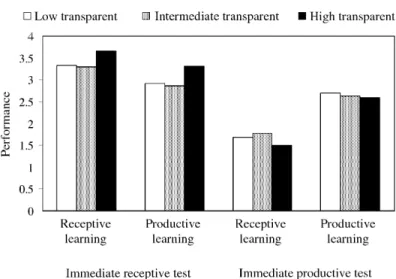
and direction of testing, F~2,250!⫽11+81,p, +001+ Figure 2 shows that, as
predicted by hypothesis 3b,high transparent idioms were comprehended
par-ticularly well ~i+e+, in the L2-L1 testing direction, with M⫽3+13, SD⫽ 0+86; M⫽3+08,SD⫽0+75;andM⫽3+49,SD⫽0+60,for low,intermediate,and high
transparency idioms,respectively!, whereas transparency had no facilitating
effect on production~M⫽2+18,SD⫽1+07;M⫽2+19,SD⫽1+04;andM⫽2+03, SD⫽1+05,respectively!+
Long-Term Retention. The fourth set of hypotheses predicted that
direc-tion of learning would affect delayed performance,especially for the
produc-tive test+4Hypothesis 4a predicted that performance on the delayed productive
test~i+e+,L1-L2!would be better when idioms were learned productively~L1-L2!
rather than receptively~L2-L1!+According to hypothesis 4b,however,
produc-tive learning was not expected to improve delayed performance on the recep-tive test~i+e+,L2-L1!+The difference in delayed performance between the two
directions of learning that was observed for the productive test ~M⫽31+00
vs+M⫽19+36! was greater than the difference between the two directions of
learning observed for the receptive test ~M⫽39+60 vs+ M⫽45+28, see also
Table 3!+To test hypothesis 4a,we compared the delayed performance on the
productive test of participants who learned receptively with the delayed per-formance of those who learned productively+ Confirming hypothesis 4a, the ttest revealed that participants who learned productively performed better
Figure 2. Immediate performance depending on condition and transparency+
than participants who learned receptively,t~23!⫽1+74,p,+05~one-tailed!+To
test hypothesis 4b,the same comparison was made for delayed performance
on the receptive test+Confirming the prediction that L1-L2 learners would not
outperform L2-L1 learners, thet test revealed that direction of learning did
not influence delayed performance,t~31!⫽1+07,p⫽+29+
Comparing the effect sizes for the delayed tests,again,supports the
rea-soning that led us to propose hypotheses 4a and 4b+ The effect size of the
finding related to hypothesis 4a is~31+00⫺19+36!017+30⫽ ⫹0+67, which is to
say that even 3 weeks after learning, productive learners still outperformed
receptive learners on the productive test by more than two thirds of a stan-dard deviation,which is a considerable effect+The effect size of the finding
related to hypothesis 4b is ~39+60⫺45+28!015+23⫽ ⫺0+37, which is small, as
no differences between the groups were found+All in all, the results support
the fourth set of hypotheses: Direction of learning affected delayed
perfor-mance,but only on the productive test+
To examine the issue of decline in test scores over time,we performed an
explorative analysis and submitted immediate and delayed performance scores into a 2⫻2⫻2 repeated-measurements MANOVA with direction of learning
~L2-L1 vs+L1-L2!and direction of testing~L2-L1 vs+L1-L2!as between-subjects
factors and time of measurement ~immediate vs+ delayed test! as a
within-subject repeated-measures factor+This analysis is based on 45% of the
sam-ple, because delayed performance scores could be obtained from only 58
participants+
A main effect of time,F~1, 54! ⫽191+58,p ,+001, indicated that, overall,
immediate performance scores were higher than delayed performance scores
~M⫽59+07,SD⫽18+53 vs+M⫽35+45,SD⫽18+08!+This deterioration was
qual-ified over time by two interactions+ An interaction of the repeated-measures
factor with direction of learning,F~1,54!⫽4+80,p,+05,showed that
deteri-oration followed a different pattern depending on the direction of learning+
Performance scores of participants in the L1-L2 learning direction decreased more over time~i+e+,fromM⫽62+21,SD⫽13+85 toM⫽35+45,SD⫽16+59!than
did those of participants in the L2-L1 learning direction~i+e+,fromM⫽55+93, SD⫽22+06 toM⫽35+45,SD⫽19+75!+A three-way interaction of the
repeated-measures factor with direction of learning and direction of testing,F~1,54!⫽
5+98,p,+02,showed that there were differences in the pattern of
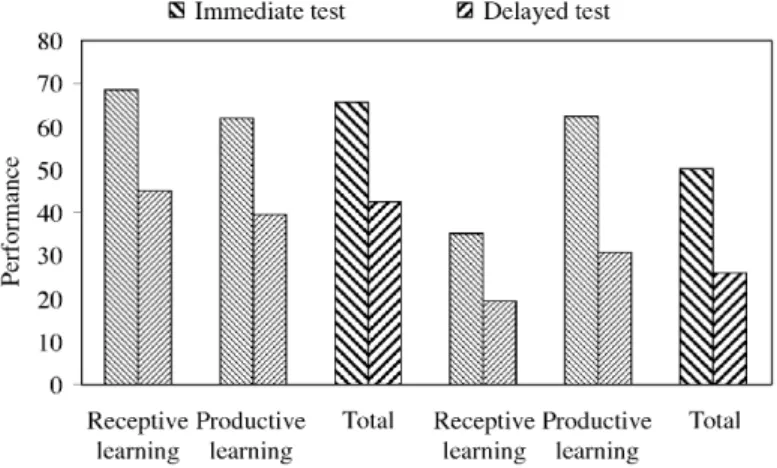
deteriora-tion across the four experimental condideteriora-tions+As Figure 3 illustrates,different
patterns of results emerge for L1-L2 and for L2-L1 testing+Although
recogni-tion scores dropped by virtually the same amount in both direcrecogni-tion-of-learning subgroups~the first and second pairs of bars from the left!,direction of
learn-ing affected the decline in production performance differently: Production
scores of participants in the L2-L1 learning condition~fourth pair of bars from the left!decreased less than scores of participants in the L1-L2 learning con-dition~fifth pair of bars from the left!,although,as found in the analysis related
to hypothesis 4b, the latter still scored better on the delayed test, t~23! ⫽
GENERAL DISCUSSION
In this study,L2 idiom learning was examined in a PAL task to investigate the
effects of direction of learning,direction of testing,idiom imageability,idiom
transparency, and long-term retention+ In our discussion, we will recap the
main results of the study,situate the implications of our findings in a broader
context,and make some suggestions for further research+
L2 Idiom Learning and Direction of Learning
In an attempt to extrapolate from the findings regarding paired-associate studies on the learning of individual,isolated,L2 words~Griffin & Harley,1996;
Mondria & Wiersma, 2004; Schneider et al+,2002;Stoddard, 1929!, we used
L2 idioms as stimulus material in order to explore whether similar principles hold when participants learn combinations of familiar words whose meaning as a whole is not familiar+We based our predictions on the idea that learning
vocabulary under conditions that make the learning procedure itself more difficult ~i+e+, L1-L2! would lead to more processing and more remembering ~Schneider et al+,2002!and on the principle of transfer-appropriate
process-ing~Bransford,Franks,Morris,& Stein,1979!,which states that a processing
compatibility between learning and testing tasks will positively affect testing task performance,whereas incompatibility will negatively affect testing task
performance+
Confirming this line of reasoning, we found that ~a! performance on the
productive test was influenced differentially by direction of learning,in such Figure 3. Immediate and delayed performance depending on condition+