COLD WAR INTERNATIONALISMS: THE USSR IN UNESCO, 1945-1967
Louis H. Porter
A dissertation submitted to the faculty at the University of North Carolina at Chapel Hill in partial fulfillment of the requirements for the degree of Doctor of Philosophy in the Department
of History.
Chapel Hill 2018
Approved by: Donald J. Raleigh Louise McReynolds Susan D. Pennybacker Chad Bryant
ABSTRACT
Louis H. Porter: Cold War Internationalisms: The USSR in UNESCO, 1945-1967 (Under the direction of Donald J. Raleigh)
This dissertation examines the participation of the USSR in the United Nations Educational, Scientific, and Cultural Organization (UNESCO) during the Cold War as a case study of the role of international organizations in Soviet engagement with the outside world. Utilizing archival material tapped in Russia and at UNESCO’s headquarters in Paris, France, I provide the first analysis of how a noncommunist international organization integrated the USSR into the transnational flow of people, publications, and ideas in the postwar era before the onset of détente in the late 1960s. I contextualize Soviet internationalism in the Western
thinking internationally and appraising the USSR’s place in the world, involving them in international public service, an international public sphere, and an international reading public. Members of the Soviet intelligentsia attended UNESCO events; Soviet professionals worked for years abroad in UNESCO’s bureaucracy; and a range of citizens read UNESCO publications inside the USSR. Once it resolved to permanently stay in UNESCO after 1959, the USSR made progress toward rivaling the West in the organization. But as decolonization accelerated in the 1960s, the pluralizing world order attenuated the impact of this progress. Nevertheless,
ACKNOWLEDGEMENTS
In the course of researching and writing this dissertation, I have received the invaluable assistance and advice of numerous people and institutions in the United States and across the Atlantic in France and Russia. The kernel of an idea for this project first came to me when reading historian Ilya V. Gaiduk’s diplomatic history of Soviet participation in the United Nations (UN). Gaiduk, who sadly passed away before expanding on his own preliminary inquiries into Soviet conduct in UN specialized agencies, drew my attention to the neglected state of research on Soviet relations with the world body. When I began to rummage around for a starting point on Soviet involvement in UNESCO in 2012, the academic librarians at the
University of Illinois’s Russian, East European, and Eurasian Center’s Summer Research Lab assisted me in getting a feel for the literature on the subject. During my time at UNC, I benefitted from a University Merit Assistantship and a Dissertation Completion Fellowship from the UNC Graduate School at the beginning and end of my graduate career respectively. I also relied on funding from the UNC Department of History for summer research and a grant from UNC’s chapter of the Department of Education’s Foreign Language and Area Studies (FLAS) Program for the improvement of my Russian language skills.
archivists at ARAN, GARF, RGANI, RGASPI, and UNESCO patiently answered my requests and graciously guided me through their holdings. I am also thankful to the National Research University–Higher School of Economics for hosting me during my time in Moscow.
I must express my gratitude to the graduate students and administrative staff of the Department of History at UNC who have helped me become a better historian and Russianist. Although before my time, Marko Dumančić first alerted me to UNC-Chapel Hill’s incredible
group of Russian historians when he did his job talk at my undergraduate institution, Oberlin College, in 2010. I would also like to thank the cohort of Russianists who critiqued a draft of one of my chapters at the Carolina Seminar, “Russia and its Empires, East and West.” This group of brilliant historians has also enlivened my time in Chapel Hill. Trevor Erlacher hosted me during prospective weekend and, along with Stephen Riegg, gave me important pointers as a first-year student. Conversations over a beer (or two) with Dan Giblin, Dakota Irvin, Peter Gengler, Michael Skalski, and others have made these years a more enjoyable and interesting experience. I also benefitted from the indispensable assistance of Joy Jones and the entire staff of the
Department of History, without whom it is safe to say that I would have been lost while navigating the process of teaching and completing the steps toward a PhD.
The faculty members of the department with whom I had the privilege to work challenged me to see my research from new perspectives and strive toward crafting rigorous arguments inspired by their profound expertise. Christopher Browning helped me to understand the Second World War on a deeper level and shaped my framing of the postwar world in this dissertation. Eren Tasar urged me to consider the role of non-Russian Soviet citizens in my project and offered multiple other useful suggestions. Chad Bryant not only presented
UNESCO, but also pointed me in the final stages of drafting to new avenues of inquiry
pertaining to Soviet international civil servants. Susan D. Pennybacker encouraged me to make my history more global in scope and to complicate my treatment of the non-Soviet themes and players surrounding UNESCO. Louise McReynolds helped me to step out of my comfort zone of postwar Soviet history and refine my thinking about the context of my project in the longue durée of Russian history and the cultural milieu of the 1950s in the West. Most of all, words cannot convey my deep thanks to my adviser, Donald J. Raleigh, who taught me how to behave, write, and think like a historian. I am indebted to him for the thoughtful feedback he provided on drafts of this dissertation. His mentoring since I first stepped into his seminar at the start of my time at UNC has enabled me to grow both personally and professionally in countless ways.
Before coming to UNC, the Oberlin College Russian Department kindled in me an interest in the Eurasian region. Tom Newlin first recruited me to take Russian 101. He made the language fun every day and was a pleasure to talk to about life in general. Benjamin Lussier and Zachary Rewinski were great comrades with whom to begin studying Russia while getting up to more than a few hijinks that made my undergraduate experience an inimitable adventure.
Most importantly, my family has given me the strength to persevere through all the ups and downs of graduate-student life. The love, care, and wisdom of my parents has given me the foundation upon which to build toward my dreams and a curiosity about the human condition that originally set me on the path toward history. I would have never made it to graduate school without them and the models they set for me growing up. The courage, empathy, and
TABLE OF CONTENTS
LIST OF FIGURES AND TABLES...xi LIST OF ABBREVIATIONS...xii INTRODUCTION...1 SECTION 1: INTERNATIONAL ORGANIZATIONS THROUGH THE
COLD WAR: HOW THE SOVIET UNION LEARNED TO LIVE WITH
UNESCO, 1945-1959...24 Chapter 1: The Missing Member State: Socialist
Nationalism, Bourgeois Internationalism, and
the Rise of International Organizations, 1945-1953...30 Chapter 2: The “Key to the Whole System”: The
USSR Enters UNESCO, 1954-1959...75 SECTION 2: “NO NEUTRAL MEN”: A DAY IN THE LIFE OF A
SOVIET INTERNATIONAL CIVIL SERVANT, 1956-1967...133 Chapter 3: Blue Bureaucrats, Red Consciences:
The Leff Affair and the Formation of the
International Civil Servant, 1919-1956...151 Chapter 4: In Search of “Sovsotrudniki”: UNESCO
Recruitment Practices and Soviet Mobilization of
International Civil Servants...187 Chapter 5: Communists by Night: International
Civil Servants and Life in the Soviet Colony in
Paris...219 Chapter 6: International Civil Servants by Day:
The Cold War of Everyday Life in the UNESCO
SECTION 3: “A WINDOW OPEN ON THE WORLD”: SOVIET CITIZENS AND THE INTERNATIONAL PUBLICS OF UNESCO,
1955-1967...355 Chapter 7: Soviet Participation in the UNESCO
International Public Sphere...361
Chapter 8: Soviet Participation in the UNESCO
Reading Public...402
Chapter 9: “Many Voices, One World”: Soviet
LIST OF FIGURES AND TABLES
Figure 1 - The Soviet Flag and the UNESCO Logo...9 Figure 2 - Pravda Cartoon about UNESCO...67 Figure 3 - Covers of The UNESCO Courier...419 Table 1 - Number and Percentage of UN Experts from the USSR and
Major Western Countries, 1956-1960...456 Table 2 - Number and Percentage of UN Fellowships Sponsored by
LIST OF ABBREVIATIONS
ACJ Allied Council for Japan
AN SSSR Academy of Sciences of the USSR
APN Soviet “News” Printing Agency
ASOON Soviet Association for the Promotion of the UN
BMS UNESCO Bureau for Relations with Member States
BPM UNESCO Bureau of Personnel and Management
BSE Great Soviet Encyclopedia
BSSR Belorussian Soviet Socialist Republic
BTAO UN Bureau of Technical Assistance Operations CAME Conference of Allied Ministers of Education
CBS Columbia Broadcasting System
CIA Central Intelligence Agency
COMECON Council for Mutual Economic Assistance
COMINFORM Communist Information Bureau
COMINTERN Communist International
CPSU Communist Party of the Soviet Union
CSCE Conference on Security and Cooperation in Europe
DPRK Democratic People’s Republic of Korea
ECOSOC United Nations Economic and Social Council
EEC European Economic Community
EPTA UN Expanded Program of Technical Assistance
FBI Federal Bureau of Investigation
FICSA Federation of International Civil Servants’ Associations
FRG Federal Republic of Germany
FSA Farm Security Administration
GDR German Democratic Republic
GKES State Committee for Foreign Economic Relations
GKKS State Committee for Cultural Relations with Foreign Countries GRTTL-ONTI Division of Scientific-Technical Information
IAEA International Atomic Energy Agency
IBE International Bureau of Education
ICIC International Committee for Intellectual Cooperation ICSAB International Civil Service Advisory Board
IIIC International Institute of Intellectual Cooperation IIL Soviet Foreign Literature Publishing House IIMK Institute for the History of Material Culture
IINiT Institute for the History of Science and Technology IIT, Bombay Indian Institute of Technology, Bombay
IKP Institute of Red Professors
ILO International Labor Organization
IOELB International Organizations Employees Loyalty Board IPSA International Political Sciences Association
MGIIIa Moscow State Institute of Foreign Languages
MGPI V. I. Lenin Moscow State Pedagogical Institute
MID USSR Ministry of Foreign Affairs
MINVUZ Ministry of Higher and Secondary Special Education
MVT USSR Ministry of Foreign Trade
NATO North Atlantic Treaty Organization
NKID Soviet People’s Commissariat for Foreign Affairs
OECD Organization for Economic Cooperation and Development OEEC Organization for European Economic Cooperation
OAS Organization of American States
OAS Organisation de l’armée secrète
OIC Organization of Intellectual Cooperation
OMEO USSR Ministry of Foreign Affairs Division of International
Economic Organizations
OMGUS Office of Military Government of the United States
PRC People’s Republic of China
ROK Republic of Korea
STA UNESCO Staff Association
TAA UN Technical Assistance Administration
TAB UN Technical Assistance Board
Tekhnopromeksport All-Union Technical and Industrial Export Organization
TsK KPSS Central Committee of the Communist Party of the Soviet Union TsK VKP(b) Central Committee of the All-Union Communist Party
UN/UNO United Nations Organization
UNC United Nations Command, Korea
UNCSW UN Commission on the Status of Women
UNECE UN Economic Commission for Europe
UNESCO United Nations Educational, Scientific, and Cultural Organization
UNICEF United Nations Children’s Fund
UNKRA United Nations Reconstruction Agency, Korea
UNRRA United Nations Relief and Rehabilitation Administration USAID United States Agency for International Development
USIA United States Information Agency
USSR Union of Soviet Socialist Republics
VGBIL All-Union State Library of Foreign Literature
VOA Voice of America
VOKS All-Union Society for Cultural Relations with the Abroad VTsSPS All-Union Central Council of Trade Unions
INTRODUCTION
In 1957, Stephen Spender, a British writer who had penned an essay for the 1949
anticommunist manifesto The God That Failed, published Engaged in Writing, a biting satirical novel portraying the failure of Western intellectuals to come to terms with the violent “excesses” committed by Soviet leader I. V. Stalin and revealed in Soviet First Secretary N. S.
Khrushchev’s 1956 “Secret Speech.” The novel follows Olim Asphalt, an official of “LITUNO” (the “literary and cultural suborgan–some said an operable appendix–of the United Nations”), during a trip to Venice, where he serves as a LITUNO observer at the “East-West Conference of European Intellectuals.” Sponsored by LITUNO and convened by an associated organization called “EUROPLUME,” the conference brings together two famous French existentialists; a pair of iconic writers of the Italian Resistance; a Hungarian poet; and three mandarins of the Soviet literary world.
Spender uses the setting of the conference not only to ridicule Western thinkers who justified Stalinist atrocities, but also to lampoon the philosophy of the real-life version of
LITUNO, the United Nations Educational, Scientific, and Cultural Organization (UNESCO)—a United Nations (UN) specialized agency that championed putting the two opposing sides of the Cold War in the same room as the best means of realizing peace. LITUNO and its associated organization envision the week-long conference as an opportunity for the intellectual elites of the capitalist and communist blocs to experiment in “reconciliation” and “engagement” in the
act of international communication would lead enemies to “mutual understanding.” Spender, a former UNESCO official himself who had attended a conference in Vienna as an observer in the spring of 1956, parodies this naïve premise at the core of the mission of LITUNO and its
associated organization in the opening remarks to the conference delivered by Bonvolio, the good-willed head of EUROPLUME:
‘I wish to make clear very precisely and in the most concrete way,’ he began, ‘that our program here is to have no program. Certain of you may have objection to this program– –or, you may say, this lack of program. But the aim of this meeting is, simply and exactly, to arrange another meeting. And for the purpose of that other meeting what we have to discuss is whether we can meet and, if so, precisely what discuss [sic]. In order to discover this, it seems best that we should examine ideas of a general order, to discover what grounds we may have of agreement, or, if I may so put it, of our agreement to disagree.’
The rest of the conference devolves into a self-indulgent, fatuously grandiloquent, and circular debate among the Western participants over the possibility of “engaging” their Soviet counterparts. Meanwhile, the Soviet representatives to the conference sit silently as objects of a solipsistic feud among the Western Left, looking on as spectators with a “remote staring air, like a range of mountains viewed from a distance.” Cut off from the conversation by “barriers of language, ideology, and imperturbability,” they occasionally utter formulaic regurgitations of official Soviet maxims or declarations echoing the conference’s nebulous goals, but seem lost in the melee. Because their interpreter has fallen behind in translating, they cannot answer
youth living in the eastern bloc before the two have sex in a gondola. Otherwise, little “mutual understanding” between the two sides comes from the whole affair.1
Notwithstanding his portrayal of the futility of the proceedings, the fact that Spender based the setting of his novel on a real conference sponsored by UNESCO testifies to the centrality of events convened by international organizations as major sites of interaction and negotiation between the capitalist and communist worlds during the Cold War. In the aftermath of the mass destruction of the Second World War, the number of international organizations grew exponentially due to a widely held assumption that the world needed to transcend the nationalist belligerence that had led to the worldwide conflicts of the first half of the twentieth century. The rise of this constellation of international organizations, which revolved around the newly created UN and its specialized agencies, heralded the advent of multilateral diplomacy as a major tool for solving global issues in every imaginable sphere of human activity.
UNESCO and these other new organizations represented an institutionalization of liberal, or Western, internationalism––the seldom studied but equally influential alternative to the
socialist internationalism of the Soviet Union. Western and socialist internationalisms have an intertwined history dating back at least to the competing visions of international solidarity born out of the revolutions of 1848.2 Unlike socialist internationalism, the founding ideology of the
1 Spender first published the novel in the journal Encounter, which he had founded together with the American political thinker Irving Kristol and which received funding from the Central Intelligence Agency (CIA). The key target of Spender’s ridicule in the novel is Jean Paul Sartre. For the novel, see Stephen Spender, “Engaged in Writing (A Short Novel, Part I),” Encounter 9, no. 7 (1957): 36–69; and Stephen Spender, “Engaged in Writing (A Short Novel, Part II),” Encounter 9, no. 8 (1957): 42–66. For an overview of Spender’s life during this time, see John Sutherland, Stephen Spender: The Authorized Biography (New York: Viking Press, 2004), 349–408.
Soviet Union that preached an upheaval of the present order by a horizontal alliance of “the workers of the world,” Western internationalism advocated for reform of the established order through varying degrees of world governance and multilateral cooperation among peaceful nations––a vision concretized as international organizations in the twentieth century. Far from behaving as bystanders to the bipolar conflict that dominated world history from 1945 to 1991, these organizations, the historian Akira Iriye writes, “were actors in the Cold War drama.”3
This dissertation is the first comprehensive history of the deeply rich social, cultural, and intellectual experiences of Soviet diplomats, scholars, professionals, and other citizens in this international organizational dimension of the “Cold War drama.” Using UNESCO as a case study for Soviet relations with the larger network of postwar international organizations from the end of the Second World War to the eve of détente in the late 1960s, I go beyond the diplomatic theater of the UN Security Council and General Assembly to investigate how the broader Soviet population viewed and left its mark on UNESCO as an example of the general Soviet strategy for dealing with international organizations founded in the spirit of Western internationalism.
Instead of approaching UNESCO as neutral grounds for different countries to conduct
multilateral diplomacy, this dissertation takes the perspective of Soviet nationals who came into contact with the organization in order to unearth the hidden social dynamics, culture, and politics at work behind the veneer of neutrality at the core of the UN system. It therefore seeks to give
these internationalists all shared a conviction that the liberalization of the intellectual “tariffs” preventing the free trade of knowledge would lead to peace. They wanted to knock down anything that prevented this flow of
information. For a genealogy of these two brands of internationalism, see Glenda Sluga, Internationalism in the Age of Nationalism, 1st ed. (Philadelphia: University of Pennsylvania Press, 2013), 3–5.
subjectivity to, and raise the voices of, the three lifeless Soviet onlookers whom Spender caricatures as little more than the objects of an ongoing Western debate.
I focus on UNESCO for my case study of Soviet participation in what I call the international organizational system––or the vast network of interconnected, specialized institutions that came into existence after the Second World War––because it represented the maximalist and most idealistic invention of the postwar movement to apply multilateral
diplomacy beyond the realm of security-related negotiations over war and peace between states. While the continued rapid growth in the number of international organizations in the latter half of the twentieth century has since marginalized UNESCO as just one of many such institutions, the UN specialized agency stood at the vanguard of the new wave of international organizations that came of age from the 1940s through the 1960s. “In those days,” Iriye notes, “no
international organization better exemplified the renewed faith in worldwide cooperation than the United Nations, Educational, Scientific, and Cultural Organization (UNESCO).”4 Founded in
1946 on the belief that “since wars begin in the minds of men, it is in the minds of men that the defenses of peace must be constructed,” UNESCO oversaw multilateral diplomacy in the expansive spheres of education, science, and culture. Involved in hosting conferences for scholars and other professionals, releasing publications on a variety of subjects, and providing educational technical assistance around the globe, it operated as both a force in its own right in these fields and as an intergovernmental mentor or benefactor to hundreds of nongovernmental organizations (NGOs).5
4 Ibid., 44.
Before Stalin’s death in 1953, the USSR initially refused to join UNESCO and all but a few noncommunist international organizations, casting them as symbols of foreign influence and “rootless cosmopolitanism” during the anti-Western campaign of xenophobia and isolationism inside the Soviet Union that coincided with the ratcheting up of Cold War tensions in the late 1940s. This boycott fit into a longstanding pattern of Soviet nonengagement with “bourgeois” international organizations. From 1919 to 1934, the communist country had sat out of the League of Nations (the predecessor to the UN). Although the Soviet Union acceded to the League in 1934 as part of its strategy of “collective security” against Nazi Germany, it soon left again when the world body expelled the communist country following the Soviet invasion of Finland in 1939.6 While this expulsion had almost no long-term impact on the Soviet Union due to the outbreak that same year of the Second World War, Soviet abstention from UN specialized agencies proved a much more consequential mistake. As this dissertation will show, the absence of the Soviet Union from the formative years of the post-1945 international organizational system allowed the West to shape the fundamental architecture, institutional cultures, politics, and administrative practices of these organizations. Because they embodied Western
internationalism, Stalin viewed UNESCO and other components of the international
organizational system as a threat to the reconsolidation of the ideological hegemony of the Soviet
Scientific Unions; The International Confederation of Free Trade Unions; The International Association of Universities; The International Council of Museums; The International Federation of Library Associations; The International Social Science Council; The World Federation of Trade Unions; The International Association of Legal Science; The International Federation of Free Teachers’ Unions; The International Political Science
Association, etc. “List of International Nongovernmental Organizations Admitted to Category A (Consultative and Associate Relations) and to Category B (Information and Consultative Relations)” (UNESCO, July 1965), 1–5, WS/0765.139/RIO, UNESDOC Online Database (referred to as “UNESDOC” in later citations),
http://www.unesco.org/new/en/unesco/resources/online-materials/publications/unesdoc-database/.
state following the brief flourishing of cultural exchange between the capitalist and communist worlds during the Second World War.
Shortly after Stalin’s death, however, the new Soviet leadership decided to join UNESCO and a slew of other international organizations in 1954.7 Alarmed by Western domination of these institutions, the Soviet foreign-policy establishment recognized the increasing influence of these bodies in international affairs and their relevance to the Cold War battle to win over the hearts and minds of the world population to either the capitalist or communist ways of life. In contrast to Stalin’s rejection of UNESCO and other international organizations, the post-Stalinist leadership resolved to confront Western internationalism in the latter’s own institutions. As G. A. Mozhaev, a young Soviet diplomat working to facilitate his country’s participation in UNESCO, wrote in a 1959 memorandum: “The intensive development of multilateral international
cooperation began in the twentieth century and particularly in the last decade.” This meant, he continued, that “there is now not a single area of knowledge and social practice not engulfed by diverse forms of international cooperation.” The USSR, Mozhaev urged, had to “raise [its] work in international organizations to the highest level of state policy.” A central node of the
international organizational system, UNESCO offered the USSR its best entrée into this
relatively new arena of diplomacy. “UNESCO,” Mozhaev asserted, “is now the key to the whole system of international nongovernmental organizations of an ideological nature. Having an
ideological nature, UNESCO since its inception and up to the present represents an arena of ideological struggle between progressive and reactionary forces.”8
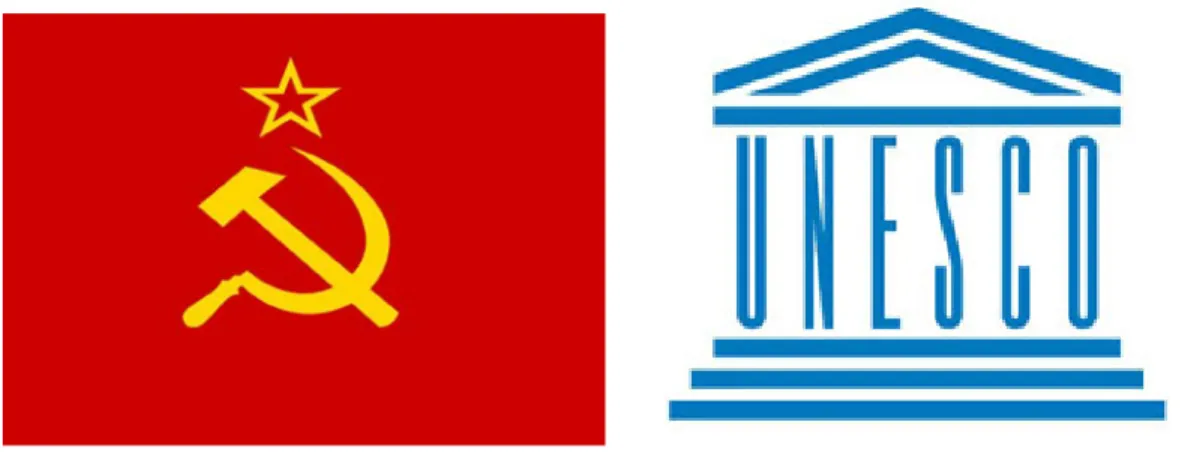
Thus the Cold War “struggle” for international organizations was the culmination of the entangled histories of Western and socialist internationalisms begun in the nineteenth century. The juxtaposition of the symbols of UNESCO and the USSR illustrates the divergent content of the two internationalisms in their institutionalized forms. On the one hand, the hammer and sickle on the red backdrop of the Soviet flag evokes the militant, divisive struggle born out of the French revolutionary tradition and aimed at uniting workers and peasants to upend the
established order under a star pointing to the five inhabited continents of the world.9 On the other hand, the substitution of the “UNESCO” acronym for the columns of the Parthenon on the UNESCO logo emblematizes the organization’s self-image as the preserver of the established order of Western civilization as well as the pediment of knowledge this civilization built atop its foundation. Harkening back to before the genesis of the revolutionary tradition extolled by the Soviet Union, the UNESCO logo manifests the organization’s mission to act as the keeper of the tradition of the Enlightenment and as the reincarnation of the genteel “Republic of Letters” that preceded the upheaval unleashed by the French Revolution.
8 Gosudarstvennyi arkhiv rossiiskoi federatsii, or the State Archive of the Russian Federation, hereafter GARF, fond (f.) 9519, opis’ (op.) 1, delo (d.) 2, listy (ll.) 198-203.
Figure 1. The Soviet Flag and the UNESCO Logo. Sources:
http://www.un.org/youthenvoy/2013/08/unesco-united-nations-educational-scientific-and-cultural-organization/; and https://www.csce.gov/sites/helsinkicommission.house.gov/files/tile-images/soviet-union_tile_745_670.jpg
* * *
Despite the well-known proliferation of international organizations after 1945, research on Soviet participation in these entities has generally focused on high-level diplomacy at the UN Security Council and General Assembly, providing only cursory descriptions of Soviet actions in the body’s specialized agencies. For example, Ilya Gaiduk’s 2013 book, Divided Together: The United States and the Soviet Union in the United Nations, 1945-1965, which remains the sole diplomatic history of Soviet participation in the UN based on Soviet archival sources, spotlights only major developments and issues discussed in the security council and general assembly (the question of Chinese representation, the Korean War, the Congo Crisis, etc.) and refrains from addressing Soviet participation in the UN’s initiatives in the spheres of economic development, science, culture, and education.10 While no study exists that homes in exclusively on the mutual
influence of the Soviet Union and UNESCO, a number of American political scientists and international legal scholars published during the Cold War short analyses that probe the sources of Soviet conduct in the various organizations under the UN’s Economic and Social Council (ECOSOC).11 Because Western political scientists could not freely access Soviet archives before the dissolution of the USSR in 1991, however, these works rely on conjecture and speculation derived from the public performances of Soviet diplomats in these agencies. Similarly, Elena Aronova, an historian of science, composed a dissertation on the emergence of science studies in the United Kingdom, the United States, and the Soviet Union that evaluates UNESCO’s
contribution to the popularization of science studies in the East and West during the Cold War. But this work does not consider the cultural and educational ventures of UNESCO nor delve deeply into the internal dynamics of the organization.12
Soviet-era research on UNESCO, which was produced by apparatchiks in the Soviet foreign-policy apparatus, manifests a heavy ideological influence and functions in my dissertation as an object of study as well as a layer of the existing literature on the topic.13 Likewise, post-Soviet Russian scholarship lacks systematic and in-depth scrutiny of how the
Korean War draws on archives but concentrates solely on the decision-making of various actors during the conflict. Iu. V. Vanin, Koreiskaia voina (1950-1953) i OON (Moskva: Institut vostokovedeniia, 2006).
11 Alexander Dallin provides a journalistic profile of Soviet participation in the international governing body during the 1950s and early 1960s. Based on firsthand experience and published material, his work offers only a brief outline of Soviet involvement in organs such as UNESCO, UNIDO, and UNICEF. Alexander Dallin, The Soviet Union at the United Nations: An Inquiry into Soviet Motives and Objectives (New York: Praeger, 1962). Other examples of contemporaneous literature are: John A. Armstrong, “The Soviet Attitude Toward UNESCO,”
International Organization 8, no. 2 (1954): 217-33, and Christopher Osakwe, The Participation of the Soviet Union in Universal International Organizations.
12 For a look at the role of Soviet representatives in UNESCO science activities, see Elena Aronova, “Studies of Science Before ‘Science Studies’: Cold War and the Politics of Science in the U.S., U.K., and U.S.S.R., 1950s-1970s” (Ph. D. dissertation, University of California, San Diego, 2012).
USSR interacted with the institution of UNESCO. For instance, Ol’ga Zolototrubova’s Russian-language dissertation, “The Soviet Union and the Work of UNESCO in the Field of Training National Cadres for the Developing Countries of Asia, Africa, and Latin America, 1954-1987,” narrowly concentrates on Soviet and UNESCO involvement in UN development projects and avoids a thorough assessment of Soviet-UNESCO relations.14
This dissertation not only fills these lacunae in the field of Soviet history, but also introduces to Soviet diplomatic history recent scholarship in the field of global history that historicizes the UN in its social, cultural, and ideological milieus.15 I apply social, cultural, and
intellectual historical methodologies to the history of international relations, going behind the scenes of the well-known drama of the security council or general assembly to tell the stories of Soviet citizens who contributed to the nuts-and-bolts operations of the UN system. I take my cue from scholars from other fields who have crafted works on the impact of UNESCO activity on issues dominating the latter half of the twentieth century, including decolonization, race, cultural exchange, the environment, and population growth. Owing to the difficulties of writing histories that involve regions outside of a historian’s field of specialization, these historians ignore the influence of these entities on the Soviet Union, often referring to the communist bloc only in passing and as little more than an obstructionist presence within the organization.16
14 Ol’ga Zolototrubova, “Sovetskii soiuz i deiatel’nost’ IuNESKO v oblasti podgotovki natsional’nykh kadrov dlia razvivaiushchikhsia stran Azii, Afriki i Latinskoi Ameriki, 1954-1987 gg.” (cand. diss., Rossiiskii universitet druzhby narodov, 1996).
15 For an example of the study of the influence of the UN on issues often confined to the framework of the nation, see Carol Elaine Anderson, Eyes Off the Prize: The United Nations and the African American Struggle for Human Rights, 1944-1955 (Cambridge: Cambridge University Press, 2003). For an overview of recent studies of the UN and its role in global issues, see Sunil Amrith and Glenda Sluga, “New Histories of the United Nations,” Journal of World History 19, no. 3 (2008): 251–74; and Glenda Sluga, “The Transnational History of International
Institutions,” Journal of Global History 6, no. 2 (July 2011): 219–22.
Indeed, as historian Glenda Sluga has argued in her groundbreaking work on
internationalism in the twentieth century, histories of international organizations tend to follow a standard narrative: Optimism about the role of international organizations reached its height in the brief period between the end of the Second World War in 1945 and the commencement of the Cold War around 1948. But after the fallout between the US and the USSR (so this narrative goes), these multilateral institutions gave way to the realpolitik of the bipolar conflict. Even Sluga, who reintroduces internationalism as a major force alongside nationalism in the making of the twentieth century, focuses on the “apogee of internationalism” in the immediate wake of the Second World War and the resurgence of this ethos in the “global seventies” without zeroing in on the importance of international organizations in the context of the Cold War of the 1950s and 1960s.17
While this chronology of the evolution of the internationalist spirit aptly characterizes Western European and North American societies, it does not apply to the experience of
internationalism in the communist bloc. Because the USSR had, for most of its existence, stood as a pariah outside the international community and resorted to isolationism in the last eight years of Stalin’s rule, its “apogee of internationalism” came just as this worldview went out of
University, 2006); Poul Duedahl, “Selling Mankind: UNESCO and The Invention of Global History, 1945-1976,” Journal of World History 22, no. 1 (2011): 101–33; and Christopher Pearson, Designing UNESCO: Art,
Architecture and International Politics at Mid-Century (Farnham, Surrey; Burlington, VT: Ashgate, 2010). Recently, a brief essay on Soviet participation in UNESCO appeared in a volume of collected essays exploring new directions in the study of the history of UNESCO and the organization’s impact on various regions. While this essay provides a broad, sweeping overview of Soviet involvement in UNESCO similar to Gaiduk’s article, it does not delve deeply into the subject. Poul Duedahl, ed., A History of UNESCO: Global Actions and Impacts (New York: Palgrave Macmillan, 2016); and Christian Ydesen and Aigul Kulnazarova, eds., UNESCO Without Borders: Educational Campaigns for International Understanding (New York: Routledge, 2017).
fashion in Western Europe and North America. Keenly aware of the economic strain of perpetual military buildup, Khrushchev declared a foreign policy of “peaceful coexistence” in the mid-1950s. This reversal of the Stalinist strategies of confrontation and isolation led not only to an increase in cultural and economic ties with the outside world, but also a campaign to peacefully prove Soviet superiority in industry, culture, education, and science.
I maintain that Soviet entry into the international organizational system in 1954 represents an overlooked but core facet of this new course in Soviet foreign policy. Intent on challenging Western hegemony over the international organizational system, Soviet officials mobilized their fellow citizens to go to conferences, work in the administrative apparatuses, and contribute to the publications of these organs. In essence, the USSR sought to contest Western control of the architecture, culture, politics, and administrative practices governing
institutionalized international relations. It set out to perform the ideology of socialist
historian Vladislav Zubok maintains, a realization of the West’s disinclination to start a nuclear war.18
Rather, I argue that it signified the USSR’s unstated recognition of the Western-designed international organizational system as the legitimate venue for multilateral diplomacy aimed at solving global problems. While both Stalin and Khrushchev envisioned communist international organizations (the COMINTERN, COMINFORM, COMECON, etc.) as, in the words of
historian György Péteri, “the embryo of a future communist world order,” Khrushchev’s decision to enter Western international organizations stunted the growth of these communist organs in their embryonic state.19 In essence, the post-Stalinist leadership lent credence to the self-representations of these Western international organizations as universalist bodies bridging the capitalist/communist divide and encompassing a diversity of nations, thereby de-universalizing these alternative communist institutions and making them little more than regional alliances within the Western international organizational system.
This concession led to the integration of the Soviet Union into a Western world order during the formative phase of the postwar period. By stressing peaceful coexistence as the main foreign-policy platform of the USSR, Khrushchev signaled a renewed commitment to what legal scholars Oona Hathaway and Scott Shapiro have described as the new “world order premised on the outlawry of war” that originated in the 1928 Kellogg-Briand Pact but came to full fruition
18 Zubok asserts that “peaceful coexistence” only modified what he calls Stalin’s “revolutionary-imperial paradigm,” or the ingrained Soviet belief in the collapse of the West and the need to preserve its empire, Vladislav Zubok, A Failed Empire: The Soviet Union in the Cold War From Stalin to Gorbachev (Chapel Hill: University of North Carolina Press, 2007), 129.
after the Second World War.20 Viewed in this way, the policy of peaceful coexistence proclaimed a Soviet promise to work for peace, and peacefully display the superiority of the socialist way of life, through the established international organizational system. Once Soviet officials had become enmeshed within this system, they found it difficult to extricate themselves. Although they complained about the “Western biases” embedded in UNESCO’s architecture, culture, politics, and administrative practices, Soviet UNESCO envoys knew that the withdrawal of their country from UNESCO or other international organizations would undermine the image of the USSR as a beacon of peace and international cooperation.
The real source of these ingrained, structural Western biases lay in the bureaucracies, or secretariats, of the UN and its specialized agencies. While most histories of the UN have focused on its representative bodies (the UN Security Council and General Assembly) as the formulators of policy, the authority to implement the vague program adopted by member states resided not in the governments of these countries but in the secretariats of the UN in New York and its
specialized agencies in Western Europe. Just as the bureaucracy of a nation state determines the implementation of legislation drawn up by elected officials, the secretariats of the UN system had considerable latitude to flesh out the specifics of, and elaborate on, the resolutions passed by the community of nations. Put simply, the delegations of UN member states showed up for a few weeks annually or biennially to vote on proposals and then left. In the intervening period, the international civil servants employed by UN secretariats, or what I call the machinery of the international organizational system, stayed on to execute these proposals and to keep the
organization running from day to day. Their personnel, who had their own ideas of the missions of their workplaces, acted as the carriers of the institutional memory and culture of the UN.
I show that the architecture, culture, politics and built-in practices of the UNESCO Secretariat reproduced Western domination, preventing the communist bloc from accruing significant power in the formative first thirteen years of Soviet participation in UNESCO from 1954 to 1967. In the eyes of Soviet diplomats, the UNESCO Secretariat functioned as a Western “deep state” not only responsible for putting into practice the “will” of member states, but also pursuing Western interests with a thoroughly bourgeois and anti-Soviet esprit de corps. Located at the international organization’s headquarters in Paris, France, the UNESCO Secretariat perpetuated the West’s advantage in the international organization even as the composition of UNESCO representative bodies (the UNESCO General Conference, or UNESCO’s equivalent of the UN General Assembly, and the UNESCO Executive Board, its veto-less version of the UN Security Council) changed as a consequence of decolonization’s accelerating pace in the early 1960s. The induction of new countries as UNESCO member states eroded Western hegemony over these representative bodies in the process. But contrary to the initial hopes of Soviet officials, the diminishment of Western power and the crystallization of a new bloc of nations from the “developing world” over the course of the 1960s did not lead to a strengthening of the influence of the communist bloc. Instead, the bipolar world gave way to a pluralist one in which the concerns of both superpowers took a back seat to the demands of the former colonies. In short, the USSR sought to ride the wave of decolonization only to get swept aside.
In the meantime, the normalization of Soviet relations with UNESCO enabled Soviet nationals to engage with the ideas, politics, and culture of the outside world in new ways,
professions to worldwide problems. By illustrating the implications of this normalization on the worldviews of Soviet citizens, this dissertation complements and expands on recent work on post-Stalinist Soviet cultural diplomacy that underscores the impact of transnational contact on the Soviet domestic order while contextualizing Soviet cultural diplomacy in an increasingly interconnected world.21 I build on new explorations by historians Anne Gorsuch and Diane Koenker into the balance the communist bloc struck “between global integration and political differentiation” when negotiating “patterns of cultural cross-pollination” that arose as a result of novel “transnational flows of information, cultural models, and ideas . . . across the capitalist-socialist divide.”22 Yet I shift this examination of Soviet cultural diplomacy from bilateral
episodic instances, such as the 1959 American National Exhibition, or more narrow and sporadic multilateral cooperation such as the Olympic Games, to the multilateral and institutionalized activities conducted by international organizations that reached broader swaths of the Soviet population over time.23 Unlike other investigations into bilateral Soviet exchanges with specific
21 Michael David-Fox has paved the way for a renewed emphasis on the impact of foreign culture and ways on Soviet domestic society. See Michael David-Fox, “The Implications of Transnationalism,” Kritika: Explorations in Russian and Eurasian History 12, no. 4 (2011): 885–904; and Michael David-Fox, Showcasing the Great
Experiment: Cultural Diplomacy and Western Visitors to the Soviet Union, 1921-1941 (Oxford; New York: Oxford University Press, 2012).
22 Gorsuch and Koenker’s edited volume tries to understand “the global sixties” from the perspective of the communist world. See Anne Gorsuch and Diane Koenker, eds., The Socialist Sixties: Crossing Borders in the Second World (Bloomington: Indiana University Press, 2013).
23 For various examples of studies that either focus exclusively on bilateral relations or one-time events, see Nigel Gould-Davies, “The Logic of Soviet Cultural Diplomacy,” Diplomatic History 27, no. 2 (April 2003): 193–214; Susan E. Reid, “Who Will Beat Whom?: Soviet Popular Reception of the American National Exhibition in Moscow, 1959,” Kritika: Explorations in Russian and Eurasian History 9, no. 4 (2008): 855–904; Pia Koivunen, “The 1957 Moscow Youth Festival: Propagating a New Peaceful Image of the Soviet Union,” in Soviet State and Society Under Khrushchev (London: Routledge, 2009), 46-65; Vladislav Zubok, Zhivago’s Children: The Last Russian
Intelligentsia (Cambridge: Belknap Press, 2009); and György Péteri, “Sites of Convergence: The USSR and Communist Eastern Europe at International Fairs Abroad and at Home,” Journal of Contemporary History 47, no. 1 (January 1, 2012): 1-8. Jenifer Parks has written the first history of how the Soviet bureaucracy worked to ensure its country’s participation in the global institution of the Olympic Games. I add to her study of how the Soviet
countries or regions, my research illustrates the gradual inclusion of the Soviet population into the emerging internationalization of education, science, and culture occurring during the postwar era. For the Soviet professionals, academicians, and other citizens who took part in UNESCO conferences, read and contributed to its publications, or went to work for the international organization, the UNESCO activities satirized by Spender as pointless attempts at reconciliation served as introductions into ongoing conversations about how to be “internationally minded” from which the isolationism of Stalinism had cut them off.24
UNESCO’s goal of encouraging people to think internationally reflected the underlying Western internationalist ethos at the heart of the organization. As the first world government, the UN system replicated elements of national governments on an international scale, including departments or ministries of labor (the International Labor Organization, or ILO), agriculture (the Food and Agricultural Organization, or FAO), health (the World Health Organization, or WHO), and others.25 UNESCO, which acted as the ministry of education, served as the
ideological wing of this world government, aspiring not only to relieve the world of the
ignorance supposedly at the root of all wars but also to foster a sense of internationalist identity through collaboration among the educated classes of different countries.
This objective mirrored the efforts of nationalists to forge a national identity through the assemblage of a shared cultural and scientific heritage as well as the standardization of
educational systems purveying the myths of the nation. In her work, Sluga argues that Benedict
Jenifer Parks, Red Sport, Red Tape: The Olympic Games, the Soviet Sports Bureaucracy, and the Cold War (Lanham, MD: Lexington Books, 2017).
24 I adopt this term from: Sluga, Internationalism in the Age of Nationalism, 6.
Andersen’s conception of the rise of national “imagined communities” pertains equally to visions of an international community in the twentieth century. With the increasing ease of travel and communication, Sluga posits that internationalist thinkers behind UNESCO and other
international organizations viewed the same “simultaneity” enabling nationalist consciousness among far flung peoples as an equally useful tool for stimulating, on an international level, “sociability” among peoples of different nations. The “narratives of internationalists,” she
concludes, “share with the constructivist historiography of the nation the concept of simultaneity; the new internationalism was imagined as nationalism writ large.”26
I add to her theory a case study of how UNESCO enabled Soviet citizens to become members of this internationalist project. UNESCO’s operations to disseminate publications with internationalist messages and gather scholars to confer on international topics instilled Soviet participants with a sense of belonging to an international community that did not necessarily conflict with their Soviet identity. I further contend that such endeavors constituted three types of international publics inspired by the nation state: 1) international public service in the UNESCO Secretariat or in the developing world as UNESCO technical experts; 2) an international reading public of UNESCO publications; and 3) the international public sphere made up of UNESCO conferences, collaborative projects, and other events. Because the original theorist of the public sphere, Jürgen Habermas, defined it as an association among liberal subjects carrying out “rational-critical discourse” independently of the control of the state, the latter concept, at first
glance, seems inappropriate in an analysis of Soviet citizens who often received marching orders from bureaucrats in the Soviet government on how to comport themselves when dealing with foreigners. But given the exclusionary nature of Habermas’s notion of the public as well as the socioeconomic influences on public spheres, a number of social theorists have doubted whether such a pure model has ever existed even in the West.27
In this dissertation, the concept serves as a useful analytical category to signify what the Western internationalist architects of UNESCO strived to create through its program. The public officials who worked for the international organization, as educational experts stationed
throughout the world or in the UNESCO Secretariat, sought either to lay the foundation for enlightened international publics through educational assistance or to organize these publics in the form of conferences and readerships. To be sure, Soviet citizens who worked to construct, or participated in, these publics received directives from the Soviet state. But they also had to creatively elaborate on these general directives when unexpected arguments, ideas, and situations arose. Although Soviet ideology molded their opinions and behavior, these citizens nevertheless exhibited agency and autonomy as they refashioned Soviet ideology to negotiate contingencies and to navigate the foreign world beyond the reaches of the Soviet state. Moreover, they took the foreign ideas gleaned from these experiences and assimilated them to their Soviet worldview, adapting elements of Western internationalism into proposals to make the USSR a better
interlocutor in the discourses cultivated by UNESCO. By doing so, they integrated their country into an ongoing process of globalization after the isolationism of late Stalinism.
This dissertation comprises three sections. In section one, I trace the history of the radical about-face in Soviet thinking about UNESCO and other Western international organizations from the USSR’s boycott of these institutions before 1953 to the point in the late 1950s at which the USSR had become fully entangled in the UNESCO node of the international organizational system. In section two, I paint a picture of the everyday lives of Soviet professionals who went to work as international civil servants in the UNESCO Secretariat in the 1950s and the first half of the 1960s. The first archival-based reconstruction of the daily lives of Soviet citizens employed in the administration of a noncommunist organization during the Cold War, this section
chronicles the struggles of these Soviet nationals to retain their loyalty to the Soviet state while serving the Western internationalist ideal of UNESCO and experimenting with an unprecedented ability to explore the West. Because the secretariat–as the mainframe of UNESCO’s vast and ever-changing network of conferences, educational assistance, and publications–enjoyed an unrivaled ability to dictate the execution of UNESCO’s program, this section also functions as the axis of my dissertation.
relations from the onset of détente and through the dissolution of the USSR as well as the role of the former communist world in the organization during the twenty-first century.
I base my picture of the USSR’s experience in the colorful world of UNESCO on material that I examined over the course of nine months at the archives of the Soviet state and Communist Party in Moscow, Russian Federation, and on documents that I tapped during three months spent at the international organization’s archives in Paris, France. To describe the day-to-day operations of the apparatus set up in the USSR to handle UNESCO affairs, I draw on, among others, the records of the Soviet National Commission for UNESCO Affairs (the Soviet
UNESCO Commission). Housed in the State Archive of the Russian Federation
(Gosudarstvennyi arkhiv rossiskoi federatsii, or GARF) and divided into nonclassified and formerly classified subsets, this voluminous collection of thousands of reports, correspondence, and records of conversation gives intricate insight into Soviet relations with the international organization and yet has remained almost completely unused by non-Russian researchers.28
Importantly, this repository also holds the extensive paperwork of the Soviet Permanent Delegation to UNESCO (the Soviet UNESCO Delegation), which oversaw the USSR’s contingent of Soviet UNESCO intermediaries in Paris. In addition, I integrate into my
dissertation the records of the trade union of the Soviet embassy in Paris. Rich with information on the general state of the “Soviet colony” revolving around the embassy in the French capital, this collection, which is also located in GARF, helps me to contextualize the Soviet mission to UNESCO in the larger community of the Soviet diplomatic corps serving in France.
For the decisions of the higher-ups of the USSR concerning UNESCO, I interrogated resolutions and minutes of meetings housed in the archives of the Central Committee of the
Communist Party of the Soviet Union (TsK KPSS) at the Russian State Archive of
Contemporary History (Rossiiskii gosudarstvennyi arkhiv noveishei istorii, or RGANI) as well as records located in the Russian State Archive of Socio-Political History (Rossiiskii
gosudarstvennyi arkhiv sotsial’no-politicheskoi istorii, or RGASPI). At the Archives of the Russian Academy of Sciences (Arkhiv rossiiskoi akademii nauk, or ARAN), I also conducted research on Soviet scholars who participated in UNESCO activities. On top of these Soviet archival holdings, I worked in the Russian State Library (Rossiiskaia gosudarstvennaia biblioteka), which contains UNESCO literature published in the Soviet Union but unavailable outside Russia.
At the UNESCO Archives, I collected documents revealing the internal deliberations of UNESCO officials about Soviet participation in the international organization as well as the personnel records of Soviet citizens who worked at its headquarters as international civil
SECTION 1
In the winter of 1947, Leonard S. Kenworthy, an employee of the UNESCO Secretariat in the Education Section, traveled to the Western occupied zones of Germany to give a lecture about the new international organization to students enrolled in an American literature class at the University of Frankfurt. Seated in a defunct bomb shelter, the audience of German youth “listened intently” to the UNESCO official’s talk. “When the period of questioning came,” Kenworthy reported back to UNESCO, “they pounced upon this opportunity.” In preparation for the lecture, the professor who taught the class had asked the students, who had come of age under the tutelage of the Nazis, to read UNESCO: Its Purpose and Its Philosophy, a small treatise in which UNESCO’s first director-general, Julian Huxley, cast the international organization as a vehicle for fostering international intellectual cooperation that would lay the basis for future global integration. Unsurprisingly, a handful of those enrolled in the course reacted with skepticism to this internationalist ideology conceived as the antithesis to the nationalist “New Order” of Nazism. “You can’t develop world loyalty,” one of the German listeners chirped, “with an eclectic philosophy like that!” Kenworthy characterized the response of this group, which likely represented “the ‘cream of the crop’ of German youth,” as mixed. As he relayed back to his superiors, they “were alert, penetrating, and ready to be shown, but not ready to be kidded.”29
The reluctance of some of these German students to embrace the message delivered by Kenworthy brings into sharp relief the worldview informing UNESCO’s architects and the historical juncture out of which it emerged. Convinced that the inherent tribalism of nationalist allegiance and an ignorance of other peoples had fueled the revanchist regimes of the Second World War, UNESCO’s founders envisioned this institution as a means of extending the reach of
the new United Nations Organization (UNO) by instilling in the world’s population a sense of belonging to an international community. This belief in the necessity of transcending the nation state as the organizing principle of international relations reflected a larger campaign, hatched in Western intellectual circles and government agencies during and after the war, to enhance the power of international organizations and, in its more extreme iterations, to forge a single world government responsible for a cosmopolitan “world citizenship” that would either coincide with, or replace, nationality as the primary political identification across the globe. If the violent nationalism of the Axis powers inspired the mission of UNESCO and other attempts to secure peace through international organization, however, the new tensions of the postwar era
challenged and therefore shaped the evolution of this internationalist crusade in its first decade. Within months of Kenworthy’s 1947 lecture in Germany, the universalizing project of UNESCO and the broader push in the West for “one world” came up against the USSR, a new resistant obstacle to this internationalist dream.
This section of my study traces the tumultuous relationship between UNESCO and the communist bloc from the creation of the organization through the 1950s in order to highlight the Soviet experience of a highly influential but overlooked dimension of the Cold War–– the world of international organizations. In historical scholarship, the fallout between the capitalist and communist worlds in the late 1940s has overshadowed the importance Western European and American public intellectuals and statesmen assigned to international organizations as a means of maintaining contact between East and West in spheres of activity outside of security (education, science, culture, health, economic assistance, etc.).30 Far from devolving into an irrelevant
30 In major histories of the origins and first years of the Cold War, international organizations outside the UN General Assembly and Security Council often have little presence other than brief discussions of the IMF or World Bank as part of the Bretton Woods system or mere references to the dates on which the USSR joined these
bystander to the Cold War, the internationalist movement embodied by UNESCO became a key foil in Soviet propaganda to the xenophobic fortification taking place within the USSR after the war. By bringing to the forefront the internationalist “moment” that spawned UNESCO, I contextualize the antiforeign or “anticosmopolitan” rhetoric of late Stalinism in its international context, demonstrating that the movers and shakers of Soviet cultural politics in the last years of Stalin’s rule depicted this Western internationalism as a symbol of the threat capitalism posed to national sovereignty. Viewed from this perspective, the Soviet decision to reverse course and join UNESCO and other international organizations after Stalin’s death in 1953 represents one of the most dramatic de-Stalinizing measures taken by the new leadership in foreign policy.
Moreover, an examination of Soviet deliberations over UNESCO after the country joined the organization sheds light on how the international organizational system set up by the West after the war played a normative role in compelling the USSR to abide by its rules and cede the power to shape the framework for multilateral diplomacy to Western dominated institutions.
In chapter 1, I draw on recent literature that historicizes the UN, UNESCO and other internationalist ventures of the postwar period to explain the initial Soviet refusal to become a member state of the organization under Stalin.31 Rather than a “universal” international organization encompassing all nations and ideologies, UNESCO had “provincial” roots in the internationalist designs of a specific element within the Western elite who imprinted the international organization with their own ideas and cultural milieu, all of which stood in direct
Empire, 51. Likewise, histories of Western internationalism in the postwar period mention the Soviet response to this trend only in reference to the communist bloc’s disdain for, or obstruction of, blueprints for world governance. Glenda Sluga, for instance, offers a short account of Soviet disparagement of UNESCO as a “cosmopolitan” organization, but does not explore the USSR’s view of UNESCO in great detail. Sluga, Internationalism in the Age of Nationalism, 113–14.
opposition to the drive for ideological purity of late Stalinism.32 While many of UNESCO’s supporters presented the organization as an apolitical arena for international collaboration, the Soviet Union interpreted the core values these Western internationalists desired to see fulfilled in UNESCO’s program of activities (the “free exchange of ideas,” the reeducation of the subjects of ex-enemy nations into democratic citizens, the revision of knowledge and culture so that it promoted “international understanding,” etc.) as a smokescreen of virtuous jargon masking capitalist imperialism and aggression against the communist world. Owing to pressure placed on it to assist in the reconstruction of Western Europe, UNESCO became aligned with the West and entangled in a bipolar conflict between capitalism and communism that left little room for neutrality. As a result of the Soviet boycott before 1954, the organization, from its founding to the death of Stalin eight years later, more closely resembled an instrument for cooperation among like-minded North Americans and Western Europeans in education, science, and culture than a forum for the reconciliation of different parties for the purpose of attaining world peace.
In chapter 2, I provide an analysis of the major developments in the first five years of Soviet participation in UNESCO. Having entered the organization with a degree of optimism about the prospects of challenging the West, the Soviet Union set up two organs unique to the post-Stalinist era, the Soviet UNESCO Commission and Delegation. These facilitators of Soviet activity in UNESCO bore responsibility for mobilizing the country’s intelligentsia to partake in UNESCO seminars, conferences, and publications. By 1958, however, the commission and delegation had grown disillusioned with the organization because of a feeling of alienation from those UNESCO member states with which they expected to find common ground, a suspicion
that UNESCO discriminated against communist countries while preserving Western hegemony within its halls, and their own inability to muster participation from their domestic agencies. Yet those involved with UNESCO matters in the Soviet Union found it much more difficult to
withdraw from the organization than they had anticipated. As a sign of the power of international organizations to bind countries to the increasing global integration that these institutions
encouraged through the exchange of persons, publications, and ideas, lower-level officials in the Soviet UNESCO Commission and Delegation, recognizing the centrality of UNESCO and other international organizations in international affairs, successfully prevented the USSR from quitting this space of multilateral cooperation. In other words, once the USSR signed on to UNESCO, and thereby tacitly conceded the value of noncommunist international organizations as an influential force in international relations, it could not easily disengage from this dimension of diplomacy without incurring significant damage to its reputation and forfeiting the benefits gained from UNESCO membership. Whatever the failures of UNESCO and other international organizations to “solve” the Cold War through concrete policies, these bodies therefore
CHAPTER 1
THE MISSING MEMBER STATE: SOCIALIST NATIONALISM, BOURGEOIS INTERNATIONALISM, AND THE RISE OF INTERNATIONAL ORGANIZATIONS,
1945-1953
UNESCO originated in a series of wartime brainstorming sessions in London about how to reconstruct, in the coming postwar era, the educational and cultural institutions of a Europe ravaged and revolutionized by the Nazi imperial project. In October 1942, nine months after the United Nations Declaration and eight months after the US Department of State’s “Advisory Committee on Postwar Foreign Policy” began toying with the idea of a future world
organization, the president of the British Board of Education, R. A. Butler, invited the ministers of education of European governments waiting out the war in Britain to come together in order to tackle “educational questions affecting the Allied countries of Europe and the United Kingdom both during the war and in the postwar period.”33 On November 16, 1942, ministers from seven governments-in-exile (Belgium, Czechoslovakia, Greece, the Netherlands, Norway, Poland, and Yugoslavia) and the British government attended the first official meeting of the Conference of
33 I. V. Gaiduk, Divided Together, 11–15; and “Conference of Allied Ministers of Education: Origin of the Conference,” n.d., 1–3, AG 2: Conference of Allied Ministers of Education: London 1942; Vol. 2:1; General Document Series; AME/A/21a., UNESCO Archives. For more in-depth and general histories of CAME and the founding of UNESCO, see Jan Opocensky’s unpublished manuscript on the history of UNESCO and James Sewell’s masterful analysis of the politics animating the international organization during its formative years. Although I use my own research in the following paragraphs to outline the origins of UNESCO, I draw on their works to frame my discussion of CAME and the early years of UNESCO: Jan Opocensky, “The Beginnings of UNESCO: 1942-1948, Vol. 1,” 1950, UNESDOC; and James Patrick Sewell, UNESCO and World Politics: Engaging in International Relations (Princeton: Princeton University Press, 1975).
Allied Ministers of Education (CAME).34 By the end of the war in 1945, CAME evolved into a multibranched agency with an Executive Bureau that oversaw seven commissions dedicated to amassing data on the resources of educational agencies in Europe.35 Early on, the Conference also recognized the necessity of creating a permanent international organization to take over its mission of overseeing the multifaceted and expensive task of reconstruction.
Of course, the concept of an international organization devoted to the realm of thought preexisted CAME. In the interwar period, the League of Nations’ Organization of Intellectual Cooperation (OIC) and associated entities––the International Committee for Intellectual
Cooperation (ICIC) and the International Institute of Intellectual Cooperation (IIIC)––assembled leading intellectuals in Paris and Geneva to foster debate among great minds. As historian Jo-Anne Pemberton notes, “the OIC . . . supplied the nascent UNESCO with an organizational
34 “Draft Report of a Conference held at the Board of Education on Monday, 16th November, 1942 at 3 p.m.,” 1–4, AG 2: Conference of Allied Ministers of Education: London 1942-1945; Vol. 1; Records of Plenary Sessions, UNESCO Archives.
35 The Books and Periodicals Commission, for instance, calculated the losses of libraries and universities under Axis control; coordinated with book repositories and “salvage drives” in nonoccupied Allied countries to raise a supply of books for occupied countries; and appointed a History Subcommittee to enlist scholars for the writing of “history textbooks of an objective character.” The Science and Audio-Visual Aids Commission, launched in July 1943, wrote reports on the lack of laboratory equipment, educational films, projectors, and slides on the continent, while the Basic Scholastic Commission, formed in May 1944, reviewed “the essential material requirements for general teaching at the primary and secondary levels during the first six months of liberation.” The Commission on Cultural Conventions and the Commission on the Protection and Restitution of Cultural Material, inaugurated in January 1943 and April 1944 respectively, studied agreements between different nations on the exchange of academic or cultural delegations and documented stolen or damaged works of art. As Allied forces advanced toward Berlin in the winter and spring of 1945, CAME moved beyond examinations of material deficits, taking on, albeit hesitantly, the perceived “special” or “psychological” effects wrought by Nazi tactics of ideological indoctrination and total war. In February 1945, the Conference initiated a Commission on “Special Educational Problems of Liberated Countries” to wrestle with questions of how to provide for displaced children and deal with the fate of the “children of quislings.” The next month, CAME organized a committee to consider the proposal, laid out in a memorandum from the Belgian minister of education, to “take immediate action” to solve the “international” problem of “denazification” of youth through education. In this memorandum, the minister urged the formulation of “teaching methods” designed to ensure the “complete reform of the children’s minds and characters” through the removal of the imprint left by “Nazi educational principles.” For the memorandum, see “Memorandum Presented by the Belgian Government on Pedagogical Aids for Reeducation Problems in Liberated Countries,” n.d., 1–3, AG 2: CAME Box 1, Commission of Enquiry on Special Educational Treatment AME/A/95, UNESCO Archives. For general outlines of the