African Public Administration and Management series, vol. 3
Public administration in
Tanzania
Current issues and challenges
Ko de Ridder Ben Emans Rudie Hulst Albertjan Tollenaar
Published by:
African Studies Centre P.O. Box 9555
2300 RB Leiden [email protected] www.ascleiden.nl
Cover design: Heike Slingerland Cover photo: Albertjan Tollenaar
Printed by Ipskamp Drukkers, Enschede
ISSN 2211-8284
ISBN 978-90-5448-142-3
v Tables and figures vii
Foreword viii Abbreviations xi
1. AFRICAN PUBLIC ADMINISTRATION AT WORK 1
Ko de Ridder, Ben Emans, Rudie Hulst & Albertjan Tollenaar
2. DECENTRALIZATION OF HUMAN RESOURCE MANAGEMENT IN TANZANIAN GOVERNMENTAL ORGANIZATIONS 8
Stella Kinemo, Emmanuel Ndikumana, Hamisi Kiyabo, Venance Shillingi, Moses Kwayu & Peter Andrea
CASE 1 CAREER JOURNEY 31
CASE 2 A BIRD’S EYE VIEW OF THE MAY DAY CEREMONY 33
3. TENSIONS IN POLITICO-ADMINISTRATIVE RELATIONS IN TANZANIAN LOCAL GOVERNMENT 35
Wilhelm Mafuru, Deogratias Mpenzi, Idda Lyatonga Swai, Oscar Tefurukwa, Orest Masue, Richard Ngowi & Wilfred Lameck
CASE 1 TEARS OF A WARD REPRESENTATIVE 52 CASE 2 LAND EVICTION IN MVOMERO 54
4. VILLAGE LEADERSHIP AND GOOD GOVERNANCE IN TANZANIA 57
Eliza Mwakasangula, George Igulu, Anosisye Kesale & Denis Kamugisha
vi
5. INSTITUTIONALIZED COPRODUCTION IN THE DELIVERY OF
AGRICULTURAL SERVICES: EXPERIENCES FROM THE CASHEW NUT VALUE CHAIN IN SOUTHERN TANZANIA 79
Gustav Kunkuta & Paul Amani
CASE 1 THE PITFALL OF COPRODUCTION IN LGAS: LOCAL CASHEW NUT PROCESSING BY WOMEN IN KITAMA WARD 100
CASE 2 CASHEW FARMING INPUTS IN SOUTHERN TANZANIA: A STATEMENT FROM A FARMER 106
vii
Tables
2.1 Legislative texts demarcating rights and responsibilities of Tanzanian LGAs 10
2.2 Three-dimensional appraisal of (de)centralization of HRM in local government organizations: the practice of recruitment & selection 16
2.3 Three-dimensional appraisal of (de)centralization of HRM in local government organizations: the practice of rewarding 17
2.4 Three-dimensional appraisal of (de)centralization of HRM in local government organizations: the practice of training & development 18
4.1 Governance principles in Tanzania 60
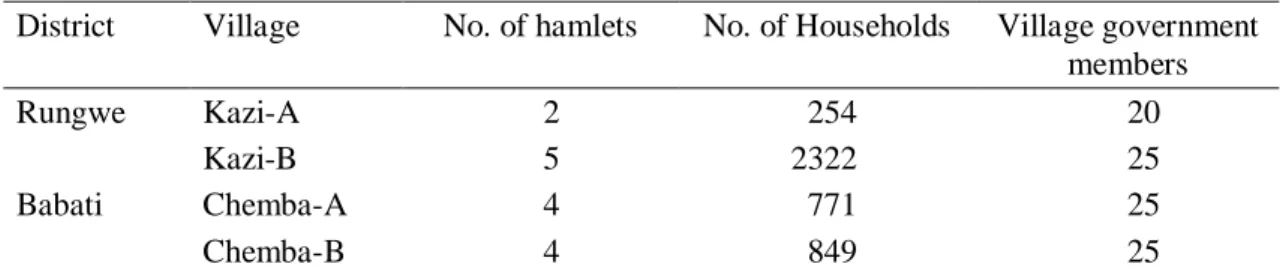
4.2 Village features 64
5.1 National cashews production statistics 2002 through 2012 in metric tons 81
Figures
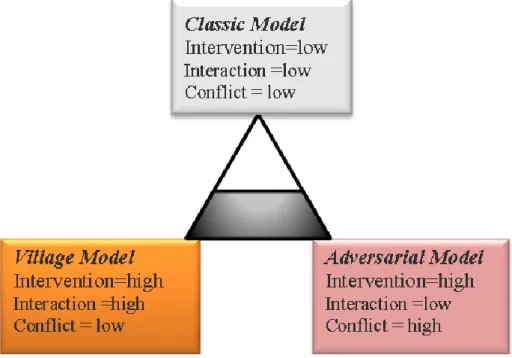
3.1 An illustration of the three politico-administrative models 39
viii
Dr. Josephat Stephen Itika
For the past three decades Tanzania has embarked on a number of policy reforms and strategies to reduce poverty and promote economic growth. The most fun-damental strategies taken started with the Civil Service Reform Programmes in the early 1990s, followed by Public Service Reform Programmes I and II and Local Government Reform Programmes I and II. These formed part of the foun-dations of the development of policy objectives envisioned in the National Strat-egy for Growth and Reduction of Poverty (NSGRP), as developed from the mac-ro policy ambitions founded under the Millennium Development Goals 2015 and Tanzania Vision 2025. The ultimate goal of these strategies has always been to achieve a high level of socio-economic transformation and growth by effective institutions of governance capable of meeting the needs of Tanzania as a middle-income country by 2025.
Although throughout the years a lot of groundwork has been done towards this goal, particularly in terms of creating an enabling environment for strong institu-tions of governance through continuous human resource capacity development, there have been indications of dissatisfactions with the outcome of such initia-tives. For example, the Key Result Area 6 of the Public Service Reform Phase II emphasized the importance, required interventions, and expected outcomes of leadership capacity development in the public service as part of strengthening public service delivery and accountability. Similarly, the Local Government Re-form Programme II, which was devoted to decentralization through the devolu-tion of powers, authority and responsibility from the central government to the lowest levels possible, has among others focused on capacity building in leader-ship development, organization and human resource development. The underly-ing philosophy has been to ensure full utilization of human capital potential.
ix
Government Authorities (LGAs). The focus has been on building the capacity of technical and managerial staff in LGAs to set standards for staff and services in order to improve performance and ultimate service delivery.
However, notwithstanding the possible improvements made up until now, the Annual Synthesis Report (2009/2010), which assessed the performance of Local Government Authorities as a precondition for their entitlement of Capacity Building Grants (CBGs), shows an increase in failure rates of performance tar-gets. Data in the Capacity Utilization Report January-December 2008 for Capaci-ty Building Grants shows that the main causes for failure center on leadership, organization and human resource management. These factors contributed to the late submission of quarterly reports to the Prime Ministers’ Office, Regional Administration and Local Government (PMO-RALG), to unharmonized Capaci-ty Building Grants, to the limited role of human resource officers in capaciCapaci-ty building planning, and to an inadequate output/outcome/impact assessment. Sim-ilarly, Training Needs Assessments conducted by Mzumbe University in 2008 and 2009 show that heads of departments and sections have an inadequate ca-pacity to manage staffing functions. For example, one of the objectives of the human resource management capacity-building component under LGRP I was to decentralize human resource management functions to heads of departments and sections while the human resource officers remain in advisory and support roles. This would have enhanced human resource management functions including cruitment, training, performance appraisal and development of appropriate re-ward systems. However, human resource structures in local authorities are still highly centralized.
This book is a result of a joint project between the School of Public Administra-tion and Management of Mzumbe University and the University of Groningen in the Netherlands under the generous support of the Dutch government through The Netherlands Organization for International Cooperation in Higher Education (Nuffic), which started in 2010. The general objective of the project was to build the university’s capacity to support the Tanzanian government in achieving the ambitions envisaged in decentralization by devolution to local authorities.
x
and implement actions designed to achieve the set objectives based on the decen-tralization by devolution framework. It means creating space for the strengthen-ing of leadership, organization and management of human resources. Since peo-ple receive public services through local authorities that employ more than 60% of the Tanzanian workforce, it is anticipated that, if effectively disseminated to all key stakeholders and internalized, knowledge in this book will make a signifi-cant contribution to the quality of staff and institutional governance and will ul-timately improve service delivery.
I wish to encourage all students, particularly those who intend to work in the public sector, to read this book and indeed take a personal copy for reference be-cause it unearths practical lessons based in a Tanzanian context that can hardly be obtained elsewhere. Those who are already working in the public sector and particularly in local authorities will also find it very insightful and refreshing, inciting desire to do things better for the good of our people and institutions.
Let me take this opportunity to express my heart-felt appreciation for a job very well done. As we all know, writing a book is a serious undertaking that re-quires the passion and commitment of all team members at all times. Special thanks should go to the Dutch Government through Nuffic for financing the pro-ject and to Professor Dr. Ko de Ridder and Dr. Albertjan Tollanaar from the Uni-versity of Groningen and Dr. Stella Kinemo from Mzumbe UniUni-versity for steer-ing the wheel together. Prof. Dr. Ben Emans from Hanze University, Dr. Rudie Hulst and Dr. Bas van Gool from VU University have been very instrumental in supporting the team with capacity building for research and writing. Thank you very much. Finally, last but not least I wish to thank the stream leaders, research-ers, reviewresearch-ers, publisher and support staff from all partner institutions for making the dream of producing this book a reality.
Dr. Josephat Stephen Itika
xi ACT Agricultural Council of Tanzania
AMCOS Agricultural Marketing Cooperative Societies ANSAF Agricultural Non-State Actors Forum CBT Cashew nut Board of Tanzania CDO Community Development Officer CDTF Cashewnut Development Trust Fund CU Cooperative Union
DbyD Development by Devolution DED District Executive Director
FAO Food and Agriculture Organization of the United Nations GDP Gross Domestic Product
HRM Human Resource Management LGA Local Government Authority
LGRP Local Government Reform Programme MP Member of Parliament
NBC National Bank of Commerce NGO Non-Governmental Organisation NMB National Microfinance Bank
NSGRP National Strategy for Growth and Reduction of Poverty PCS Primary Cooperative Society
PMO-RALG Prime Minister’s Office-Regional Administration and Local Government
SACCOS Savings and Credit Cooperative Societies SIDO Small Industry Development Organization TANECU Tandahimba Primary Cooperative Society TCMB Tanzanian Cashew Marketing Board Tsh Tanzanian shilling
UNDP United Nations Development Programme
UNESCAP United Nations Economic and Social Commission for Asia and the Pasific UNIDO United Nations Industrial Development Organization
URT United Republic of Tanzania VC Village Chairperson
1
African public administration at work
Ko de Ridder, Ben Emans, Rudie Hulst & Albertjan Tollenaar
Introduction
de-veloping its own indigenous ways and means for shaping and operating public institutions.
This state of affairs offers quite a challenge for academic public administra-tion, in particular for teaching public administration and training future public officials. In the average African country, and certainly also in Tanzania, public administration educational programs primarily make use of text books from abroad, notably from Western countries. Too often it is taken for granted that notions, concepts and tools that do fit the administrative culture of origin are straightforwardly applicable on the receiving end as well. Thus students of public administration may end up with a perception of the subject that does not fit the administrative realities in their own country. To put it bluntly: there is a risk that a student of public administration in Africa might very well gain a better under-standing of the local government system in Great Britain or the USA than in Tanzania or Nigeria. The teaching and studying of public administration in Afri-ca should be about AfriAfri-can public administration. The challenge then is to extract the core insights from public administration scholarship around the world and make them applicable to gain a better understanding of indigenous governance issues.
This book is an attempt to do just that. Actually, it is the second attempt. Four years ago, in 2011, staff members of the Mzumbe School of Public Administra-tion and Management (SoPAM), in cooperaAdministra-tion with scholars from the Universi-ty of Groningen, published a book under the title: Theories and Stories (Itika, De Ridder & Tollenaar 2011). That book discussed a number of core concepts of the public administration discourse, connected with case stories derived from the Tanzanian administrative reality. The present volume is building on that experi-ence. The cases in Theories and Stories were not originally written to test a con-cept or an administrative approach in the Tanzanian public realm. They were se-lected because they offered a good illustration of how a general concept could be applied for a specific Tanzanian situation. The present book is based on original studies, for which a theoretical approach or notion was the starting point. In fact, the activities leading up to the writing of the papers in this book were a trajectory of consecutive steps, starting with case study research and ending up with casting original case study material into the mould of a chapter in a text book.
From case research to educational case
Cases selection: administrative cases in a DbyD environment.
The overarching theme of this project is Decentralization by Devolution. In Tan-zania, DbyD is a huge transformation program that has been developed and im-plemented over the last 15 years. Development has been sluggish, implementa-tion was slow and fragmented and results up to now are ambivalent. This is not unusual, as far as public administration reform programs all over the world go. Beyond that, decentralization is a public administration concept with many for-eign roots and a variety of interpretations. The Tanzanian variety as it resulted from these many years of development and implementation has not been char-tered in detail yet. The intention of the project was to take stock of DbyD achievements in four selected areas, and make an inventory of the way decentral-ized institutions actually work.
The approach chosen required the selection of four specific PA areas in which DbyD could effectively be studied. The areas selected are four current issues in Tanzanian public administration that are within the areas of expertise of the staff of the School of Public Administration and Management of Mzumbe University. SoPAM wishes to play a leading role in these specific areas, both academically and in terms of transferring knowledge to the practitioners of public administra-tion. For that reason financial issues were left out. The project set out with the following four topics: 1) public administration and leadership, 2) organizational and institutional development, 3) human resource management and 4) service delivery management. For each of these topics, researchable cases had to be cho-sen. For the first topic, the staff team responsible picked ‘leadership at the village level’ as the specific subject for a number of case studies. According to all policy documents, ‘leadership’ is considered as a crucial factor for the success of the DbyD policy. While in a complementary PhD study the focus is on leadership at the district level, the village level was considered appropriate for case studies in the framework of this project.
For the second topic, organizational and institutional development, the team zoomed in on one institutional issue, politico-administrative relations at the dis-trict level. The Tanzanian disdis-trict, the core of local government, is still in a state of flux. Decision making at the district level can only be done well if politicians and bureaucrats have established some sort of rapport. The team set out to map the politico-administrative landscape at the district level, doing case studies in two districts.
government. Districts do have some leeway however, in a number of areas. The team wanted to know what room the district administration has to conduct its own human resource management and how that room is being used.
The team responsible for the fourth topic, service delivery management, zoomed in on twee two rather differing cases, of which one made it to this vol-ume. The first case was in the policy area of health management, the second was about (local) government involvement in the processing of crops, more particu-larly cashew nut crops. In the management of crop processing many conflicting interests are involved and government tends to be involved in order to reconcile these interests in an even-handed way, creating a fair deal for all concerned. The case of the cashew nut crops seemed particularly promising because fairly recent-ly new institutions at the district level had been put in place for the fair admin-istration of crop handling.
Issues with case studies
Case study research is a particularly completed approach to social research. It has the advantage that the social reality under study can be presented in rich detail, as opposed to quantitative strategies that are far more reductionist in nature. A dis-advantage is that there are no clear cut cook book like recipes available that in-form the methodology to be applied. There are good handbooks however that offer lots of useful pointers and directives. For the methodology applied in this project, the research teams used Yin’s book on case study research (Yin 2013). Still, all kinds of methodological decisions had to be made. Three methodologi-cal issues are highlighted here: the transformation of theories, the accessibility of data sources and the problems of data processing.
Theories
literature those theoretical notions that might fit the research questions concern-ing the four topics outlined in the previous section.
For the research into leadership of officials at the local level, the research team drew upon the established literature on leadership styles and applied the dichotomy of transactional and transformational leadership to qualify the behav-iour of the local leaders. The charge here was to find out whether the tools for observation as developed for leadership behaviour in western urbanized societies would work in the context of Tanzanian villages. The team that had set out to analyse the issue of the relationship between the counsellors and the bureaucrats at the district level, could fall back on a vast literature from all over the world. They came up with a model that highlights three distinct forms in which politico-administrative relations may manifest themselves, from which they derived a set of indicators to observe the real world. Beyond that, they became interested in the subjective perceptions politicians and administrators entertained about each other. The HRM team took its lead from both the literature on decentralization and on personnel management, in order to create a frame work in which district HRM practices could be captured as a function of central-local relations. For the analysis of the cashew nut crop processing, the research team selected the theo-retical notion of coproduction to make sense of both the institutional arrange-ments and the actual practices in the field.
Access
Data collection for case research in administrative practices requires adequate access into administrative institutions and processes, for observation, for the analysis of documents and for conversations with the persons involved. Adminis-trative organizations greatly vary in the accessibility for research. In Tanzania, the problems involved in gaining access are burgeoned by the long distances, the difficult roads and the complex communications. The research teams succeeded in tackling the problems involved by using their personal networks in the admin-istrative system of Tanzania. All staff members involved are university teachers, and many if not most of their former students found their way into the practice of public administration. Personal networks proved a valuable resource for the opening up the system for data mining.
Data processing
ordered set of data from which the administrative processes and institutions un-der scrutiny could be described and analysed. The outcome of the data processing was laid down in a case study report for each of the four research projects (Kinemo et al. 2015, Mafuru et al. 2015, Mfaume & Kunkuta 2015, Mwakasan-gula et al. 2015).
Transforming cases research into educational cases
A research report is not the same as an educational case. It rather takes quite a transformation to derive an educational case from the material contained in the research report. An educational case is a story. The story has a limited time frame and is concerned with just one incident, one decision or one organization. Still, the educational case is rich in detail. It comes as close to making a snapshot of administrative reality as possible. What makes a good educational case? First of all it has to be based on good research: the rendering of the facts has to be relia-ble. Furthermore, the story needs to be told systematically. Rich detail is fine, but all detail needs to be functional for getting the meaning of the story across. It has to be clear what the intention of the case is: what theoretical notion it is supposed to illustrate; what type of analyse it is intended to evoke, etc.
A good educational case has at least three utilities in the class room.
1. Course material often is primarily theoretical; it defines, categorizes, enu-merates, explains. Educational cases offer the real life story that not just shows or illuminates the theoretical expositions. Particularly for that large slice of the student body that has not been actively out in the field educa-tional cases offer indispensable glimpses of the administrative reality that the text books are explaining.
2. Educational cases offer illustrative material for understanding concepts, theories, process models etc. Theories are lenses, that make it possible to view reality in a certain way, to analyze and to explain. Educational cases present opportunities for the student of public administration to practice the use of such analytical tools.
The cases in this volume are written by public administration scholars from Tan-zania. They are all teaching courses in public administration and public manage-ment. Most of them have lots of experience with the realities of development administration and governance, as a consultant, a researcher or a civil servant. They bring African public administration into the class room.
References
ITIKA,J.J. DE RIDDER &A.TOLLENAAR, eds. (2011), Theories and Stories in African Public Administration. Leiden: African Studies Centre, via http://irs.ub.rug.nl/ppn/334231450 KINEMO,S.M.,E.NDIKUMANA,H.KIYABO,V.SCHILLINGI,M.D.KWAYU,P.T.ANDREA (2015),
Human resource management in a decentralized context; the case of Dodoma municipal and Chamwino district councils. Morogoro: Mzumbe University, via
http://ssrn.com/abstract=2564984.
MAFURU,W.,D.MPENZI,I.LYATONGA SWAI,O.TEFURUKWA,O.MASUE,R.NGOWI &W. LAMECK (2015), Politico-Administrative Relations in Tanzanian Local Government Authorities, via http://ssrn.com/abstract=2561813.
MFAUME,R.T.&G.E.KUNKUTA (2015), Delivery of agricultural service under
decentralization by devolution: Reality of co-production in cashew value chain in Southern Regions of Tanzania. School of Public Administration and Management, Mzumbe
University Tanzania. Via http://ssrn.com/abstract=2575679
MWAKASANGULA,E.,G.R.IGULU,D.KAMUGISHA,A.KESALE &S.FUNDI (2015),The
Influence of Leadership on Good Governance: The Case of Selected Villages in Rungwe and Babati District Councils in Tanzania, Morogoro: Mzumbe University, via
http://ssrn.com/abstract=2562328.
2
Decentralization of Human
Resource Management in
Tanzanian governmental
organizations
Stella Kinemo, Emmanuel Ndikumana, Hamisi Kiyabo, Venance Shillingi, Moses Kwayu & Peter Andrea
Introduction
in-creased. In the present chapter this particular development - the decentralization of governmental HRM - is critically examined. More specifically, two issues are identified and discussed. The first one is the actual degree of HRM decentraliza-tion in the Tanzanian Local Government Authorities (LGAs) of today. As will be seen, the state of affairs is still characterized by centralization rather than decen-tralization, in spite of the initial LGRP ambitions. The second issue to be dis-cussed is the whole of the outcomes, both positive and negative, that may be ex-pected to result from HRM decentralization. An analysis of these outcomes may help to answer the question of which HR functions are best performed by a de-centralized governmental structure and which are best performed by a de-centralized structure. The underlying assumption is the commonly held view that decentrali-zation has its advantages as well as disadvantages (Pollit & Bouckaert 2000; Shafritz et al. 2001; Tessema et al. 2009).
In the first section of the chapter the legislation that sets the stage for HRM decentralization is outlined. As is the case in the chapter as a whole, the concept of HRM-decentralization is split up into the decentralization of 1) employee se-lection & retention, 2) employee rewarding, and 3) employee training & devel-opment. These three practices together are considered to cover, by and large, the whole range of crucial HRM responsibilities. The second section, which is based on what is known from academic literature, gives an analysis of the advantages and disadvantages of the decentralization of HRM practices. In the third section the subject matter of the previous sections is examined from the perspective of people for whom the HRM of local authorities forms part of their daily work. It recounts the experiences of civil servants (including HR managers) and council members in two LGAs. Those experiences add authenticity to statements made in the preceding sections. In the fourth and final section, the contents of the other sections are integrated into the conclusions that can be drawn.
Actual degree of HRM decentralization: the rules
Table 2.1 Legislative texts demarcating rights and responsibilities of Tanzanian LGAs
Mainland legislation Government (Urban Authorities) Act 1982 Local Government Finance Act 1982 Urban Authorities (Rating) Act 1983 Regional Administration Act 1997
Local Government Laws (Miscellaneous Amendments) Act 199910 Amendments to these laws that formed part of the Local
Govern-ment Reform Program, from 1999 Zanzibar legislation Zanzibar Municipal Council Act 1995
District and Town Councils Act 1995
Recruitment & selection
Generally speaking, the procedures for recruitment and selection in Local Gov-ernment Authorities are predominantly centralized (controlled by the Central Government). This is especially the case regarding the recruitment and selection of civil servants in managerial positions. These are firstly the District Executive Director (in District Authorities) and the Town/Municipal/City Director (in Ur-ban Authorities), and secondly the Heads of Departments. Typical departments headed by the latter are, for example, those for education and culture, trade and economic affairs, health and social welfare, planning and finance, and personnel and administration. The appointment of those civil servants is straightforwardly a matter of centralization. The president directly appoints city council directors whereas the minister responsible for local governments appoints directors of town, municipal, and district councils as well as the heads of departments all over the country. The actual recruitment work is done by a central government agency called the Public Service Recruitment Secretariat (PSRS) which was established in accordance with Section No. 29 (1) of the Public Service (Amendment) Act, No. 18 of 2007. The Act mandates the Secretariat to conduct the recruitment pro-cesses of public servants within the public service. Recruitment and selection procedures are furthermore governed by a number of statutes including the Pub-lic Service Act No.8 of 2002 as amended by Act No.18 of 2007, PubPub-lic Service Regulations 2003, Public Service Scheme 2003, as well as employment guide-lines and establishment circulars.
heads of departments (see above) apply furthermore no less to the appointments of other employees. The local authorities are, however, involved in decisions re-garding selection and recruitment in that they are the ones who identify vacant posts and propose budgets for fulfilling those posts. Overall, however, the state of affairs can evidently not be characterized as being decentralized. An appropri-ate qualification would be, say, ‘95% centralization’. Only in the recruitment of lower cadre temporary employees have the local authorities some autonomy.
Rewarding
As is the case with recruitment and selection, the rewarding of civil servants of Local Government Authorities is regulated in a mainly centralistic way. To begin with, the local authorities have no say in the design of pay systems (salary scales, salary levels, retirement benefits schemes) for their employees. According to the Public Service Pay and Incentive Policy 2010, it is the role of the (central) gov-ernment to develop a total reward system in the public service (which includes local governments). A number of central government agencies are involved in this process, including the President’s Office for Public Service Management, the Prime Minister’s Office for Regional Administration and Local Government, and the Ministry of Finance and Economic Affairs. The latter ensures that public ser-vice pay is systematically enhanced in an affordable and sustainable manner. In sum, the making of pay systems for civil servants in Local Government Authori-ties is a matter of unqualified centralistic decision making. That is not to say that the practice of rewarding is entirely centralized, because this practice involves more than making pay systems. It also involves the application of those systems.
The application of pay systems includes, to begin with, decision-making re-garding salary increases for employees. According to the Standing Orders of 2009 those decisions are at the discretion of the central government. Setting aside prescribed annual increments for which public servant are eligible, no increase in salary may be authorized without the explicit approval of the Permanent Secre-tary (Establishments). The local authorities only play a role in the first phase of the decision-making process. They submit salary increase proposals upon the recommendation of employee supervisors. This part of the reward practice can thus be qualified as moderately decentralized.
local authorities are to a certain extent autonomous. They are free to give those bonuses to selected employees, paying them from their own budgets.
With regard to the payment of temporary lower cadre personnel the local au-thorities do have some freedom, without the restrictions implied by the regula-tions outlined above. Given these regularegula-tions, however, the HRM practice of re-warding local government employees has to be characterized as a generally cen-tralized arrangement overall. The local authorities are expected to perform the role of executors rather than initiators of payment policies.
Training & development
Compared to recruitment & selection and rewarding, training & development of local government employees is less strictly regulated and, as a consequence, more subject to decentralized decision-making. The ultimate goals of this HRM practice are listed in certain documents of the central government, such as the Training Strategy for LGAs 2010. Among those goals are the enhancement of competences that are needed for the functioning of personnel and the functioning of the organization as a whole, and an equal access to training opportunities for staff of all grade levels. By specifying objectives of training and development, the central government thus cements the outlines of the way that HRM practice has to be enacted. Viewed from that perspective, the arrangement can be called centralistic. The translation of the instructions into actual measures, however, is a responsibility of the local authorities themselves. With that, a truly decentralistic element is added to the arrangement. As long as their plans for training and de-velopment can be shown to fit in with the guidelines of the central government, the local authorities as a rule receive the budgets needed to implement those plans.
Advantages and disadvantages of HRM decentralization
contemporary political ideology with its reliance upon the beneficence of free market forces (Legge 1995). This ideology tends to embrace a decentralized gov-ernmental structure as the preferred vehicle for optimizing everything, including HRM functions. Causes like these can be said to explain the trend toward HRM decentralization but that is not to say, of course, that they also justify it. For the latter, an overview of the factual pros and cons of HRM decentralization is re-quired. In the present section of this chapter such an overview is unfolded. Elabo-rating on views expounded in the literature, the advantages and disadvantages of decentralization of the HRM practices of recruitment and selection, rewarding, and development and training are outlined. Firstly, a couple of points will be made about the advantages and disadvantages of decentralization in general. Thereafter, the focus shifts to HRM decentralization.
The key argument for the decentralization of government systems in general is that local rather than central authorities are best equipped for making decisions about local affairs, as they have more knowledge of local circumstances that have to be taken into account (Hope 2001). Policies are assumed to become more flex-ible, innovative, responsive, and tailor-made through decentralization (Berman et al. 2001; Cayer 2004, Hays & Kearney 2001). Additionally, the policy-making process is expected to become more efficient, that is, less time- and resource- consuming due to shortened communication lines between decision-makers and involved parties (Hope 2001). There is also a downside to this model: an undeni-able disadvantage of decentralized, compared to centralized, forms of policy making is that outside the centre it may be hard to hire and keep the expertise needed for high-quality decision making. It was actually, according to Wood (2000: 90), the lack of technical capacities on the part of local authorities that initially gave rise to the centralization of public services. All in all, the picture that arises is thus a mixed one, showing advantages as well as disadvantages of decentralized forms of government.
contact with the involved workers. Other authors such as Cayer (2004), Hays and Kearney (2001), Coggburn (2005), and Selden et al. (2001), arrive at similar conclusions. Next to the enhanced flexibility, these authors also stress that a higher degree of responsiveness of HRM policies is made possible by decentrali-zation. For instance, the probability that selection decisions match job require-ments characteristic of the local situation is highest when the involved selection officer has firsthand knowledge of that situation. Local HR managers know how to customize practices to meet local HR needs.
Tessema et al. (2009), while being mainly in favour of HRM decentralization, also have an eye for its disadvantages. In their view, a central agency is needed to make sure that Human Resource Management performances across local and re-gional units all match up to fixed standards. This signifies the strategic role of the central government of setting standards and accordingly monitoring and evaluat-ing the work that is done in the field. In a sense, this can be considered as another plea for HRM-decentralization, because central agencies will be more able to fulfil their strategic role adequately when they are freed from the responsibilities of daily HRM operations that are outside their own setting (Quah 2007; Cheema 2005; Jones 2001). For HR managers in the involved local and regional units those responsibilities are less burdensome.
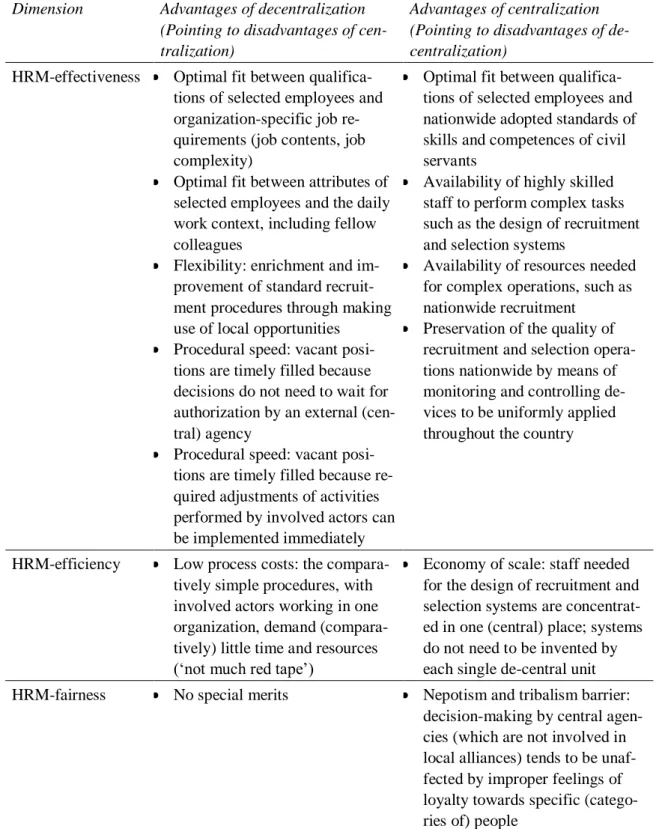
In Tables 2.2-2.4 the above situation is translated into lists of tangible ad-vantages and disadad-vantages of HRM-decentralization that are expected to be manifest in the daily operations of local government organizations (decentraliza-tion disadvantages being phrased as centralization advantages). This is done sep-arately for the three HRM-practices of recruitment & selection, rewarding and training & development. For reasons of analytical clarity the tables are set up three-dimensionally: a distinction is made between advantages in terms of HRM-effectiveness, HRM-efficiency and HRM-fairness, respectively. The meaning of these terms are clarified below, beginning with HRM-effectiveness, along with a discussion of the table contents.
HRM-decentralization and HRM-effectiveness
not always the best possible candidates (Cohen & Wheeler 1997), employed people are under-utilized (World Bank 1999), good performance is not promoted (Cohen & Wheeler 1997), and well-performing employees are badly retained (Budhwar & Debrah 2001; Kiggundu 1989). The question is whether HRM de-centralization may help to improve this state of affairs.
Recruitment and selection practices are effective to the degree that the best possible people are recruited and selected in view of the organization’s needs. As is articulated in Table 2.2, decentralized practices seem to be more advantageous in this respect than centralized ones, mainly due to the many opportunities avail-able for making decisions that are in accordance with local circumstances and locally experienced organization needs. Candidates who are posted from central recruitment may lack the experience and commitment needed for work in periph-eral and other regions, simply due to the fact that central recruiters are unfamiliar with the circumstances in those regions. On the other hand, in centralized prac-tices attention is likely to be paid to other essential needs, that is, organization-overarching (national) needs. A further advantage of centralized practices, com-pared to decentralized ones, is that they tend to be manned by agents with better skills who can rely on a broader range of resources. Those agents, in contrast to their de-central colleagues, are well-equipped not only for the design of recruit-ment and selection methods but also for complex operations such as, for instance, the recruitment of teachers and other professionals countrywide. Compared to agents in remote areas they are obviously in a better position to do that job effec-tively. Without some form of centralization, the even distribution of employees to every corner of the country is hard to realize.
Table 2.2 Three-dimensional appraisal of (de)centralization of HRM in local government organizations: the practice of recruitment & selection
Dimension Advantages of decentralization
(Pointing to disadvantages of cen-tralization)
Advantages of centralization (Pointing to disadvantages of de-centralization)
HRM-effectiveness Optimal fit between qualifica-tions of selected employees and organization-specific job re-quirements (job contents, job complexity)
Optimal fit between attributes of selected employees and the daily work context, including fellow colleagues
Flexibility: enrichment and im-provement of standard recruit-ment procedures through making use of local opportunities Procedural speed: vacant
posi-tions are timely filled because decisions do not need to wait for authorization by an external (cen-tral) agency
Procedural speed: vacant posi-tions are timely filled because re-quired adjustments of activities performed by involved actors can be implemented immediately
Optimal fit between qualifica-tions of selected employees and nationwide adopted standards of skills and competences of civil servants
Availability of highly skilled staff to perform complex tasks such as the design of recruitment and selection systems
Availability of resources needed for complex operations, such as nationwide recruitment
Preservation of the quality of recruitment and selection opera-tions nationwide by means of monitoring and controlling de-vices to be uniformly applied throughout the country
HRM-efficiency Low process costs: the compara-tively simple procedures, with involved actors working in one organization, demand (compara-tively) little time and resources (‘not much red tape’)
Economy of scale: staff needed for the design of recruitment and selection systems are concentrat-ed in one (central) place; systems do not need to be invented by each single de-central unit HRM-fairness No special merits Nepotism and tribalism barrier:
Local agents, due to the fine-tuning possibilities they have, are in a good position for achieving these objectives. Central agents, on the other hand, are indispensa-ble for creating the basic conditions for the latter, due to the resources they have for maintaining the rewarding machinery, among other things.
Table 2.3 Three-dimensional appraisal of (de)centralization of HRM in local government organizations: the practice of rewarding
Dimension Advantages of decentralization
(Pointing to disadvantages of cen-tralization)
Advantages of centralization (Pointing to disadvantages of de-centralization)
HRM-effectiveness Adaptability of reward levels to locally specific requirements re-garding the motivation and reten-tion of employee categories Adaptability of reward levels to
the unique performance levels of individual employees
Adaptability of reward levels to specific needs of (categories of) employees
Flexibility through the incorpora-tion of local specificities in nego-tiations regarding reward levels and related employee rights
Adaptability of reward levels to norms and intentions inherent in the country’s policies for build-ing workforces in governmental organizations
Availability of highly skilled staff for designing and applying reward systems
Preservation of the quality of rewarding practices nationwide by means of monitoring and con-trolling devices that are uniform-ly applied throughout the country
HRM-efficiency Low process costs: the compara-tively simple procedures (the in-volved actors working in one and the same organization) demand (comparatively) little time and resources
Economy of scale: staff needed for the design of reward systems is concentrated in one (central) place; systems do not need to be redesigned by each single de-central unit
HRM-fairness Fine-tuning opportunities, result-ing from beresult-ing able to pay atten-tion to delicate and/or more or less concealed circumstances that justify certain reward measures for individual employees
Equal treatment of employees nationwide
Nepotism and tribalism barrier: decision-making by central agen-cies (which are not involved in local alliances) tends to be unaf-fected by improper feelings of loyalty towards specific (catego-ries of) employees
has certain merits as well (see Table 2.4). An instructive document on this sub-ject is the Training Strategy for LGAs (2010), which contains a list of drawbacks to the way the training and development practice tends to be enacted.
Table 2.4 Three-dimensional appraisal of (de)centralization of HRM in local government organizations: the practice of training & development
Dimension Advantages of decentralization
(Pointing to disadvantages of cen-tralization)
Advantages of centralization (Pointing to disadvantages of de-centralization)
HRM-effectiveness Adaptability of training programs to the organization’s need for employee competences, derived from the organization’s own long-term policy making and per-sonnel planning
Adaptability of training programs to the specific ambitions and pos-sibilities of individual employees Room for the development of
tailor-made on-the-job training programs for employees
Adaptability of training and development policies to the na-tion’s ambition regarding capaci-ty building in governmental or-ganizations
Availability of highly skilled specialists for managing the se-lection of programs for training and development and for moni-toring the quality of training pro-viders
Preservation of the quality of training and development prac-tices nationwide by means of monitoring and controlling de-vices that are uniformly applied throughout the country
HRM-efficiency Low process costs: the compara-tively simple procedures for the allocation of training and devel-opment opportunities (the in-volved actors working in one and the same organization), demand (comparatively) little time and resources
Economy of scale: staff needed for finding appropriate training and development programs, ne-gotiating with the providers of those programs, and monitoring the quality of provided programs are concentrated in one (central) place
HRM-fairness Fine-tuning opportunities, result-ing from beresult-ing able to pay atten-tion to delicate and/or more or less concealed circumstances that justify certain training & devel-opment investments for individu-al employees
Equal treatment of employees nationwide
Three drawbacks in this list can be viewed as (unintended) results of the central-ized nature of involved practices. In that sense, the document can be said to make a case for decentralization. Firstly, the authors of the document observe in some LGAs an over-emphasis on training activities linked to certificates and academic degrees at the expense of programs that focus on skills needed by employees in their daily work. An intensified involvement of local decision-makers might im-prove this situation. Through this, skills needed locally would come into view more easily. Secondly, existing capacity-building plans often fail to be based, according to the document, on organization-specific assessments of the training needs of employees. Local agents, compared to their central counterparts, are obviously in a better position to execute, understand, and use training needs as-sessments. Thirdly, there appears to be an overwhelming focus on a traditional classroom setup for training programs, far removed from the real-life profession-al environment. Only locprofession-al agents are sufficiently familiar with the employees’ work environment in order to be able to build training devices into that environ-ment (training-on-the-job programs, as an alternative to class-room courses). In reducing the likelihood of these types of drawbacks, decentralization can thus be said to be indispensable for the promotion of training and development effective-ness, defined in the document as building a capacity to deliver an improvement in service.
The other side of the argument is that roles played by central government agencies are indispensable as well. Agents operating de-centrally are simply una-ble to do much of their work without the instruction, support, and advice of cen-tral agencies. For instance, the Training Strategy for LGAs document points to the importance of monitoring the quality of training providers. That is clearly an overarching LGA job, and is not suited for decentralization. Furthermore, train-ing and development is a business in a complicated market of supply and de-mand. For navigating the market, that is, for finding the best training services for their employees, local governments will always be dependent on the expertise of specialists of the central government.
HRM decentralization and HRM efficiency
pro-decentralization argument: the more tasks and responsibilities are concentrated within the local authorities, the less need there is of coordination of work be-tween the central and de-central agents. In the Training Strategy for LGAs doc-ument, referred to above, the lack of this type of efficiency was marked as one of the drawbacks of existing training and development practices. As to the practices of recruitment and selection and rewarding the situation will not be different (see Tables 2.2-2.4).
Another type of efficiency that needs to be taken into account derives from the plain fact that expertise is expensive. For that reason, irrespective of other rea-sons that may make sense, it can be wise for local authorities to let experts in the central government do certain pieces of work as an alternative to hiring experts themselves to that end. Doing so is also a matter of sharing costs between those authorities. In Tables 2.2-2.4 this is referred to as the economy-of-scale ad-vantage of centralization.
HRM decentralization and HRM fairness
More than other managers, HR managers serve two parties in the organization (Ulrich et al. 2007). On the one hand, they work for the organization as a whole. This part of their job was dealt with in the discussion of HRM effectiveness. On the other hand, they have to guard the interests of employees. This part of their job gives rise to an additional dimension to take into account when weighing the pros and cons of HRM decentralization: fairness. As defined by Jenkins (2012), fairness means, in short, equal opportunities for all employees. Worded in a more articulated way, this statement means that decisions that affect employees are fair when they are based on business- and policy-related criteria only, devoid of dis-crimination, arbitrariness and secrecy, and thus safeguard equal opportunities for all employees. With regard to recruitment and selection this means that all (cate-gories of) eligible applicants get the same treatment, irrespective of their racial background and their personal relationships with decision makers. With regard to rewarding and training and development it means that the same set of criteria is used for all (categories of) employees. Those criteria can be anything; rewarding criteria may include an employee’s job level, seniority, performance level and so on; criteria for providing training and development opportunities may include needs felt by the organization as well as needs of the employees themselves. The selection of those criteria is not a fairness issue. What counts is that chosen crite-ria, whatever they are, are consistently applied to the workforce as a whole.
that investments in training and development are equal throughout the country. As to fairness within the workforces of local authorities the story is different. In making this happen, both centralization and decentralization have an advantage (see Tables 2.2-2.4). Local, compared to central, authorities are in a better posi-tion to respect the interests of their employees due to the fact that they can close-ly examine the particular situation of each employee. Central authorities, on the other hand, are less likely than their local counterparts to apply non-objective criteria as decision makers due to their distance to the particular field. Centraliza-tion helps to preclude tribalistic and other types of discriminaCentraliza-tion in the execu-tion of HRM practices.
HRM at work: experiences in two LGAs
From the preceding sections two things have become clear. First, current legisla-tion leaves, by and large, little room for HRM decentralizalegisla-tion in Tanzanian Lo-cal Government Authorities (despite the initial ambitions of reformers that initi-ated decentralization programs in 1999). Second, the quality of HRM in Tanzani-an LGAs in terms of effectiveness, efficiency, Tanzani-and fairness is best guarTanzani-anteed through a substantial degree of HRM decentralization. The combination of these two conflicting realities seems to create an embarrassing situation for human re-source managers and other members of LGA organizations. For them, decentrali-zation is something badly needed and simultaneously difficult to attain. The question remains as to how this group of people experience this situation. In or-der to find answers, the authors of this chapter have conducted a study in two districts (Kinemo et al. 2015). Both districts were in Dodoma: the urban Dodoma Municipal Council and the rural Chamwino District Council. In the present sec-tion the key outcomes of this study are presented. The actual level of HRM-decentralization is described, as is, in relation to this, the experienced quality of HRM practices in use in the two districts. As to the latter, the concepts of effec-tiveness, efficiency, and fairness, as they were coined in the preceding section, serve as a descriptive framework. Furthermore, the setup of the section as a whole parallels the structure of the two preceding sections in that the research outcomes in regard to recruitment and selection, rewarding, and training and de-velopment are successively dealt with.
Experiences with recruitment and selection practices
and in Dodoma and Chamwino councilors and other actors do make use thereof indeed. This state of affairs gives rise to several problems according to the expe-riences of the people of Dodoma and Chamwino.
To begin with, there appear to be serious problems with effectiveness. The councils, due to their dependence on the central government for budget approval, cannot always get an adequate number of staff. Furthermore, Chamwino Council often finds it difficult to retain centrally recruited employees when they become unable to cope with rural circumstances, a typical outcome of poor selection de-cisions by central agencies. A specific example is that of a centrally selected driver who was apparently professionally inept. Another manifestation of ineffec-tiveness is that quite often vacancies remain unfilled for far too long as a conse-quence of the many recruitment and selection steps that have to be taken. A peri-od of six months from defining an employment need to the actual employment of someone is not exceptional.
Local actors such as councilors are especially involved in the appointment of lower grade personnel. Remarkably, this was associated with recruitment and selection ineffectiveness rather than effectiveness, because improper decision criteria were seen to infiltrate decision-making processes. Put bluntly, councilors used to demand their own relatives and friends to be selected. All in all, the ef-fectiveness of recruitment and selection processes, as the people in the Dodoma and Chamwino districts experience them, thus tends to fall short of the expecta-tions they have.
The Dodoma and Chamwino people likewise experience the efficiency of re-cruitment and selection processes to be low. The councils’ dependency on central agencies and the resulting complexity of procedures generates several forms of inefficiency. The procedures not only take up much time, they also give rise to economic inefficiency because, in anticipation of the finalization of long-lasting appointment procedures, temporary workers may need to be employed using the funds of the councils themselves. In Chamwino a lot of money is invested further in the retention of employees who, inappropriately recruited by a central agency, are not comfortable with the circumstances of remote stations.
Experiences with practices of rewarding
In Dodoma and Chamwino salary systems are applied in the same way that they are applied elsewhere in the country. Decision-making power regarding things such as salary levels and the payment of salaries is thus entirely in the hands of central government authorities. Nationwide norms and standards maintain con-trol. That is not to say that the rewarding practices in use in the two districts are devoid of decentralization elements. Those elements, though, relate to compensa-tion in terms of non-salary benefits only.
The non-salary benefits that are given include material ones (incidental bo-nuses, allowances) and non-material ones (such as recommendation letters). The authorities in Dodoma and Chamwino provide those benefits to selected employ-ees for three types of reasons. Firstly, they do so in order to reward and conse-quently promote excellent performance and hard working. Recommendation let-ters are provided to that end, but also bonuses in cash. In Dodoma, for instance, high-performing teachers can get 200,000 Tsh. Secondly, compensations for em-ployees may form part of an attraction and retention strategy, especially in the Chamwino district. Clinical officers, for instance, are given a fully furnished house (not as a gift but for accommodation) in order to reduce unattractive em-ployment aspects. The reason is scarcity: a shortage of staff forces the authorities to allocate budgets for this type of compensation. Thirdly, incentives offered can be based on the assessment of specific needs in specific areas. The Dodoma Mu-nicipal Council provides, for instance, motorbikes and fuel costs to extension officers and to staff in the administration department. Subsistence allowances for first-appointment staff and housing allowances for department heads are other examples of benefits in this category.
and responsibility levels associated with jobs are not sufficiently reflected in sal-ary levels. This may be due to the fact that the central authorities that decide sala-ry levels are unfamiliar with the actual contents of jobs in local government or-ganizations. Local authorities would be better equipped, then, to take care of this part of the salary system design.
Doubts also exist regarding the effectiveness of some de-central elements of the reward systems in use. One problem is that allowances, such as those made available by the Dodoma and Chamwino Councils, are always provided very late. Regardless of their purpose, this can only reduce their usefulness. Another prob-lem is that the applied criteria for providing performance bonuses tend to be far from clear. Sometimes it is felt that loyalty, rather than high performance, is re-warded. For promoting excellence and hard work this is of course counterproduc-tive. It thus seems that the local authorities are somehow poorly equipped to manage these practices. There is, however, the special case of recommendation letters. There are no complaints about the way that this type of reward is provid-ed. Unfortunately it is not highly appreciated, because employees prefer tangible rewards.
Mostly positive things can be said regarding the efficiency of the reward sys-tem in Dodoma and Chamwino. The machinery for administrating salaries is known to work smoothly, with salaries mostly being paid on time. The involved central governmental agencies can apparently be relied on. Efficiency of the non-centralized elements of the reward system in use is not really an issue, given the low volume of those elements. The work associated with them is not that time and money consuming.
Experiences with training and development practices
Training and development practices are expected to solve problems. They need to close the gap between available and needed employee competences. Their infra-structure in the Dodoma and Chamwino districts is strictly split up into two dis-tinct steps. The first one consists of the analyses of training needs (assessments of the training needs of employees and employee categories) and the preparation of training plans. Local managers do this part of the job. The second step, which is at the discretion of central agencies, involves the evaluation of submitted train-ing plans and, more importantly, the provision of funds for the execution of plans once approved. This state of affairs is neatly in accordance with formal regula-tions (see first section of this chapter). It appears, however, to generate problems rather than solutions.
The effectiveness of the training and development practices in use, as Dodoma and Chamwino HR managers experience it, is hampered by a lack of connected-ness of the two steps mentioned above. As a result of that lack, badly needed funds may not be allowed in full, or not in time, or piecemeal only. The decision-makers in the central government are apparently insufficiently aware of local concerns. As a consequence, the workforces in the two districts tend to be sub-optimally trained. Too few employees are actually trained.
Likewise, the efficiency of the work evidently suffers from the described state of affairs. Performing training need assessments, translating those assessments into training plans and, finally, submitting those plans in an orderly fashion is a demanding and bureaucratic job. Performing that job is a waste of time and mon-ey when there is no reasonable guarantee of funds.
There are no serious fairness problems associated with the described state of affairs, although the unpredictability of the decisions made by the central gov-ernment may give rise, of course, to feelings of arbitrariness. Outcomes of deci-sions can therefore be felt to be unfair. In principle, rules are applied without any considerations other than formal, objective and impersonal ones. Furthermore those rules, disputable as they inevitably always are, are not inherently unfair by themselves. On the contrary, they assure that employees in Dodoma and Cham-wino are not treated differently from their colleagues elsewhere in the country.
details that may be added. Most notably, a number of negative outcomes of HRM centralization, additional to the ones listed in the tables, came into view:
(Effectiveness problem) Unresponsiveness of central agencies may result in insufficient numbers of employees hired.
(Effectiveness problem) Unfamiliarity of central agencies with local circum-stances may result in the appointment of employees who, being unfit for those circumstances, are hard to retain.
(Effectiveness problem) As a consequence of the tardiness of central agen-cies’ operations, vacancies sometimes remain unfilled for too long.
(Effectiveness problem) Unresponsiveness of central agencies may result in an insufficient number of employees that are actually trained.
(Efficiency problem) Local budgets sometimes need to be spent on filling temporary vacancies when budgets are made available too late by central agencies.
(Efficiency problem) Local budgets sometimes need to be spent on retaining employees who, being appointed by central agencies, do not feel comfortable with local circumstances.
(Efficiency problem) Local agents often invest time and money in the devel-opment of training plans that eventually fail to be approved by central agents.
Conclusions
Saying that HRM decentralization in Tanzanian governmental organizations is something worth to think about is an understatement, given the state of affairs depicted in the preceding sections. Firstly, it was shown that the existing legisla-tion tends to imply a lot of limitalegisla-tions regarding the realizalegisla-tion of HRM decen-tralization. Thereafter it was argued that the quality of HRM is endangered in several respects when those limitations are actually put into practice. Finally, a description of the situation in Dodoma and Chamwino made clear that the latter is indeed happening. At first sight, this state of affairs seems to call for another local government reform program, which will once more enlarge the discretion-ary power of local authorities: still more HRM decentralization, in short. Indeed, a conclusion that can be drawn from the facts collected in this chapter is that the human resource management of LGAs would benefit from a number of thor-oughgoing decentralization measures, such as:
A change of rules in such a way that recruitment decisions can only be made with the explicit consent of the local authorities, or even on the initiative of those authorities.
A change of rules in such a way that the task of taking care of the training and development of local civil servants is entirely transferred from the central government to the local governments.
Measures like these might indeed be beneficial, but it would be short-sighted to take them without simultaneously paying attention to a number of issues that fundamentally affect HRM quality in Tanzanian LGAs. These issues came into view in the preceding sections. Three of them are elaborated below and each of the resulting elaborations gives rise to the need for more measures to be taken in addition to extra decentralization measures.
1. Some indispensable contributions to the quality of local HRM can only be made through the centralization of decision-making. Thoughtless decentrali-zation actions might only destroy those contributions. Firstly, in regards to HRM effectiveness, a central agency will always be needed in order to keep an eye on the way local authorities do their work. Secondly, in regards to HRM efficiency, it would be a waste of resources if local authorities were made responsible for tasks such as nationwide recruiting and nationwide ne-gotiations with suppliers of training and development services. Finally, in re-gards to HRM fairness, only the influence of the central government can make sure that civil servants all over the country are treated alike. To safe-guard the quality of local HRM in these respects, a number of centralized HRM tasks thus need to be solidified rather than weakened.
2. In regards to the fairness of HRM, local authorities may sometimes be liable to give in to forces that privilege certain people in the community. As a con-sequence, forms of tribalism and nepotism in the community are suspected and this plain fact could be a reason to curtail the power of the local authori-ties somehow. It would, however, make no sense to reduce the decentraliza-tion of HRM responsibilities to that end. Entitling central agencies instead of local authorities to make certain types of decisions would only relocate the problem and would furthermore generate new problems. Rather than re -centralization, the instalment of fairness inspectors who work independently of authorities could be a solution.
spe-cific competences of that person and the central government may simultane-ously have reasons not to appoint that person there because those competenc-es are needed elsewhere. There is a conflict of two equally rcompetenc-espectable inter-ests, then. In solving that type of conflict, measures in terms of HRM central-ization or HRM decentralcentral-ization can only fail. They would be in favour of the interests of one party at the expense of the interests of the other. A different type of solution is needed: one that helps to integrate local and central inter-ests. It is too much to elaborate on this issue here. In any case, solutions should preferably not consist of new and meticulous demarcations of rights and responsibilities. Instead, recipes for optimizing co-decision making pro-cesses of local and central authorities are called for.
This chapter started by raising a couple of simple questions about HRM decen-tralization in Tanzanian governmental organizations. It ended by giving complex answers to these questions and, in addition to that, raising new questions. For the reader, this might be a discouraging and frustrating experience. Hopefully, how-ever, the chapter made clear to him/her that simple answers will always run the risk of being false. Hopefully, the chapter provided him/her with concepts to be used when deliberating how to act. In fact, the chapter can be seen as a series of lessons learnt from decentralization efforts in the past. Viewed that way, it may serve to equip the makers of future policies to do their job, however puzzling the lessons may sometimes feel.
References
ANALOUI, F, (2002), The Changing Pattern of HRM. Aldershot, UK: Ashgate.
ANTWI,K.,F.ANALOUI &J.CUSWORTH (2007), Human Resource Development Challenges Facing Decentralized Local Governments in Africa: Empirical Evidence from Ghana. Leadership, Learning, Institutes and Public Service: A Conference for leaders who shape and deliver Learning and Development 7-9 November 2007 Accra, Ghana, pp. 1-24.
BENNELL,P. (1994). Improving the performance of the public sector in LDCs: new approaches to human resource planning and management (Occasional Paper N. 25). Geneva, Switzerland: International Labour Organization.
BERMAN,E.,J.BOWMAN &M.VAN WART (2001), Human Resource Management in public service: Paradoxes, process & Problems. London: Sage.
BEUGRE,C.,&O.OFFODILE (2001), Managing for organizational effectiveness in sub-Saharan Africa. A Cultural fit model. International Journal of Human resource Management 10(4), pp. 535-550.
BUDHWAR,P.&Y.DEBRAH (2001), Introduction. In: P. Budhwar & Y. Debrah, eds., Human Resource Management in developing countries, pp.1-15. London: Routledge.
CAYER,J. (2004). Public Personnel Administration. New York: St. Martin’s.
COHEN,J.&J.WHEELER (1997), Training and retention in African Public sectors: Capacity