Statin and Aspirin Use Among Hispanic and Latino Adults at High
Cardiovascular Risk: Findings From the Hispanic Community Health
Study/Study of Latinos
Dima M. Qato, PharmD, MPH, PhD; Todd A. Lee, PharmD, PhD; Ramon Durazo-Arvizu, PhD; Donghong Wu, MS; Jocelyn Wilder, MPH; Samantha A. Reina, MS; Jianwen Cai, PhD; Franklyn Gonzalez, II, MS; Gregory A. Talavera, MD, MPH; Robert J. Ostfeld, MD, MS; Martha L. Daviglus, MD, PhD
Background-—Despite variations in the prevalence of cardiovascular disease and related risk factors among US Hispanic/Latino
adults of diverse backgrounds, there is little information on whether disparities exist in the use of medications for the primary and secondary prevention of cardiovascular disease. We examined the prevalence of statin and aspirin use among diverse US Hispanic/Latino adults at high cardiovascular risk.
Methods and Results-—A multicenter population-based study, the Hispanic Community Health Study/Study Of Latinos, included a
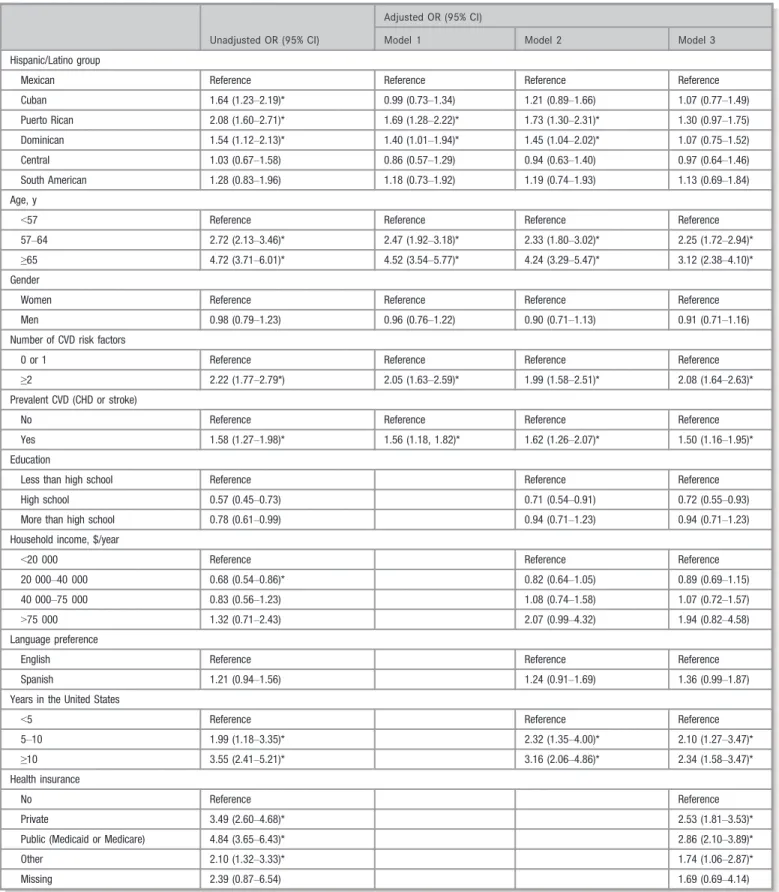
total of 16 415 participants of Mexican, Puerto Rican, Cuban, Dominican, South American, and Central American backgrounds who were aged 18 to 74 years and enrolled between March 2008 and June 2011. Our analyses were limited to 4139 participants considered to be at high cardiovascular risk. Age-adjusted prevalence of statin and aspirin use was 25% and 44%, respectively, overall but varied by Hispanic/Latino background among those at high cardiovascular risk; statin use was significantly higher (P<0.001) among adults of Puerto Rican (33%) and Dominican (28%) backgrounds compared with adults of other backgrounds (Mexican, 24%; Cuban, 22%; Central American, 20%; South American, 22%). There was no difference in aspirin use. After adjusting for health insurance coverage, the difference in prevalence of statin use was substantially reduced among participants with a Puerto Rican background, from an odds ratio of 1.73 (95% CI 1.30–2.31) to 1.30 (95% CI 0.97–1.75), and with a Dominican background, from an odds ratio of 1.45 (95% CI 1.04–2.02) to 1.07 (95% CI 0.75–1.52), in comparison to their counterparts.
Conclusions-—Among Hispanic/Latino adults of diverse backgrounds, statin use was more prevalent among adults with Puerto
Rican and Dominican backgrounds at high cardiovascular risk. These differences in statin use were explained, in part, by differences in insurance coverage. Thesefindings have important implications for the prevention of disparities in cardiovascular outcomes within the growing US Hispanic/Latino population. (J Am Heart Assoc. 2016;5:e002905 doi: 10.1161/ JAHA.115.002905)
Key Words: cardiovascular risk•disparities•Hispanic/Latino•statins
C
ardiovascular medications such as statins and aspirin are widely used in the United States1 and are critical for primary and secondary prevention of cardiovascular disease (CVD),2–5 which is increasingly common in the growing and aging US Hispanic/Latino population. Despite evidence of disparities in CVD and CVD risk factors, includinghyperc-holesterolemia, among adults from the diverse Hispanic/ Latino groups that compose the US Hispanic/Latino popula-tion,6 current information on use of medications for the prevention of CVD, including statins and aspirin, is limited.
Despite the benefits of statins and aspirin for the primary and secondary prevention of CVD among adults at high
From the Department of Pharmacy Systems, Outcomes and Policy, University of Illinois College of Pharmacy, Chicago, IL (D.M.Q., T.A.L., J.W.); Division of Epidemiology and Biostatistics, University of Illinois School of Public Health, Chicago, IL (D.M.Q., T.A.L., J.W.); Department of Biostatistics, Loyola University Chicago, Chicago, IL (R.D.-A.); Institute for Minority Health Research, University of Illinois College of Medicine, Chicago, IL (R.D.-A., D.W., M.L.D.); Department of Psychology, University of Miami, Coral Gables, FL (S.A.R.); Department of Biostatistics, University of North Carolina at Chapel Hill, NC (J.C., F.G.); South Bay Latino Research Center, Graduate
School of Public Health, San Diego State University, San Diego, CA (G.A.T.); Department of Medicine, Division of Cardiology, Montefiore Medical Center, Bronx, NY
(R.J.O.).
Correspondence to:Dima M. Qato, PharmD, MPH, PhD, 833 S. Wood St., Chicago, IL 60612. E-mail: [email protected] Received November 5, 2015; accepted February 8, 2016.
ª2016 The Authors. Published on behalf of the American Heart Association, Inc., by Wiley Blackwell. This is an open access article under the terms of the Creative
cardiovascular risk, previous analyses have documented racial and ethnic disparities in their use in the United States.7,8 These prior analyses, however, aggregated Hispanic/Latino participants into 1 group and thus did not examine the use of statins and/or aspirin by Hispanic/Latino background. Dis-parities in the use of preventive cardiovascular medications may be an important but overlooked contributor to observed disparities in CVD6 within the diverse Hispanic/Latino pop-ulation in the United States.
The study used data from the landmark Hispanic Commu-nity Health Study/Study of Latinos (HCHS/SOL) to examine prevalence of cardiovascular medication use among diverse US Hispanic/Latino adults at high cardiovascular risk. Sociodemographic, acculturation, and access-to-care factors associated with cardiovascular medication use were also examined.
Methods
Participants
The HCHS/SOL is a population-based cohort study devised to estimate the prevalence of CVD risk factors and to examine the prospective relationship between risk factors and disease outcomes among persons of diverse Hispanic/Latino back-grounds. It included participants of Cuban, Dominican, Mexican, Puerto Rican, Central American, and South American
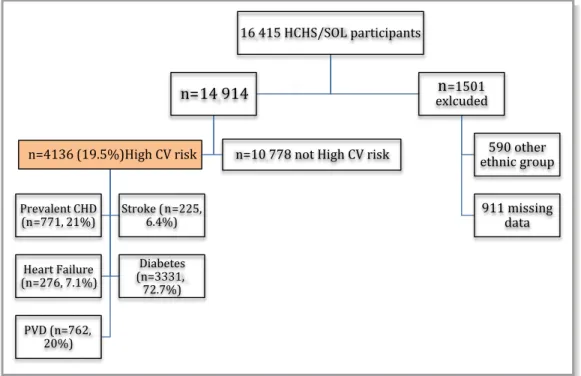
origins who were recruited from community areas surrounding 4 field centers in the Bronx, New York; Chicago, Illinois; Miami, Florida; and San Diego, California, between March 2008 and June 2011. A stratified, multistage, area probability sample of households was obtained to screen candidates for eligibility. Of 39 384 persons who were screened and selected and who met the eligibility criteria, 16 415 were enrolled for the study. The sample design, cohort selection, and study implementation were described previously.9 The current analyses excluded 911 participants who were missing information on CVD and 590 participants who did not self-identify as any of the 6 aforementioned Hispanic/Latino groups (Figure 1). Consequently, the analytic sample (n=4136) included data from 14 914 participants. Institu-tional review boards at each participating institution approved the protocol, and all participants provided written informed consent.
Data
Data were collected during a baseline examination conducted at examination centers located at eachfield site and included biological measures, interviewer-administered questionnaires, and a medication inventory.
Body mass index was calculated as weight in kilograms divided by height in meters squared. After a 5-minute rest period, 3 seated blood pressure measurements were
Figure 1. Flowchart of participants at high cardiovascular risk who were included in the HCHS/SOL sample. CHD indicates coronary heart disease; CV, cardiovascular; HCHS/SOL, Hispanic Community Health Study/Study of Latinos; PVD, peripheral vascular disease.
N
AL
RESE
obtained, and the second and third readings were averaged. Blood samples were collected according to standardized protocols and analyzed for total serum cholesterol, plasma glucose, high-density lipoprotein, low-density lipoprotein, and hemoglobin A1c levels.
Information was obtained by questionnaires on demo-graphic factors, socioeconomic status (education and income), proxy measures of cigarette smoking, medical history, and insurance status. Acculturation was also assessed using a modified version of the Short Acculturation Scale for Hispanics, which captured the degree of adaptation to new physical, cultural, social, and economic environments; proxy measures of acculturation (years of residence in the United States, nativity, and language preference) were also assessed.9Insurance status was derived based on responses to the question,“What type of health insurance or health care coverage do you have?” Responses included the following 4 categories: none, private (employer-sponsored or individual plan), public (Medicare, Medicaid, or military or US Depart-ment of Veterans Affairs), or other.
Participants at high cardiovascular risk were defined as those who reported ever being diagnosed with coronary heart disease (CHD; myocardial infarction) or a CHD risk equivalent (stroke, peripheral vascular disease, heart failure, and/or diabetes). The Adult Treatment Panel III guidelines were used to derive our definition of high cardiovascular risk. Partic-ipants with CHD or a CHD risk equivalent were considered to be at highest risk (10-year risk >20%) for developing a cardiovascular event.10 Prevalent CVD was defined as self-reported history of CHD (myocardial infarction, coronary bypass surgery, balloon angioplasty, or stent placement in coronary arteries) or stroke. As illustrated in Figure 1, our analytic sample was restricted to 4136 participants defined as having high cardiovascular risk, which included participants with and without prevalent CVD.
Major CVD risk factors were based on current guidelines. Hypertension was defined as systolic blood pressure of
≥140 mm Hg, diastolic blood pressure of ≥90 mm Hg, or receipt of medication for hypertension. Uncontrolled hyper-cholesterolemia was defined as total cholesterol ≥240 mg/ dL, high-density lipoprotein cholesterol <40 mg/dL, or low-density lipoprotein cholesterol ≥160 mg/dL. Obesity was defined as a body mass index ≥30, calculated as weight in kilograms divided by height in meters squared. Diabetes mellitus was defined as fasting glucose≥126 mg/dL, 2-hour– postload plasma glucose ≥200 mg/dL, hemoglobin A1c
≥6.5%, use of diabetes medications, or self-reported history of diabetes.
Participants were instructed to bring all prescription and nonprescription medications taken in the past month to the study center at the time of their physical examination. Cardiovascular medication use was defined as the use of at
least 1 statin or aspirin medication. We defined statin medication use as the use of at least 1 statin (3-hydroxy-3-methyglutaryl coenzyme A reductase inhibitors) and aspirin use as the use of at least 1 aspirin-containing product (that was not restricted by aspirin indication). We also examined the concurrent use of at least 1 statin and 1 aspirin product.
Statistical Analysis
All reported values (prevalence and odds ratio [OR]) were weighted to adjust for sampling probability and nonresponse.9 Descriptive statistics provided age-adjusted estimates (based on the mean age of our analytic sample) for the prevalence of each variable overall and were stratified by Hispanic/Latino background group. Survey-specific procedures were used to compute 95% CIs to account for the 2-stage sampling design, stratification, and clustering. Prevalence of statin and aspirin use was estimated for the sample as a whole and separately within each of the Hispanic/Latino background groups. Comparisons across Hispanic/Latino background groups were performed using the Wald chi-square statistic.
Multivariable logistic regression was used to model differences in the prevalence of statin use among those with high CVD risk. Multivariable multistage logistic regression was adjusted for demographic and clinical factors in model 1; for socioeconomic and acculturation factors in model 2; and additionally for health insurance status in model 3. Our rationale for variable selection was based on factors known to influence the use of medications. ORs with 95% CIs were computed. All statistical tests were 2-sided. No adjustments were made for multiple comparisons. All analyses were performed using SAS version 9.2 (SAS Institute).
Results
As depicted in Figure 1, 19.5% of eligible individuals (N=14 914) were considered to be at high cardiovascular risk. There were significantly more Puerto Rican adults (26%) at high cardiovascular risk in comparison to the other Hispanic/Latino groups, and this result corresponds to previous findings.6 The distribution of participants at high cardiovascular risk is included in Figure 1.
Participants
Table 1 depicts weighted estimates of the demographic and socioeconomic characteristics of Hispanic/Latino partici-pants at high cardiovascular risk. Mean age was 52 years (95% CI 51.4–53.0), and of the 4136 participants included in the sample, 54% were women. Approximately 33% (95% CI
N
AL
RESE
30.9–35.8) had more than a high school education, and 51% (95% CI 48.0–53.0) had an annual family income of less than $20 000. The majority of participants were married or living with a partner (51%), 80% (95% CI 77.9–82.4) had resided in the United States for >10 years, and Spanish was the preferred language (83%). These sociodemographic charac-teristics varied by Hispanic/Latino group.
Table 2 reports the prevalence of CVD and cardiovascular risk factors and health care characteristics by Hispanic/ Latino group. The prevalence of CVD (prevalent CHD or stroke) was 26% overall but ranged from 21% (Mexican background) to 33% (Puerto Rican background). The preva-lence of hypertension was 49% (95% CI 46.7–50.6) overall and ranged from 39% (South American background) to 54% (Dominican background). In addition, uncontrolled hyperc-holesterolemia (untreated or treated, uncontrolled) was 43% overall and varied by Hispanic/Latino background; it was lowest in those with Dominican (34%) and Puerto Rican (39%) backgrounds and highest in those with Central American (50%) and Cuban (48%) backgrounds who were at high cardiovascular risk.
Diabetes was the most prevalent cardiovascular risk factor, affecting 60% (95% CI 58.2–62.5) of participants at high cardiovascular risk. There was a statistically significant (P<0.001) difference in diabetes prevalence among His-panic/Latino background groups, ranging from 51% of participants with a South American background to 68% of participants with a Mexican background who were at high cardiovascular risk. Obesity and smoking were significantly more prevalent among participants with a Puerto Rican background, 60% of whom were obese and 32% of whom were current smokers.
Overall, 81% of participants were using at least 1 medication of any type. More than one-third of participants (37%, 95% CI 34.7–39.5) were not insured, and that result corresponds to national estimates of uninsured rates for the Hispanic/Latino population in the United States. Neverthe-less, there were statistically significant differences among Hispanic/Latino groups, ranging from 12% of participants with a Puerto Rican background to 53% of participants with a Central American background who were uninsured. In addi-tion, 32% of participants were publically insured with either Medicare or Medicaid, and 23% had private insurance coverage.
Differences in the Prevalence of Cardiovascular
Medication Use
Table 3 reports the estimated prevalence of statin and aspirin use and their concurrent use among participants at high cardiovascular risk by gender and Hispanic/Latino group. Hispanic/Latino adults at high cardiovascular risk were more
likely to use aspirin (44%) than statins (25%), with 17% concurrently using a statin and aspirin. There were significant differences between Hispanic/Latino groups for both men and women in the use of statins. Specifically, Puerto Rican participants were significantly more likely to use statins (33%) than other Hispanic/Latino groups, with the lowest preva-lence in participants with a Central American background (22%).
Among participants at high cardiovascular risk who were aged≥65 years, statin use was more prevalent (47%, 95% CI 42.0–51.2) overall than among those aged <65 years, with significant differences among Hispanic/Latino background groups for participants aged <65 years (Table 4). The magnitude of these differences was statistically significant and was similar to those presented in Table 3. Furthermore, there were statistically significant differences among His-panic/Latino groups among the insured overall. These differences persisted in both age groups for both insured and uninsured participants but, because of limited statistical power, were not statistically significant.
Factors Associated With Differences in Statin Use
Table 5 displays the results of the bivariate and multivariate analyses examining statin use among Hispanic/Latino partic-ipants at high cardiovascular risk. Differences in statin use between Hispanic/Latino background groups at high cardio-vascular risk persisted after accounting for differences in age and gender (model 1). Those from Puerto Rican and Domini-can backgrounds who were at high cardiovascular risk had significantly higher odds (OR 1.7 [95% CI 1.28–2.22] and OR 1.4 [95% CI 1.01–1.94], respectively) of using statins than those from a Mexican background.
These differences in statin use persisted after controlling for differences in socioeconomic and acculturation variables (model 2) but were no longer statistically significant after accounting for differences in health insurance coverage (model 3). Specifically, differences in insurance coverage substantially reduced the odds of statin use among those with a Puerto Rican background (OR 1.3, 95% CI 0.97–1.75]) or a Dominican background (OR 1.07, 95% CI 0.75,– 1.52]) who were at high cardiovascular risk in comparison to their Mexican counterparts. Participants with Cuban, Central American, and South American backgrounds were equally likely to use statins in comparison to those with a Mexican background after accounting for differences in demographic and cardiovascular risk factors.
We also examined the age-adjusted prevalence of statin use for participants of Mexican and Puerto Rican backgrounds by site and found no statistically significant differences. Statin use, for example, among participants with a Mexican back-ground who were at high cardiovascular risk was 24.6% (95%
N
AL
RESE
CI 21.1–28.0) in Chicago and 23.0% (95% CI 18.6–27.5) in San Diego.
Differences in the Prevalence of Statin and
Aspirin Use Among Adults at High Cardiovascular
Risk With and Without Prevalent CVD
Figure 2 displays the prevalence of statin and aspirin use and their concurrent use among participants at high cardiovascu-lar risk with (n=939) and without (n=3197) prevalent CVD. Overall, 33% of participants with prevalent CVD were using statin medications and 51% were using aspirin. Although there were notable differences in statin use and aspirin use across Hispanic/Latino background groups, these differences were not statistically significant.
Overall, 23% of participants at high cardiovascular risk without prevalent CVD were using a statin, and 42% were using aspirin. There was a statistically significant difference in the prevalence of statin use by Hispanic/Latino back-ground group (P<0.001). Those with a Central American background were the least likely to use statins (17%), and those with a Puerto Rican background who were without CVD but at high cardiovascular risk were the most likely to report the use of statins (32%). These differences persisted in both men and women (data not shown). We found no significant difference in the prevalence of aspirin use by Hispanic/Latino background groups among participants without prevalent CVD.
Discussion
To our knowledge, this study is the first to document variations in the use of statins and aspirin among the diverse Hispanic/Latino population in the United States. We found that among Hispanic/Latino adults at high risk of CVD, 25% used statins and less than half (44%) used aspirin. Despite evidence that demonstrates clinical benefits for the primary and secondary prevention of CVD, our findings indicated substantial underuse of statins, particularly for the primary prevention of CVD, among the growing Hispanic/Latino population in the United States.
We also found that adults with Puerto Rican and Dominican backgrounds who were at high cardiovascular risk were significantly more likely than other Hispanic/Latino back-ground groups, including those with a Mexican backback-ground, to use these cardiovascular medications. These disparities were not related to differences in cardiovascular risk profiles or socioeconomic or acculturation factors, including language preference, but rather were associated with differences in health insurance. These findings suggest that certain His-panic/Latino background groups may encounter more barri-ers than othbarri-ers in accessing prescription medications. Recent efforts through the Patient Care and Affordable Care Act to expand insurance coverage11 may contribute to improve-ments in the use of statins and ultimately lead to prevention of CVD within the growing Hispanic/Latino population in the United States.
Table 3. Prevalence of Cardiovascular Medication Use Among Participants at High Cardiovascular Risk Overall and by Hispanic/ Latino Group (Age-Adjusted)
Participants, % (95% CI)
All (n=4136) Mexican (n=1620) Cuban (n=558) Puerto Rican (n=944) Dominican (n=410)
Central American (n=395)
South American (n=209)
Statin use
Overall§ 25.4 (23.8–27.1) 23.5 (20.4–26.6) 22.2 (18.2–26.2) 32.9 (29.7–36.2) 28.3 (24.2–32.4) 20.0 (14.7–25.2) 22.4 (15.7–29.1)
Men† 25.9 (23.0–28.8) 24.3 (19.0–29.5) 21.9 (15.9–27.8) 32.2 (26.6–37.8) 31.8 (24.1–39.4) 17.9 (10.5–25.2) 32.0 (19.6–44.4)
Women‡ 24.9 (22.7–27.2) 22.8 (18.8–26.7) 22.5 (16.1–29.0) 33.5 (28.6–38.3) 25.8 (20.2–31.4) 21.6 (14.4–28.8) 17.1 (9.9–24.3)
Aspirin use
Overall 44.0 (41.9–46.2) 42.7 (38.9–46.4) 42.0 (37.3–46.6) 47.2 (43.1–51.3) 48.0 (41.7–54.3) 42.0 (35.7–48.3) 42.9 (34.5–51.3)
Men 44.7 (41.4–47.9) 42.9 (37.1–48.7) 43.4 (36.6–50.2) 45.1 (37.9–52.2) 53.8 (45.5–62.1) 42.2 (31.5–52.9) 48.3 (34.3–62.4)
Women 43.6 (40.8–46.4) 42.7 (37.5–47.9) 40.5 (34.5–46.6) 49.3 (44.0–54.5) 43.9 (36.1–51.7) 41.9 (33.9–49.9) 40.0 (29.8–50.2)
Concurrent aspirin and statin use
Overall§ 17.4 (15.9–18.9) 16.3 (13.8–18.8) 13.1 (9.5–16.8) 22.8 (19.8–25.7) 19.7 (15.9–23.6) 16.1 (10.9–21.2) 17.0 (11.0–23.0)
Men 18.1 (15.5–20.7) 17.0 (12.5–21.5) 14.1 (8.7–19.5) 20.5 (16.2–24.7) 25.7 (18.3–33.0) 16.3 (9.0–23.5) 26.3 (13.9–38.7)
Women‡ 16.7 (14.9–18.6) 15.7 (12.6–18.9) 12.2 (7.0–17.4) 24.8 (20.1–29.6) 15.5 (10.9–20.2) 16.0 (8.7–23.2) 11.9 (6.1–17.6)
Values were weighted for survey design and nonresponse and adjusted for age. †P<0.05.
‡P<0.01.
§P<0.001.
N
AL
RESE
Our findings from the HCHS/SOL suggest that prior research that primarily classified Hispanic/Latino participants as a single group may underestimate disparities in the use of preventative cardiovascular medications within the diverse Hispanics/Latino population currently living in the United States.7,8 In contrast to a previous study7 indicating that
46% of Hispanics/Latino and 38% of black participants at high cardiovascular risk use statins compared with 50% of the non-Hispanic white population, our findings demonstrated variations in statin use within the diverse US Hispanic/Latino population at high cardiovascular risk, particularly for the primary prevention of CVD, for which statin medications are indicated.
Although prior analyses reported racial and ethnic dispar-ities in the use of aspirin,7 we found no such differences within the Hispanic/Latino population at high cardiovascular risk. This was true for aspirin use for both primary and secondary prevention of CVD. In fact, more than half (51%) of Hispanic/Latino participants with prevalent CVD were using aspirin—a medication that can be obtained without a prescription at a fraction of the cost—whereas only 33% were using a statin (which is available only by prescription). These findings suggest that addressing cost and access barriers to the use of prescription medications (versus nonprescription) is particularly important for the US His-panic/Latino population.
We also evaluated differences in statin use by Hispanic/ Latino background that suggest, in contrast to our finding on aspirin use, variation in the use of statins among adults at high cardiovascular risk within the Hispanic/Latino population. These differences were particularly pronounced among those without prevalent CVD. Of note, 32% of
participants with a Puerto Rican background versus 17% and 21% of those with Central American and Mexican back-grounds, respectively, at high cardiovascular risk used statins for the primary prevention of CVD. Participants with Central American and Mexican backgrounds who were at high cardiovascular risk were more likely to have uncon-trolled (untreated or treated) hypercholesterolemia (50%) and diabetes (68%), respectively, both of which are leading risk factors for CVD. Improving access to and use of statins among the Hispanic/Latino population, particularly back-ground-specific groups most at risk for underuse, is critical for efforts aimed at reducing the burden of CVD and should be a public health priority. These efforts are particularly important considering recent American College of Cardiology and American Heart Association guidelines2 that recom-mend treatment with statins for both primary and secondary prevention of CVD.
Our study suggests that policies and interventions to reduce disparities in the use of preventive cardiovascular medications within the diverse Hispanic/Latino population must address barriers to accessing health insurance. Although recent implementation of the Affordable Care Act, which sought to improve health insurance coverage, is promising11—with evidence that uninsured rates among Hispanic/Latino adults declined to 23% in 2014 compared with 36% in 201312—there is significant variation at the state level. Of note,>33% of Latino/Hispanic adults living in states that have not expanded Medicaid (eg, Texas) remain unin-sured compared with an uninunin-sured rate of 17% among those living in states (eg, Illinois) that have implemented Medicaid expansion.12 Consequently, Medicaid expansion may con-tribute to improvements in insurance coverage and thus statin Table 4. Prevalence of Statin Use Among Participants at High Cardiovascular Risk by Hispanic/Latino Group According to Age Group and Insured Status
Participants, % (95% CI)
All (n=4136) Mexican (n=1620) Cuban (n=558) Puerto Rican (n=944) Dominican (n=410)
Central American (n=395)
South American (n=209)
Aged≥65 y 46.6 (42.0–51.2) 39.0 (29.5–48.5) 48.7 (39.8–57.5) 52.4 (44.5–60.3) 51.4 (37.3–65.4) 41.7 (22.8–60.7) 35.6 (17.7–53.6)
Aged<65 y§ 19.5 (17.8–21.3) 16.5 (13.3–19.6) 16.3 (12.4–20.3) 28.5 (24.3–32.6) 21.3 (17.0–25.6) 13.7 (9.3–18.2) 20.5 (13.5–27.6)
Insured
Overall§ 34.0 (31.5–36.5) 28.0 (23.1–32.9) 43.5 (37.0–49.9) 36.0 (31.7–40.3) 31.8 (25.7–37.8) 28.3 (19.9–36.8) 26.5 (16.3–36.7)
Aged≥65 y 51.5 (46.4–56.6) 47.0 (35.5–58.4) 53.6 (44.3–63.0) 53.1 (44.6–61.7) 54.9 (39.1–70.6) 46.0 (25.4–66.6) 39.2 (18.3–60.1)
Aged<65 y 26.5 (24.0–29.0) 22.7 (17.9–27.6) 30.3 (22.1–38.6) 30.8 (26.2–35.4) 24.8 (19.5–30.0) 21.5 (13.2–29.8) 21.5 (10.1–32.8)
Uninsured
Overall 11.4 (9.1–13.8) 11.9 (8.2–15.7) 8.5 (3.8–13.2) 14.7 (7.2–22.2) 12.3 (3.8–20.8) 9.5 (4.4–14.6) 20.8 (11.7–29.9)
Aged≥65 y 16.9 (4.8–29.0) 14.6 (0.0–30.3) 20.6 (0.0–48.4) 0 6.9 (0.0–21.5) 16.1 (0.0–40.3) 24.9 (0.0–50.4)
Aged<65 y 11.0 (8.7–13.2) 11.8 (7.9–15.6) 6.9 (3.2–10.7) 15.2 (7.5–22.9) 12.8 (3.7–21.8) 8.5 (4.1–12.8) 20.2 (10.8–29.6)
Values were weighted for survey design and nonresponse and adjusted for age.
§P<0.001.
N
AL
RESE
Table 5. Sociodemographic, Acculturation, and Health Care Factors Associated With Differences in Statin Use Among the Hispanic/Latino Population at High Cardiovascular Risk
Unadjusted OR (95% CI)
Adjusted OR (95% CI)
Model 1 Model 2 Model 3
Hispanic/Latino group
Mexican Reference Reference Reference Reference
Cuban 1.64 (1.23–2.19)* 0.99 (0.73–1.34) 1.21 (0.89–1.66) 1.07 (0.77–1.49)
Puerto Rican 2.08 (1.60–2.71)* 1.69 (1.28–2.22)* 1.73 (1.30–2.31)* 1.30 (0.97–1.75)
Dominican 1.54 (1.12–2.13)* 1.40 (1.01–1.94)* 1.45 (1.04–2.02)* 1.07 (0.75–1.52)
Central 1.03 (0.67–1.58) 0.86 (0.57–1.29) 0.94 (0.63–1.40) 0.97 (0.64–1.46)
South American 1.28 (0.83–1.96) 1.18 (0.73–1.92) 1.19 (0.74–1.93) 1.13 (0.69–1.84)
Age, y
<57 Reference Reference Reference Reference
57–64 2.72 (2.13–3.46)* 2.47 (1.92–3.18)* 2.33 (1.80–3.02)* 2.25 (1.72–2.94)*
≥65 4.72 (3.71–6.01)* 4.52 (3.54–5.77)* 4.24 (3.29–5.47)* 3.12 (2.38–4.10)*
Gender
Women Reference Reference Reference Reference
Men 0.98 (0.79–1.23) 0.96 (0.76–1.22) 0.90 (0.71–1.13) 0.91 (0.71–1.16)
Number of CVD risk factors
0 or 1 Reference Reference Reference Reference
≥2 2.22 (1.77–2.79*) 2.05 (1.63–2.59)* 1.99 (1.58–2.51)* 2.08 (1.64–2.63)*
Prevalent CVD (CHD or stroke)
No Reference Reference Reference Reference
Yes 1.58 (1.27–1.98)* 1.56 (1.18, 1.82)* 1.62 (1.26–2.07)* 1.50 (1.16–1.95)*
Education
Less than high school Reference Reference Reference
High school 0.57 (0.45–0.73) 0.71 (0.54–0.91) 0.72 (0.55–0.93)
More than high school 0.78 (0.61–0.99) 0.94 (0.71–1.23) 0.94 (0.71–1.23)
Household income, $/year
<20 000 Reference Reference Reference
20 000–40 000 0.68 (0.54–0.86)* 0.82 (0.64–1.05) 0.89 (0.69–1.15)
40 000–75 000 0.83 (0.56–1.23) 1.08 (0.74–1.58) 1.07 (0.72–1.57)
>75 000 1.32 (0.71–2.43) 2.07 (0.99–4.32) 1.94 (0.82–4.58)
Language preference
English Reference Reference Reference
Spanish 1.21 (0.94–1.56) 1.24 (0.91–1.69) 1.36 (0.99–1.87)
Years in the United States
<5 Reference Reference Reference
5–10 1.99 (1.18–3.35)* 2.32 (1.35–4.00)* 2.10 (1.27–3.47)*
≥10 3.55 (2.41–5.21)* 3.16 (2.06–4.86)* 2.34 (1.58–3.47)*
Health insurance
No Reference Reference
Private 3.49 (2.60–4.68)* 2.53 (1.81–3.53)*
Public (Medicaid or Medicare) 4.84 (3.65–6.43)* 2.86 (2.10–3.89)*
Other 2.10 (1.32–3.33)* 1.74 (1.06–2.87)*
Missing 2.39 (0.87–6.54) 1.69 (0.69–4.14)
Model 1: adjusted for Hispanic/Latino group, age, gender, CVD status. Model 2: adjusted for all variables in model 1 plus education, income, language, Short Acculturation Scale for Hispanics score, and number of years in the United States. Model 3: adjusted for all variables in model 2 and health insurance. Values were weighted for survey design and nonresponse. CHD indicates coronary heart disease, CVD, cardiovascular disease; OR, odds ratio.
*P<0.05.
N
AL
RESE
use for some Hispanic/Latino groups but not others based on state of residence. Future research should examine the impact of the Affordable Care Act on disparities in access to prescription medications, including statins, within the His-panic/Latino population.
Limitations
Our analysis has several limitations. First, our definition of high cardiovascular risk, including prevalent CVD, includes self-reported information and lacks some variables used by others when assigning cardiovascular risk (eg, Framingham risk score). Second, although other prescription medications may be used for the prevention of CVD, we focused on statins and aspirin because they arefirst-line recommendations with proven benefit for CVD and are currently used almost exclusively for this purpose. Third, our measure of aspirin use does not differentiate between aspirin used regularly for CVD prevention and aspirin used for symptomatic treatment as an analgesic. Fourth, the HCHS/SOL did not include any other US racial or ethnic groups for comparison; however, the findings for statin and aspirin use of the Hispanic/Latino population in aggregate are similar to those found in other national surveys.7 Finally, our analyses excluded 1501 participants with missing information. Compared with the 14 914 participants included in our analysis, these partici-pants were less likely to be uninsured (40% versus 49%;
P<0.001) and were slightly younger (mean age 38 years versus 41 years;P<0.001).
Conclusions
Among Hispanic/Latino adults of diverse backgrounds, statin use—especially for the primary prevention of CVD—was more prevalent in those with Puerto Rican and Dominican backgrounds who were at high cardiovascular risk. Statin use was associated with insurance coverage and may contribute to future cardiovascular outcomes within the growing US Hispanic/Latino population that is experiencing a growing burden of CVD and CVD risk factors. Efforts to increase the use of statins among Hispanic/Latino adults at high cardio-vascular risk, particularly targeting at-risk groups such as those with Mexican and Central American backgrounds, should include improving access to health insurance cover-age. Efforts to improve prescription of, access to, and use of statins are particularly important.
Sources of Funding
The Hispanic Community Health Study/Study of Latinos was carried out as a collaborative study supported by contracts from the National Heart, Lung, and Blood Institute (NHLBI) to the University of North Carolina (N01-HC65233), University of 0 0.2 0.4 0.6 0.8 1
All* Mexican Cuban Puerto Rican Dominican Central South
Ad
ults at
Hig
h
Card
iov
a
sc
u
lar
Risk
witho
u
t
prev
alent
Coro
nary
Heart
D
is
e
ase
or Stro
ke
(n=319
7
)
Stan Use
All Mexican Cuban Puerto Rican Dominican Central South
Aspirin use
All* Mexican Cuban Puerto Rican Dominican Central South
Stan and Aspirin Use
0 0.2 0.4 0.6 0.8 1 All
Mexican Cuban Puerto Rican Dominican Central South
Ad
ults at
Hig
h
Card
iov
asc
u
lar
Risk
with
Pre
v
ale
n
t
Co
ronary
Hea
rt D
iseas
e or Stro
ke
(n=93
9
)
0 0.2 0.4 0.6 0.8 1 All
Mexican Cuban Puerto Rican Dominican Central South
0 0.2 0.4 0.6 0.8 1 All
Mexican Cuban Puerto Rican Dominican Central South
Miami (N01-HC65234), Albert Einstein College of Medicine (N01-HC65235), Northwestern University (N01-HC65236) University of Illinois at Chicago (HHSN268201300003I), and San Diego State University (N01-HC65237). The following Institutes/Centers/Offices contribute to the HCHS/SOL through a transfer of funds to the NHLBI: National Institute on Minority Health and Health Disparities, National Institute on Deafness and Other Communication Disorders, National Institute of Dental and Craniofacial Research, National Institute of Diabetes and Digestive and Kidney Diseases, National Institute of Neurological Disorders and Stroke, NIH Institution-Office of Dietary Supplements.
Disclosures
None.
References
1. Qato DM, Alexander GC, Conti RM, Johnson M, Schumm P, Lindau ST. Use of prescription and over-the-counter medications and dietary
supple-ments among older adults in the United States.JAMA. 2008;300:2867–
2878.
2. Stone NJ, Robinson JG, Lichtenstein AH, Bairey Merz CN, Blum CB, Eckel RH, Goldberg AC, Gordon D, Levy D, Lloyd-Jones DM, McBride P, Schwartz JS, Shero ST, Smith SC Jr, Watson K, Wilson PW, Eddleman KM, Jarrett NM, LaBresh K, Nevo L, Wnek J, Anderson JL, Halperin JL, Albert NM, Bozkurt B, Brindis RG, Curtis LH, DeMets D, Hochman JS, Kovacs RJ, Ohman EM, Pressler SJ, Sellke FW, Shen WK, Smith SC Jr, Tomaselli GF. 2013 ACC/AHA guideline on the treatment of blood cholesterol to reduce atherosclerotic cardiovascular risk in adults: a report of the American College of Cardiology/
American Heart Association Task Force on Practice Guidelines.Circulation.
2014;129:S1–S45.
3. Stone NJ, Robinson JG, Lichtenstein AH, Goff DC Jr, Lloyd-Jones DM, Smith SC Jr, Blum C, Schwartz JS. Treatment of blood cholesterol to reduce atheroscle-rotic cardiovascular disease risk in adults: synopsis of the 2013 American
College of Cardiology/American Heart Association cholesterol guideline.Ann
Intern Med. 2014;160:339–343.
4. Parekh AK, Galloway JM, Hong Y, Wright JS. Aspirin in the secondary
prevention of cardiovascular disease.N Engl J Med. 2013;368:204–205.
5. Xie M, Shan Z, Zhang Y, Chen S, Yang W, Bao W, Rong Y, Yu X, Hu FB, Liu L. Aspirin for primary prevention of cardiovascular events: meta-analysis of randomized controlled trials and subgroup analysis by sex and diabetes status.
PLoS One. 2014;9:e90286.
6. Daviglus ML, Talavera GA, Aviles-Santa ML, Allison M, Cai J, Criqui MH, Gellman M, Giachello AL, Gouskova N, Kaplan RC, LaVange L, Penedo F, Perreira K, Pirzada A, Schneiderman N, Wassertheil-Smoller S, Sorlie PD, Stamler J. Prevalence of major cardiovascular risk factors and cardiovascular diseases among Hispanic/Latino individuals of diverse backgrounds in the
United States.JAMA. 2012;308:1775–1784.
7. Qato DM, Lindau ST, Conti RM, Schumm LP, Alexander GC. Racial and Ethnic disparities in cardiovascular medication use among older adults in the United
States.Pharmacoepidemiol Drug Saf. 2010;19:834–842.
8. Mann D, Reynolds K, Smith D, Muntner P. Trends in statin use and low-density lipoprotein cholesterol levels among US adults: impact of the 2001 National
Cholesterol Education Program guidelines.Ann Pharmacother. 2008;42:1208–
1215.
9. Sorlie PD, Aviles-Santa LM, Wassertheil-Smoller S, Kaplan RC, Daviglus ML, Giachello AL, Schneiderman N, Raij L, Talavera G, Allison M, Lavange L, Chambless LE, Heiss G. Design and implementation of the Hispanic
Community Health Study/Study of Latinos.Ann Epidemiol. 2010;20:629–641.
10. Expert Panel on Detection E, Treatment of High Blood Cholesterol in A. Executive summary of the third report of the national cholesterol education program (NCEP) expert panel on detection, evaluation, and treatment of high
blood cholesterol in adults (adult treatment panel III).JAMA. 2001;285:2486–
2497.
11. Sommers BD, Musco T, Finegold K, Gunja MZ, Burke A, McDowell AM. Health
reform and changes in health insurance coverage in 2014.N Engl J Med.
2014;371:867–874.
12. Doty MM, Rasmussen PW, Collins SR. Catching up: Latino health coverage gains and challenges under the Affordable Care Act: results from the
Commonwealth Fund Affordable Care Act Tracking Survey. Issue Brief
(Commonw Fund). 2014;26:1–15.
N
AL
RESE