Entrepreneurship, Knowledge, and the Industrial Revolution
Mustafa Aykut Attar
A dissertation submitted to the faculty of the University of North Carolina at Chapel Hill in partial fulfillment of the requirements for the degree of Doctor of Philosophy in the Department of Economics.
Chapel Hill 2011
Approved by:
Lutz A. Hendricks
Neville R. Francis
Richard T. Froyen
Pietro F. Peretto
Abstract
Mustafa Aykut Attar: Entrepreneurship, Knowledge, and the Industrial Revolution
(Under the direction of Lutz A. Hendricks)
This dissertation constructs and studies a simple unified growth model that explains the
timing of the industrial revolution through entrepreneurship and entrepreneurs’
previ-ously unexplored role in the accumulation of useful knowledge.
Three premises are responsible for the main results: First, inventions and discoveries,
i.e. two forms of useful knowledge, are differentiated such that a larger stock of
discov-eries implies a higher level of inventive productivity. Second, entrepreneurs own and
manage the firms operating in the innovative sector of the economy, and they thus may
find it optimal to spend some of their scarce time endowment to inventive activity by
de-creasing the time allocated to routine management otherwise. Third, the stock of useful
discoveries expands in time through the process of collective discovery. Entrepreneurs,
during their lifetime, serendipitously perceive new useful discoveries and share what they
discover with each other in their common social environment.
Two key results are that (i) the optimal level of inventive effort by entrepreneurs is
zero if the stock of useful discoveries is sufficiently small, and (ii) an industrial revolution,
i.e. an endogenous switch from zero to positive inventive effort, is an inevitable outcome
of the process of collective discovery even though it might be delayed for long epochs of
stagnation. Population growth and structural transformation, i.e. two well-documented
aspects of the transition from stagnation to growth, are not only affected by technological
progress as usual but also determine how fast the economy moves towards its invention
threshold.
during the last 350 years, the model performs reasonably well in explaining the main
patterns of the transition from stagnation to growth, i.e. the demographic transition,
urbanization, industrialization and the acceleration of technological progress.
Counter-factual experiments show that even small deviations from the benchmark model may
Acknowledgments
Several people other than my always supportive parents and my brother contributed to
this dissertation, and I would like to express my appreciation to them.
My advisor Lutz Hendricks contributed to this dissertation, firstly, by teaching me
how to design a research agenda and, secondly, by providing comments and suggestions
that made me gain new and important insights about the contents and the scope of my
dissertation. I most possibly benefited from the tacit component of his knowledge on the
way of becoming a research economist.
Other members of the dissertation committee were very friendly and helpful in all
stages of my graduate studies: Neville Francis and Richard Froyen provided valuable
comments that helped me realize some aspects of the dissertation that need to be
ad-dressed further. Pietro Peretto’s research-oriented course on economic growth inspired
me more than anything else. I started thinking about the role of Schumpeterian notions
for unified growth theory after taking that course, and his comments and suggestions
played a key role in finalizing this dissertation. Equally valuable were the comments and
suggestions by John Seater, and I received valuable feedback at the Triangle Dynamic
Macroeconomics workshop organized by him.
Oksana Leukhina shared the data collected by her and her co-author Michael Bar.
Her support saved a good deal amount of time for me, and the data in turn proved to be
very useful.
I benefited from conversations with Aykut Kibritçio˘glu and Aydın Ördek on the
dissertation topic, and Michael Salemi provided a very valuable technical comment on an
All my close friends, living now in Chapel Hill or in some other place, were really
supportive. Two of my friends, Volkan Selçuk and Onur Yeni, played a key role and
assisted me financially for my last semester in Chapel Hill. The last but surely not the
least, my girlfriend Günnur’s unconditional support was very important at all stages of
Table of Contents
List of Tables . . . xi
List of Figures . . . xii
Chapters 1 Introduction . . . 1
2 The Related Literature . . . 7
2.1 From Stagnation to Growth . . . 7
2.2 Three Fundamental Premises . . . 10
3 The Model Economy . . . 13
3.1 Environment . . . 13
3.1.1 Demographic Structure . . . 13
3.1.2 Endowments . . . 15
3.1.3 Preferences . . . 16
3.1.4 Technologies . . . 18
3.2 Occupations . . . 23
3.2.1 Entrepreneurs . . . 23
3.2.2 Workers . . . 24
3.3 Markets . . . 24
3.4.1 Modern Sector . . . 25
3.4.2 Traditional Sector . . . 27
3.5 Decision Problems . . . 28
3.5.1 Workers’ Problem . . . 29
3.5.2 Entrepreneurs’ Problem . . . 30
3.5.3 Occupational Choice . . . 31
3.6 Market Clearing Conditions . . . 32
4 Static, Dynamic, and Asymptotic Equilibria . . . 33
4.1 Static General Equilibrium . . . 33
4.1.1 Ex Ante Symmetry and Ex Post Heterogeneity . . . 34
4.1.2 The Invention Threshold and the Industrial Revolution . . . 35
4.1.3 Productivity, Wage, and Output . . . 37
4.1.4 The Structural Transformation . . . 38
4.1.5 Fertility and the Demographic Transition . . . 39
4.1.6 The Supply of Entrepreneurship . . . 40
4.1.7 Output per worker and Output per capita . . . 41
4.2 Dynamic General Equilibrium . . . 41
4.3 The Asymptotic Equilibrium . . . 43
4.3.1 Two Preliminary Tasks . . . 43
4.3.2 The Global Stability . . . 45
4.3.3 The Asymptotic Rates of (Economic) Growth . . . 46
4.4 The Absence of the Weak and the Strong Scale Effects . . . 48
4.5 The Equilibrium Path: From Stagnation to Growth . . . 49
5 The Timing of the Industrial Revolution: Some Tentative Results . . . 52
5.1 Preliminaries. . . 54
5.1.1 First-Order and Second-Order Effects . . . 54
5.2 Results. . . 56
6 The Quantitative Analysis . . . 59
6.1 Preliminaries. . . 59
6.1.1 Time, Generational Growth Rates, and the Initial Period. . . 60
6.1.2 The Data . . . 62
6.1.3 Parameterizing theξ(K)Function . . . 67
6.1.4 Calibration . . . 68
6.2 Results. . . 74
6.2.1 Some Simulations for the Calibration Period 1650-2000 . . . 74
6.2.2 The Equilibrium Path over the Long-Run . . . 76
6.2.3 Counter-factual Experiments and the Timing Question . . . 79
7 Discussion . . . 82
7.1 The Industrial Revolution: Break or Continuity?. . . 82
7.2 Serendipitous Inventions . . . 84
7.3 Managers vs. Inventors . . . 85
7.4 The Fishing Out Effect . . . 86
7.5 The Scale Effect in the Process of Collective Discovery . . . 88
7.6 Science and Scientists . . . 90
7.7 Endogenous Survival and Longevity . . . 91
8 Concluding Remarks . . . 92
Appendix A Proofs . . . 94
Appendix B The Conditional Dynamical System . . . 102
List of Tables
Table 2.1 Two Forms of Useful Knowledge in Mokyr’s (2002) Theory . . . 10
Table 2.2 The Usefulness of Knowledge: A Simple Framework . . . 11
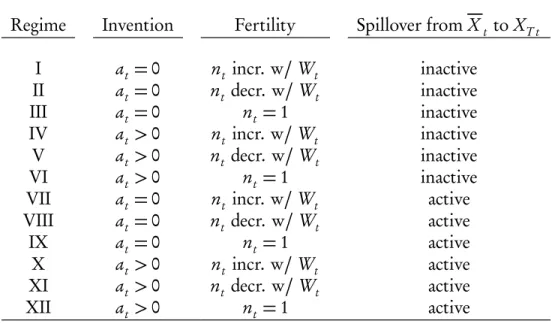
Table 4.1 Equilibrium Regimes . . . 45
Table 5.1 The Timing of the Industrial Revolution: Case 1 (nt incr. w/Wt) . . . 56
Table 5.2 The Timing of the Industrial Revolution: Case 2 (nt decr. w/Wt) . . . 57
Table 6.1 The Regression Results for the Exogenous Variables . . . 64
Table 6.2 The Benchmark Calibration Results . . . 72
List of Figures
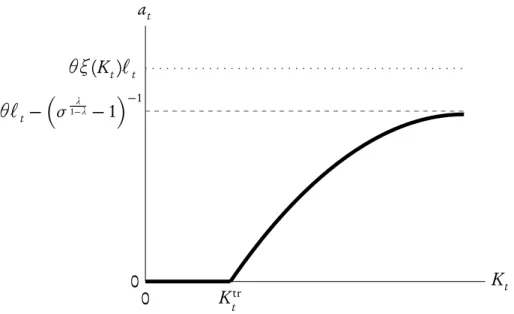
Figure 4.1 The Arrival Rate as a Function of the Stock of Discoveries . . . 36
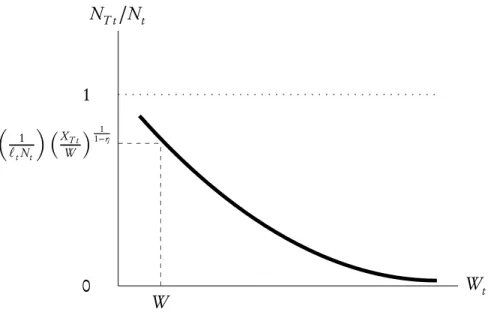
Figure 4.2 The Labor Share of the Traditional Sector as a Function of Real Wage . . 39
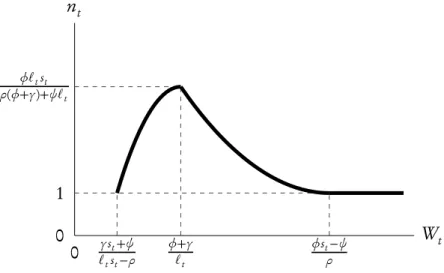
Figure 4.3 Net Fertility as a Function of Real Wage . . . 40
Figure 4.4 The Process of Collective Discovery fort<∞and fort → ∞. . . 47
Figure 6.1 Real Income, Real Wage, and Population in England: 1200-1860 . . . 60
Figure 6.2 Real NNI per capita and Population: 1650-2000 . . . 61
Figure 6.3 The Decline of the Traditional Sector: 1650-1975 . . . 62
Figure 6.4 Survival Probability and Adult Longevity: Data vs. Fitted Values . . . 65
Figure 6.5 The Measures of Gross Fertility in England: 1650-2000 . . . 66
Figure 6.6 Model vs. Data . . . 73
Figure 6.7 The Invention Threshold and the Collective Discovery . . . 74
Figure 6.8 Some Equilibrium Relations . . . 75
Figure 6.9 The Long-Run Evolution of the Equilibrium . . . 76
Figure 6.10 Long-Run Gross Growth Rates (Smoothed) . . . 77
Figure 6.11 The Process of Collective Discovery over the Long-Run . . . 78
Figure 6.12 The Experimental Specifications of Exogenous Variables . . . 79
Figure 7.1 Patented Process Innovations in England, 1661-1850 . . . 83
Figure B.1 TheX Xt Set and the Dynamics ofXt . . . 103
Figure B.2 Theqqt Locus and the Dynamics ofqt . . . 105
Figure B.3 The Convergence to the Asymptotic Equilibrium . . . 106
Whether we define the entrepreneur as an "innovator" or in any other way, there remains the task to see how the chosen definition works out in practice as applied to historical materials. In fact it might be argued that the historical investigation holds logical priority and that our definitions of entrepreneur, entrepreneurial function, enterprise, and so on can only grow out of ita posteriori. Personally, I believe that there is an incessant give
and take between historical and theoretical analysis and that, though for the investigation of individual questions it may be necessary to sail for a time on one tack only, yet on principle the two should never lose sight of each other. In consequence we might formulate our task as an attempt to write a comprehensive history of entrepreneurship.
Joseph A. Schumpeter
Chapter 1
Introduction
Why did the Industrial Revolution start when it did? Why not earlier or later? Why was
the stagnation of living standards so prolonged? Which factors did keep today’s developed
societies and others in a quasi-trap of poverty for several millennia?
In the last decade, many growth theorists have returned to this timing question with
the methodology of Galor and Weil’s (2000)Unified Growth Theory: A unified model is
the one that not only features stagnation and growth equilibria but also accounts for the
factors that trigger and govern thegradualtransition from the former to the latter.
This dissertation constructs and studies a simple unified growth model that explains
thetimingof the Industrial Revolution throughentrepreneurshipand entrepreneurs’ role
for the accumulation ofuseful knowledge. The growth of living standards in the model is
due to new inventions created by entrepreneurs who behave very much like Schumpeter’s
(1934) "entrepreneur-inventor"s, and the start of the industrial revolution is an
endoge-nously occurring switch from an equilibrium regime of zero inventive effort to that of
positive inventive effort.
What motivates the emphasis on entrepreneurial invention, in addition to the
Schum-peterian view of the first Industrial Revolution suggested by Solo (1951), Baumol (1990),
Murphy et al. (1991) and Mokyr (2010), is Meisenzahl and Mokyr’s (forthcoming)
proso-pographical evidence on 759 British inventors born between 1660 and 1830. Among 598
employed as non-managers, and 467 of them (around 78%) were business owners. The
latter statistic suggests that understanding the role of inventors who were incentivized by
profit motive during the Industrial Revolution may be of prime importance, and this
dis-sertation develops a simple model that makes entrepreneurs’ role explicit unlike existing
unified growth models.
Three premises are responsible for the main results: First, building on Mokyr’s
(2002) theory of useful knowledge,inventionsanddiscoveriesare differentiated such that,
for a given level of effort directed to inventive activity, it is less likely to be
success-ful in achieving a given number of inventions if the number of available discoveries is
smaller. By this premise, recently exploited by O’Rourke et al. (2008) and Strulik (2009)
as well, the model endogenizes the productivity term of a standard invention
technol-ogy that exhibits constant-returns-to-scale with respect to its rival labor input. Second,
entrepreneurs in the model establish and manage their firms in a perfectly competitive
sector that produces the single consumption good in the economy. That entrepreneurs
appropriate positive profit by managing their own firms implies that it may be optimal
for entrepreneurs to allocate some of their scarce time endowment to inventive activity
while decreasing the time spent on routine management, hence the termentrepreneurial
inventionas in Grossmann (2009). Finally, the stock of useful discoveries expands in time
through the process ofcollective discovery. Entrepreneurs, during their lifetime,
serendip-itously perceive new useful discoveries, i.e. new knowledge components about natural
phenomena underlying the production processes but not being themselves inventions,
and share what they discover with each other in their common social environment. This
premise is a way to formalize, albeit imperfectly, what Mokyr (2002) callsindustrial
en-lightenment, and it is motivated, among others, by Jacob (1997), Bekar and Lipsey (2004)
and Landes (2006) who emphasize the creation and the diffusion of useful knowledge
among British/European entrepreneurs and capitalists.
Two key results follow from these three premises. First, there exists an
longevity, the optimal level of inventive effort by entrepreneurs is zero. Second, the
endogenous mass of entrepreneurs through collective discovery determines how fast the
economy moves to its invention threshold. Provided that an industrial revolution is
possi-ble, it is aninevitableoutcome of the process of collective discovery even though it might
be delayed for long epochs of stagnation. The question is thus what factors explain the
mass of entrepreneurs.
To answer this in a parsimonious way within a unified growth framework, the model
incorporates two well-documented aspects of the transition from stagnation to growth,
i.e. population growth and structural transformation, since these determine the mass of
entrepreneurs through the use of economy-wide resources for different tasks.
The model closely follows Jones (2001), Strulik and Weisdorf (2008) and
de la Croix and Licandro (2009) to deliver the following story of demographic change
in the simplest way: Population growth is endogenous through optimal fertility choice
in a two-generation framework. Given exogenous patterns of child survival and adult
longevity, the endogenous evolution of economic prosperity governs the dynamics of
a demographic transition. Specifically, a minimum consumption constraint implies an
upper limit of fertility when the economy is sufficiently poor. An increase in incomes,
within this regime of fertility choice, leads to higher fertility. Once the economy becomes
sufficiently rich, however, this income effect vanishes completely. The optimal level of
fertility declines with technological progress since time, becoming more expensive,
in-creases the unit time cost of a born child. Parents’ strict preference towards reproductive
success, i.e. leaving at least one surviving child, implies a constant level of population
for sufficiently high income levels. Since earth as a closed system has a finite carrying
capacity of people in reality, a constant level of population in the long-run is a desired
feature. Yet, contrary to Peretto and Valente’s (2011) model that explicitly considers the
role of natural resource scarcity, the model simply predicts a constant level of population
in the long-run through preferences towards reproductive success. The model also
by non-homothetic preferences that eliminate the income effect on fertility completely
for sufficiently high income levels. This is, of course, not to say that the endogenous
natural resource scarcity and the quality-quantity traoff are not important for the
de-mographic transition, but the model is greatly simplified by these deviations and still
returns an empirically plausible story of demographic change.
The way in which the model incorporates structural transformation is similar to
that of Hansen and Prescott (2002) and Bar and Leukhina (2010a) such that (i) a single
consumption good is produced with two technologies, i.e. traditional/rural and
mod-ern/urban technologies, and (ii) the traditional technology admits land as an input in
fixed supply. In contrast with Hansen and Prescott (2002) and Bar and Leukhina (2010a),
on the other hand, (i) technological progress in the modern sector is endogenous through
entrepreneurial invention and (ii) a spillover effect from the modern to the traditional
sector endogenizes productivity change in the traditional sector as in Desmet and Parente
(2009) at some period after the industrial revolution. Under an inequality restriction that
governs the growth of relative productivity in the long-run, the traditional sector faces
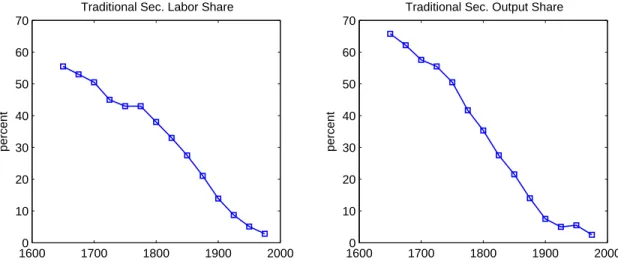
an eventual demise. The mapping from the model to the data associates the declines of
the labor and the output shares of the traditional sector in the model respectively with
the rises of urbanization and industrialization as in Bar and Leukhina (2010a).
The trajectory of economic development this dissertation predicts, consistent with
the conventional wisdom of unified growth theory, is as follows: Adult longevity, child
survival probability, the stock of useful discoveries, and urbanization rate are all at their
historically minimum levels in the very beginning. Inventive activity is not optimal, and
the modern/urban sector is small. Poverty is severe, limiting net fertility and population
growth. In time, however, the minuscule increases in adult longevity and child survival
probability, if any, minimally increase net fertility, and the stock of discoveries keeps
expanding albeit at a still slow rate due to the small number of entrepreneurs. This
pro-cess continues for sufficiently many periods to eventually make inventive effort optimal.
gross/net fertility first. Once productivity is sufficiently high, however, adult individuals
find it too costly to produce too many children and limit fertility. Urbanization on the
other hand keeps accelerating to make the mass of entrepreneurs even larger and
collec-tive discovery even more produccollec-tive. Thus, industrialization accelerates. The asymptotic
equilibrium features perpetual growth of labor productivity and output per capita with
a strictly positive asymptotic growth rate and a constant level of population.
The quantitative analysis of the model calibrates the structural parameters and the
initial values of state variables to match the observed patterns of economic development
in England from 1650 to 2000. England is not only the first industrialized economy
but also the one for which a sufficiently large set of data exists. The simulations for the
period from 1650 to 2000 show that the model economy performs reasonably well in
explaining population and output per capita dynamics and the rises of urbanization and
industrialization. The calibrated model is next used for some counter-factual experiments
on the timing of the industrial revolution as in Desmet and Parente (2009). The results,
interpreted only as suggestive and only for the timing of England’s industrial revolution,
indicate that small deviations from the benchmark model may create large timing effects.
The contribution of this dissertation to the literature can be described as follows: First
and the foremost, the dissertation shows that thinking a bit seriously about the
produc-tivity term of an otherwise standard invention technology and bringing the entrepreneur
back to the scene of economic development allow us to understand why purposeful
in-vention may not be optimal for a very long episode of history and why an industrial
rev-olution is inevitable. Entrepreneurs’ dual role for inventions and discoveries in a unified
growth framework, motivated strongly by the anecdotal and prosopographical evidence,
is the previously unexplored mechanism proposed in this dissertation. Second, the model
eliminates both the weak andthe strong scale effects of population size as in Grossmann
(2009). The absence of the weak scale effect is important because the role of population
size during the modern growth regime remains ambiguous in most unified growth
plays the role of the horizontal dimension of technological progress of the
second-generation Schumpeterian models of Young (1998), Peretto (1998a), Aghion and Howitt
(1998, Ch. 12) and Dinopoulos and Thompson (1998). Third, due to stochastic invention
and ex post heterogeneity across firms in the modern sector, the model explains, unlike
other unified growth models, (i) why more innovative firms on average are larger and
why the size distribution of innovative firms are skewed; two well-known regularities
most recently reiterated, respectively, by Akcigit and Kerr (2010) and Klette and Kortum
(2004). Finally, although the model does not incorporate human capital in its usual sense,
that it does not crucially require a rise in the demand for embodied skills for the industrial
revolution to start, as that of O’Rourke et al. (2008), answers Clark’s (2005) criticism of
unchanged skill premium during the first Industrial Revolution.
The plan of the dissertation is as follows: The next chapter provides a discussion of
the related literature to more clearly locate the contribution of this dissertation. Chapter
3 introduces the model economy. Chapter 4 defines and analyzes the uniquely existing
static, dynamic and asymptotic equilibria of the model and then characterizes a possible
equilibrium path from a unified growth perspective. Chapter 5 provides some tentative
(analytical) results on the timing of the industrial revolution. Chapter 6 presents a
quan-titative analysis of the model economy. Chapter 7 provides a discussion of some aspects
of the model and manipulates over some possible extensions. Chapter 8 concludes with
Chapter 2
The Related Literature
This chapter presents a discussion of the related literature in two sections: First, the
no-table contributions to the literature studying the transition from stagnation to growth
are mentioned, and the relation of the dissertation with this literature is specified.
Sec-ond, scholars who have contributed earlier on the three fundamental premises of the
model, i.e. the discovery-invention distinction, entrepreneurial invention, and collective
discovery, are credited, and the contribution of this dissertation is described.
2.1 From Stagnation to Growth
Poverty trap models of Murphy et al. (1989), Azariadis and Drazen (1990), Becker et al.
(1990) and Matsuyama (1991) predict multiple steady-state equilibria, but these models
leave the mechanism that explains the transition from stagnation to growth unexplored.1
An early study that deals explicitly with the transition is of Goodfriend and McDermott
(1995) who argue that there exists a critical mass of population that makes
industri-alization efficient through the market size effect. Tamura (1996) extends the model
of Becker et al. (1990) by a clearer account of transitional dynamics. Building on
Azariadis and Drazen’s (1990) model, Arifovic et al. (1997) endow agents by adaptive
learning that eventually triggers the takeoff. Acemoglu and Zilibotti (1997) explain the
minuscule rates of capital accumulation and economic growth during the early stages of
development by the absence of complete financial markets that diversify risk. All these
early models, however, fail to account for the demographic transition.
Galor and Weil’s (2000) model, for the first time, successfully explains not only the
prolonged Malthusian stagnation and the endogenous occurrence of an industrial
revo-lution but also the demographic transition. The authors show that, once the
Malthu-sian constraint of subsistence consumption and the quality-quantity trade-off of human
capital accumulation in the fashion of, e.g., Becker et al. (1990) are conveniently
inte-grated with the skill-biased technological change and with the slow pace of
technology-population interaction as in Boserup (1965) and in Kremer (1993), the desired result
fol-lows; a gradual and endogenously occurring phase transition from stagnation to growth
that does not require a major shock.
Notable contributions to the literature include that of Hansen and Prescott (2002)
who study the decline of the land-based sector and the rise of industrialization within
a neoclassical framework with exogenous technological progress. Lucas (2002) merges
this framework with endogenous fertility choice and human capital accumulation. The
emphasis on the demographic transition as a result of endogenous fertility choice is
main-tained by Jones (2001) who extends the analysis, for the first time, by a very simple
formulation of incentives to innovate. The decline of agriculture is studied (i) within
the framework of Hansen and Prescott (2002) but with endogenous growth in
manu-facturing sector by Kögel and Prskawetz (2001) and (ii) within Galor and Weil’s (2000)
framework by Tamura (2002). The analysis of the demographic transition is extended
further by Hazan and Berdugo (2002) and Doepke (2004) who introduce child labor, by
Boldrin and Jones (2002) who revisit the old-age security hypothesis with game
theoret-ical notions, and by Lagerlöf (2003) who endogenizes mortality. Galor and Moav (2002)
of the valuations for human capital accumulation across individuals is subject to natural
selection.2
A majority of unified growth models either do not utilize the invention of new
products and new processes as the source of technological progress at all or
productiv-ity change is incorporated in a reduced-form way such that the mechanism of
endoge-nous technological progress remains as a black-box. Motivated partly by this
dissatis-faction and partly by the critiques of some economic historians such as Mokyr (2002),
Crafts (2005), Lipsey et al. (2005) and Clark (2007) who keep stressing the role of
inven-tions for understanding the transition from stagnation to growth, some recent unified
growth models explicitly deal with the incentives leading agents to innovate, be them
individual "consumer/producer"s or firms. O’Rourke et al. (2008) study the transition
from unskilled-labor-biased technological change to the skill-biased technological change.
Desmet and Parente (2009) put the emphasis on the evolution of market competition
that, once sufficiently intensified, activates purposeful innovation by monopolistic firms.
Milionis and Klasing’s (2009) model, featuring "consumer/producer"s, explains why
hu-man capital accumulation eventually leads to purposeful invention. In Bar and Leukhina
(2010b), individuals optimally choose the time they spend on innovative activities while
the main emphasis is directed to the effects of mortality on knowledge transmission. The
last but not the least, Madsen et al. (2010) show that the last four hundred years of British
economic growth can best be understood as a story of endogenous technological progress.
The model constructed in this dissertation contributes to this second strand of the
unified growth literature that endogenizes technological progress with an explicit
inven-tion technology and profit-seeking agents. The model is truly unified in the sense that
the gradual phase transition from stagnation to growth occurs endogenously. Most
im-portantly, the new mechanism proposed features entrepreneurs’ dual role for inventions
and discoveries.
Table 2.1: Two Forms of Useful Knowledge in Mokyr’s (2002) Theory Propositional Knowledge Prescriptive Knowledge
Epistemic Technical
Laws and Principles Blueprints and Recipes
What-Knowledge How-Knowledge
Discoveries Inventions
2.2 Three Fundamental Premises
The conceptual framework of useful knowledge that this dissertation builds upon, with
discoveries and inventions being distinct knowledge forms, is due to Mokyr (2002). In
his theory, discoveries are propositional forms of knowledge that do not have direct
tech-nological applications. Discoveries are laws and principles that answer "What?"
ques-tions about natural phenomena underlying the production processes. Invenques-tions, in
contrast, are prescriptive in the sense that they provide answers to "How?" questions;
inventions take the forms of blueprints and recipes. Table 2.1 presents this conceptual
framework, and Table 2.2 remarks the two roles of useful knowledge studied in this
dissertation. Other than Mokyr (2002), the role of the discovery-invention distinction
and the usefulness of discoveries for inventive activity have been emphasized by Landes
(1969), Rosenberg (1974), Nelson (1982) and Easterlin (1995) in explaining the history
of technological progress. In one context, Weitzman (1998, p. 345) has suggested that
knowledge accumulation has distinct recombinantandproductivity aspects. The former
corresponds, in a sense, to the role of discoveries for inventions. With reference to
knowl-edge capital, Lucas (2002, p. 12) has asked "[w]hat can be gained by disaggregating into
two or more knowledge-related variables." The model studied in this dissertation answers
this question by showing that, when the productivity of inventive effort is endogenous
to how large the stock of useful discoveries is, purposeful and costly invention may
re-main suboptimal. The distinction between discoveries and inventions is also emphasized
by Haruyama (2009) in an endogenous growth model with perfectly competitive
Table 2.2: The Usefulness of Knowledge: A Simple Framework
Discoveries Inventions
useful in increasing useful in increasing the productivity of the productivity of
inventive effort worker hours
ones who have incorporated the distinction into the formal analysis of unified growth.
However, the dual role of entrepreneurship for useful knowledge remains unexplored in
a unified model with population growth and structural transformation. This is what this
dissertation attempts to deliver.
At least since Schumpeter (1934), "entrepreneur-inventor"s are leading actors of the
narratives of the Industrial Revolution. Solo (1951), Baumol (1990), Murphy et al. (1991)
and Mokyr (2010), among others, have argued specifically that entrepreneurial invention
was indeed the engine of technological progress during the first Industrial Revolution
long before the rise of modern R & D lab. Peretto (1998b) has emphasized the distinction
between "entrepreneurial invention" and corporate R & D in a second generation
Schum-peterian model. Michelacci (2003) has previously studied the role of entrepreneurial
skills in bringing inventions to markets. From another perspective, Doepke and Zilibotti
(2008) and Galor and Michalopoulos (2009) have studied the role of entrepreneurial traits
for long run economic development. This model, differently from all these,
incorpo-rates both occupational choice and entrepreneurial invention within a unified growth
setting. Two-occupation framework of the model is similar to, and even simpler than,
those of Lucas (1978), Murphy et al. (1991) and Michelacci (2003), and the formulation
of entrepreneurial invention under perfect competition shares similarities with the
treat-ments of Hellwig and Irmen (2001), Grossmann (2009) and Haruyama (2009).
The process of collective discovery by entrepreneurs has been described by Landes
(2006, p. 6) as "the seventeenth-century European mania for tinkering and improving."
Bekar and Lipsey (2004) go further to argue that the diffusion of Newtonian mechanics
similar argument on the diffusion of scientific culture, again with an emphasis on British
success, is made by Jacob (1997). Kelly (2005) develops a network model that analyzes
this type of collective learning for the industrial revolution. Lucas (2009) also emphasizes
collective learning in a model that differentiates propositional knowledge from
produc-tivity. O’Rourke et al. (2008) and Milionis and Klasing (2009), with environments
simi-lar to that of Galor and Weil (2000), link the accumulation of propositional knowledge to
human capital accumulation respectively through the number of high-skilled individuals
and the individual-level stock of skills. Howitt and Mayer-Foulkes (2005) assume that the
skill level of entrepreneurs is proportional to the average productivity associated with
intermediate inputs of production. The last but not the least, Strulik (2009) suggests that
propositional knowledge grows through learning-by-doing at the firm level. What
dif-ferentiates this paper’s formulation of propositional knowledge is the role ofthe mass of
entrepreneurs. More entrepreneurs with longer lives create more useful discoveries given
the quality of creating and diffusing these discoveries. This type of scale effect by which
knowledge growth depends not on the mass of entire population but instead on a certain
Chapter 3
The Model Economy
This chapter first introduces the model environment and then specifies market and
own-ership structures. Next follow the occupational structure and the decision problems
solved by each occupational group. Market clearing conditions at the end close the model.
The model economy features some simplifications that are not uncommon in the
uni-fied growth literature: The economy is closed, there does not exist a political authority,
and there is no physical capital. This is an economy of a single consumption good
pro-duced (i) with a traditional/rural technology to which land is an essential input and (ii)
with a modern/urban technology that is utilized by entrepreneurs.
3.1 Environment
The calendar time of the model economy, denoted byt, is discrete with an infinite
hori-zon: t∈N+.
3.1.1 Demographic Structure
There exist two overlapping generations: Individuals who areadultsin periodtgive birth
to childrenat the beginning of period t, i.e. at the beginning of their adulthood. Their
Fertility
Reproduction is asexual, and bt ∈ R++ denotes the total number of children a generic
adult in period t optimally chooses to give birth to, i.e. the gross fertility per adult.
Note thatbt, not being discrete in the model, represents theaveragegross fertility among
period-t adults, and the total fertility rate of the economy is equal to 2bt under the
as-sumption that the sex ratio of population is 1/2.
Survival Probability
The survival of a child born at the beginning of period t is a Bernoulli event with the
survival probability st ∈[0, 1]. For simplicity, (i) st is common across period-t children,
(ii)st is known by period-tadults with certainty, and (iii) the sequence{st}t∈N
+of survival probabilities is exogenous. Strongly motivated by actual data from developed economies,
{st}t∈N+ is assumed to be a non-decreasing sequence satisfying
s0<1 and s⋆≡lim
t→∞st =1
At t=0 that corresponds to some distant past, only some of the children born to an
adult survive to adulthood. The distant future, on the other hand, represents an era at
which the health/mortality revolution is complete so that all children survive.
Population Growth
Notice that, givenbtandst, the gross growth rate of adult population, i.e. the net fertility
per adult, satisfies nt ≡stbt. Denote by Nt ∈R++ the adult population in period t and assume thatN0>0. The law of motion ofNt is
Adult Longevity
Not less important than the number Nt of adult individuals is how long they live on
average since labor is an input of the production and the invention technologies.3 The
simplest way of capturing the role of adult longevity within this two generations
frame-work is to assume, as in Hazan and Zoabi (2006), that all period-t adults live a
frac-tion ℓt ∈ [0, 1] of period t. For simplicity, again, (i) ℓt is common across period-t
adults, (ii)ℓt is known by period-t adults with certainty, and (iii) the sequence{ℓt}t∈N+ of longevity fractions is exogenous. Also motivated by actual data from developed
economies,{ℓt}t∈N+ is assumed to be a non-decreasing sequence satisfying
ℓ0<1 and ℓ⋆≡tlim→∞ℓt =1
The reasoning behind the survival probability thus applies to adult longevity: In
some distant past, adult individuals do not live up to the maximum lifespan. When
the health/mortality revolution is complete in distant future, however, they enjoy the
longest life.
3.1.2 Endowments
Labor
Normalizing the length of a period to unity implies that period-t adults have a time
en-dowment ofℓt unitseach. This time endowment is the only source of their homogeneous
labor force. Children in contrast do not have a time endowment, and they remain idle
until they become adults next period.
Land
Land is a production factor of the traditional technology, and the total land endowment
of the economy is normalized to unity. What fraction of individuals own land and at
what proportions, on the other hand, are of minor importance from an analytical point
of view since, as we shall see below, the model builds upon a very simplified view of what
happens in the sector using the traditional technology as in Galor and Weil (2000) and
Desmet and Parente (2009).
3.1.3 Preferences
A generic period-tadult derives lifetime utility from her consumptionCtand net fertility
nt.4 The utility function representing these preferences is
U(Ct,nt)≡Ct+φln(nt) φ >0 (3.2)
with boundary restrictions
Ct ≥γ >0 (3.3)
nt≥1 (3.4)
Strulik and Weisdorf (2008) and de la Croix and Licandro (2009) build on this type of
non-homothetic preferences to understand the various aspects of the demographic
tran-sition. Here, a discussion of the notions embedded in (3.2)-(3.4) is necessary:
The preference parameter φ >0 determines the strength of parental desire towards
reproduction. Such a parameter is a common element of economic models of
demogra-phy.
The non-homotheticity of preferences is important for two reasons: First, the risk
neutrality of preferences with respect toCt eliminates the direct income effect on
ity. This guarantees fertility to decrease with the cost of reproduction when the
econ-omy is sufficiently rich (Ct > γ). Fertility theories based on homothetic preferences
face difficulties to generate a negative fertility-income relationship (Jones et al., 2011),
and the model assumes away such difficulties, in part, with these non-homothetic
pref-erences. The second reason of adapting risk neutral preferences with respect to Ct is
to simplify the decision problem of entrepreneurs. As we shall see below, the decision
toward entrepreneurial invention is in essence an expected utility problem with
occupa-tional choice.
The preference parameterγ >0 in (3.3) denotes some baseline or "subsistence" level
of adult consumption as in Galor and Weil (2000), Jones (2001) and others;γ is the level
of consumption that partially determines the upper bound of fertility when the economy
is sufficiently poor (Ct=γ). It shall be clear below that (3.3) simply reintroduces a direct
income effect on fertility for a sufficiently poor economy: An adult’s consumption is her
first priority, and she has to adjust her fertility accordingly.5
The inequality in (3.4) represents the parental preference for reproductive success in
transmitting genes to the next generations. What motivates this is the long run stability
of population levels observed in nature. A successful parent is the one who leaves at least
one surviving child.6 (3.4) is a very simple way of introducing reproductive success in a
model of fertility choice, but this suffices to produce the desired property:7 The baseline
level of net fertility is equal to unity as in Jones (2001), and this implies a stabilizinglevel
of population when the economy is sufficiently rich.
5. In this model,γ represents subsistence not merely inbiologicalterms; Landes (1969, pp. 13-14) and Voth (2003, p. 224) argue that Western European economies in general and England in particular were richer than many other economies around the world on the eve of the Industrial Revolution.
6. Recall that all surviving children become fecund at the beginning of their adulthood by construction.
3.1.4 Technologies
Reproduction
There are two inputs of reproduction: Each child born, whether she survives or not,
requires ρ > 0 units of time to be raised to adulthood and consumes ψ > 0 units of
consumption good provided by her parent.8
Time cost of reproduction is a common theme of a vast majority of fertility
theo-ries, and it plays an essential role in this model of demographic transition. Simply, the
cost of reproduction increases in an economy that records sustained increases in labor
productivity since a unit of time becomes more expensive.
Goods cost of reproduction, albeit not necessary for fertility to decline in advanced
stages of economic development, adds to the consistency of the model in which adults
must consume a minimum amount ofγ >0.
The Modern Technology
The following mention of firms and entrepreneurs is necessary to introduce the
remain-ing technologies of the model with maximum clarity: In any competitive equilibrium of
this model economy, (i) there exists a set[0,Et]of firms that operate with the modern
technology of production, and (ii) each firm using the modern technology is owned by
an entrepreneur. Hence, the set of entrepreneurs is also [0,Et] where Et < Nt is the
endogenously determined mass of entrepreneurs.9
8. In contrast with existing models featuring a time cost of reproduction, this model does not restrict the time spent on reproduction to be the parent’s time exclusively. We shall see below that this interpreta-tion is necessary for a particular simplifying assumpinterpreta-tion on the cost of reproducinterpreta-tion for entrepreneurs.
9. Also note that, since there exists a unique consumption good in this economy, the traditional technol-ogy might be sufficiently productive, compared to the modern technoltechnol-ogy, to imply Et =0 at least
Production: Leti ∈[0,Et]be a representative firm. The Cobb-Douglas technology of
production is
Yi t= Xi thw i tλhmi t1−λ λ∈(0, 1) (3.5)
where Yi t denotes output, Xi t > 0 denotes labor productivity associated with worker
hours hw i t, andhmi t denotes management hours allocated to production.
Recall that the labor endowment of (adult) individuals is homogeneous. Accordingly,
what differentiates worker and management hours in (3.5) is only the nature of the tasks
in the question: Two distinct tasks are required to produce the good. Workers are the ones
who actually produce the good in its finalized form with their eye-hand coordination, and
managers are the ones who tell workerswhatto do andhowto do it.
The knowledge content of management is represented by Xi t which is a measure of
prescriptive knowledge;Xi t identifies the "quality" of the production process.
Productivity Change: What cause the labor productivity of the modern technology to grow in time are new inventions created through costly inventive projects. The invention
projects, requiring research hours directed to invention, generate a stochastic number of
inventions, and each new invention increases a baseline level of productivity by some
fixed factor.
Suppose, as in Desmet and Parente (2009) and many others, that the modern sector
firms in period t have access to the average productivityXt∈R++ attained by the firms of the previous generation. The termaccesshere refers to the intergenerational diffusion
of prescriptive knowledge embedded inXt. Simply define this average as
Xt ≡Et−−11
Z Et−1
0
Xj t−1dj (3.6)
Define now firmi’s operating productivity as
Xi t ≡σzi tX
t (3.7)
whereσ >1 is the stepsize of inventions andzi t ∈N+ is the stochastic number of
inven-tions satisfying
zi t ∼Pois ai t
(3.8)
In (3.8),ai t ∈R+denotes the arrival rate of inventions and satisfies
ai t =θξ Kt
hr i t θ >0 (3.9)
where hr i t denotes the amount of hours allocated to research by firmi. This invention
technology features constant returns to scale with respect to rival labor input hr i t.
The novelty here is the term θξ Kt, i.e. the level of
research productivity per unit
of inventive effort, where Kt ∈R++ denotes the number of costlessly accessible useful discoveries to be utilized in the process of inventing.ξ Kt
, assumed to be continuously
differentiable, is the intrinsic component of research productivity explained byepistemic
foundations;θ >0 is the extrinsic productivity of invention.
Three restrictions on ξ Kt
are central to the main results of this paper, and it is
more convenient for the sake of the discussion to formally state them first:
ξ′(K)>0 for allK <∞ ξ(0) =0 lim
K→∞ξ(K) =1 (3.10)
The first restriction here represents the conjecture that it is more likely to be
success-ful in invention if more usesuccess-ful discoveries are available. In light of the earlier discussion
functionξ Kt.10
The second restriction imposes that discoveries are essential inputs of invention
projects. In Mokyr’s (2002, pp. 13-14) words, "[t]he likelihood that a laptop computer
would be developed in a society with no knowledge of computer science, advanced
elec-tronics, materials science, and whatever else is involved is nil."
The third restriction originates from the conjecture that the productivity of research
per unit of inventive effort should have an upper limit when Kt → ∞ as in, e.g.,
Weitzman (1998): The arrival rate is a growth factor of productivity, and this has to
have an upper limit naturally imposed by (neuro)physiological capabilities of humans;
the arrival rate should be bounded above for any level of inventive effort that is less than
infinity. That Kt goes to infinity means, on the other hand, that every single knowable
thing about the natural phenomena underlying the production processes is known. This
is the ultimate enlightenment that eliminates what causes a unit of inventive effort to be
less productive than its full potential ofθ, i.e. the narrowness of the epistemic bases for
invention. An inventor, knowing practically everything about the natural phenomena,
does not have to spend her time with trying to realize which certain discoveries are
use-ful. She simply generates an expected number of inventions with constant (maximum)
productivityθas in many other endogenous technology models.
The Traditional Technology
Production: The Cobb-Douglas production function that determines the volumeYT t
of output produced with the traditional technology is
YT t =X˜T tHT tηL1T t−η η∈(0, 1) (3.11)
where ˜XT t is labor productivity,HT tis the total amount of hours allocated to production,
andLT t is land input.
Productivity Change: Since the main purpose is not to develop a theory of traditional technology’s labor productivity growth, a very simple law of motion for ˜XT t is adapted
following Desmet and Parente (2009):
˜
XT t+1
˜
XT t =max
ζ0,
Xt+1
Xt
ζ1
ζ0>1,ζ1>0 (3.12)
In (3.12), ζ0 > 0 denotes an exogenous (gross) growth rate of ˜XT t. The second
ar-gument of the maximum function imposes that ˜XT t grows faster thanζ0if the spillover
effect from the modern technology is high enough. (3.12) thus captures initially slow and
stable and then accelerating rates of productivity growth of the land-based technologies.
Collective Discovery
The last technology to be specified is of the stockKt of useful discoveries. In its generic
form, what creates new discoveries is simply time. The conjecture, as introduced earlier,
is that entrepreneurs, owning the firms using the modern technology, collectively
dis-cover new pieces of propositional knowledge during their lifetime. They not only create
new knowledge in this serendipitous way individually but also share what they create
with each other in their common environment, e.g. in coffeehouses. This is a network
effect that is consistent with the common knowledge characterization of useful
discover-ies.
The simplest way to formalize this is a linear knowledge production function of the
form
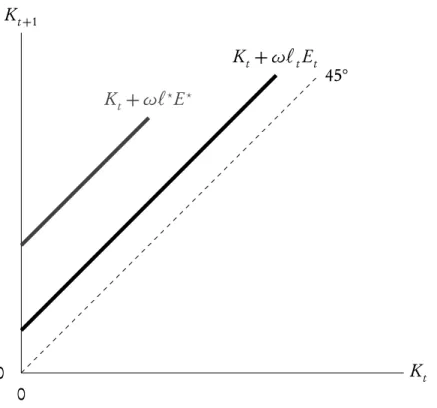
Kt+1−Kt =ωℓtEt ω >0 (3.13)
variable, is the input of the collective discovery process andω >0 represents the quality
of environment for creating and sharing useful discoveries. This constant thus represents
geographical, cultural and social determinants of collective discovery process.11
3.2 Occupations
Recall that the set of entrepreneurs is[0,Et]in equilibrium, andi indexes entrepreneurs.
The remaining massNt−Et of adult individuals forms the set of workers.
Equilibria of this model build upon two decision problems solved respectively by
entrepreneurs and workers. The purpose of this and the following sections is to derive
these decision problems.
The problems involve fertility choice for both occupations and an additional decision
regarding the inventive activity for entrepreneurs. These decisions are finalized in the
sense that they embed other decisions these individuals have to take optimally. That is,
if the occupation is chosen optimally and the decision problems are solved, both at the
beginning of adulthood, other actions follow contingently.
To proceed with maximum clarity, it is necessary at this stage to briefly discuss what
entrepreneurs and workers do.
3.2.1 Entrepreneurs
An entrepreneur, as noted earlier, establishes a firm that uses the modern technology.
There are no establishment costs involved. Once an entrepreneur establishes the firm,
she becomes the business owner until the end of her life. The firm dies with its
en-trepreneur, and each generation raises new entrepreneurs who establish and own new
firms using the modern technology.
As the business owner, an entrepreneur purchases an optimal level of worker hours.
The other necessary input, i.e. management, is provided by the entrepreneur herself.
11. Note that the linearity with respect toℓtEt is not a crucial assumption of the model. The qualitative
This creates an incentive for the entrepreneur to spend resources for inventive activities.
An entrepreneur, as any adult individual, also chooses her fertility. The key
simpli-fying assumption here is that entrepreneurs hire workers to take care of their children.12
From a technical point of view, this simplifying assumption is necessary to separate the
choice of fertility from the decision regarding the inventive activity for an entrepreneur.
3.2.2 Workers
Those who choose to become workers supply hours for three activities:
First, some workers are employed by entrepreneurs to work in their firms using the
modern technology.
Second, some workers, again being employed by entrepreneurs, take care of
en-trepreneurs’ children at home.
Finally, some workers choose to work in the firms that use the traditional technology.
3.3 Markets
All sellers and all buyers in any market of this economy are price-takers. This is a model
ofperfect competition.
Two things are traded in markets. First, the consumption good is demanded by all
adult individuals in the economy and produced/sold by firms that use either the
tradi-tional or the modern technology. The consumption good is the numéraire of the
econ-omy. Second, a worker hour is traded at wageWt>0.
3.4 Production Sectors
3.4.1 Modern Sector
Entrepreneurial invention occurs, if it is optimal, in the modern sector and generates
positive economic growth through productivity increases. Then, the question is what
creates an incentive to invent for each entrepreneur under perfect competition. That
each entrepreneur manages her firm by providing the manager hours herself answers
this question: Management is basically the quasi-fixed factor of production that implies
positive profit for the entrepreneur. Assuming that the invention technology is costlessly
accessible, it shall be the case that the entrepreneur may find it optimal to allocate some
of her scarce time endowment to inventive activity.
Optimal Ex Post Profit
The first task in characterizing what happens in the modern sector is to derive the optimal
ex postprofit maximized through the optimal choice of the demand for worker hours.
Ignoring the complications regarding the timing of eventswithina period and
follow-ing, e.g., Aghion and Howitt (2009), assume that an entrepreneur can choose the level of
optimal demand for worker hourshw i t for given(Xi t,hmi t,Wt)to maximize profit. The
profit function is defined as
Π hw i t,Xi t,hmi t,Wt
≡ Xi thw i tλhmi t1−λ−Wthw i t (3.14)
The optimal hw i t andΠ hw i t,Xi t,hmi t,Wt
thus satisfy
hw i t ≡arg max
h Π h,Xi t,hmi t,Wt
=λ
1 1−λX
λ 1−λ
i t hmi t W
1 1−λ
t
(3.15)
Πi t= (1−λ)λ1−λλ
Xi t Wt
1−λλ
Entrepreneurial Invention
ReplaceXi t withσzi tX
t. The invention technology, via (3.8) and (3.9), then implies the
expected profit as in
EΠi t≡
∞ X z=0 az
i texp −ai t
z!
(1−λ)λ1−λλ
σzX t Wt
λ 1−λ
hmi t
(3.17)
The term in the first brackets denotes the Poisson probability of generating z
inven-tions givenai t. The term in the second brackets is the level of optimalex postprofit when
entrepreneur generates zinventions givenai t.
What does not allow entrepreneur i to be able to spend an infinite amount of
re-sources to inventive activity is her time constraint: hmi t+hr i t≤ℓt. SinceEΠi t is strictly
increasing inhmi t, this constraint holds with strict equality in equilibrium:
hmi t+hr i t=ℓt (3.18)
Together with (3.9), (3.18) allows us to rewrite the expected profit as
EΠi t=
∞ X z=0 az
i texp −ai t
z!
(1−λ)λ1−λλ
σzX t Wt
λ 1−λ
ℓt− ai t θξ Kt
!
(3.17′)
Lemma 1: The expected profit in (3.17′) can be rewritten as
EΠi t =exp Σai t Λ Xt Wt Γ
ℓt− ai t θξ Kt
!
(3.17′′)
where
Γ≡ λ
1−λ Λ≡(1−λ)λ
λ
are defined for notational ease.
Proof— See Appendix A.
(3.17′′) now identifies the cost of and the return to inventive activity. The first term, exp Σai t
, increases the expected profit by some factor greater than one depending on
the sizeσ of invention and the productivity elasticityλof output. The last term in the
last parentheses, ai t/θξ Kt
, is the time cost of inventing with an expected numberai t
of inventions. Clearly, (3.17′′) specifies thedeterministiclevel of profit when no inventive activity is undertaken (ai t =0). Xi t is equal toXt in this case.
Production
The production at the firm level is implied by (3.5) given (hw i t,Xi t,hmi t) where hw i t
satisfies (3.15). The final task to complete the discussion of the modern sector is thus to
define the totalex postproduction:
Yt =
Et Z
0
Yi tdi (3.19)
3.4.2 Traditional Sector
There exists a single firm in this sector, and there do not exist property rights over the
land.13 With total land endowment of the economy normalized to unity, these
assump-tions allow us to work with the following restricted form of the traditional technology
YT t =XT tHT tη (3.12′)
whereXT t ≡X˜T tη .
Those who supply worker hours to this sector’s firm are assumed to be the owners
of the firm with equal ownership shares. Hence, these workers equally appropriate a
positive profit in addition to their income originating from labor supply. It turns out
that workers in the traditional sector earn,per unit hour, the average productXT tHT tη−1. In any equilibrium, then, we must have
XT tHT tη−1=Wt (3.20)
due to the perfect mobility of labor across sectors.
From (3.20) follows the massNT t of workers employed in the traditional sector:
NT t ≡HT t
ℓt (3.21)
Note that a richer treatment with land rents would pose no serious difficulties given
the constant-returns-to-scale technology (3.12) and under, e.g., the law of primogeniture
that simplifies the intergenerational transmission of land ownership. In that case, those
who own, e.g., equal shares of land would appropriate the land rents in every generation,
leaving the land ownership to one of their surviving children.
3.5 Decision Problems
This subsection finally derives the decision problems solved by entrepreneurs and
work-ers. Three remarks follow before proceeding to the derivations:
First, notice that workers are indifferent between taking care of their children on
their own and hiring workers as entrepreneurs do so. In what follows, it is assumed that
workers take care of children with their own time.
Second, given preferences and the entire discussion above, the new elements needed
are the budget constraints individuals face.
Finally, note that only two problems are of interest, one for workers and one for
For entrepreneurs, the uniqueness of the problem follows from the fact that they all face
the same baseline productivity Xt. That there exists only one problem solved by all
entrepreneurs in turn implies that entrepreneurs of generation t act symmetrically with
respect to certain choice variables. Then, once the uncertainty regarding the inventive
activity is resolved, a cross-section probability distribution characterizes the remaining
entrepreneur-level variables.
3.5.1 Workers’ Problem
Rewrite the utility function (3.2) for our representative worker who gives birth to bw t
children and consumesCw t units:
Uw t ≡Cw t+φln stbw t
Since this worker earns the unit wage ofWtand spendsρbw t amount of worker hours
andψbw t amount of goods for child care, her budget constraint reads
Cw t+ψbw t≤(ℓt−ρbw t)Wt
ThatUw t is strictly increasing inCw t leads this budget constraint to hold with strict
equality. Eliminating bw t vianw t =stbw t then implies
Cw t =
ℓt−ρ
nw t st
Wt−ψ
nw t st
(3.22)
Note thatCw t≥γ, following from (3.3), and (3.22) now determine the upper level of
nw t as in
nw t ∈
1,(Wtℓt−γ)st
ρWt+ψ
(3.23)
Uw t=
ℓt−ρ
nw t st
Wt−ψ
nw t st
+φln nw t
(3.24)
subject to (3.23).
3.5.2 Entrepreneurs’ Problem
The utility function (3.2) can be rewritten for entrepreneuri as
Ui t ≡Ci t+φln stbi t
whereCi t andbi t respectively denote her consumption level and the number of children
she gives birth to. The budget constraint she faces reads
Ci t+ψbi t+ρbi tWt = Πi t (3.25)
whereψbi t+ρbi tWt indicates the total cost of havingbi t children.
As in the derivation of the workers’ problem, Ui t is strictly increasing inCi t,
imply-ing that the budget constraint above holds with strict equality. This allows us to rewrite
Ui t as
Ui t = Πi t−ψbi t−ρbi tWt+φln stbi t
The only worth-to-be-emphasized difference with the workers’ problem here is that
entrepreneur i’s decision towards inventive activity is taken under uncertainty, i.e. to
maximizeEUi t =EΠi t−ψbi t−ρbi tWt+φln stbi t
. Thus, the appropriate form of the
minimum consumption constraint for entrepreneurs’ problem is
ECi t ≥γ
This inequality, the budget constraint above and EΠi t as in (3.17′′) imply that net
ni t ∈ 1,
exp Σai t Λ
Xt
Wt Γ
ℓt− ai t θξ(Kt)
−γ
st
ρWt+ψ
(3.26)
Therefore, entrepreneurs, choosingni t andai t, seek to maximize
EUi t =exp Σai t Λ Xt Wt Γ
ℓt− ai t θξ Kt
!
−ψ
ni t st
−ρ
ni t st
Wt+φln ni t
(3.27)
subject to (3.26) and
ai t∈0,amaxt (3.28)
where amaxt ≡θξ Kt
ℓt > 0 is the maximum possible arrival rate when entrepreneur
spends her entire labor endowment to inventive activity.
3.5.3 Occupational Choice
By solving the decision problems derived above, workers and entrepreneurs act
opti-mally. What completes the occupational choice with individual rationality is therefore
the followingequal utilitiesrestriction:
EUi t =Uw t (3.29)
An adult individual, taking all actions at the beginning of her adulthood, must be
indif-ferent between becoming an entrepreneur and becoming a worker.14