IMPLEMENTATION OF EVIDENCE-BASED PRACTICE IN 2 STATES: LESSONS FROM THE CHRONIC DISEASE SELF-MANAGEMENT PROGRAM
Deborah Paone
A dissertation submitted to the faculty at the University of North Carolina at Chapel Hill in partial fulfillment of the requirements for the degree of Doctor of Public Health in the Department of Health Policy and Management in the Gillings School of Global Public Health.
Chapel Hill 2014
Approved by: George Pink Mary Altpeter
Suzanne Havala Hobbs Bryan Weiner
iii ABSTRACT
Deborah Paone: Implementation of Evidence-Based Practice in 2 States: Lessons from the Chronic Disease Self-Management Program
(Under the direction of George Pink)
This study examined implementation of the evidence-based Chronic Disease
Self-Management Program in two states by eight organizations. These were classified into two types: Aging service organizations (ASOs) or Health care organizations (HCOs). They were chosen based on inclusion criteria at the state level and selection criteria at the organizational level. Each met criteria for achieving a high level of implementation during a defined two-year period. All organizations continued to offer the program.
This was a mixed methods study, using primary qualitative data (telephone key informant interviews), and secondary quantitative data (number of workshops offered and participant completion rate), to explore (retrospectively) factors in implementation. Respondents provided information on internal and external factors and discussed challenges and strategies used. Utility of the research methods chosen was also evaluated.
The examination found agreement among the eight organizations regarding why they had adopted the Chronic Disease Self-Management Program--citing the alignment between the program and their organizations’ mission and purpose to improve health status and promote better self-care. Organizations were also alike in that they described the importance of internal champions and senior leader buy-in for effective implementation and sustainability. The ASOs more often described the value of peer and collaborative networks. The HCOs more often
iv
and sustainability. The primary challenges identified by both types of organizations included difficulty in recruiting participants and irregular or insufficient funding sources.
The method for organizational selection and the construction of the key informant instruments facilitated analysis. Utilizing a 5-point Likert-scale response pattern with follow-up open-ended probes in the question set provided the investigator with information for categorizing and coding each response in a way that allowed for comparisons across organizations.
v DEDICATION
This paper, and the doctoral work leading up to it, is dedicated to the memory of my mother, Judy.
A deep-thinker, wise soul, and woman of the highest integrity, Judy re-imagined her life and went back to college in her 40’s. She absorbed the lessons learned through formal education and
through life. She touched many lives in profound ways. For some reason, she was only blind to my flaws—encouraging me and always finding good.
Mom, I walk every day trying to honor your memory with my life choices.
It is because of you that I have courage to try and to persevere. You continue to be a source of inspiration, love, and guidance.
vi
ACKNOWLEDGEMENTS
I’d like to acknowledge my husband, Mark, who endured three years of weekends with me tethered to my computer. Here’s to saying hello to free time again.
Thank you to the state and organizational representatives who participated as key informants, providing insight and information on their implementation experiences.
Thank you to the members of my Dissertation Committee who guided the process to produce this work. Special thanks to external members Nancy Whitelaw and Mary Altpeter, whose knowledge about national dissemination efforts of CDSMP and other evidence-based practices enhanced this examination.
Thanks to Kristie Kulinski from the National Council on Aging for her data support, and to Matthew Lee Smith, Terry Brady, Kate Lorig, Trisha Greenhalgh, Karen Blasé, and Laura Damschroder for providing their insights on CDSMP and/or on approaches for studying implementation of evidence-based practices.
Thank you to the faculty members of the UNC Department of Health Policy and Management for their commitment to the DrPH program—especially to Sue Hobbs for her dedication to get done the day-to-day work that is required.
vii
TABLE OF CONTENTS
LIST OF TABLES . . . x
LIST OF FIGURES . . . xi
DEFINITIONS OF TERMS . . . xii
CHAPTER 1: Background and Significance . . . 1
A. Introduction . . . 1
B. Problem Statement . . . 1
C. EBP Background . . . 6
1. Chronic Disease Self-Management Program Description . . . 6
2. Dissemination Efforts . . . 9
3. CDSMP Research and Evaluation . . . 10
D. Summary . . . 14
CHAPTER 2: Literature Review . . . 15
A. Introduction . . . 15
B. Background - Frameworks. . . 16
C. Methods . . . 23
D. Findings & Implications . . . 27
1. Factor: Program Fit . . . 28
2. Factor: Translation . . . 29
3. Factor: Internal Capability, External Training, and Technical Help . . . . 30
4. Factor: Readiness . . . 31
viii
E. Summary . . . 33
CHAPTER 3: Study Design and Methods . . . 34
A. Introduction . . . 34
B. Factor Selection . . . 34
C. Conceptual Model . . . 38
D. Research Questions, Hypotheses, & Aims . . . 40
E. Quantitative Methods and Data Sources . . . 42
1. ARRA Data Set . . . 42
2. Inclusion Criteria for “Effective Implementation” . . . 44
3. Electronic Survey . . . 46
F. Qualitative Methods and Data Sources . . . 46
1. Key Informants . . . 47
G. Analysis . . . 49
F. Summary . . . 51
CHAPTER 4: Results . . . . . 52
A. Introduction . . . 52
B. Selection Results – States, Organizations . . . 52
C. States’ Profiles and Perspectives . . . 55
D. Profile of Organizational Key Informants . . . 60
E. Case Analysis (Aim 1) . . . 61
1. Similarities Observed Across Organizational Types . . . 61
2. Aging Services Organizations - Factor Analysis . . . 69
ix
F. Analysis of State/External Support (Aim 2) . . . 85
G. Challenges & Strategies . . . 89
H. Methodological Considerations (Aim 3) . . . 93
1. Design & Scope . . . 93
2. Limitations . . . 95
I. Summary . . . 96
CHAPTER 5: Plan for Change . . . 97
A. Introduction . . . 97
B. Discussion & Implications . . . 97
1. Commonalities . . . 97
2. Differences . . . 99
3. Challenges and Barriers . . . 101
C. Recommendations . . . 106
D. Stakeholder Analysis . . . 114
E. Dissemination Strategies . . . 116
F. Conclusion . . . 118
Appendix A: Summary of Literature Review Articles . . . 122
Appendix B: Electronic Survey – Organizations . . . 144
Appendix C: Organizational Survey Protocol . . . 145
Appendix D: State Representatives Interview Protocol . . . 149
Appendix E: State Website Review . . . 152
Appendix F: Dissemination Strategies, by Stakeholder Type . . . 153
x
LIST OF TABLES
Table 1 – Factors for Literature Review . . . 26
Table 2 – Definition of “Success” for the Studies Reviewed, Results of Ranking . . . 27
Table 3 – Implementation Factors Examined . . . 29
Table 4 – Crosswalk for Factors Chosen to Examine Implementation Experience . . . 37
Table 5 – CDSMP Implementing Organizations and Study Groupings . . . 43
Table 6 – Organizational Pool, by state and # participating . . . 53
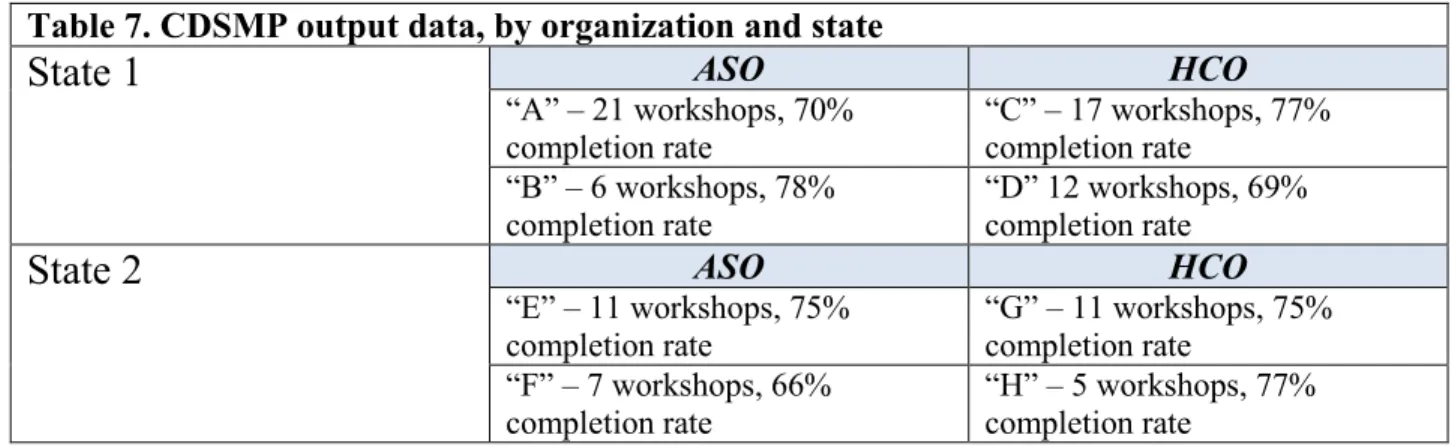
Table 7 – CDSMP Output data, by organization and state . . . 53
Table 8 – CDSMP License Ownership Status, among selected organizations . . . 54
Table 9 – Summary of CDSMP Program Data, by type of organization and by state . . . 61
Table 10 – ASOs Funding Sources . . . 73
Table 11 – HCOs Funding Sources . . . 81
Table 12 – Summary of Factor Comparison for ASOs and HCOs . . . 88
Table 13 – Top Implementation Challenges and Barriers, by type of organization . . . . 89
Table 14 – Strategies/Advice offered, by CDSMP organizations . . . 90
xi
LIST OF FIGURES
Figure 1 – Greenhalgh et al., 2004 - Conceptual Model for Implementation . . . 17
Figure 2 – Damschroder et al., 2009 - CFIR Conceptual Model for Implementation . . . 19
Figure 3 – Durlak and DuPre, 2008 - Conceptual Model for Implementation . . . 22
Figure 4 – Literature Review Search Process & Results . . . 25
Figure 5 – Paone Conceptual Model of Implementation for this Study . . . 39
Figure 6 – “Value” Factor Ratings, by organization . . . 63
Figure 7 – “Fit” Factor Ratings, by organization . . . 65
Figure 8 – “Ease of Use” Factor Ratings . . . 66
Figure 9 – “Demand/Recruitment” Factor Ratings . . . 69
Figure 10 – Side-by-side Comparison of ASOs’ Factor Ratings . . . 76
Figure 11 – Side-by-side Comparison of HCOs’ Factor Ratings . . . . . . 84
Figure 12 – “Level of External Support & Helpfulness” Factor Ratings . . . . . . 87
Figure 13 – Causal loop analysis - Damaging effect of payment norms on CDSMP . . . 104
xii
DEFINITION OF TERMS1
Assimilation Gap – the unrealized potential for population health improvement that occurs when interventions that are adopted by individuals or organizations are not deployed widely (e.g., at the population or public health level) and/or not sustained.
Core Components – the essential features of an intervention that are responsible for the efficacy or effectiveness of the intervention as observed in the original research trial.
Disability2 – the World Health Organization defines disability as an umbrella term covering impairments (problem in body function or structure), activity limitations (difficulty encountered by a person in executing a task), and participation restrictions (problem experienced by a person in involvement in life situations). Thus, disability is not “just a health problem,” but a “complex phenomenon, reflecting the interaction between the features of a person’s body and features of the society in which he or she lives.”
Disability Prevention3 – A secondary disability prevention strategy refers to an approach that seeks to help a person who already has the target disease or condition maintain or improve their level of function or other health outcomes. A tertiary disability prevention strategy refers to an approach that seeks to help that person avoid permanent disability from their disease or
condition.
Dissemination – an active approach for spreading evidence-based interventions to the target audience via determined channels using planned strategies.
Evidence-based (EB) – a program, practice, process, guideline or other intervention that has proven efficacy and effectiveness based on sound testing using scientific methods in an experimental or quasi-experimental design. The randomized controlled trial (RCT) design for testing interventions is considered the gold standard. Other designs include the case/control method, and the pre-test/post-test method, using standardized validated measurement instruments.
External Validity – when implementation procedures and a standardized protocol for a given intervention are used in settings outside the original testing environment and the anticipated effects are observed. That is, the intervention is generalizable.
Fidelity – the degree to which the intervention is implemented as it is prescribed in the original protocol. Fidelity is commonly measured by 4 key elements: (1) adherence to the program
1
In recognition of the need to move toward a common lexicon in dissemination and implementation research, I have drawn extensively from the text Dissemination and Implementation Research in Health: Translating Science to Practice to define these terms (Eds. Brownson, Colditz, Proctor. New York: Oxford University Press, 2012). Many of the definitions are taken directly from this text, particularly Chapter 2 by Rabin, B. and Brownson, R. “Developing the Terminology for Dissemination and Implementation Research.” Other sources include: Greenhalgh et al., 2004, Chinman et al., 2005, Wandersman, 2008, Durlak and DuPre, 2005).
2World Health Organization website http://www.who.int/topics/disabilities/en/. Accessed on December 28, 2012. 3See Pope and Tarlov, authors of a 1991 Institute of Medicine Report: Disability in America: Toward a National
xiii
protocol, (2) dose or amount of the program delivered, (3) quality of program delivery, and (4) participant response.
Functional decline – a negative change in functional status; from independence to partial dependence, or from partial dependence to total dependence.
Functional status4– a measure of a person’s ability to perform activities needed for everyday life. Often measured by the Katz Index of Activities of Daily Living (a scale of dependency in six activities: bathing, dressing, going to the toilet, transferring, continence and feeding). Functional independence is defined as needing no help to perform the activities of daily living. Partial functional dependence is defined as needing assistance in two to four activities of daily living. Total functional dependence is defined as needing assistance in five or six activities of daily living.
Implementation - the process of putting to use the tested intervention protocol or integrating the evidence-based intervention within a setting.
Implementation Effectiveness– the successful deployment of an evidence-based intervention within a particular setting (e.g., worksite, school, health clinic, community social service agency, etc.), using a structured process following the prescribed protocol, which results in anticipated benefit to the intended group, and where the intervention is continued for a period of time. Implementation Science – the study of what happens after adoption occurs, especially in organizational settings.
Innovation5– an idea, practice, program, or object that is perceived as new by an individual or other unit of adoption (used interchangeably with the term evidence-based program in this report.) A “complex innovation” is one that has several components, requires inputs or effort on multiple levels or by multiple parties, sequentially or in tandem.
Intermediary Agent – an entity or individual providing direct assistance to an organization to build capacity for effective implementation. Assistance can include funding, needs assessments, technical support and training on the innovation, fidelity monitoring, and other types of support. Internal Validity – when an intervention is administered within a setting as prescribed by a standardized protocol deploying the core components and the anticipated effects are observed. That is, the intervention is specific.
Tertiary Prevention6– refers to efforts or approaches that target the person who already has symptoms of a disease or condition. The goals of tertiary prevention include: to prevent damage
4Marengoni et al., 2008.
5In this study, the term “innovation,” “intervention,” “practice” and evidence-based program” are used
synonymously.
xiv
and pain from the disease, to slow down the disease, to prevent the disease from causing other problems. The National Library of Medicine MeSH subject heading descriptor defines tertiary prevention as: “Measures aimed at providing appropriate supportive and rehabilitative services to reduce morbidity and maximize quality of life after a long-term disease or injury is present.” 7 Translation/Adaptation – the enhancement of an evidence-based intervention (using knowledge and information from potential users and agents from the field) to adapt components for wider and efficacious use. Such translation should lead to equal beneficial effects. (Note that there is a tension between allowing for adaptation to fit practice settings and maintaining fidelity to the tested protocol).
Type III Error – when the failure of an intervention (or inability to detect intended effects) is attributable to poor or inadequate implementation.8
7
http://www.nlm.nih.gov/cgi/mesh/2011/MB_cgi?mode=&term=Tertiary+Prevention
8Allen, J. Linnan, L., and Emmons, K., “Fidelity and Its Relationship to Implementation Effectiveness, Adaptation,
1
CHAPTER 1: Background and Significance
Introduction
Research in the growing field of dissemination and implementation science suggests that there are complex and interactive forces that impact how well an organization implements an evidence-based program (EBP), how closely the outcomes in the field match those observed in the testing of the program, and how likely the program will be sustained (Meyers, Durlak, and Wandersman, 2012). Organizational characteristics such as internal climate, staff capability, or leadership may either promote or impede acceptance of the evidence-based program. There may be resistance to learning how to follow the evidence-based protocol, or reluctance to commit scarce resources that could be used in other ways. External factors such as technical support and availability of mentors may promote adoption and implementation. This chapter briefly explores concepts and issues in effective program implementation and how to study and measure it. It describes common challenges that organizations face in implementing EBPs. It then offers background on one EBP—the Chronic Disease Self-Management Program, which is the EBP chosen for this dissertation study.
Problem Statement
2
artifacts of the process hamper progress (Green et al., 2009). Even when the job of translation for deployment from research to practice has been achieved, and practitioners are aware of the program, effective implementation is uncertain (Klein & Knight, 2005; Green & Glasgow, 2006; Glasgow et al., 1999; Ginexi & Hilton, 2006).
Implementation of complex innovations—those requiring multiple inputs within an organization or system—is even harder to assure. The implementation process itself is challenging. Phases of the implementation process have been described as: Exploration, Adoption, Active Implementation, and Sustainment (Aarons, et al., 2012). Often there is not a clear, linear path from adoption to sustaining the program---rather the journey is characterized by a series of fits and starts, with internal and external forces affecting progress (Fixsen et al., 2005; Scheirer, 2005).
Evidence-based programs (EBPs) present additional challenges as they require fidelity to a protocol that may or may not have been effectively translated for the organizational setting in which it is being implemented. Protocols developed by the researcher without sufficient practice based input and testing may not fit the real world complexities or challenges of various settings. Capacity-building at several levels may be a step that is missed in preparing for implementation (Fixsen et al., 2005, Aarons et al., 2012).
3
discontinued. Such anemic results discourage future adoption and implementation efforts. Practitioners, organizational leaders, policymakers, and funders question the use of resources if implementation fidelity is uncertain and sustainability is not assured.
Research from the management and health services literature typically identifies factors such as leadership, organizational climate, staff buy-in, and acceptability to the consumer, patient, or client as important for implementation success (Simpson, 2002; Simpson, 2011; Klein & Sorra, 1996, Aarons et al., 2012). Greenhalgh and colleagues also describe a good “innovation to system fit” as one where the existing values, norms, strategies, goals, skill mix, supporting technologies, and ways of working are aligned (Greenhalgh, et al., 2004, p.608). However, taking the time to ensure that there is a good program-to-organizational fit may be difficult if there is a window of time when funding is available or when organizations are offered incentives to encourage adoption. Organizational readiness has been defined as “the extent to which
organizational members are psychologically and behaviorally prepared to implement” the EBP (Aarons et al, 2012, p. 137).
4
Researchers can choose to study implementation effectiveness using different units of analyses. One can consider the observed effect on individuals who participate in the program as users or consumers—the intended beneficiaries. Other foci include the actions of organizations and their staff members—those responsible for implementation. This would include whether the program components were implemented as intended (with fidelity to the protocol) and what factors positively or negatively affected the implementation process. There are also the
influences from the larger environment that can impede or enhance the success of efforts at the organizational or staff level. This larger context often includes examining the actions of one or more intermediary agents—for example, those whoprovide technical assistance or promote dissemination of the program in the field (e.g., a state department, consultant, or program certification body).
Understanding the factors present among organizations that effectively implemented an EB program can help identify what needs to be enhanced, what barriers exist, how some organizations have overcome these barriers, and lessons learned in implementation. In order to compare across organizations (retrospectively), the researcher must narrow the scope and attempt to reduce the number of variables that may affect the implementation results. Strategies could include choosing one EBP with a tight protocol that has been extensively translated for various settings. This helps ensure that the components and resources required for implementing the EBP with fidelity are well understood and are the same across organizations. Other strategies for further narrowing include: choosing a defined time period in which the implementation occurred, choosing a specific geographic area for study, and/or identifying a specific funding or
5
these criteria. Characteristics of the organizations such as scope and service orientation can allow for grouping the organizations into similar categories. The researcher must also locate key staff member(s) from each organization who have institutional memory about the implementation experience, if the examination is retrospective.
There are numerous evidence-based programs from which to choose for study. Some of these focus on health promotion and disability prevention/management for older adults and those with chronic conditions—such as the one chosen for this dissertation research.
Improving health management of people with chronic conditions is a key public health issue. Chronic conditions drive as much as three-quarters of health care costs in the United States. Medicare beneficiaries with multiple chronic conditions account for 76% of Medicare expenditures (Bodenheimer et al., 2009; Anderson & Horvath, 2004). The prevalence rate within the U.S. of adults with multiple chronic conditions is 26%, or one in every four adults (Ward and Schiller, 2013). The prevalence increases significantly with age.9 In 2010 there were 40.3 million Americans age 65 and older and approximately three out of every four had one or more chronic conditions.10
Chronic conditions that are not well managed result in greater disability and higher medical care costs. There is a negative effect on the individual, the health care system, and the population from unaddressed or poorly managed chronic conditions. In addition to medical costs and care requirements arising from chronic disease, there are often concomitant functional issues affecting the individual that are due to chronic conditions. In the most recent National Health Interview Survey (2010), 23 million older people (62% of all older adults) reported having
9 Note that only 10 conditions were included in the National Health Interview Study from which the prevalence
calculations were made. Others, such as Alzheimer’s disease, depression, HIV infection, mental health conditions, etc. were not included. Thus the proportion of people with one or more chronic conditions in the population is likely to be underestimated compared to the actual prevalence in the population.
6
difficulty with one or more activities of daily living (e.g., bathing, dressing, eating, etc.).11 Researchers describe the progression from chronic disease diagnosis to functional limitations to physical disability as a “pathway” (Hung et al., 2011, Gobbens, et al., 2010). Persons with physical disabilities and multiple chronic conditions are especially vulnerable to further decline and at higher risk of mortality (Marengoni et al., 2008; Hung et al., 2011).
EBP Background
Evidence-based programs for older adults and those with chronic conditions include those that focus on physical activity, falls management/balance, nutrition, medication
management, depression, self-care management, mental health and other dimensions of health and function (Frank and Lau, 2013). These programs have been developed and tested through practice-informed research and translated for a variety of organizational settings. Dissemination of these programs has been supported by the National Institutes of Health, the Centers for Disease Control and Prevention, and the Administration for Community Living. However, effective implementation of these EB programs is not assured, even when carefully-crafted protocol, guides, manuals, and technical support are provided.
CDSMP Description
For this study, the investigator chose an EBP that has over 25 years of testing and dissemination history and has been implemented in many types of organizations across the United States and in over two dozen countries. The Chronic Disease Self-Management Program (CDSMP) was designed by Stanford University researchers as a secondary and tertiary
prevention strategy for adults with chronic disease to better manage their own conditions and maintain or even improve their health status.
11National Health Interview Survey Data. Found at: http://www.cdc.gov/nchs/data/nhis/earlyrelease/201106_12.pdf
7
The Chronic Disease Self-Management Program is guided by a tightly-scripted protocol. It follows a 6 week, 2.5 hour/week group format. Each week the workshop focuses on a specific self-care management and educational topic. Topics addressed by the group include: 1)
techniques to deal with issues such as pain, fatigue, and frustration, 2) physical activity and exercise to maintain or improve strength, flexibility and endurance, 3) appropriate use of
medications, 4) communicating effectively with family, friends, and health care professionals, 5) nutrition, 6) decision-making, and 7) how to evaluate new treatments (Stanford University Patient Education web site).12 Instructors (two instructors are required for every workshop) follow a script and participants set a goal each week. Participants report on progress they have made, week by week, to the other participants in the group. The format includes facilitated interaction and group sharing. Participants often encourage each other and offer insights into the way they have managed their own conditions.
The conceptual basis for CDSMP is self-efficacy theory (Bandura, 1997). The theory refers to the hypothesis that expectations by an individual about their personal efficacy (e.g., performance, mastery) will determine whether a behavior “will be initiated, how much effort will be expended, and how long it will be sustained” (Bandura, 1977). The development of the
Chronic Disease Self-Management Program “evolved from knowledge and practice experience gained over 12 years in conducting a community-based education program for people with arthritis” (Lorig, et al., 1996, p. 3). The program is designed to build on the strengths and capability of individuals—including belief in their own abilities, knowledge of what to do regarding their condition, and behavior skills to address situations that arise (Lorig, 1996).
12Stanford University Patient Education Research Center website. Found at:
8
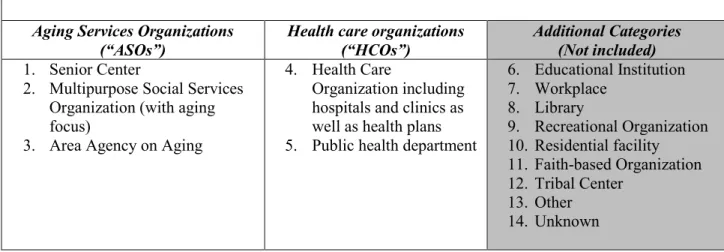
Although a wide variety of organizations can implement CDSMP, they must follow specific requirements. Aging service organizations, such as senior centers, Area Agencies on Aging, and multi-purpose social service organization for the elderly are the most frequent providers of CDSMP.13 Health care organizations such as Federally Qualified Health Centers (FQHC) or clinics, health plans, and health care systems also offer the program.
Organizations must operate under a current license, granted only by Stanford University’s Patient Education Research Center. Stanford requires organizations offering the program to use only certified instructors, who have been trained by a Master Trainer. Instructors receive more than 30 hours of training and must complete other steps to become certified to facilitate the workshop. There must be two workshop leaders per class session—and it is recommended that organizations train leaders who have a chronic condition themselves (“peer leaders”). Workshop leaders must facilitate a minimum of one workshop per year. Periodic refresher training sessions are required by Stanford. The course sessions are tightly scripted. The workbook must be
followed as directed. Stanford has a robust fidelity monitoring system (Stanford University Patient Education Research Center website).14
The program was tested in a randomized controlled trial of 952 subjects receiving the CDSMP from community-based program sites in the 1990’s followed by another study of 831 subjects followed over several years through a longitudinal trial. In both trials CDSMP proved to have significant positive effects on participants’ self-efficacy, levels of exercise, self-reported health, and other health status measures. The participant group also had fewer hospital days (Lorig et al., 1999 and Lorig et al., 2001).
9
While some organizations learned about and adopted the CDSMP in the late 1990s, dissemination was not widespread. Through active promotion by federal agencies (U.S. Administration on Aging, National Institutes of Health, Agency for Healthcare Research and Quality, and Centers for Disease Control and Prevention) and through a national aging advocacy and service organization (National Council on Aging), CDSMP gained the attention of health care systems, health plans, social service organizations, and other providers serving adults with chronic conditions.
Dissemination Efforts
In 2006 and 2007 an evidence-based health promotion and disease management program initiative (called “Empowering Older People to Take More Control of Their Health Through Evidence-Based Prevention Programs”) was administered through the Administration on Aging (now Administration for Community Living). Twenty-four states were selected to receive funds to promote implementation of CDSMP and other EB programs. Subsequently, the American Reinvestment and Recovery Act (ARRA) funded dissemination of the CDSMP through a collaborative initiative (called “Communities Putting Prevention to Work: Chronic Disease Self-Management Program”). The Centers for Disease Control and Prevention (CDC) and the Centers for Medicare and Medicaid Services (CMS) worked with the Administration on Aging to
10
responses are scored in terms of readiness and willingness on six elements: (1) Innovativeness, (2) Evidence-based Programs, (3) Staff/Volunteer Resources, (4) Partnerships, (5)
Organizational Culture and Support, and (6) Implementation Resources and Systems (NCOA website).
Estimates of participation by older adults who could benefit from CDSMP show that participation is still low. For example through the ARRA grant initiative, approximately 100,000 persons from 45 states and 2 regions participated in the CDSMP during those two years
(Woodstock et al, 2013). This represents less than 1% of the 65+ population estimated to have one or more chronic conditions. This assimilation gap—the unrealized potential for population health benefit from a proven evidence-based intervention—has a human and economic cost. In a recent presentation by Whitelaw, Ory, and Smith, these researchers stated that if just 10% of persons with chronic conditions participated in CDSMP, there would be an estimated return of investment of $4.2 billion in health care cost savings.15 This estimate is based on a study of over 1,100 CDSMP participants in 17 states, comparing baseline, 6 months, and 12 months healthcare costs and extrapolating net savings after considering costs of the program. The findings showed a potential net savings of $364 per person (Ahn et al., 2013).
CDSMP Research and Evaluation
Over the last few years there have been several studies of CDSMP and the outcomes observed at the participant or at the intermediary (e.g., state) level. One older study examined CDSMP implementation at the organizational unit level. A brief review of these CDSMP studies is offered here to provide background.
15Whitelaw, Ory and Smith presented findings during an National Council on Aging webinar on March 19, 2013,
11
Studying results from a wide variety of organizational providers of CDSMP, researchers have looked at outcomes for participant group(s)—to confirm that the intended outcomes
persisted among different ethnic/racial minority populations or disease/condition sub-groups. For example, a recent study of CDSMP participants with Type 2 diabetes found statistically
significant improvements in health indicators and health behaviors (Lorig, et al., 2013). A study of the health-related outcomes of a sample of 687 CDSMP participants found that significant improvements were observed for health outcomes such as depression, self-assessed health, and unhealthy physical days (Ory, 2013).
A program evaluation of CDSMP found successful dissemination through intermediary agents—the state unit on aging and the state or local public health department (Woodstock et al., 2013). This process evaluation focused primarily on the states’ activities (as the “grantees”).16 Researchers conducted site visits to six states and then conducted one-hour telephone interviews with key informants representing each of the 47 state grantees. The evaluation report describes the administrative, training, marketing, fidelity monitoring, and other types of support that these states provided to implementing organizations—and whether those functions were centralized or decentralized. The report also described the characteristics (e.g., age, gender, race/ethnicity) of participants who entered and completed the workshops under this grant. The authors state that “CDSMP was implemented successfully in a diverse set of organizational arrangements. Aging services networks served as grantees in most states, using aging services providers such as AAAs [Area Agencies on Aging], state and local public health departments, and private health systems as key partners” (Woodstock et al., 2013, p. viii).
16The purpose for the process evaluation was described as follows: “to examine the populations served by different
state grantees, how grantees implemented their CDSMP programs, and how programs differ in terms of completion rates, distribution channels, delivery systems, and the capacity of grantees to disseminate and sustain their
12
While most of the focus was on the state’s (“grantees”) experience, the investigators also looked at the implementation sites in terms of type (e.g., clinic, senior center, library, etc.), location (e.g., rural, urban) and the frequency of workshops offered by the site. They found that completion rates were lowest in residential facilities and highest among faith-based
organizations. They also found that participants attending workshops offered in metropolitan areas had a slightly lower completion rate than participants attending workshops offered in non-metro areas (Woodstock, et al, 2013, p. 72).
A study of 100,000 adults attending CDSMP workshops over several years (across the U.S.) looked at participants and their completion rates, by delivery site. Smith separated “completer participants” into four groups based on participants’ completion date. He examined whether completion rates changed over time. Results showed that organizations providing the program became more effective in reaching participants (and/or the program gained in
visibility/popularity) over time (Smith et al, 2013).
An older study conducted by the Stanford researcher who led development of the
13
implementation by this health plan and care system: (1) attributes of CDSMP, (2) administrative factors, and (3) organizational factors. Attributes of the program that hindered implementation were that it was a group, self-care program, rather than a diagnosis and treatment program—and therefore did not really fit with the clinic’s usual practices. With regard to administrative factors identified, participant recruitment was the most significant barrier negatively impacting
implementation (as many as one-third of the workshops were cancelled due to lack of
participants within the first year). Enabling organizational factors which were important included having a dedicated coordinator, local administrator support, physician buy-in, and cross-regional communication and information sharing.
Researcher and NCOA spokesperson Dr. Nancy Whitelaw asserts there is a pressing need [emphasis added] for more attention to “the contextual, organizational, community, and political factors” that affect the uptake in program adoption, implementation and sustainability (Whitelaw, 2010). NCOA has identified three strategies that appear to contribute to success across evidence-based health promotion and prevention efforts (this would include, but is not limited to, CDSMP). The three strategies call for the development of: (1) coalitions of
14 Summary
An organization faces many challenges to implementing an evidence-based health promotion and disability prevention program. One such program, the Chronic Disease Self-Management Program, targets individuals with one or more chronic conditions. This is a population group that experiences high health care costs, diminished functional abilities, and reduced quality of life if self-care management behaviors are lacking. Thus, effective
15
CHAPTER 2: Literature Review
Introduction
According to information provided at a recent “Dissemination and Implementation” research conference, there are now more than 60 separate frameworks for dissemination and implementation research.17 This chapter presents several of these frameworks and compares the factors and constructs within them. Though different terms may be used, there are commonalities that guide the study of implementation and help evaluate effectiveness. Reoccurring concepts include: assessing and measuring organizational (internal) factors, examining the interaction between organizational characteristics and the program/innovation components, identifying external or contextual issues, and realizing that implementation is a journey with a non-linear path.
The literature review offered in this chapter presents examples of health promotion and disability prevention EBPs that focused on older adults and those with chronic conditions and could be implemented in community settings. Peer-review journal articles of implementation studies were selected for review to examine the implementation processes, challenges, context, and other factors that affected program success. The review was intended to provide insight into the factors that appear to support successful implementation of EBPs. The terms “innovation,” “intervention,” “program” and “evidence-based practice” are used interchangeably.
17 Training Institute for Dissemination and Implementation Research in Health, A joint conference of the Office of
16 Background - Frameworks
Everett M. Rogers first reported on what he called the “diffusion of innovations” in 1962 as he studied why Iowa farmers delayed adoption of new ideas that could have been profitable for them. Rogers defined diffusion as “the process in which an innovation is communicated through certain channels over time among the members of a social system” (Rogers, 2003, p.5). Dr. Rogers identified five attributes of innovation that impact how widely it is adopted:
1. Relative Advantage – Is the innovation perceived as being better than what it replaces?
2. Compatibility – Is the innovation perceived as congruent with values, experiences, and needs of potential adopters?
3. Complexity- Is the innovation perceived as difficult to understand and use? 4. Trialability – Can the innovation be tested?
5. Observability- Are the results of the innovation visible to others?
In a systematic review of the literature to consider the spread and sustainability of
innovations in health service delivery, researcher Trisha Greenhalgh and colleagues conducted a meta-analysis looking for factors that impact adoption and maintenance of innovations
17 O
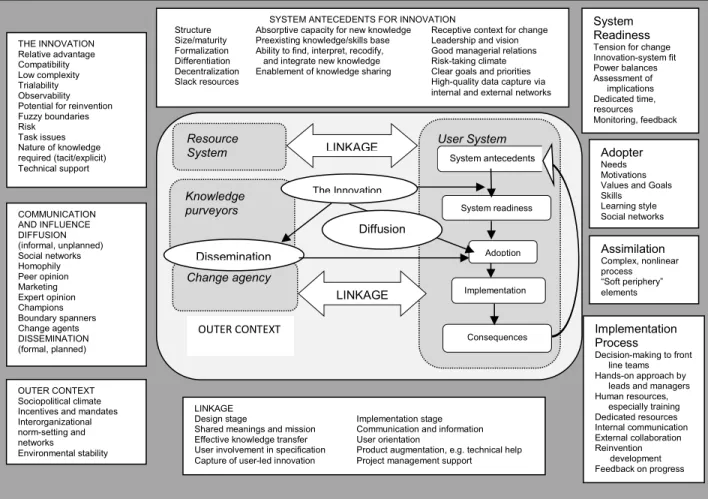
Figure 1. Rendition of the Conceptual Model for Considering the Determinants of Diffusion, Dissemination, and Implementation of Innovations in Health Service Delivery and Organization, Based on a Systematic Review of Empirical Research Studies. Greenhalgh, et al., 2004.
Dr. Greenhalgh describes system antecedents for innovation which include structural factors, an organization’s absorptive capacity for new knowledge, and the relative context for change. She also describes system readiness for innovation factors, which includes the tension for change, the innovation-system fit, the power balance between those who support and oppose the adoption, an assessment of implications, the level of time and resources that will need to be dedicated, and capacity for monitoring and feedback. The implementation process itself includes factors related to staff capability/capacity, training, communication, dedicated resources,
collaboration, feedback/monitoring, and leadership/management. These three domains are interactive, and can either support or impede program adoption. With regard to her commentary
SYSTEM ANTECEDENTS FOR INNOVATION
Structure Absorptive capacity for new knowledge Receptive context for change Size/maturity Preexisting knowledge/skills base Leadership and vision Formalization Ability to find, interpret, recodify, Good managerial relations Differentiation and integrate new knowledge Risk-taking climate Decentralization Enablement of knowledge sharing Clear goals and priorities
Slack resources High-quality data capture via
internal and external networks THE INNOVATION Relative advantage Compatibility Low complexity Trialability Observability Potential for reinvention Fuzzy boundaries Risk
Task issues Nature of knowledge required (tacit/explicit) Technical support COMMUNICATION AND INFLUENCE DIFFUSION (informal, unplanned) Social networks Homophily Peer opinion Marketing Expert opinion Champions Boundary spanners Change agents DISSEMINATION (formal, planned) OUTER CONTEXT Sociopolitical climate Incentives and mandates Interorganizational norm-setting and networks
Environmental stability
LINKAGE
Design stage Implementation stage
Shared meanings and mission Communication and information Effective knowledge transfer User orientation
User involvement in specification Product augmentation, e.g. technical help Capture of user-led innovation Project management support
User System System antecedents Knowledge purveyors Change agency System readiness The Innovation Adoption Implementation
Consequences Implementation Process
Decision-making to front line teams
18
about the literature (as of 2004), Dr. Greenhalgh found a lack of information related to
implementation and maintenance of innovations among health service organizations. The few empirical studies found were “impoverished by lack of process information.” Furthermore she recommended further research on the following question: “By what processes are particular innovations in health service delivery and organization implemented and sustained (or not) in particular contexts and settings, and can these processes be enhanced? This question, which was probably the most serious gap in the literature we uncovered for this review would benefit from in-depth mixed-methodology studies aimed at building up a rich picture of the process and impact” (Greenhalgh et al., 2004, p. 620). From Dr. Greenhalgh’s work, the “user system” (pertaining to the organizations implementing the innovation) and the effects of the outer context on that user system are most relevant to this examination.
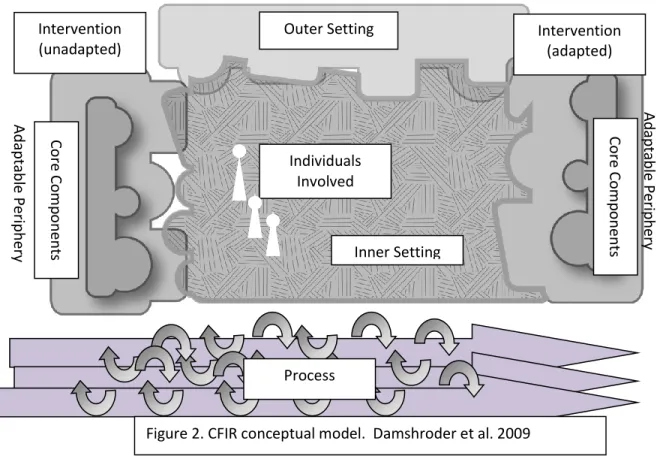
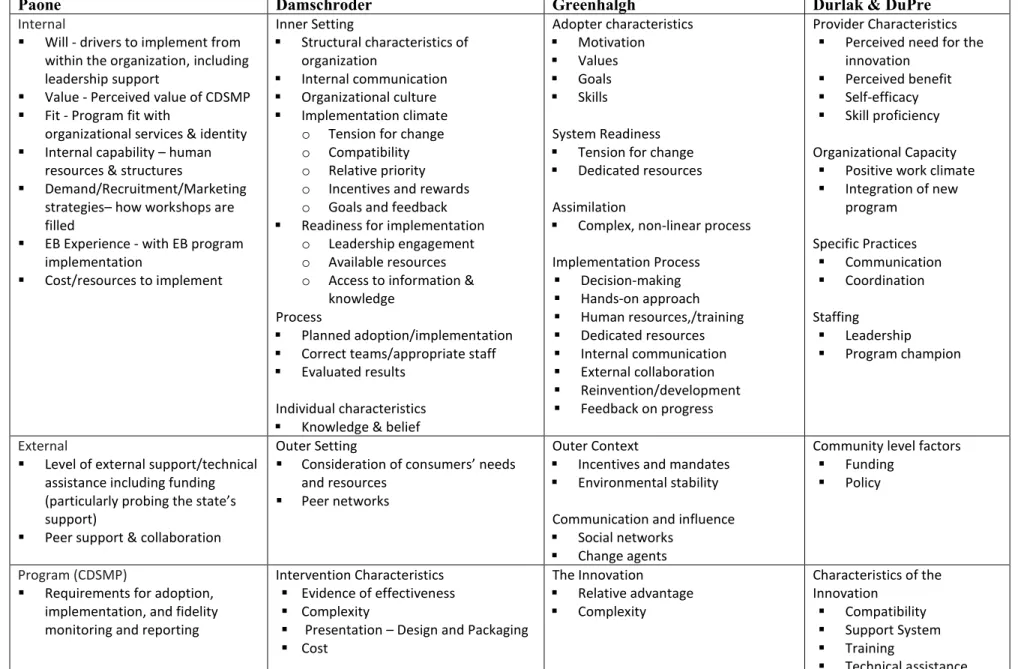
In a subsequent meta-analysis of nineteen implementation and dissemination frameworks (including Greenhalgh’s), Laura Damschroder and colleagues also found common themes and constructs across the frameworks (Damschroder, et al., 2009). Damschroder and colleagues identified thirty-one unique constructs and categorized them within five domains. They then created the Consolidated Framework for Implementation Research (CFIR) to offer an
overarching framework. The CFIR conceptual model is shown in Figure 2. The five domains involved in implementation as depicted in CFIR are: Intervention Components/Characteristics, Outer Setting, Inner Setting, Individual Characteristics, and Implementation Process
19
influenced by internal and external factors. In describing CFIR, Damschroder says this framework helps “open the black box of the implementation component” for further study.
Dean Fixsen, Karen Blasé, and colleagues studied implementation examples particularly drawing from the field of education (Fixsen et al., 2009). They identified six functional stages (not linear) as follows: (1) exploration, (2) installation, (3) initial implementation, (4) full implementation, (5) innovation, and (6) sustainability. Their framework has seven core
implementation components. They based their framework on the foundational assumption that implementation is a process happening in fits and starts over time (generally 2 to 4 years), and that changes in the core components can affect the stage of implementation. They give an example of an organization that experiences a large staff turnover—thus moving the stage of
Ad
ap
tabl
e
P
erip
h
ery
Outer Setting
Inner Setting
Intervention (adapted)
Co
re
Co
m
p
o
n
ents
Individuals Involved Intervention
(unadapted)
Co
re
Co
m
p
o
n
ents
Ad
ap
tabl
e
P
erip
h
ery
Process
20
implementation backward—from full implementation to initial implementation—as the new staff are trained on the program. Fixsen, Blasé and colleagues place on special emphasis on human capability and systems that support the practitioner/worker implementing the program as enabling factors. Their 7 core implementation components (which are inter-connected) include:
1. staff selection
2. pre-service and in-service training 3. ongoing coaching and consultation 4. staff evaluation
5. decision-support data systems 6. facilitative administrative support 7. systems interventions
Fixsen says strength in one area can compensate for weakness in another. Furthermore, these components “exist quite independently” from the program/intervention outcomes or quality. In other words, an organization can do a great job at implementing a so-so program, or do a bad job at implementing a fantastic program. Because implementation is so dependent on human
behavior, successful and sustained implementation will require ongoing training, coaching, feedback, data, and the other systems working in tandem to regularly maintain the desired behavior. A key concept offered by Fixsen is that of a purveyor (or program consultant)—those who are actively working to implement the program or practice. These individuals become experts—acquiring new understanding of strategies and insights over time that enhance, facilitate, streamline, or improve implementation of the program. Being able to tap into this knowledge base is invaluable.
21
sufficiently to practitioners, organizations, or communities. Second, researchers or others promoting the practice/program find that it is difficult to entice organizations or communities to even consider adoption given other priorities. Third, attempts by adopting organizations to implement the program are often difficult and more challenging than anticipated (e.g., due to lack of training, insufficient human resources, money, or time, lack of leadership support, or other organizational or contextual issues). Fourth, even if implementation efforts overcome all of these hurdles, the organization or community may not sustain the program (Durlak & DuPre, 2008 p. 327-328). Adding to these challenges is the fact that the implementation process is rarely documented or examined, so often there is not a clear understanding of what went wrong or why.
Durlak and DuPre present 8 factors for studying implementation: 1. fidelity
2. dosage 3. quality
4. participant responsiveness
5. program differentiation
6. monitoring of comparison groups 7. program reach
8. adaptation
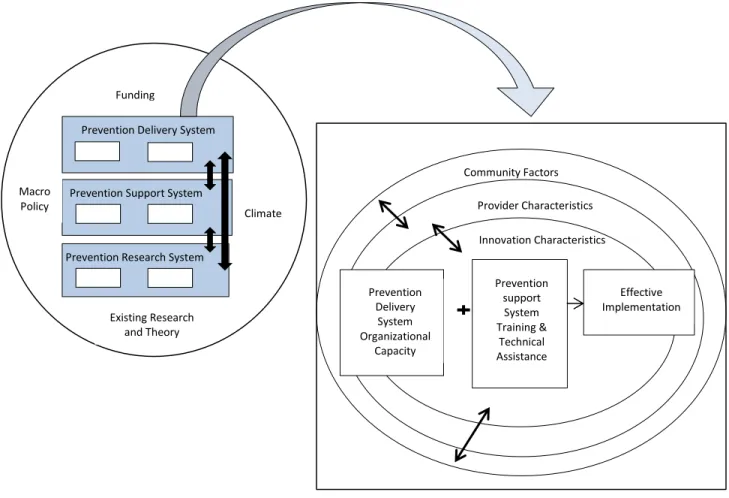
Durlak and DuPre offer a strong case that implementation matters. They found that programs that devoted resources and monitored implementation had larger effects—76% of the studies showed a significant positive relationship between implementation level and the outcomes measured. Durlak and DuPre illustrate their framework (Figure 3) as a dynamic interplay between the environment/context for dissemination (that includes macro policy, existing research, and funding in which the prevention delivery system, support system, and research system operate) and the implementation structure. Factors that influence the implementation process include: community participation/collaboration, provider characteristics, innovation characteristics, organizational capacity, and technical assistance/training.
In other words, it’s more than just the program you’ve picked. It’s the program in context of
22
Figure 3. From Durlak, J. A., & DuPre, E. P. (2008). Implementation matters: A review of research on the influence of implementation on program outcomes and the factors affecting implementation. American Journal of Community Psychology, 41(3), 327-350.
As seen in the brief descriptions provided here of frameworks and studies of
implementation, one of the challenges for researchers is the lack of consistent terminology and differences in categorization of similar constructs. There have been several attempts at creating a standard taxonomy in order to evaluate success of efforts (Proctor et al., 2011). Proctor and colleagues created a distinction between service system outcomes (such as changes in provider behavior or improvement in processes of care), clinical outcomes (such as observed impact at the patient/client level), and implementation outcomes, defined as “the effects of deliberative and purposive actions to implement new treatments, practices, and services” (Proctor et al., 2011, p.
Funding
Existing Research and Theory Prevention Delivery System
Prevention Support System
Prevention Research System
Climate Macro
Policy
Prevention support System Training &
Technical Assistance Prevention
Delivery System Organizational
Capacity
Effective Implementation Innovation Characteristics
23
65). Factors important in measuring implementation outcomes identified in Proctor’s analysis include: acceptability, adoption, appropriateness, costs, feasibility, penetration, and
sustainability.
Methods
A literature review of implementation studies of evidence-based health promotion programs for older adults was conducted from March – April 2012 as a precursor to this dissertation study. Examples were sought of health promotion programs for adults that were implemented in community settings—with the additional requirement that the organizational issues in implementation needed to be adequately described in the methods or findings section of the study. This literature review looked at studies of organizations involved in post-adoption and implementation of previously tested evidence-based health promotion programs. Thus translation studies were also excluded. Sixteen studies were identified out of 102 articles reviewed. Of these sixteen, twelve studies contained enough detail in the findings and discussion sections to
examine the implementation processes, challenges, context, and other factors that affected program success—at least at a basic level.
Inclusion and exclusion criteria for the literature search were as follows: Inclusion Criteria
The study must be in the field of health promotion/disease prevention and examine evidence-based program implementation
The study must describe how the innovation was actually implemented in the field or in a particular organization—beyond the original trial where the innovation was tested. The innovation must focus on middle-aged and older adults.
24
The methods used within the study or program evaluation must meet a minimum set of methodological standards. 18
The article must have been published between 2000 and 2012, must be in English, and the full text must be available.
Exclusion Criteria
The study cannot be merely theoretical – it must describe practice implementation or dissemination of the innovation.
The study cannot focus only on practitioner behavior, attitudes, or preferences– it must have an organizational focus.
The innovation cannot be designed for an institutional setting (hospital, emergency room, nursing home, or residential care facility)—but rather be a health promotion program or disease prevention program. Therefore, it could not be a diagnostic technique, surgical technique, medication, or medical device.
The full literature review search and results process is depicted in Figure 4.
18These standards are adapted from Greenhalgh et al., 2004. The standards I used were: the authors describe the
25
Figure 4. LITERATURE REVIEW SEARCH PROCESS & RESULTS
PubMed Google Scholar
Apply specific Exclusion criteria
Apply specific Inclusion criteria
Eliminate duplicates
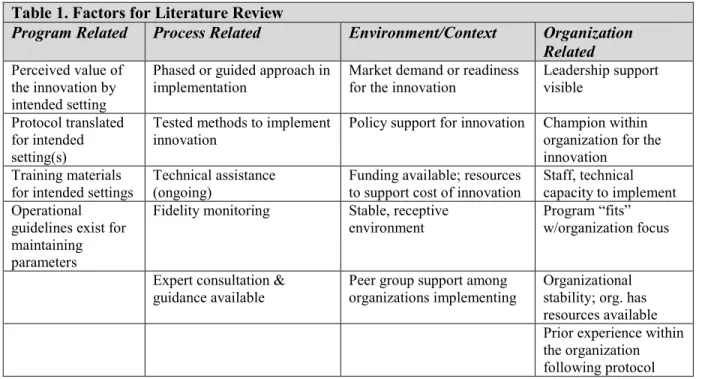
Implementation success was specifically defined in terms of the organization’s level of program implementation (i.e., did the organization or community fully implement the program with all of its components and reach the desired target participants). The factors of interest were: (1) program factors about the innovation itself (e.g., the innovation components and protocol), (2) process factors about how the innovation was implemented (e.g., steps toward adoption,
N = 42 references
Duplicates discovered N=1 References title and brief description provided by the
search database are reviewed = 79 out of 102
are eliminated
30 references excluded from PubMed set
49 references excluded from Google Scholar set based on
exclusion criteria
References reviewed based on read of full text = 6 out
of 23 are eliminated
5 references excluded from PubMed set
1 reference excluded from Google Scholar set based on
inclusion criteria
Studies included in analysis = 16
N = first 60
4 references have insufficient detail to allow
for ranking of level of success of diffusion and/or authors do not adequately describe implementation
experience Final set of articles upon
which provide enough detail for categorization and
26
training and preparation), (3) contextual or environmental factors that affected the implementation (e.g., the market demand for the innovation, policy support) and (4)
organizational factors (e.g., the staff capacity, leadership support, climate for the innovation adoption). These factors were selected based on: (1) the conceptual models and frameworks reviewed prior to conducting the search, and (2) reflections from researcher’s personal experience in evaluating the implementation process of evidence-based programs in the field. Chosen factors are shown in Table 1.
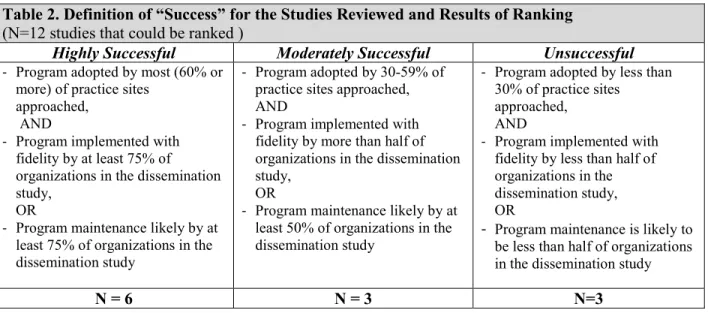
Articles were separated into three groups based on whether the dissemination efforts described in the study were highly successful, moderately successful, or unsuccessful. These terms were defined a priori as shown in Table 2, focusing on three characteristics:
1. program adoption rate,
2. the implementation fidelity by the organizations, and
3. the likelihood that the innovation would be maintained following the dissemination study.
Table 1. Factors for Literature Review
Program Related Process Related Environment/Context Organization
Related Perceived value of
the innovation by intended setting
Phased or guided approach in implementation
Market demand or readiness for the innovation
Leadership support visible
Protocol translated for intended setting(s)
Tested methods to implement
innovation Policy support for innovation Champion within organization for the innovation
Training materials for intended settings
Technical assistance (ongoing)
Funding available; resources to support cost of innovation
Staff, technical capacity to implement Operational
guidelines exist for maintaining parameters
Fidelity monitoring Stable, receptive
environment Program “fits” w/organization focus
Expert consultation & guidance available
Peer group support among organizations implementing
27
In some cases, information was lacking on one or two of these items. However within the
methods or discussion sections there were often clues about these characteristics. For a complete list of the studies reviewed, see Appendix A.
Table 2. Definition of “Success” for the Studies Reviewed and Results of Ranking (N=12 studies that could be ranked )
Highly Successful Moderately Successful Unsuccessful
- Program adopted by most (60% or more) of practice sites
approached, AND
- Program implemented with fidelity by at least 75% of organizations in the dissemination study,
OR
- Program maintenance likely by at least 75% of organizations in the dissemination study
- Program adopted by 30-59% of practice sites approached, AND
- Program implemented with fidelity by more than half of organizations in the dissemination study,
OR
- Program maintenance likely by at
least 50% of organizations in the dissemination study
- Program adopted by less than 30% of practice sites
approached, AND
- Program implemented with fidelity by less than half of organizations in the dissemination study, OR
- Program maintenance is likely to be less than half of organizations in the dissemination study
N = 6 N = 3 N=3
Findings & Implications
In this examination of twelve studies of innovation dissemination, only four studies provided evidence of positive attributes or strengths in all four factor areas. These four studies were ranked as “highly successful.” There were two additional studies ranked as “highly
successful” that had some of these positive attributes—for a total of six highly successful studies. The factors that emerged as important in these highly successful innovation dissemination efforts were:
robust translation of the innovation for use in the intended practice settings,
extensive and ongoing training and technical assistance provided for the implementation, good program-to-environment or program-to-organizational “fit,” and,
availability of necessary resources, especially the human resources within the implementing organization.
28
lack of fit between the innovation and the organization or between the innovation and the environment,
insufficient translation of the innovation,
Incomplete training in relation to the capability available within the implementing organization
lack of capability or “readiness” within the organization,
need for additional technical or expert support offered to the implementing organizations (often realized in hindsight when determining implementation fidelity) or other additional resources (e.g., time, money)
These issues are discussed in more detail below. Factor: Program Fit
All of the innovations included in this examination were focused on modifying health behaviors, and/or promoting better self-care and disease prevention or condition management by adults. This included physical activity programs, self-care management programs, nutrition programs, chronic disease education and awareness, and balance and mobility improvement programs. These programs were implemented at the city, community, organization, and practitioner level, although those implemented at the practitioner level also involved some additional level of organizational process change or institutional development to adopt the innovation. This is important in terms of discussing program “fit” within organizational and environmental context, which was one factor that was predicted as being important. In fact the fit with the organization and the environment emerged as a factor most frequently found which
appeared to be related to the ease or difficulty of implementation among these twelve examples of innovation dissemination.
29
To be certain that a proposed innovation is a good fit with an organization, one has to understand the purpose, scope, capability, and operational constraints on the organization as well as the reasons why the organization is seeking to implement the innovation within the context and environment in which it operates. Does the innovation represent a significant upgrade in the organization’s existing service? Is it being demanded by clients/participants that the organization serves? Is it central to the organization’s identity or service complement? Is this innovation poised to lend a “competitive advantage” or credibility to the organization in terms of the marketplace? Does the innovation replace another service? Understanding the context and environment and the organization’s drive to adopt the innovation would add much needed information to researchers for interpreting this issue of “fit,” and might offer a way to identify the characteristics of organizations that are ready for adoption.
Factor: Translation
Innovation “preparation” within all six of the highly successful studies appeared robust and included modifications of the innovation protocol for use in the field, development of a comprehensive set of materials to guide efforts, and provision of extensive training (piloted for use in practice settings). This process takes time and resources. In all six of the highly successful innovation dissemination examples translation for widespread dissemination had largely already occurred. The background detail provided within these articles about the innovation translation development indicates the process took many years and multiple pilots. Thus, another factor that emerged was comprehensiveness of the translated innovation—ready and fit for
dissemination.
30
the research trial and find it hard to accept modifications to their original approach. There is a natural tension between wanting to maintain complete adherence to the research-driven protocol and needing to adapt the innovation for the “real world.” How much modification can be done on the innovation before it is something other than what was studied? This is not easily answered. This is a reason for much earlier involvement of real-world practice input in the design of the innovation itself (prior to the first trial). A second challenge is that the researchers are unlikely to fully understand the operational structures, internal processes, and usual practices of
organizations that are providing direct service (e.g., to older adults or family caregivers). This is a very important reason for engaging practitioners and testing in real-world settings early on in the translational process. A third issue is that researchers may not be familiar with specific cultural, environment, or marketplace realities that the organizations face. Modifications of innovation components or development of additional tools to allow a phased approach for use might be necessary. Ginexi and Hilton say this about the “two-way” process of translation:
Sometimes the discovery of a solution can be out of sync with a provider’s readiness to use it. The technology may be ready for application (technology push); however, the need has not sufficiently evolved to justify implementation (practice pull). Sometimes the reverse is the case, and the evolution of a
provider’s problem outpaces the scientist’s ability to find a solution. A plausible but unproven service may be provided, unfortunately. The two-way process of translation often results in an imperfect interface that must be adjusted before implementation of an efficacious service can occur (Ginexi & Hilton, 2006, p. 336).
Factor: Internal Capability, External Training and Technical Help
31
volunteers and community staff in senior centers and residential housing units, community pharmacists in local pharmacies, registered nurses and public health nurses serving seniors in the community through home health care agencies, primary care practices utilizing health promotion or other types of health workers, community leaders and organizers in health-related departments or municipal organizations, and volunteers and staff of Area Agency on Aging organizations.
In these dissemination studies, utilizing only highly trained or highly educated
interventionists did not equate with success. Some of the most successful implementation efforts utilized volunteers. Some of the least successful studies also utilized volunteers. Other
moderately successful studies utilized nurses. Some highly successful studies utilized community health workers. Thus, the interventionist characteristics alone did not appear to predict
implementation success (at least not in this group of studies).
The presence of ongoing technical assistance from external source(s) emerged as an important factor that was different between the successful and unsuccessful efforts. In the successful efforts, ongoing support was provided to the staff or volunteers as they conducted the prescribed activities within the innovation protocol. There were two studies that described interventionists who did not perform the duties as directed—both efforts were ranked as unsuccessful and both lacked ongoing technical support. Thus a third factor was ongoing technical/expert support.
Factor: Readiness
32
the churches that did achieve success—these were also the churches that had prior experience with health promotion efforts and/or health “advocates” (which could be an indicator of greater organizational readiness).
In these studies, the issue of readiness was most often discussed in terms of training the staff or volunteers who would be serving as interventionists. Logically, it makes sense that people within organizations who feel ready to operate a new program will do better than people within organizations who do not feel quite ready. Prior experience with similar tasks or programs is one factor that helps individuals feel capable. Another supporting mechanism is training. Training of the key interventionist was provided in all of the studies. Unfortunately, most of these studies did not describe this training in enough detail to fully differentiate the level, adequacy, or comprehensiveness of training to allow comparison on this factor.
In most of these efforts a volunteer or staff member was part of the health promotion or wellness intervention—often serving to coach the participant, facilitate group discussion, or encourage behavior change. If these interventionists were unsure about their duties, felt